
Some Facts About Ecclesiastes Eccl 2 24 There
Some Facts About Ecclesiastes 关于传道书的一些事实 Eccl 2: 24 “There is nothing better for a man than taking meat and drink, and having delight in his work. This again I saw was from the hand of God. ” Eccl 12: 13 -14 “This is the last word. All has been said. Have fear of God and keep his laws; because this is right for every man. God will be judge of every work, with every secret thing, good or evil. ” Pastor Chui http: //Christ. Center. Gospel. org ckchui 1@yahoo. com
Ecclesiastes’ Kingdom Key 传道书的国度钥匙 - 1 n God’s Purpose in View: Ecclesiastes is Solomon’s bully pulpit, his sermon summarizes his explorations in and musings about life and concluded that “Everything is empty. ” From God’s point of view, as expressed by Jesus Christ, reveals that Ecclesiastes verifies and illustrates three New Testament life principles.
Ecclesiastes’ Kingdom Key 传道书的国度钥匙 - 2 n God’s Purpose in View: 1. Life is fulfilling only when it is given away. Jesus’ call to His disciples is centered in a commitment to lay down one’s life for others. Ecclesiastes complains, “I sought everything and found nothing. ” In contrast, Jesus says, “If you lose your life for my sake, you will find it. ” (Matt 10: 39).
Ecclesiastes’ Kingdom Key 传道书的国度钥匙 - 3 n God’s Purpose in View: 2. Life in pursuit of excellence without sacrifice will ultimately disappoint. Ecclesiastes warns against searching for transient glory. However noble, neither the search for knowledge and wisdom (1: 16 -18) nor the erecting of man-made monuments or works of art (2: 4 -6) can bring contentment. Even such dignified pursuits, which are higher than quest after pleasure (2: 1 -3) or searching for fame (2: 17 -20), still prove to be an illusion. Only the New Testament kingdom pathway of pouring out one’s life (Phil 2: 17) can bring contentment (Phil 4: 11) and a sense of true achievement (Phil 4: 13).
Ecclesiastes’ Kingdom Key 传道书的国度钥匙 - 4 n God’s Purpose in View: 3. Life that is lived solely on the earthly-plane breeds cynicism. The recurrent phrase “under the sun” (1: 14) contrasts sharply with one’s position in Christ, “seated in the heavenlies” (Eph 2: 6). Life seen from the spiritual viewpoint gives perspective to all things—goals, possessions, enjoyment, and knowledge. Without the heavenly perspective, even life’s finest attainments become lackluster; life turns in on itself, and the short-lived nature even of earth’s most durable things reveals their lack of substance. Praise God that we can be born into a kingdom that transcends earth’s limits (John 3: 3), a kingdom that increases in its joys and fulfillment (Is 3: 6 -7), and a kingdom that shall never fade away (Lk 1: 32 -33).
Ecclesiastes’ Master Key: Jesus Revealed 传道书的主要钥匙: 启示耶� While Jesus said little about wisdom, Paul had much to say n about the wisdom given by God (Rm 11: 33) contrasted to the wisdom of this world with its human limitations (I Cor 1: 17). In Matt 6: 19 -21, Jesus warned against seeking wealth in this life, urging instead an investment in eternal values, a perspective that echoes the Preacher’s indictment of materialism in 2: 1 -11, 18 -26; 4: 4 -6; 5: 8 -14. The stress Jesus laid on heaven likewise mirrors the Preacher’s despair of finding true value “under the sun” in this life. The conclusion to which the Preacher is driven—that true value lies only in reverence and obedience to God (12: 13)—mirrors Jesus’ teachings that one’s values should be first determined by a proper attitude toward God (Matt 22: 37) and then a proper attitude toward one’s fellow human beings (Matt 22: 39).
Ecclesiastes’ Power Key: Holy Spirit at Work 传道书的动力钥匙: 圣灵的 作 All references to “spirit” in Ecclesiastes are to the life-force n that animates the human or the animal (3: 18 -21). The book anticipates some of the problems faced by the apostle Paul to implement spiritual gifts in I Cor 12 -14. People who believe that God speaks to them through the Holy Spirit in dreams and visions would have to heed the wise advice of the Preacher that not every dream is the voice of God (5: 3). Paul had this in mind for the revelatory gifts of tongues and prophecy in I Cor 14: 29, when he advises an orderly manifestation followed by a judgment on the utterance by the assembly. Likewise, the Preacher’s stress on reverence and obedience to God parallels Paul’s concern for the edification of the church (I Cor 14: 5). True spiritual gifts will be used in a spirit of reverence for the glory of God through Christ and the edification of the believers.
Some Facts About Ecclesiastes 关于传道书的一些事实 Author and Date n Background n Content n Outline n Truths and Actions n 作者和日期 背景 内容 概述 真理和行动
Author and Date of Ecclesiastes 传道书的作者和日期 n Ecclesiastes was written by Solomon (about 971 to 931 B. C. ) in his old age. The pessimistic tone was in keeping with his spiritual state at that time. Solomon must have come to his senses before his death, repented, and turned back to God. Scattered through the book are allusions to his wisdom (1: 16) wealth (2: 8), servants (2: 7), pleasures (2: 3), and building activities (2: 4 -6). Because of the problems posed by an apostate Solomon and because some of the language in the book belongs to a period much later in Israel’s history, some scholars believe the book may have its origin in the time of Ezra (about 450 B. C. ).
Background of Ecclesiastes 传道书的背景 The book evinces a time when traditional solutions to n life’s great questions, particularly the meaning of life, have lost their relevance for the author. The Preacher introduces a methodology that is predicated by observation and induction. Wisdom, when found in other parts of the Bible, is a synonym for virtue and piety; its antithesis, folly, thus becomes “wickedness. ” This book has such a meaning as in Chapters 7 -11. But in the opening chapter, the author deals with wisdom as pure thought, more like Greek philosophy, the enduring worth of which he questions. The Preacher determines to seek out that meaning through his own experience and observation so that he may personally verify it and pass it down to his disciples.
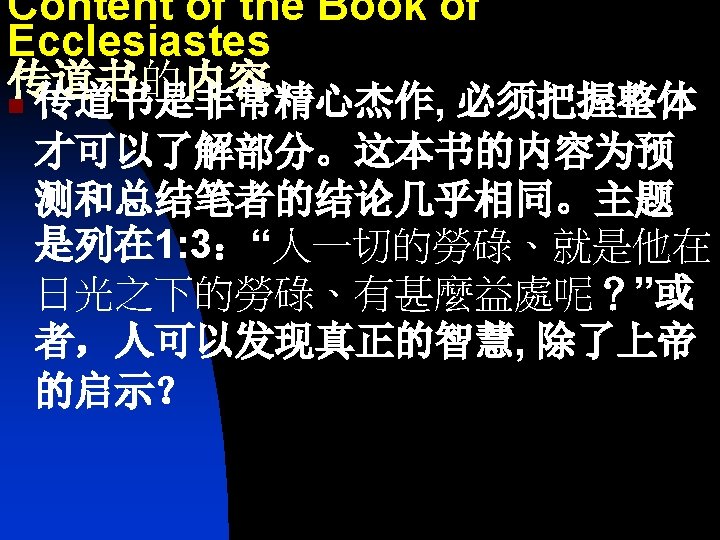
Content of the Book of Ecclesiastes 传道书的内容 n The book of Ecclesiastes gives very evidence of being a carefully composed literary essay that must be grasped as a totality before it can be understood in part. The content of the book is defined by nearly identical verses which circumscribe the book by anticipating and by summarizing the conclusions of the author. The theme is set forth in 1: 3: "what profit has a man from all his labor in which he toils under the sun? " Or, can true wisdom be found by a human being apart from a revelation from God?
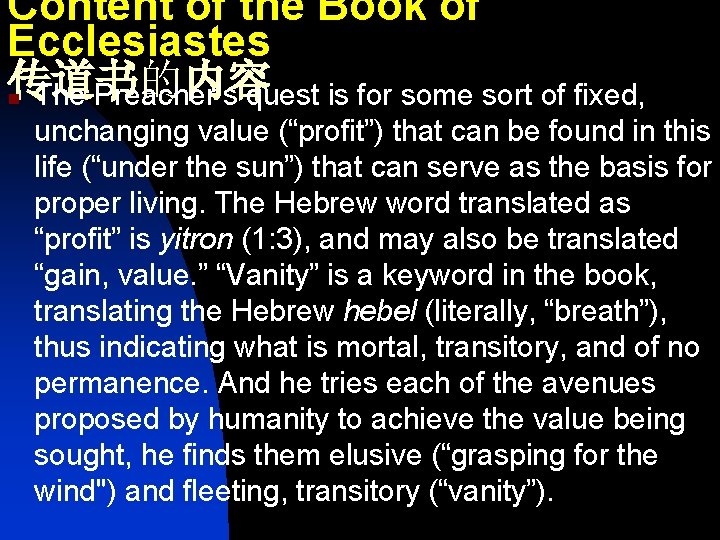
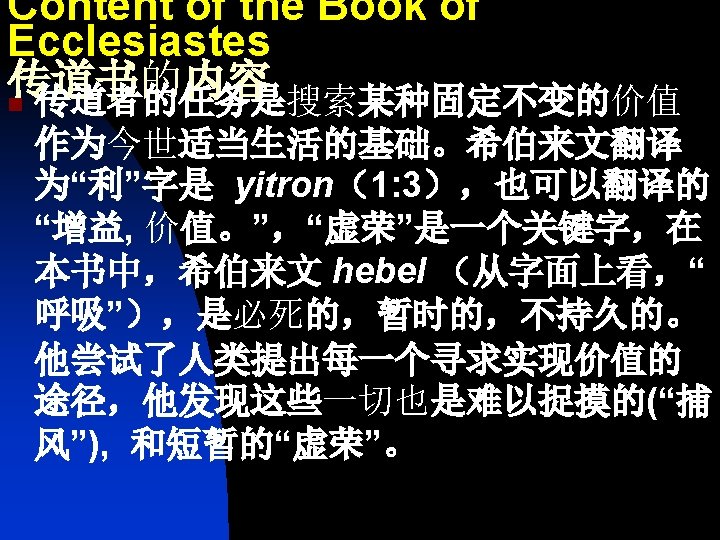
Content of the Book of Ecclesiastes 传道书的内容 n The Preacher’s quest is for some sort of fixed, unchanging value (“profit”) that can be found in this life (“under the sun”) that can serve as the basis for proper living. The Hebrew word translated as “profit” is yitron (1: 3), and may also be translated “gain, value. ” “Vanity” is a keyword in the book, translating the Hebrew hebel (literally, “breath”), thus indicating what is mortal, transitory, and of no permanence. And he tries each of the avenues proposed by humanity to achieve the value being sought, he finds them elusive (“grasping for the wind") and fleeting, transitory (“vanity”).
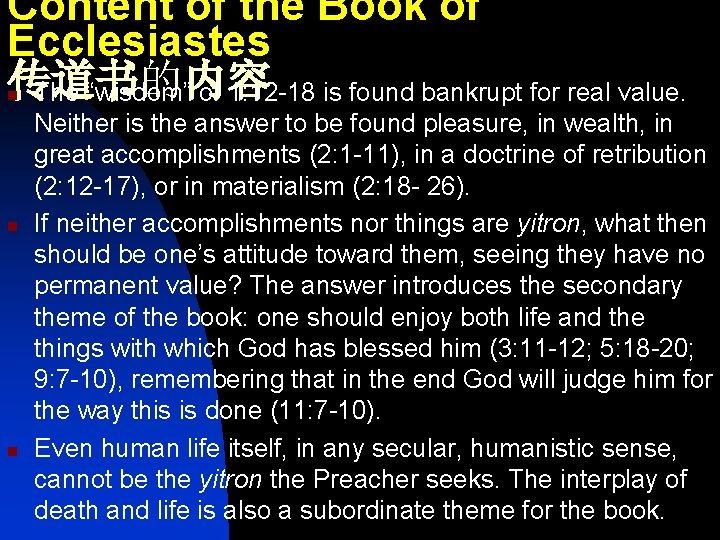
Content of the Book of Ecclesiastes 传道书的内容 The “wisdom” of 1: 12 -18 is found bankrupt for real value. n n n Neither is the answer to be found pleasure, in wealth, in great accomplishments (2: 1 -11), in a doctrine of retribution (2: 12 -17), or in materialism (2: 18 - 26). If neither accomplishments nor things are yitron, what then should be one’s attitude toward them, seeing they have no permanent value? The answer introduces the secondary theme of the book: one should enjoy both life and the things with which God has blessed him (3: 11 -12; 5: 18 -20; 9: 7 -10), remembering that in the end God will judge him for the way this is done (11: 7 -10). Even human life itself, in any secular, humanistic sense, cannot be the yitron the Preacher seeks. The interplay of death and life is also a subordinate theme for the book.
Content of the Book of Ecclesiastes 传道书的内容 n But returning to the Preacher’s grand quest: is it destined to conclude (12: 8), as it began (1: 2), on a note of despair? The Preacher’s constant probing of all existence for meaning shows him to be an optimist, not a pessimist, and his failure to discover any absolute, abiding value in this life (“under the sun”) does not mean his quest is a failure. Instead, he finds himself compelled (by his observation that God placed order in the universe at the time of creation, 3: 1 -14) to seek the value he seeks in the world to come (not “under the sun” but “above the sun, ” so to speak).
Content of the Book of Ecclesiastes 传道书的内容 n Although he does not specifically state it as such, the logic that undergirds his entire quest compels him to find the only real yitron in the fear (reverence) and obedience of God (11: 712: 7). This is affirmed in the epilogue: Reverence for God and keeping His commandments are the whole duty of mankind (12: 13). This duty must be carried out in full knowledge that, while there is no real justice to be had in this life, God will eventually judge all that is and set it right (11: 9; 12: 14). On this profound note the book concludes.
Ecclesiastes’ Personal Application 传道书的个人应用 Too often Christians in the modern church find n themselves passive intellectually, accepting almost anything they are taught or simply challenging a doctrine on the basis of how it feels instead of looking to see whether it has a biblical foundation. The Preacher’s challenge finds a parallel in the apostle Paul’s words to the Ephesian Christians not to be “tossed to and fro and carried about with every wind of doctrine” (Eph. 4: 14). With the privilege of interpreting the Scriptures for oneself, clearly established by Luther and the Reformers, comes the obligation to “search the Scriptures” (John 5: 39) and see what they really say.
Ecclesiastes’ Personal Application 传道书的个人应用 n The determination of the Preacher to find what is of real value in this life should be a challenge for any true believer in Jesus Christ, “the way, the truth, and the life” (John 14: 6). The Preacher’s failure to find real value in earthly things and comfortable lifestyles challenges the Christian who lives in this age of greed and materialism to concentrate on the things that are above (Col. 3: 1) and not to glorify greed and possessions.
Outline of Ecclesiastes 传道书的概述 n 1. Prologue 1: 1 -2. u Identification of the book (1: 1). u Summary of the Preacher’s investigations (1: 2). Solomon boldly states theme he will demonstrate. n 2. Statement of the Problem 1: 3 -11. u Can true value be found in this life? (1: 3). u Exposition of the problem: A refutation of humanistic solutions (1: 4 -11). In a series of brief discourses, Solomon shares the reasoning by which he arrived at the conclusion that life is meaningless.
Outline of Ecclesiastes 传道书的概述 n 3. Attempts at Solutions to the Problem 1: 12 -2: 26. u The refutation of pure reason: Human wisdom alone is useless (1: 12 -18). Knowledge disappoints. Solomon’s own experience proves to him that knowledge and learning bring only grief. A less intelligent person might not have realized how meaningless life is! u The failure of hedonism: Pleasure in itself is meaningless (2: 1 -11). Pleasures are empty. Solomon’s position made it possible for him to deny himself nothing. He finds that all is meaningless.
Outline of Ecclesiastes 传道书的概述 u The failure of retribution: The wise and the fool face a common end (2: 12 -17). Contrasts are irrelevant. While ultimate meaning escapes us, isn’t it possible that one person’s life might be more meaningful than another’s? No, for even distinctions between the wise and the foolish are irrelevant, as death overtakes both. u The failure of materialism (2: 18 -26). Solomon’s great accomplishments cannot give his life meaning. The good things of life can be accepted and enjoyed but will not give meaning to one’s existence.
Outline of Ecclesiastes 传道书的概述 4. Developing the Theme 3: 1 -6: 12. n u Uselessness in man’s efforts to change the created order (3: 1 -15). Life is organized in a pattern of repeated cycles. Yet observation of the cycles does not lead to an understanding of beginnings or endings. Only a grasp of origins or destiny might reveal life’s meaning. u Uselessness in an equal end for unequal creatures (3: 16 -22). Injustice demonstrates meaninglessness. The existence of injustice is a demonstrable fact of life. There may be judgment after death. But from all that man can observe, a human being dies just like an animal. There is no evidence that the spirit of one rises up to God, and the other dissipates into dust.
Outline of Ecclesiastes 传道书的概述 4. Developing the Theme 3: 1 -6: 12, continued. u Uselessness in an oppressed life (4: 1 -3). u Uselessness of envy (4: 4 -6). Oppression, toil, and friendlessness, human suffering, and ambition also give evidence of meaninglessness. u Uselessness in being alone (4: 7 -12). u Uselessness in a hereditary monarchy (4: 13 -16). u Uselessness in pretense in formal religion (5: 1 -7). The existence of God is evident to Solomon from the creation. But beyond that, little can be said by those limited to earth of a God who is in heaven (verse 2).
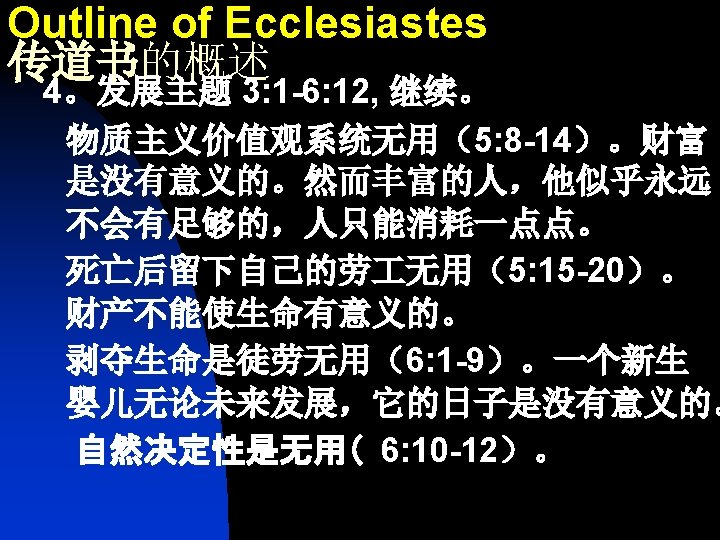
Outline of Ecclesiastes 传道书的概述 4. Developing the Theme 3: 1 -6: 12, continued. u Uselessness in materialistic values systems (5: 814). Riches are meaningless. However rich a person may be, he never seems to have enough, even though one can only consume a little. u Uselessness in leaving the products of one’s labor behind at death (5: 15 -20). Possessions cannot make life meaningful. u Uselessness in the futility of a deprived life (6: 1 -9). Whatever the future holds for a newborn infant, its days will be without meaning. u Uselessness in the determinism of nature (6: 10 -12).
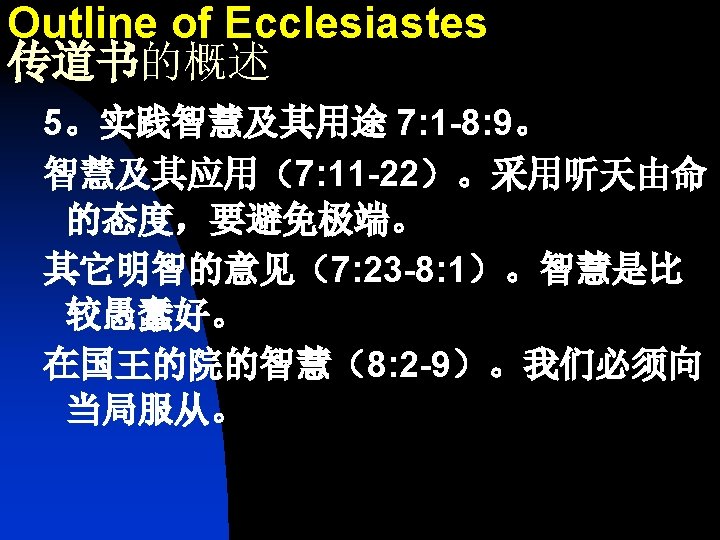
Outline of Ecclesiastes 传道书的概述 n 5. Practical Wisdom and its Uses 7: 1 -8: 9. u Solomon has demonstrated that no meaning or purpose to human life can be discerned by an examination of human experience. Still, Solomon concludes that some ways are better than others. He proceeds from his discoveries to suggest rules for the best life possible to us under the circumstances. u Moralizing proverbs about life and death, good and evil (7: 1 -10).
Outline of Ecclesiastes 传道书的概述 5. Practical Wisdom and its Uses 7: 1 -8: 9. u. Wisdom and its applications (7: 11 -22). A fatalistic attitude is to be adopted, and extremes are to be avoided. u. Miscellaneous wise observations (7: 238: 1). Wisdom is preferable to folly. u. Wisdom in the king’s court (8: 2 -9). One must submit to authorities.
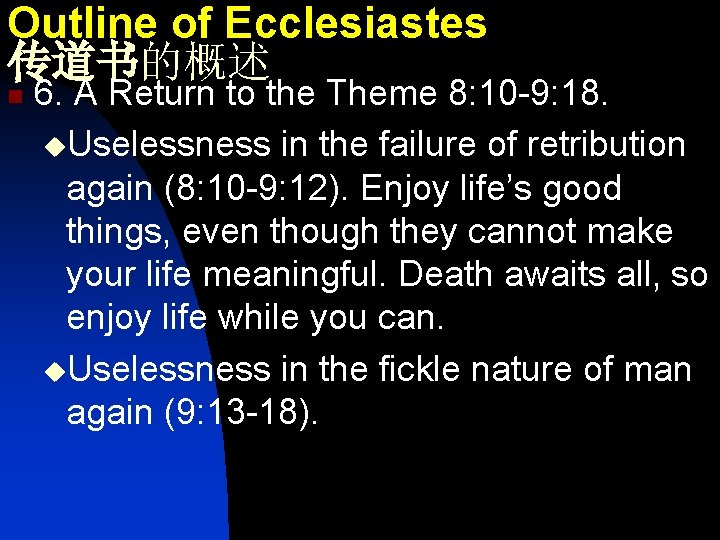
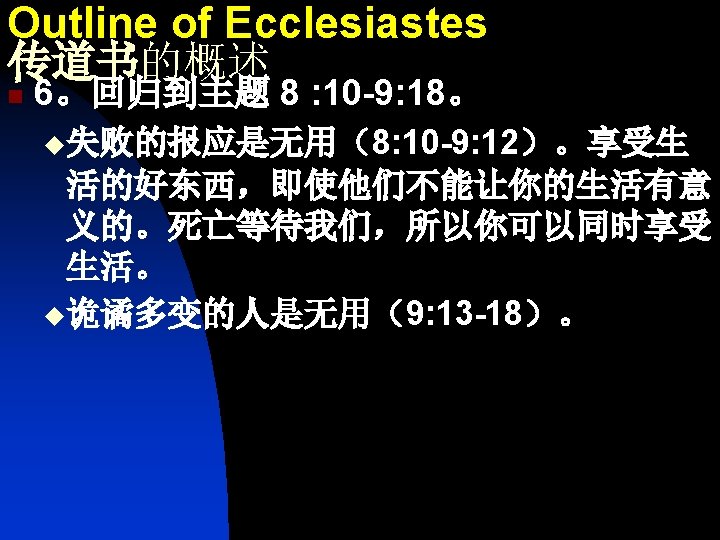
Outline of Ecclesiastes 传道书的概述 n 6. A Return to the Theme 8: 10 -9: 18. u. Uselessness in the failure of retribution again (8: 10 -9: 12). Enjoy life’s good things, even though they cannot make your life meaningful. Death awaits all, so enjoy life while you can. u. Uselessness in the fickle nature of man again (9: 13 -18).
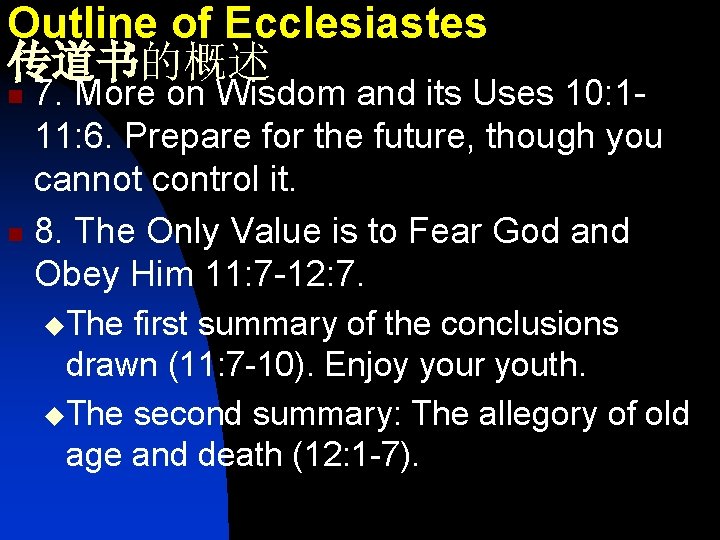
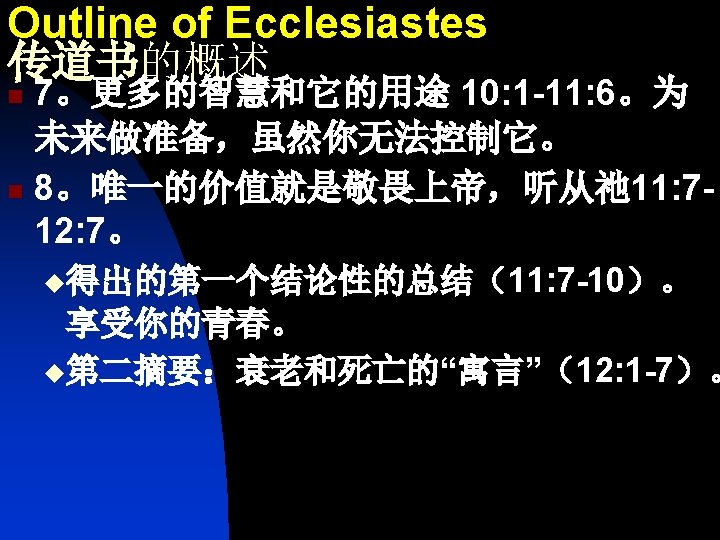
Outline of Ecclesiastes 传道书的概述 7. More on Wisdom and its Uses 10: 111: 6. Prepare for the future, though you cannot control it. n 8. The Only Value is to Fear God and Obey Him 11: 7 -12: 7. n u. The first summary of the conclusions drawn (11: 7 -10). Enjoy your youth. u. The second summary: The allegory of old age and death (12: 1 -7).
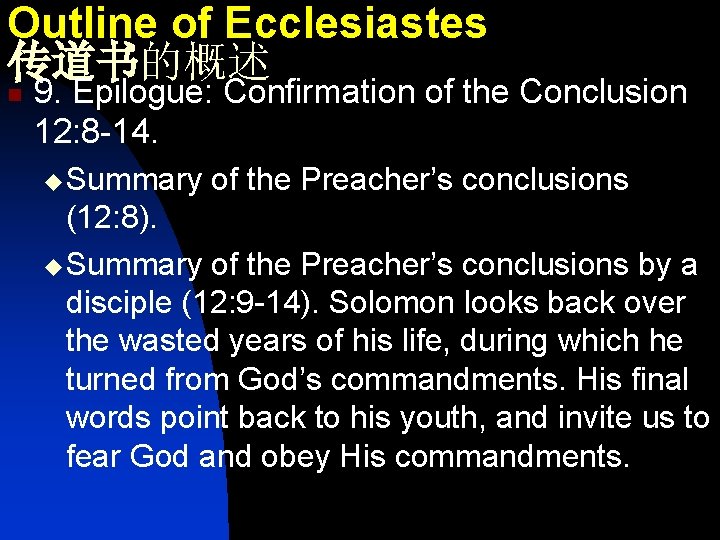
Outline of Ecclesiastes 传道书的概述 n 9. Epilogue: Confirmation of the Conclusion 12: 8 -14. u Summary of the Preacher’s conclusions (12: 8). u Summary of the Preacher’s conclusions by a disciple (12: 9 -14). Solomon looks back over the wasted years of his life, during which he turned from God’s commandments. His final words point back to his youth, and invite us to fear God and obey His commandments.
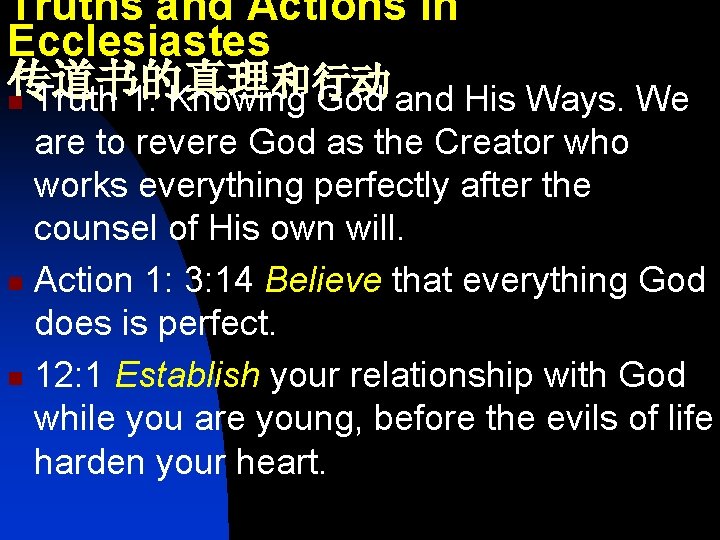
Truths and Actions in Ecclesiastes 传道书的真理 和行动 n Truth 1: Knowing God and His Ways. We are to revere God as the Creator who works everything perfectly after the counsel of His own will. n Action 1: 3: 14 Believe that everything God does is perfect. n 12: 1 Establish your relationship with God while you are young, before the evils of life harden your heart.
Truths and Actions in Ecclesiastes 传道书的真理 和行动 n Truth 2: Guidelines for Growing in Godliness. The “Preacher” counsels his readers toward godly living. We are to live with a view to the futility and vanity of a life spent without reference to God. Much of the energy we spend trying to accomplish various tasks ends up “sowing to the wind. ” The life lived in fidelity and integrity is the only one that has any real meaning.

Truths and Actions in Ecclesiastes 传道书的真理 和行动 Action 2: 2: 24 -26 Seek to please God in all you do. n n n 3: 22 Endeavor to find enjoyment in your work and daily life. 7: 8 -9 Avoid rashness or hastiness. Know that God is never in a hurry. Make no important decisions with an agitated spirit. 8: 5 -6 Determine to obey those who have the rule over you. Believe that you will know how and when to accomplish the assigned task. 9: 7 -10 Conduct a Spirit-filled life. Honor marital fidelity. Serve the Lord with all your might. 12: 12 -14 Do not attempt to substitute scholarship for obedience. Cultivate the fear of the Lord.
Truths and Actions in Ecclesiastes 传道书的真理 和行动 n Truth 3: Keys to Wise Living. The “Preacher” says that if you know God and seek to live your life before Him in a way that pleases Him, you will be living wisely. Wise living involves learning to assess the relative value of choices one might make. The wise individual chooses those things that have lasting value. Often the wisest choices will not be those that are apparently best by the world’s standards.
Truths and Actions in Ecclesiastes 传道书的真理 和行动that the pursuit of Action 3: 2: 1 -11 Understand n n n pleasure for its own sake is a vain pursuit. 2: 12 -16 Understand that a life lived strictly for the sake of wisdom is futile. 2: 17 -23 Recognize that dedication to work as its own reward is a vain pursuit. 5: 18 -20 Get into work you really enjoy and for which you can be grateful. Understand that to toil without enjoyment is vain and meaningless. 6: 1 -2 Understand that to work so hard that you cannot enjoy the fruit of your labors is foolishness. Beware of workaholism! 7: 15 -18 Avoid taking extreme positions unnecessarily.
Truths and Actions in Ecclesiastes 传道书的真理 和行动 n Truth 4: Steps in Developing Humility. One message in Ecclesiastes comes through loud and clear: Walk gently and humbly before the Lord. “God is in heaven, and you on earth. ” The more we know about God, the more humble we will be. The humble person recognizes his own limitations and accepts them.
Truths and Actions in Ecclesiastes 传道书的真理 和行动 n Action 4: 1: 10 -11 Accept and recognize that n n n human understanding of history is partial and distorted. Know that the facts mankind has forgotten could change your perceptive entirely. 3: 11 Accept your limitations. Know that you cannot comprehend eternity. Learn to accept God’s perfect timing. 4: 13 -16 Understand that the pursuit of personal ambition is vain and futile. 7: 1 -4 Be mindful of your mortality. Let bereavement bring you times of sober selfassessment.
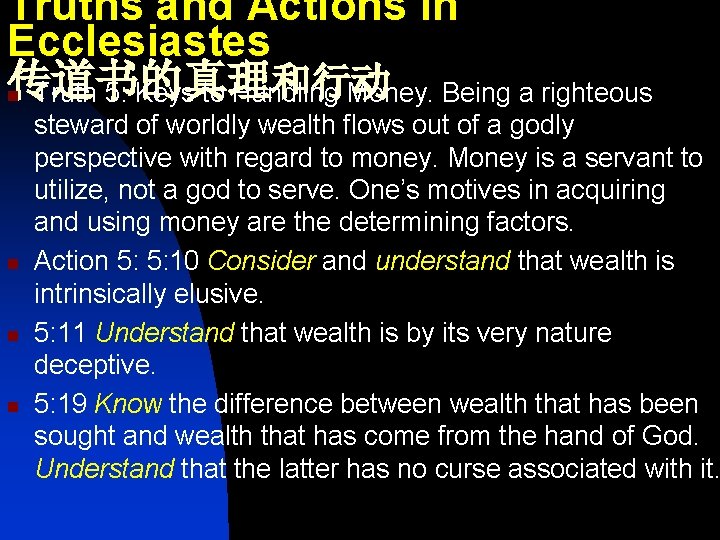
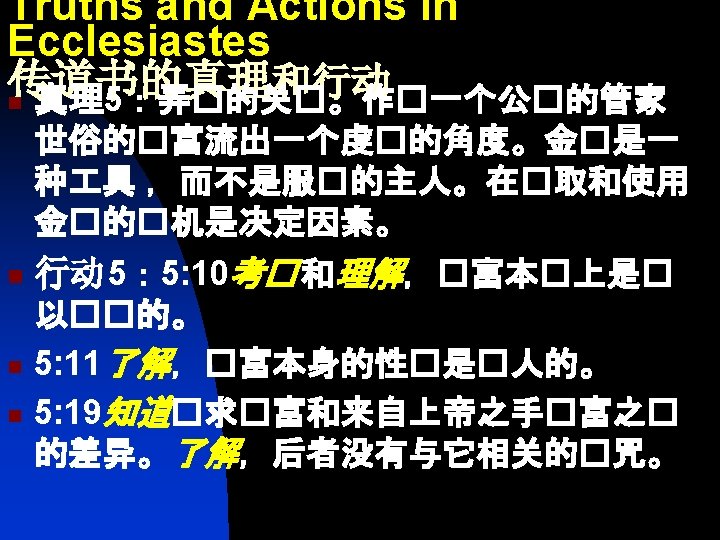
Truths and Actions in Ecclesiastes 传道书的真理 和行动 Truth 5: Keys to Handling Money. Being a righteous n n steward of worldly wealth flows out of a godly perspective with regard to money. Money is a servant to utilize, not a god to serve. One’s motives in acquiring and using money are the determining factors. Action 5: 5: 10 Consider and understand that wealth is intrinsically elusive. 5: 11 Understand that wealth is by its very nature deceptive. 5: 19 Know the difference between wealth that has been sought and wealth that has come from the hand of God. Understand that the latter has no curse associated with it.
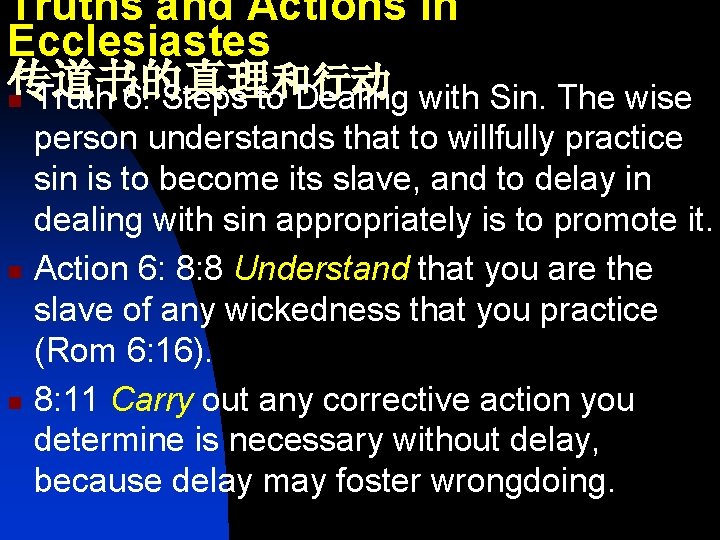
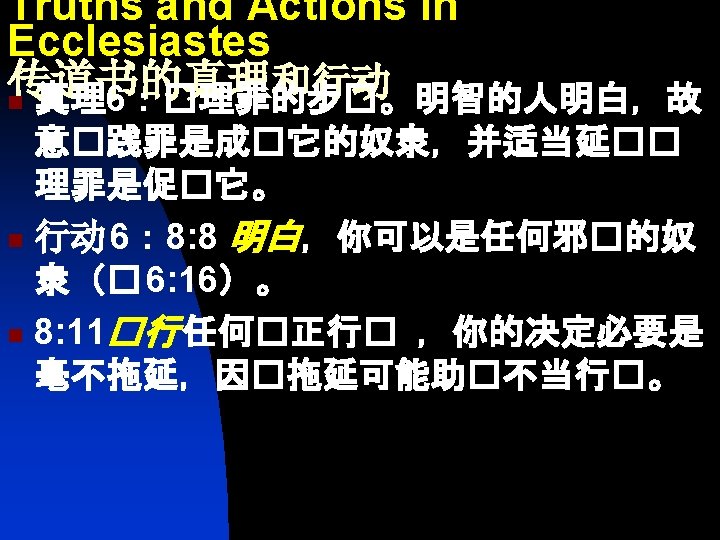
Truths and Actions in Ecclesiastes 传道书的真理 和行动 n Truth 6: Steps to Dealing with Sin. The wise n n person understands that to willfully practice sin is to become its slave, and to delay in dealing with sin appropriately is to promote it. Action 6: 8: 8 Understand that you are the slave of any wickedness that you practice (Rom 6: 16). 8: 11 Carry out any corrective action you determine is necessary without delay, because delay may foster wrongdoing.
Truths and Actions in Ecclesiastes 传道书的真理 和行动 n Truth 7: How to Tame the Tongue. When we n n speak, we must be aware that the Lord hears every word we say. Presumptuous speech displeases the Lord and can bring discipline. Action 7: 5: 1 -3 Be quick to listen and slow to speak. Cultivate humility and learn to walk softly before the Lord. 5: 4 -7 Do not speak presumptuously of spiritual commitment or endeavor. Cultivate reverence for the Lord.
References: 参考文献: 1. Several Internet sources. n 2. Several versions of the Bible. n 3. Hayford’s Bible Handbook, 1995. n 1。几个互联网资源。 n 2。几个版本的圣经。 n 3。海福德圣经手册,1995年。 n

n Gloria Deo 愿荣耀归上帝
- Slides: 77