
Some Definitions Population the whole group of people
- Slides: 14
Some Definitions
• Population – the whole group of people you want studied • Sample – a selection of individuals taken from the population • Example: – Population: SRB Students – Sample: 198 students from SRB • Census – data collected from the entire population
• Longitudinal Study – a single group being studied over a period of time (usually a smaller group) – Example: conduct a survey of only grade 9’s on values, next year give those grade 10’s another survey on values, the year after, etc. – You see how things change over time • Cross-Sectional Study – a larger group being studies at one time. – Example: The Data Class Surveys (Technology, Drugs and Alcohol, Values, etc. )
Types of Sampling
Simple Random Sampling A simple random sample requires that: • All selections be equally likely Example: • All grade 12’s in foyer, and give every one a ticket. From bucket draw out 40 tickets, this is your sample.
Systematic Random Sampling Used when you want to sample a fixed percentage of the population. You pick a random starting point, then select every nth person from then on. Example: I want to choose 20% of the 180 grade 12’s. How many grade 12’s is 20%? 20% of 180 = 36
Systematic Random Sampling (con’t) Line up the grade 12’s. Randomly pick a starting point, now I have to go every nth person? 180 ÷ 36 = 5 Start at 3 rd person, then 8 th, then 13 th, then 18 th, then etc.
Stratified Random Sample The population is divided into groups (called strata). These groups could be by grade, gender, age, geographic area, etc. A simple random sample from each groups is then taken. However, the size of each of these samples is proportional to the groups size.
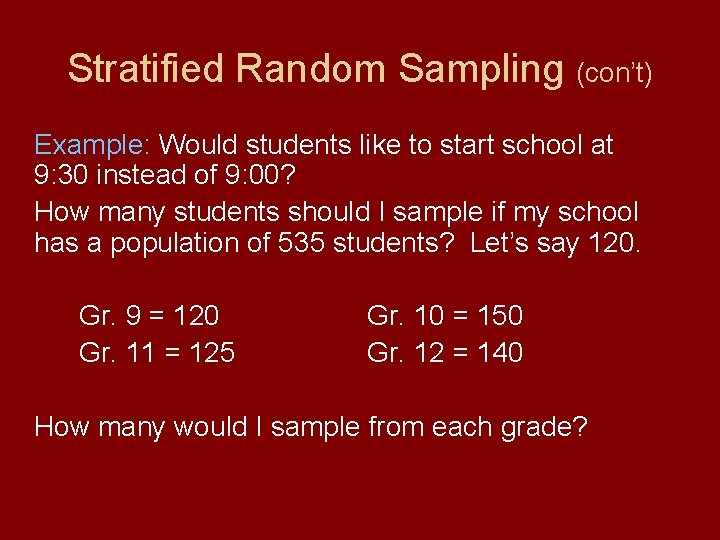
Stratified Random Sampling (con’t) Example: Would students like to start school at 9: 30 instead of 9: 00? How many students should I sample if my school has a population of 535 students? Let’s say 120. Gr. 9 = 120 Gr. 11 = 125 Gr. 10 = 150 Gr. 12 = 140 How many would I sample from each grade?
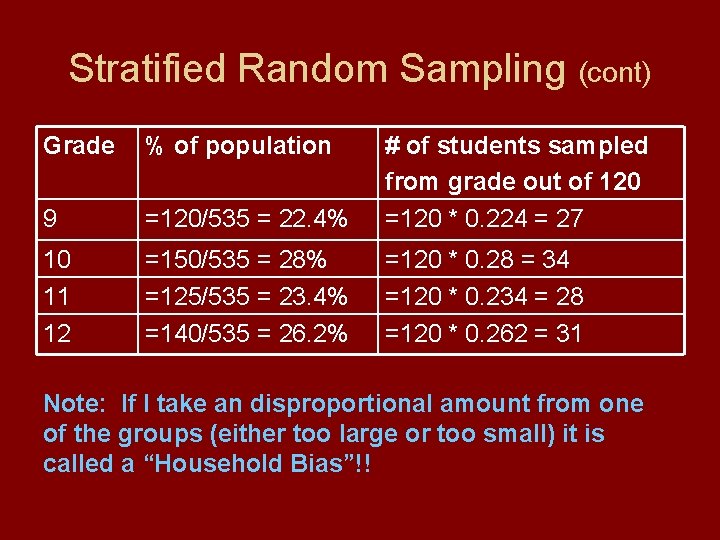
Stratified Random Sampling (cont) Grade % of population 9 =120/535 = 22. 4% # of students sampled from grade out of 120 =120 * 0. 224 = 27 10 11 12 =150/535 = 28% =125/535 = 23. 4% =140/535 = 26. 2% =120 * 0. 28 = 34 =120 * 0. 234 = 28 =120 * 0. 262 = 31 Note: If I take an disproportional amount from one of the groups (either too large or too small) it is called a “Household Bias”!!
Cluster Random Sampling The population is organized into groups. A random sample of the groups is taken, however, every person is the group is surveyed. Example: Grade 12 Survey – Grade 12 Period 1 classes. I randomly choose 3 of these classes, and everyone in those classes does the survey.
Cluster Random Sampling (con’t) Example: How do parents feel about the new curriculum? Randomly choose 4 out of the 100 schools and survey all of the parents of those students.
Multi-Stage Random Sampling The population is organized into groups. A random sample of groups is taken. Within each random group, a random number of members is taken. Example: School Survey – School is grouped into Period 1 classes. Randomly select 15 classes, and 10 students in each of those classes.
Additional Notes For the multi-stage random sampling, you could combine with other methods. Example: You could use systematic sampling to get the groups and cluster sampling with the chosen groups. **How Much is Enough? ** The larger the population, the larger the sample. The larger the sample, the more reliable your results! If there is a lot of variety in your population, you may need an even larger sample to make reliable conclusions.