
Some conclusions from QM Energy is absorbed and
Some conclusions from QM
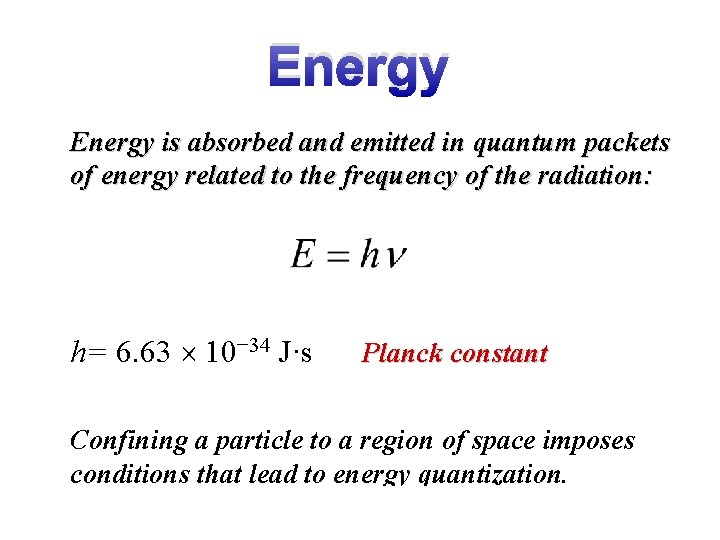
Energy is absorbed and emitted in quantum packets of energy related to the frequency of the radiation: h= 6. 63 10− 34 J·s Planck constant Confining a particle to a region of space imposes conditions that lead to energy quantization. Copyright (c) Stuart Lindsay 2008
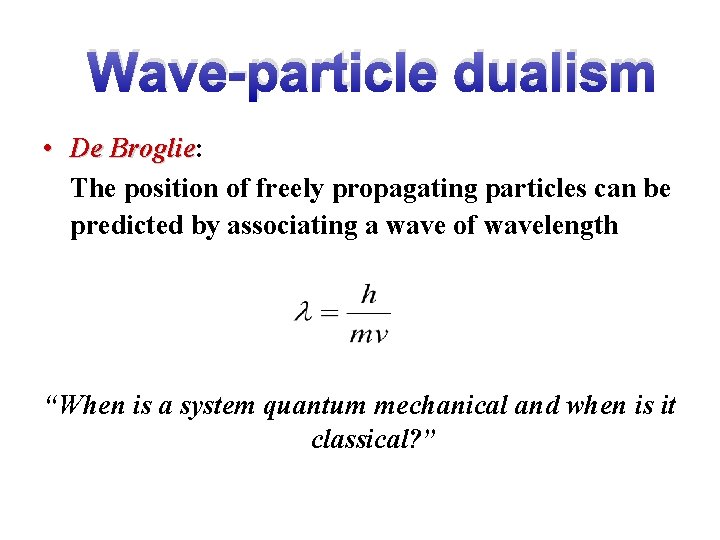
Wave-particle dualism • De Broglie: Broglie The position of freely propagating particles can be predicted by associating a wave of wavelength “When is a system quantum mechanical and when is it classical? ” Copyright (c) Stuart Lindsay 2008
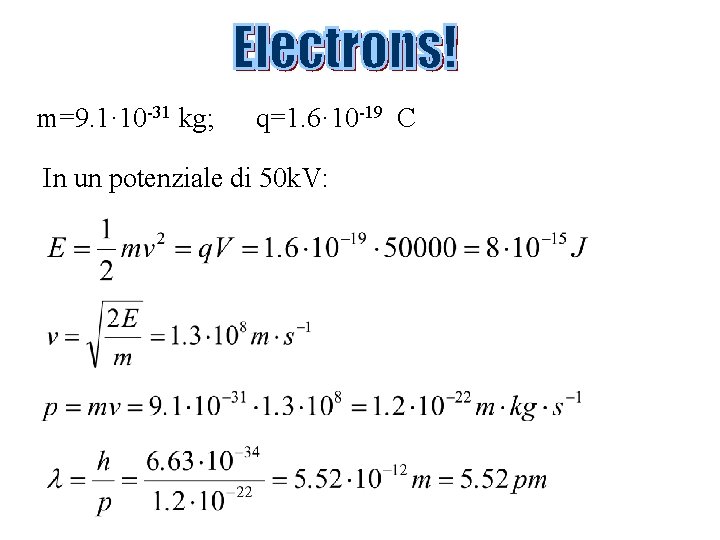
m=9. 1· 10 -31 kg; q=1. 6· 10 -19 C In un potenziale di 50 k. V:
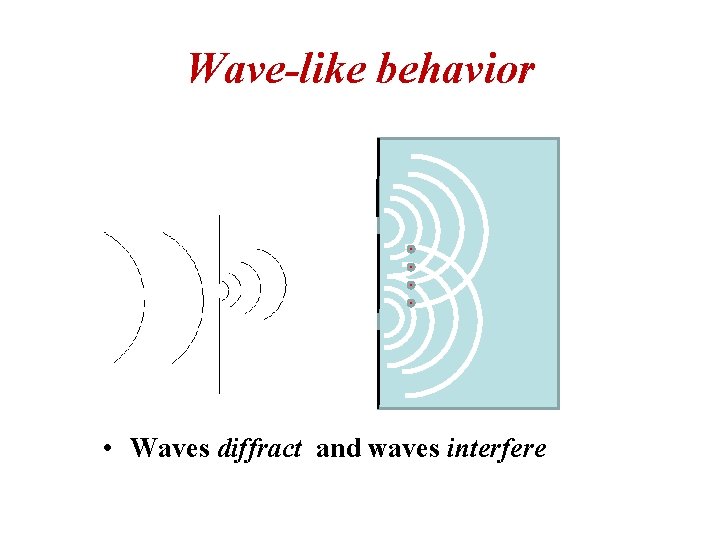
Wave-like behavior • Waves diffract and waves interfere Copyright (c) Stuart Lindsay 2008
The key points of QM • Particle behavior can be predicted only in terms of probability. Quantum mechanics provides the tools for making probabilistic predictions. • The predicted particle distributions are wave-like. The De Broglie wavelength associated with probability distributions for macroscopic particles is so small that quantum effects are not apparent. Copyright (c) Stuart Lindsay 2008
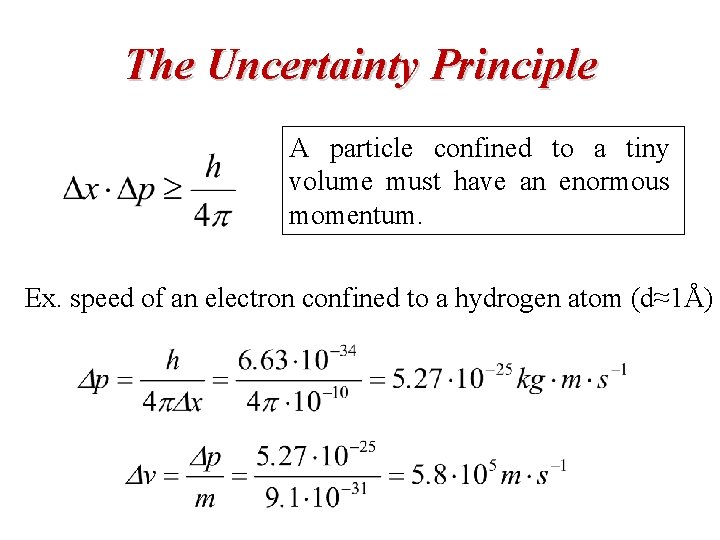
The Uncertainty Principle A particle confined to a tiny volume must have an enormous momentum. Ex. speed of an electron confined to a hydrogen atom (d≈1Å)
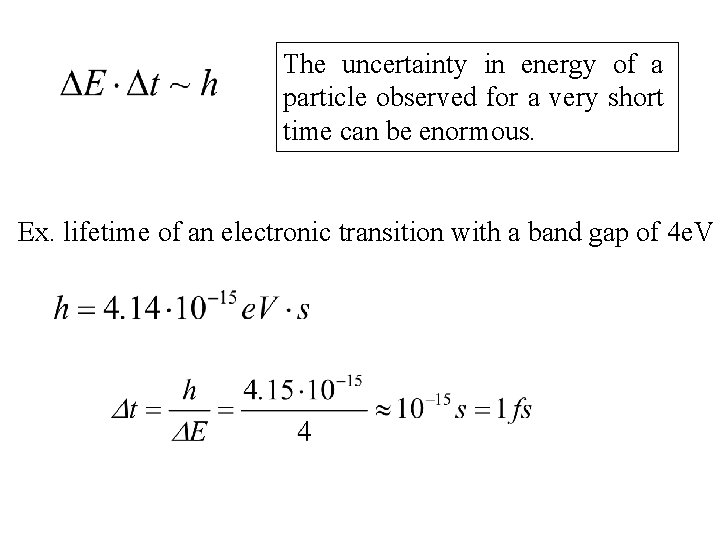
The uncertainty in energy of a particle observed for a very short time can be enormous. Ex. lifetime of an electronic transition with a band gap of 4 e. V
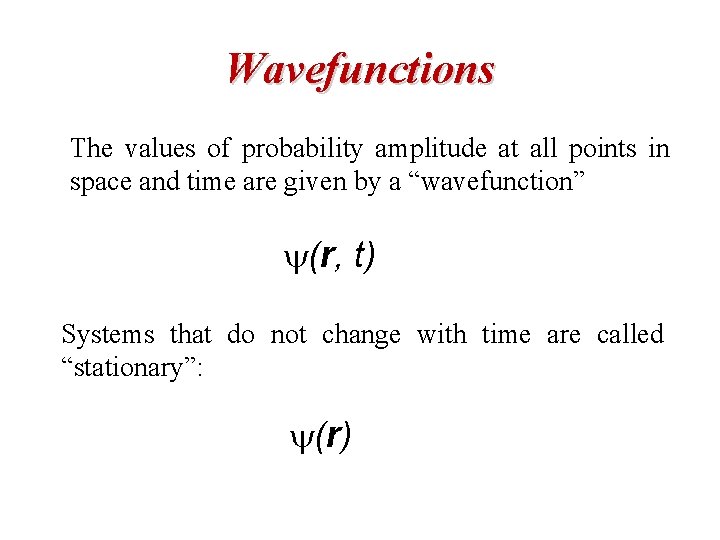
Wavefunctions The values of probability amplitude at all points in space and time are given by a “wavefunction” (r, t) Systems that do not change with time are called “stationary”: (r)
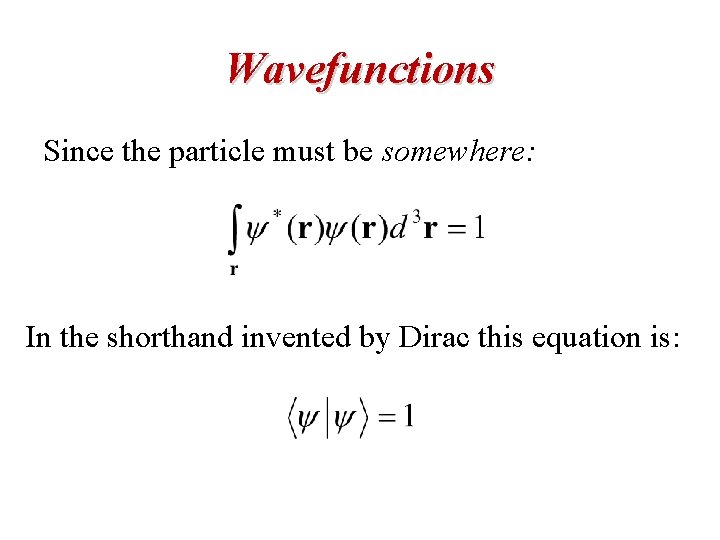
Wavefunctions Since the particle must be somewhere: In the shorthand invented by Dirac this equation is:
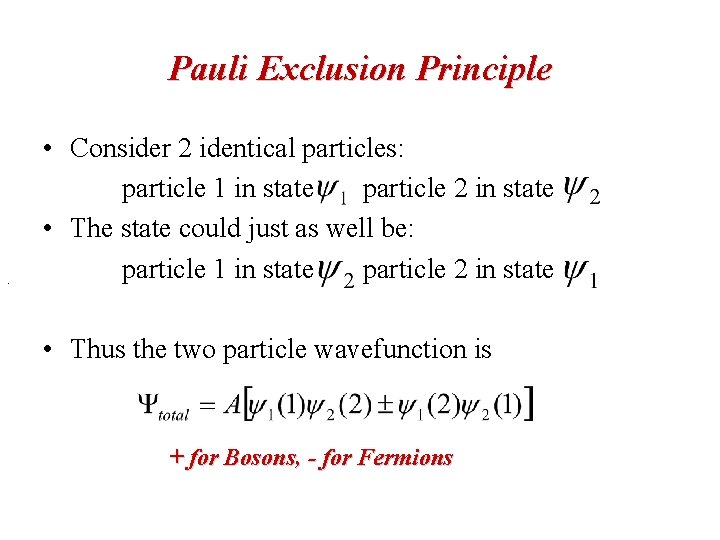
Pauli Exclusion Principle . • Consider 2 identical particles: particle 1 in state particle 2 in state • The state could just as well be: particle 1 in state particle 2 in state • Thus the two particle wavefunction is + for Bosons, - for Fermions

Bosons and fermions • Fermions are particles with odd spins, where the quantum of spin is Electrons have spin and are Fermions • 3 He nuclei have spin and are Fermions • 4 He nuclei have spins and are Bosons Copyright (c) Stuart Lindsay 2008
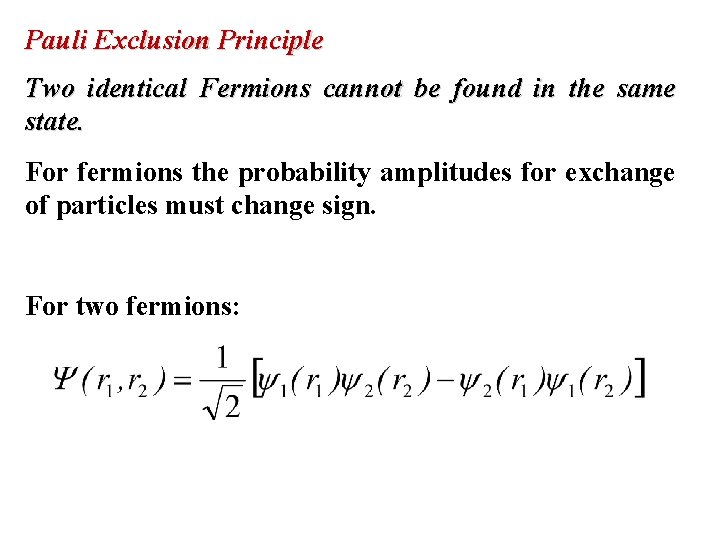
Pauli Exclusion Principle Two identical Fermions cannot be found in the same state. For fermions the probability amplitudes for exchange of particles must change sign. For two fermions:
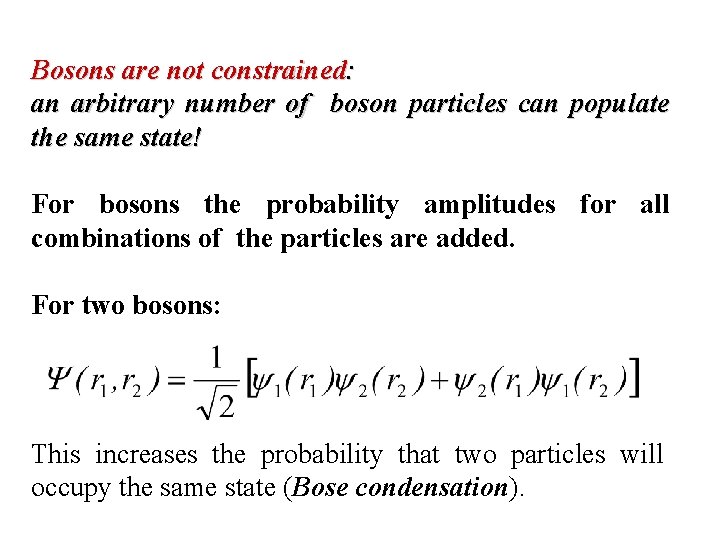
Bosons are not constrained: an arbitrary number of boson particles can populate the same state! For bosons the probability amplitudes for all combinations of the particles are added. For two bosons: This increases the probability that two particles will occupy the same state (Bose condensation).
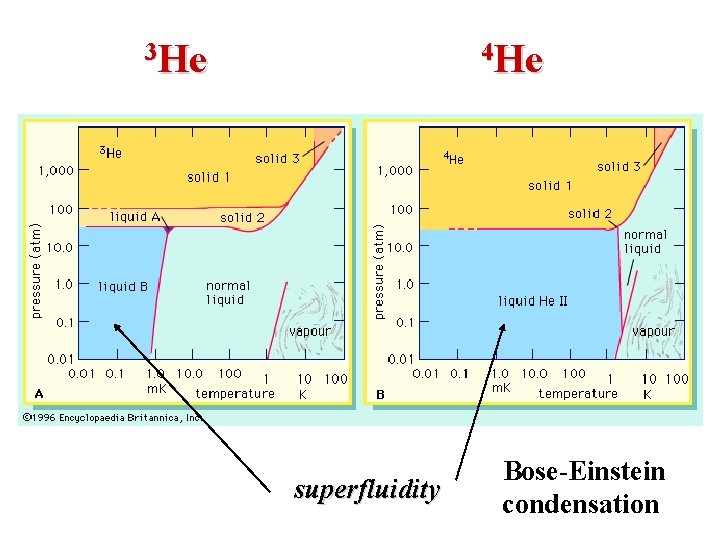
3 He 4 He superfluidity Bose-Einstein condensation
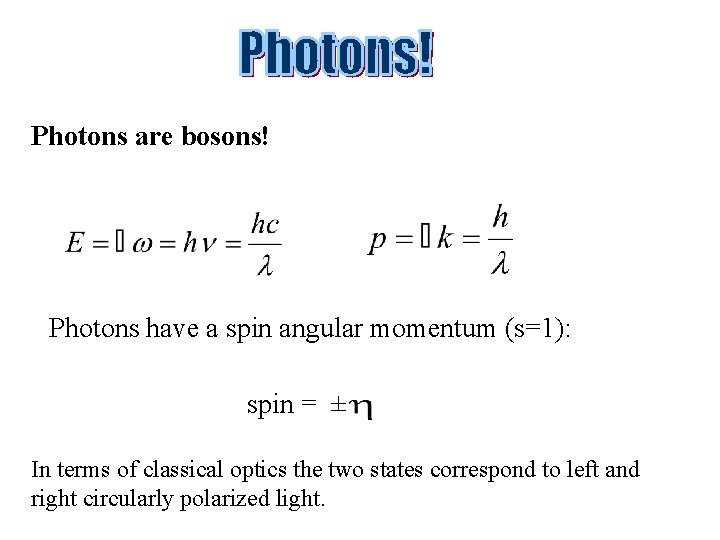
Photons are bosons! Photons have a spin angular momentum (s=1): spin = ± In terms of classical optics the two states correspond to left and right circularly polarized light.
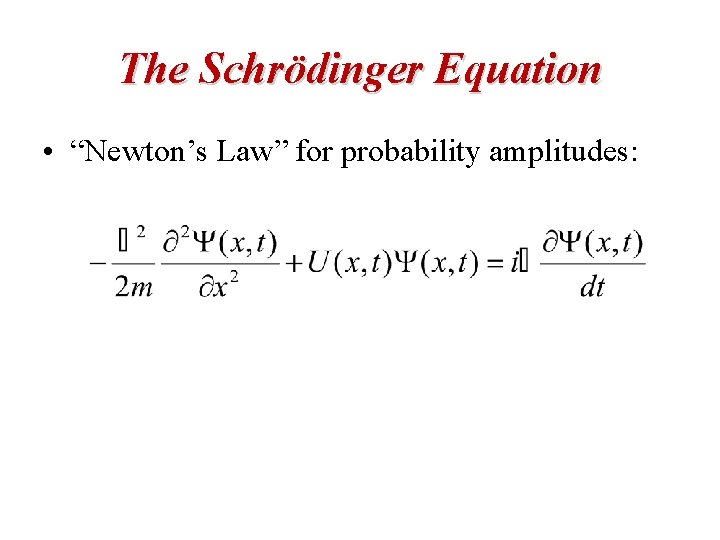
The Schrödinger Equation • “Newton’s Law” for probability amplitudes:
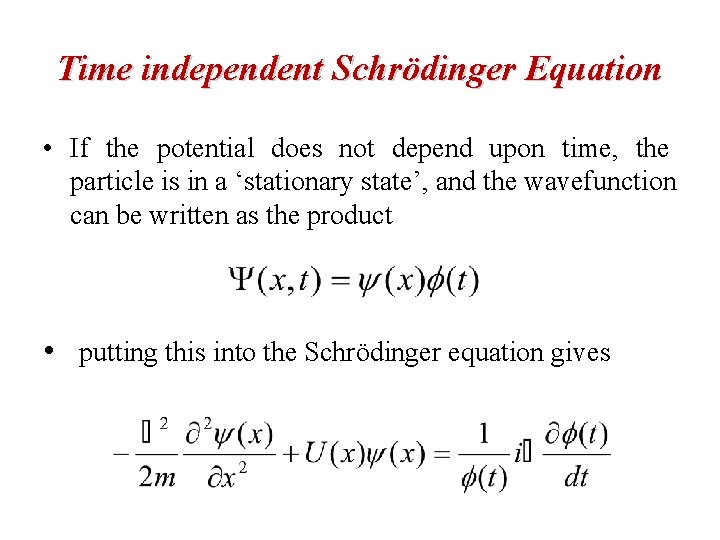
Time independent Schrödinger Equation • If the potential does not depend upon time, the particle is in a ‘stationary state’, and the wavefunction can be written as the product • putting this into the Schrödinger equation gives
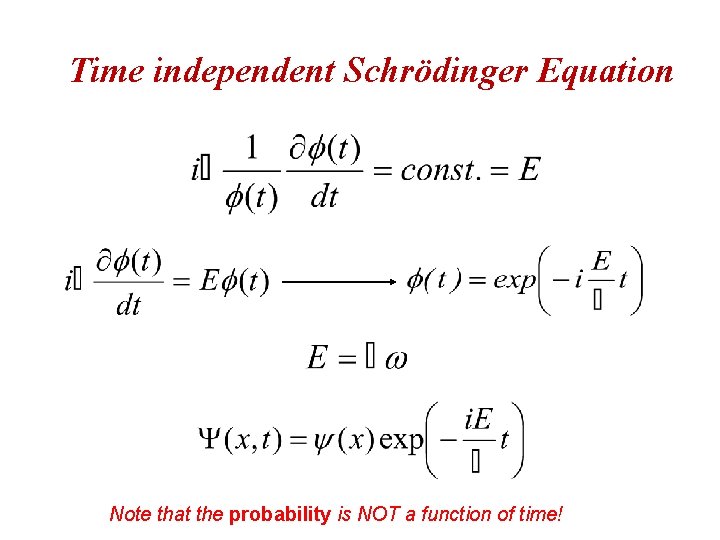
Time independent Schrödinger Equation Note that the probability is NOT a function of time!
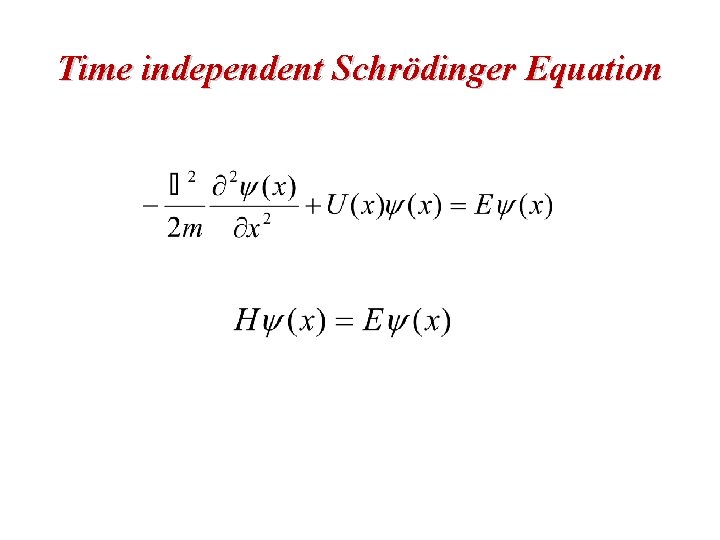
Time independent Schrödinger Equation
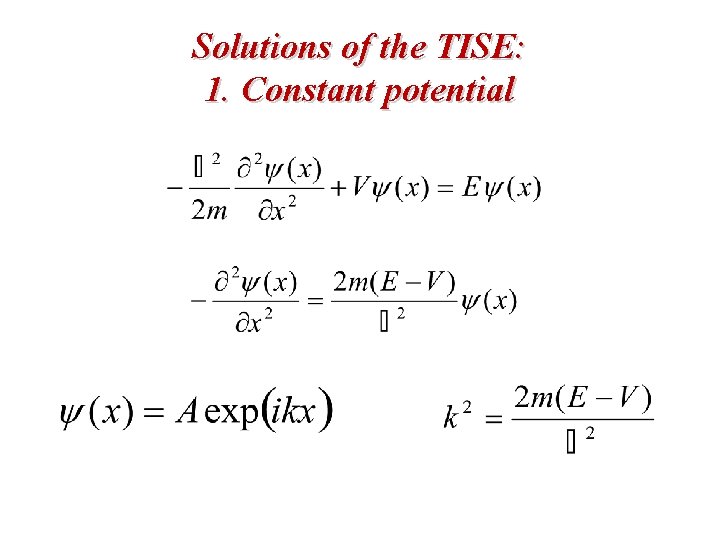
Solutions of the TISE: 1. Constant potential
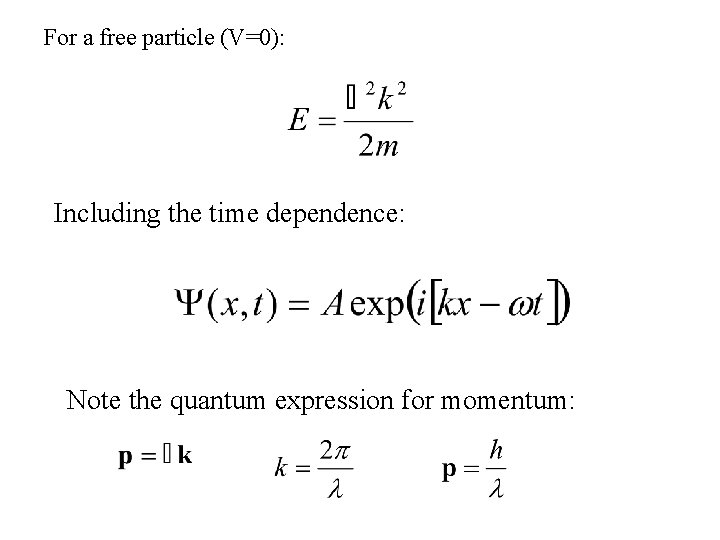
For a free particle (V=0): Including the time dependence: Note the quantum expression for momentum:
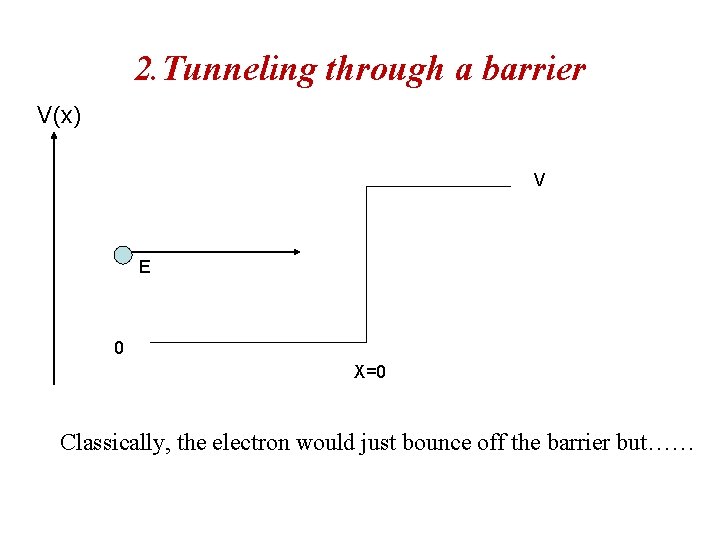
2. Tunneling through a barrier V(x) V E 0 X=0 Classically, the electron would just bounce off the barrier but……
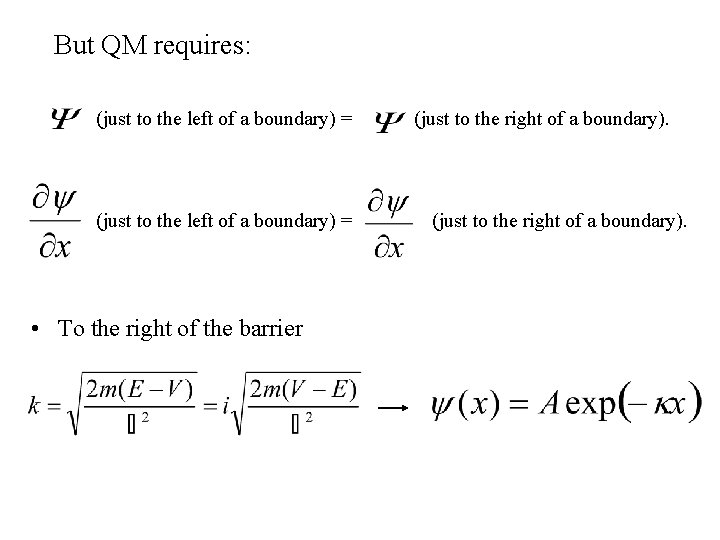
But QM requires: (just to the left of a boundary) = • To the right of the barrier (just to the right of a boundary).
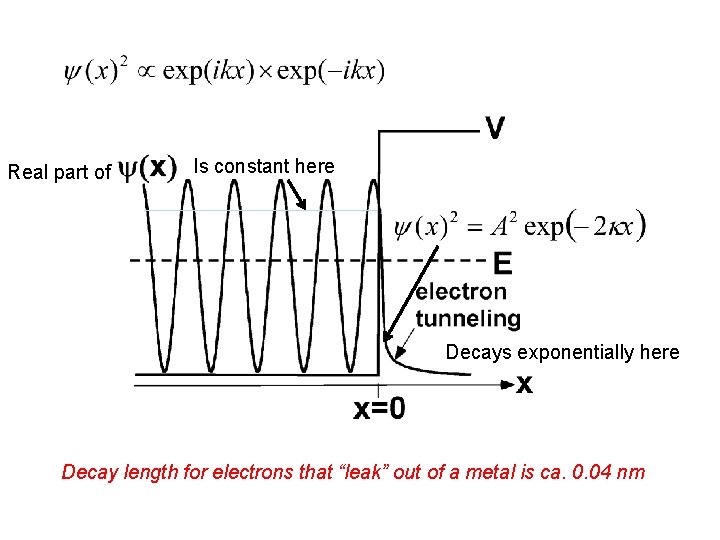
Real part of Is constant here Decays exponentially here Decay length for electrons that “leak” out of a metal is ca. 0. 04 nm
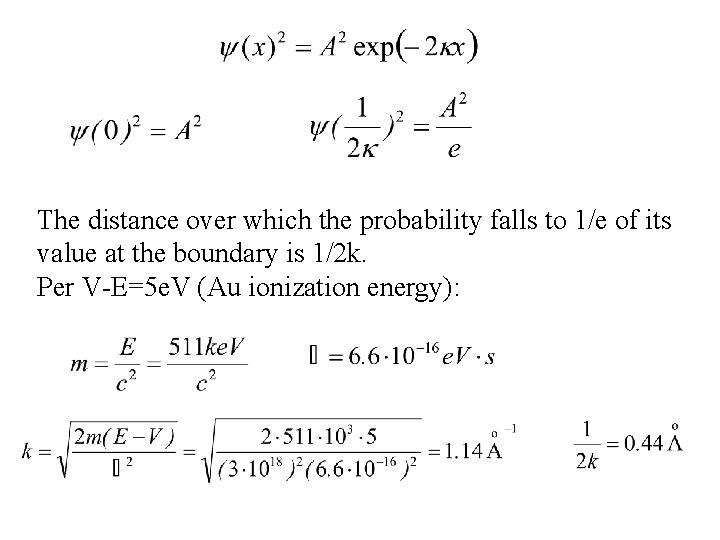
The distance over which the probability falls to 1/e of its value at the boundary is 1/2 k. Per V-E=5 e. V (Au ionization energy):
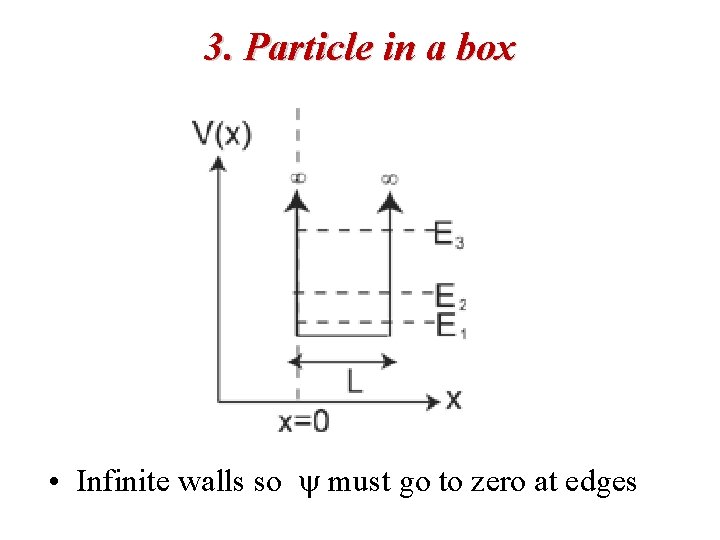
3. Particle in a box • Infinite walls so must go to zero at edges
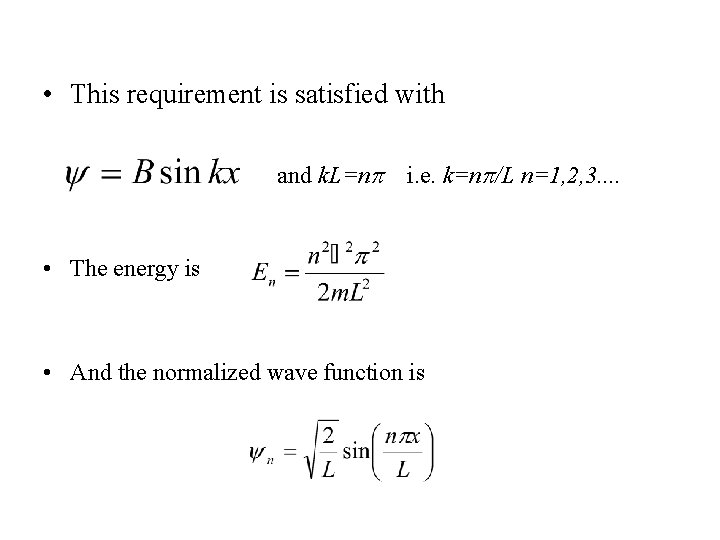
• This requirement is satisfied with and k. L=n i. e. k=n /L n=1, 2, 3. . • The energy is • And the normalized wave function is
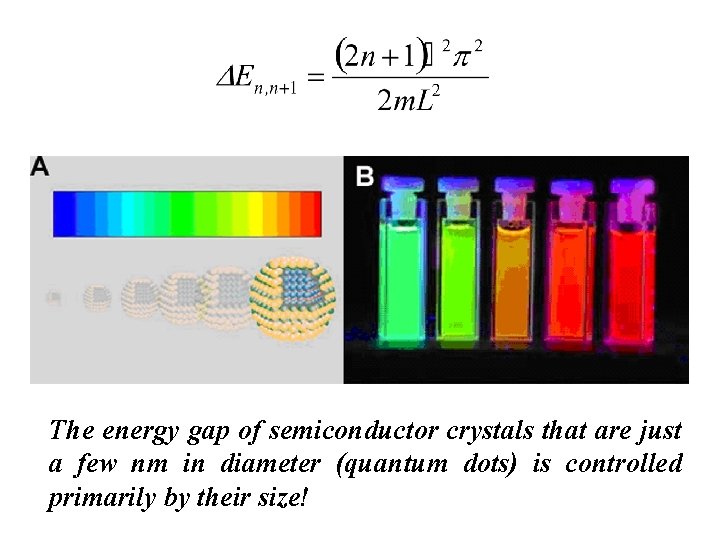
The energy gap of semiconductor crystals that are just a few nm in diameter (quantum dots) is controlled primarily by their size!
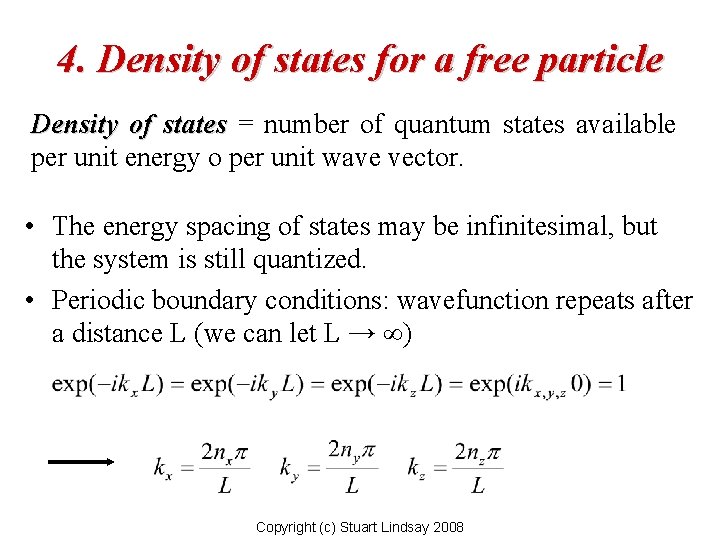
4. Density of states for a free particle Density of states = number of quantum states available per unit energy o per unit wave vector. • The energy spacing of states may be infinitesimal, but the system is still quantized. • Periodic boundary conditions: wavefunction repeats after a distance L (we can let L → ) Copyright (c) Stuart Lindsay 2008
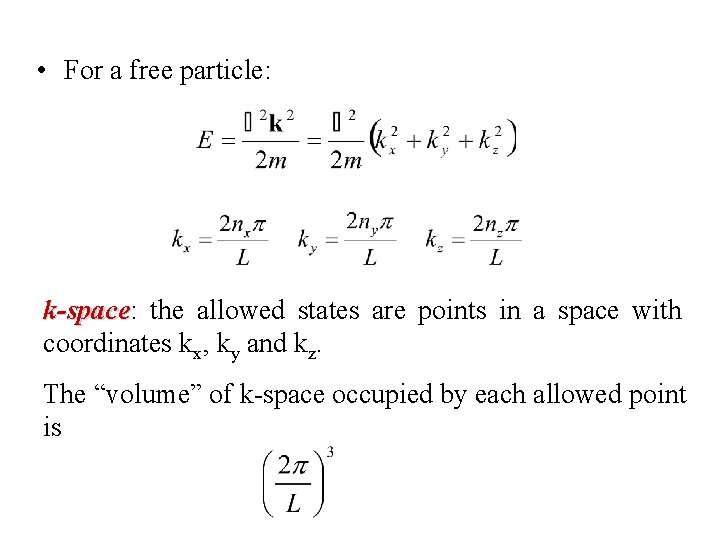
• For a free particle: k-space: k-space the allowed states are points in a space with coordinates kx, ky and kz. The “volume” of k-space occupied by each allowed point is
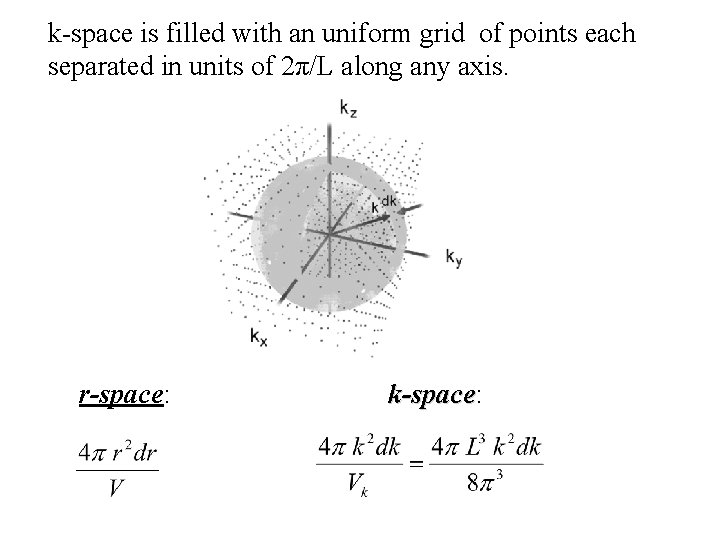
k-space is filled with an uniform grid of points each separated in units of 2π/L along any axis. r-space: k-space: k-space
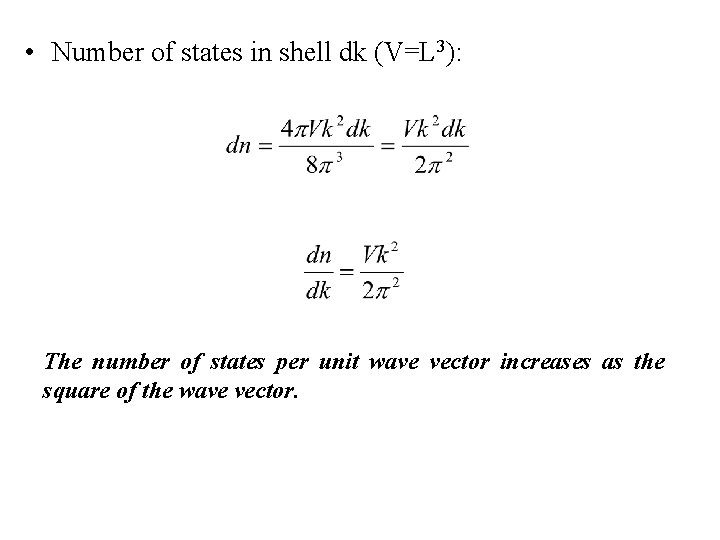
• Number of states in shell dk (V=L 3): The number of states per unit wave vector increases as the square of the wave vector.
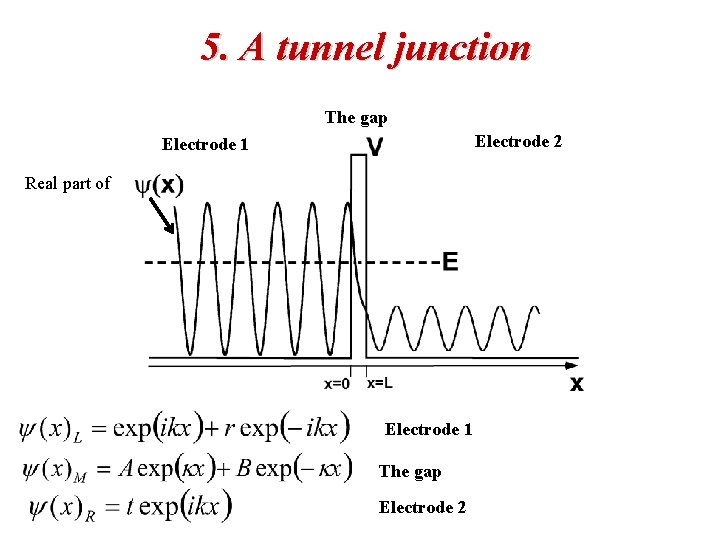
5. A tunnel junction The gap Electrode 2 Electrode 1 Real part of Electrode 1 The gap Electrode 2
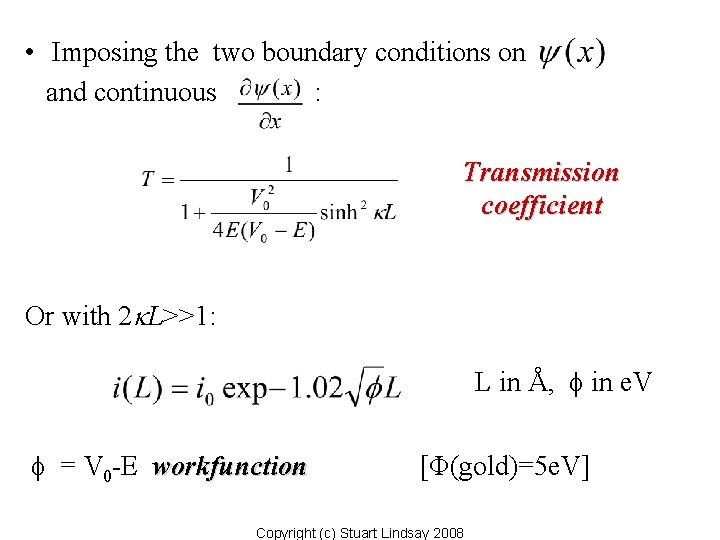
• Imposing the two boundary conditions on and continuous : Transmission coefficient Or with 2 L>>1: L in Å, in e. V = V 0 -E workfunction [Φ(gold)=5 e. V] Copyright (c) Stuart Lindsay 2008
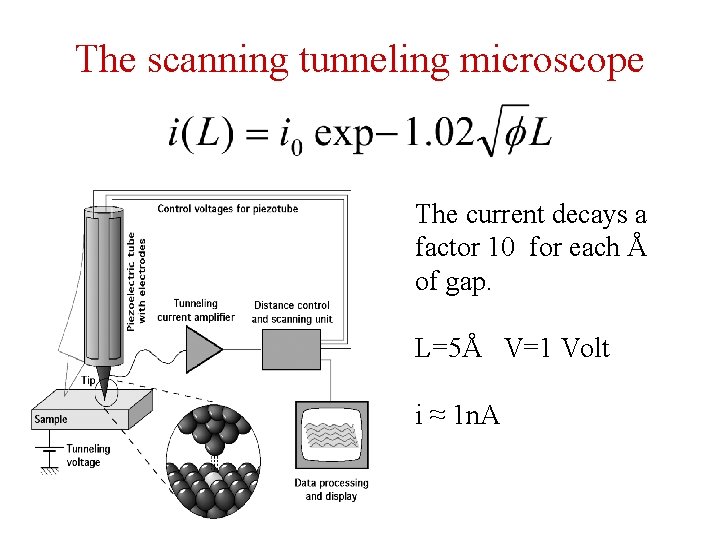
The scanning tunneling microscope The current decays a factor 10 for each Å of gap. L=5Å V=1 Volt i ≈ 1 n. A
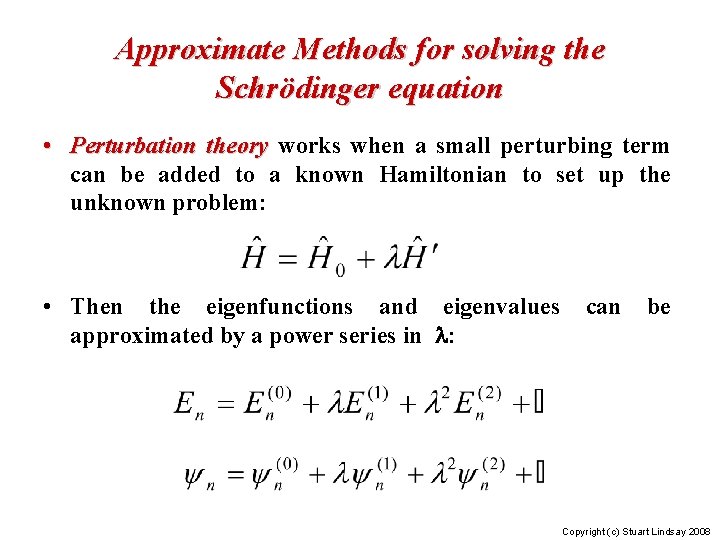
Approximate Methods for solving the Schrödinger equation • Perturbation theory works when a small perturbing term can be added to a known Hamiltonian to set up the unknown problem: • Then the eigenfunctions and eigenvalues approximated by a power series in : can be Copyright (c) Stuart Lindsay 2008
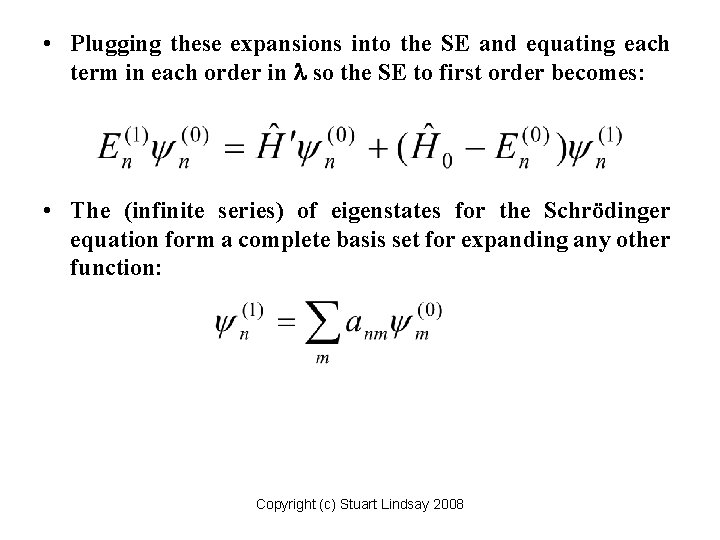
• Plugging these expansions into the SE and equating each term in each order in so the SE to first order becomes: • The (infinite series) of eigenstates for the Schrödinger equation form a complete basis set for expanding any other function: Copyright (c) Stuart Lindsay 2008
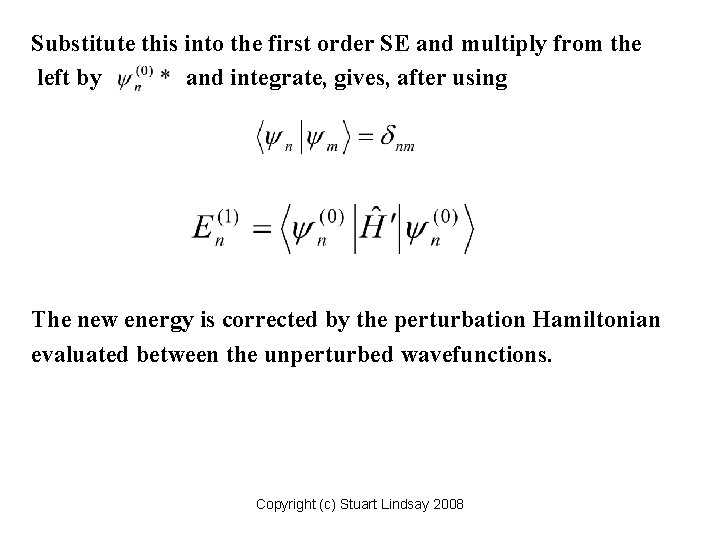
Substitute this into the first order SE and multiply from the left by and integrate, gives, after using The new energy is corrected by the perturbation Hamiltonian evaluated between the unperturbed wavefunctions. Copyright (c) Stuart Lindsay 2008
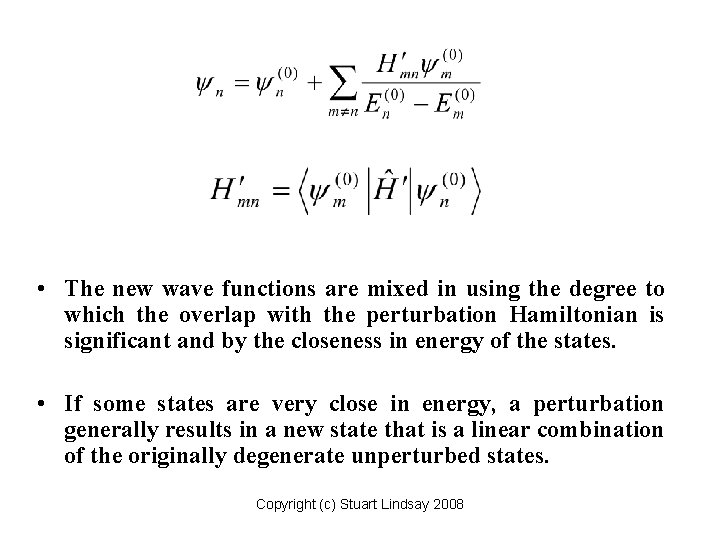
• The new wave functions are mixed in using the degree to which the overlap with the perturbation Hamiltonian is significant and by the closeness in energy of the states. • If some states are very close in energy, a perturbation generally results in a new state that is a linear combination of the originally degenerate unperturbed states. Copyright (c) Stuart Lindsay 2008
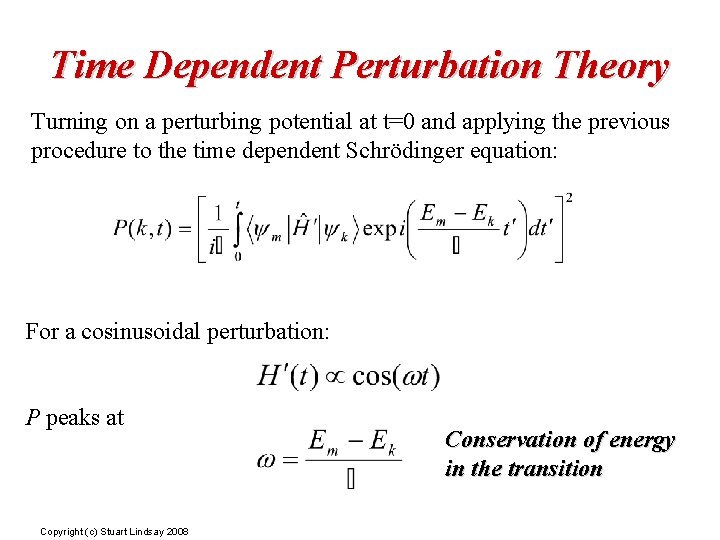
Time Dependent Perturbation Theory Turning on a perturbing potential at t=0 and applying the previous procedure to the time dependent Schrödinger equation: For a cosinusoidal perturbation: P peaks at Copyright (c) Stuart Lindsay 2008 Conservation of energy in the transition
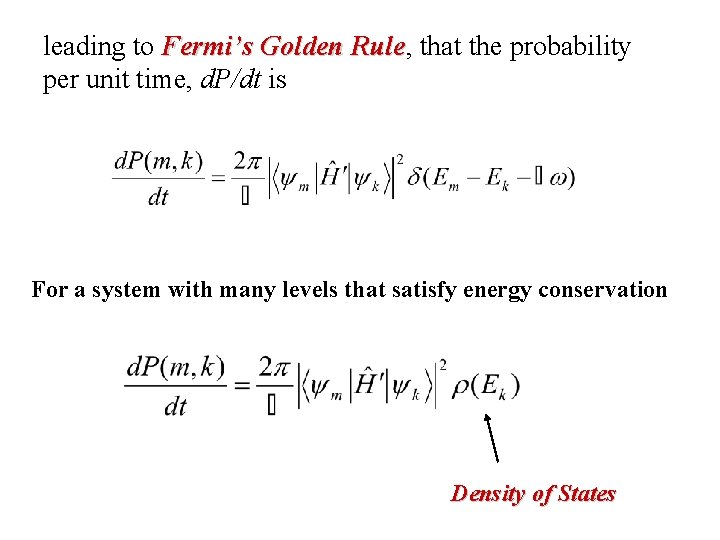
leading to Fermi’s Golden Rule, Rule that the probability per unit time, d. P/dt is For a system with many levels that satisfy energy conservation Density of States
- Slides: 42