
SOME ASPECTS IN Neonatal Management BY RUBANA BAABBAD
SOME ASPECTS IN Neonatal Management BY: RUBANA BAABBAD MD CONSULTANT NEONATOLOGIST
Contents: n Resuscitation n. APGAR Score n. Management of Premature Infant n. Management of Infant Diabetic Mother n. Premature vs dysmature
Delivery Room Resuscitation ANTICIPATION & RECOGNITION OF NEONATE IN DISTRESS: Primary Apnea: due to brief hypoxia Recovers with stimulation and oxygen supplement. Secondary Apnea: with prolonged hypoxia. Requires assisted ventilation and oxygen. Assume all times that it is secondary and resuscitate immediately.
Goals of Resuscitation: 1) Minimizing Immediate Heat Loss 2) Establishing Normal Respiration and Lung Expansion 3) Increasing Arterial PO 2 4) Supporting Adequate Cardiac Output
STEPS FOR EFFECTIVE RESUSCITATION Preparation: pediatric team should be present a)identify high risk deliveries : fetal n distress, fetal disease or serious conditions like meconium, prematurity, post- maturity abnormal fetal wt. , major anomalies, hydrops, multiple gestation, cord prolapse, abruptio placentae. Labor &delivery conditions: like APH. , abnormal presentation, difficult labor
NO PEDIATRIC TEAM REQUIRED: PERSONNEL FOR EVALUATION neonatal conditions : unexpected congenital anomalies, respiatory distress, unanticipated neonatal depression. Maternal conditions: signs of maternal infection maternal illness e. g. DM, isoimmunization, PET, renal, endocrine, pulmonary, or cardiac disease.
NESSESARY EQUIPMENT 1. 2. 3. 4. 5. 6. 7. 8. 9. 10. 11. Radiant warmer Oxygen source Self inflating bag with reservoir or anesthesia bag Face mask with appropriate size Suction Stethoscope Emergency box: laryngoscope, batteries ET. Tubes, drugs: epinephrin(1: 10000), Na. Hco 3 4. 2%, Naloxon, albumin, and Na. CL 0. 9% Umbilical catheterization tray Syringes, needles, t-connectors, and stopcocks Transport incubator with batteries Pulse oximetry
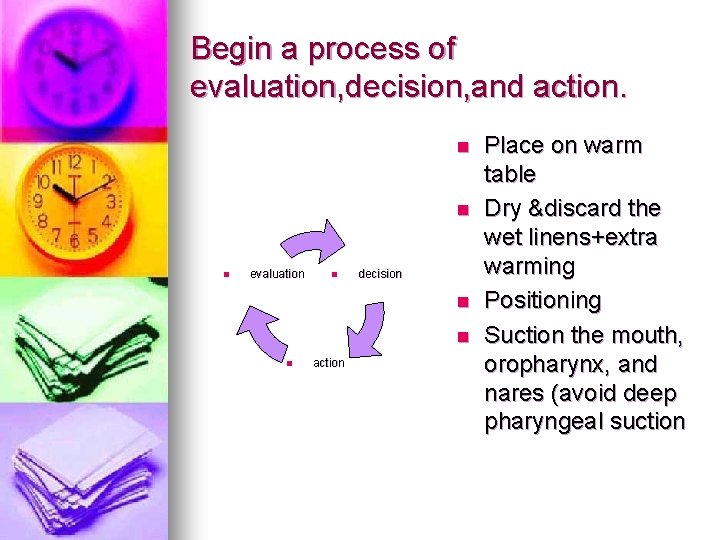
Begin a process of evaluation, decision, and action. n n n evaluation n decision n action Place on warm table Dry &discard the wet linens+extra warming Positioning Suction the mouth, oropharynx, and nares (avoid deep pharyngeal suction
EVALUATION&ACTION Evaluate for: n color: cyanosed ------oxygen n Respiratory distress: signs? n Indications of bag and mask ventilation: apnea, HR< 100 n Rate, press, technique indication for intubation, ET size & suction catheter sizes. n
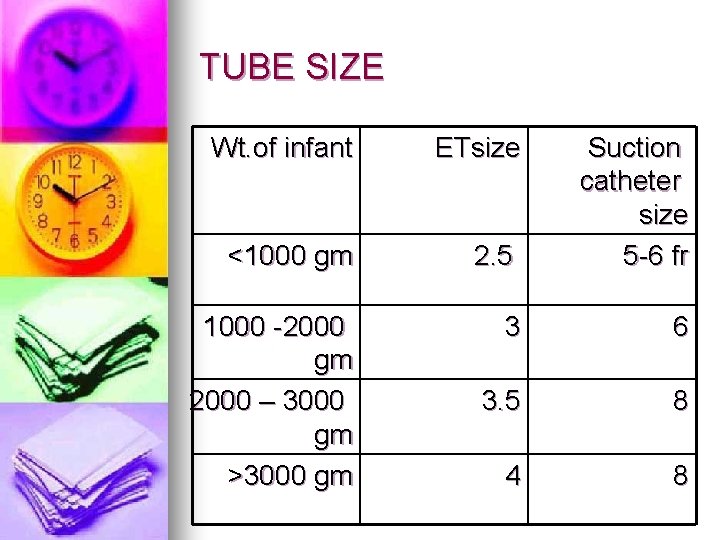
TUBE SIZE Wt. of infant ETsize <1000 gm 2. 5 Suction catheter size 5 -6 fr 1000 -2000 gm 2000 – 3000 gm >3000 gm 3 6 3. 5 8 4 8
CHEST COMPRESSIONS n Indications: if after 15 -30 sec of +ve press ventilation 100% O 2 & HR<60 / 60 -80 bpm & not ↑ n Technique : 1 finger breadth below nipple line, using 2 fingers compress 1 -2 cm 90 min ratio 3: 1 cc to vent.
Medications used for resuscitation n n n Indications: Bradycardia with HR < 80 BPM despite adequate ventilation with 100% O 2 and chest compression for mini. Of 30 sec or HR=0 Epinephrine Volume expanders Naloxone hydrochloride Na. HCO 3
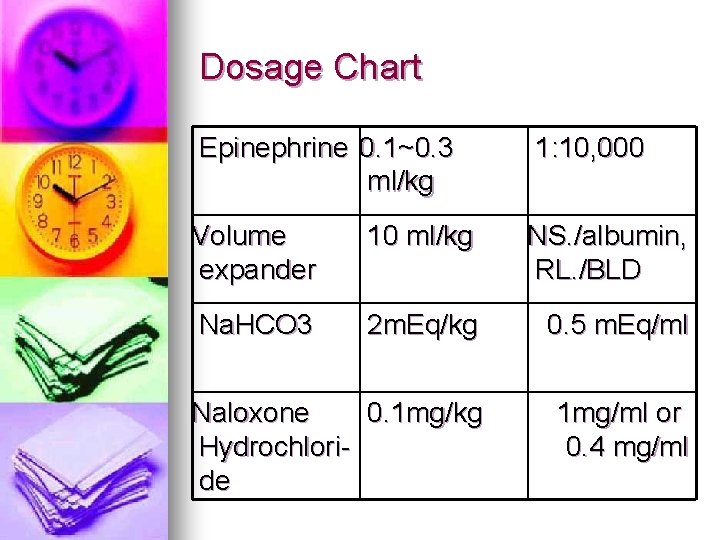
Dosage Chart Epinephrine 0. 1~0. 3 ml/kg 1: 10, 000 Volume expander 10 ml/kg NS. /albumin, RL. /BLD Na. HCO 3 2 m. Eq/kg 0. 5 m. Eq/ml Naloxone 0. 1 mg/kg Hydrochloride 1 mg/ml or 0. 4 mg/ml
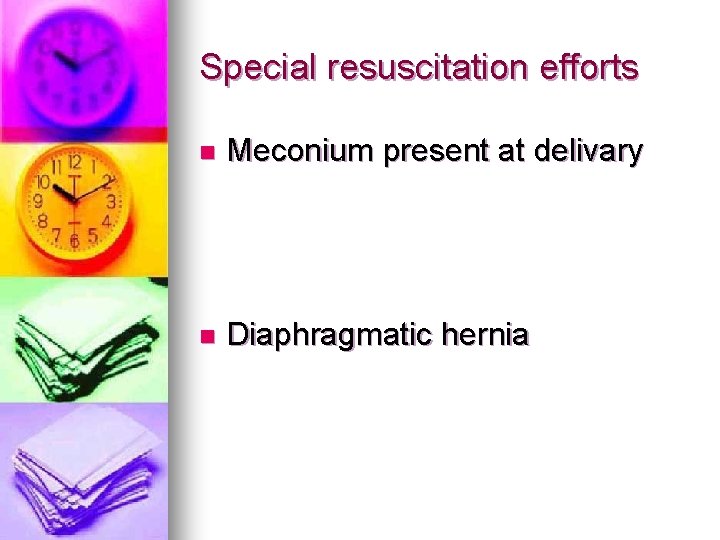
Special resuscitation efforts n Meconium present at delivary n Diaphragmatic hernia
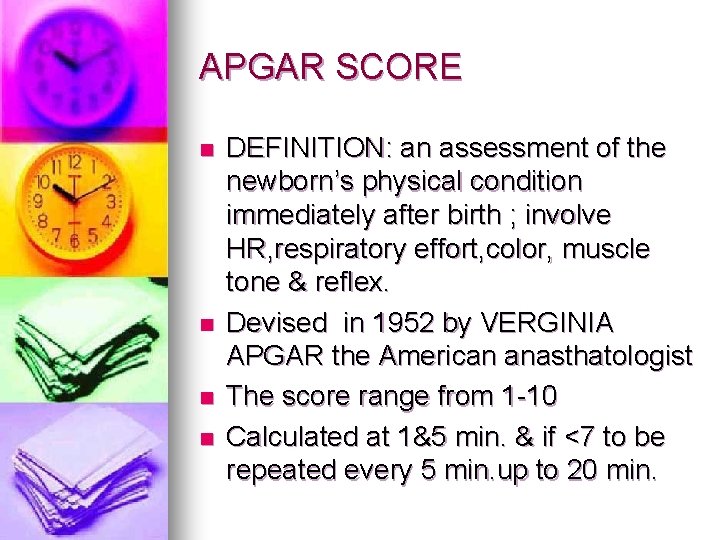
APGAR SCORE n n DEFINITION: an assessment of the newborn’s physical condition immediately after birth ; involve HR, respiratory effort, color, muscle tone & reflex. Devised in 1952 by VERGINIA APGAR the American anasthatologist The score range from 1 -10 Calculated at 1&5 min. & if <7 to be repeated every 5 min. up to 20 min.
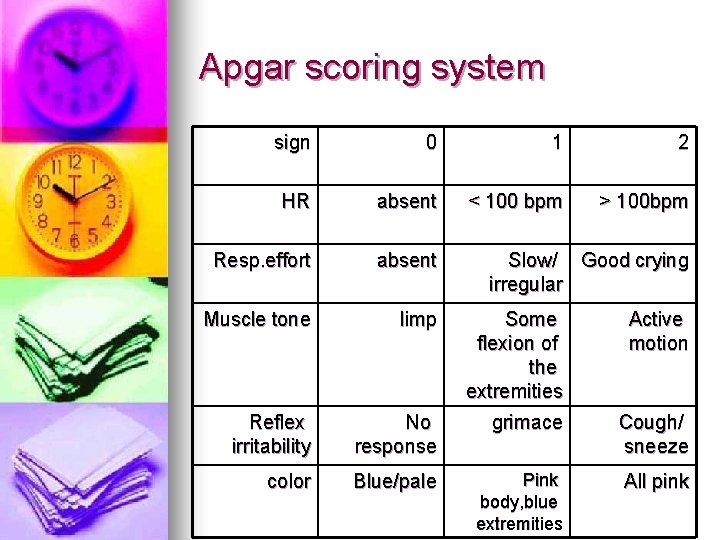
Apgar scoring system sign 0 1 2 HR absent < 100 bpm > 100 bpm Resp. effort absent Muscle tone limp Some flexion of the extremities Active motion Reflex irritability No response grimace Cough/ sneeze color Blue/pale Pink body, blue extremities All pink Slow/ Good crying irregular
Definition of dysmaturity 1. Characteristic of faulty embryologic development, often leading to structura and/or functional abnormalities. 2. Relating to or characteristic of an infant whose birth weight is inappropriately lo for its gestational age
Premature vs. Dysmature n n n > 20 wks. &< 37 weeks Incomplete organ system development thin shiny skin, extended arms and legs, little subcutanous fat, spase hair few palmar and sole creases, poorly developed ear cartilage , genitalia boys few rugae undescended testicles- girls gaping labia prominent clitoris n postmaturity syndrome: a syndrome due to placental insufficiency that causes chronic stress and hypoxia, seen in fetuses and neonates in postterm pregnancies, characterized by decreased subcutaneous fat, skin desquamation, and long fingernails, often with yellow meconium staining of the nails, skin, and vernix.
The Premature infant n The premature infant is quickly transferred from the warm fluid medium of the liquor amnii with its practically constant temperature to the variable circumstances of an extrauterine life; he/she loses the preparatory transition-time of the third trimester of intrauterine existence.
Problems of prematurity n n n n Thermoregulation Respiratory distress Apnea Sepsis poor sucking& swallowing reflex Neurologic Cvs Hematologic Nutritional Gastrointestinal Metabolic Renal Immunologic opthalmologic
Management of premature infants n n n n Thermal regulation O 2 therapy & assissted ventilation PDA Fluid& electrolite management Nutrition Hyperbilirubinemia Infection immunization
Management of infants of diabetic mothers n n n Evaluation: before delivery : size, pulmonary maturity, obvious anomalies After delivery: Apgar score, physical examination for major congenital anomalies In the nursery: continuous evaluation repeat the examination, monitor blood glucose, hematocrit, calcium & bilirubin levels.
- Slides: 22