
Somatic Embryogenesis In plant tissue culture the developmental
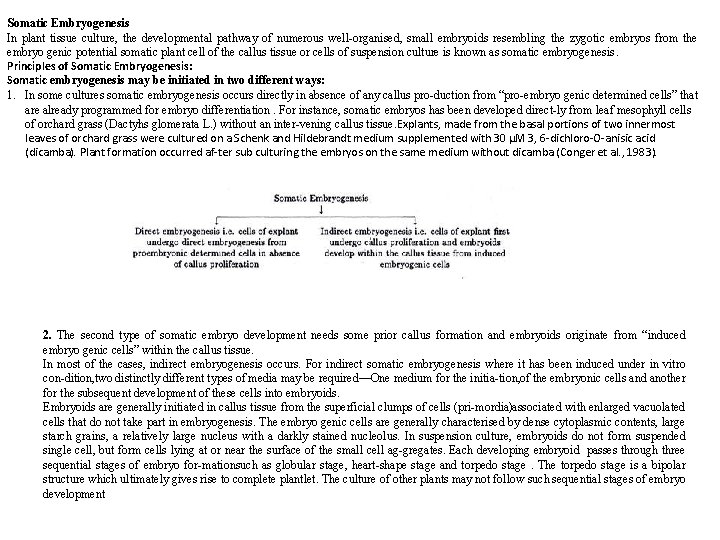
Somatic Embryogenesis In plant tissue culture, the developmental pathway of numerous well organised, small embryoids resembling the zygotic embryos from the embryo genic potential somatic plant cell of the callus tissue or cells of suspension culture is known as somatic embryogenesis. Principles of Somatic Embryogenesis: Somatic embryogenesis may be initiated in two different ways: 1. In some cultures somatic embryogenesis occurs directly in absence of any callus pro duction from “pro embryo genic determined cells” that are already programmed for embryo differentiation. For instance, somatic embryos has been developed direct ly from leaf mesophyll cells of orchard grass (Dactyhs glomerata L. ) without an inter vening callus tissue. Explants, made from the basal portions of two innermost leaves of orchard grass were cultured on a Schenk and Hildebrandt medium supplemented with 30 µM 3, 6 dichloro O anisic acid (dicamba). Plant formation occurred af ter sub culturing the embryos on the same medium without dicamba (Conger et al. , 1983). 2. The second type of somatic embryo development needs some prior callus formation and embryoids originate from “induced embryo genic cells” within the callus tissue. In most of the cases, indirect embryogenesis occurs. For indirect somatic embryogenesis where it has been induced under in vitro con dition, two distinctly different types of media may be required—One medium for the initia tion, of the embryonic cells and another for the subsequent development of these cells into embryoids. Embryoids are generally initiated in callus tissue from the superficial clumps of cells (pri mordia)associated with enlarged vacuolated cells that do not take part in embryogenesis. The embryo genic cells are generally characterised by dense cytoplasmic contents, large starch grains, a relatively large nucleus with a darkly stained nucleolus. In suspension culture, embryoids do not form suspended single cell, but form cells lying at or near the surface of the small cell ag gregates. Each developing embryoid passes through three sequential stages of embryo for mationsuch as globular stage, heart shape stage and torpedo stage. The torpedo stage is a bipolar structure which ultimately gives rise to complete plantlet. The culture of other plants may not follow such sequential stages of embryo development
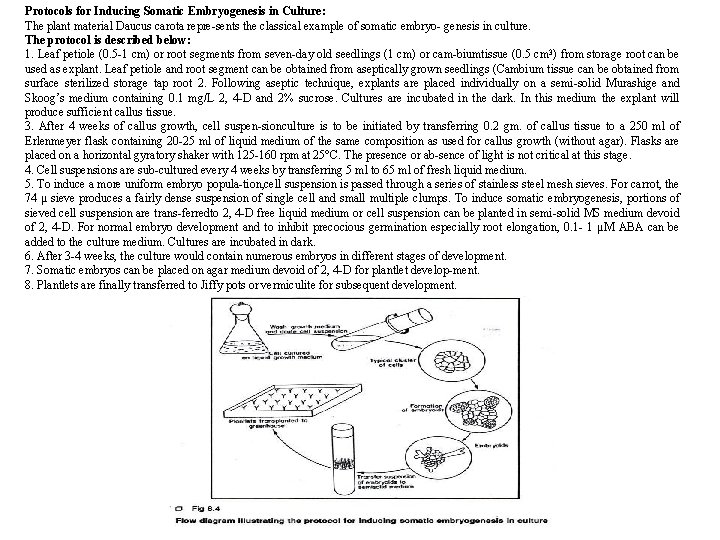
Protocols for Inducing Somatic Embryogenesis in Culture: The plant material Daucus carota repre sents the classical example of somatic embryo genesis in culture. The protocol is described below: 1. Leaf petiole (0. 5 1 cm) or root segments from seven day old seedlings (1 cm) or cam biumtissue (0. 5 cm 3) from storage root can be used as explant. Leaf petiole and root segment can be obtained from aseptically grown seedlings (Cambium tissue can be obtained from surface sterilized storage tap root 2. Following aseptic technique, explants are placed individually on a semi solid Murashige and Skoog’s medium containing 0. 1 mg/L 2, 4 D and 2% sucrose. Cultures are incubated in the dark. In this medium the explant will produce sufficient callus tissue. 3. After 4 weeks of callus growth, cell suspen sion culture is to be initiated by transferring 0. 2 gm. of callus tissue to a 250 ml of Erlenmeyer flask containing 20 25 ml of liquid medium of the same composition as used for callus growth (without agar). Flasks are placed on a horizontal gyratory shaker with 125 160 rpm at 25°C. The presence or ab sence of light is not critical at this stage. 4. Cell suspensions are sub cultured every 4 weeks by transferring 5 ml to 65 ml of fresh liquid medium. 5. To induce a more uniform embryo popula tion, cell suspension is passed through a series of stainless steel mesh sieves. For carrot, the 74 µ sieve produces a fairly dense suspension of single cell and small multiple clumps. To induce somatic embryogenesis, portions of sieved cell suspension are trans ferredto 2, 4 D free liquid medium or cell suspension can be planted in semi solid MS medium devoid of 2, 4 D. For normal embryo development and to inhibit precocious germination especially root elongation, 0. 1 1 µM ABA can be added to the culture medium. Cultures are incubated in dark. 6. After 3 4 weeks, the culture would contain numerous embryos in different stages of development. 7. Somatic embryos can be placed on agar medium devoid of 2, 4 D for plantlet develop ment. 8. Plantlets are finally transferred to Jiffy pots or vermiculite for subsequent development.
Importance of Somatic Embryogenesis: The potential applications and importance of in vitro somatic embryogenesis and organo genesisare more or less similar. The mass pro duction of adventitious embryos in cell culture is still regarded by many as the ideal propagation system. The adventitious embryo is a bipolar structure that develops directly into a complete plantlet and there is no need for a separate root ingphase as with shoot culture. Somatic embryo has no food reserves, but suitable nutrients could be packaged by coating or encapsulation to form some kind of artificial seeds. Such ar tificialseeds produce the plantlets directly into the field. Unlike organogenesis, somatic embryos may arise from single cells and so it is of special significance in mutagenic studies. Plants derived from asexual embryos may in some cases be free of viral and other pathogens. For an example, Citrus plant propagation from embryo genic callus of nuclear origin are free of Virus. So it is an alternative approach for the production of disease free plants.
- Slides: 3