
SOMALI NATIONAL UNIVERSITY Administrative Law Delegated Legislation Administrative
- Slides: 34
SOMALI NATIONAL UNIVERSITY Administrative Law (Delegated Legislation)
Administrative Law (Recap) • Administrative law is that branch of the law that developed in response to the socio- economic functions of the State and the increased powers of the government. • As the State developed, the relationship between inter-governmental agencies became complex; • therefore the need to regulate the relationship as their complexity increased – a law that would regulate the relationship of the different agencies as well as act as checks on the exercise of powers of these governmental agencies; and also to defend the rights of citizens from governmental. • Furthermore Administrative law is a branch of public law. • Public law is the branch of law regulating the relationship between the citizen and the State. 2
Administrative Law Recap (cont. ) • Administrative law is a public law category in the sense that it deals with the intercourse between governmental institutions on the one hand private individuals or corporations on the other. • Because of the involvement of the modern State in activities hitherto the exclusive domain of non-governmental actors, there has been the need for governments to establish many agencies that is, ministries, parastatals, bureaus, departments, etc. for the actualization and implementation of governmental projects and programmes. • It is also a study of governance; congress or parliament creates authority, the President enforces that authority and the courts confine or discipline the exercise of that authority. • Thus, the starting point for many administrative law cases is an act of parliament that allows the agency to function. 3
Administrative Law Recap (cont. ) • According to the traditional theory, the function of the executive is to administer the law enacted by the legislature; • In the ideal state, the legislative powers must be exercised exclusively by the legislature who are directly responsible to the electorate. • Apart from the pure administrative function executive also performs legislative and the judicial function. • The issue of delegated legislation has been one of the most debated issues in the domain of legal theory because of its various implications. 4
Administrative Law Recap (cont. ) • One of the most significant developments of the present century is the growth in the legislative powers of the executives. • The development of the legislative powers of the administrative authorities in the form of the delegated legislation occupies very important place in the study of the administrative law. • We know that there is no such general power granted to the executive to make law it only supplements the law under the authority of legislature. 5
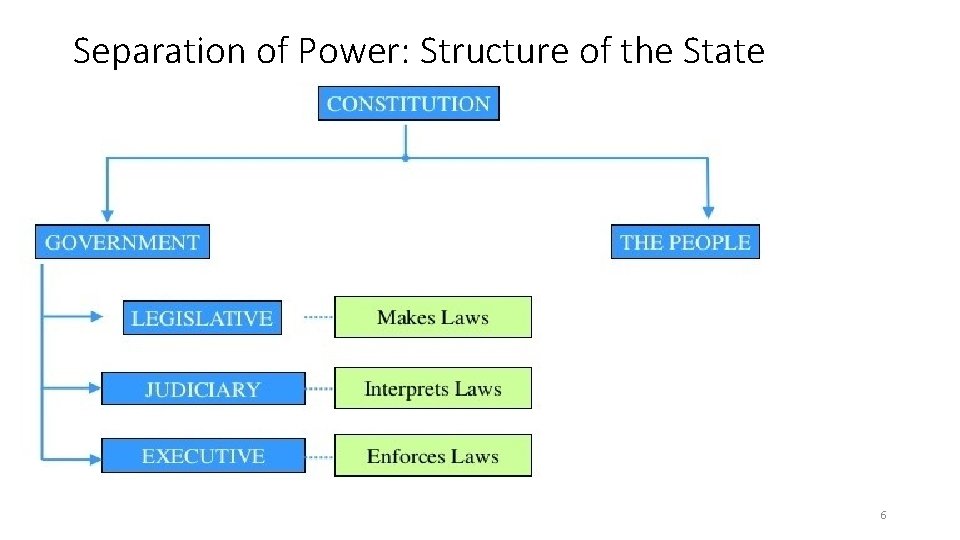
Separation of Power: Structure of the State 6
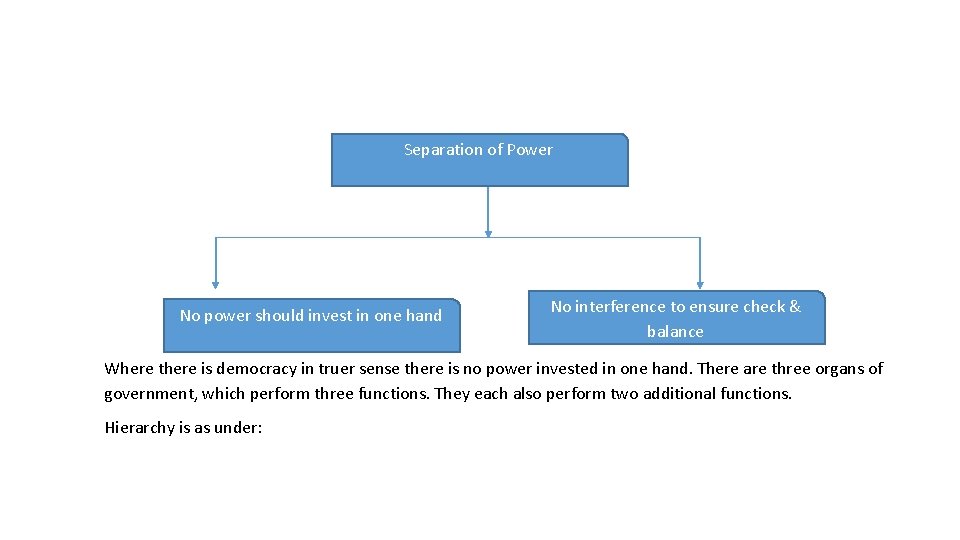
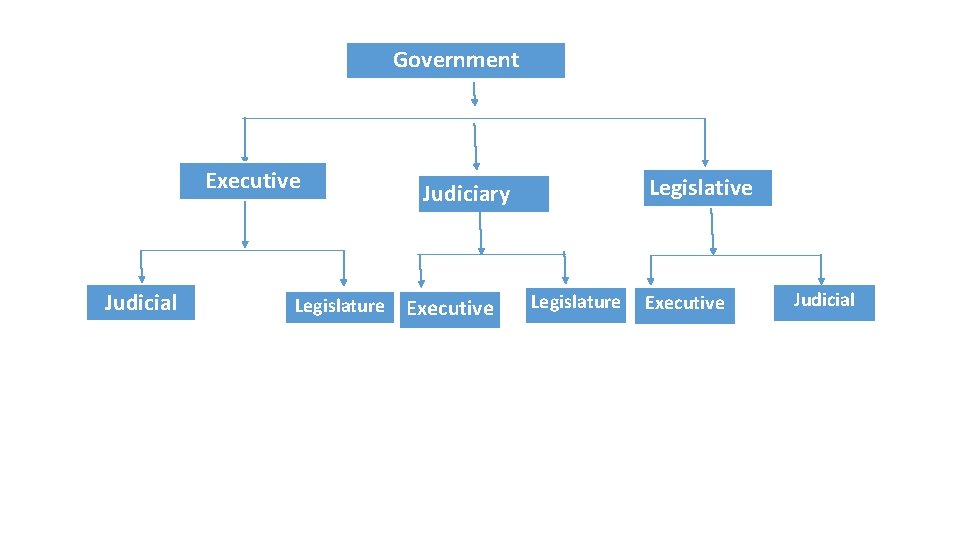
Separation of Power No power should invest in one hand No interference to ensure check & balance Where there is democracy in truer sense there is no power invested in one hand. There are three organs of government, which perform three functions. They each also perform two additional functions. Hierarchy is as under:
Government Executive Judicial Legislature Legislative Judiciary Executive Legislature Executive Judicial
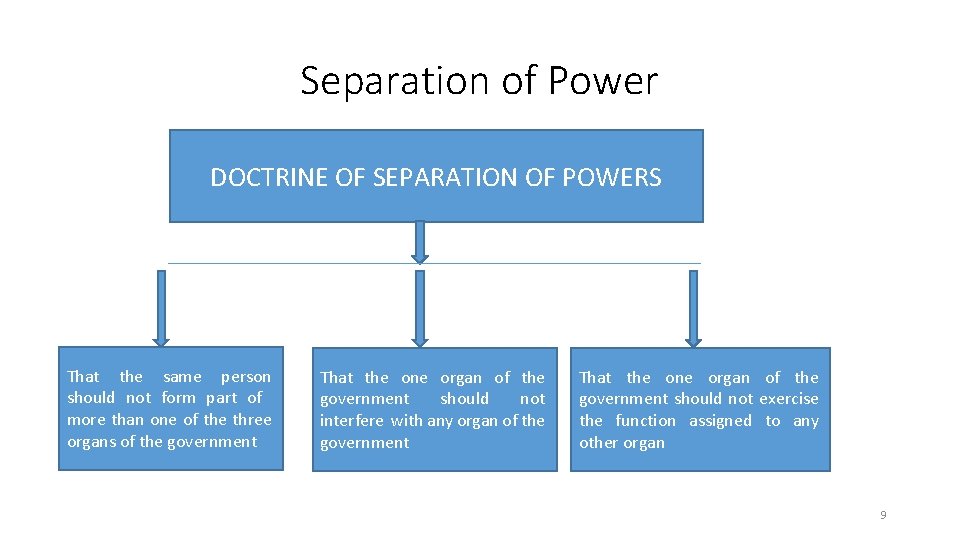
Separation of Power DOCTRINE OF SEPARATION OF POWERS That the same person should not form part of more than one of the three organs of the government That the one organ of the government should not interfere with any organ of the government That the one organ of the government should not exercise the function assigned to any other organ 9
Types of Legislation • Parliament is the supreme legal authority in SFR and only Parliament has the authority to enact any law it wishes. • Such legislation is superior to all other sources of law and may not be challenged in courts. • Legislation splits into: a) Primary Legislation; and b) Delegated Legislation a) Primary Legislation o Includes Acts of Parliament or Statutes (the terms are interchangeable) and enacted by Parliament. o Statutes lay out Parliaments general intention in a particular field. o An Act of Parliament creates a new law or changes an existing law. o An Act is a Bill approved by both Houses of the Federal Parliament and formally assent by the President. o Once implemented, an Act is law and applies to whole of the country or to specific areas of the country. o Once an Act is in force, citizens can be prosecuted under an Act in court if they break the laws laid out within it. 10
Types of Legislation (cont. ) • Only Parliament may enact Acts of Parliament. • Any such Acts are superior to all other sources of law and may not be challenged in the courts. • Although Parliament passes the legislation it is the task of the judges to interpret it – this is known as Statutory Interpretation b) Delegated Legislation o Includes STATUTORY INSTRUMENTS o Statutory Instruments refers to rules and regulations made by Government Ministers o There are many departments in the government each one deals with a different area of policy and can make rules and regulations in the respect of the matters with which it deals. o Many statutory instruments are brought into force each year o Some statutory instruments may be very short where as others may be very long 11
Delegation of powers – meaning: • Delegation of powers means those powers, which are given by the higher authorities to the lower authorities to make certain laws, i. e. , powers given by the legislature to administration to enact laws to perform administration functions. • The law legislate by the administration with the powers given by the legislature is called delegated legislation. • Delegated legislation is, referred to as “Ancillary”, “Subordinate”, Administrative Legislation or as Quasi. Legislation”. Distinguishing between "Supreme Legislation" and "Subordinate Legislation", 12
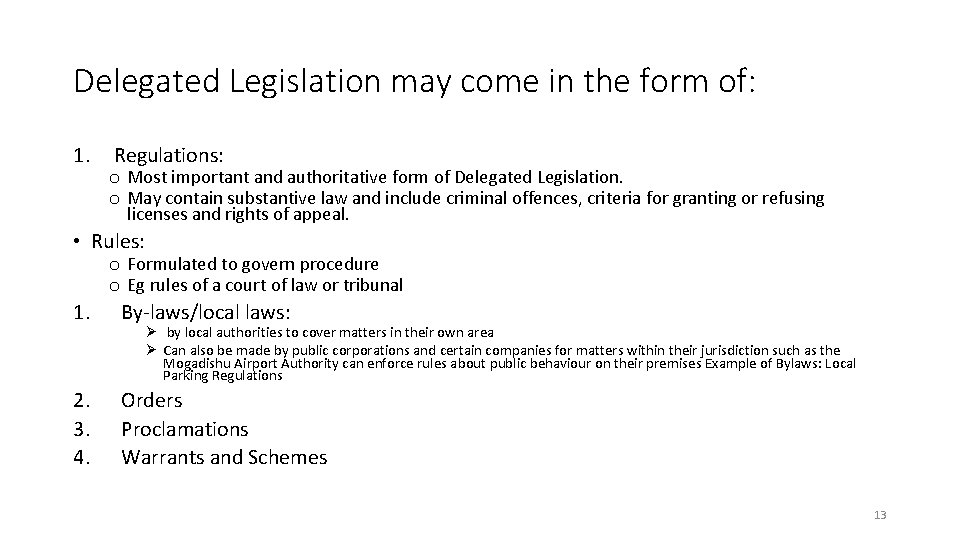
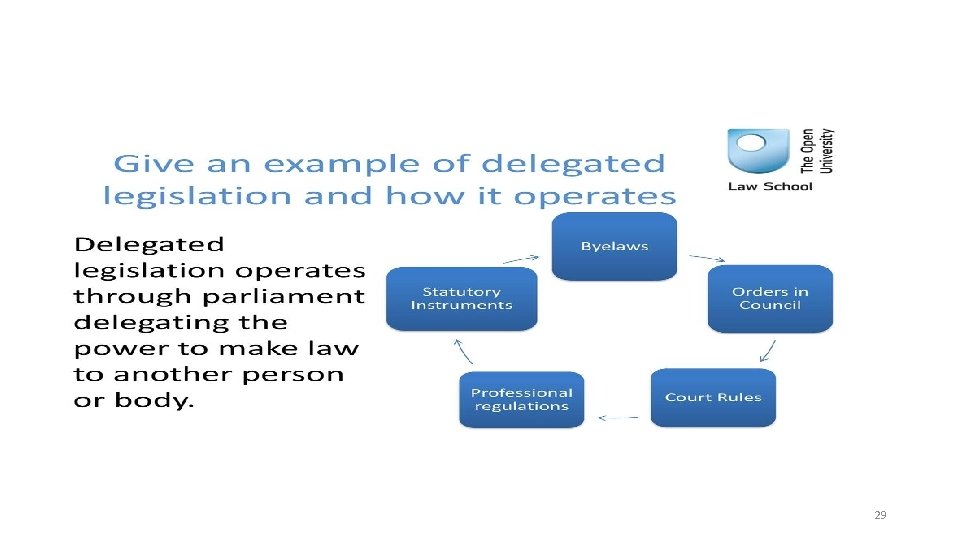
Delegated Legislation may come in the form of: 1. Regulations: o Most important and authoritative form of Delegated Legislation. o May contain substantive law and include criminal offences, criteria for granting or refusing licenses and rights of appeal. • Rules: o Formulated to govern procedure o Eg rules of a court of law or tribunal 1. By-laws/local laws: 2. 3. 4. Orders Proclamations Warrants and Schemes Ø by local authorities to cover matters in their own area Ø Can also be made by public corporations and certain companies for matters within their jurisdiction such as the Mogadishu Airport Authority can enforce rules about public behaviour on their premises Example of Bylaws: Local Parking Regulations 13
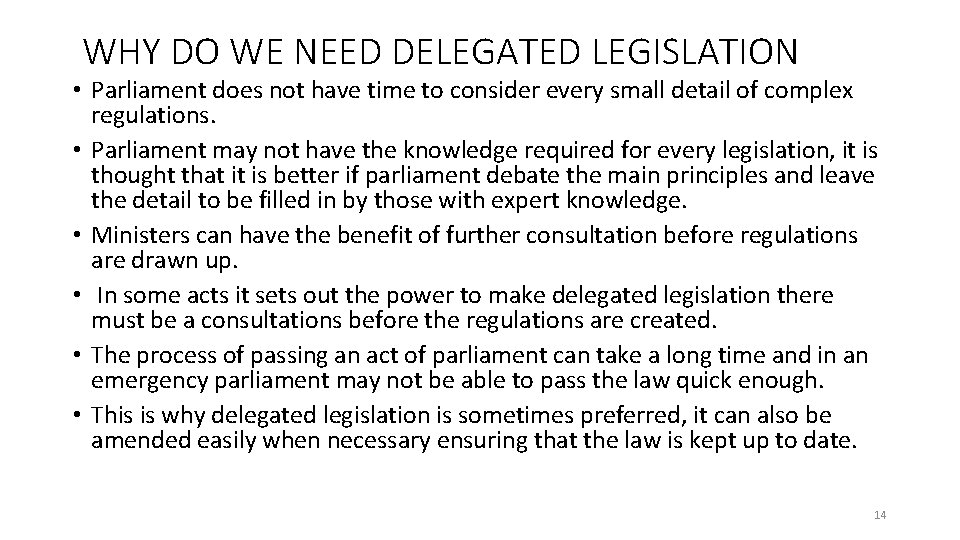
WHY DO WE NEED DELEGATED LEGISLATION • Parliament does not have time to consider every small detail of complex regulations. • Parliament may not have the knowledge required for every legislation, it is thought that it is better if parliament debate the main principles and leave the detail to be filled in by those with expert knowledge. • Ministers can have the benefit of further consultation before regulations are drawn up. • In some acts it sets out the power to make delegated legislation there must be a consultations before the regulations are created. • The process of passing an act of parliament can take a long time and in an emergency parliament may not be able to pass the law quick enough. • This is why delegated legislation is sometimes preferred, it can also be amended easily when necessary ensuring that the law is kept up to date. 14
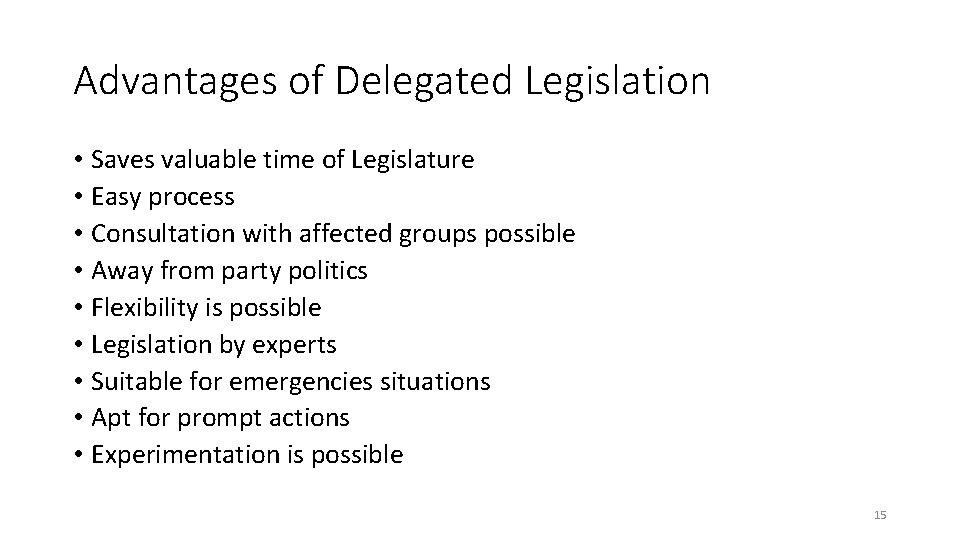
Advantages of Delegated Legislation • Saves valuable time of Legislature • Easy process • Consultation with affected groups possible • Away from party politics • Flexibility is possible • Legislation by experts • Suitable for emergencies situations • Apt for prompt actions • Experimentation is possible 15
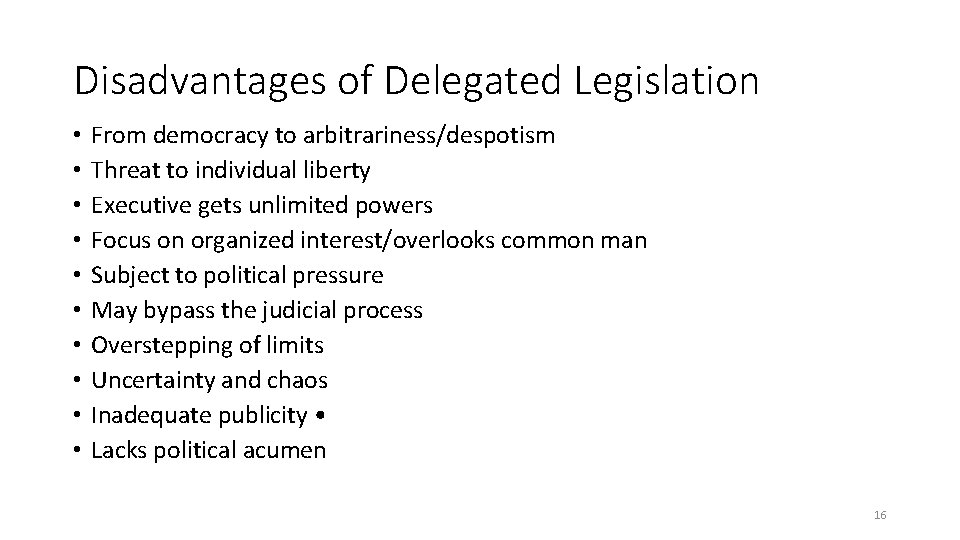
Disadvantages of Delegated Legislation • • • From democracy to arbitrariness/despotism Threat to individual liberty Executive gets unlimited powers Focus on organized interest/overlooks common man Subject to political pressure May bypass the judicial process Overstepping of limits Uncertainty and chaos Inadequate publicity • Lacks political acumen 16
Criticism against Delegated Legislation • The arguments against the practice of delegated legislation include: i. Delegated legislation is a usurpation of the powers of the parliament to make laws for the nation. It waters down the doctrine of parliamentary supremacy. ii. It is a negation of the concept of rule of law as the usual procedures for the making of laws are not always observed. iii. The control of delegated legislation is inadequate: Parliament has no time, opportunity or the special expertise that may be required to keep close surveillance and make needed objections to administrative legislations. iv. Administrative lawmakers sometimes have too much power and discretions. For instance, the delegation of legislative power to ministers, head of departments and so forth, is often done in phrases such as “As the Hon. Minister deems fit”, “In the opinion of the Hon. Minister and so on. ” These subjectively worded phrases may lead to arbitrary use of delegated power. 17
Delegated Legislation—Executive Legislation • Delegated legislation may be distinguished from Executive Legislation. • The Delegated legislation refers to the legislation made by the authorities other than the Legislature to whom the Legislature delegates its legislative power, • The legislation made by the Executive in the exercise of power confers on it expressly by the Constitution, is not delegated legislation, but strictly speaking, it is original legislation. 18
Delegated Legislation—Executive Legislation • The source of delegated legislation is always an Act of the Legislature; • The source of the Executive Legislation is a provision of the Constitution. • Further, that delegated legislation to be constitutionally valid is to comply with the guidelines traced through judicial pronouncements interpreting general principles in this respect; • while a piece of Executive Legislation is required to be consistent with the provisions of the constitution. 19
Growth of Delegation of Power and its Reasons • Many factors are responsible for the rapid growth of delegated legislation in every modern democratic state. • The traditional theory of ‘laissez faire’ has been given up by every state and the old ‘police state’ has now become a ‘welfare state’. • Because of this radical change in the philosophy as to role to be played by the state, their functions have increase. • Consequently, delegated legislation has become essential and inevitable. 20
Growth of Delegation of Power and its Reasons Some of the reasons of the growth of the Delegation of Powers are as follows: 1. 2. 3. 4. 5. Pressure upon Parliamentary Time: Parliament is too busy to deal with the increasing mass of legislations, which are necessary to regulate daily affairs. Technicality: Modern legislation requires technicality and expertise knowledge of problems of various fields, our legislators, who are politicians are not expected to have such knowledge. Flexibility: Subordinate legislations are more flexible, quickly and easily amendable and revocable than ordinary legislation, in case of failure or defect in its application. Experiment: The practice of delegated legislation enables the executive to experiment. The method permits rapid utilization of experience and implementation of necessary changes. Emergency: In the time of emergency, quick action is required to be taken. The legislative process is not equipped to provide for urgent solution to meet the situation. Hence there is need for delegation of power. 21
Provisional Federal Constitution of Somalia • The Provisional Federal Constitution of Somalia vest the powers to make laws on the Federal Parliament of Somalia as under Article 63, 69 & 71 of FPC. • Thus the Parliament has inherent powers to make or unmake any law provided it within the constitutional limit. • However, also under Article 90(c) it is provided that “Parliament may delegate its legislative power or any person or department of the government to make regulations having the force of law”. • Article 36 stipulates the “every person has the right to administrative decisions that are lawful, reasonable and conducted in a procedurally fair manner. ” 22
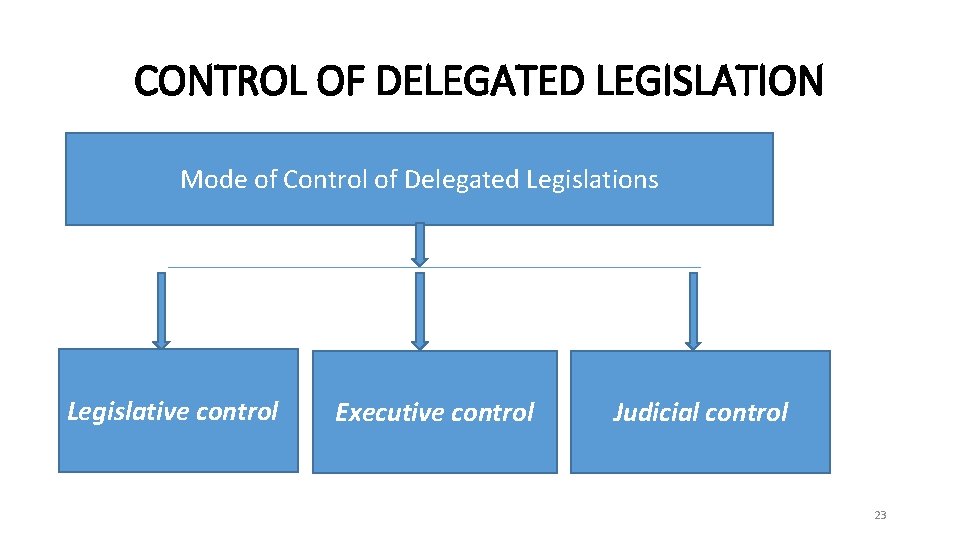
CONTROL OF DELEGATED LEGISLATION Mode of Control of Delegated Legislations Legislative control Executive control Judicial control 23
CONTROL OF DELEGATED LEGISLATION • If the arguments of skeptics of delegated legislation are considered, it is realised that their major concern is the risk of abuse of delegated power by a delegate. • To prevent arbitrariness, it is necessary to develop a system of control of delegated legislation. • The principle behind control of delegated legislation is that when the legislature delegates power, it retains in it the power to control how that power is exercised. • It does not divest itself of the power to alter, modify or even repeal such delegated powers. • The delegate only acts as an agent of the legislature and must act within the confines of the enabling legislation. 24
CONTROL OF DELEGATED LEGISLATION • Generally, delegated legislation can be controlled on the three levels of government. • There is legislative control, executive control and judicial control of delegated legislation. • The problem with delegated legislation in Somalia is the lack of a robust system of control. • While the constitution provides for the delegation of powers in certain instances, it does not provide for a general pattern or procedure to follow in the making and control of these legislations. • The absence of a statute making general regulations on delegated legislation in Somalia means that the procedure to be followed in each particular case depends on the enabling law and this causes confusing variations and a lack of uniformity. • The closest the country has gotten to general provisions on delegated legislation are some provisions of Interpretation Act, which provides albeit in very skeletal form general powers that may be exercised by a delegate and prescribes sanctions for its breach. 25
CONTROL BY PARLIAMENT • As earlier stated, parliament has a duty to ensure that powers delegated to persons or bodies to legislate on a particular area of competence are not abused. • They ensure this by inserting provisions in the empowering legislation that require that subordinate legislation to be laid before the legislature for scrutiny before it becomes effective. • Laying Procedure • Some statutes may require the subordinate legislation to be laid before parliament before it becomes operative. • Laying requirement is just a mechanism to inform the parliament of the legislation, it does not attract any parliamentary procedure for control or scrutiny. • The problem with the laying provisions is that it does not give room for parliament to critically scrutinize the subordinate legislation. • The parliament is only permitted to ask questions but no direct attack upon such legislation is possible. 26
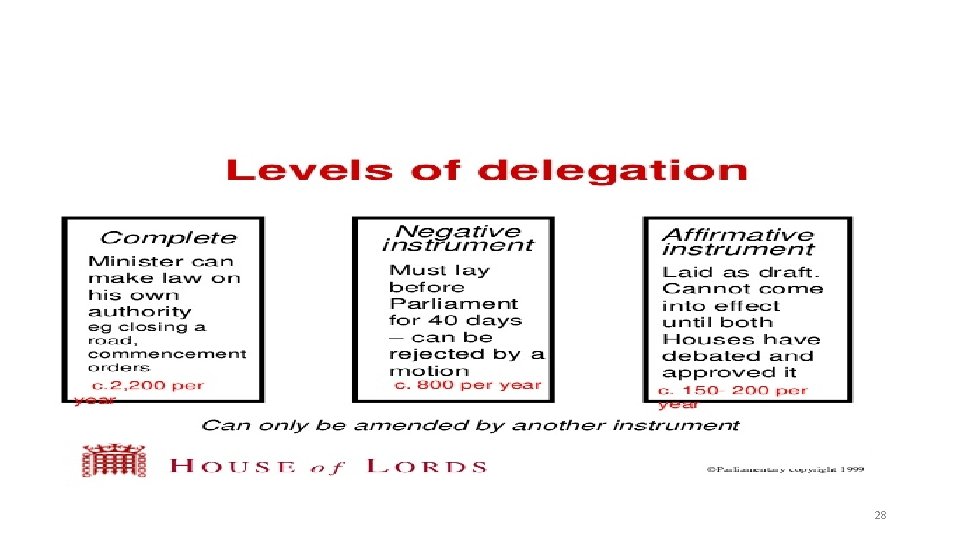
• Affirmative Procedure: provide the more stringent form of Parliamentary control, since the Statutory Instrument (SI) or draft SI must receive positive approval. • Negative Procedure: provides a less stringent form of Parliamentary control than the affirmative procedure. The SI will remain in force, or may be made, unless a Member introduces an annulment resolution (commonly known as a ‘prayer’) within 40 days, and the resolution is passed. • Scrutiny by Committees • Consultation • Publication 27
28
29
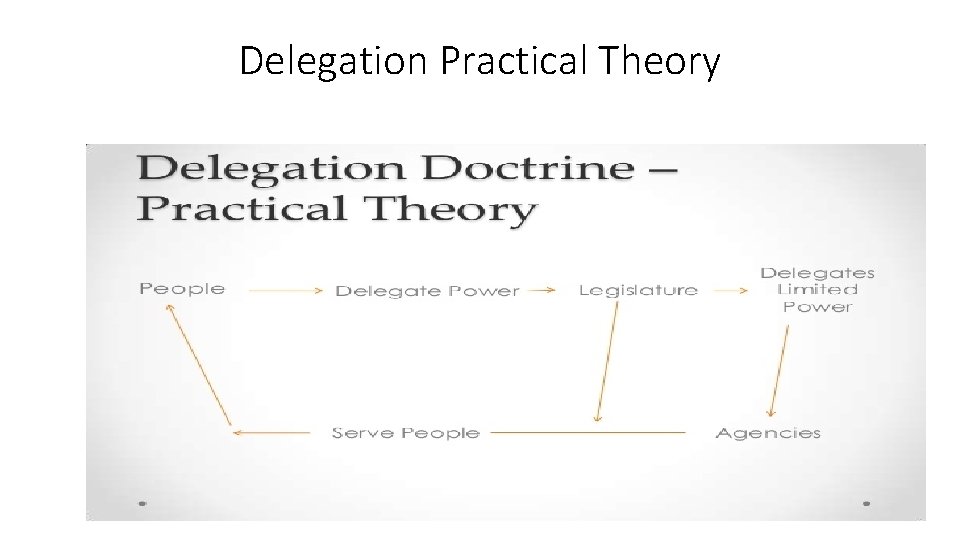
Delegation Practical Theory 30
JUDICIAL REVIEW • Another very important method of control of delegated legislation is by judicial review. • As the name implies it involves scrutiny of the subordinate legislation made by the law courts against the standards of the parent Act and Constitution. • Delegated legislation is usually subjected to judicial review to determine whether it is enacted in accordance with the process and powers granted under the empowering legislation. • Judicial review is the most frequently used method of challenging subordinate legislation in Somalia. 31
JUDICIAL REVIEW • At the core of judicial review of delegated legislation is the Ultra Vires Doctrine. • An ultra vires act has been defined as one done without legal authority. • In more descriptive terms, it means delegated legislation cannot exceed the limits of its principal legislation. • Where that happens, the legislation is one passed without legal authority and is subject to be declared as ultra vires by the law courts 32
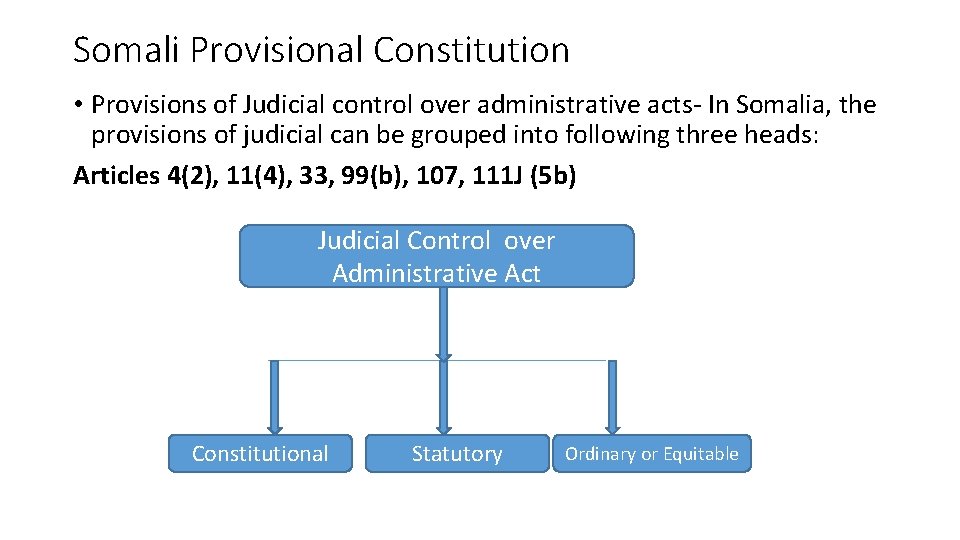
Somali Provisional Constitution • Provisions of Judicial control over administrative acts- In Somalia, the provisions of judicial can be grouped into following three heads: Articles 4(2), 11(4), 33, 99(b), 107, 111 J (5 b) Judicial Control over Administrative Act Constitutional Statutory Ordinary or Equitable
JUDICIAL REVIEW • The principal act would most times set out the procedure to be followed to enact any subordinate legislation under it. • It would also set out the nature and substance of such delegated legislation. • Hence, where there is a defect in procedure adopted to pass the delegated legislation, it becomes void for Procedural ultra vires. • Also, where the subordinate legislation infringes the substance of the parent act, it becomes void for Substantive ultra vires 34