
Solving the Indoor SLAM Problem for a LowCost
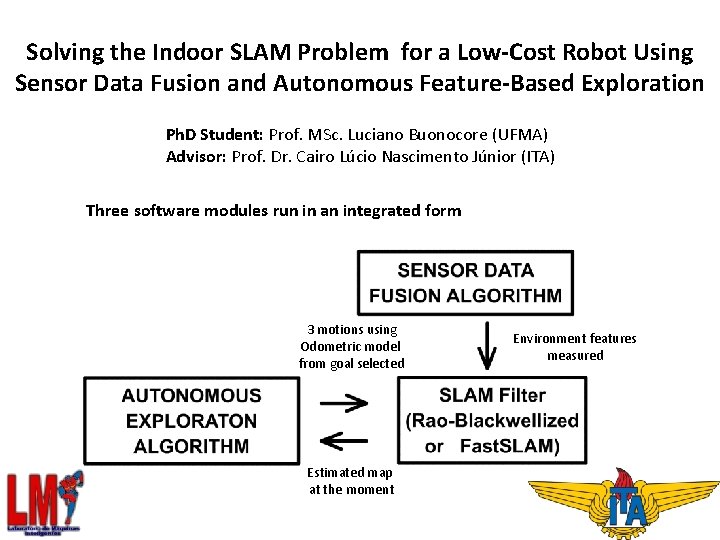
Solving the Indoor SLAM Problem for a Low-Cost Robot Using Sensor Data Fusion and Autonomous Feature-Based Exploration Ph. D Student: Prof. MSc. Luciano Buonocore (UFMA) Advisor: Prof. Dr. Cairo Lúcio Nascimento Júnior (ITA) Three software modules run in an integrated form 3 motions using Odometric model from goal selected Estimated map at the moment Environment features measured
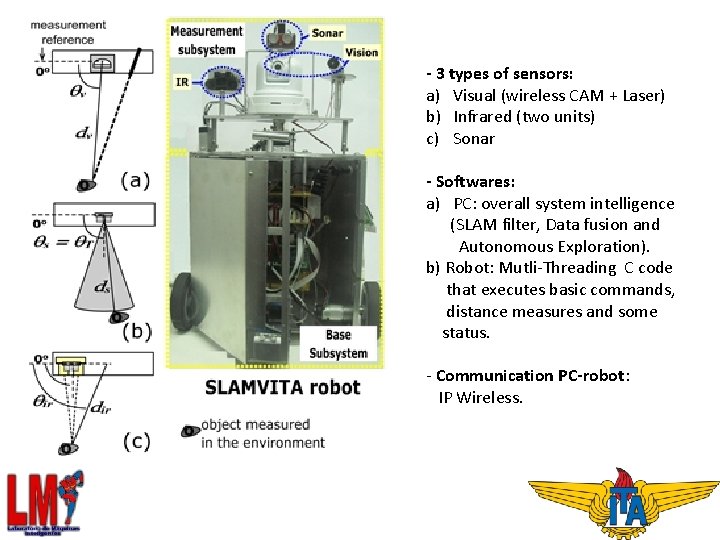
- 3 types of sensors: a) Visual (wireless CAM + Laser) b) Infrared (two units) c) Sonar - Softwares: a) PC: overall system intelligence (SLAM filter, Data fusion and Autonomous Exploration). b) Robot: Mutli-Threading C code that executes basic commands, distance measures and some status. - Communication PC-robot: IP Wireless.
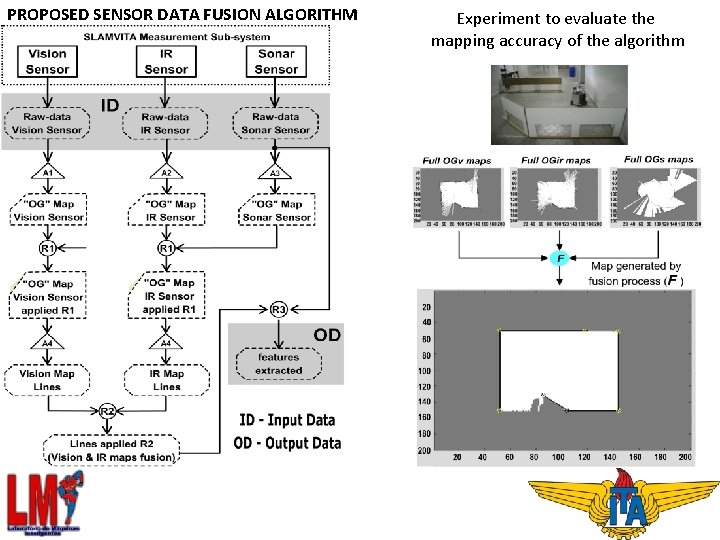
PROPOSED SENSOR DATA FUSION ALGORITHM Experiment to evaluate the mapping accuracy of the algorithm
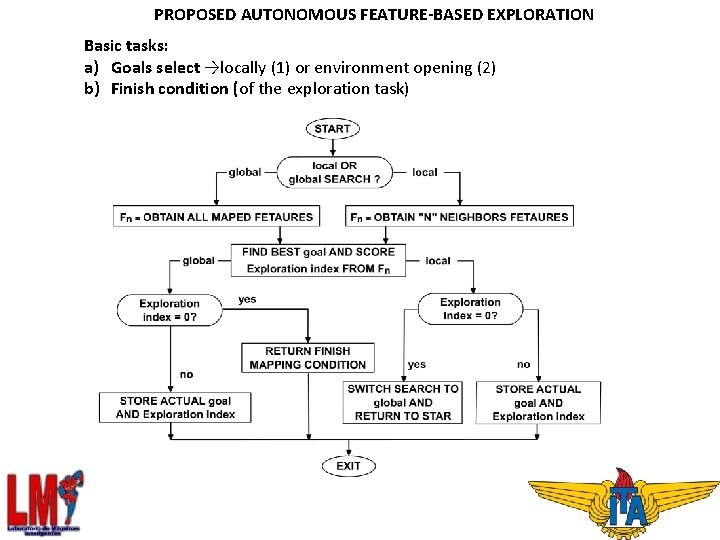
PROPOSED AUTONOMOUS FEATURE-BASED EXPLORATION Basic tasks: a) Goals select →locally (1) or environment opening (2) b) Finish condition (of the exploration task)
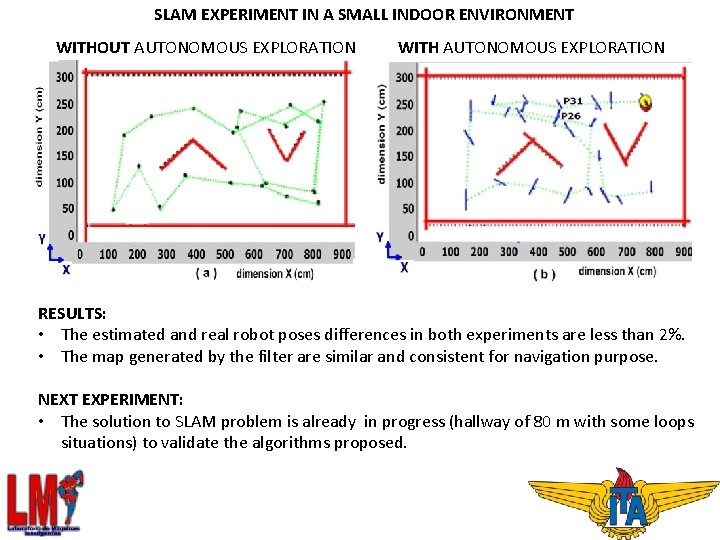
SLAM EXPERIMENT IN A SMALL INDOOR ENVIRONMENT WITHOUT AUTONOMOUS EXPLORATION WITH AUTONOMOUS EXPLORATION RESULTS: • The estimated and real robot poses differences in both experiments are less than 2%. • The map generated by the filter are similar and consistent for navigation purpose. NEXT EXPERIMENT: • The solution to SLAM problem is already in progress (hallway of 80 m with some loops situations) to validate the algorithms proposed.
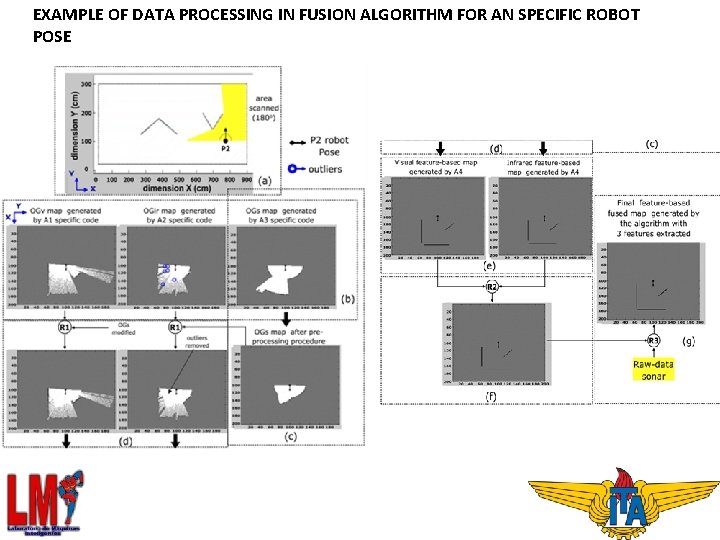
EXAMPLE OF DATA PROCESSING IN FUSION ALGORITHM FOR AN SPECIFIC ROBOT POSE
- Slides: 6