
Solving the following system of 2 equations in
- Slides: 17
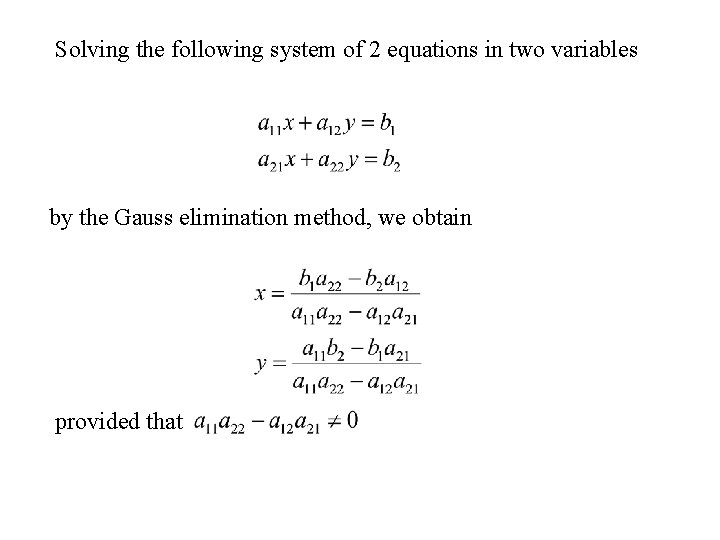
Solving the following system of 2 equations in two variables by the Gauss elimination method, we obtain provided that
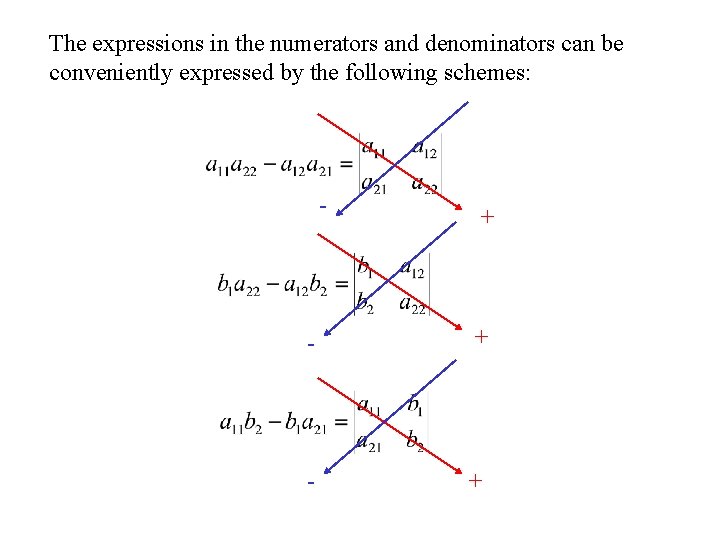
The expressions in the numerators and denominators can be conveniently expressed by the following schemes: - + - +
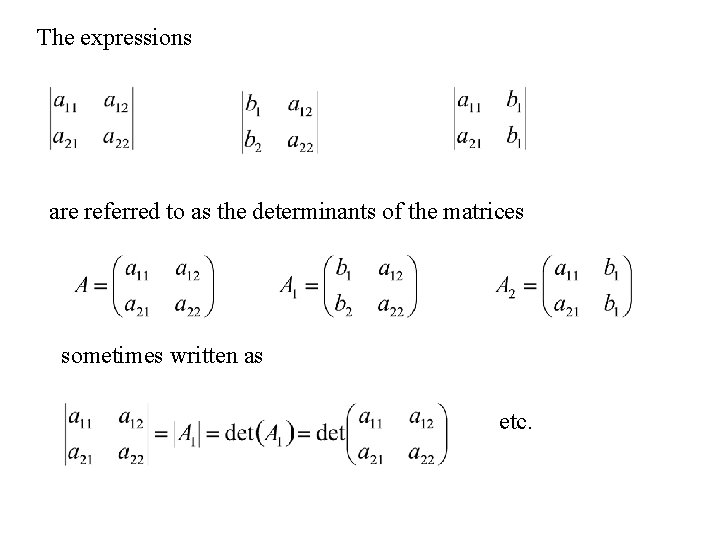
The expressions are referred to as the determinants of the matrices sometimes written as etc.
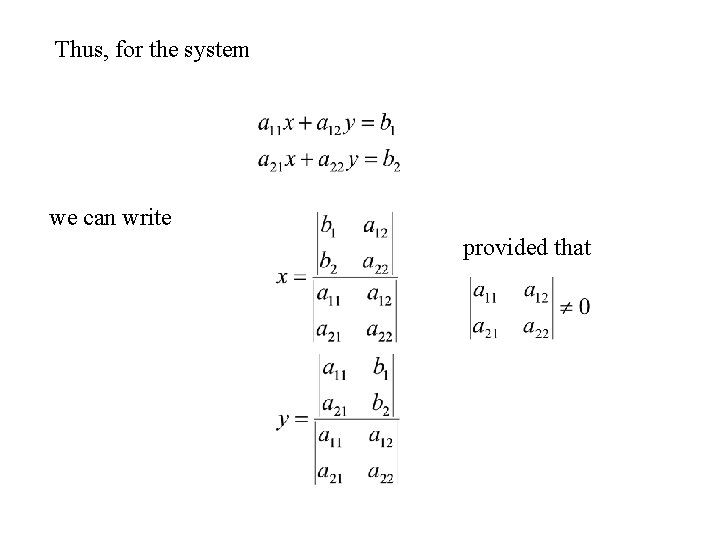
Thus, for the system we can write provided that
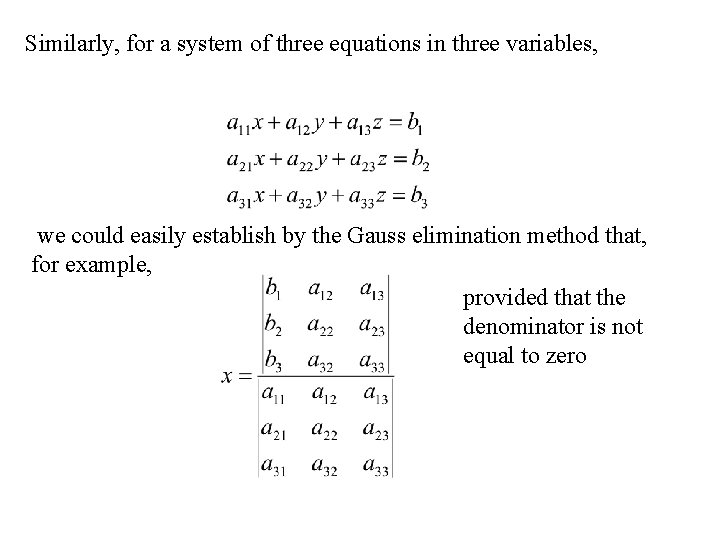
Similarly, for a system of three equations in three variables, we could easily establish by the Gauss elimination method that, for example, provided that the denominator is not equal to zero
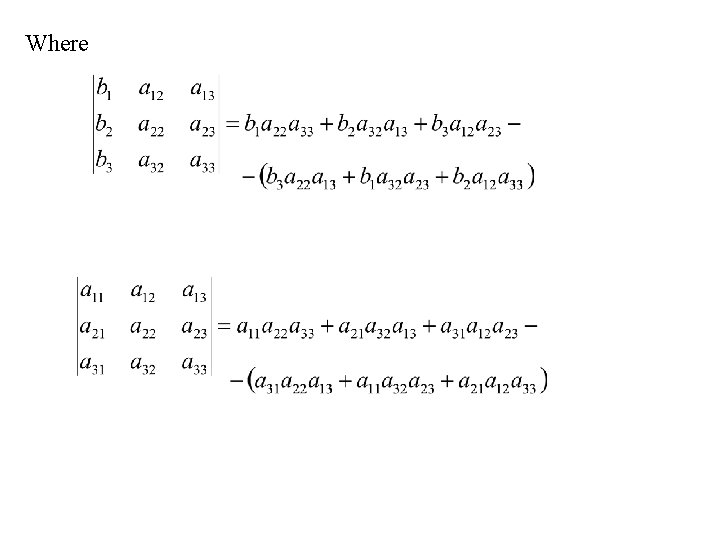
Where
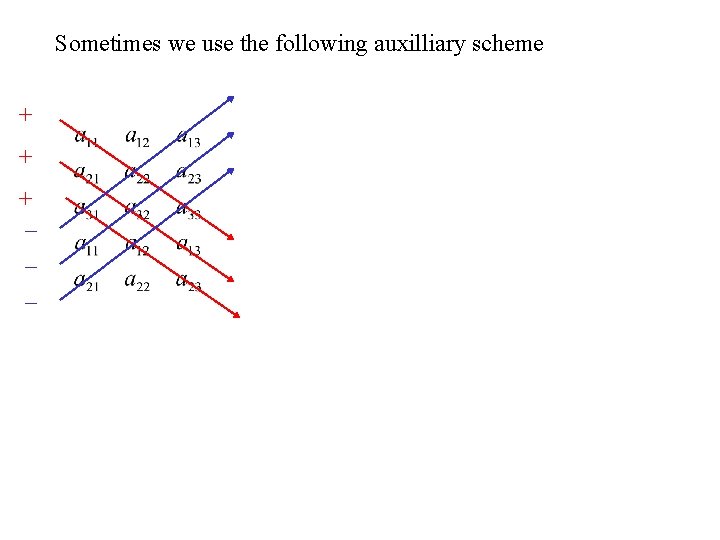
Sometimes we use the following auxilliary scheme + + + – – –
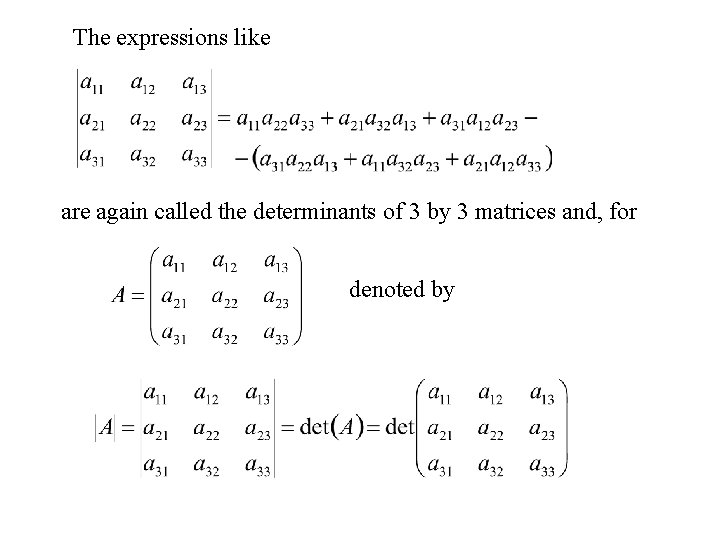
The expressions like are again called the determinants of 3 by 3 matrices and, for denoted by
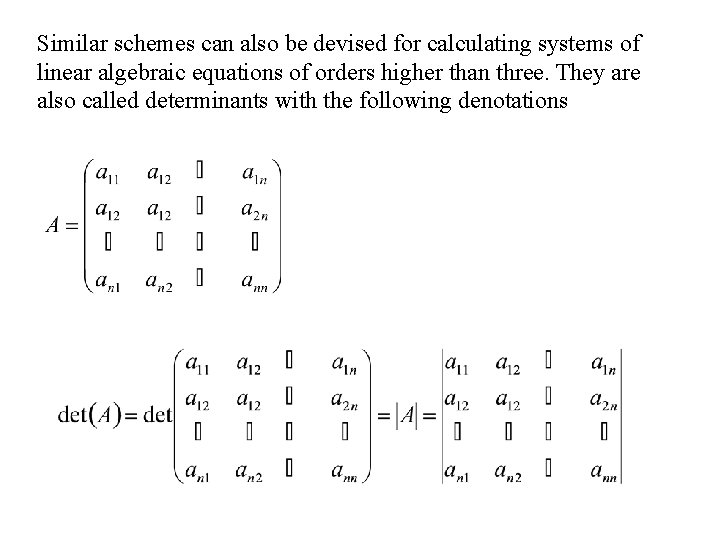
Similar schemes can also be devised for calculating systems of linear algebraic equations of orders higher than three. They are also called determinants with the following denotations
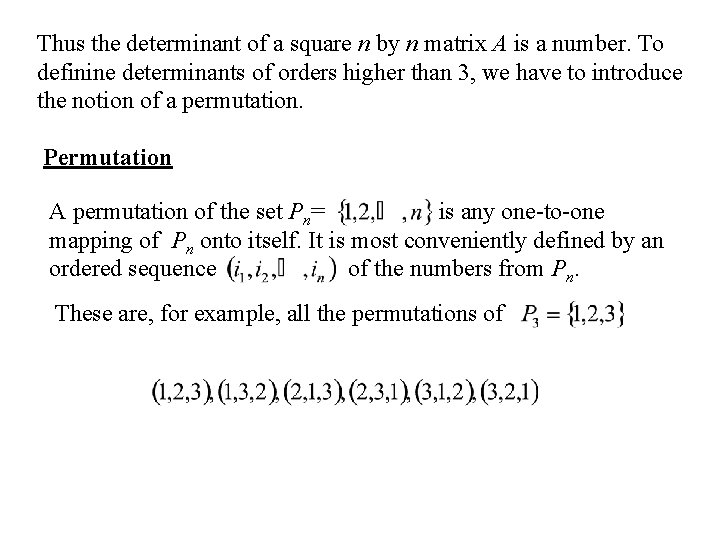
Thus the determinant of a square n by n matrix A is a number. To definine determinants of orders higher than 3, we have to introduce the notion of a permutation. Permutation A permutation of the set Pn= is any one-to-one mapping of Pn onto itself. It is most conveniently defined by an ordered sequence of the numbers from Pn. These are, for example, all the permutations of
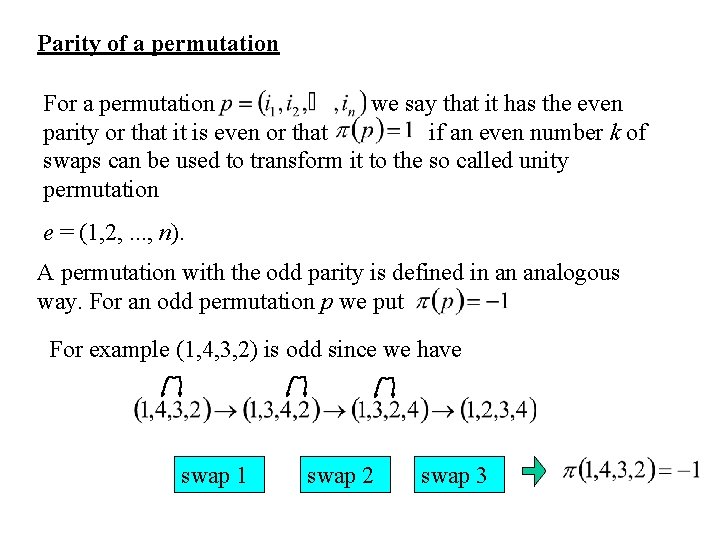
Parity of a permutation For a permutation we say that it has the even parity or that it is even or that if an even number k of swaps can be used to transform it to the so called unity permutation e = (1, 2, . . . , n). A permutation with the odd parity is defined in an analogous way. For an odd permutation p we put For example (1, 4, 3, 2) is odd since we have swap 1 swap 2 swap 3
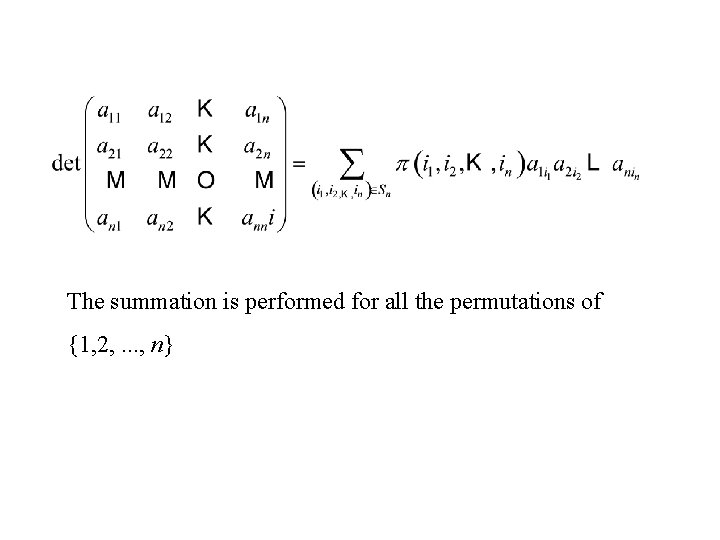
The summation is performed for all the permutations of {1, 2, . . . , n}
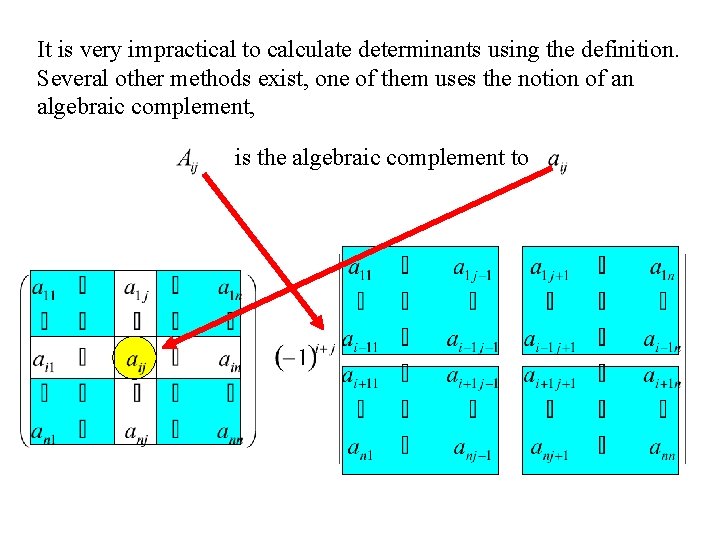
It is very impractical to calculate determinants using the definition. Several other methods exist, one of them uses the notion of an algebraic complement, is the algebraic complement to
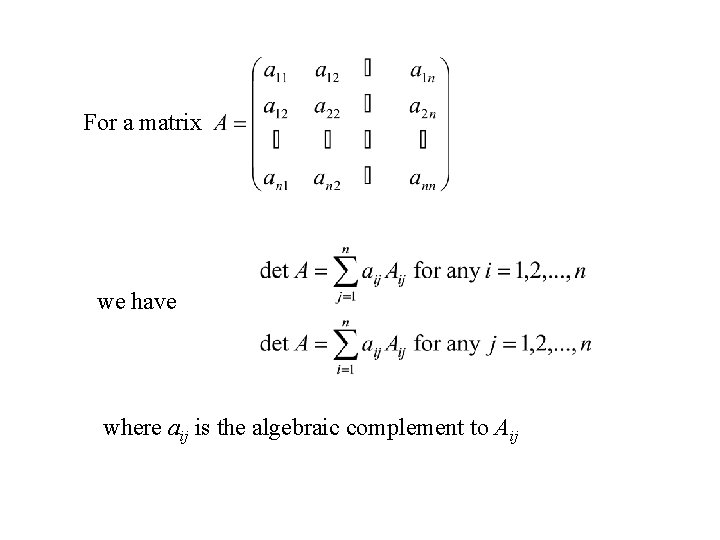
For a matrix we have where aij is the algebraic complement to Aij
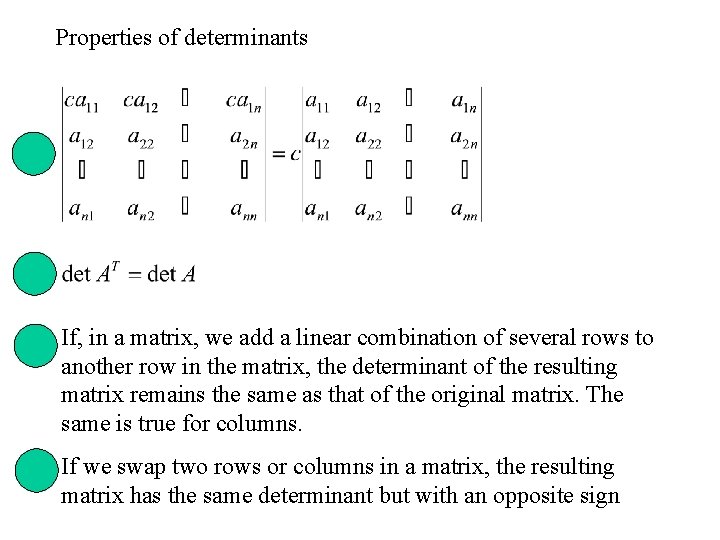
Properties of determinants If, in a matrix, we add a linear combination of several rows to another row in the matrix, the determinant of the resulting matrix remains the same as that of the original matrix. The same is true for columns. If we swap two rows or columns in a matrix, the resulting matrix has the same determinant but with an opposite sign
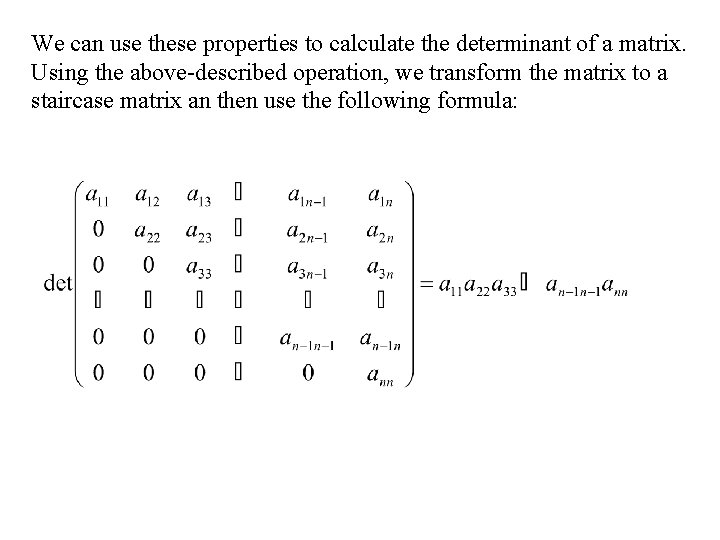
We can use these properties to calculate the determinant of a matrix. Using the above-described operation, we transform the matrix to a staircase matrix an then use the following formula:
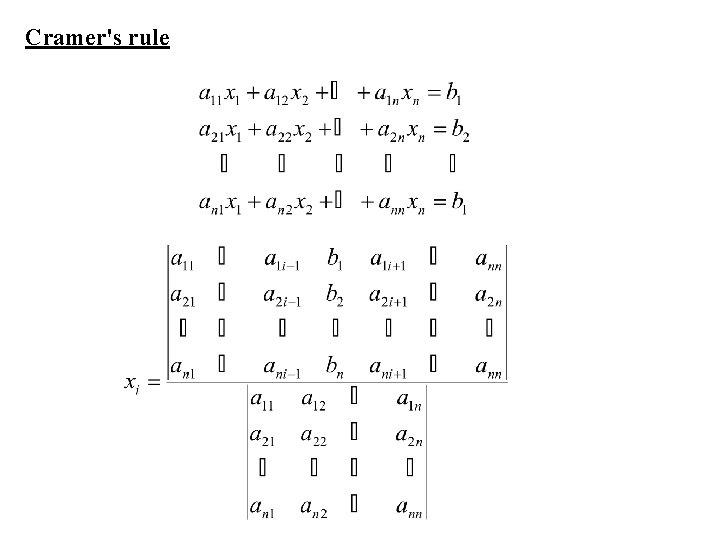
Cramer's rule