
Solving the affordable housing crisis through Policy reforms
Solving the affordable housing crisis through Policy reforms Team: Big Coug Energy

The issue: Housing Affordability As of 2017 nearly half of renter households spent more than 30 percent of income on rent. Over the years the issue has become more prevalent. This comes as a result of significant housing shortages throughout major Metropolitan areas primarily as a result of restrictive zoning laws that inhibit higher density residencies from being constructed.

Geography Area: Seattle Currently 81% of residential land in the Seattle area is zoned for single family housing In a 2018 report released by the seattle planning commission stated that the land allocated for single family housing accommodated only 5% of all new housing added in the city in the decade preceding their report.
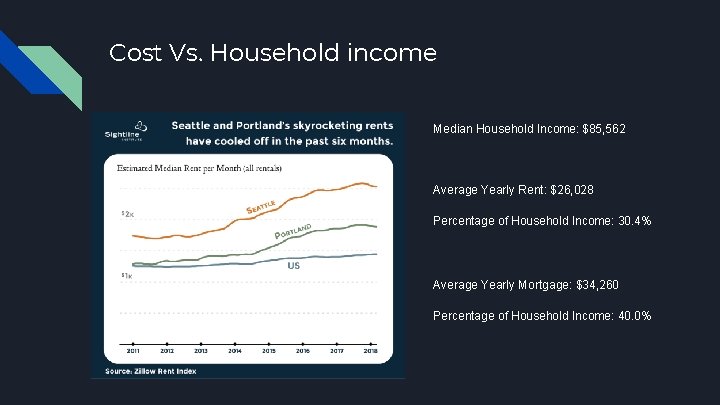
Cost Vs. Household income Median Household Income: $85, 562 Average Yearly Rent: $26, 028 Percentage of Household Income: 30. 4% Average Yearly Mortgage: $34, 260 Percentage of Household Income: 40. 0%
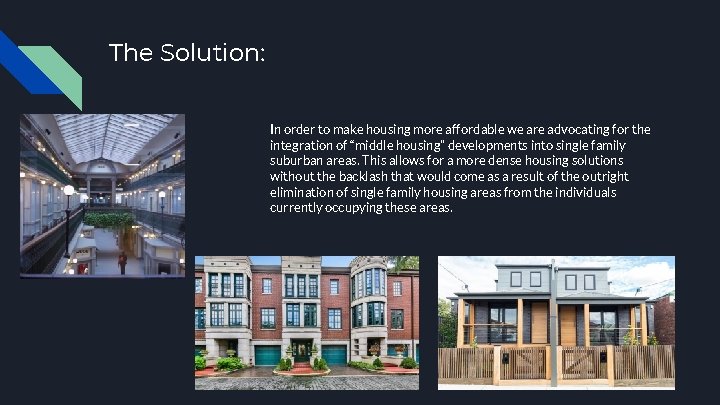
The Solution: In order to make housing more affordable we are advocating for the integration of “middle housing” developments into single family suburban areas. This allows for a more dense housing solutions without the backlash that would come as a result of the outright elimination of single family housing areas from the individuals currently occupying these areas.
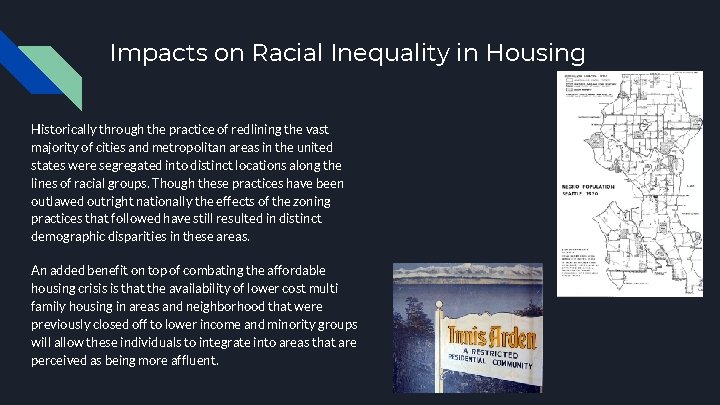
Impacts on Racial Inequality in Housing Historically through the practice of redlining the vast majority of cities and metropolitan areas in the united states were segregated into distinct locations along the lines of racial groups. Though these practices have been outlawed outright nationally the effects of the zoning practices that followed have still resulted in distinct demographic disparities in these areas. An added benefit on top of combating the affordable housing crisis is that the availability of lower cost multi family housing in areas and neighborhood that were previously closed off to lower income and minority groups will allow these individuals to integrate into areas that are perceived as being more affluent.
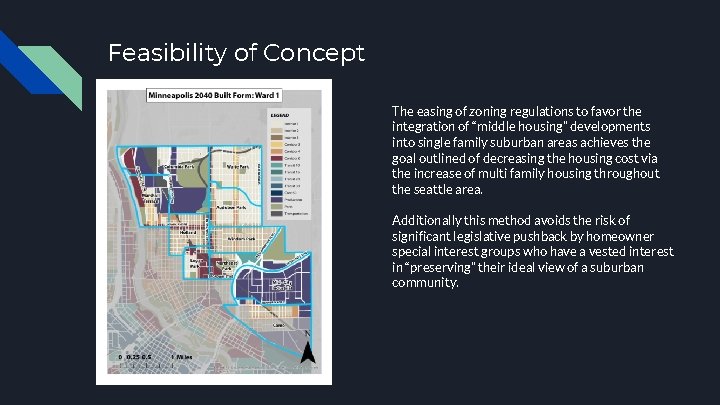
Feasibility of Concept The easing of zoning regulations to favor the integration of “middle housing” developments into single family suburban areas achieves the goal outlined of decreasing the housing cost via the increase of multi family housing throughout the seattle area. Additionally this method avoids the risk of significant legislative pushback by homeowner special interest groups who have a vested interest in “preserving” their ideal view of a suburban community.

Bibliography: Source: https: //www. sightline. org/2018/05/03/want-less-expensive-housing-then-make-it-less-expensive-to-build-housing/ https: //depts. washington. edu/civilr/segregation_maps. htm Images: https: //depts. washington. edu/civilr/images/segregated/schmidt%20 black%201920. png https: //www. brookings. edu/policy 2020/votervital/how-can-government-make-housing-more-affordable/ https: //www. nytimes. com/interactive/2019/06/18/upshot/cities-across-america-question-single-family-zoning. html https: //www. popsugar. com/home/Providence-Shopping-Mall-Converted-Apartments-37434301
- Slides: 8