
Solving Sudoku with Consistency A Visual and Interactive
- Slides: 1
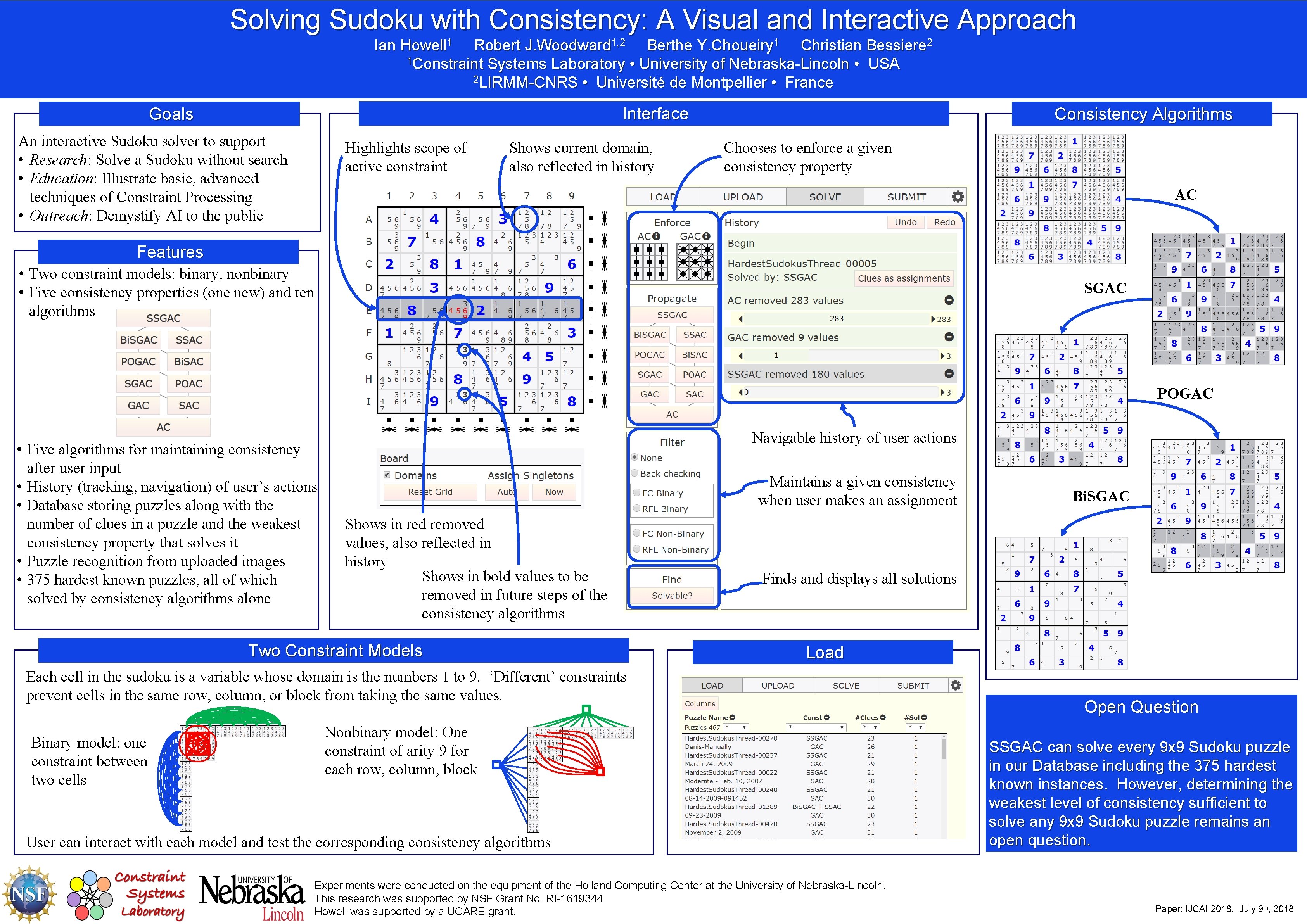
Solving Sudoku with Consistency: A Visual and Interactive Approach Ian Howell 1 Robert J. Woodward 1, 2 Berthe Y. Choueiry 1 Christian Bessiere 2 1 Constraint Systems Laboratory • University of Nebraska-Lincoln • USA 2 LIRMM-CNRS • Université de Montpellier • France Interface Goals An interactive Sudoku solver to support • Research: Solve a Sudoku without search • Education: Illustrate basic, advanced techniques of Constraint Processing • Outreach: Demystify AI to the public Highlights scope of active constraint Shows current domain, also reflected in history Consistency Algorithms Chooses to enforce a given consistency property AC Features • Two constraint models: binary, nonbinary • Five consistency properties (one new) and ten algorithms SGAC POGAC • Five algorithms for maintaining consistency after user input • History (tracking, navigation) of user’s actions • Database storing puzzles along with the number of clues in a puzzle and the weakest consistency property that solves it • Puzzle recognition from uploaded images • 375 hardest known puzzles, all of which solved by consistency algorithms alone Navigable history of user actions Maintains a given consistency when user makes an assignment Shows in red removed values, also reflected in history Shows in bold values to be removed in future steps of the consistency algorithms Two Constraint Models Finds and displays all solutions Load Each cell in the sudoku is a variable whose domain is the numbers 1 to 9. ‘Different’ constraints prevent cells in the same row, column, or block from taking the same values. Binary model: one constraint between two cells Bi. SGAC Nonbinary model: One constraint of arity 9 for each row, column, block User can interact with each model and test the corresponding consistency algorithms Experiments were conducted on the equipment of the Holland Computing Center at the University of Nebraska-Lincoln. This research was supported by NSF Grant No. RI-1619344. Howell was supported by a UCARE grant. Open Question SSGAC can solve every 9 x 9 Sudoku puzzle in our Database including the 375 hardest known instances. However, determining the weakest level of consistency sufficient to solve any 9 x 9 Sudoku puzzle remains an open question. Paper: IJCAI 2018. July 9 th, 2018