
Solving problems by searching Chapter 3 Outline n
Solving problems by searching Chapter 3
Outline n n n Problem-solving agents Problem types Problem formulation Example problems Basic search algorithms
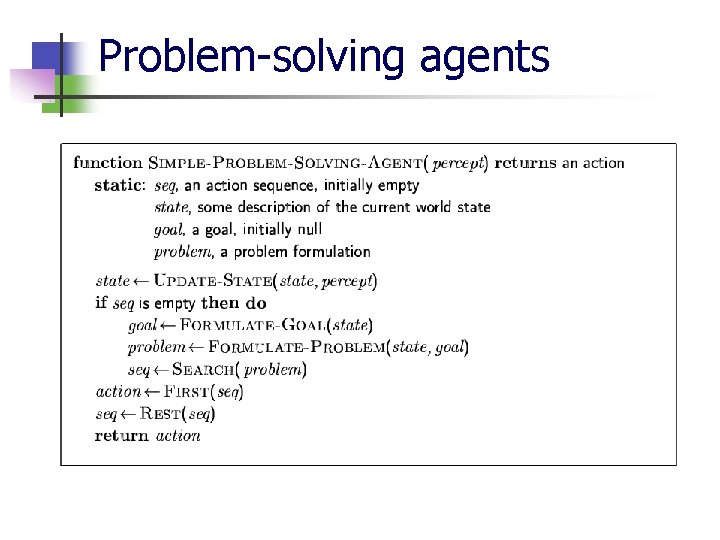
Problem-solving agents
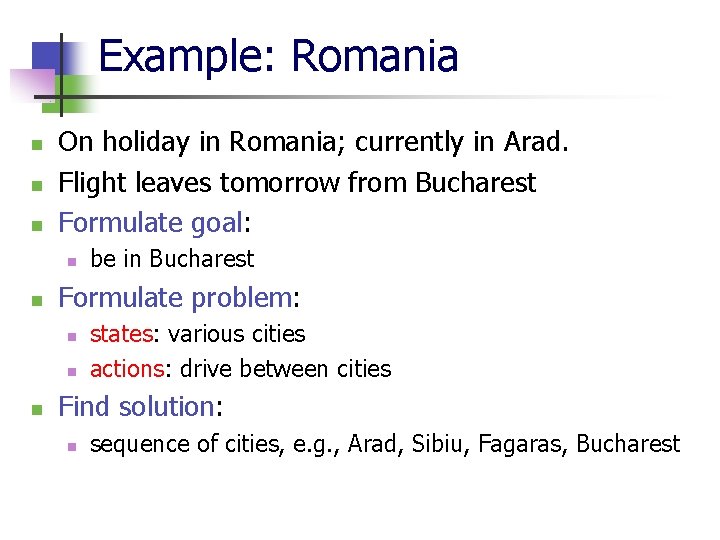
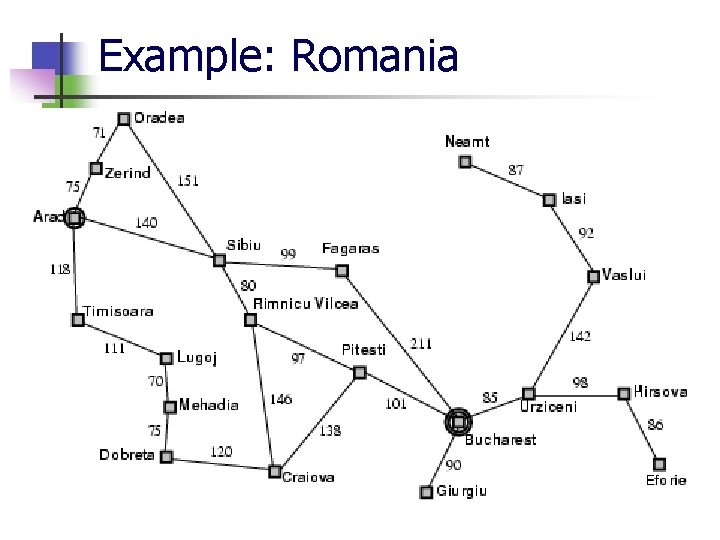
Example: Romania n n n On holiday in Romania; currently in Arad. Flight leaves tomorrow from Bucharest Formulate goal: n n Formulate problem: n n n be in Bucharest states: various cities actions: drive between cities Find solution: n sequence of cities, e. g. , Arad, Sibiu, Fagaras, Bucharest
Example: Romania
Problem types n Deterministic, fully observable single-state problem n n Non-observable sensorless problem (conformant problem) n n Agent may have no idea where it is; solution is a sequence Nondeterministic and/or partially observable contingency problem n n n Agent knows exactly which state it will be in; solution is a sequence percepts provide new information about current state often interleave} search, execution Unknown state space exploration problem
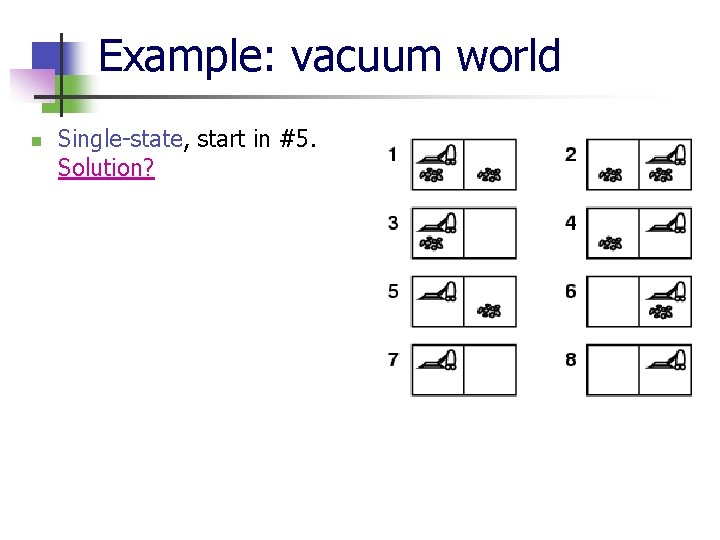
Example: vacuum world n Single-state, start in #5. Solution?
![Example: vacuum world n n Single-state, start in #5. Solution? [Right, Suck] Sensorless, start](http://slidetodoc.com/presentation_image_h2/c087402ad0c7c6c022283a405df15b4b/image-8.jpg "Example: vacuum world n n Single-state, start in #5. Solution? [Right, Suck] Sensorless, start")
Example: vacuum world n n Single-state, start in #5. Solution? [Right, Suck] Sensorless, start in {1, 2, 3, 4, 5, 6, 7, 8} e. g. , Right goes to {2, 4, 6, 8} Solution?
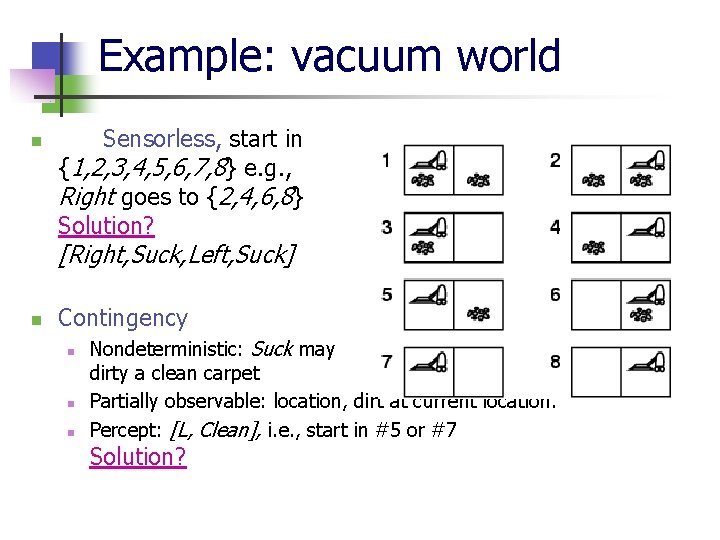
Example: vacuum world n Sensorless, start in {1, 2, 3, 4, 5, 6, 7, 8} e. g. , Right goes to {2, 4, 6, 8} Solution? [Right, Suck, Left, Suck] n Contingency n n n Nondeterministic: Suck may dirty a clean carpet Partially observable: location, dirt at current location. Percept: [L, Clean], i. e. , start in #5 or #7 Solution?
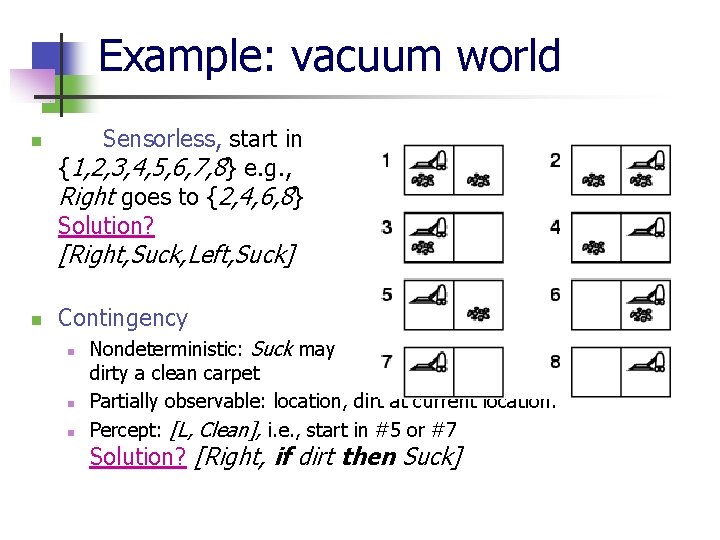
Example: vacuum world n Sensorless, start in {1, 2, 3, 4, 5, 6, 7, 8} e. g. , Right goes to {2, 4, 6, 8} Solution? [Right, Suck, Left, Suck] n Contingency n n n Nondeterministic: Suck may dirty a clean carpet Partially observable: location, dirt at current location. Percept: [L, Clean], i. e. , start in #5 or #7 Solution? [Right, if dirt then Suck]
Single-state problem formulation A problem is defined by four items: 1. 2. 3. 4. initial state e. g. , "at Arad" actions or successor function S(x) = set of action–state pairs n e. g. , S(Arad) = {<Arad Zerind, Zerind>, … } goal test, can be n explicit, e. g. , x = "at Bucharest" n implicit, e. g. , Checkmate(x) path cost (additive) n n n e. g. , sum of distances, number of actions executed, etc. c(x, a, y) is the step cost, assumed to be ≥ 0 A solution is a sequence of actions leading from the initial state to a goal state
Selecting a state space n Real world is absurdly complex state space must be abstracted for problem solving n n (Abstract) state = set of real states (Abstract) action = complex combination of real actions n n n For guaranteed realizability, any real state "in Arad“ must get to some real state "in Zerind" (Abstract) solution = n n e. g. , "Arad Zerind" represents a complex set of possible routes, detours, rest stops, etc. set of real paths that are solutions in the real world Each abstract action should be "easier" than the original problem
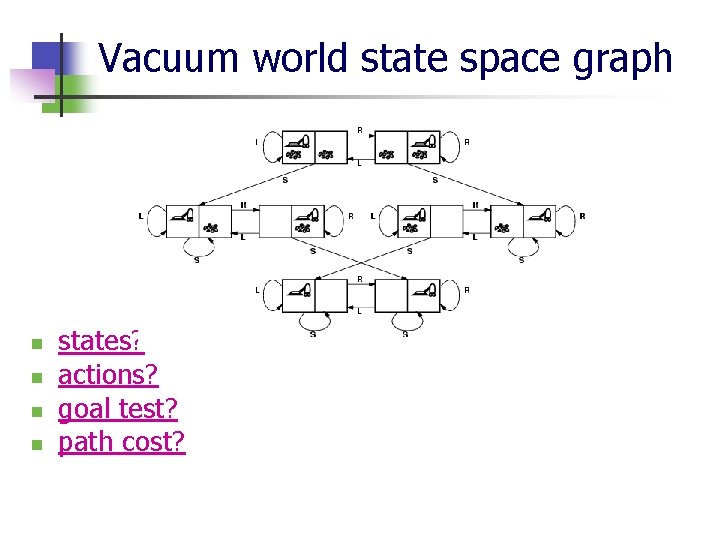
Vacuum world state space graph n n states? actions? goal test? path cost?
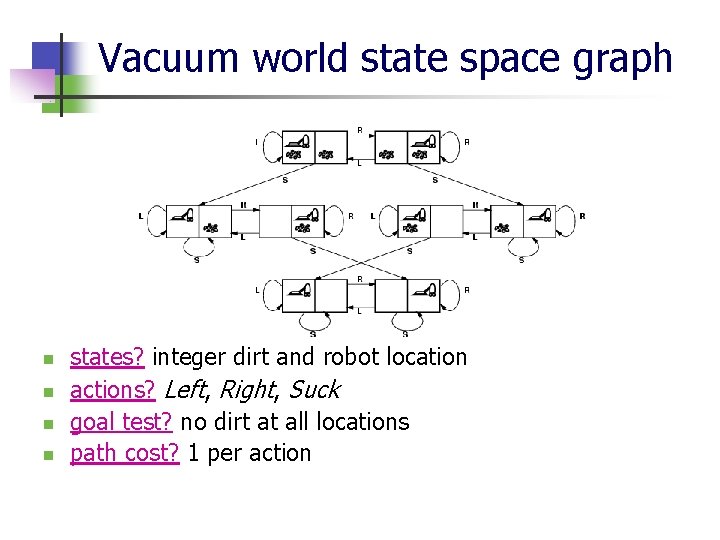
Vacuum world state space graph n n states? integer dirt and robot location actions? Left, Right, Suck goal test? no dirt at all locations path cost? 1 per action
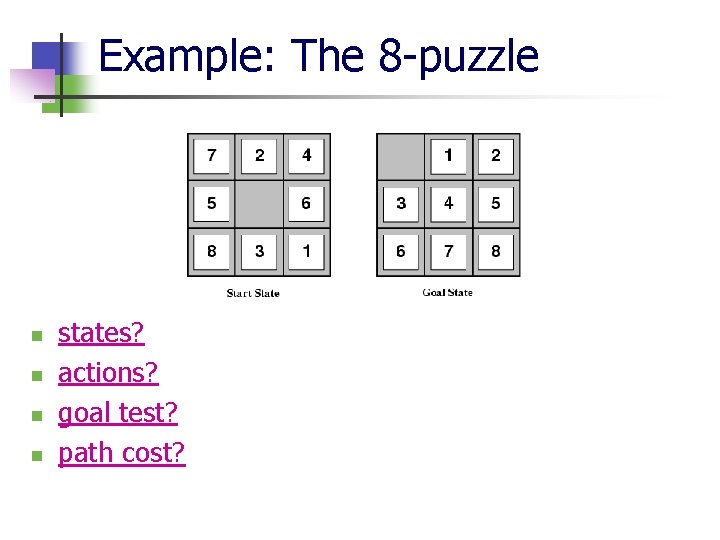
Example: The 8 -puzzle n n states? actions? goal test? path cost?
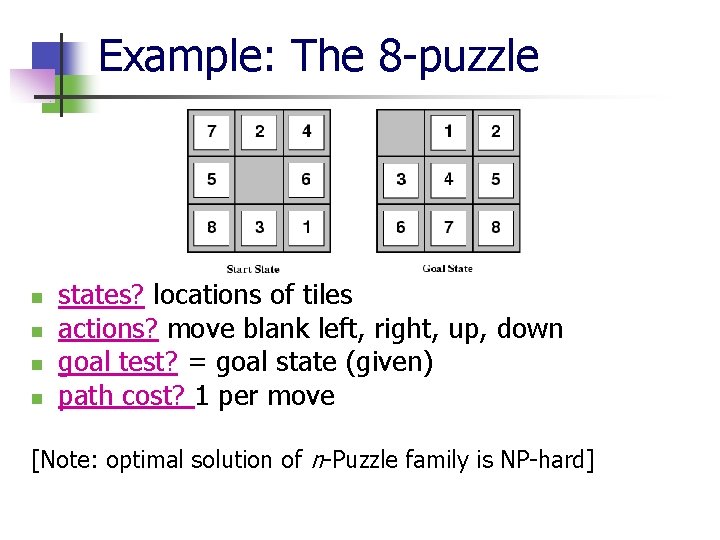
Example: The 8 -puzzle n n states? locations of tiles actions? move blank left, right, up, down goal test? = goal state (given) path cost? 1 per move [Note: optimal solution of n-Puzzle family is NP-hard]
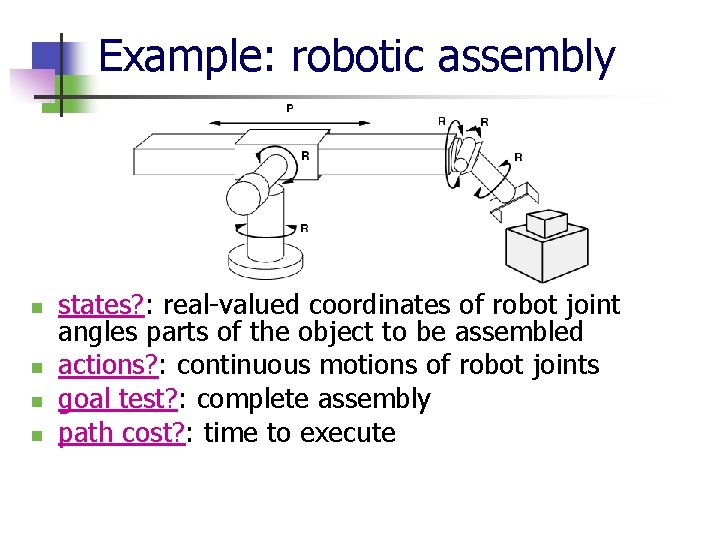
Example: robotic assembly n n states? : real-valued coordinates of robot joint angles parts of the object to be assembled actions? : continuous motions of robot joints goal test? : complete assembly path cost? : time to execute
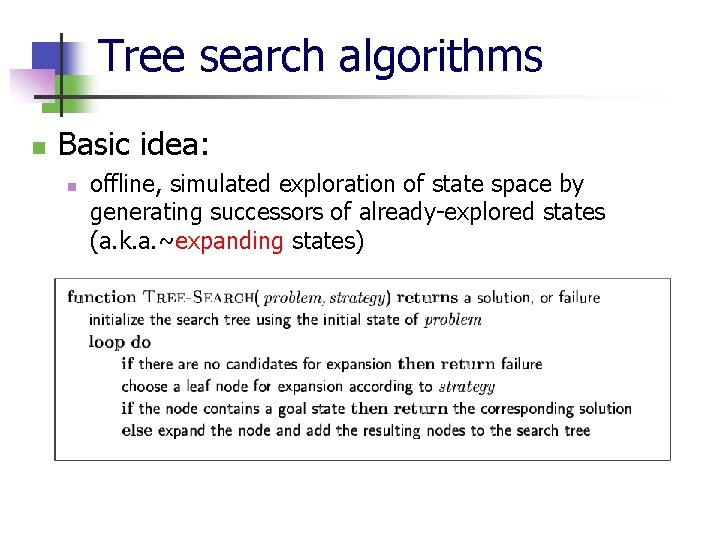
Tree search algorithms n Basic idea: n offline, simulated exploration of state space by generating successors of already-explored states (a. k. a. ~expanding states)
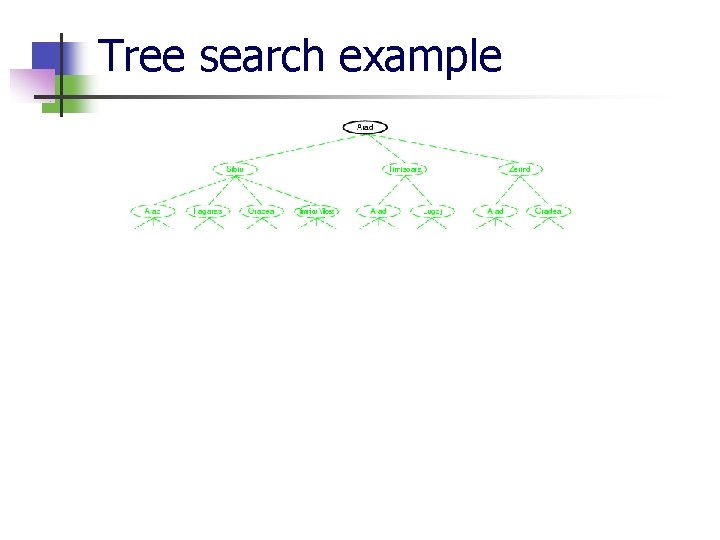
Tree search example
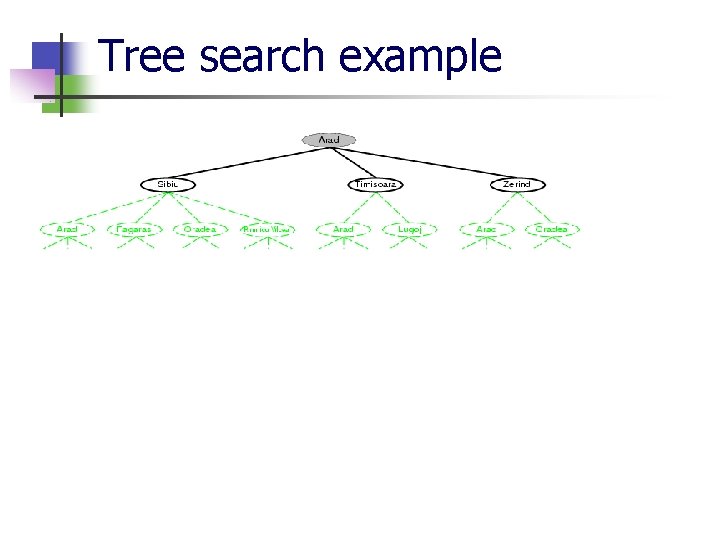
Tree search example
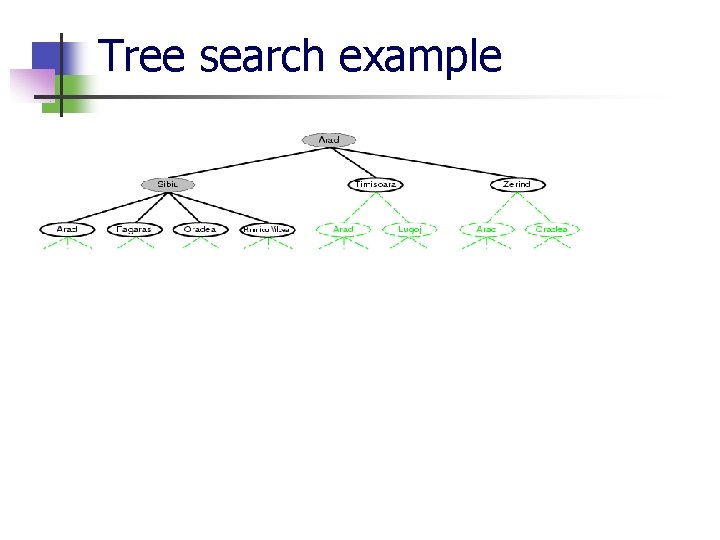
Tree search example
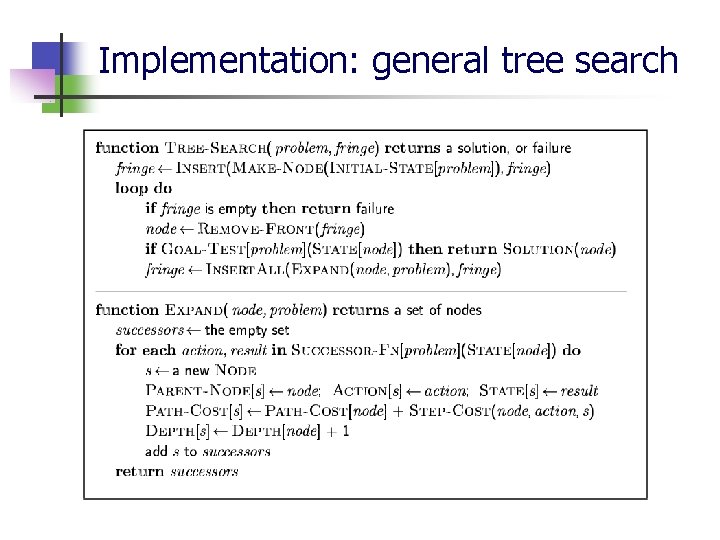
Implementation: general tree search
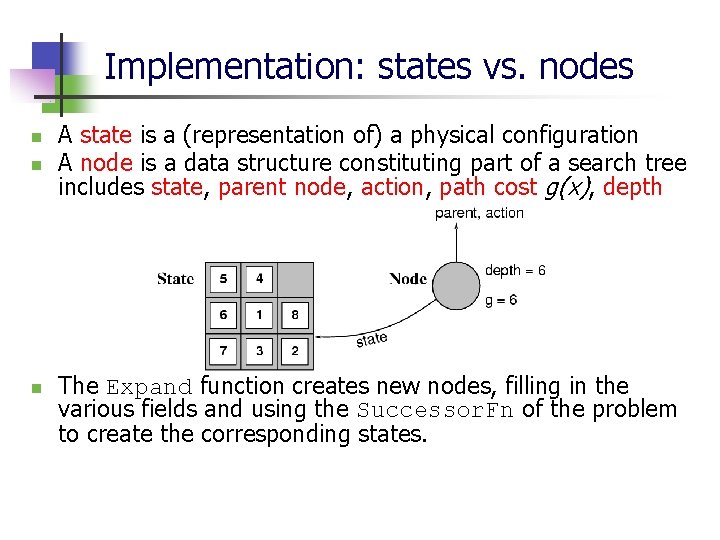
Implementation: states vs. nodes n n n A state is a (representation of) a physical configuration A node is a data structure constituting part of a search tree includes state, parent node, action, path cost g(x), depth The Expand function creates new nodes, filling in the various fields and using the Successor. Fn of the problem to create the corresponding states.
Search strategies n n A search strategy is defined by picking the order of node expansion Strategies are evaluated along the following dimensions: n n n completeness: does it always find a solution if one exists? time complexity: number of nodes generated space complexity: maximum number of nodes in memory optimality: does it always find a least-cost solution? Time and space complexity are measured in terms of n n n b: maximum branching factor of the search tree d: depth of the least-cost solution m: maximum depth of the state space (may be ∞)
Uninformed search strategies n n n Uninformed search strategies use only the information available in the problem definition Breadth-first search Uniform-cost search Depth-first search Depth-limited search Iterative deepening search
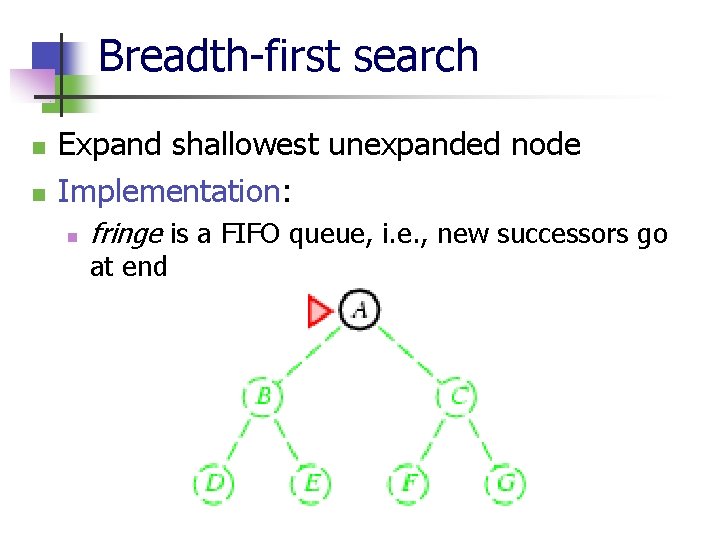
Breadth-first search n n Expand shallowest unexpanded node Implementation: n fringe is a FIFO queue, i. e. , new successors go at end
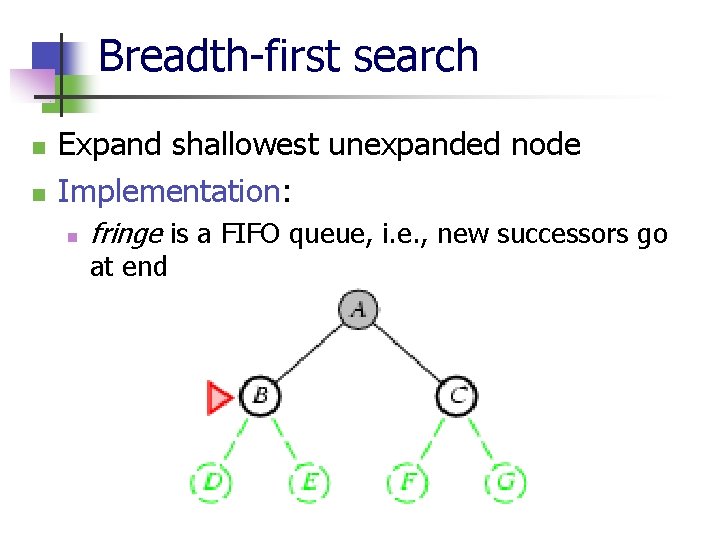
Breadth-first search n n Expand shallowest unexpanded node Implementation: n fringe is a FIFO queue, i. e. , new successors go at end
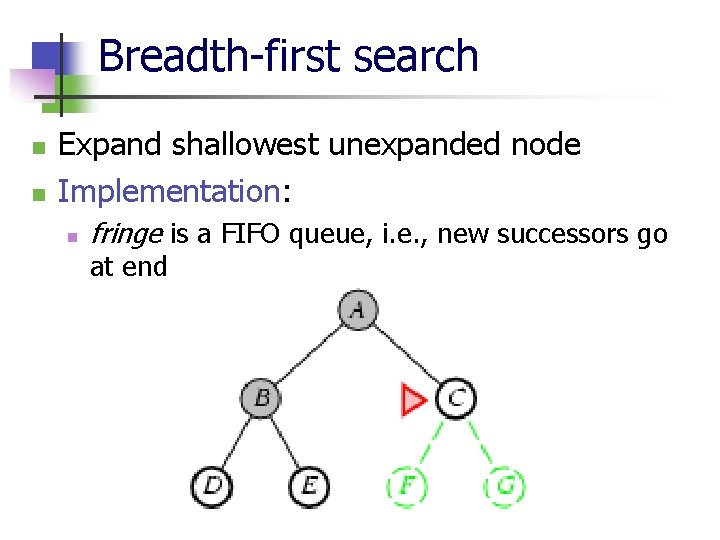
Breadth-first search n n Expand shallowest unexpanded node Implementation: n fringe is a FIFO queue, i. e. , new successors go at end
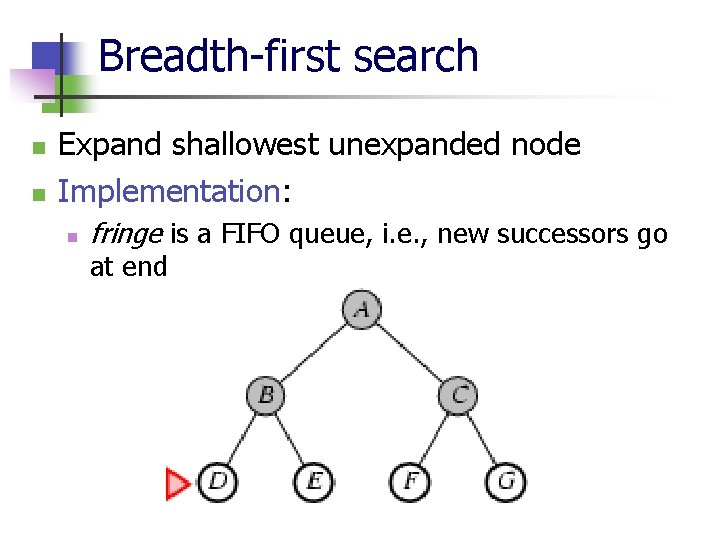
Breadth-first search n n Expand shallowest unexpanded node Implementation: n fringe is a FIFO queue, i. e. , new successors go at end
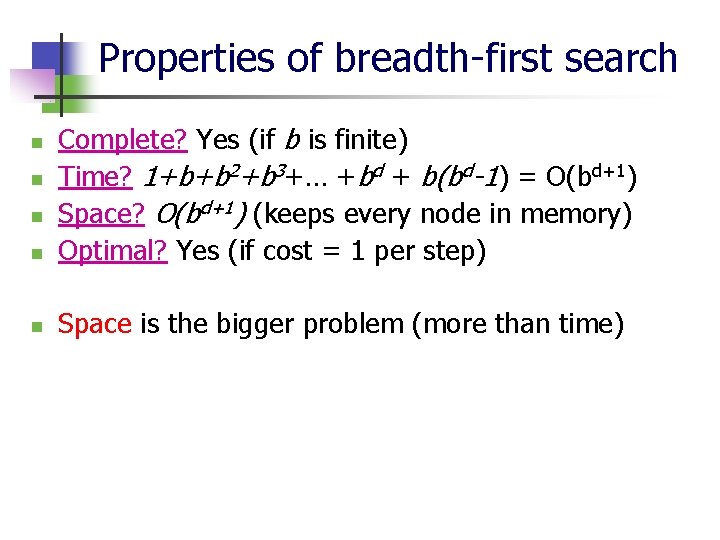
Properties of breadth-first search n Complete? Yes (if b is finite) Time? 1+b+b 2+b 3+… +bd + b(bd-1) = O(bd+1) Space? O(bd+1) (keeps every node in memory) Optimal? Yes (if cost = 1 per step) n Space is the bigger problem (more than time) n n n
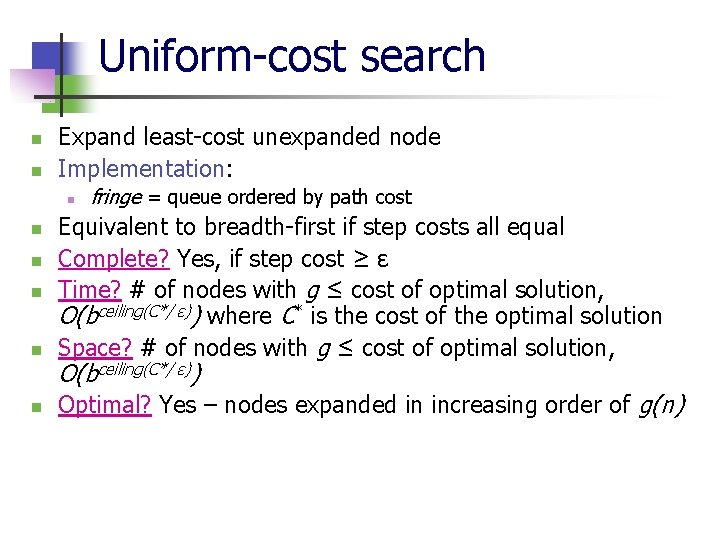
Uniform-cost search n n Expand least-cost unexpanded node Implementation: n fringe = queue ordered by path cost n Equivalent to breadth-first if step costs all equal Complete? Yes, if step cost ≥ ε Time? # of nodes with g ≤ cost of optimal solution, O(bceiling(C*/ ε)) where C* is the cost of the optimal solution Space? # of nodes with g ≤ cost of optimal solution, n Optimal? Yes – nodes expanded in increasing order of g(n) n n n O(bceiling(C*/ ε))
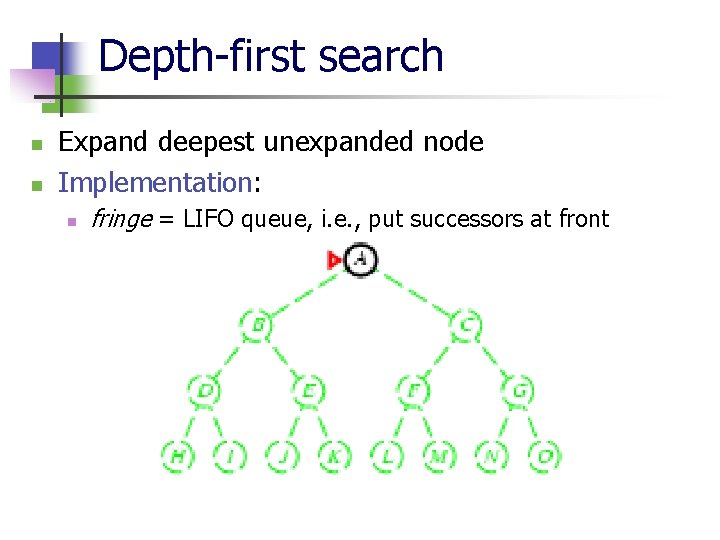
Depth-first search n n Expand deepest unexpanded node Implementation: n fringe = LIFO queue, i. e. , put successors at front
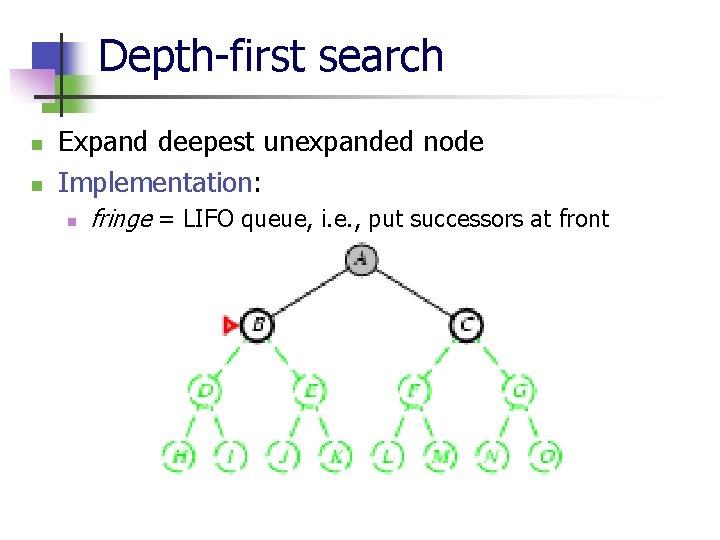
Depth-first search n n Expand deepest unexpanded node Implementation: n fringe = LIFO queue, i. e. , put successors at front
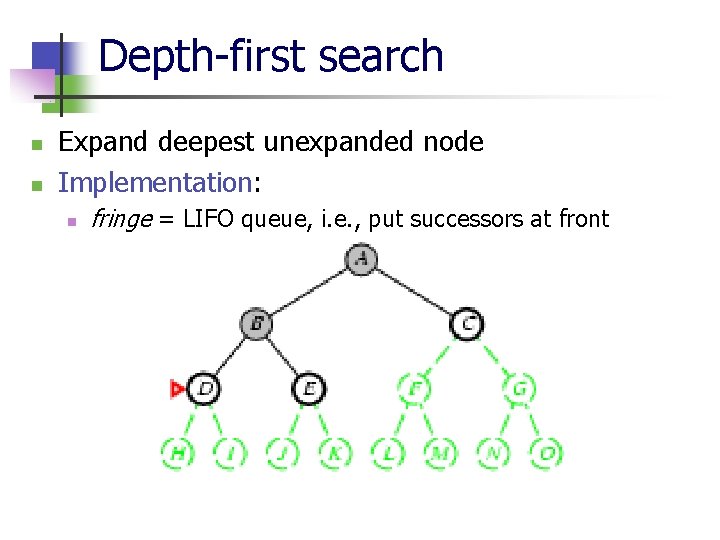
Depth-first search n n Expand deepest unexpanded node Implementation: n fringe = LIFO queue, i. e. , put successors at front
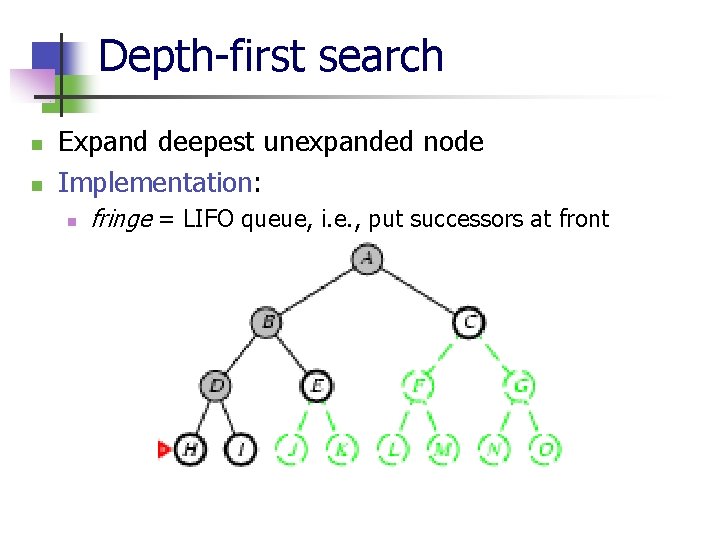
Depth-first search n n Expand deepest unexpanded node Implementation: n fringe = LIFO queue, i. e. , put successors at front
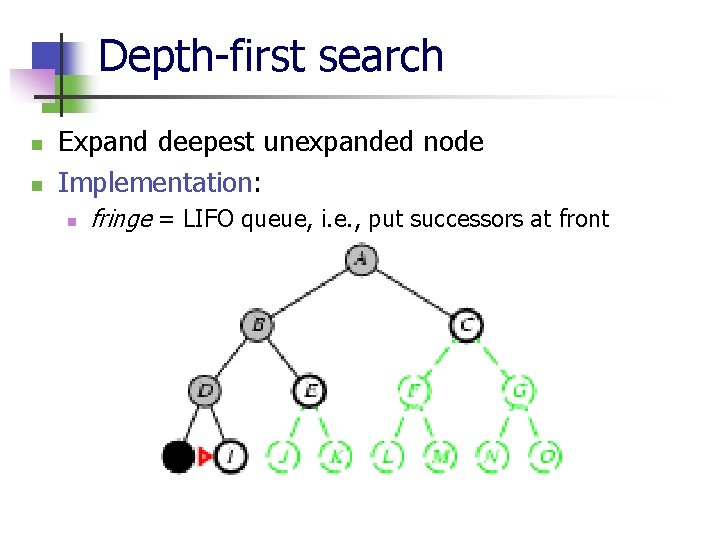
Depth-first search n n Expand deepest unexpanded node Implementation: n fringe = LIFO queue, i. e. , put successors at front
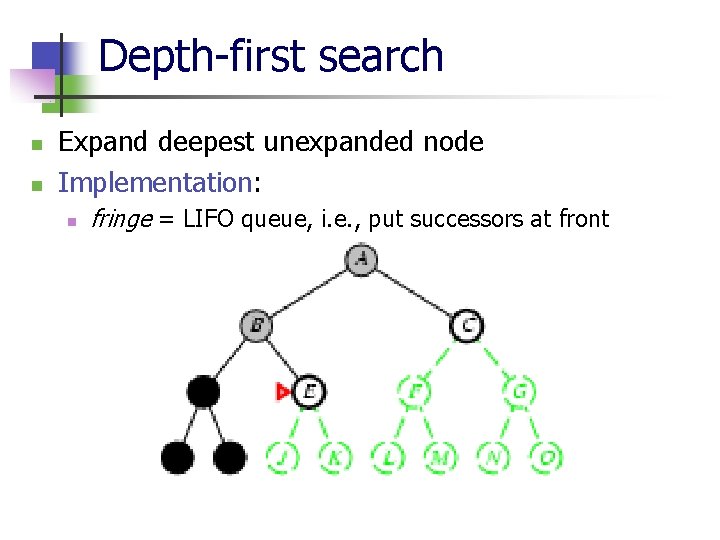
Depth-first search n n Expand deepest unexpanded node Implementation: n fringe = LIFO queue, i. e. , put successors at front
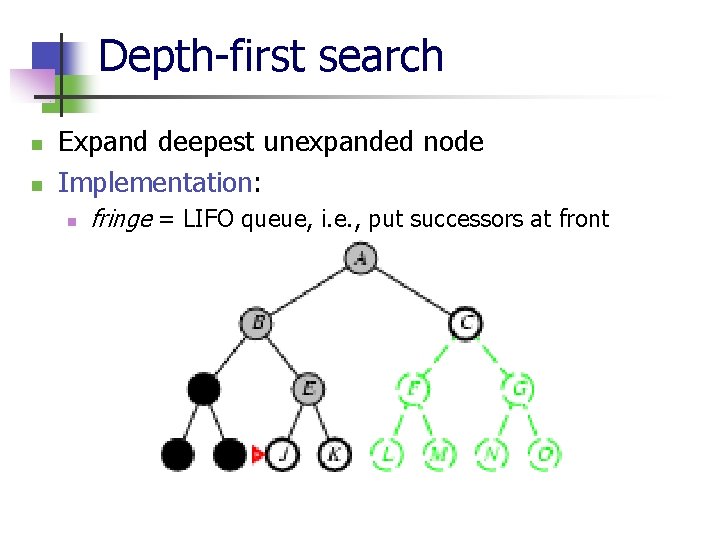
Depth-first search n n Expand deepest unexpanded node Implementation: n fringe = LIFO queue, i. e. , put successors at front
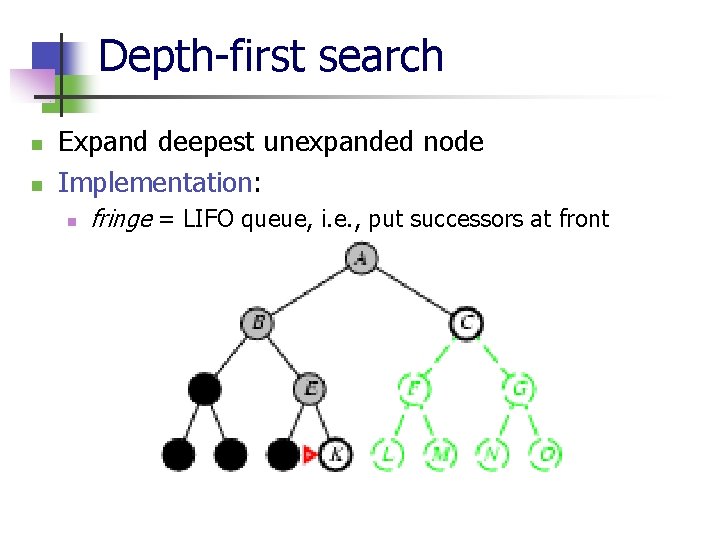
Depth-first search n n Expand deepest unexpanded node Implementation: n fringe = LIFO queue, i. e. , put successors at front
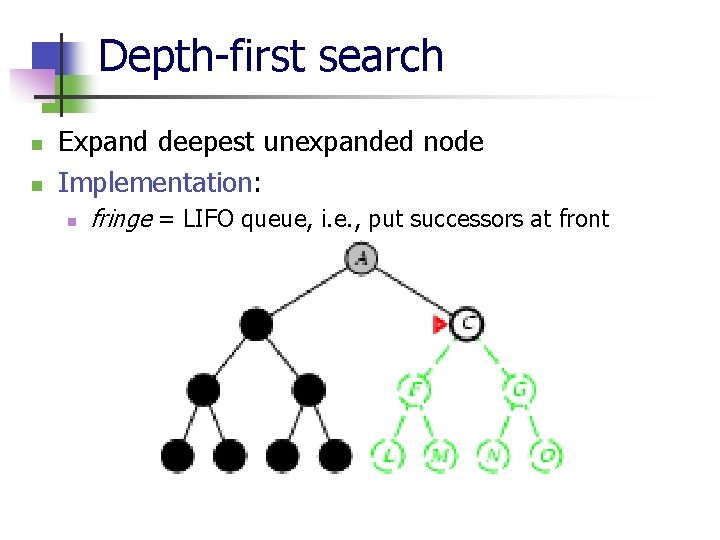
Depth-first search n n Expand deepest unexpanded node Implementation: n fringe = LIFO queue, i. e. , put successors at front
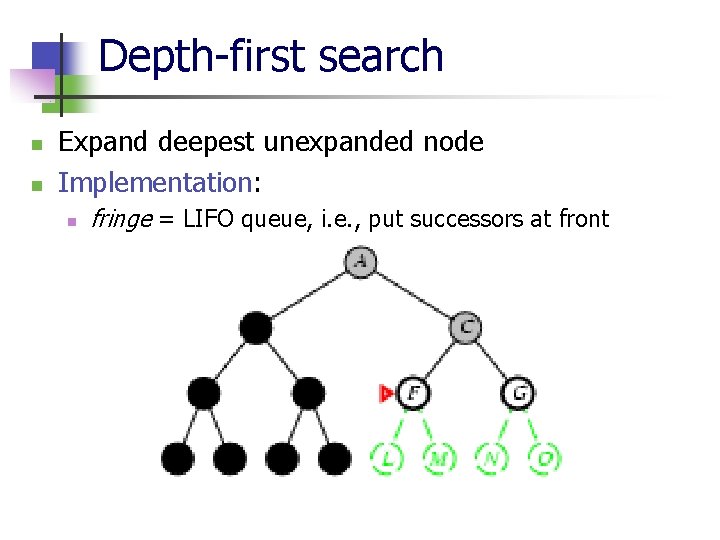
Depth-first search n n Expand deepest unexpanded node Implementation: n fringe = LIFO queue, i. e. , put successors at front
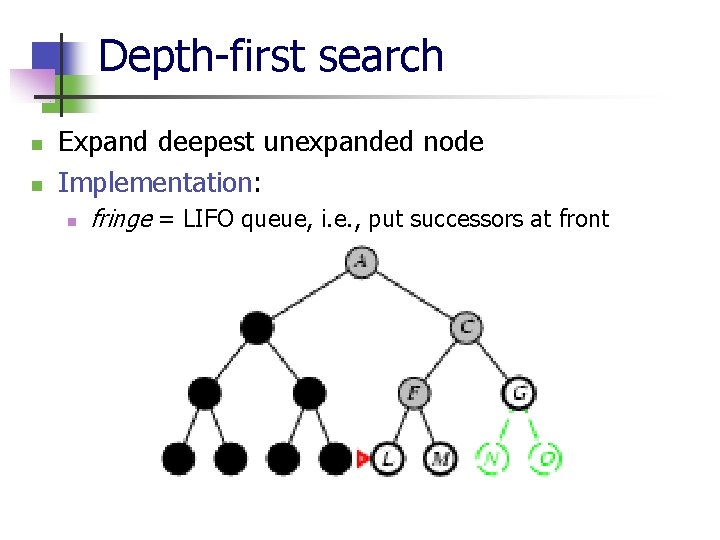
Depth-first search n n Expand deepest unexpanded node Implementation: n fringe = LIFO queue, i. e. , put successors at front
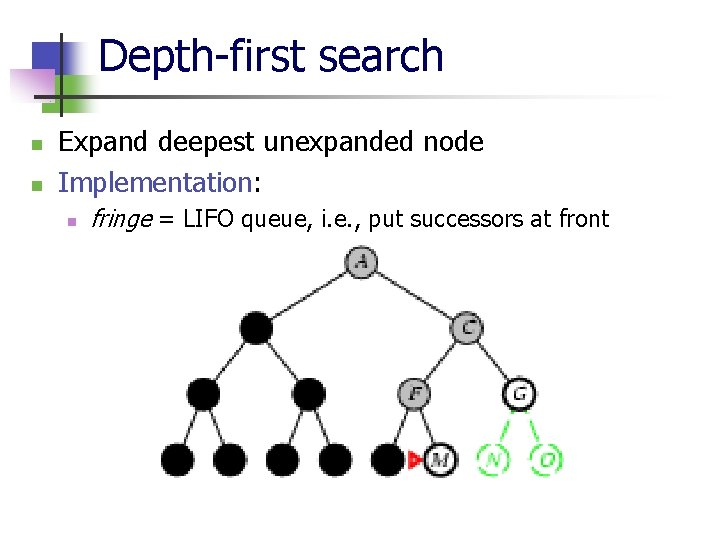
Depth-first search n n Expand deepest unexpanded node Implementation: n fringe = LIFO queue, i. e. , put successors at front
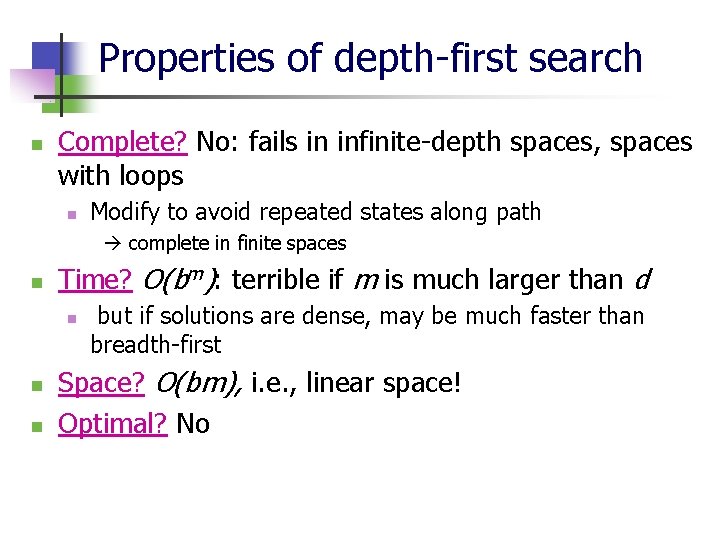
Properties of depth-first search n Complete? No: fails in infinite-depth spaces, spaces with loops n Modify to avoid repeated states along path complete in finite spaces n Time? O(bm): terrible if m is much larger than d n n n but if solutions are dense, may be much faster than breadth-first Space? O(bm), i. e. , linear space! Optimal? No
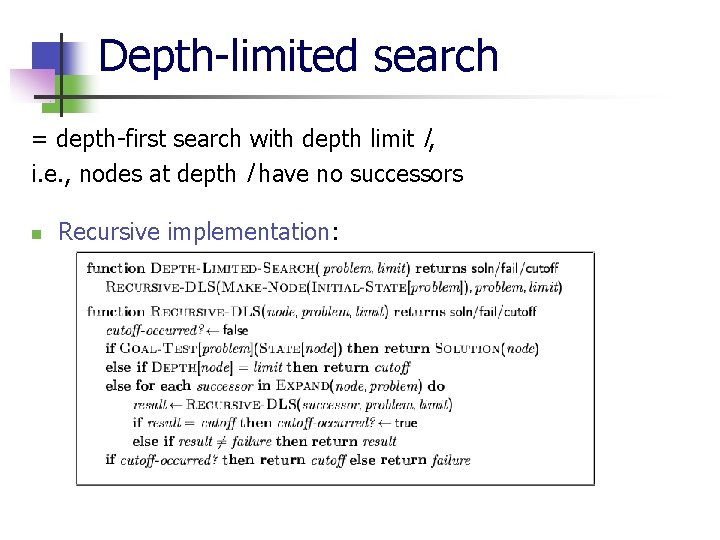
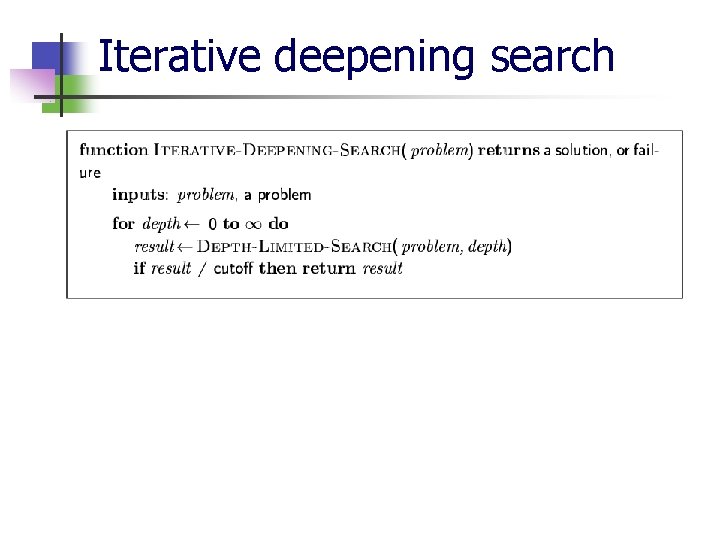
Depth-limited search = depth-first search with depth limit l, i. e. , nodes at depth l have no successors n Recursive implementation:
Iterative deepening search
Iterative deepening search l =0
Iterative deepening search l =1
Iterative deepening search l =2
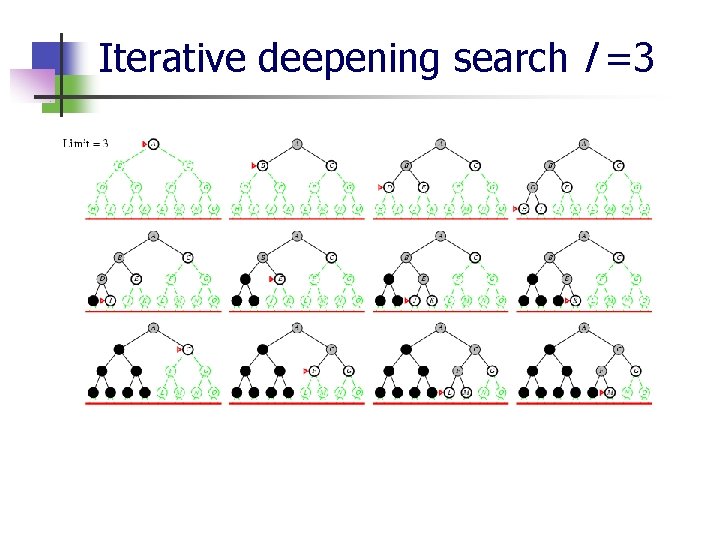
Iterative deepening search l =3
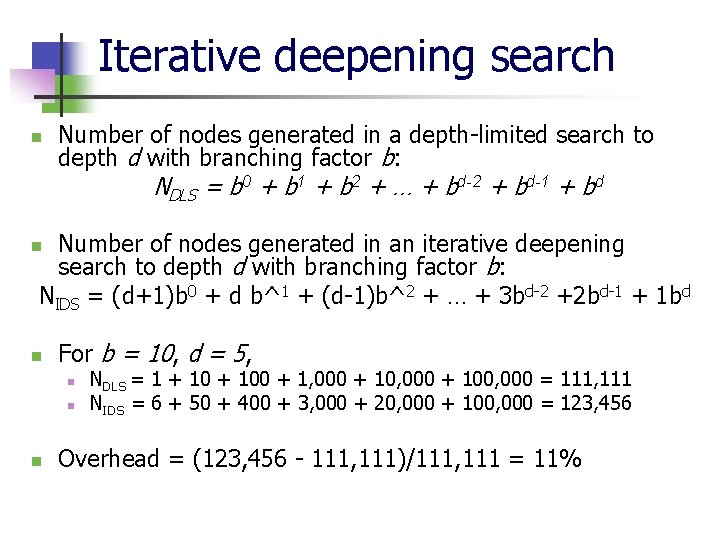
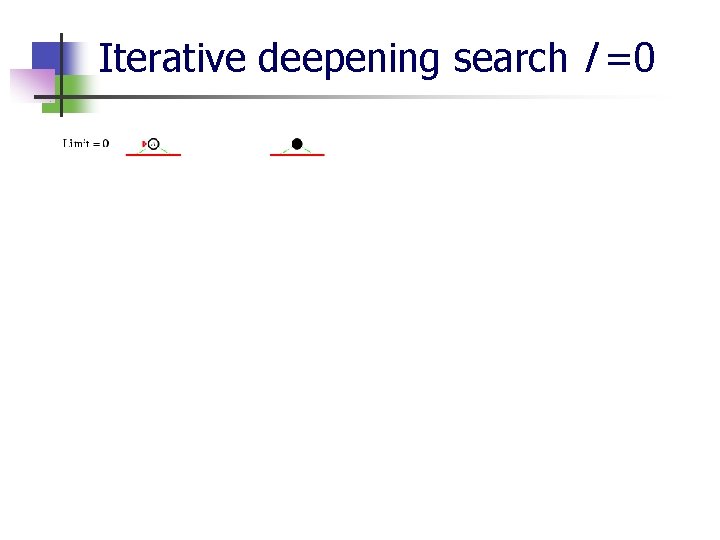
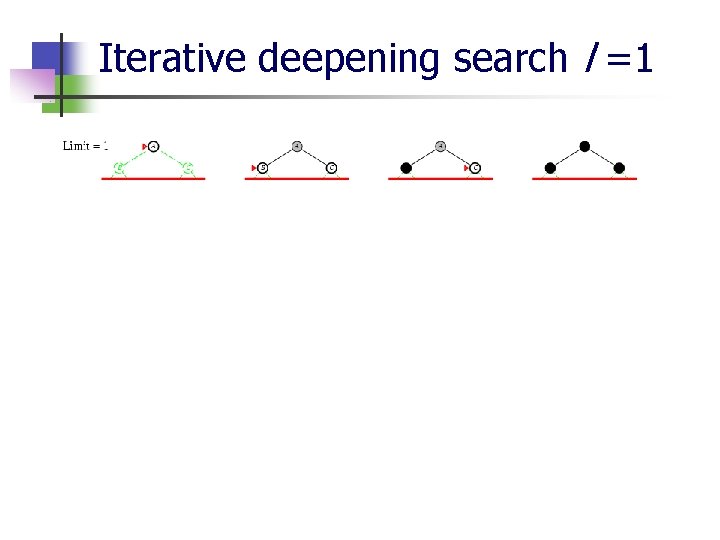
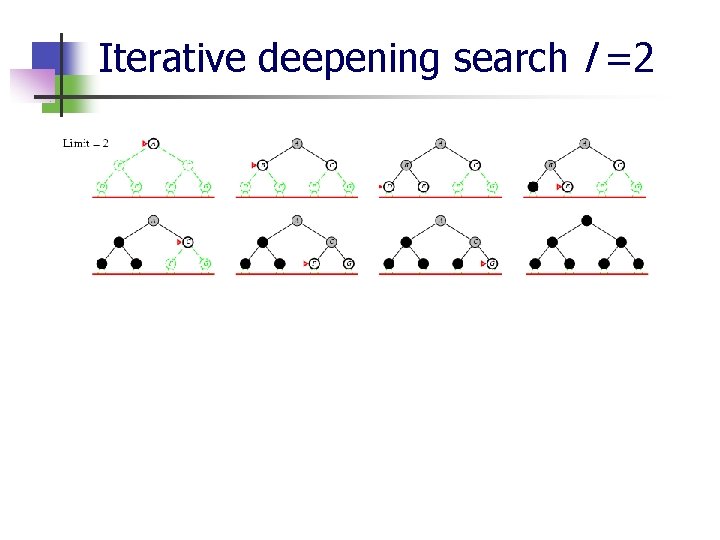
Iterative deepening search n Number of nodes generated in a depth-limited search to depth d with branching factor b: NDLS = b 0 + b 1 + b 2 + … + bd-2 + bd-1 + bd Number of nodes generated in an iterative deepening search to depth d with branching factor b: NIDS = (d+1)b 0 + d b^1 + (d-1)b^2 + … + 3 bd-2 +2 bd-1 + 1 bd n n For b = 10, d = 5, n n n NDLS = 1 + 100 + 1, 000 + 100, 000 = 111, 111 NIDS = 6 + 50 + 400 + 3, 000 + 20, 000 + 100, 000 = 123, 456 Overhead = (123, 456 - 111, 111)/111, 111 = 11%
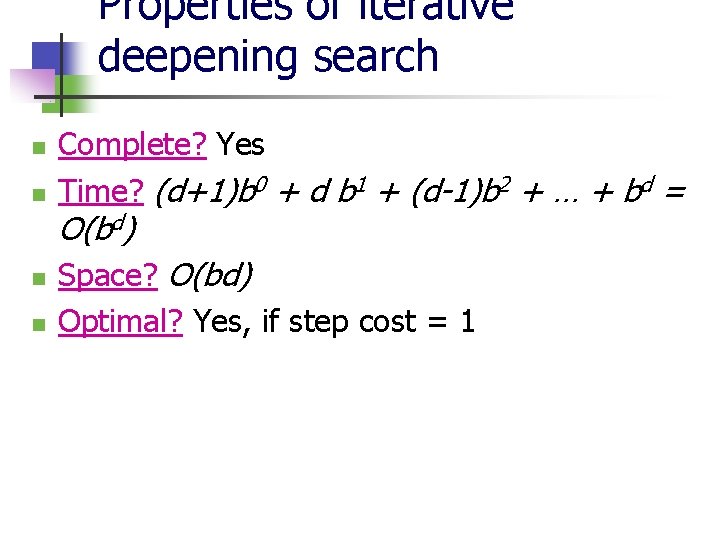
Properties of iterative deepening search n n Complete? Yes Time? (d+1)b 0 + d b 1 + (d-1)b 2 + … + bd = O(bd) n n Space? O(bd) Optimal? Yes, if step cost = 1
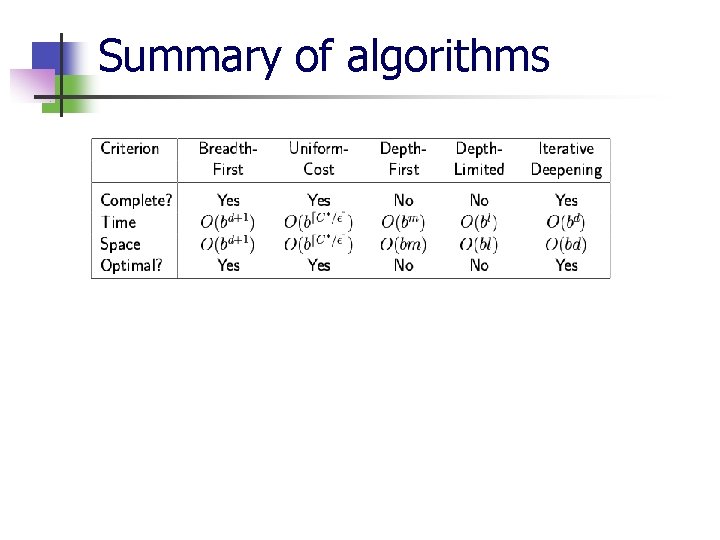
Summary of algorithms
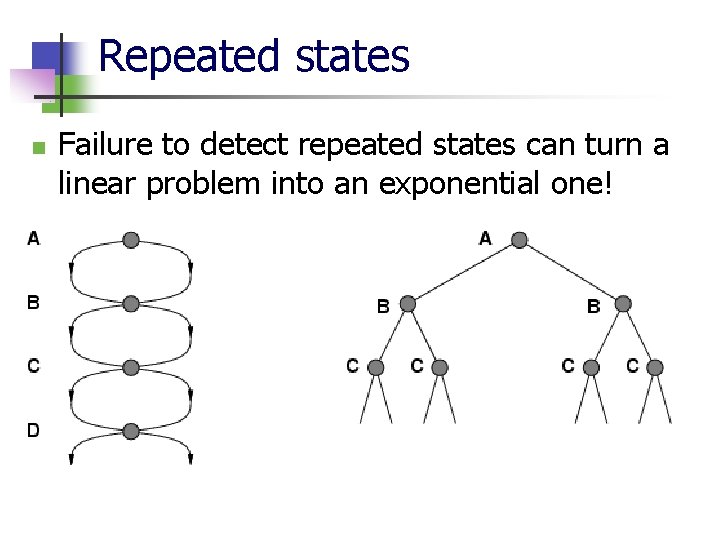
Repeated states n Failure to detect repeated states can turn a linear problem into an exponential one!
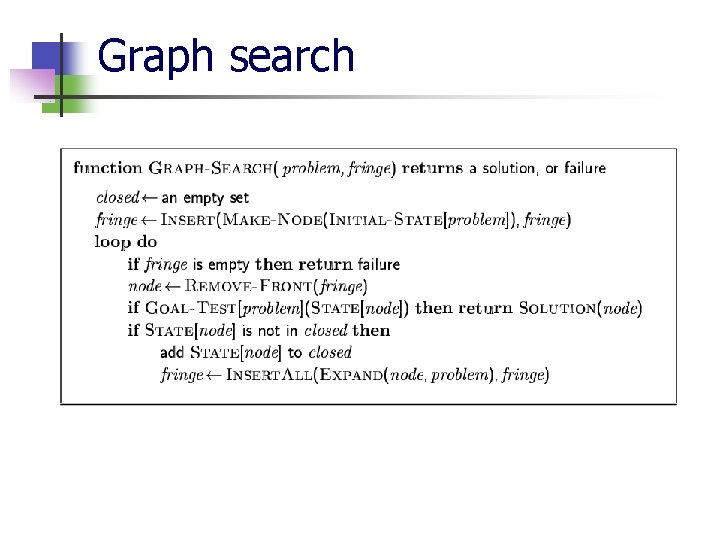
Graph search
Summary n n n Problem formulation usually requires abstracting away realworld details to define a state space that can feasibly be explored Variety of uninformed search strategies Iterative deepening search uses only linear space and not much more time than other uninformed algorithms
- Slides: 56