
Solving Mole body parts problems A SUMMARY Step
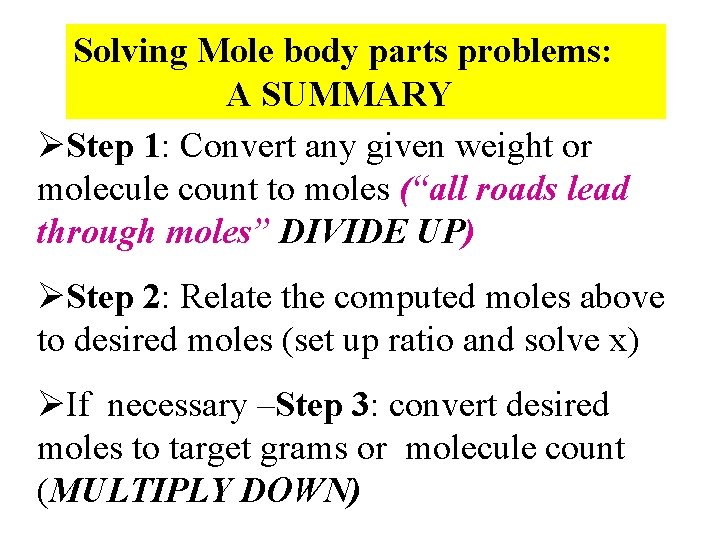
Solving Mole body parts problems: A SUMMARY ØStep 1: Convert any given weight or molecule count to moles (“all roads lead through moles” DIVIDE UP) ØStep 2: Relate the computed moles above to desired moles (set up ratio and solve x) ØIf necessary –Step 3: convert desired moles to target grams or molecule count (MULTIPLY DOWN)
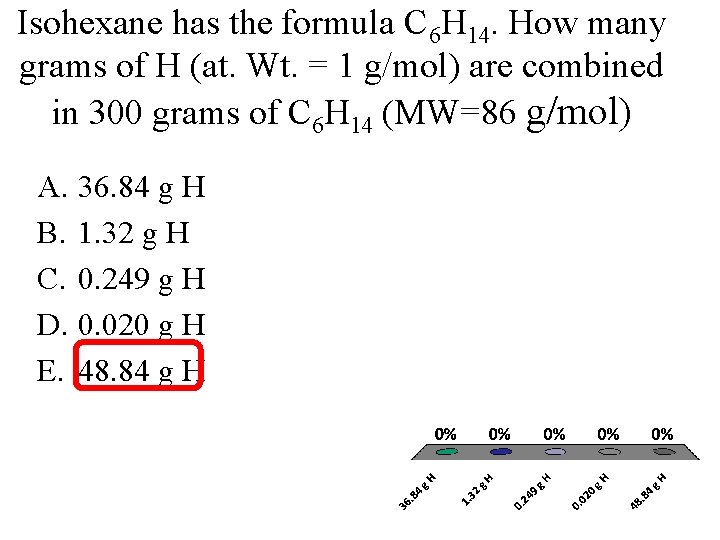
Isohexane has the formula C 6 H 14. How many grams of H (at. Wt. = 1 g/mol) are combined in 300 grams of C 6 H 14 (MW=86 g/mol) A. 36. 84 g H B. 1. 32 g H C. 0. 249 g H D. 0. 020 g H E. 48. 84 g H
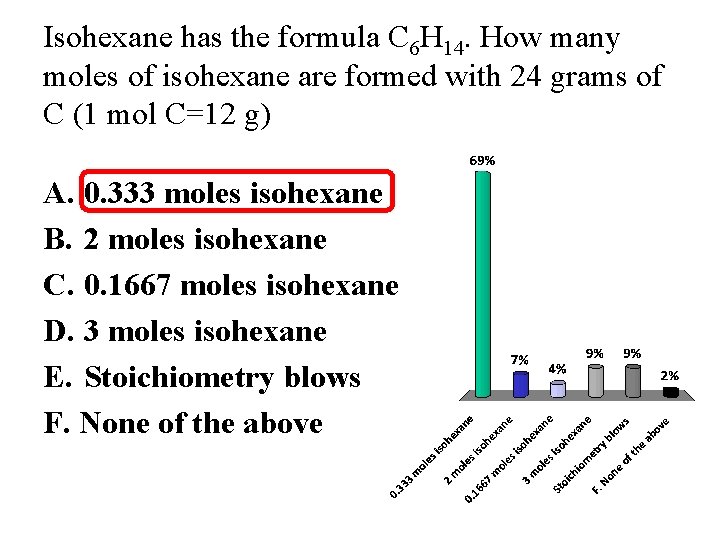
Isohexane has the formula C 6 H 14. How many moles of isohexane are formed with 24 grams of C (1 mol C=12 g) A. 0. 333 moles isohexane B. 2 moles isohexane C. 0. 1667 moles isohexane D. 3 moles isohexane E. Stoichiometry blows F. None of the above
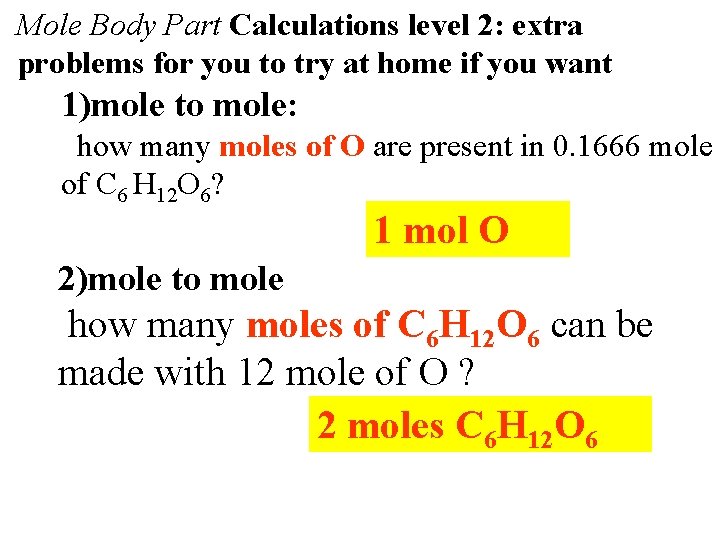
Mole Body Part Calculations level 2: extra problems for you to try at home if you want 1)mole to mole: how many moles of O are present in 0. 1666 mole of C 6 H 12 O 6? 1 mol O 2)mole to mole how many moles of C 6 H 12 O 6 can be made with 12 mole of O ? 2 moles C 6 H 12 O 6
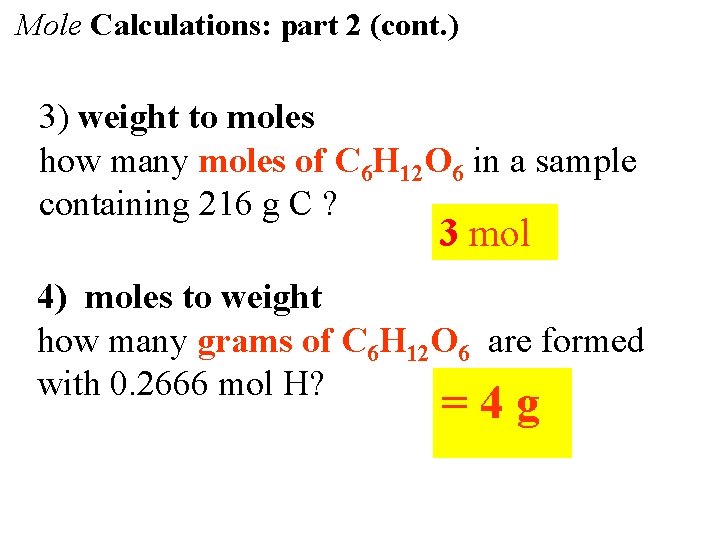
Mole Calculations: part 2 (cont. ) 3) weight to moles how many moles of C 6 H 12 O 6 in a sample containing 216 g C ? 3 mol 4) moles to weight how many grams of C 6 H 12 O 6 are formed with 0. 2666 mol H? =4 g
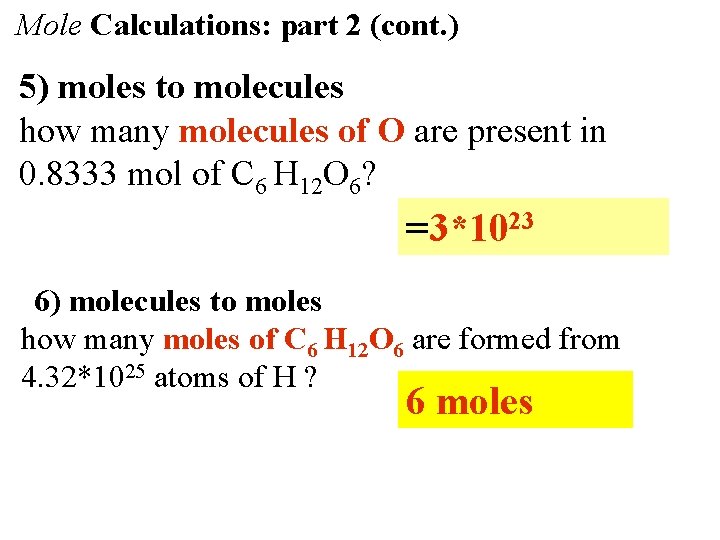
Mole Calculations: part 2 (cont. ) 5) moles to molecules how many molecules of O are present in 0. 8333 mol of C 6 H 12 O 6? =3*1023 6) molecules to moles how many moles of C 6 H 12 O 6 are formed from 4. 32*1025 atoms of H ? 6 moles
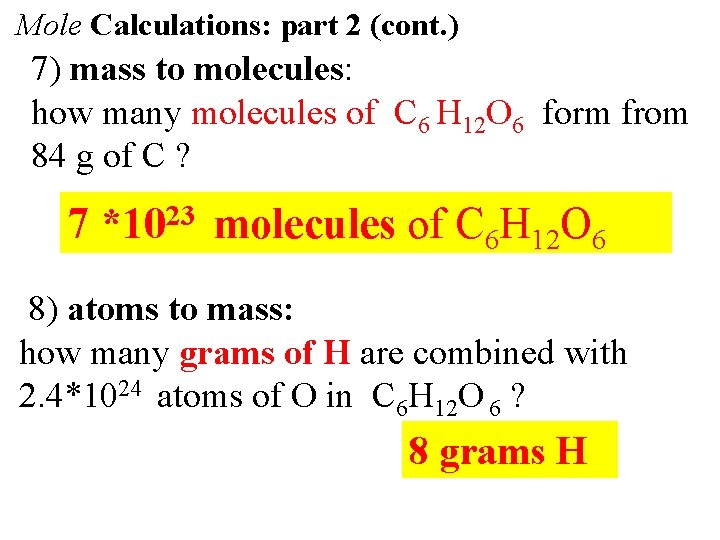
Mole Calculations: part 2 (cont. ) 7) mass to molecules: how many molecules of C 6 H 12 O 6 form from 84 g of C ? 7 *1023 molecules of C 6 H 12 O 6 8) atoms to mass: how many grams of H are combined with 2. 4*1024 atoms of O in C 6 H 12 O 6 ? 8 grams H
The road trip through mole land so far… • Basic mole-mass-count conversions ( divide up, multiply down) • Mole ratio conversion within a compound (`body parts’ relationships)
The mole road ahead. . . • % composition problems and combustion analysis (pp. 94 -103) : moles level 2 b • Reaction balancing (pp. 105 -108) • Reaction stoichiometry predictions, limiting yields and % yields ( pp. 108 -123): moles level 3
Why bother with all of this ? ?
% composition problems: using mole concept to convert weights to formulas Sample % composition problem #1 A compound of N and O contains 63. 63 wt % N and 36. 36 wt % O. What is the empiric formula of the compound ?
Definition: empiric formula= mole ratio of elements in a compound expressed in lowest whole numbers Example: CH 2 O = empiric formula of glucose (sugar we metabolize)
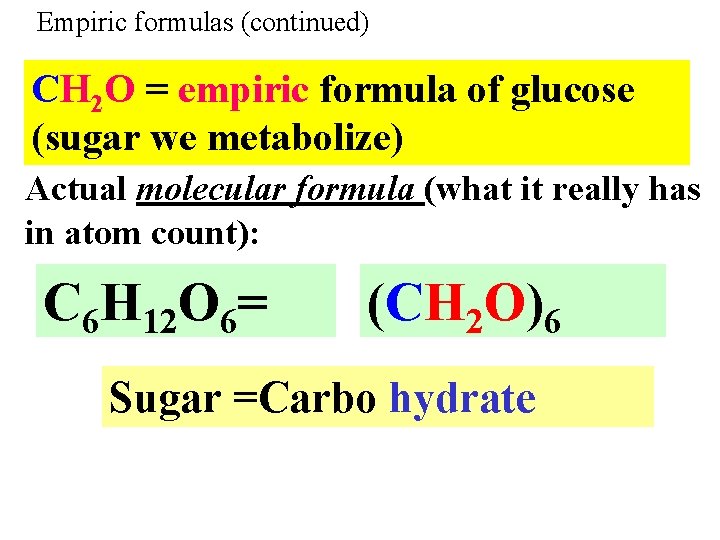
Empiric formulas (continued) CH 2 O = empiric formula of glucose (sugar we metabolize) Actual molecular formula (what it really has in atom count): C 6 H 12 O 6= (CH 2 O)6 Sugar =Carbo hydrate
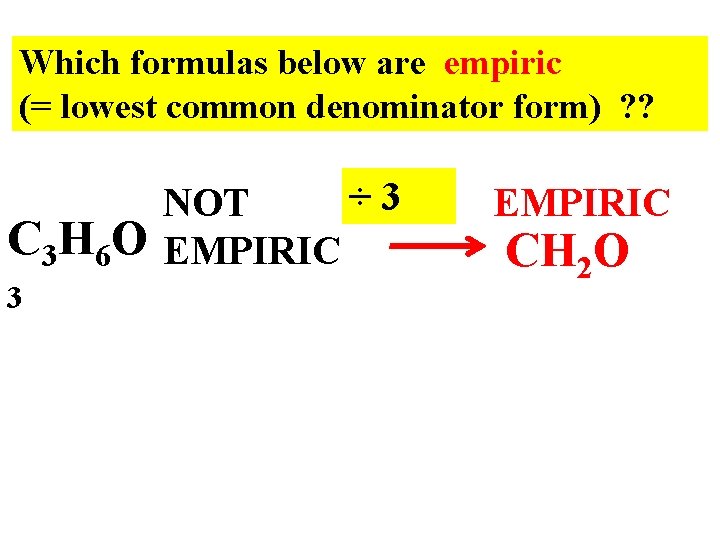
Which formulas below are empiric (= lowest common denominator form) ? ? C 3 H 6 O 3 ÷ 3 NOT EMPIRIC CH 2 O
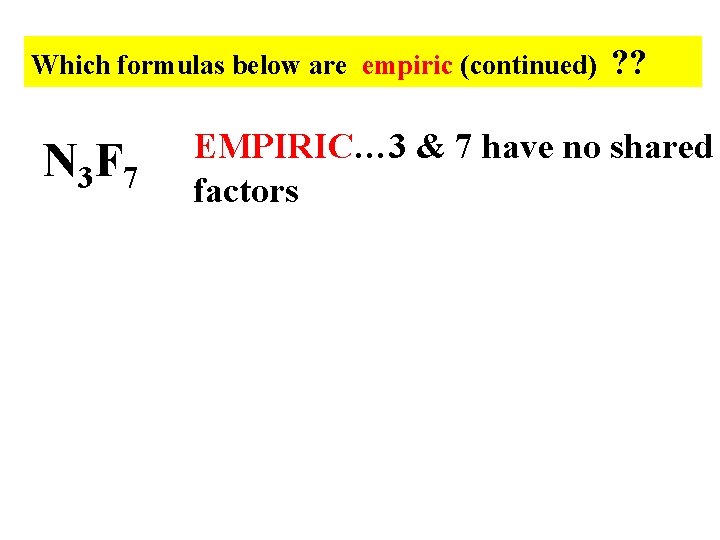
Which formulas below are empiric (continued) N 3 F 7 ? ? EMPIRIC… 3 & 7 have no shared factors
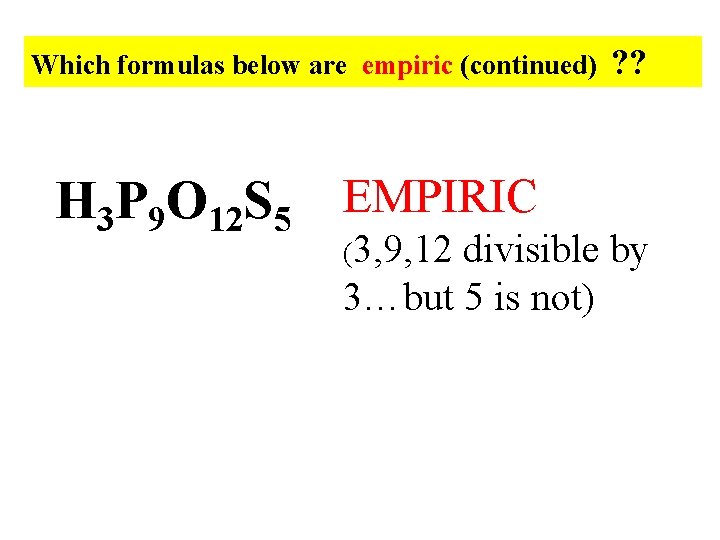
Which formulas below are empiric (continued) H 3 P 9 O 12 S 5 EMPIRIC (3, 9, 12 ? ? divisible by 3…but 5 is not)
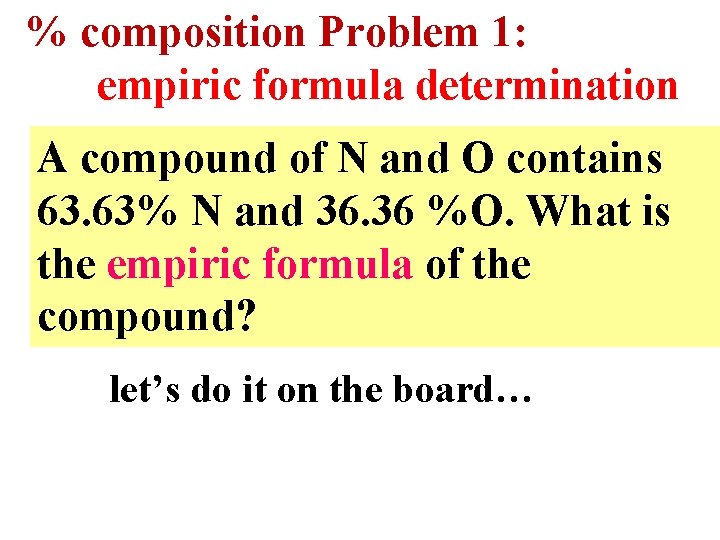
% composition Problem 1: empiric formula determination A compound of N and O contains 63. 63% N and 36. 36 %O. What is the empiric formula of the compound? let’s do it on the board…
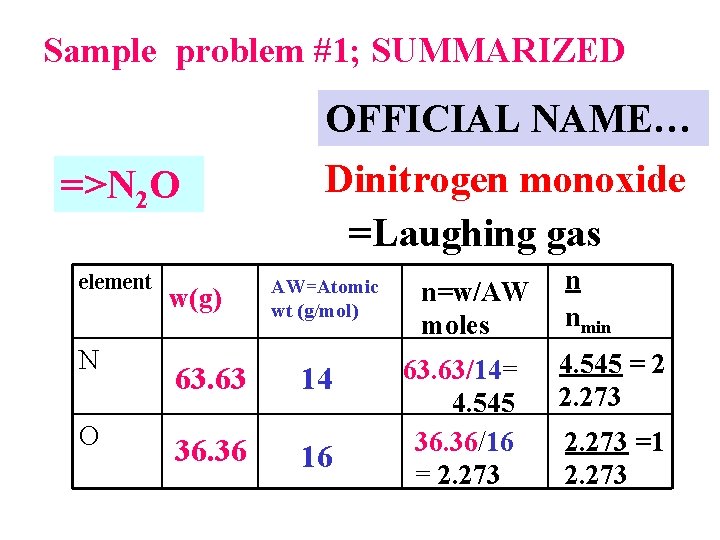
Sample problem #1; SUMMARIZED OFFICIAL NAME… =>N 2 O element N O w(g) 63. 63 36. 36 Dinitrogen monoxide =Laughing gas AW=Atomic wt (g/mol) 14 16 n=w/AW moles 63. 63/14= 4. 545 36. 36/16 = 2. 273 n nmin 4. 545 = 2 2. 273 =1 2. 273
Joseph Priestley 1772 http: //www. youtube. com/watch? v=_Ha-Zr. UPJ_E
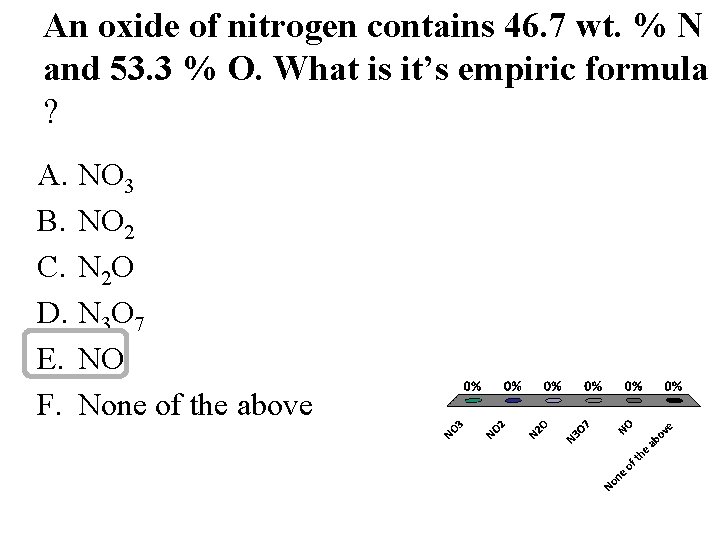
An oxide of nitrogen contains 46. 7 wt. % N and 53. 3 % O. What is it’s empiric formula ? A. NO 3 B. NO 2 C. N 2 O D. N 3 O 7 E. NO F. None of the above
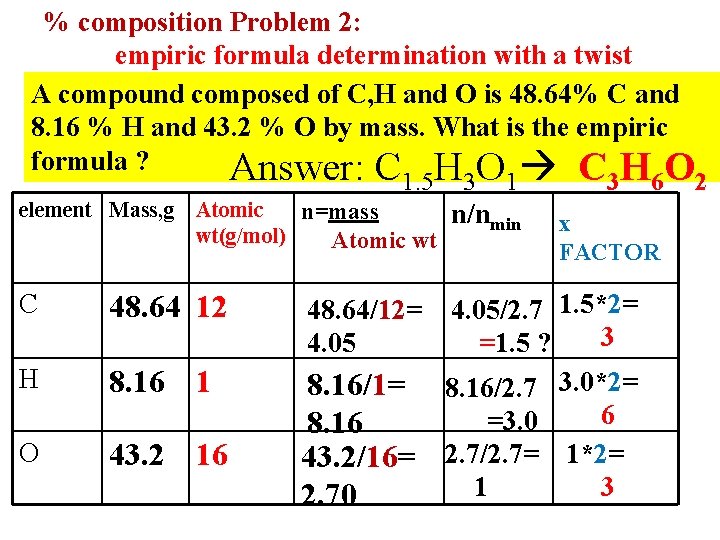
% composition Problem 2: empiric formula determination with a twist A compound composed of C, H and O is 48. 64% C and 8. 16 % H and 43. 2 % O by mass. What is the empiric formula ? Answer: C H O 1. 5 3 1 3 element Mass, g Atomic n=mass wt(g/mol) Atomic wt n/nmin C 48. 64 12 48. 64/12= 4. 05 H 8. 16 1 O 43. 2 16 8. 16/1= 8. 16 43. 2/16= 2. 70 4. 05/2. 7 1. 5*2= 3 =1. 5 ? 8. 16/2. 7 3. 0*2= 6 =3. 0 2. 7/2. 7= 1*2= 1 3 6 x FACTOR 2
- Slides: 21