
SOLVING GENETICS PROBLEMS Biology Unit 6 Powerpoint 2
SOLVING GENETICS PROBLEMS Biology Unit 6 Powerpoint #2 / Chapter 11 Mr. Velekei
Vocabulary 9. Phenotype 10. Genotype 11. Dominant 12. Recessive 13. Homozygous 14. Heterozygous
Unit 6: Genetics





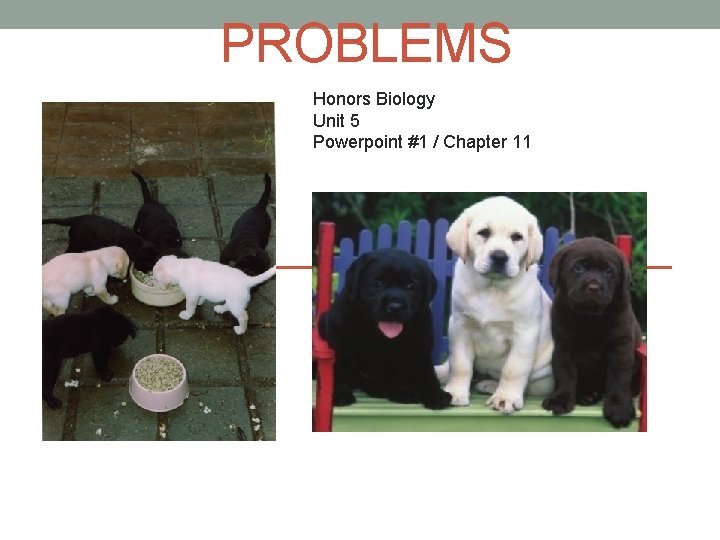
PROBLEMS Honors Biology Unit 5 Powerpoint #1 / Chapter 11
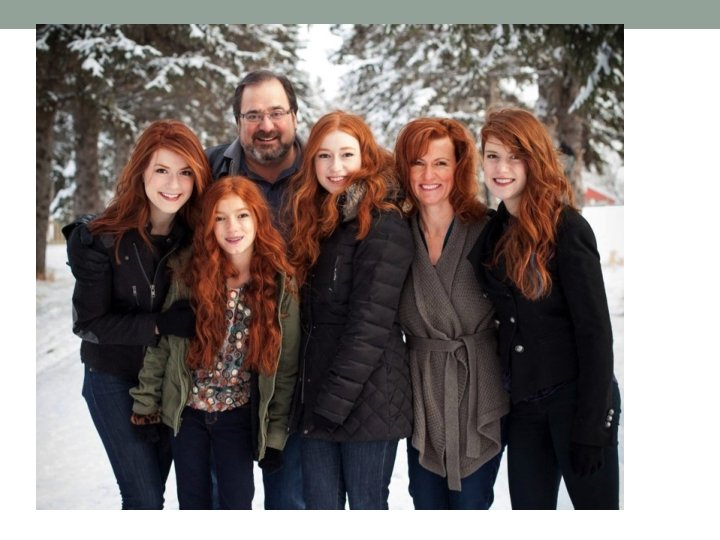
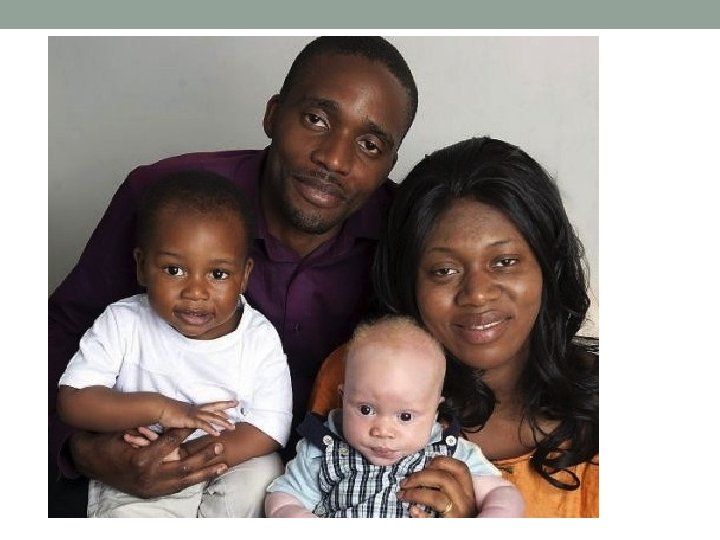
Traits • What are some of your traits? • Where did they come from? • Do you look like one of your parents, a combination, or neither? • Do certain traits “run” in your family? Or pop up after skipping a generation • What traits are common in our class? why do you think that is?
Terminology Gene: segment of DNA that determines a trait (protein) Alleles: different forms of a gene (ex: Height: tall allele, or short allele)
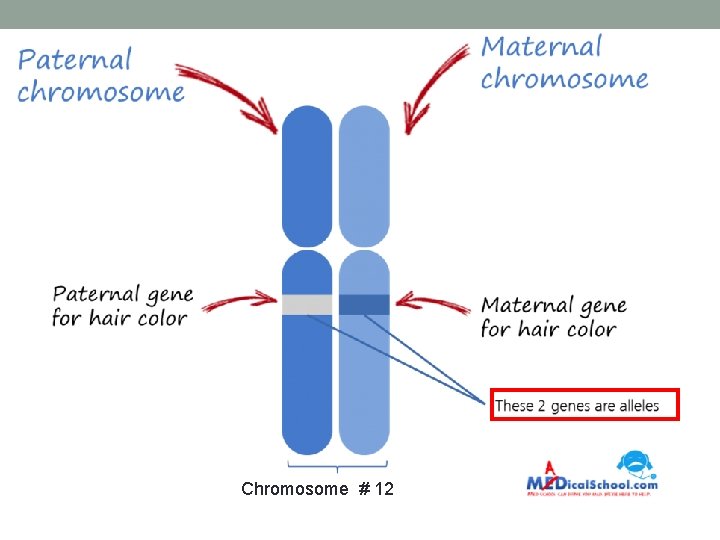
Chromosome # 12
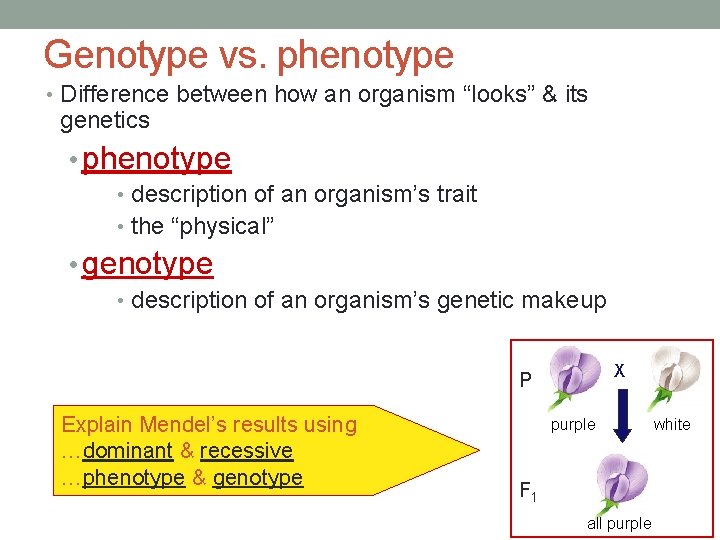
Genotype vs. phenotype • Difference between how an organism “looks” & its genetics • phenotype • description of an organism’s trait • the “physical” • genotype • description of an organism’s genetic makeup X P Explain Mendel’s results using …dominant & recessive …phenotype & genotype purple F 1 all purple white
Notation A capital letter represents the dominant allele. A lower case letter represents the recessive allele. Example: Pea plant height – Tall: T Short: t
Remember… Dominant: An allele that causes its phenotype in a heterozygous genotype. Examples: TT, Tt (Tall) • Recessive: An allele that causes a phenotype only seen in a homozygous genotype. Example: tt (short) •
Allele: A variety of a gene • A gene for hair color could have the B allele: _______ for Brown hair or b _______ for Blonde hair • A gene for flower color could have B allele: ______for blue flower or b ____ for red flower • A gene for height could have the alleles: _______ for tall or _______ for T t short
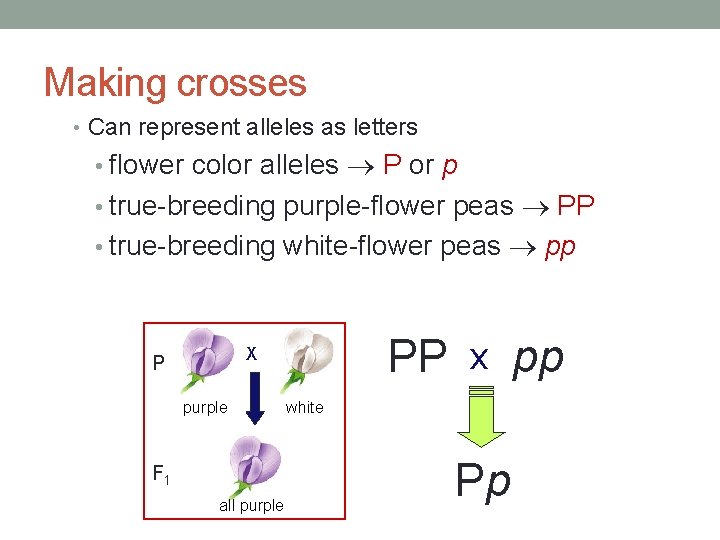
Making crosses • Can represent alleles as letters • flower color alleles P or p • true-breeding purple-flower peas PP • true-breeding white-flower peas pp PP x pp X P purple F 1 all purple white Pp
Solving Genetics Problems Homozygous: organism with two identical alleles for a trait Heterozygous: organism with two different alleles for a trait
Solving Genetics Problems Homozygous dominant: organism with two dominant alleles Homozygous recessive: organism with two recessive alleles
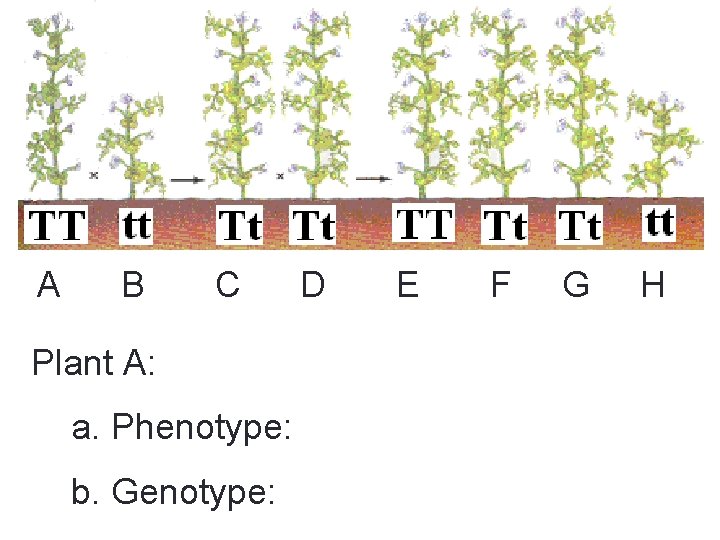
A B C Plant A: a. Phenotype: b. Genotype: D E F G H
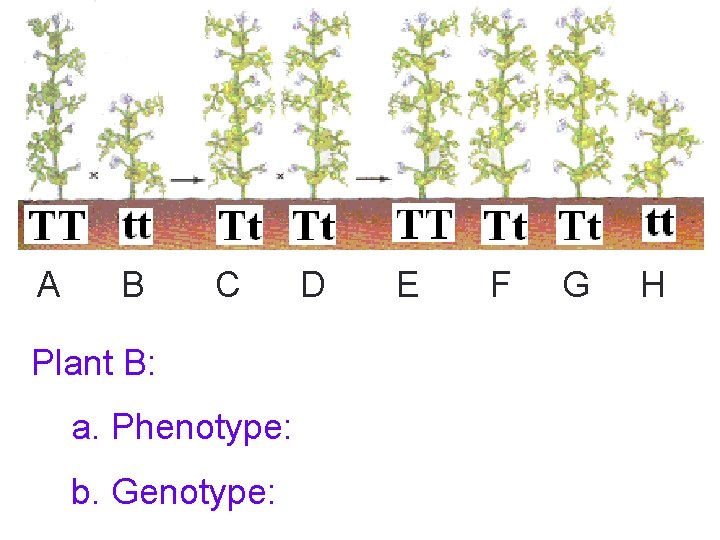
A B C Plant B: a. Phenotype: b. Genotype: D E F G H
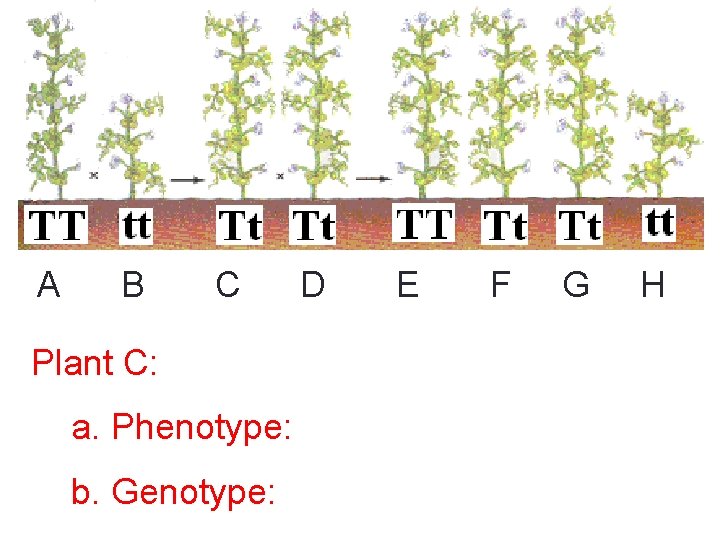
A B C Plant C: a. Phenotype: b. Genotype: D E F G H
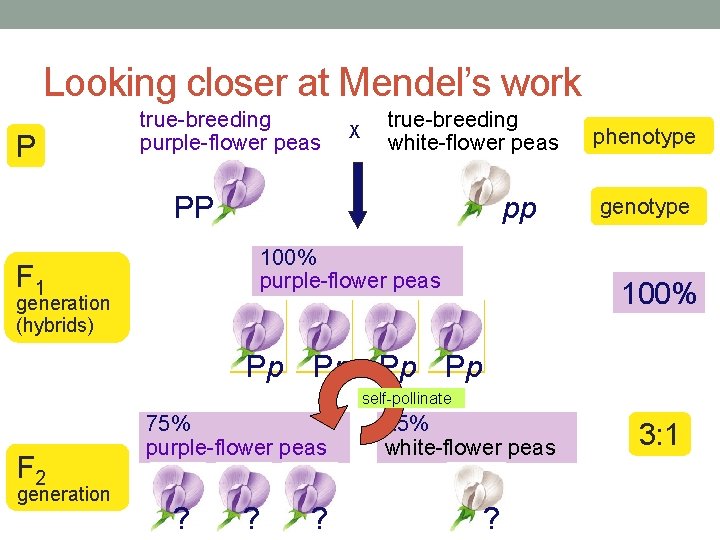
Looking closer at Mendel’s work P true-breeding purple-flower peas X true-breeding white-flower peas PP pp 100% purple-flower peas F 1 generation (hybrids) phenotype genotype 100% Pp Pp self-pollinate F 2 generation 75% purple-flower peas ? ? ? 25% white-flower peas ? 3: 1
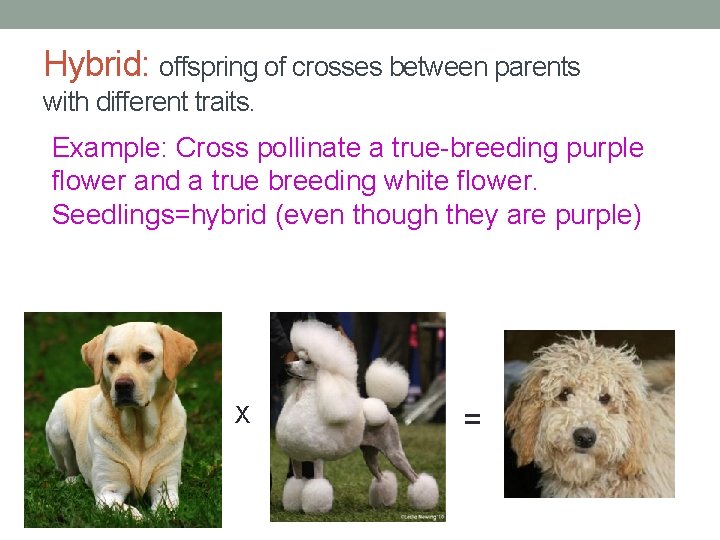
Hybrid: offspring of crosses between parents with different traits. Example: Cross pollinate a true-breeding purple flower and a true breeding white flower. Seedlings=hybrid (even though they are purple) X =
Hybrid Cars Gas + Electric
Solving Genetics Problems We need a method to predict the traits of the offspring, and we have it, its called the Punnett Square!
Solving Genetics Problems Goal: to predict the traits of offspring 1. Identify trait(s) and assign a letter to each (capital letter for dominant, lower case letter for recessive)
Solving Genetics Problems Goal: to predict the traits of offspring 1. Identify trait(s) and assign a letter to each (capital letter for dominant, lower case letter for recessive) 2. Determine parents’ genotypes
Solving Genetics Problems Goal: to predict the traits of offspring 1. Identify trait(s) and assign a letter to each (capital letter for dominant, lower case letter for recessive) 2. Determine parents’ genotypes 3. Draw Punnett square and fill in
Solving Genetics Problems Goal: to predict the traits of offspring 1. Identify trait(s) and assign a letter to each (capital letter for dominant, lower case letter for recessive) 2. Determine parents’ genotypes 3. Draw Punnett square and fill in 4. Determine the probabilities for offspring of each genotype and phenotype
Solving Genetics Problems Example: In pea plants, the gene for tall height is dominant to the gene for short height. A short pea plant is cross pollinated with a true breeding tall pea plant. 1. Assign letters: tall = T short = t 2. Parents’ genotypes True breeding tall: TT True breeding short = tt
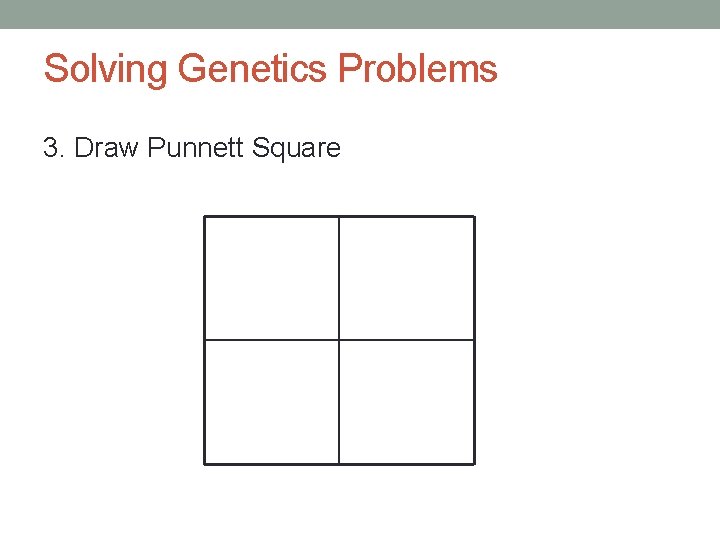
Solving Genetics Problems 3. Draw Punnett Square
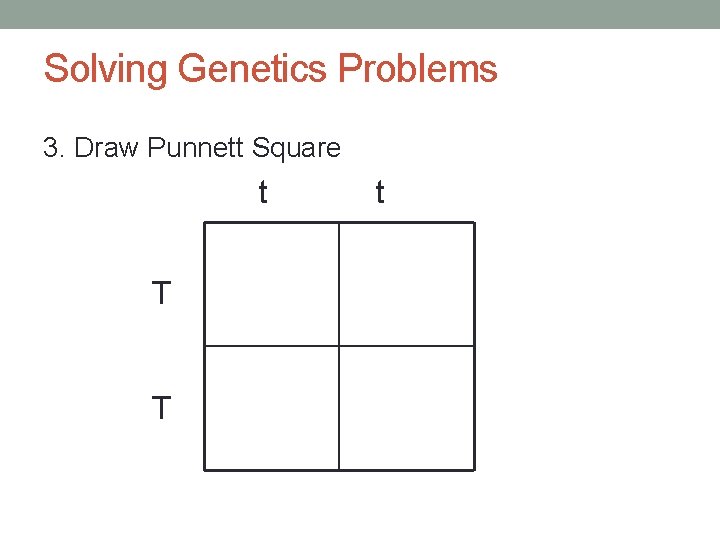
Solving Genetics Problems 3. Draw Punnett Square t T T t
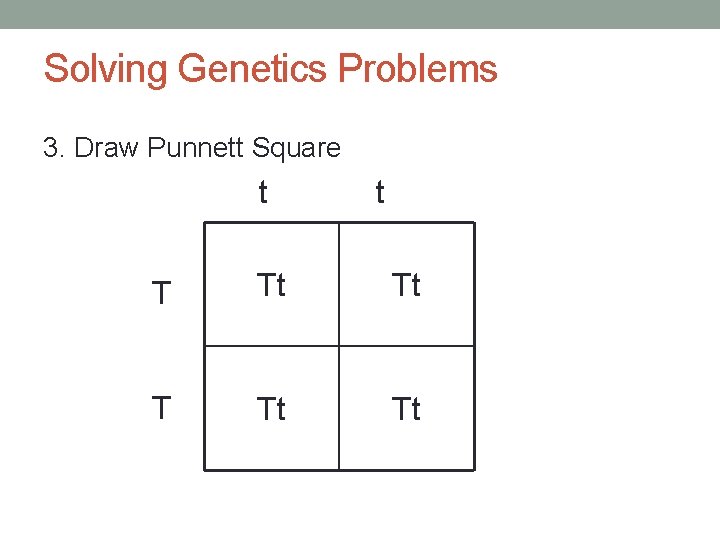
Solving Genetics Problems 3. Draw Punnett Square t t T Tt Tt
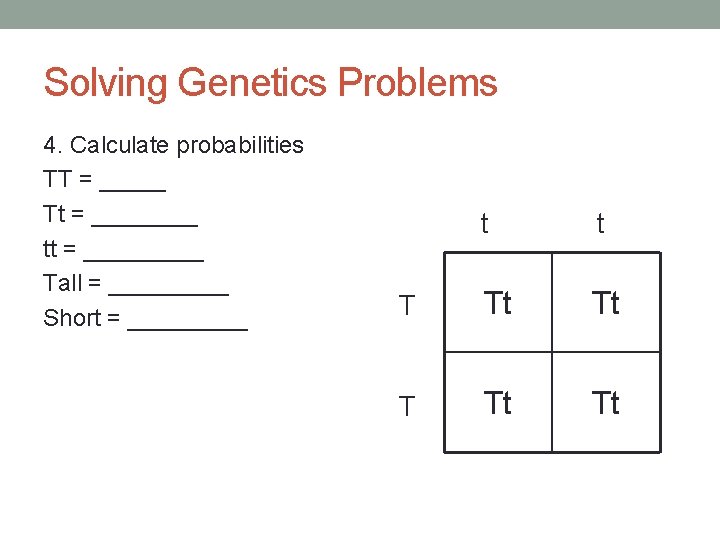
Solving Genetics Problems 4. Calculate probabilities TT = _____ Tt = ____ tt = _____ Tall = _____ Short = _____ t t T Tt Tt
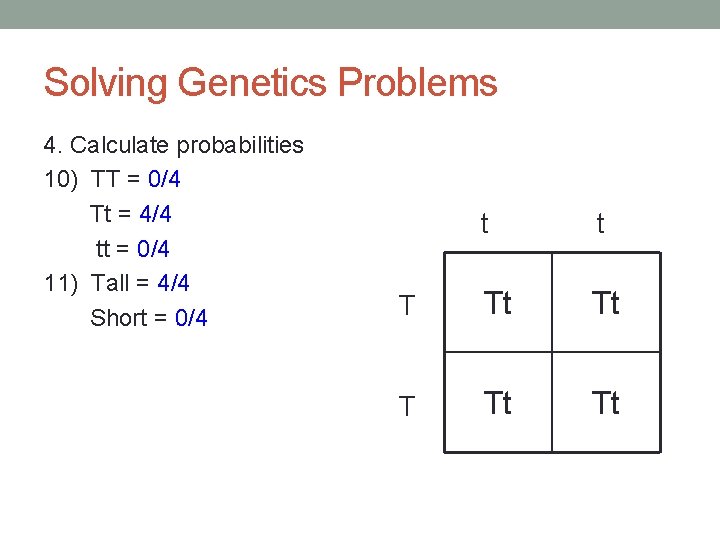
Solving Genetics Problems 4. Calculate probabilities 10) TT = 0/4 Tt = 4/4 tt = 0/4 11) Tall = 4/4 Short = 0/4 t t T Tt Tt
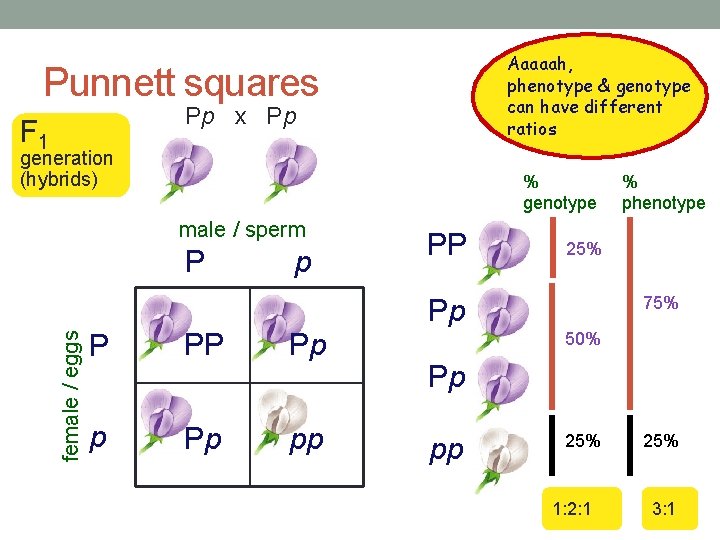
Aaaaah, phenotype & genotype can have different ratios Punnett squares Pp x Pp F 1 generation (hybrids) % genotype male / sperm P p PP 25% 75% female / eggs Pp P PP Pp pp % phenotype 50% Pp pp 25% 1: 2: 1 25% 3: 1
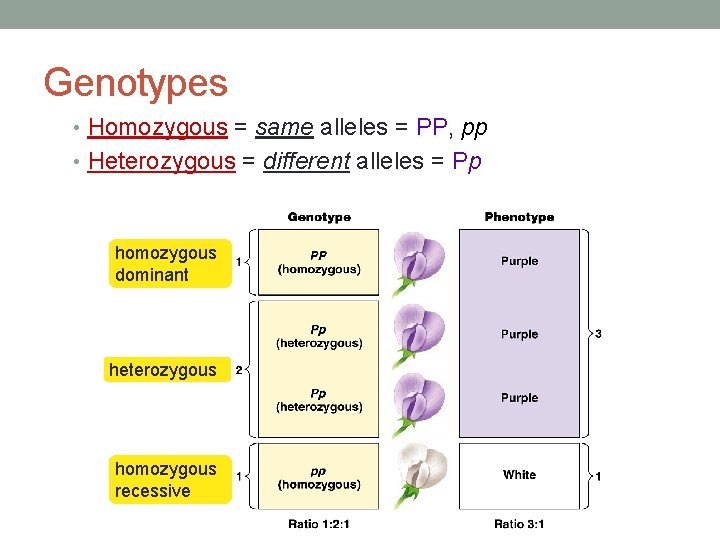
Genotypes • Homozygous = same alleles = PP, pp • Heterozygous = different alleles = Pp homozygous dominant heterozygous homozygous recessive
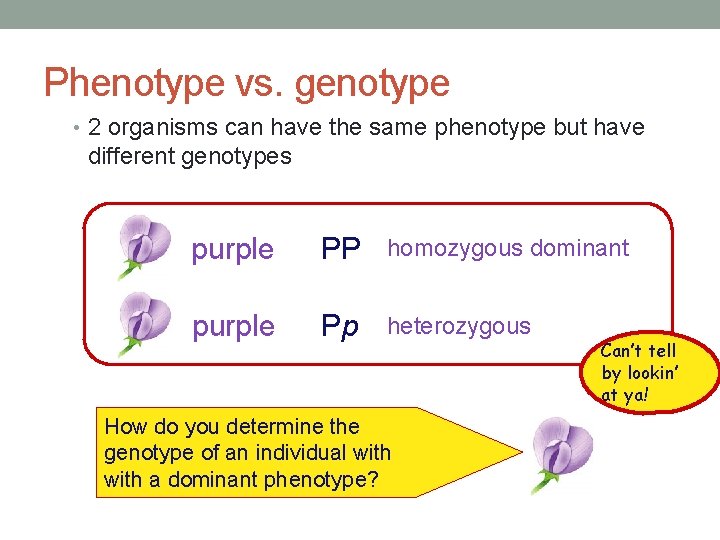
Phenotype vs. genotype • 2 organisms can have the same phenotype but have different genotypes purple PP homozygous dominant purple Pp heterozygous How do you determine the genotype of an individual with a dominant phenotype? Can’t tell by lookin’ at ya!
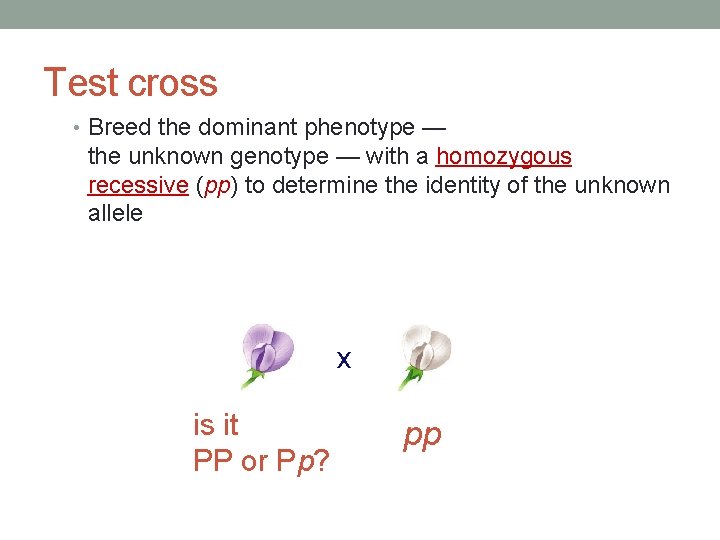
Test cross • Breed the dominant phenotype — the unknown genotype — with a homozygous recessive (pp) to determine the identity of the unknown allele x is it PP or Pp? pp
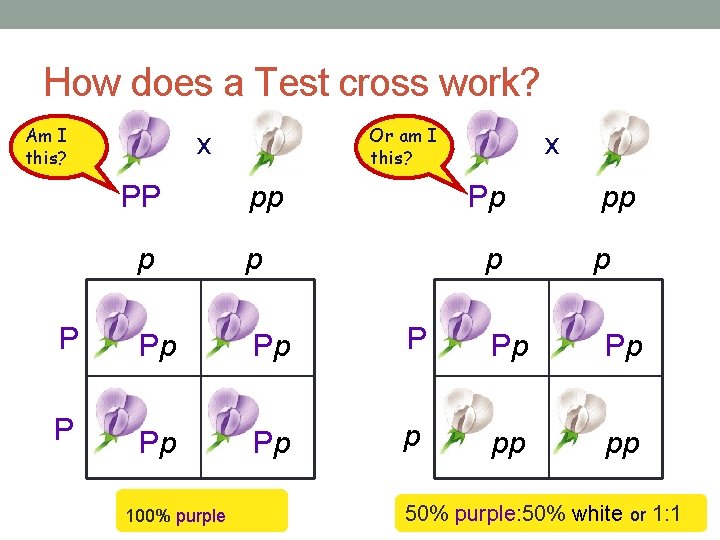
How does a Test cross work? Am I this? Or am I this? x PP pp x Pp p p P Pp Pp p pp pp 100% purple p pp p 50% purple: 50% white or 1: 1
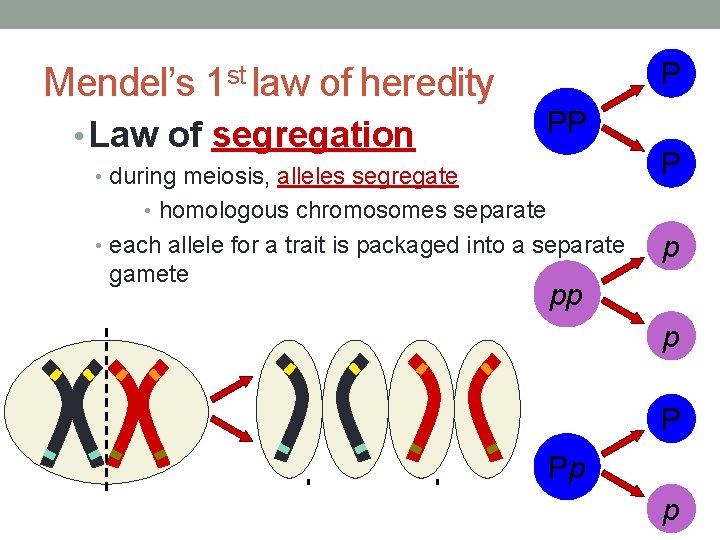
P Mendel’s 1 st law of heredity • Law of segregation PP P • during meiosis, alleles segregate • homologous chromosomes separate • each allele for a trait is packaged into a separate gamete p pp p P Pp p
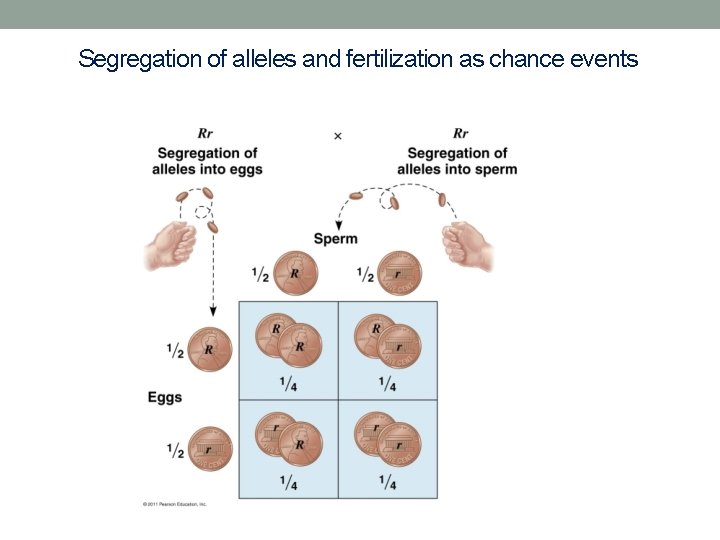
Segregation of alleles and fertilization as chance events
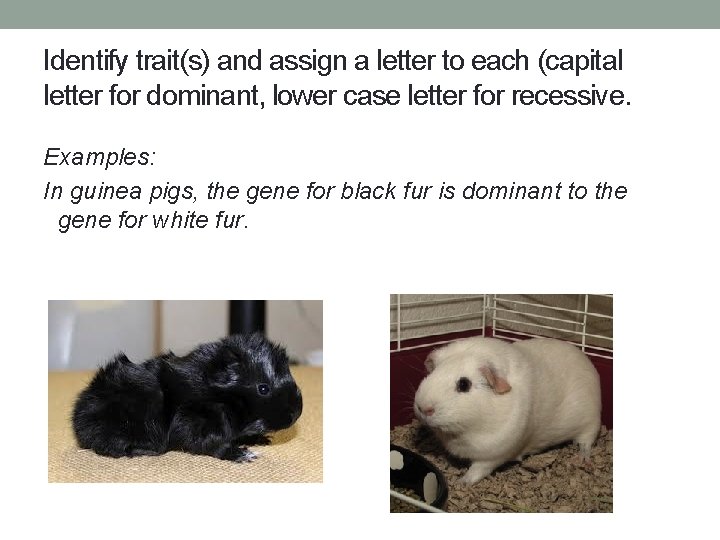
Identify trait(s) and assign a letter to each (capital letter for dominant, lower case letter for recessive. Examples: In guinea pigs, the gene for black fur is dominant to the gene for white fur.
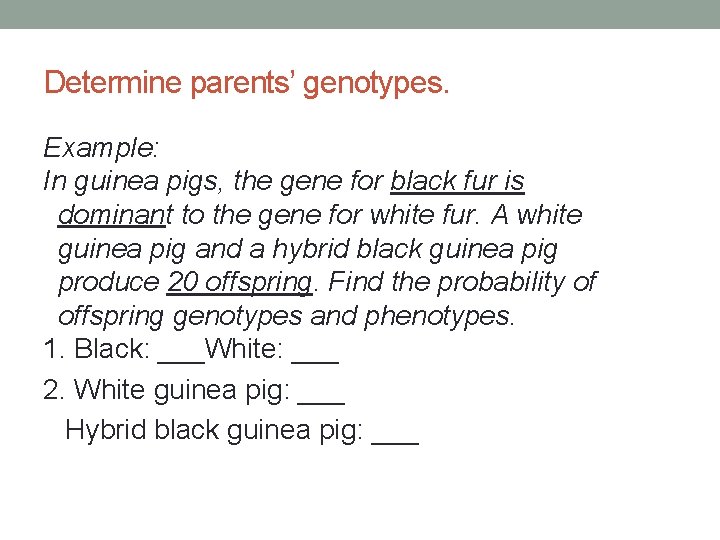
Determine parents’ genotypes. Example: In guinea pigs, the gene for black fur is dominant to the gene for white fur. A white guinea pig and a hybrid black guinea pig produce 20 offspring. Find the probability of offspring genotypes and phenotypes. 1. Black: ___White: ___ 2. White guinea pig: ___ Hybrid black guinea pig: ___
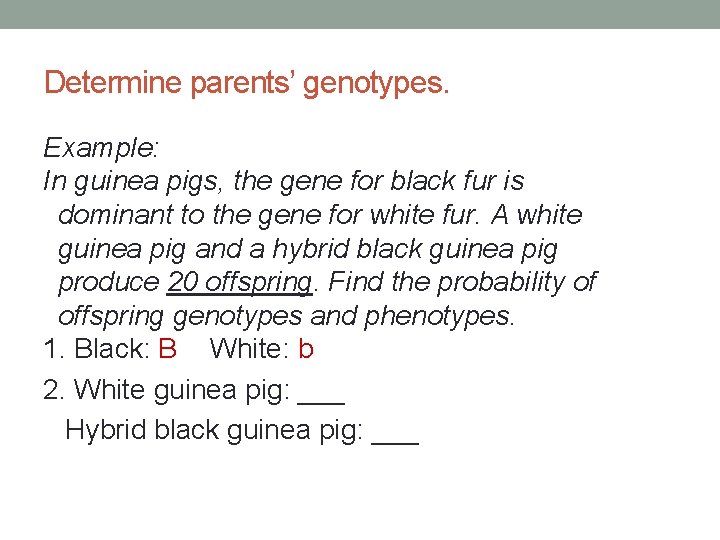
Determine parents’ genotypes. Example: In guinea pigs, the gene for black fur is dominant to the gene for white fur. A white guinea pig and a hybrid black guinea pig produce 20 offspring. Find the probability of offspring genotypes and phenotypes. 1. Black: B White: b 2. White guinea pig: ___ Hybrid black guinea pig: ___
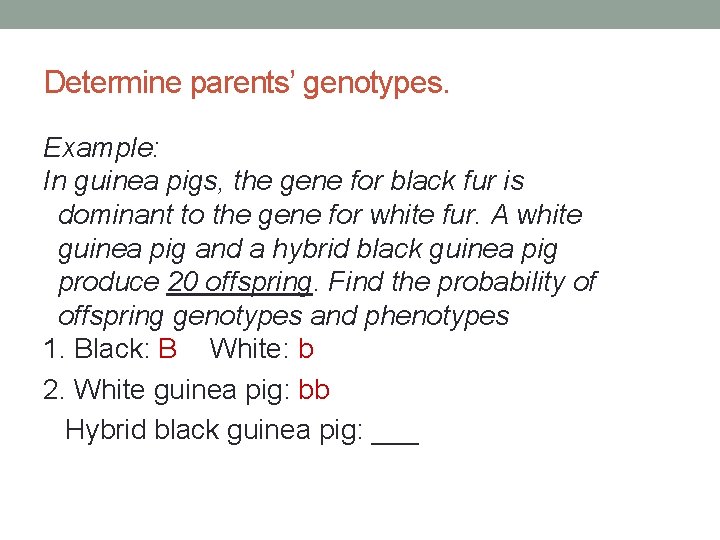
Determine parents’ genotypes. Example: In guinea pigs, the gene for black fur is dominant to the gene for white fur. A white guinea pig and a hybrid black guinea pig produce 20 offspring. Find the probability of offspring genotypes and phenotypes 1. Black: B White: b 2. White guinea pig: bb Hybrid black guinea pig: ___
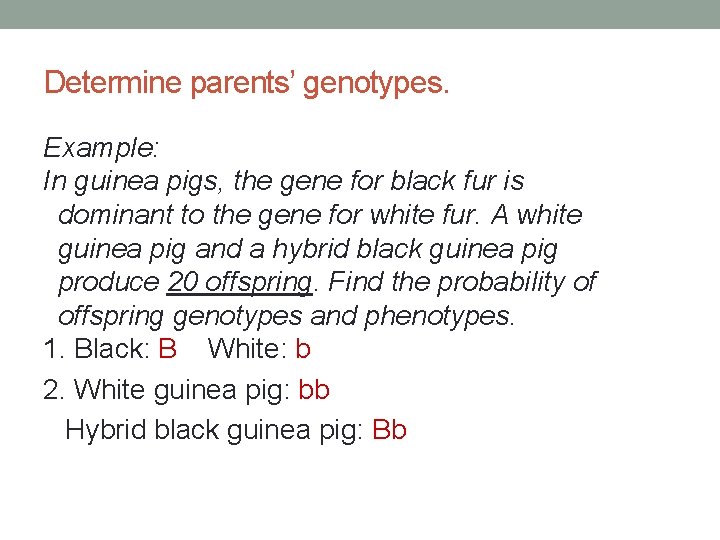
Determine parents’ genotypes. Example: In guinea pigs, the gene for black fur is dominant to the gene for white fur. A white guinea pig and a hybrid black guinea pig produce 20 offspring. Find the probability of offspring genotypes and phenotypes. 1. Black: B White: b 2. White guinea pig: bb Hybrid black guinea pig: Bb
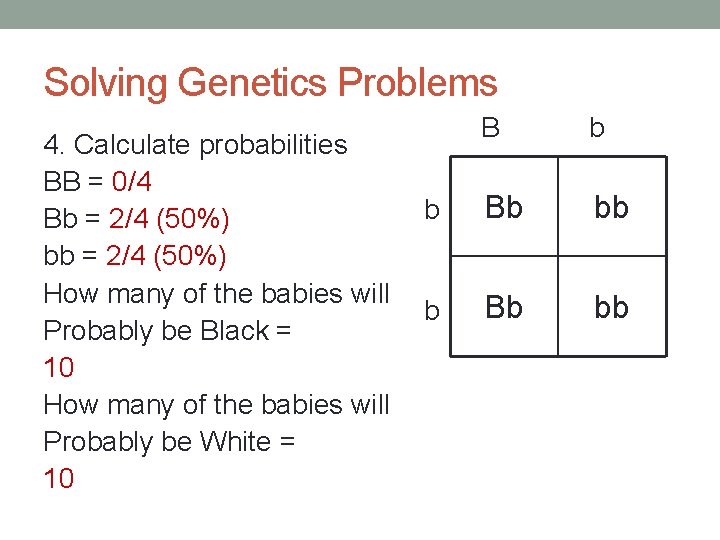
Solving Genetics Problems 4. Calculate probabilities BB = 0/4 Bb = 2/4 (50%) bb = 2/4 (50%) How many of the babies will Probably be Black = 10 How many of the babies will Probably be White = 10 B b b Bb bb
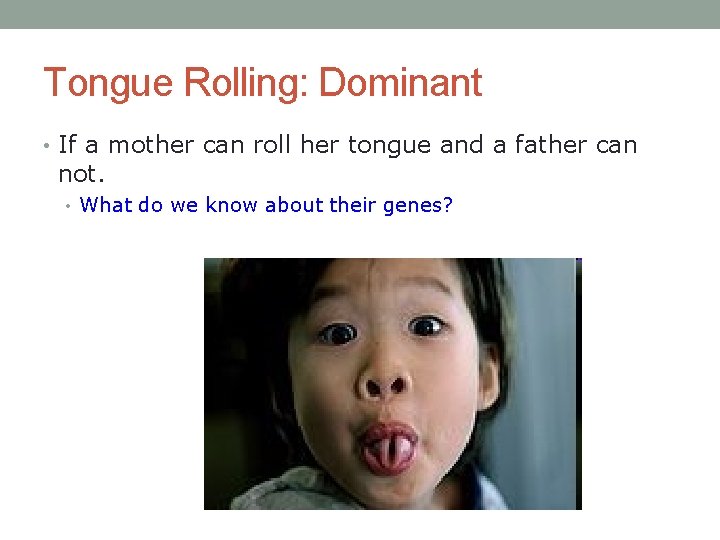
Tongue Rolling: Dominant • If a mother can roll her tongue and a father can not. • What do we know about their genes?
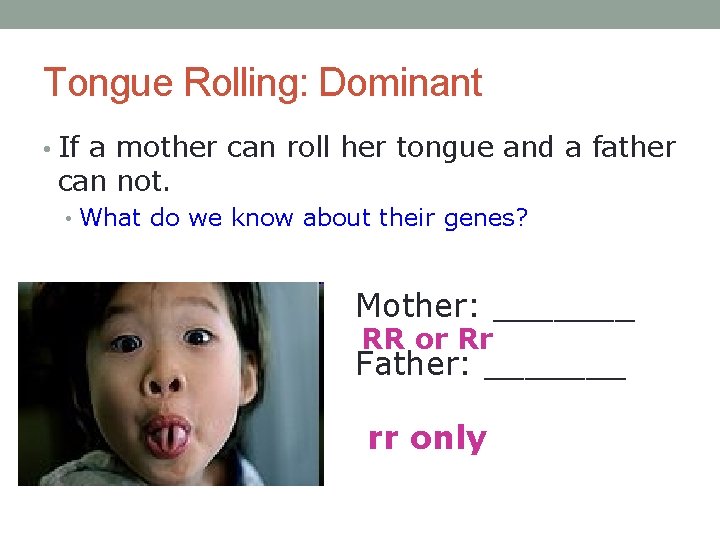
Tongue Rolling: Dominant • If a mother can roll her tongue and a father can not. • What do we know about their genes? Mother: _______ RR or Rr Father: _______ rr only
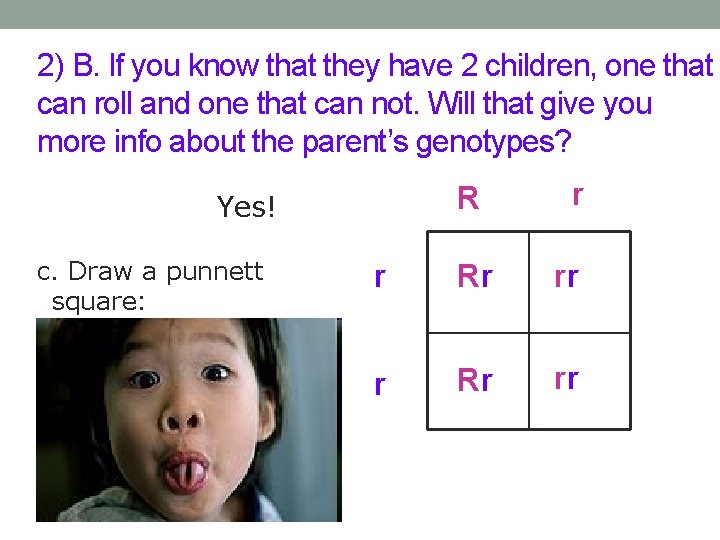
2) B. If you know that they have 2 children, one that can roll and one that can not. Will that give you more info about the parent’s genotypes? R Yes! c. Draw a punnett square: r r Rr rr
Tongue Rolling: Dominant d. Which people in the family would be considered hybrids? Mom and the child that can roll their tongue e. Are their any genotypes that this mother and father can not produce in their offspring? Why or why not? Yes, they can not produce a Homozygous Dominant (RR) child because the father only has recessive genes (r) to pass on
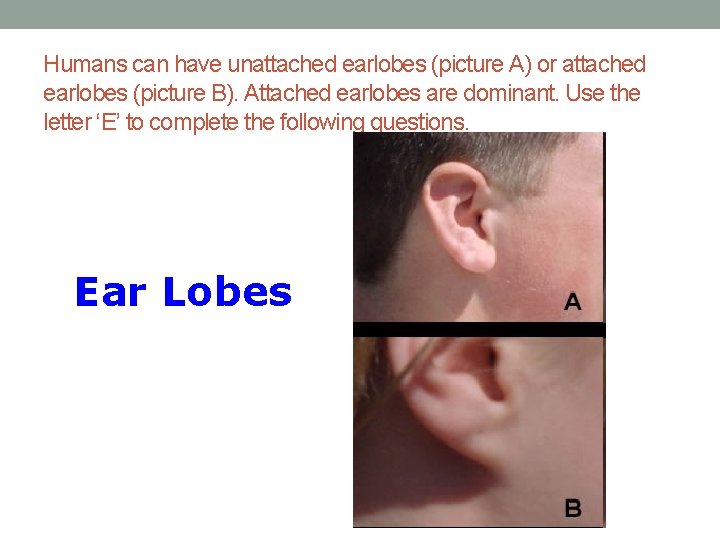
Humans can have unattached earlobes (picture A) or attached earlobes (picture B). Attached earlobes are dominant. Use the letter ‘E’ to complete the following questions. Ear Lobes
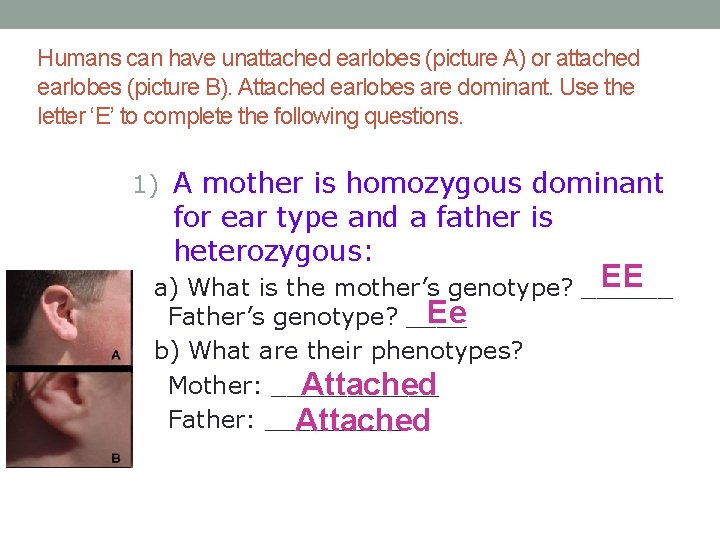
Humans can have unattached earlobes (picture A) or attached earlobes (picture B). Attached earlobes are dominant. Use the letter ‘E’ to complete the following questions. 1) A mother is homozygous dominant for ear type and a father is heterozygous: EE a) What is the mother’s genotype? ______ Ee Father’s genotype? ____ b) What are their phenotypes? Mother: ______ Attached Father: _____ Attached

1) A mother is homozygous dominant for ear type and a father is heterozygous: • Draw a punnett square: E e E EE Ee
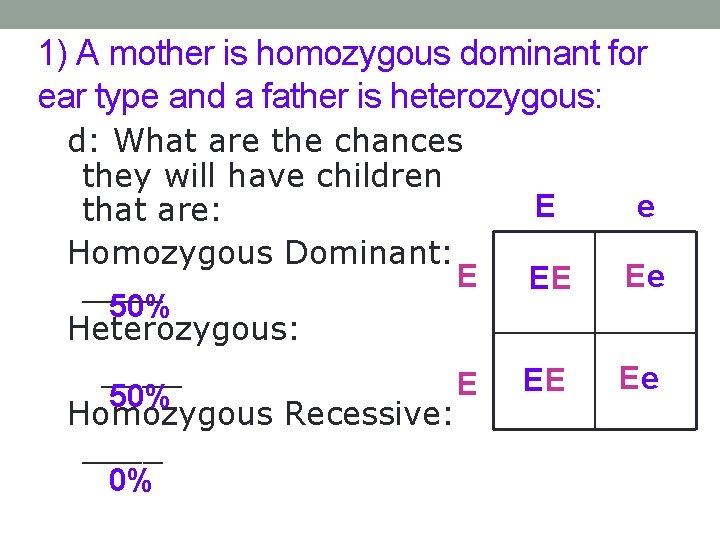
1) A mother is homozygous dominant for ear type and a father is heterozygous: d: What are the chances they will have children that are: Homozygous Dominant: E ____ 50% Heterozygous: ____ E 50% Homozygous Recessive: ____ 0% E e EE Ee
DIHYBRID (2 FACTOR) CROSSES + INCOMPLETE AND CODOMINANCE
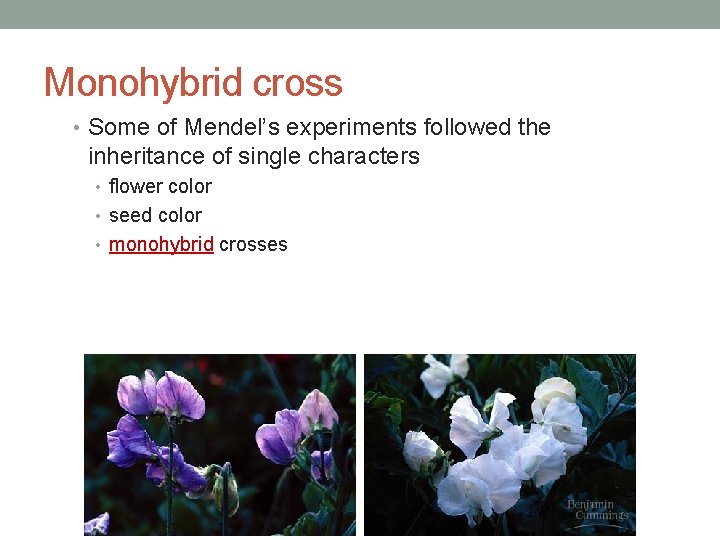
Monohybrid cross • Some of Mendel’s experiments followed the inheritance of single characters • flower color • seed color • monohybrid crosses
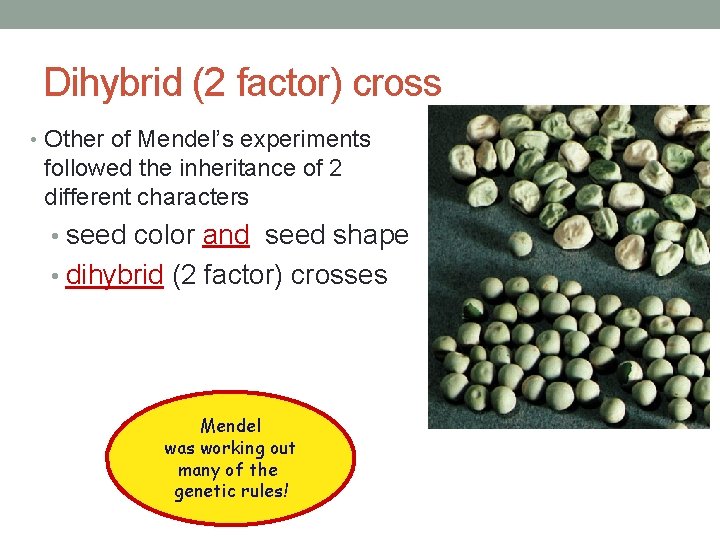
Dihybrid (2 factor) cross • Other of Mendel’s experiments followed the inheritance of 2 different characters • seed color and seed shape • dihybrid (2 factor) crosses Mendel was working out many of the genetic rules!
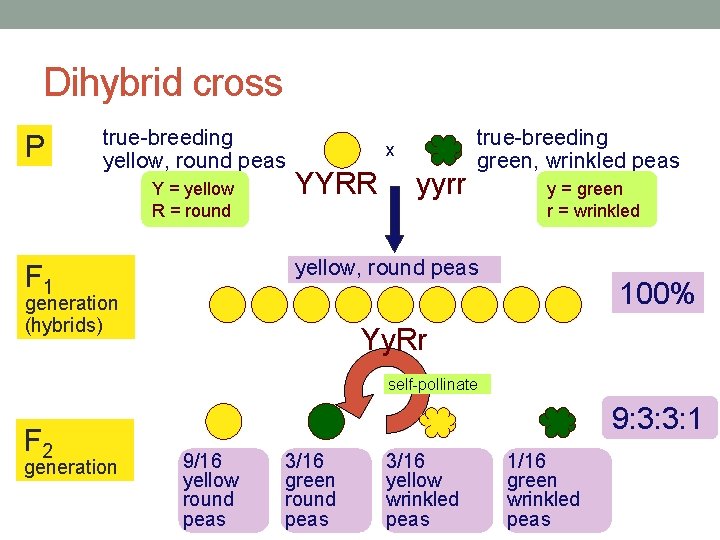
Dihybrid cross P true-breeding yellow, round peas Y = yellow R = round x YYRR yyrr true-breeding green, wrinkled peas y = green r = wrinkled yellow, round peas F 1 generation (hybrids) 100% Yy. Rr self-pollinate F 2 generation 9: 3: 3: 1 9/16 yellow round peas 3/16 green round peas 3/16 yellow wrinkled peas 1/16 green wrinkled peas
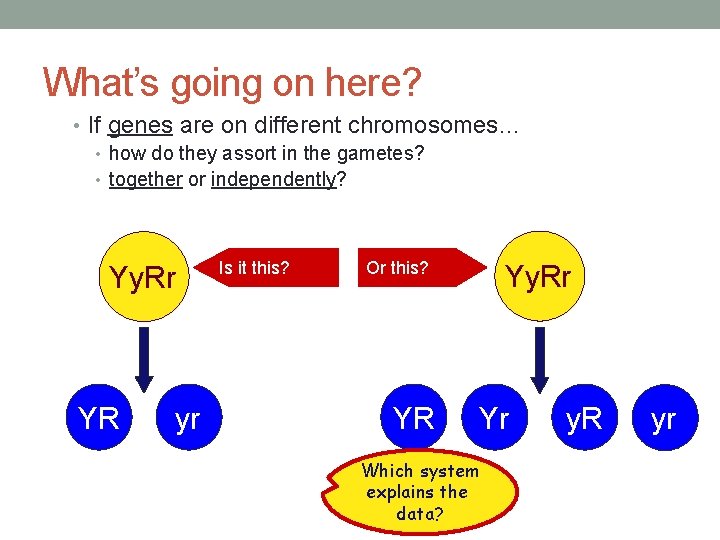
What’s going on here? • If genes are on different chromosomes… • how do they assort in the gametes? • together or independently? Yy. Rr YR yr Is it this? Or this? YR Which system explains the data? Yy. Rr Yr y. R yr
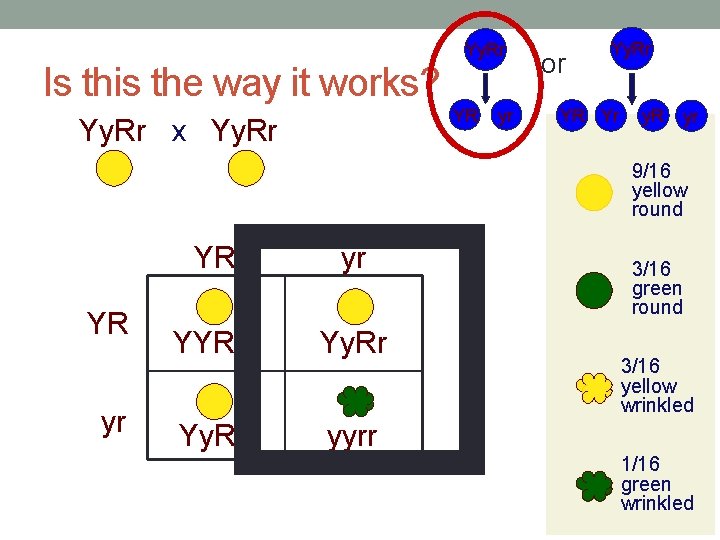
Is this the way it works? YR Yy. Rr x Yy. Rr YR yr Yy. Rr yr � YR yr YYRR Yy. Rr yyrr or Yy. Rr YR Yr y. R yr 9/16 yellow round 3/16 green round 3/16 yellow wrinkled 1/16 green wrinkled
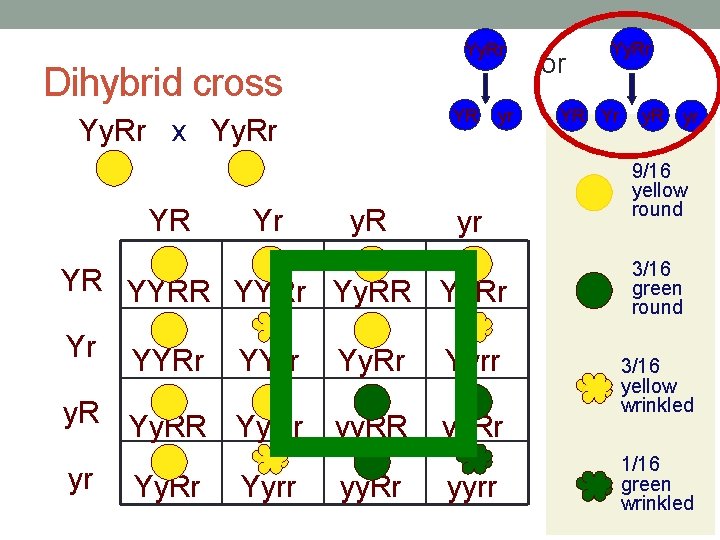
Yy. Rr Dihybrid cross YR Yy. Rr x Yy. Rr YR Yr y. R yr yr � YR YYRr Yy. RR Yy. Rr Yr YYrr Yy. Rr Yyrr y. R Yy. Rr yy. RR yy. Rr yr YYRr Yyrr yy. Rr yyrr or Yy. Rr YR Yr y. R yr 9/16 yellow round 3/16 green round 3/16 yellow wrinkled 1/16 green wrinkled
The laws of probability govern Mendelian inheritance • Rule of Multiplication: • probability that 2+ independent events will occur together in a specific combination multiply probabilities of each event • Ex. 1: probability of throwing 2 sixes • 1/6 x 1/6 = 1/36 • Ex. 2: probability of having 5 boys in a row • ½ x ½ x ½ = 1/32
The laws of probability govern Mendelian inheritance • Rule of Addition: • Probability that 2+ mutually exclusive events will occur add together individual probabilities • Ex. 1: chances of throwing a die that will land on 4 or 5? • 1/6 + 1/6 = 1/3
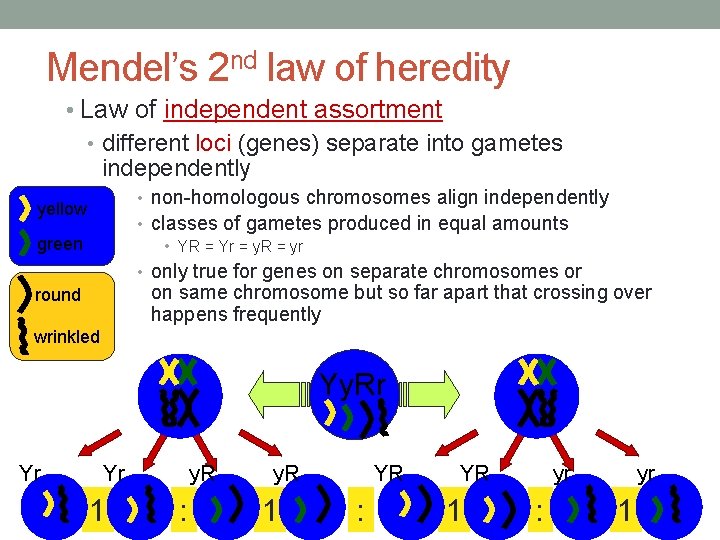
Mendel’s 2 nd law of heredity • Law of independent assortment • different loci (genes) separate into gametes independently • non-homologous chromosomes align independently • classes of gametes produced in equal amounts yellow green • YR = Yr = y. R = yr • only true for genes on separate chromosomes or on same chromosome but so far apart that crossing over happens frequently round wrinkled Yy. Rr Yr Yr 1 y. R : y. R 1 YR : YR 1 yr : yr 1
Review: Mendel’s laws of heredity • Law of segregation • monohybrid cross • single trait • each allele segregates into separate gametes • established by Metaphase 1 • Law of independent assortment • dihybrid (or more) cross • 2 or more traits • genes on separate chromosomes assort into gametes independently EXCEPTION § linked genes
Beyond Mendel’s Laws of Inheritance
Vocabulary 15. Co-dominance 16. Incomplete dominance 17. Probability
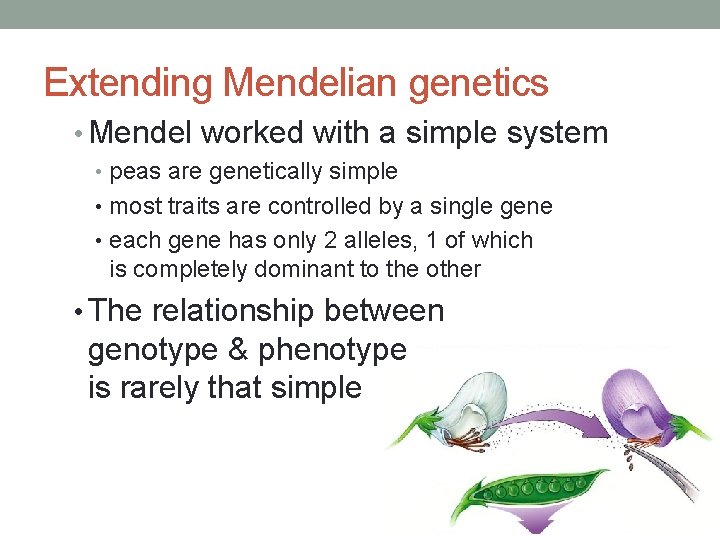
Extending Mendelian genetics • Mendel worked with a simple system • peas are genetically simple • most traits are controlled by a single gene • each gene has only 2 alleles, 1 of which is completely dominant to the other • The relationship between genotype & phenotype is rarely that simple
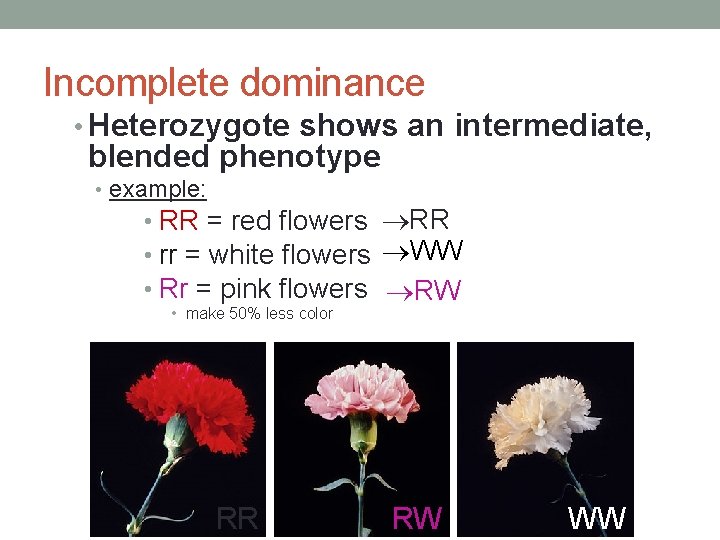
Incomplete dominance • Heterozygote shows an intermediate, blended phenotype • example: • RR = red flowers RR • rr = white flowers WW • Rr = pink flowers RW • make 50% less color RR RW WW
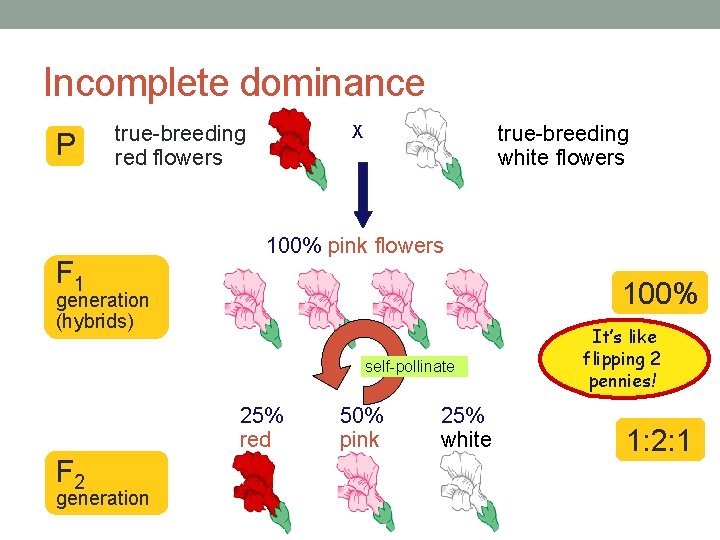
Incomplete dominance P true-breeding red flowers F 1 true-breeding white flowers X 100% pink flowers 100% generation (hybrids) self-pollinate 25% red F 2 generation 50% pink 25% white It’s like flipping 2 pennies! 1: 2: 1
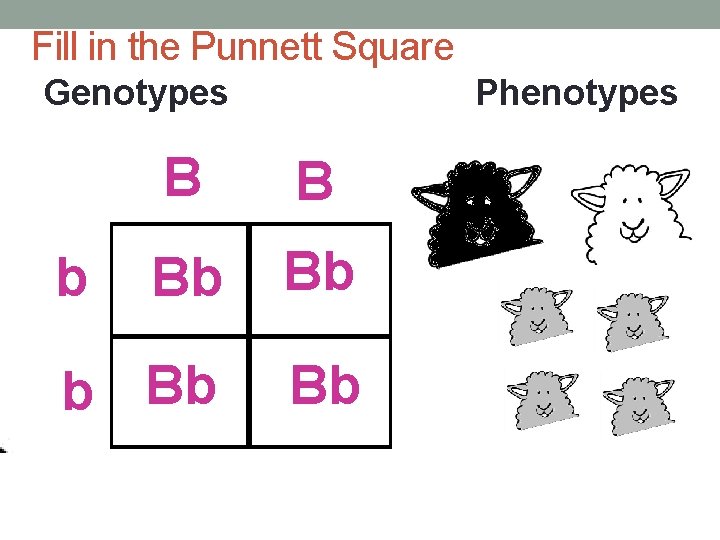
Fill in the Punnett Square Genotypes Phenotypes B B Bb Bb b
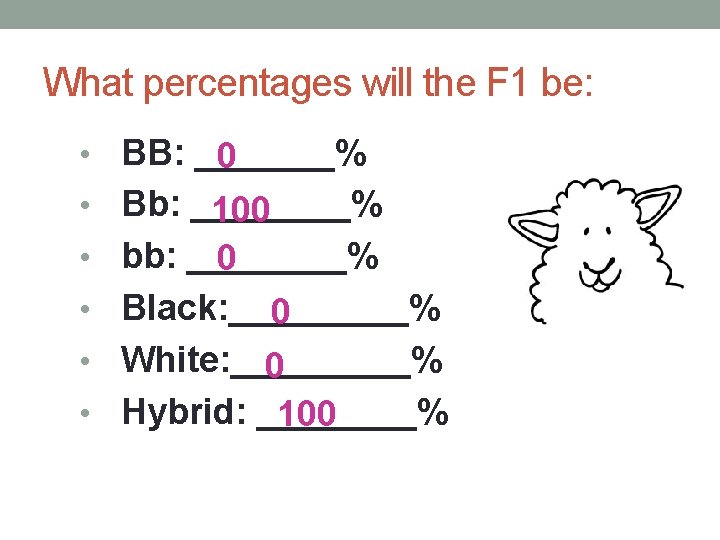
What percentages will the F 1 be: • • • BB: _______% 0 Bb: ____% 100 bb: ____% 0 Black: _____% 0 White: _____% 0 Hybrid: ____% 100
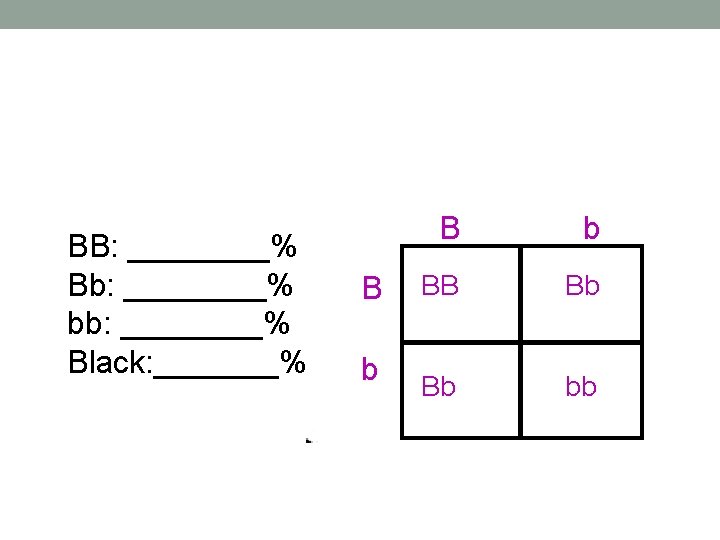
BB: ____% Bb: ____% bb: ____% Black: _______% B b BB Bb Bb bb
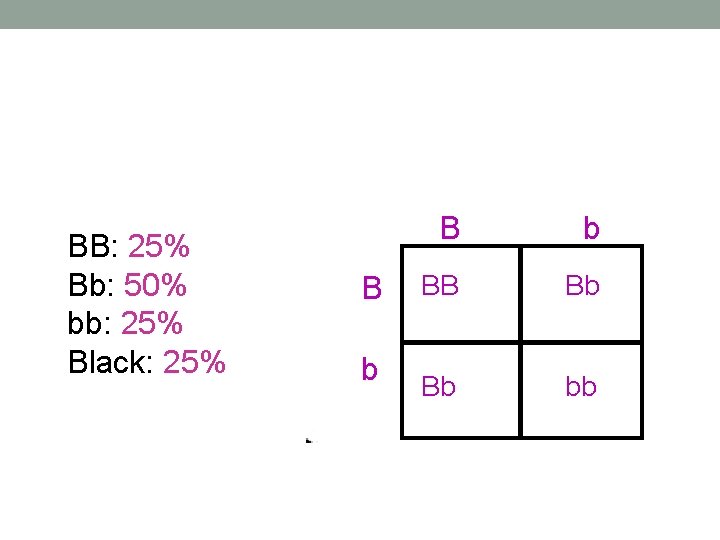
BB: 25% Bb: 50% bb: 25% Black: 25% B b BB Bb Bb bb
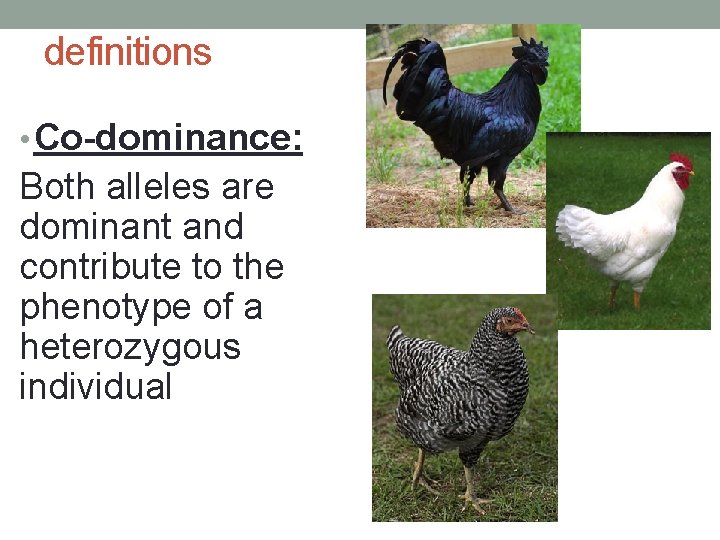
definitions • Co-dominance: Both alleles are dominant and contribute to the phenotype of a heterozygous individual
Solve the following crosses: Co-Dominance 3. In Cows the trait for coat (fur) color is expressed by FR for Red fur and FW for white fur. The hybrid of the two is called a Roan color (FRFW) a) Describe what you think the Roan cow’s fur will look like:
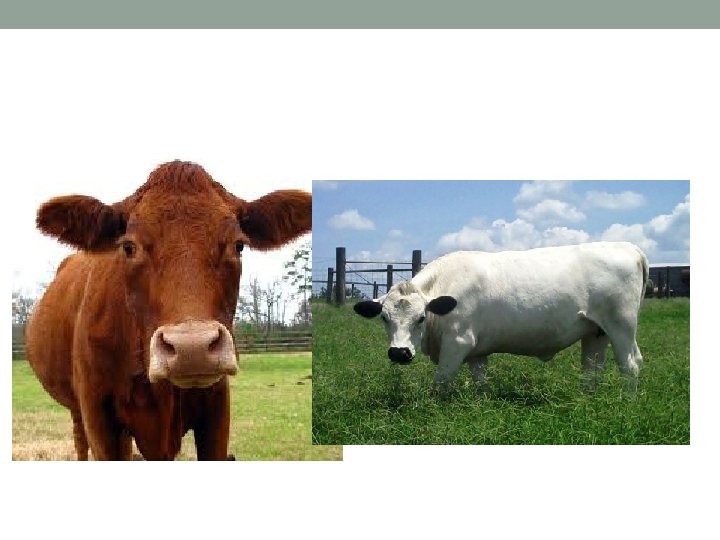
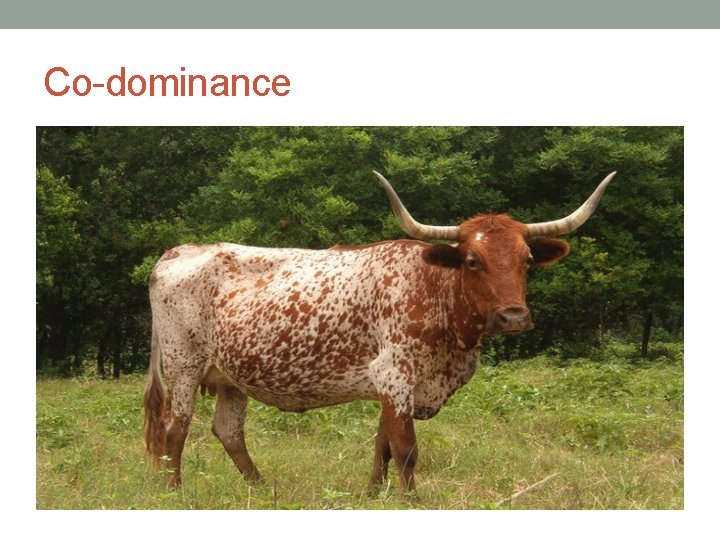
Co-dominance
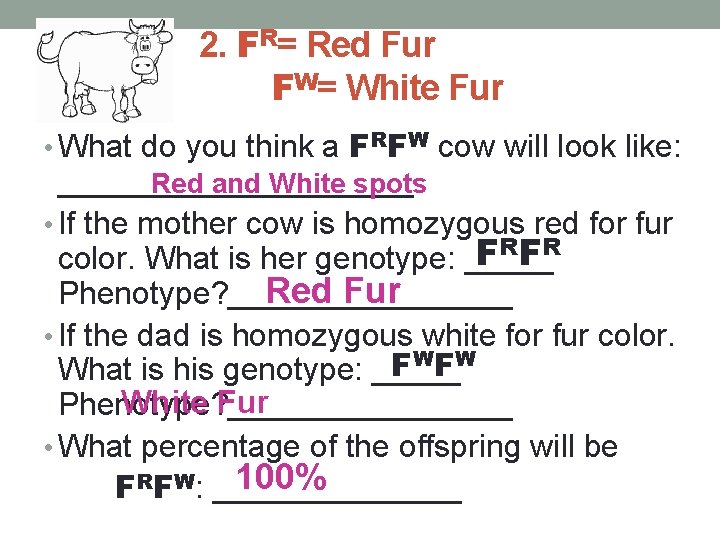
2. FR= Red Fur FW= White Fur • What do you think a FRFW cow will look like: __________ Red and White spots • If the mother cow is homozygous red for fur RF R F color. What is her genotype: _____ Red Fur Phenotype? ________ • If the dad is homozygous white for fur color. WFW F What is his genotype: _____ White Fur Phenotype? ________ • What percentage of the offspring will be 100% FRFW: _______
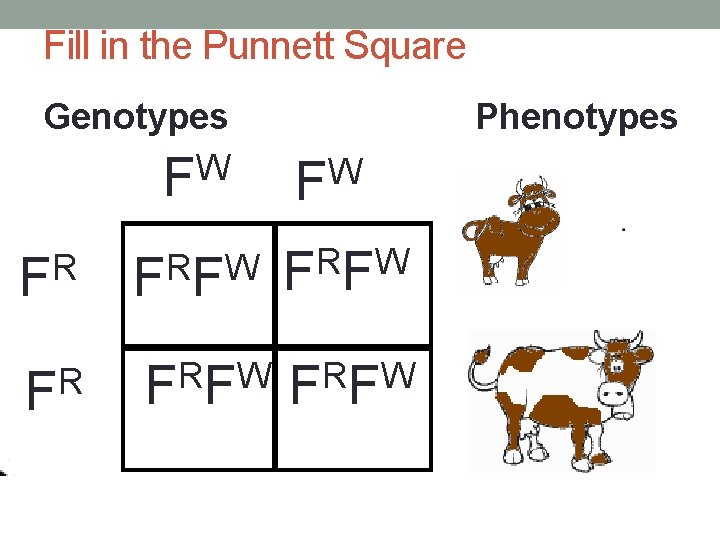
Fill in the Punnett Square Genotypes W F R F R W F F Phenotypes W F R W F F
Solve the following crosses: Co-Dominance In mushrooms there is a gene for Purple Spots (SP) and a gene for Green spots (SG). Cross a Homozygous purple with a Homozygous Green. a) What do you think their offspring will look like? Genotype? Phenotype? b) What will the genotype and phenotype percentages be in the F 2 when you cross two from the F 1 generation.
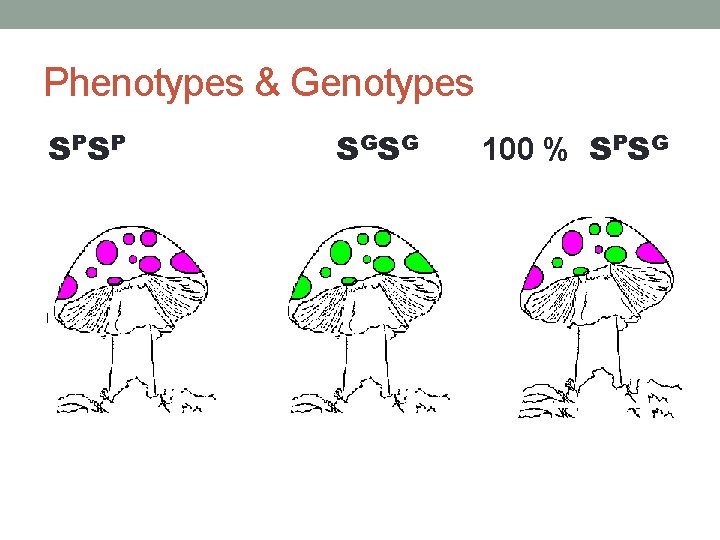
Phenotypes & Genotypes S PS P S GS G 100 % SPSG
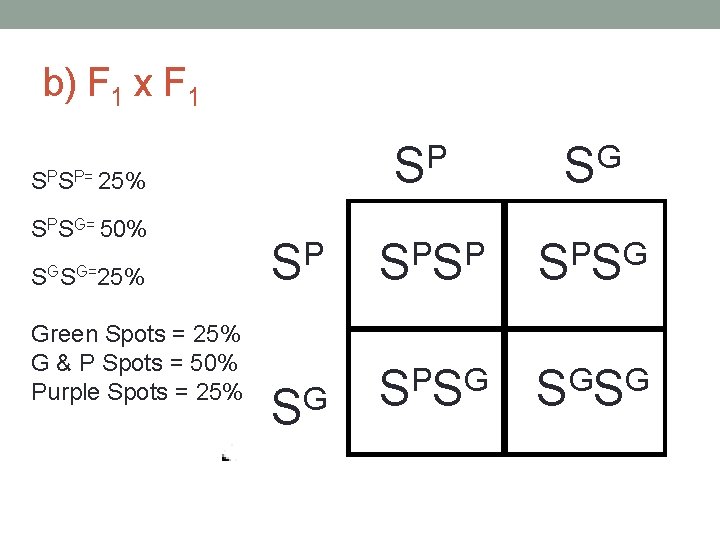
b) F 1 x F 1 P S SPSP= 25% SPSG= 50% SGSG=25% Green Spots = 25% G & P Spots = 50% Purple Spots = 25% SP G S S PS P S PS G P G S S G G S S
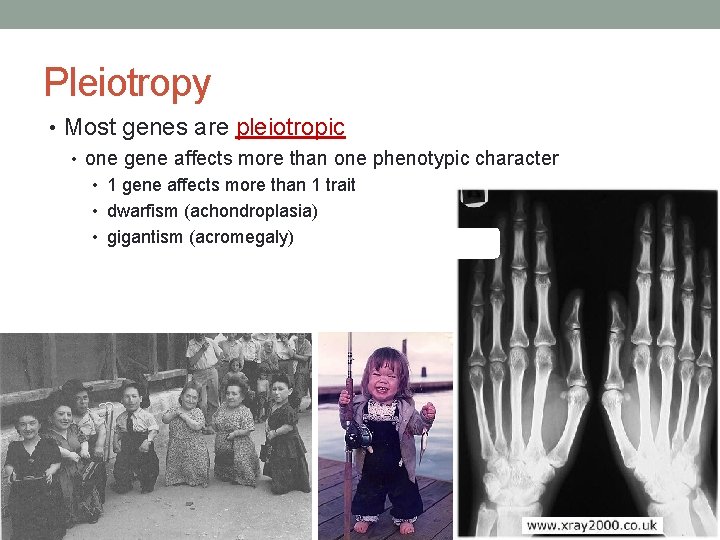
Pleiotropy • Most genes are pleiotropic • one gene affects more than one phenotypic character • 1 gene affects more than 1 trait • dwarfism (achondroplasia) • gigantism (acromegaly)
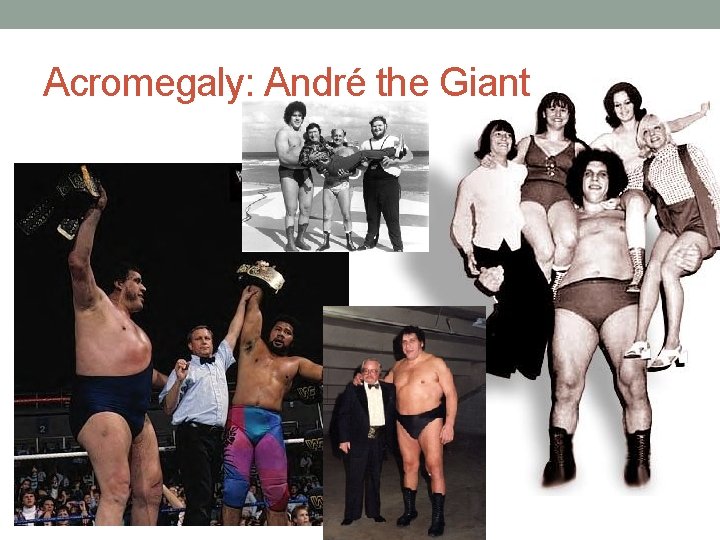
Acromegaly: André the Giant
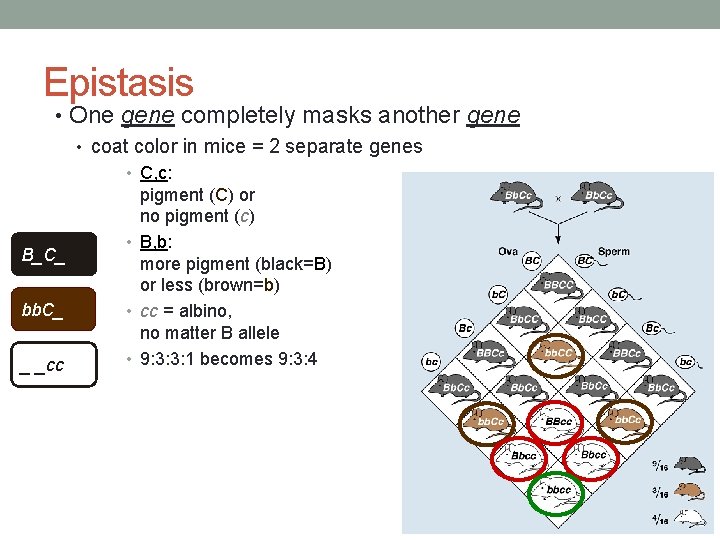
Epistasis • One gene completely masks another gene • coat color in mice = 2 separate genes • C, c: B_C_ bb. C_ _ _cc pigment (C) or no pigment (c) • B, b: more pigment (black=B) or less (brown=b) • cc = albino, no matter B allele • 9: 3: 3: 1 becomes 9: 3: 4
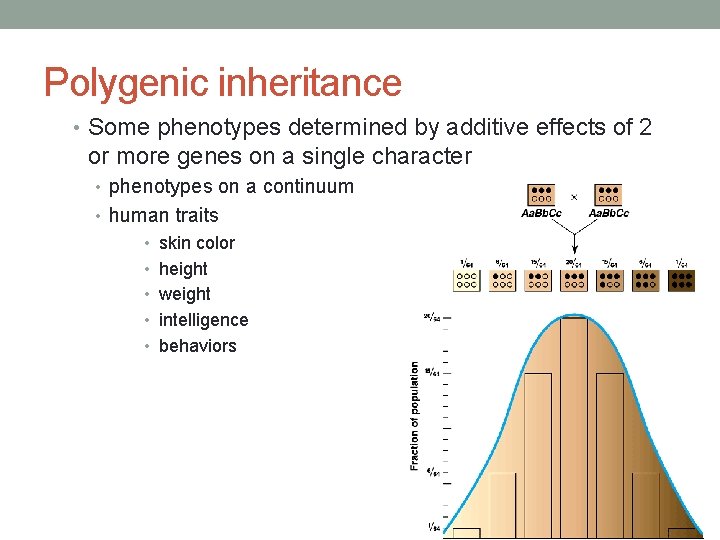
Polygenic inheritance • Some phenotypes determined by additive effects of 2 or more genes on a single character • phenotypes on a continuum • human traits • skin color • height • weight • intelligence • behaviors
- Slides: 96