
Solving for Euler poles Forward problem Given rotation
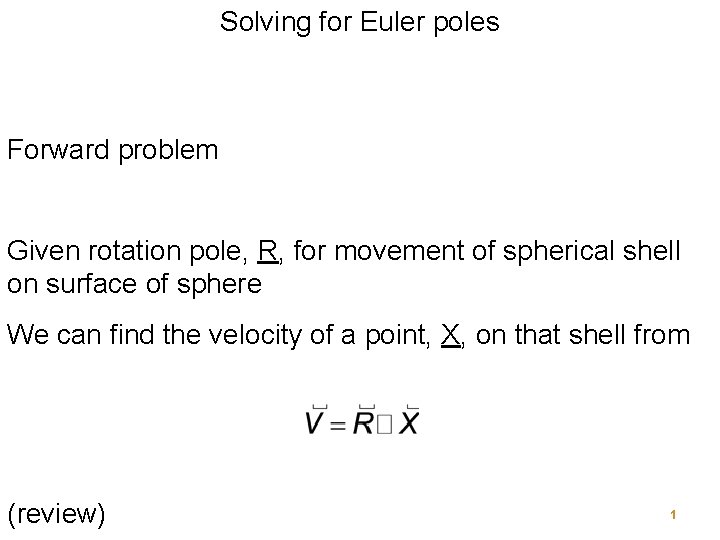
Solving for Euler poles Forward problem Given rotation pole, R, for movement of spherical shell on surface of sphere We can find the velocity of a point, X, on that shell from (review) 1
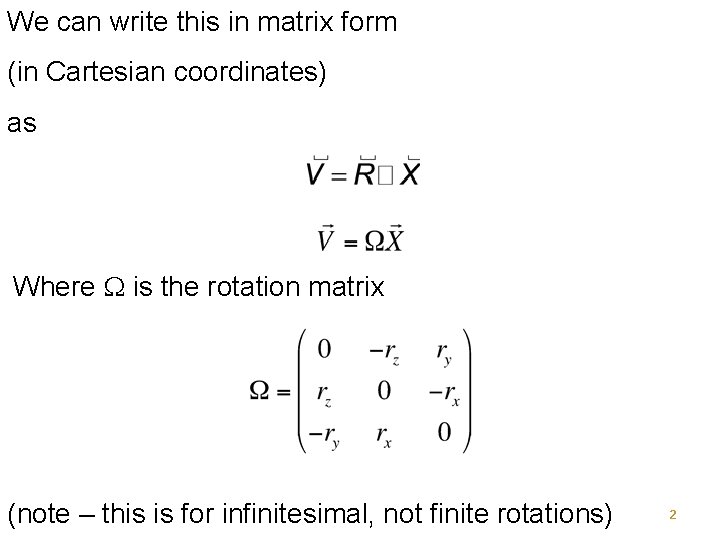
We can write this in matrix form (in Cartesian coordinates) as Where W is the rotation matrix (note – this is for infinitesimal, not finite rotations) 2
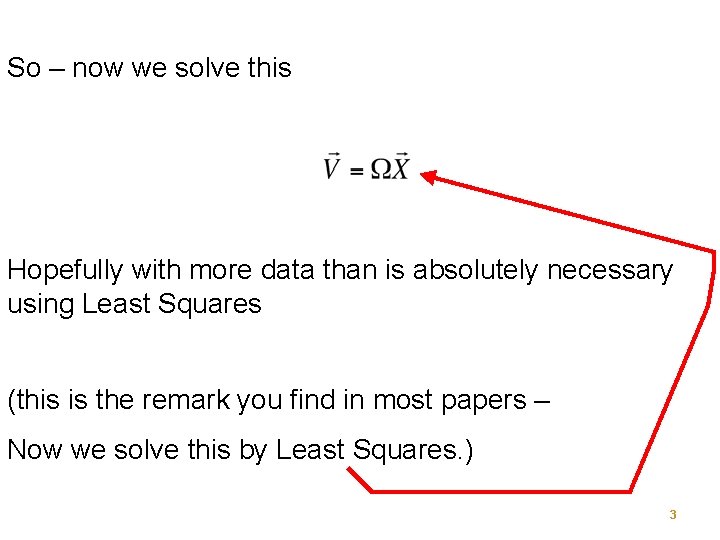
So – now we solve this Hopefully with more data than is absolutely necessary using Least Squares (this is the remark you find in most papers – Now we solve this by Least Squares. ) 3
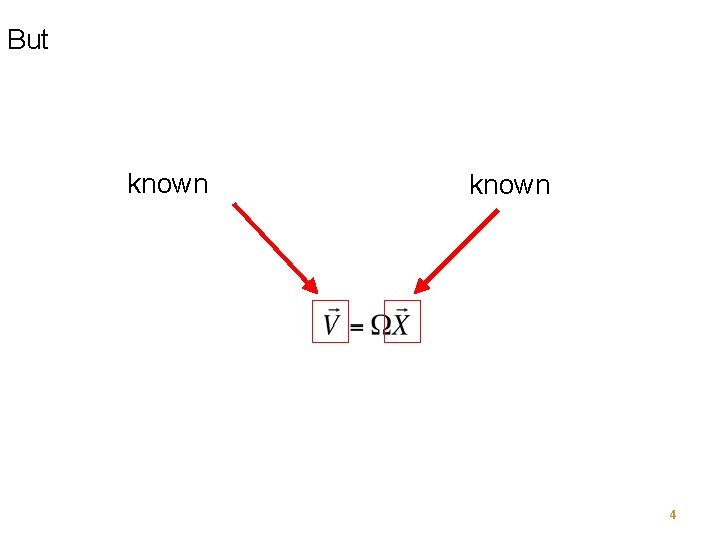
But known 4
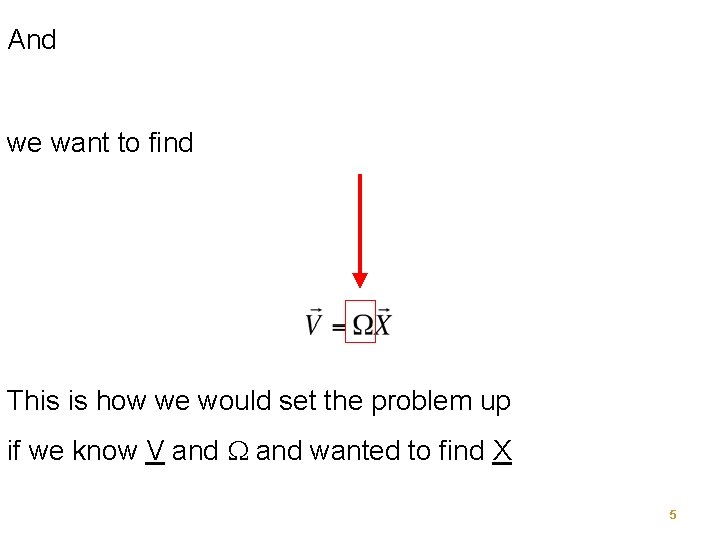
And we want to find This is how we would set the problem up if we know V and W and wanted to find X 5
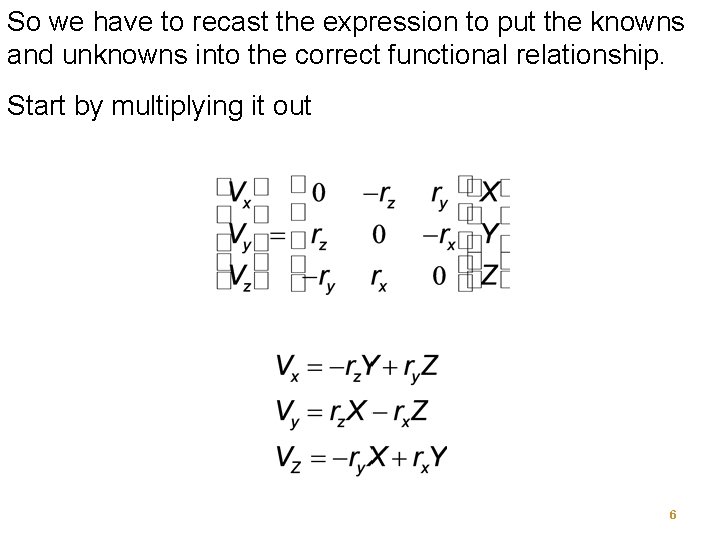
So we have to recast the expression to put the knowns and unknowns into the correct functional relationship. Start by multiplying it out 6
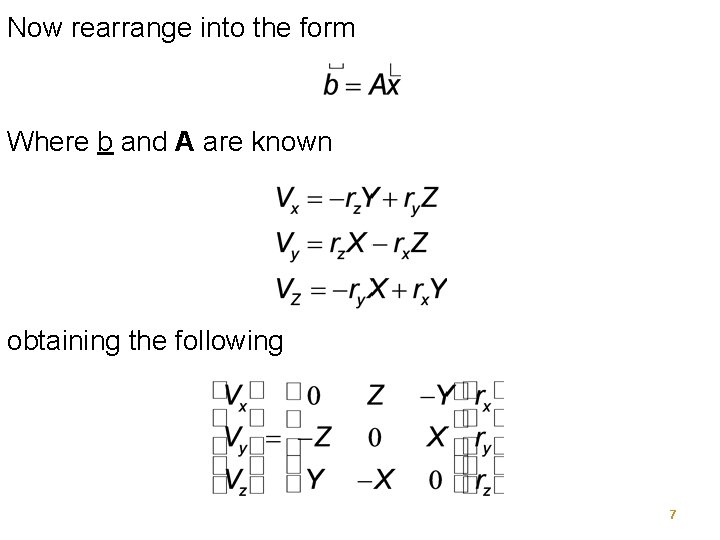
Now rearrange into the form Where b and A are known obtaining the following 7
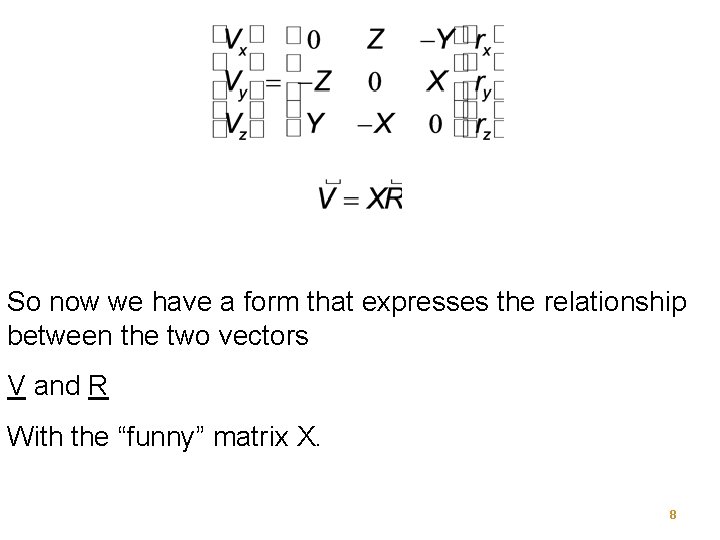
So now we have a form that expresses the relationship between the two vectors V and R With the “funny” matrix X. 8
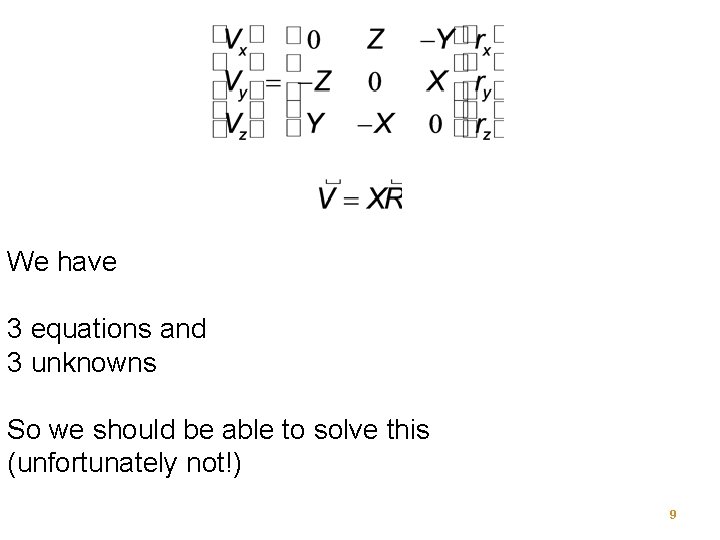
We have 3 equations and 3 unknowns So we should be able to solve this (unfortunately not!) 9
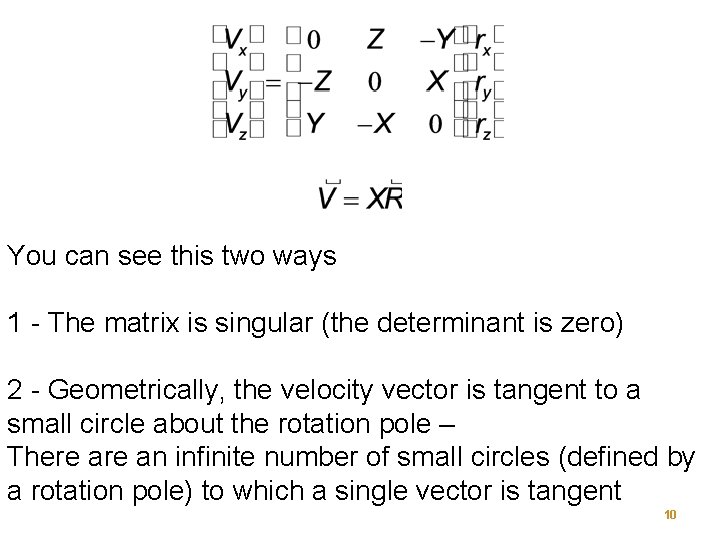
You can see this two ways 1 - The matrix is singular (the determinant is zero) 2 - Geometrically, the velocity vector is tangent to a small circle about the rotation pole – There an infinite number of small circles (defined by a rotation pole) to which a single vector is tangent 10
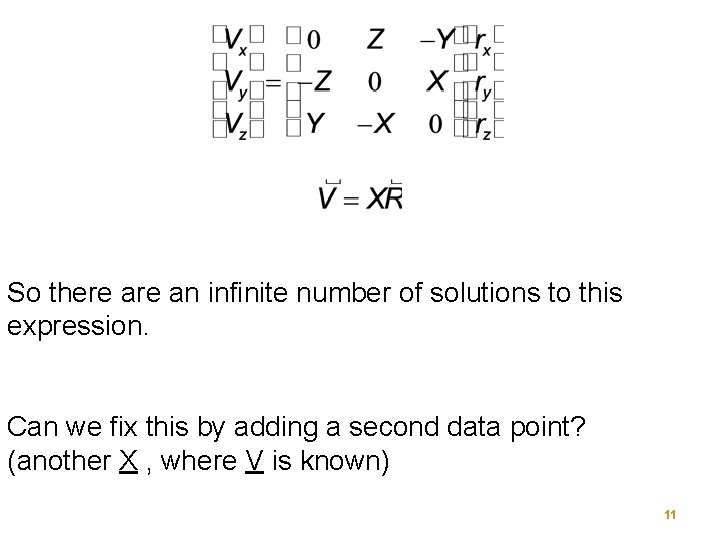
So there an infinite number of solutions to this expression. Can we fix this by adding a second data point? (another X , where V is known) 11

Yes – or we would not have asked! 12
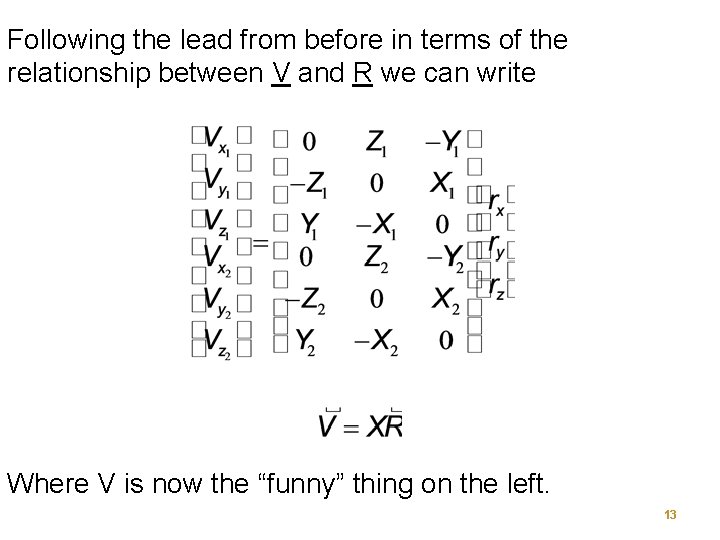
Following the lead from before in terms of the relationship between V and R we can write Where V is now the “funny” thing on the left. 13
Geometrically Given two points we now have Two tangents to the same small circle And (assuming they are not incompatible – i. e contradictory resulting in no solution. ) we can find a single (actually there is a 180° ambiguity) Euler pole 14
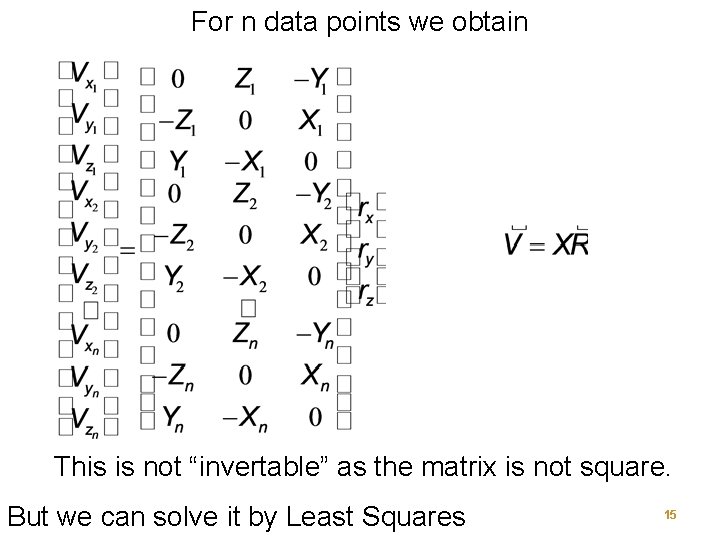
For n data points we obtain This is not “invertable” as the matrix is not square. But we can solve it by Least Squares 15
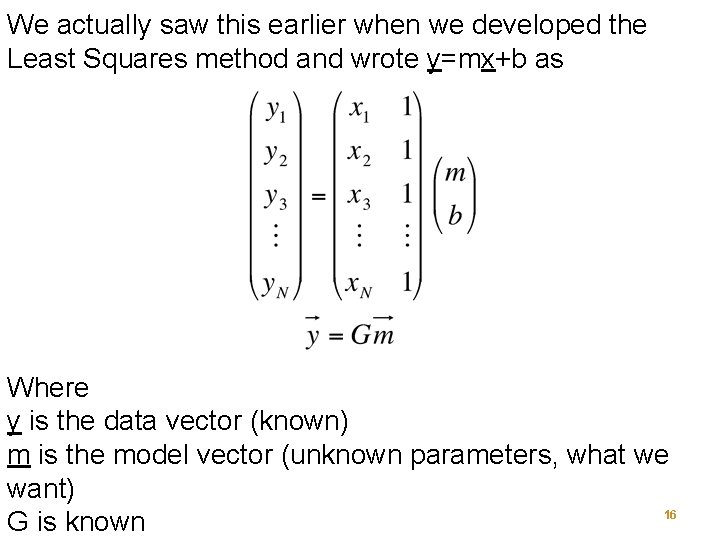
We actually saw this earlier when we developed the Least Squares method and wrote y=mx+b as Where y is the data vector (known) m is the model vector (unknown parameters, what we want) 16 G is known
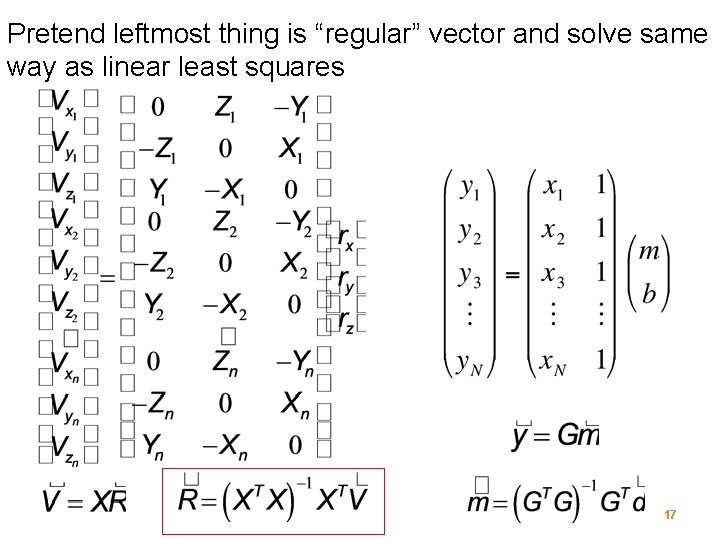
Pretend leftmost thing is “regular” vector and solve same way as linear least squares 17
- Slides: 17