
Solvent Abuse and Toxicity the Philippine Experience Irma
Solvent Abuse and Toxicity: the Philippine Experience Irma R. Makalinao, MD DPPS Associate Professor Department of Pharmacology and Toxicology University of the Philippines Manila INHALANT ABUSE AMONG CHILDREN AND ADOLESCENTS National Institute on Drug Abuse/Fogarty Center 7 -9 November 2005
There is no comprehensive epidemiologic data on the magnitude on inhalant abuse among children and adolescents in the Philippines
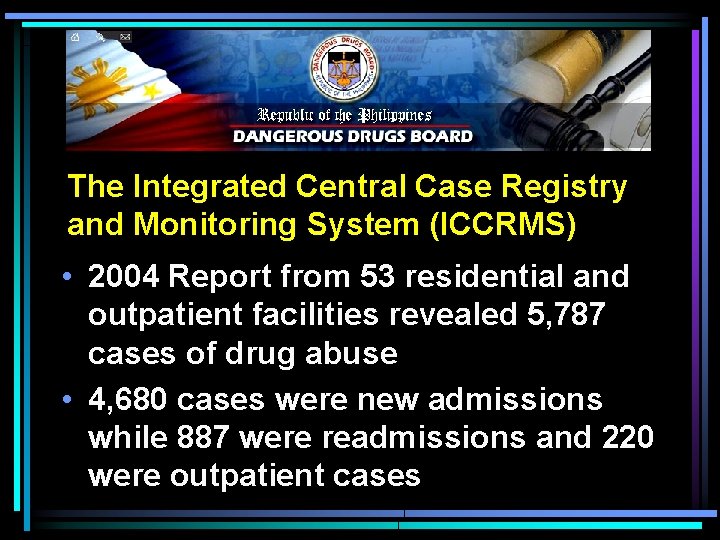
The Integrated Central Case Registry and Monitoring System (ICCRMS) • 2004 Report from 53 residential and outpatient facilities revealed 5, 787 cases of drug abuse • 4, 680 cases were new admissions while 887 were readmissions and 220 were outpatient cases
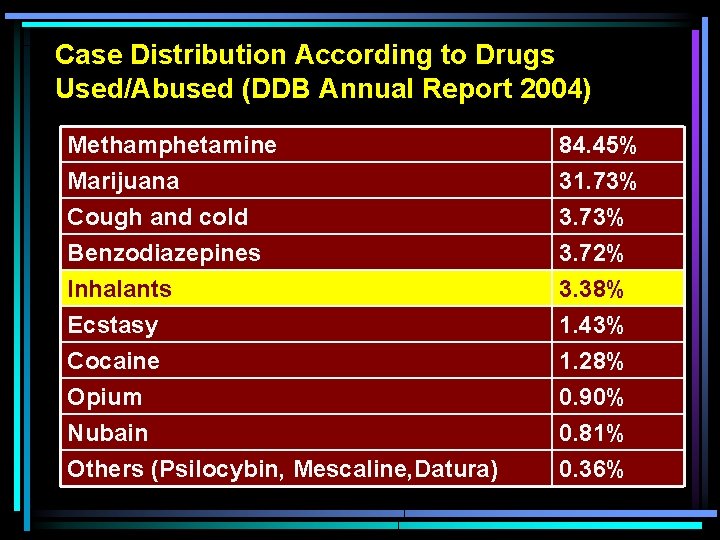
Case Distribution According to Drugs Used/Abused (DDB Annual Report 2004) Methamphetamine Marijuana Cough and cold Benzodiazepines 84. 45% 31. 73% 3. 72% Inhalants Ecstasy Cocaine Opium Nubain Others (Psilocybin, Mescaline, Datura) 3. 38% 1. 43% 1. 28% 0. 90% 0. 81% 0. 36%
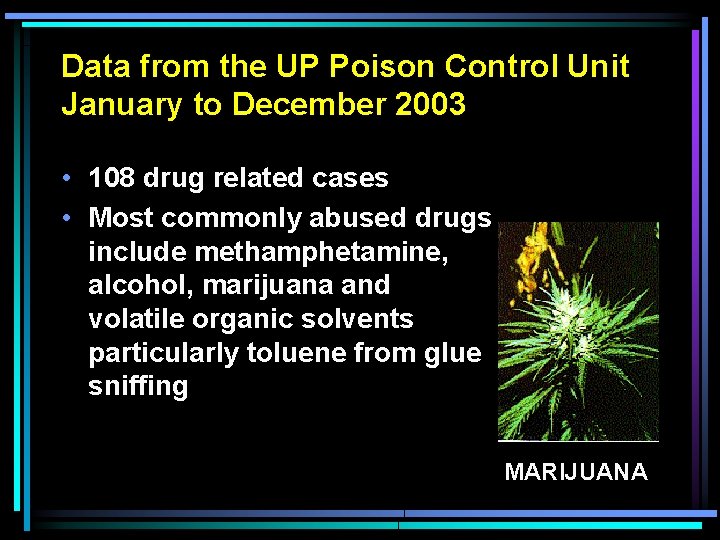
Data from the UP Poison Control Unit January to December 2003 • 108 drug related cases • Most commonly abused drugs include methamphetamine, alcohol, marijuana and volatile organic solvents particularly toluene from glue sniffing MARIJUANA

Chronic Solvent abuse among Filipino street children in Manila • Preliminary results revealed: – Cognitive dysfunction particularly memory impairment – Hyperactivity – Performed poorly on the groove peg board test – On physical examination they were malnourished Unfinished study from the UP POISON CONTROL

Toluene Abuse in the Philippines “Rugby sniffing is one of the most common ways by which toluene is abused • A “rugby sniffer” often puts the chemical in a plastic bag and inhales the vapors directly from the bag to achieve a state of “euphoria” •
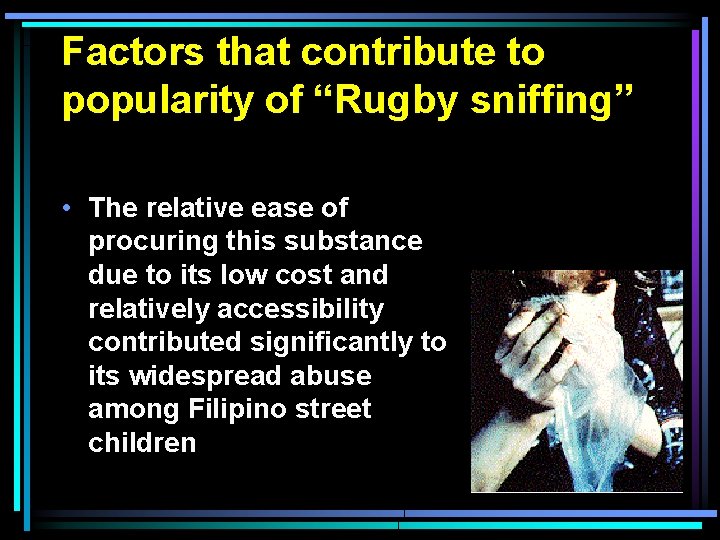
Factors that contribute to popularity of “Rugby sniffing” • The relative ease of procuring this substance due to its low cost and relatively accessibility contributed significantly to its widespread abuse among Filipino street children
Solvent Abuse among Filipino street children • UNICEF estimates the number of street children in the Philippines to range from 75, 000 to 80, 000 • Data from DSWD show that the number increases by 6, 365 annually • HALF of the Philippine’s street children have at one time or another snorted "rugby" and other aromatic solvents to assuage hunger pangs ( Source: Kanlungan sa Er-Ma Ministry)
Over the last 10 years several NGOs tried to determine the profile of the street children who abused solvents • These include: – Unang Hakbang Foundation – Development Endeavors for Organized Sustainability Foundation – Kuya Center for Street Children – Sarnelli Center for Street Children – Tahanan Outreach Projects and Services – Virlanie Foundation
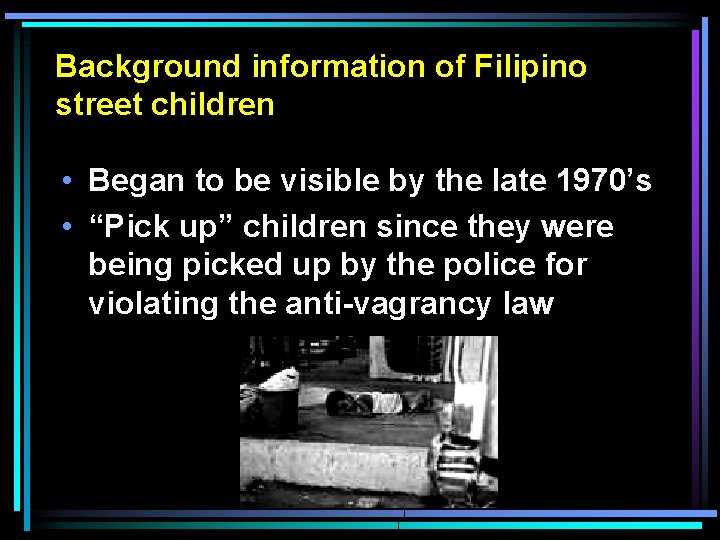
Background information of Filipino street children • Began to be visible by the late 1970’s • “Pick up” children since they were being picked up by the police for violating the anti-vagrancy law
Who are the Filipino street children? • In the Philippines, there are three different categories of street children: – children on the streets – children of the streets – completely abandoned children
The Filipino street child … • Children on the streets - work on the street but do not live there • Children of the street - who live and work on the streets • Completely abandoned and neglected children - entirely on their own for physical and psychological survival

Solvent Toxicity
Pharmacokinetics of Toluene • Aromatic hydrocarbon methylbenzene • Liquid with high volatility and low viscosity • 40 -60% absorbed via the respiratory tract • Dermal absorption is rapid while GI absorption is slow • Widely distributed once absorbed with the highest concentration in adipose tissue, followed by the bone marrow, adrenals, kidneys, liver, brain and blood
Biologic marker for exposure and toxicity • The mixed function oxidase system metabolizes 60 -75% of the absorbed toluene to benzoic acid • Toluene is hydroxylated to form benzylalcohol • Benzylacohol is conjugated with glycine to form hippuric acid • Hippuric acid can easily be measured from the urine

Elimination of toluene • 20 -40% of absorbed toluene is eliminated unchanged in the expired air • Following a single acute exposure elimination is complete within 24 hours
Clinical Manifestations • Toluene abusers are exposed to levels above 1000 ppm. Levels of exposure greater thatn 600 ppm cause confusion and delirium • Data on the toxic effects of toluene among patients seen at the Poison Center were from inhalational exposure with chest tightness, chest pain and altered mental status as the most common presenting symptom at the emergency room
Biphasic response among toluene sniffers • Initial excitatory phase followed by depression • The excitatory phase is characterized by euphoria, delusions, less commonly visual and auditory hallucinations • With prolonged exposure- confusion, disorientation, muscular incoordination ataxia,

Treatment Protocol from the UP National Poison Control Center • History • Examination – Changes in sensorium – MSE and complete neurologic exam – Check for arrhythmias and chemical pneumonitis • General Measures • Laboratory Exam • Treatment of Specific Problems

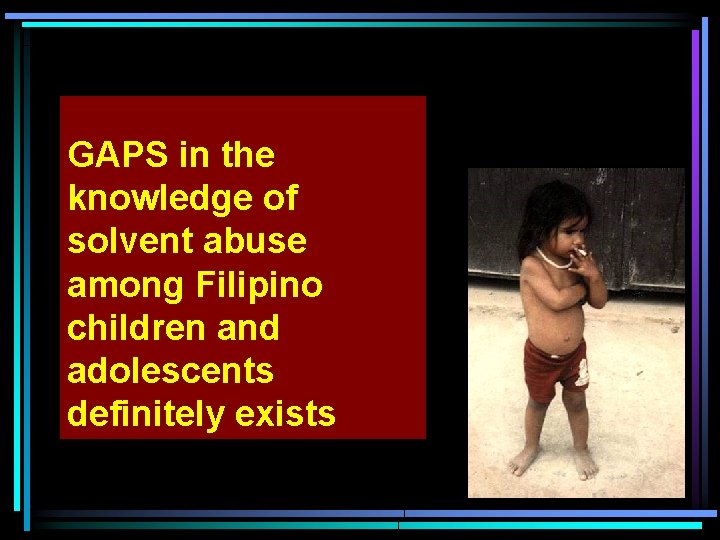
GAPS in the knowledge of solvent abuse among Filipino children and adolescents definitely exists
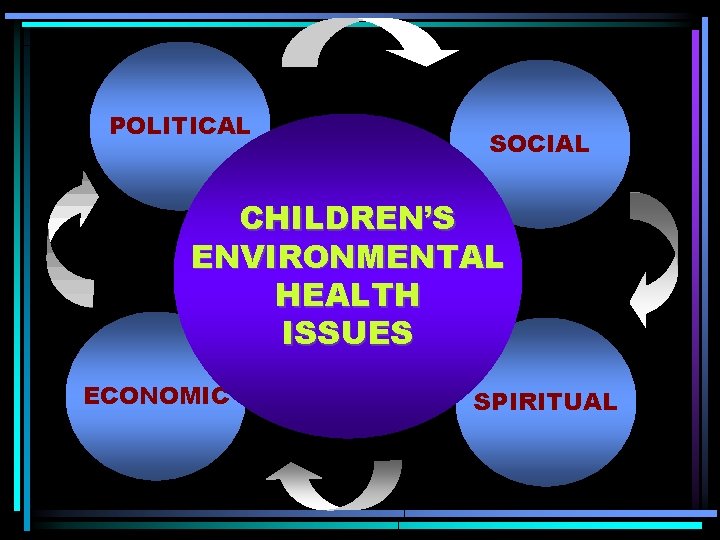
POLITICAL SOCIAL CHILDREN’S ENVIRONMENTAL HEALTH ISSUES ECONOMIC SPIRITUAL
We were born to protect LIFE
- Slides: 25