
Solvent Abuse Aims Objectives D r u g
Solvent Abuse • Aims & Objectives D r u g N e t P r o f e s s i o n a l Su p p o r t – Reduce solvent abuse by young people – Reduce associated problems • Objective(s) – Reduce availability – Support youth & families – Improve case management – Re-integrate youth – Manage problems such as intoxication on the street, anti-social behaviour – Mobilise community action – Maintain community action Slide 1
Solvent Abuse D r u g N e t P r o f e s s i o n a l Su p p o r t • • • Overview of Areas Effects Harms Protective Factors Types of Users Reasons for Abuse Possible Interventions Slide 2
Solvent Abuse Effects - Short Term D r u g N e t P r o f e s s i o n a l Su p p o r t • Similar to alcohol but quick • Differences depending upon drug, individual, & environment • Intoxication in 1 -5 minutes, wears off in 3 -40 minutes (unless topped-up) • About half have visual illusions • Possibly, red eyes, runny nose, nausea, headache Slide 3
Solvent Abuse Harms D r u g N e t P r o f e s s i o n a l Su p p o r t • Accidents when intoxicated • Anti-social behaviour (disruption, stealing, vandalism, etc) • May affect short-term memory & impulsivity (mostly reversible) • Brain damage mostly from petrol sniffing generally rare from other substances • Sudden Sniffing Death (Butane & Aerosols) - rare • Suffocation from plastic over head, spray directly into mouth, inhale vomit - rare • Weight loss (long-term use) Slide 4
Solvent Abuse Protective Factors D r u g N e t P r o f e s s i o n a l Su p p o r t • Most young people don’t use (positive peer pressure) • Seen as ‘gutter drug’ by most youth • Unpleasant smell & after effects • Generally, easy detected • Used in public • Feared by most youth as harmful • Not advertised or glamorised • Short-term intoxication • Most grow out of use with no harm Slide 5
Solvent Abuse Types of Users D r u g N e t P r o f e s s i o n a l Su p p o r t • Experimental, Social, Dependent, Chaotic • Come from all groups (Aboriginal, Non-Aboriginal, rich, poor) • Some groups more visible • Some have underlying problems some don’t • Mostly aged 12 - 16 Some younger & older users Slide 6
Solvent Abuse Reasons for Abuse D r u g N e t P r o f e s s i o n a l Su p p o r t • Same as why adults use alcohol: – fun, socialise, effect, available • To challenge adults • To copy adults (intoxication) • Feelings of failure (lack of success) – Cover up bad feelings – Show they don’t care about themselves – Show they are hurting & to get attention – A form of self-harm – Be successful at being bad &/or sad – Join with other ‘outcasts’ Slide 7
Solvent Abuse D r u g N e t P r o f e s s i o n a l Su p p o r t • • Interventions - Overview Retailer Interventions Youth Support Family Support Managing Intoxication Agency Support & Agency Resources Media Management What Not to Do Community Action Slide 8
Solvent Abuse Interventions D r u g N e t P r o f e s s i o n a l Su p p o r t • Retailer Interventions – Retailers Acting Against Solvent Use Kit – Point of sale restrictions – Use of signs – Staff training – Display & placement of products – Protocols between retailers, police, youth workers, & other welfare workers – Advantages for retailers Slide 9
Solvent Abuse Interventions D r u g N e t P r o f e s s i o n a l Su p p o r t • Youth Support – Aim to reintegrate back into the community – Emotional Support & Monitoring click here for more info – Inter-agency case management for longterm users with multiple issues – Generic youth activities • Recreation, Sport, Youth Centre, Dances. . . eg Community Construction Playground – School Drug Education Project • Curriculum, Policy, Truancy, School Services Staff • Pause Prompt & Praise Program – Peer support programs Slide 10
Solvent Abuse Interventions D r u g N e t P r o f e s s i o n a l Su p p o r t • Family Support – Parent support groups – Parent drug education – Teach Emotional Support & Monitoring – PDIS – “Family Fun Day” – Respite care – Management of parent alcohol and other drug use Slide 11
Solvent Abuse Interventions D r u g N e t P r o f e s s i o n a l Su p p o r t • Managing Intoxication – Police use of 138 B of Child Welfare Act – Community Patrol – “Safe House” to sober up and to assist Police and Community Patrol – Do not chase or scare intoxicated person – Remove solvents Slide 12
Solvent Abuse Interventions D r u g N e t P r o f e s s i o n a l Su p p o r t • Health & Welfare Agency Support – Solvent abuse training – Inter-agency protocols re shared case management & youth drug use – Drug management web site support Click here for Drug. Net if internet access Click here for Info on Volatile Substances from CEIDA – CDST consultancy support – ADIS consultancy support Slide 13
Solvent Abuse Interventions D r u g N e t P r o f e s s i o n a l Su p p o r t • Agencies & Resources – Local Drug Action Group – Community Drug Service Team – ADIS & PDIS telephone supports – Education, AMS, FCS, Police, Mo. J, Sport & Rec, Local Council – Youth accommodation services – Other youth services – Other general services & organisations – Service groups Slide 14
Solvent Abuse Interventions D r u g N e t P r o f e s s i o n a l Su p p o r t • Media Management – Provide good news stories about youth – Develop a relationship with media – Request limit sensational solvents stories, no naming of products or methods of use – Provide local contact point & ADIS number – Use local notice board to post good news stories, photographs & youth project updates Slide 15
Solvent Abuse Interventions D r u g N e t P r o f e s s i o n a l Su p p o r t • What Not to Do (Remember Protective Factors) – Don’t advertise solvents to others who otherwise might not be interested – Don’t have special solvents lessons in schools – Don’t use solvent abuse as the criteria for special attention - may reinforce the solvent abuse – Don’t physically punish solvent abusers – Don’t chase or scare solvent abusers Slide 16
Solvent Abuse Community Action D r u g N e t P r o f e s s i o n a l Su p p o r t • Link up with others – Identify key stake-holders – 1: 1, small and large group meetings • Acknowledge any distress – hear & reflect back emotional content – mobilise energy into action • What’s happening? – How much abuse – What actually is the problem – who’s doing what, what’s helped & hindered Slide 17
Solvent Abuse Community Action (Cont) D r u g N e t P r o f e s s i o n a l Su p p o r t • Make a plan – S. M. A. R. T. Goals (Specific, Meaningful, Realistic, Assessable, Time-Bound) – How would it look if the problem was fixed? – Who, What, How, By When – Identify supports • Make a start – Small steps • Review action – Use telephone, e-mail & face to face – What happened, what was learned, what next? Slide 18
Solvent Abuse Community Action (Cont) • How to maintain action D r u g N e t P r o f e s s i o n a l Su p p o r t – Complex problems require short and long -term solutions – DO spend time to identify all the positive thing which have happened – DO make public success via media or through personal rewards – DO plan to meet regularly – Expect energy to drop off - revive with imaginative mini projects – DON’T gossip or fight - there always room for different approaches. Everyone doesn’t have to agree on everything. Slide 19
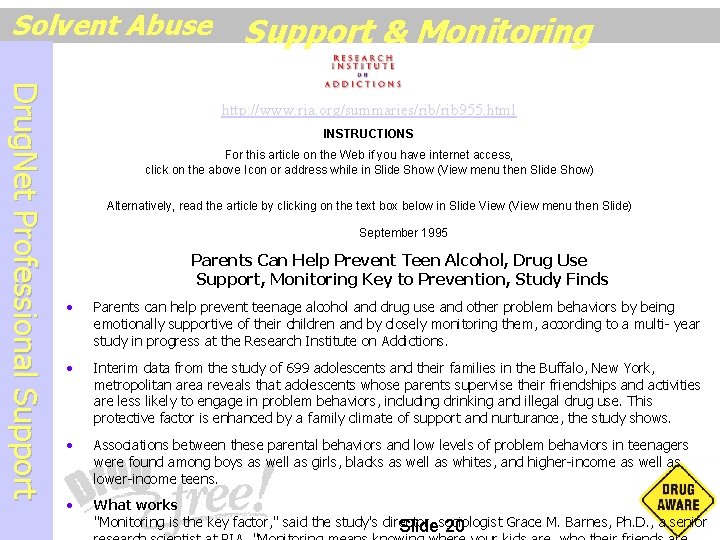
Solvent Abuse Support & Monitoring D r u g N e t P r o f e s s i o n a l Su p p o r t http: //www. ria. org/summaries/rib 955. html INSTRUCTIONS For this article on the Web if you have internet access, click on the above Icon or address while in Slide Show (View menu then Slide Show) Alternatively, read the article by clicking on the text box below in Slide View (View menu then Slide) September 1995 Parents Can Help Prevent Teen Alcohol, Drug Use Support, Monitoring Key to Prevention, Study Finds • Parents can help prevent teenage alcohol and drug use and other problem behaviors by being emotionally supportive of their children and by closely monitoring them, according to a multi- year study in progress at the Research Institute on Addictions. • Interim data from the study of 699 adolescents and their families in the Buffalo, New York, metropolitan area reveals that adolescents whose parents supervise their friendships and activities are less likely to engage in problem behaviors, including drinking and illegal drug use. This protective factor is enhanced by a family climate of support and nurturance, the study shows. • Associations between these parental behaviors and low levels of problem behaviors in teenagers were found among boys as well as girls, blacks as well as whites, and higher-income as well as lower-income teens. • What works "Monitoring is the key factor, " said the study's director, Grace M. Barnes, Ph. D. , a senior Slidesociologist 20
- Slides: 20