
Solve problems involving exponential growth and decay Exponential
Solve problems involving exponential growth and decay.

Exponential growth occurs when an amount (i. e. money) increases by the same rate in each time period. If something grows exponentially it grows quicker and quicker.
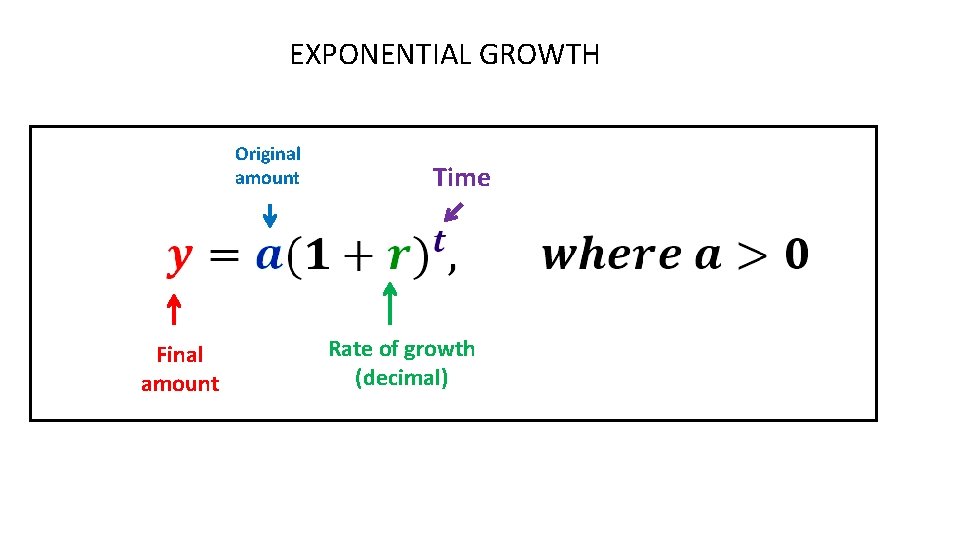
EXPONENTIAL GROWTH Original amount Final amount Time Rate of growth (decimal)
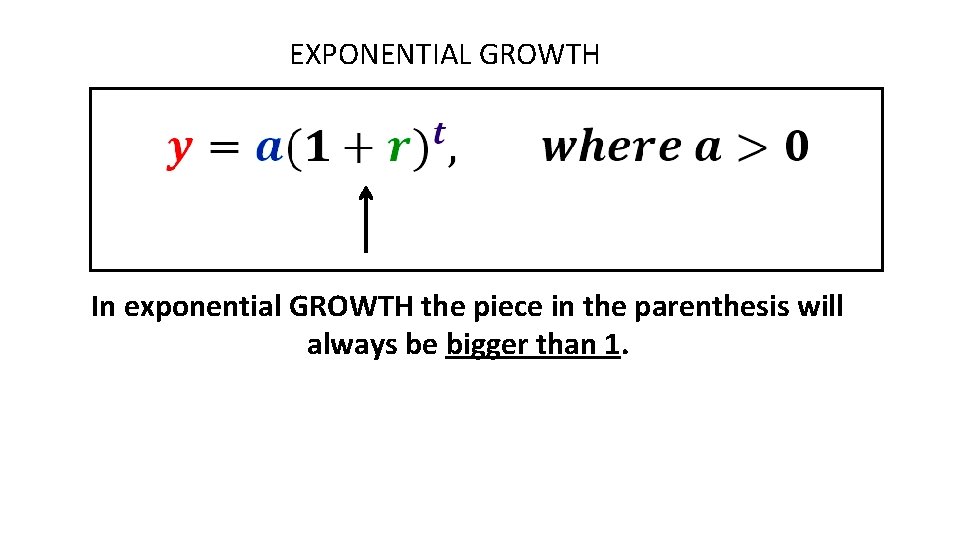
EXPONENTIAL GROWTH In exponential GROWTH the piece in the parenthesis will always be bigger than 1.
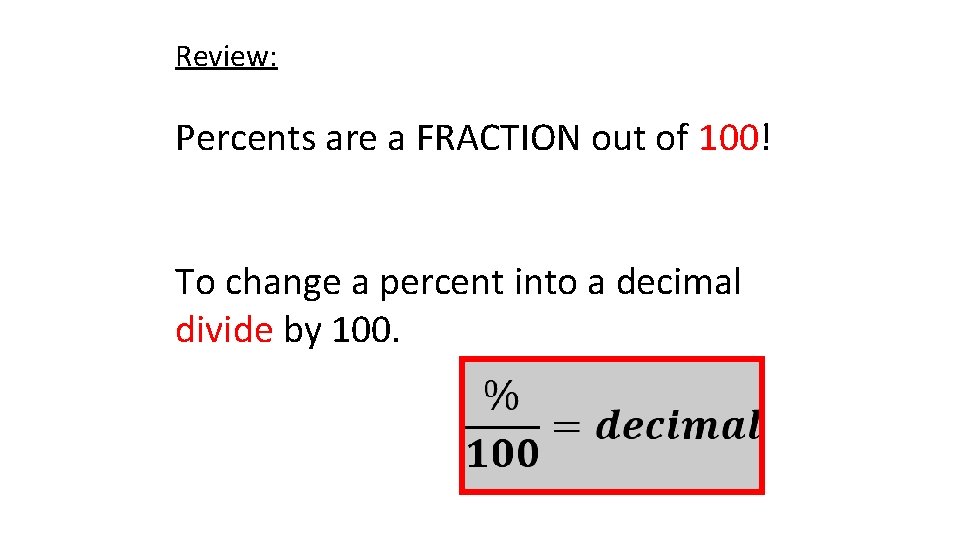
Review: Percents are a FRACTION out of 100! To change a percent into a decimal divide by 100.
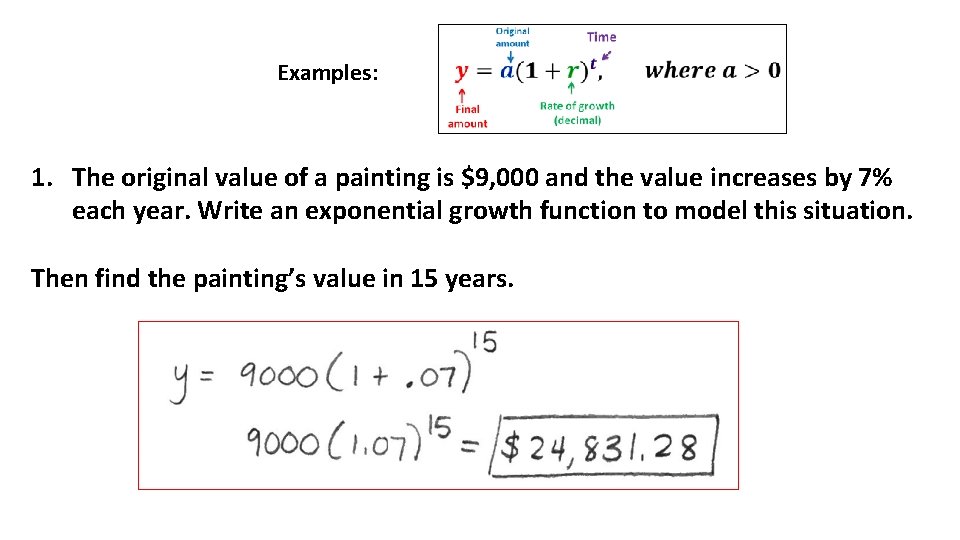
Examples: 1. The original value of a painting is $9, 000 and the value increases by 7% each year. Write an exponential growth function to model this situation. Then find the painting’s value in 15 years.
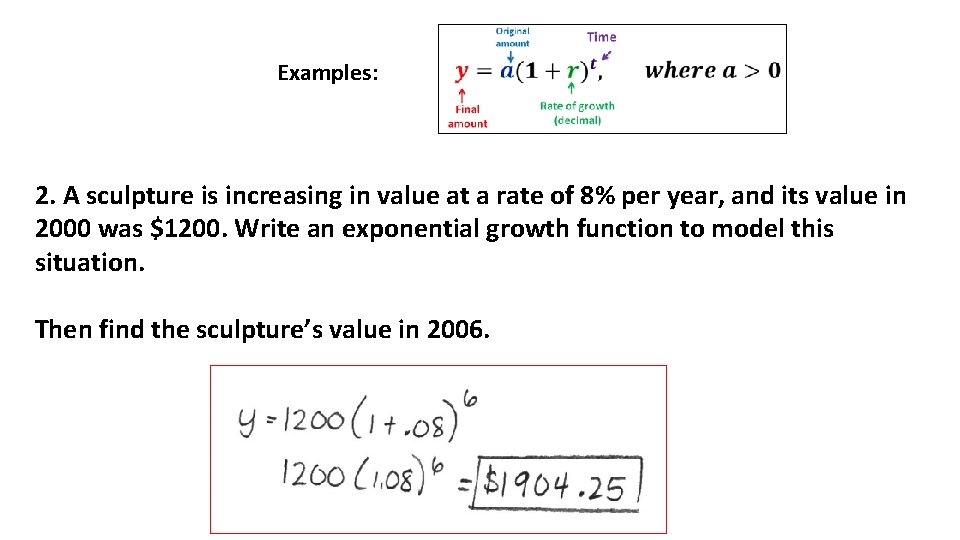
Examples: 2. A sculpture is increasing in value at a rate of 8% per year, and its value in 2000 was $1200. Write an exponential growth function to model this situation. Then find the sculpture’s value in 2006.
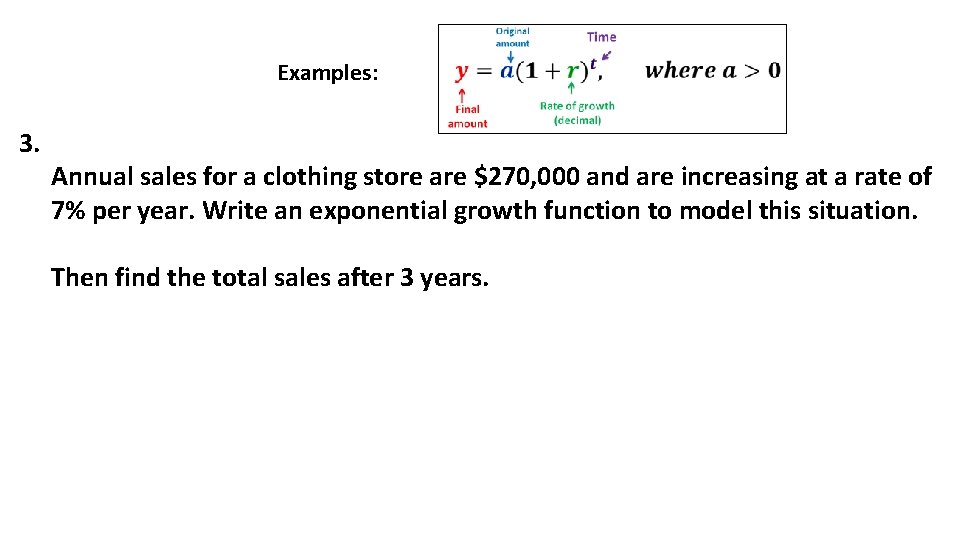
Examples: 3. Annual sales for a clothing store are $270, 000 and are increasing at a rate of 7% per year. Write an exponential growth function to model this situation. Then find the total sales after 3 years.
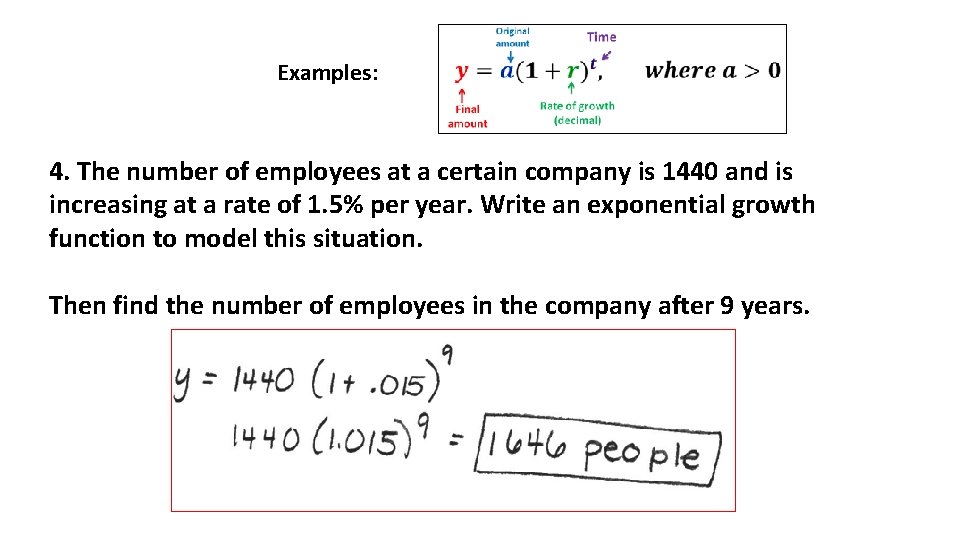
Examples: 4. The number of employees at a certain company is 1440 and is increasing at a rate of 1. 5% per year. Write an exponential growth function to model this situation. Then find the number of employees in the company after 9 years.
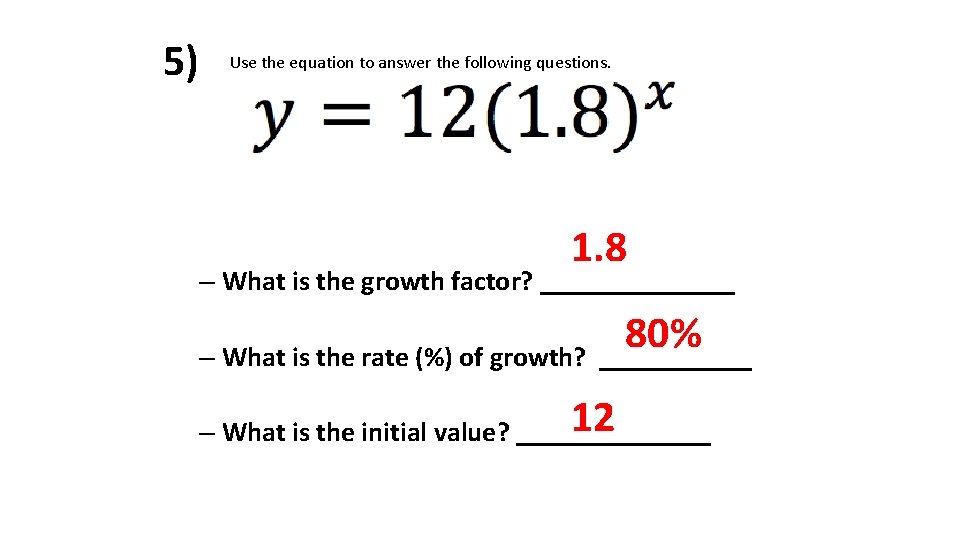
5) Use the equation to answer the following questions. 1. 8 – What is the growth factor? _______ 80% – What is the rate (%) of growth? ______ 12 – What is the initial value? _______
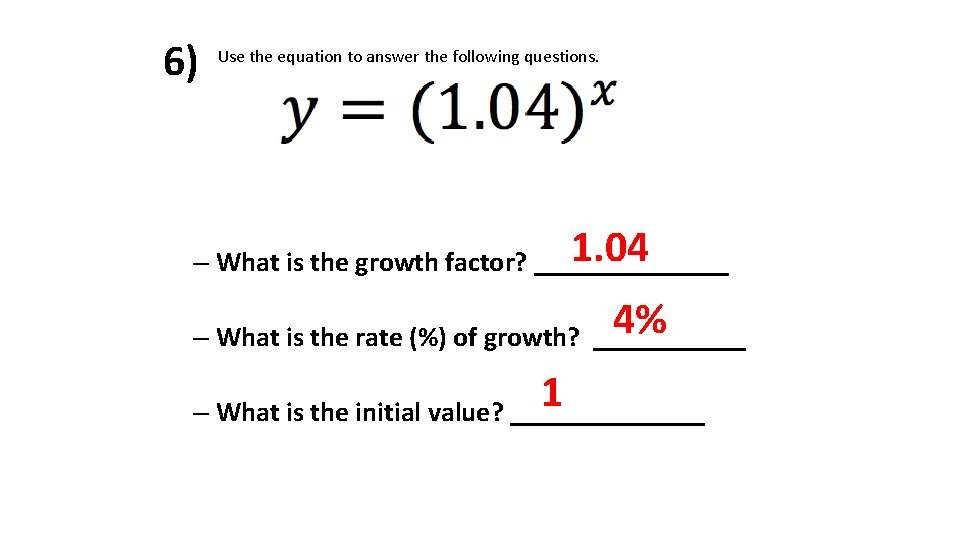
6) Use the equation to answer the following questions. 1. 04 – What is the growth factor? _______ 4% – What is the rate (%) of growth? ______ 1 – What is the initial value? _______
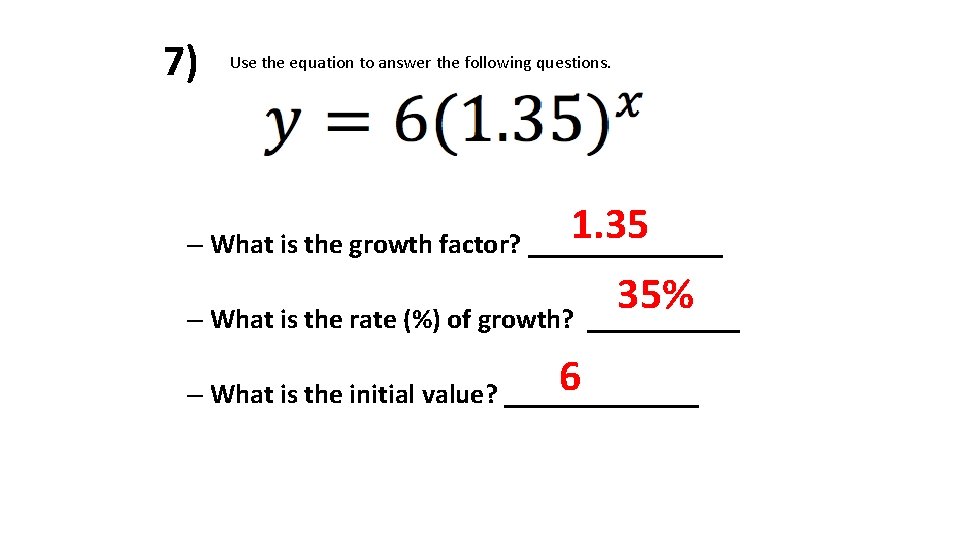
7) Use the equation to answer the following questions. 1. 35 – What is the growth factor? _______ 35% – What is the rate (%) of growth? ______ 6 – What is the initial value? _______
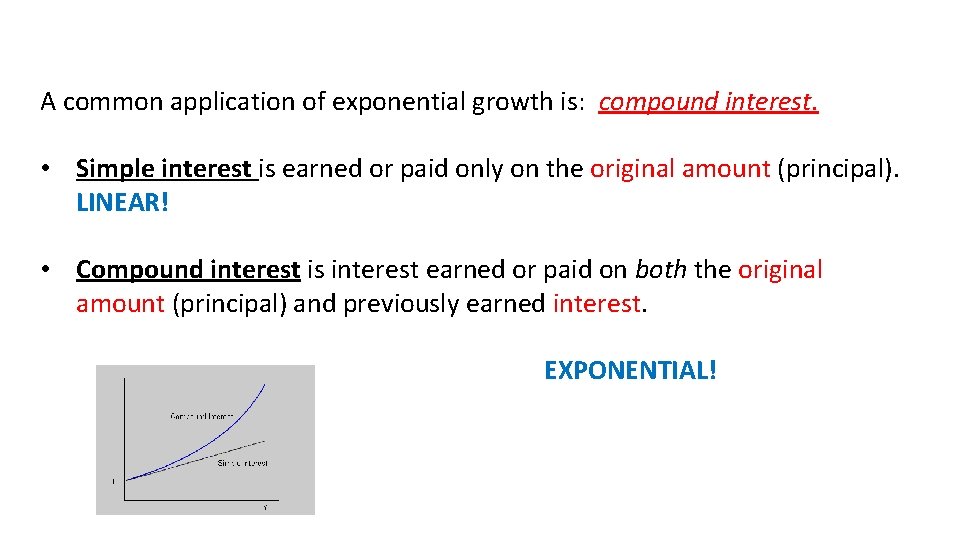
A common application of exponential growth is: compound interest. • Simple interest is earned or paid only on the original amount (principal). LINEAR! • Compound interest is interest earned or paid on both the original amount (principal) and previously earned interest. EXPONENTIAL!
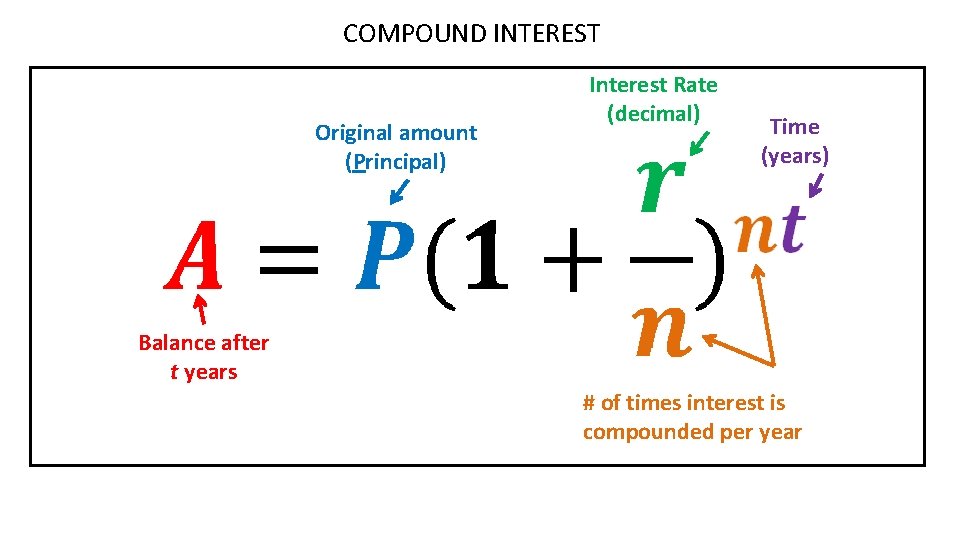
COMPOUND INTEREST Original amount (Principal) Interest Rate (decimal) Time (years) Balance after t years # of times interest is compounded per year
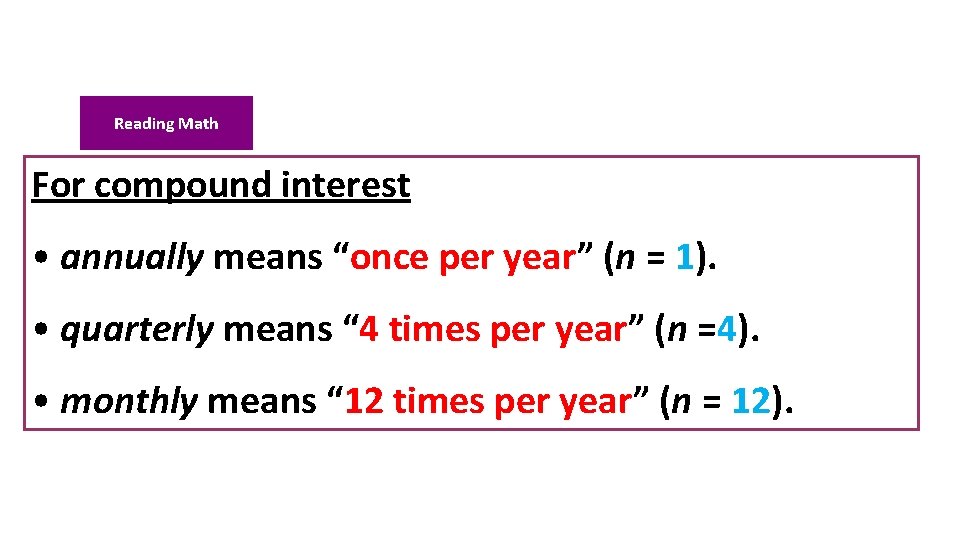
Reading Math For compound interest • annually means “once per year” (n = 1). • quarterly means “ 4 times per year” (n =4). • monthly means “ 12 times per year” (n = 12).
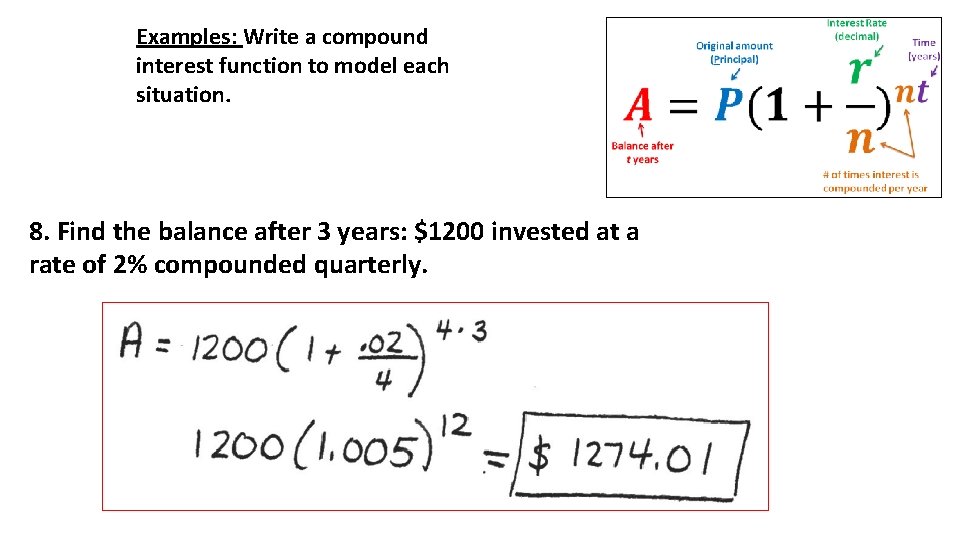
Examples: Write a compound interest function to model each situation. 8. Find the balance after 3 years: $1200 invested at a rate of 2% compounded quarterly.
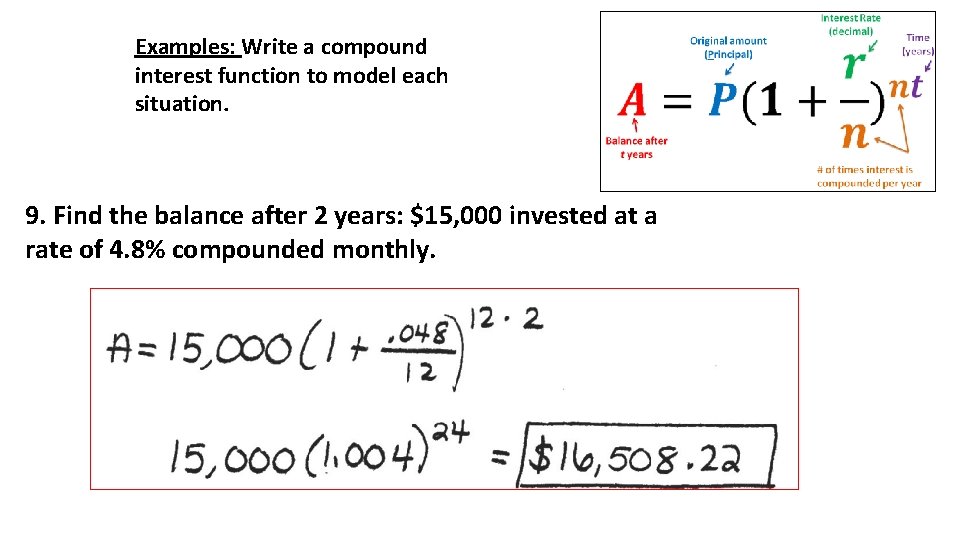
Examples: Write a compound interest function to model each situation. 9. Find the balance after 2 years: $15, 000 invested at a rate of 4. 8% compounded monthly.
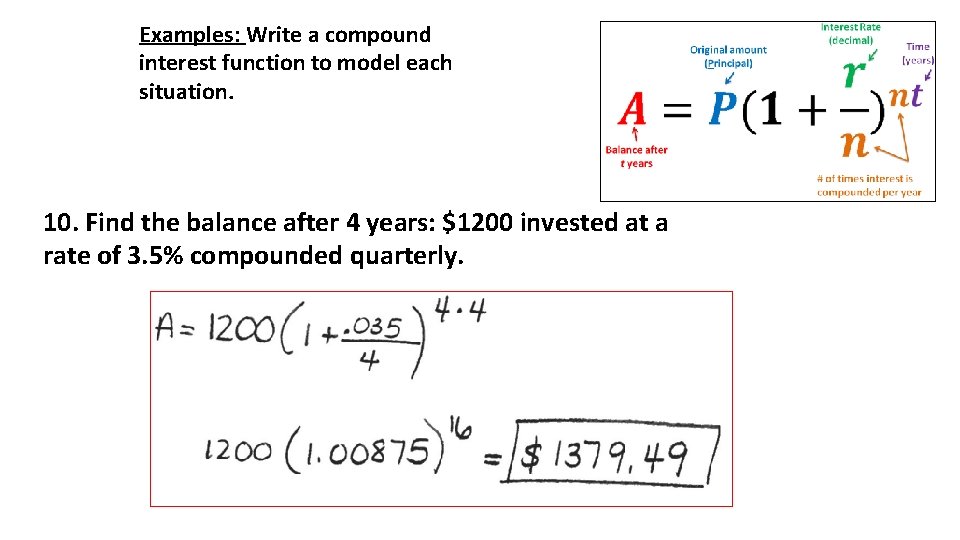
Examples: Write a compound interest function to model each situation. 10. Find the balance after 4 years: $1200 invested at a rate of 3. 5% compounded quarterly.
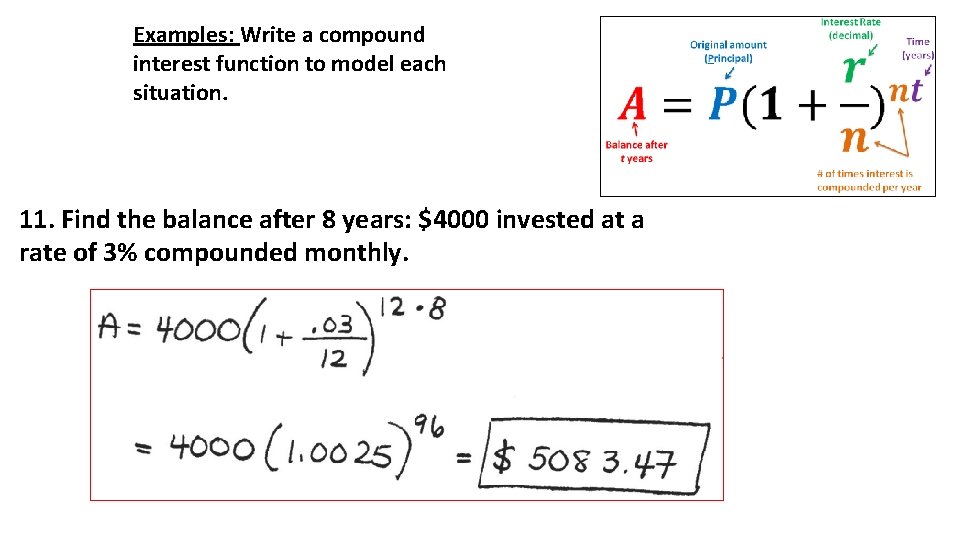
Examples: Write a compound interest function to model each situation. 11. Find the balance after 8 years: $4000 invested at a rate of 3% compounded monthly.
Day #2 Exponential Decay
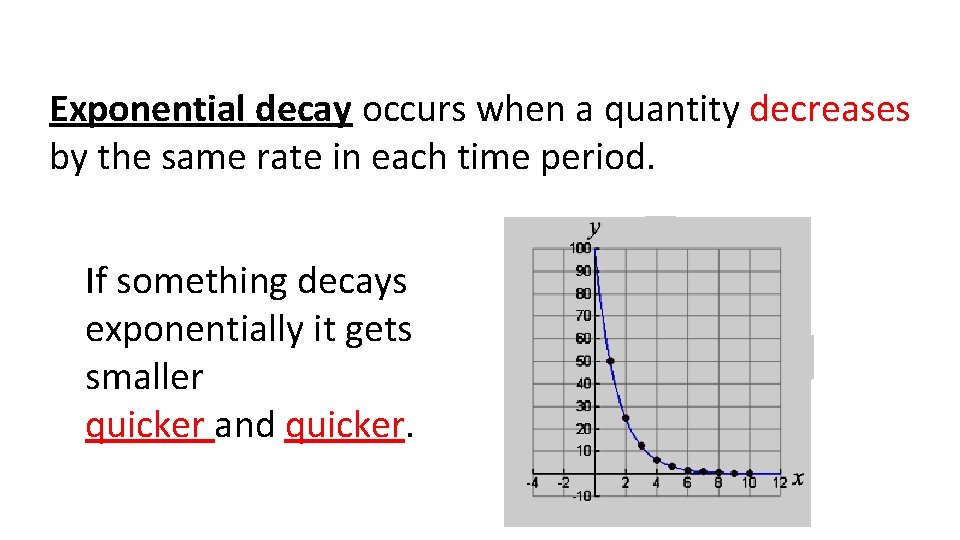
Exponential decay occurs when a quantity decreases by the same rate in each time period. If something decays exponentially it gets smaller quicker and quicker.
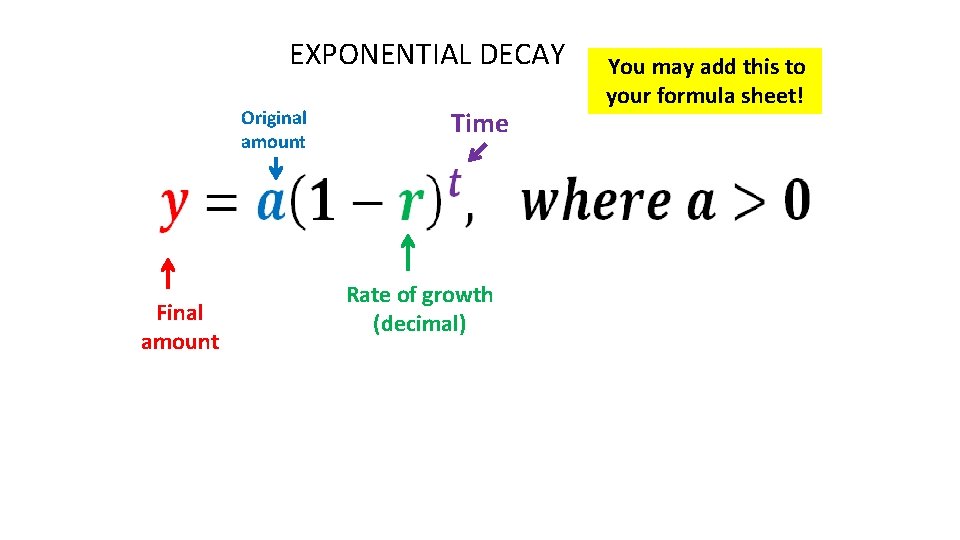
EXPONENTIAL DECAY Original amount Final amount Time Rate of growth (decimal) You may add this to your formula sheet!
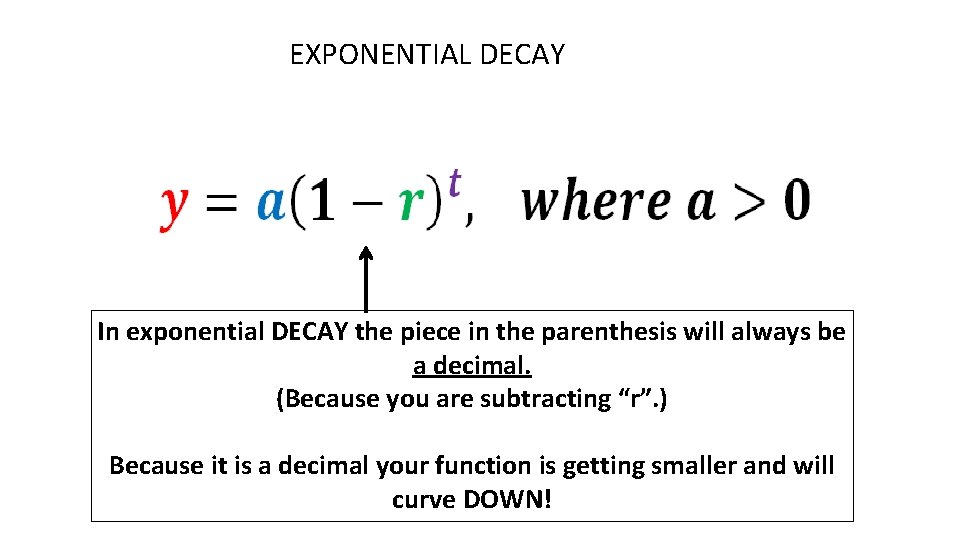
EXPONENTIAL DECAY In exponential DECAY the piece in the parenthesis will always be a decimal. (Because you are subtracting “r”. ) Because it is a decimal your function is getting smaller and will curve DOWN!
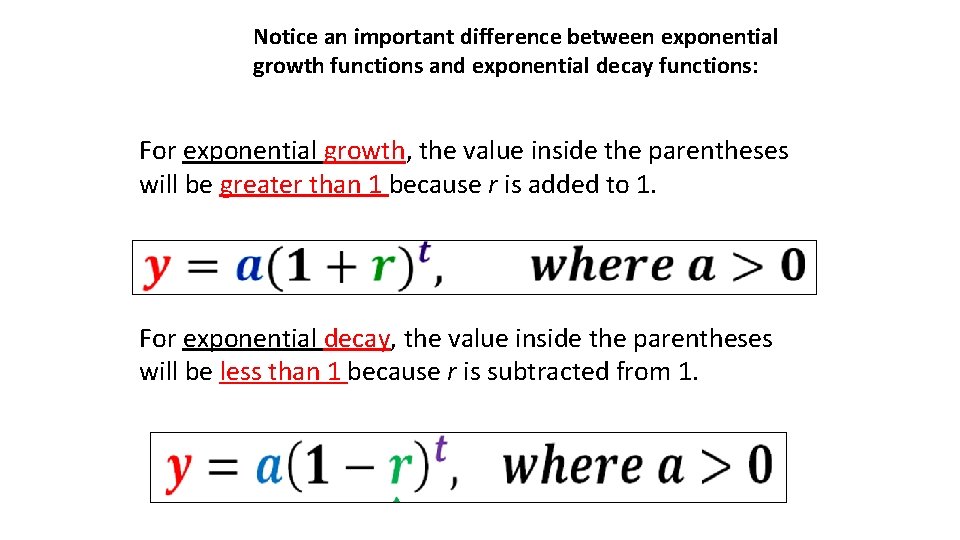
Notice an important difference between exponential growth functions and exponential decay functions: For exponential growth, the value inside the parentheses will be greater than 1 because r is added to 1. For exponential decay, the value inside the parentheses will be less than 1 because r is subtracted from 1.
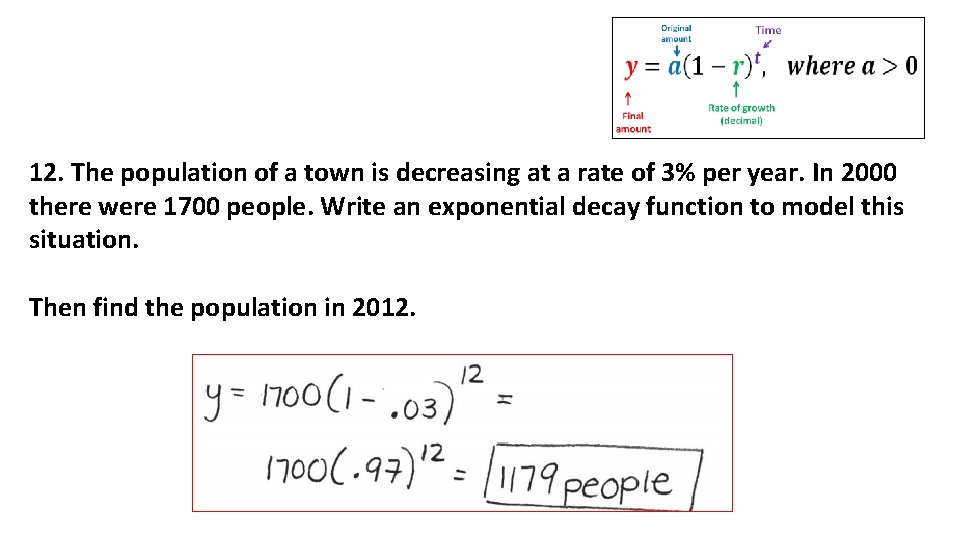
12. The population of a town is decreasing at a rate of 3% per year. In 2000 there were 1700 people. Write an exponential decay function to model this situation. Then find the population in 2012.
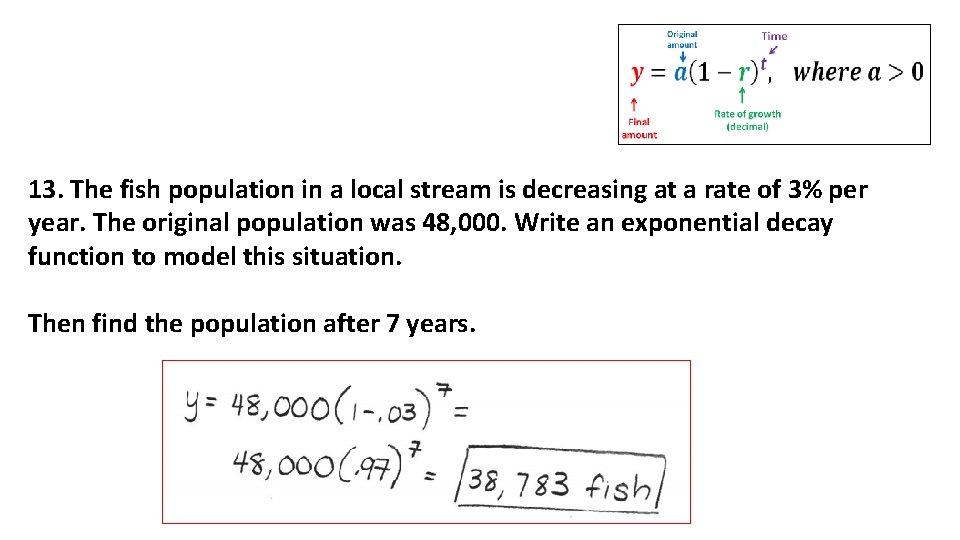
13. The fish population in a local stream is decreasing at a rate of 3% per year. The original population was 48, 000. Write an exponential decay function to model this situation. Then find the population after 7 years.
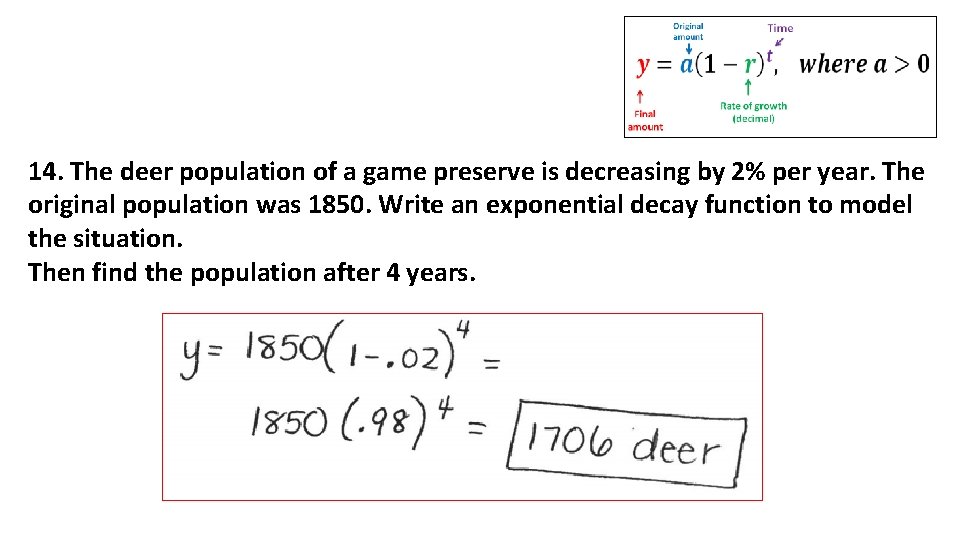
14. The deer population of a game preserve is decreasing by 2% per year. The original population was 1850. Write an exponential decay function to model the situation. Then find the population after 4 years.
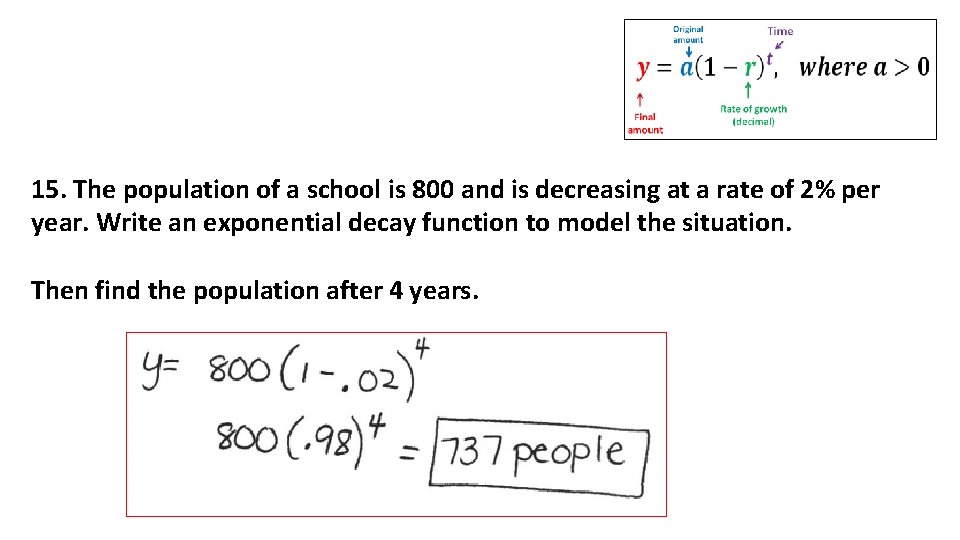
15. The population of a school is 800 and is decreasing at a rate of 2% per year. Write an exponential decay function to model the situation. Then find the population after 4 years.
A common application of exponential decay is the half-life of a substance. This is the time it takes for one-half of the substance to decay into another substance.
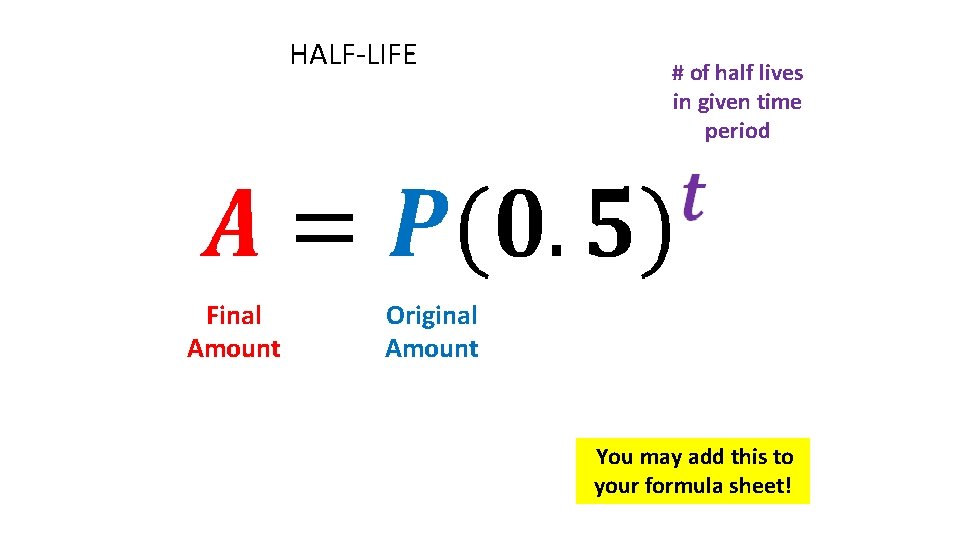
HALF-LIFE Final Amount # of half lives in given time period Original Amount You may add this to your formula sheet!
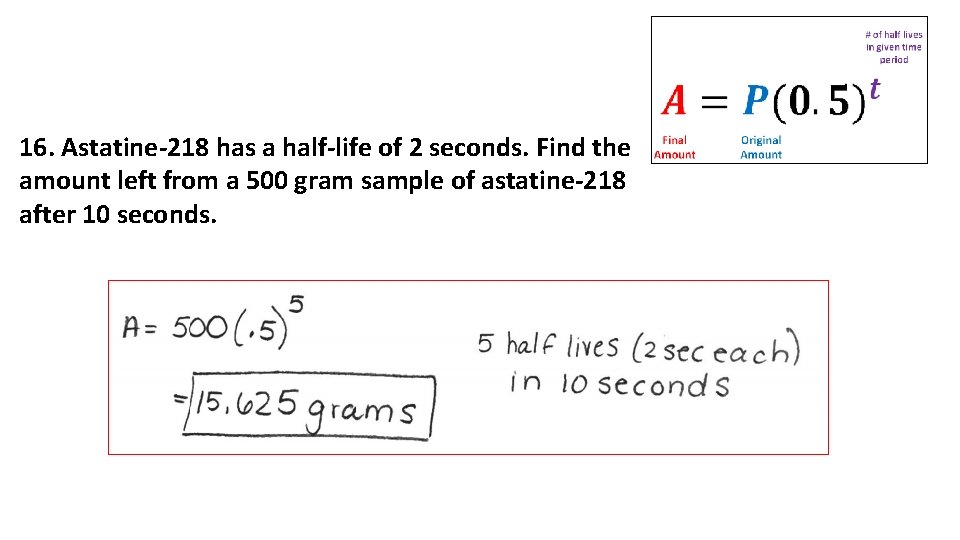
16. Astatine-218 has a half-life of 2 seconds. Find the amount left from a 500 gram sample of astatine-218 after 10 seconds.
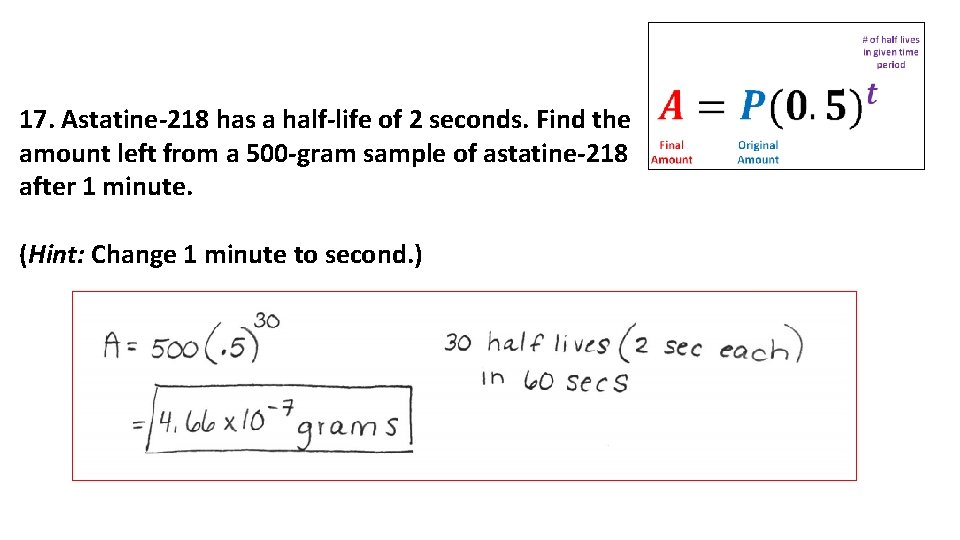
17. Astatine-218 has a half-life of 2 seconds. Find the amount left from a 500 -gram sample of astatine-218 after 1 minute. (Hint: Change 1 minute to second. )
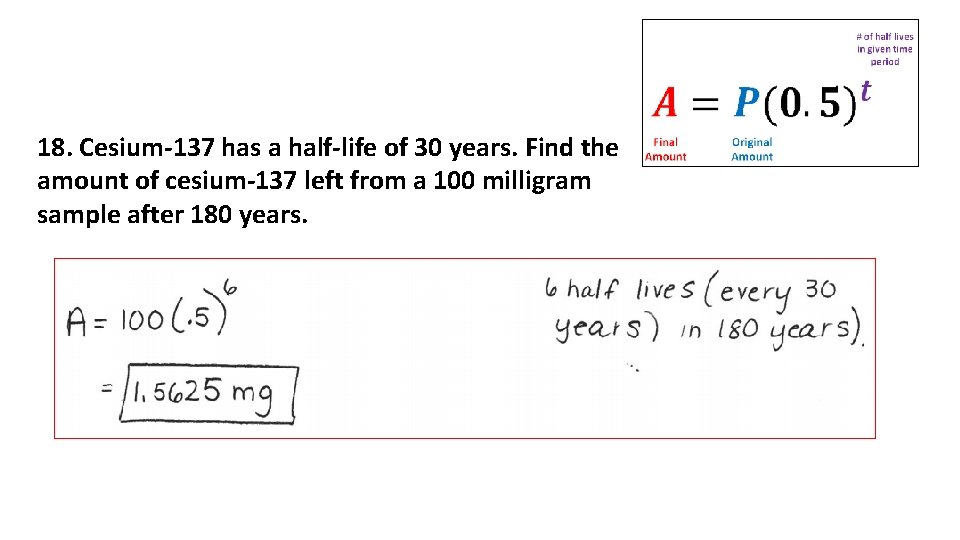
18. Cesium-137 has a half-life of 30 years. Find the amount of cesium-137 left from a 100 milligram sample after 180 years.
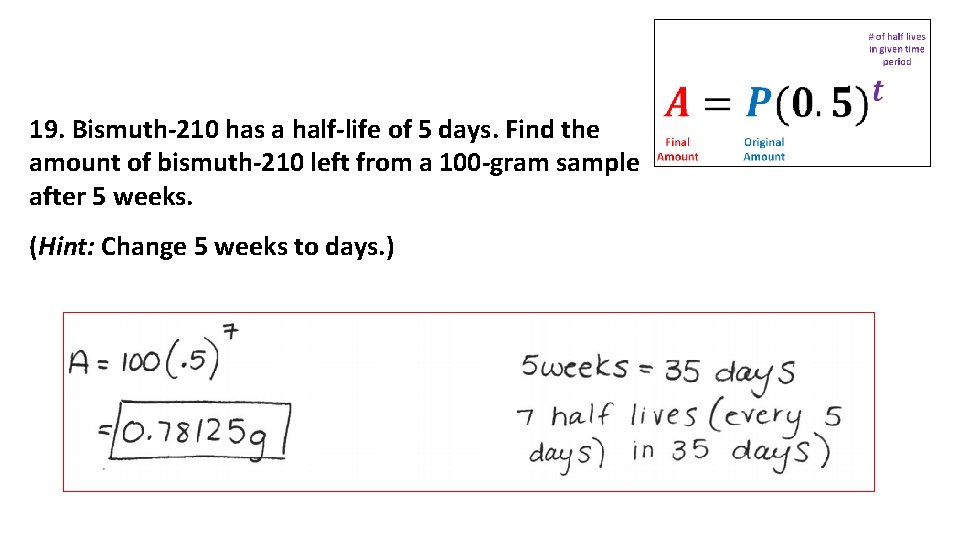
19. Bismuth-210 has a half-life of 5 days. Find the amount of bismuth-210 left from a 100 -gram sample after 5 weeks. (Hint: Change 5 weeks to days. )
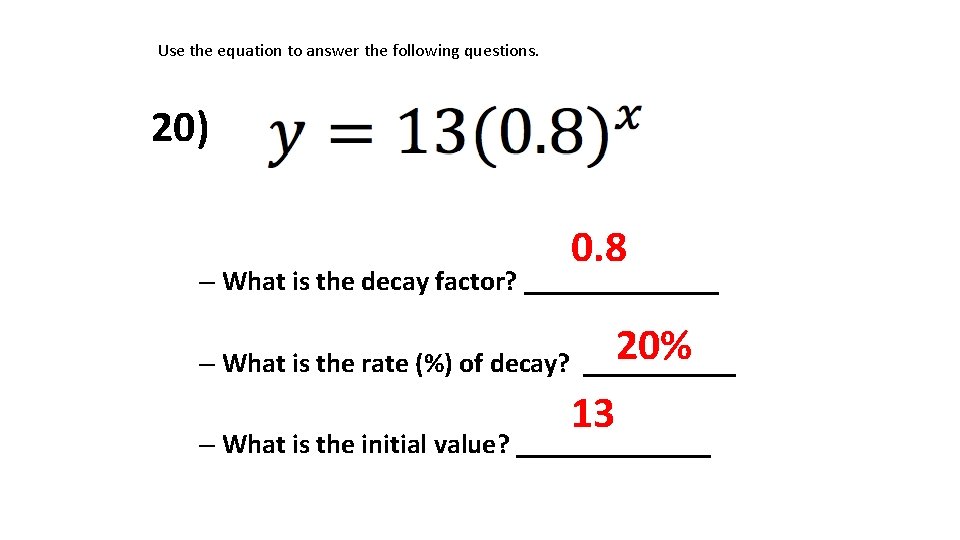
Use the equation to answer the following questions. 20) 0. 8 – What is the decay factor? _______ 20% – What is the rate (%) of decay? ______ 13 – What is the initial value? _______
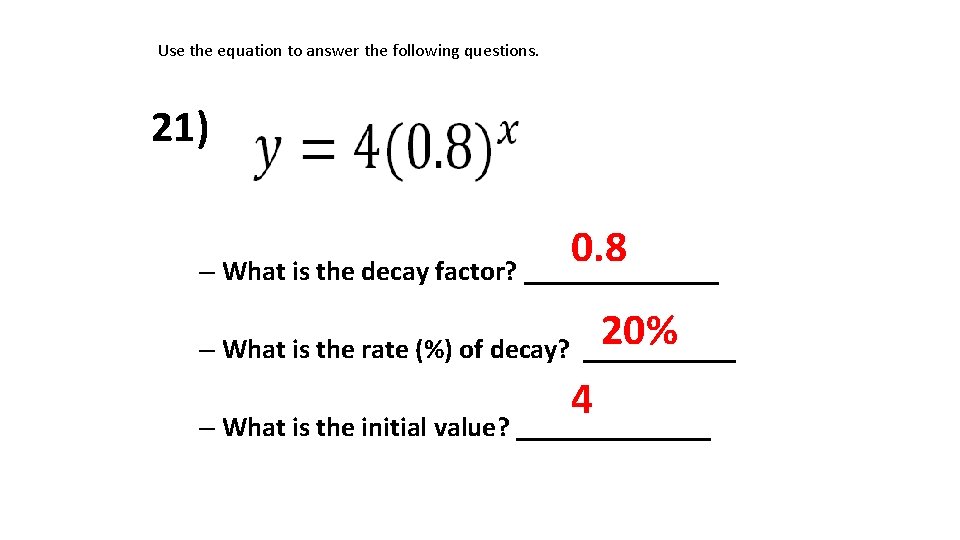
Use the equation to answer the following questions. 21) 0. 8 – What is the decay factor? _______ 20% – What is the rate (%) of decay? ______ 4 – What is the initial value? _______
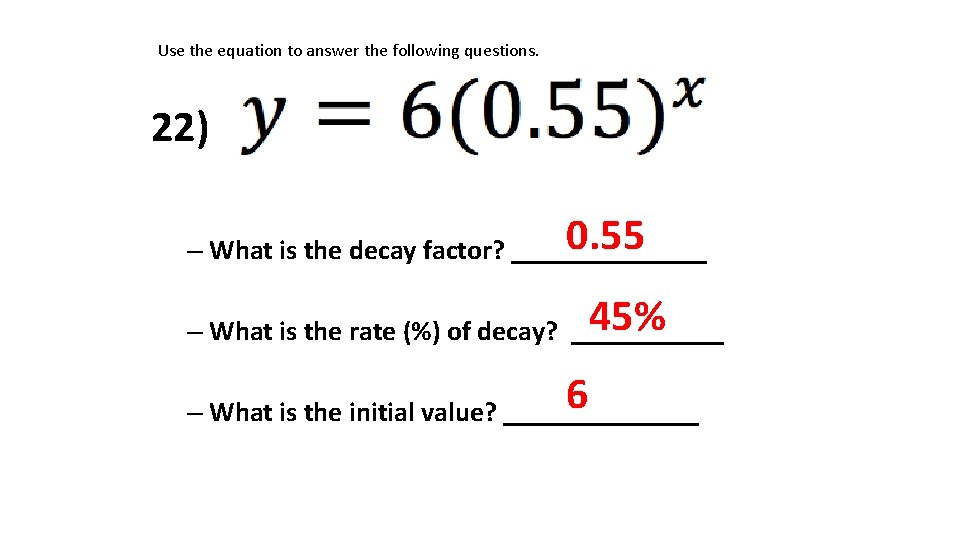
Use the equation to answer the following questions. 22) 0. 55 – What is the decay factor? _______ 45% – What is the rate (%) of decay? ______ 6 – What is the initial value? _______
- Slides: 37