
SOLUTIONS TYPES OF MIXTURES Heterogeneous mixturesmixtures that do


- Slides: 53
SOLUTIONS
TYPES OF MIXTURES • Heterogeneous mixtures-mixtures that do not blend smoothly-not uniform throughout-individual substances remain distinct. • Two Types of Heterogeneous Mixtures are: Suspensions Colloids
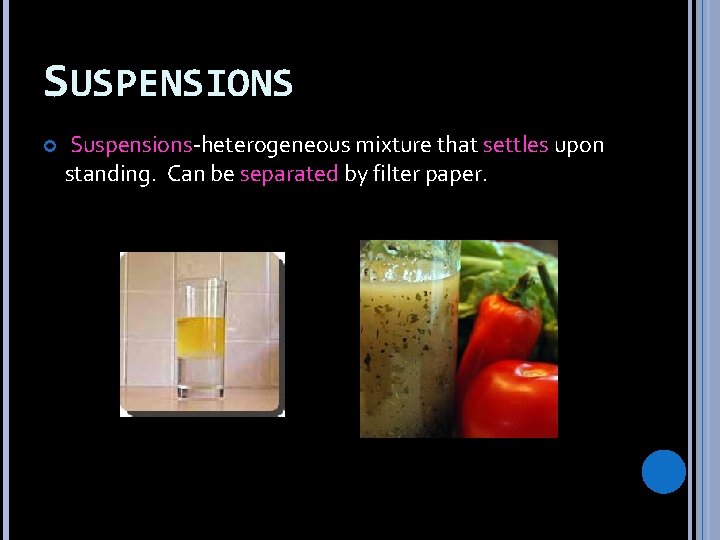
SUSPENSIONS Suspensions-heterogeneous mixture that settles upon standing. Can be separated by filter paper.
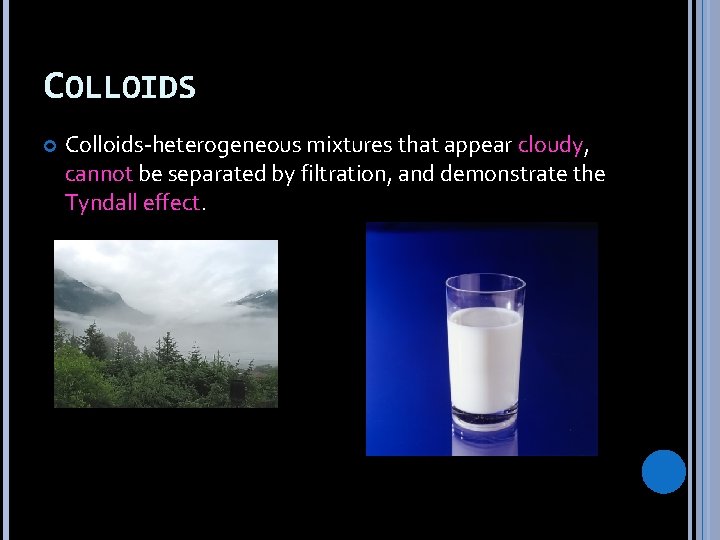
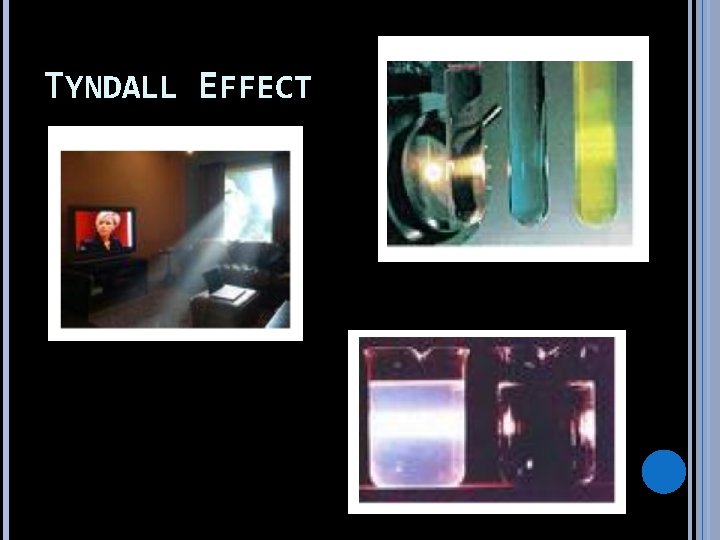
COLLOIDS Colloids-heterogeneous mixtures that appear cloudy, cannot be separated by filtration, and demonstrate the Tyndall effect.
TYNDALL EFFECT
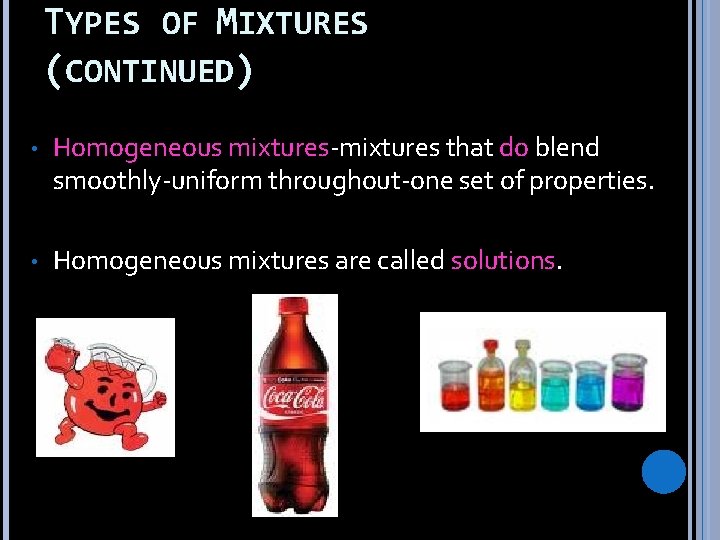
TYPES OF MIXTURES (CONTINUED) • Homogeneous mixtures-mixtures that do blend smoothly-uniform throughout-one set of properties. • Homogeneous mixtures are called solutions.
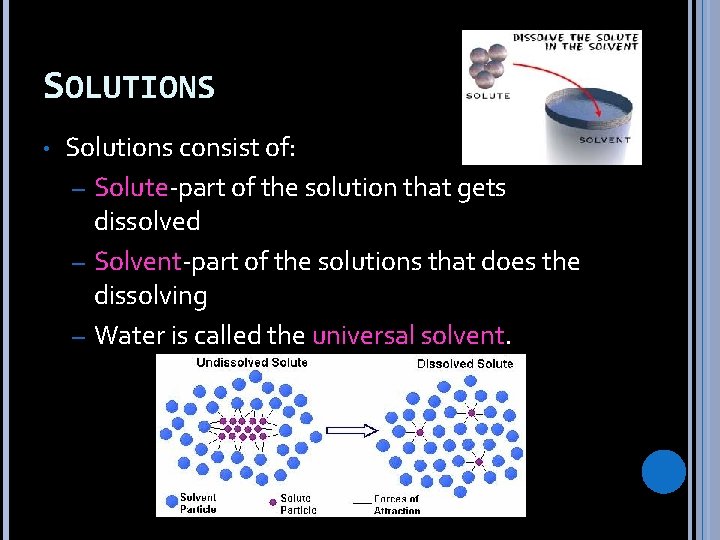
SOLUTIONS • Solutions consist of: – Solute-part of the solution that gets dissolved – Solvent-part of the solutions that does the dissolving – Water is called the universal solvent.
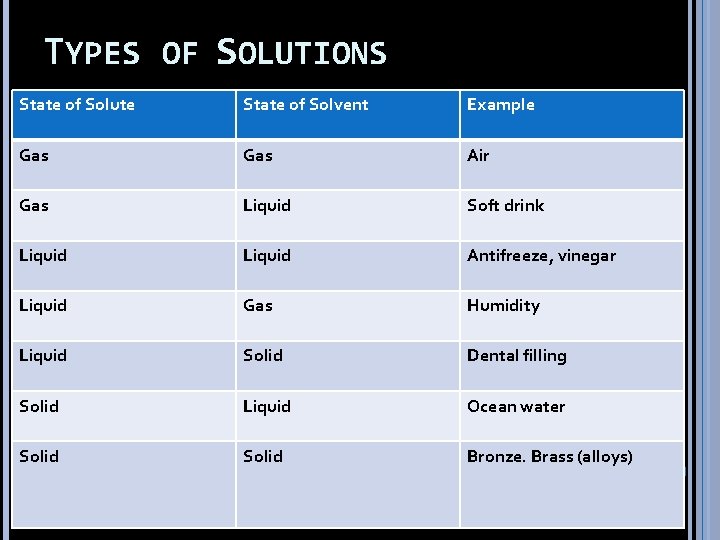
TYPES OF SOLUTIONS State of Solute Gas 1. State of Solvent Enter answer Gas text. . . Example Air Gas Liquid Soft drink Liquid Antifreeze, vinegar Liquid Gas Humidity Liquid Solid Dental filling Solid Liquid Ocean water Solid Bronze. Brass (alloys)
MUDDY WATER IS AN EXAMPLE OF A 10 colloid solution suspension 1. 2. 3. 1 2 3 4 5 6 7 8 9 10 21 22 23 24 25 26 27 28 29 30 11 12 13 14 15 16 17 18 19 20
FOG IS AN EXAMPLE OF A 10 colloid solution suspension 1. 2. 3. 1 2 3 4 5 6 7 8 9 10 21 22 23 24 25 26 27 28 29 30 11 12 13 14 15 16 17 18 19 20
ITALIAN SALAD DRESSING IS AN EXAMPLE OF A 10 colloid solution suspension 1. 2. 3. 1 2 3 4 5 6 7 8 9 10 21 22 23 24 25 26 27 28 29 30 11 12 13 14 15 16 17 18 19 20
KOOL-AID IS AN EXAMPLE OF A 10 colloid solution suspension 1. 2. 3. 1 2 3 4 5 6 7 8 9 10 21 22 23 24 25 26 27 28 29 30 11 12 13 14 15 16 17 18 19 20
PURE AIR IS AN EXAMPLE OF A 10 colloid solution suspension 1. 2. 3. 1 2 3 4 5 6 7 8 9 10 21 22 23 24 25 26 27 28 29 30 11 12 13 14 15 16 17 18 19 20
SALT IS DISSOLVED IN WATER. SALT IS THE 10 solute solvent 1. 2. 1 2 3 4 5 6 7 8 9 10 21 22 23 24 25 26 27 28 29 30 11 12 13 14 15 16 17 18 19 20
SUGAR IS DISSOLVED IN SWEET TEA. THE TEA IS THE 10 solute solvent 1. 2. 1 2 3 4 5 6 7 8 9 10 21 22 23 24 25 26 27 28 29 30 11 12 13 14 15 16 17 18 19 20
OXYGEN GAS DISSOLVED IN LAKE WATER IS AN EXAMPLE OF A 10 Liquid dissolved in a gas Gas dissolved in a liquid Gas dissolved in a solid Solid dissolved in a gas 1. 2. 3. 4. 1 2 3 4 5 6 7 8 9 10 21 22 23 24 25 26 27 28 29 30 11 12 13 14 15 16 17 18 19 20
CARBON DISSOLVED IN IRON TO MAKE STEEL IS AN EXAMPLE OF A 10 Solid dissolved in a solid Solid dissolved in a liquid Solid dissolved in a gas Liquid dissolved in a solid Gas dissolved in a solid 1. 2. 3. 4. 5. 1 2 3 4 5 6 7 8 9 10 21 22 23 24 25 26 27 28 29 30 11 12 13 14 15 16 17 18 19 20
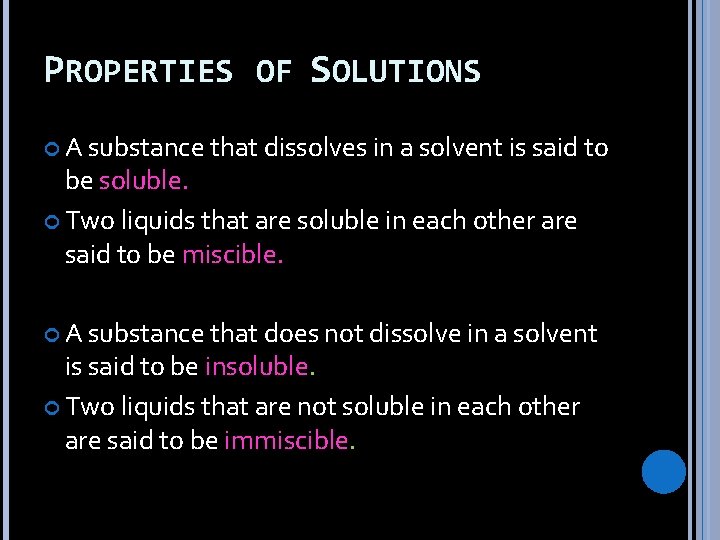
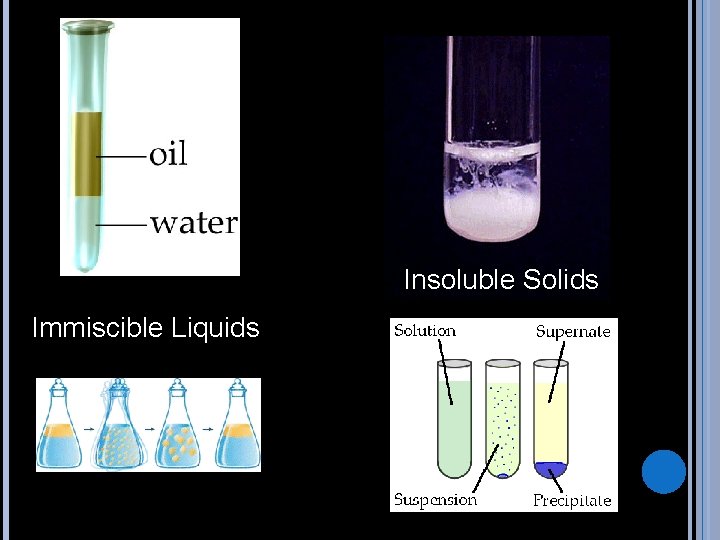
PROPERTIES OF SOLUTIONS A substance that dissolves in a solvent is said to be soluble. Two liquids that are soluble in each other are said to be miscible. A substance that does not dissolve in a solvent is said to be insoluble. Two liquids that are not soluble in each other are said to be immiscible.
Insoluble Solids Immiscible Liquids
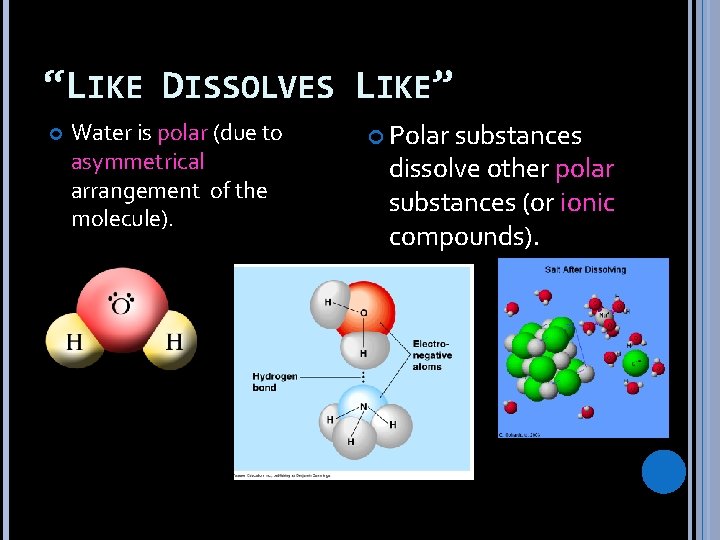
“LIKE DISSOLVES LIKE” Water is polar (due to asymmetrical arrangement of the molecule). Polar substances dissolve other polar substances (or ionic compounds).
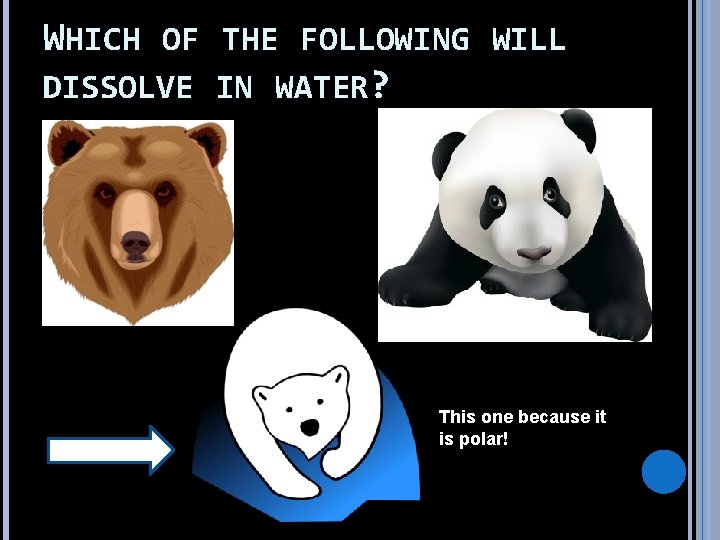
WHICH OF THE FOLLOWING WILL DISSOLVE IN WATER? This one because it is polar!
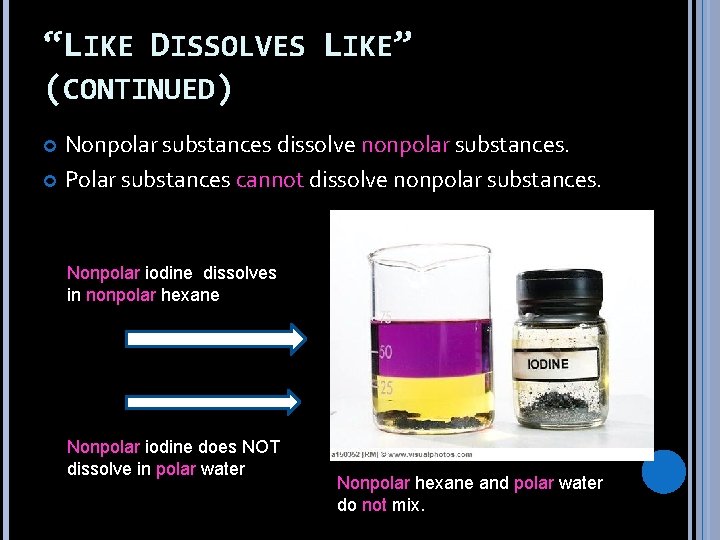
“LIKE DISSOLVES LIKE” (CONTINUED) Nonpolar substances dissolve nonpolar substances. Polar substances cannot dissolve nonpolar substances. Nonpolar iodine dissolves in nonpolar hexane Nonpolar iodine does NOT dissolve in polar water Nonpolar hexane and polar water do not mix.
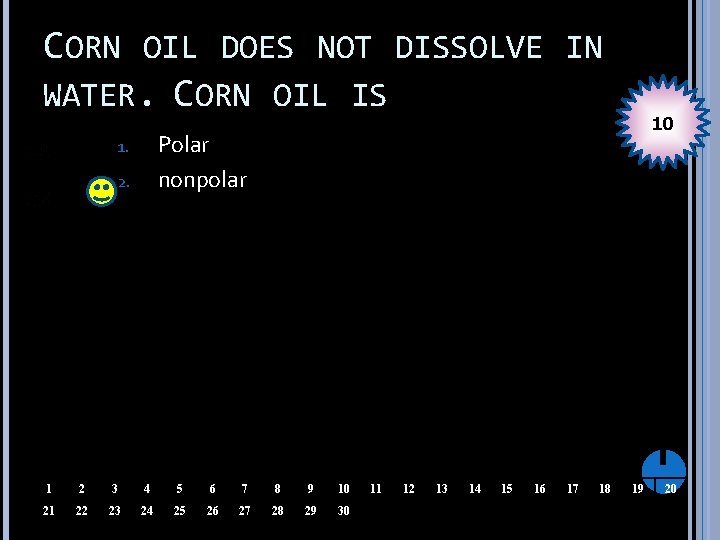
CORN OIL DOES NOT DISSOLVE IN WATER. CORN OIL IS 10 Polar nonpolar 1. 2. 1 2 3 4 5 6 7 8 9 10 21 22 23 24 25 26 27 28 29 30 11 12 13 14 15 16 17 18 19 20
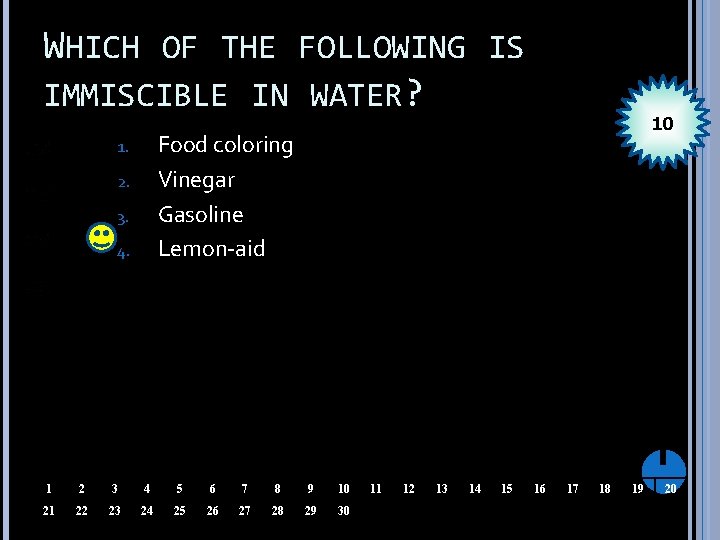
WHICH OF THE FOLLOWING IS IMMISCIBLE IN WATER? 10 Food coloring Vinegar Gasoline Lemon-aid 1. 2. 3. 4. 1 2 3 4 5 6 7 8 9 10 21 22 23 24 25 26 27 28 29 30 11 12 13 14 15 16 17 18 19 20
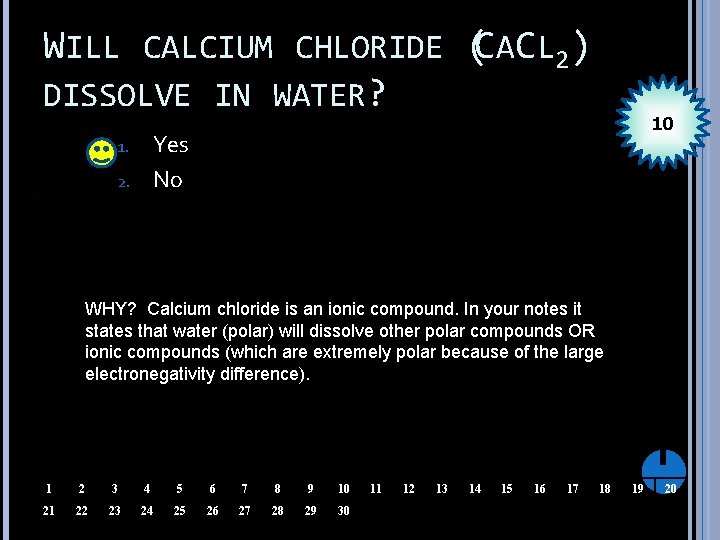
WILL CALCIUM CHLORIDE (CACL 2) DISSOLVE IN WATER? 10 Yes No 1. 2. WHY? Calcium chloride is an ionic compound. In your notes it states that water (polar) will dissolve other polar compounds OR ionic compounds (which are extremely polar because of the large electronegativity difference). 1 2 3 4 5 6 7 8 9 10 21 22 23 24 25 26 27 28 29 30 11 12 13 14 15 16 17 18 19 20
REMEMBER HOW TO DRAW LEWIS STRUCTURES? SYMMETRICAL STRUCTURES=NONPOLAR ASYMMETRICAL STRUCTURE= POLAR http: //www. youtube. com/watch? v=a. WNf 9 YTzaa. A Only watch this video clip from the beginning until the 4: 00 minute mark. This should remind you how to use the N-A=S method for drawing lewis structures.
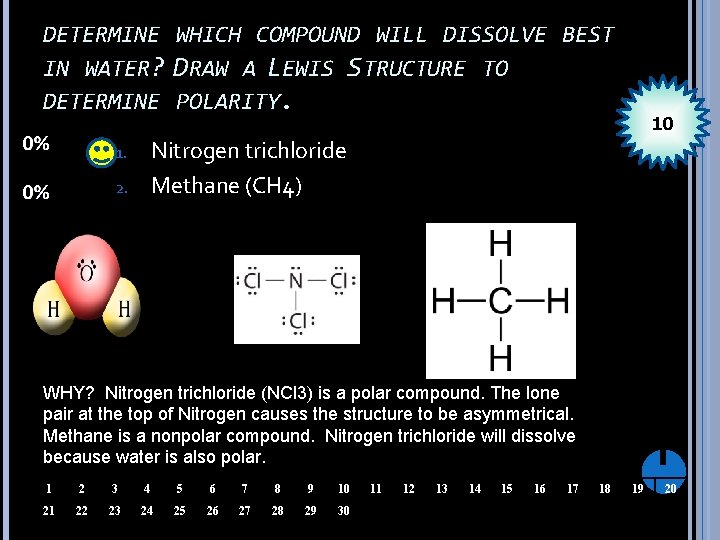
DETERMINE WHICH COMPOUND WILL DISSOLVE BEST IN WATER? DRAW A LEWIS STRUCTURE TO DETERMINE POLARITY. 10 Nitrogen trichloride Methane (CH 4) 1. 2. WHY? Nitrogen trichloride (NCl 3) is a polar compound. The lone pair at the top of Nitrogen causes the structure to be asymmetrical. Methane is a nonpolar compound. Nitrogen trichloride will dissolve because water is also polar. 1 2 3 4 5 6 7 8 9 10 21 22 23 24 25 26 27 28 29 30 11 12 13 14 15 16 17 18 19 20
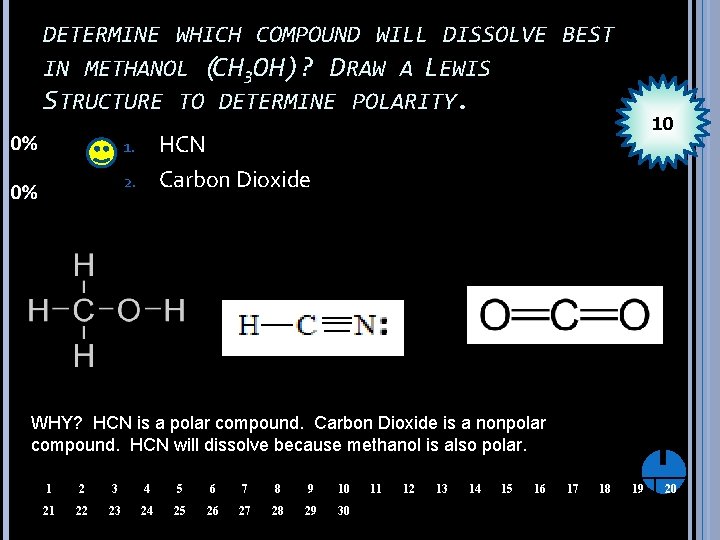
DETERMINE WHICH COMPOUND WILL DISSOLVE BEST IN METHANOL (CH 3 OH)? DRAW A LEWIS STRUCTURE TO DETERMINE POLARITY. 10 HCN Carbon Dioxide 1. 2. WHY? HCN is a polar compound. Carbon Dioxide is a nonpolar compound. HCN will dissolve because methanol is also polar. 1 2 3 4 5 6 7 8 9 10 21 22 23 24 25 26 27 28 29 30 11 12 13 14 15 16 17 18 19 20
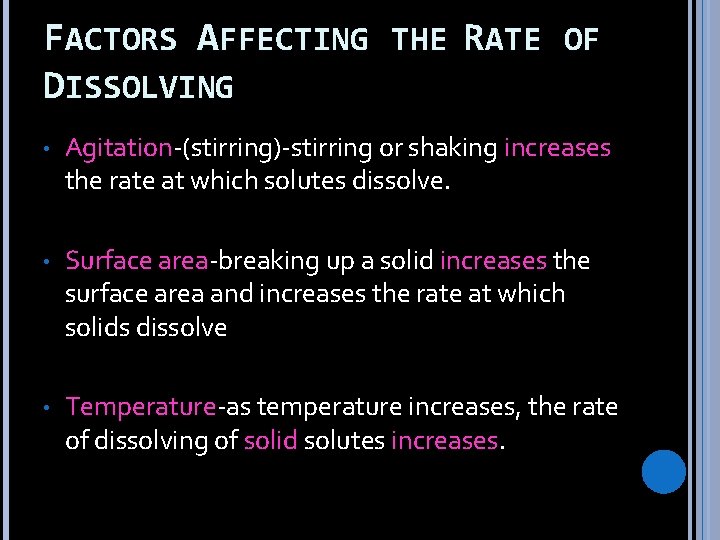
FACTORS AFFECTING THE RATE OF DISSOLVING • Agitation-(stirring)-stirring or shaking increases the rate at which solutes dissolve. • Surface area-breaking up a solid increases the surface area and increases the rate at which solids dissolve • Temperature-as temperature increases, the rate of dissolving of solid solutes increases.
SOLUBILITY • Solubility is defined as the amount of solute that will dissolve in a given amount of solvent at a particular temperature
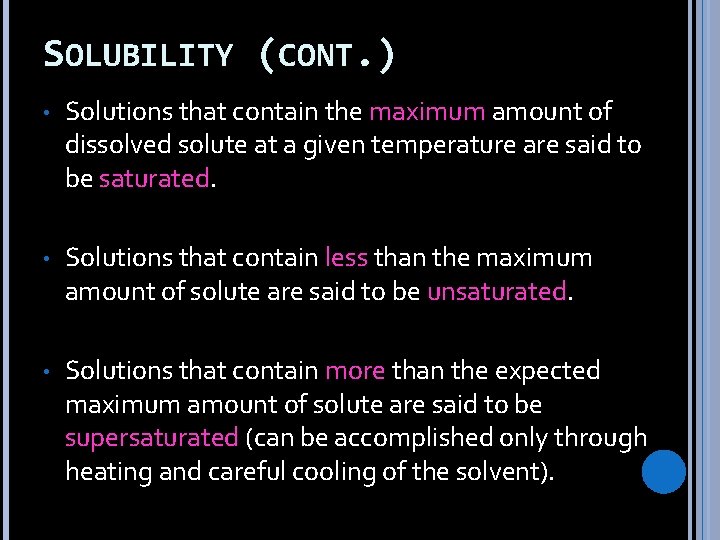
SOLUBILITY (CONT. ) • Solutions that contain the maximum amount of dissolved solute at a given temperature are said to be saturated. • Solutions that contain less than the maximum amount of solute are said to be unsaturated. • Solutions that contain more than the expected maximum amount of solute are said to be supersaturated (can be accomplished only through heating and careful cooling of the solvent).
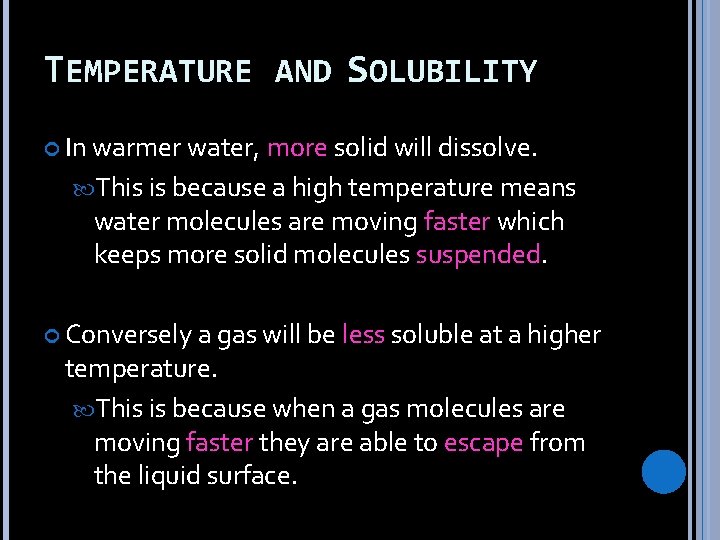
TEMPERATURE AND SOLUBILITY In warmer water, more solid will dissolve. This is because a high temperature means water molecules are moving faster which keeps more solid molecules suspended. Conversely a gas will be less soluble at a higher temperature. This is because when a gas molecules are moving faster they are able to escape from the liquid surface.
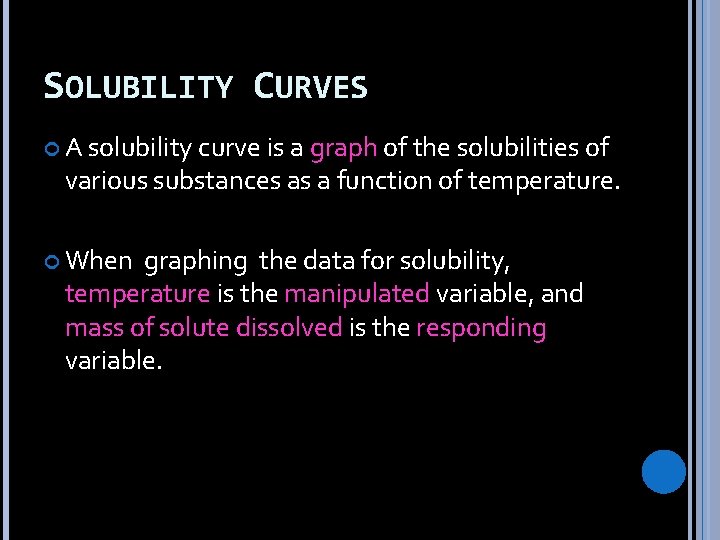
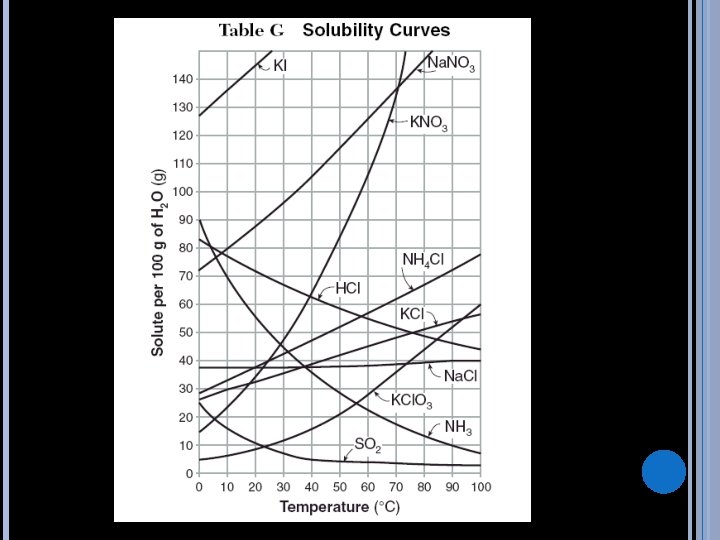
SOLUBILITY CURVES A solubility curve is a graph of the solubilities of various substances as a function of temperature. When graphing the data for solubility, temperature is the manipulated variable, and mass of solute dissolved is the responding variable.
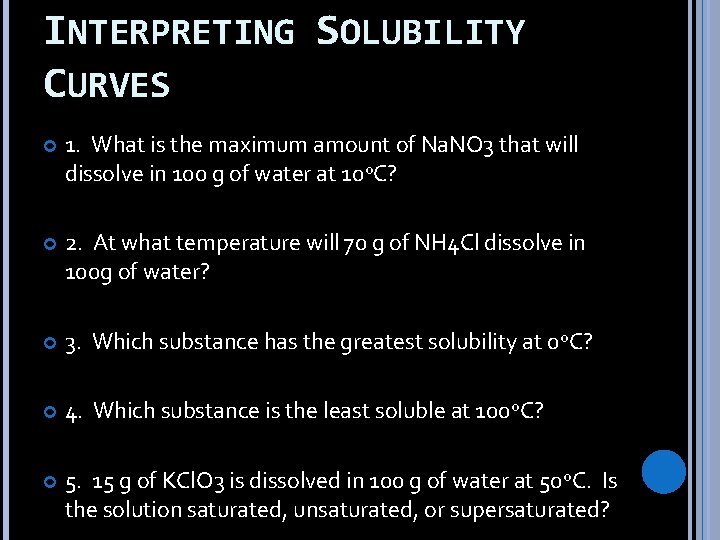
INTERPRETING SOLUBILITY CURVES 1. What is the maximum amount of Na. NO 3 that will dissolve in 100 g of water at 10 o. C? 2. At what temperature will 70 g of NH 4 Cl dissolve in 100 g of water? 3. Which substance has the greatest solubility at 0 o. C? 4. Which substance is the least soluble at 100 o. C? 5. 15 g of KCl. O 3 is dissolved in 100 g of water at 50 o. C. Is the solution saturated, unsaturated, or supersaturated?
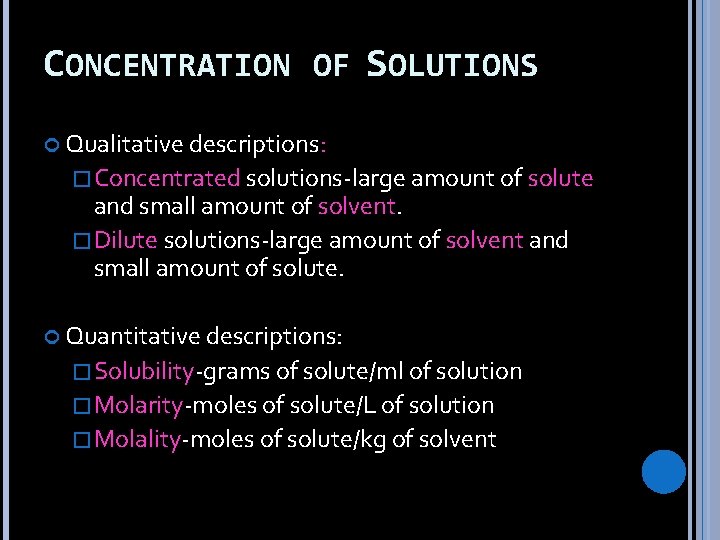
CONCENTRATION OF SOLUTIONS Qualitative descriptions: �Concentrated solutions-large amount of solute and small amount of solvent. �Dilute solutions-large amount of solvent and small amount of solute. Quantitative descriptions: �Solubility-grams of solute/ml of solution �Molarity-moles of solute/L of solution �Molality-moles of solute/kg of solvent
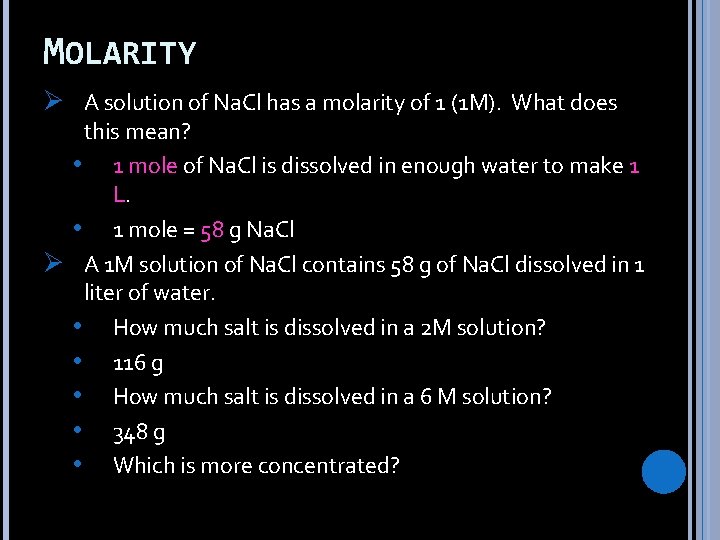
MOLARITY Ø A solution of Na. Cl has a molarity of 1 (1 M). What does this mean? • 1 mole of Na. Cl is dissolved in enough water to make 1 L. • 1 mole = 58 g Na. Cl Ø A 1 M solution of Na. Cl contains 58 g of Na. Cl dissolved in 1 liter of water. • How much salt is dissolved in a 2 M solution? • 116 g • How much salt is dissolved in a 6 M solution? • 348 g • Which is more concentrated?
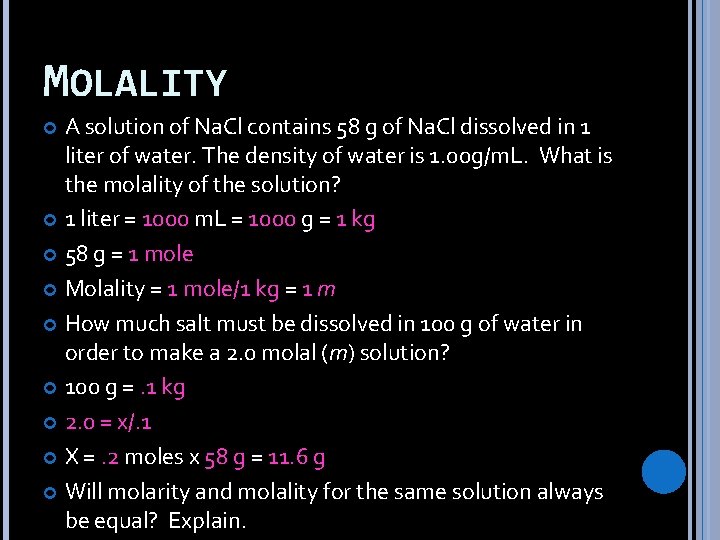
MOLALITY A solution of Na. Cl contains 58 g of Na. Cl dissolved in 1 liter of water. The density of water is 1. 00 g/m. L. What is the molality of the solution? 1 liter = 1000 m. L = 1000 g = 1 kg 58 g = 1 mole Molality = 1 mole/1 kg = 1 m How much salt must be dissolved in 100 g of water in order to make a 2. 0 molal (m) solution? 100 g =. 1 kg 2. 0 = x/. 1 X =. 2 moles x 58 g = 11. 6 g Will molarity and molality for the same solution always be equal? Explain.
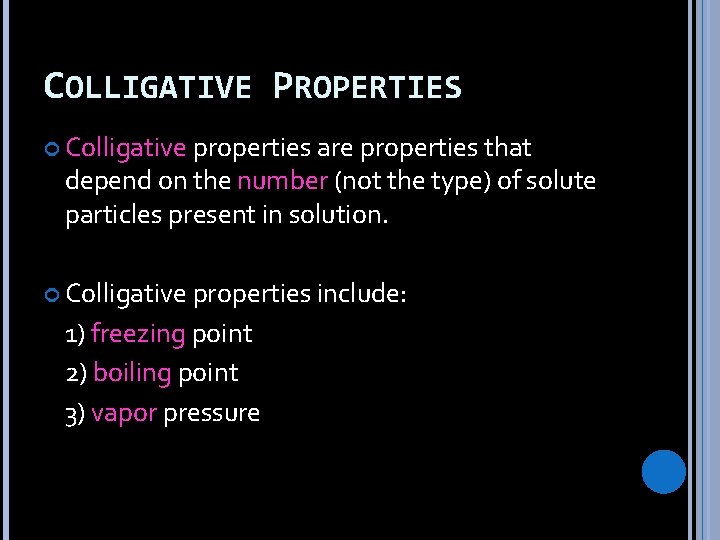
COLLIGATIVE PROPERTIES Colligative properties are properties that depend on the number (not the type) of solute particles present in solution. Colligative properties include: 1) freezing point 2) boiling point 3) vapor pressure
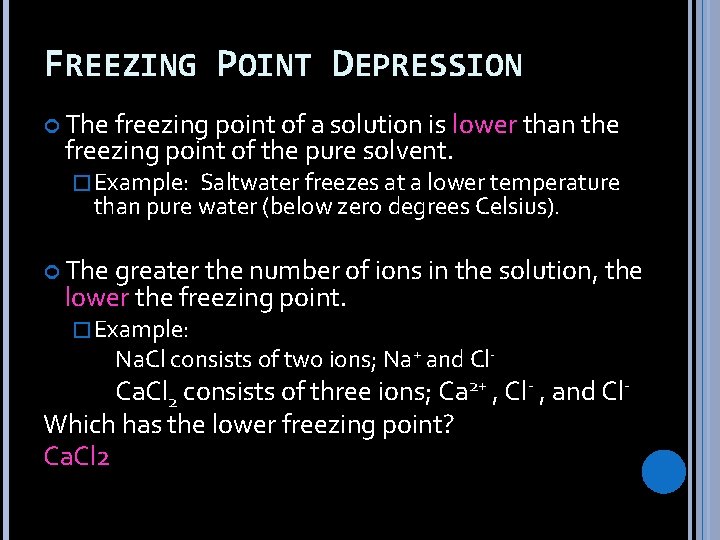
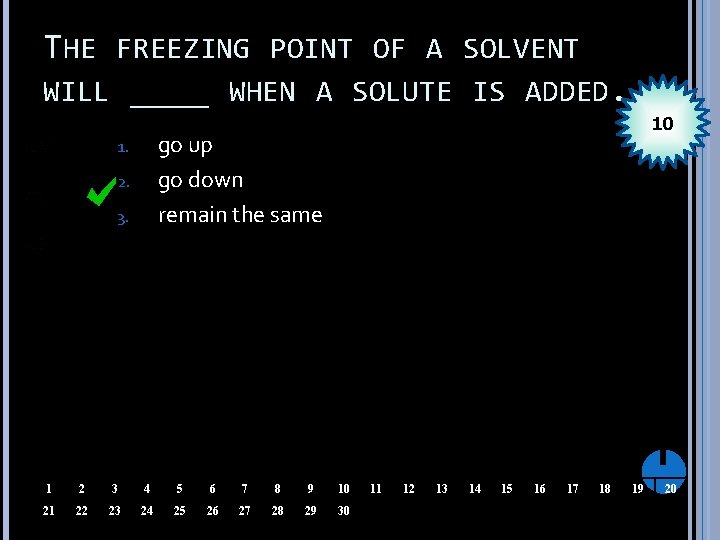
FREEZING POINT DEPRESSION The freezing point of a solution is lower than the freezing point of the pure solvent. � Example: Saltwater freezes at a lower temperature than pure water (below zero degrees Celsius). The greater the number of ions in the solution, the lower the freezing point. � Example: Na. Cl consists of two ions; Na+ and Cl- Ca. Cl 2 consists of three ions; Ca 2+ , Cl- , and Cl. Which has the lower freezing point? Ca. Cl 2
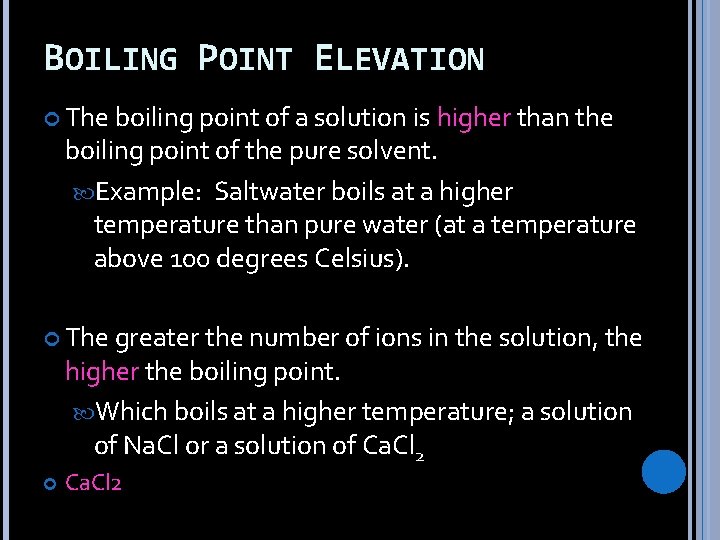
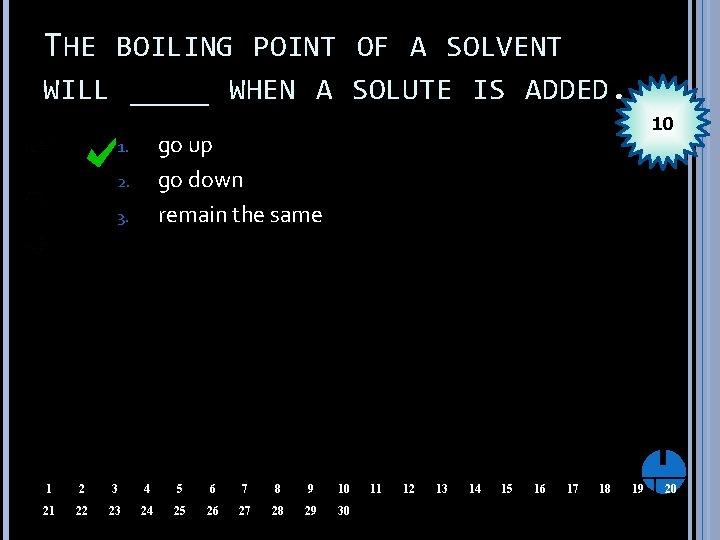
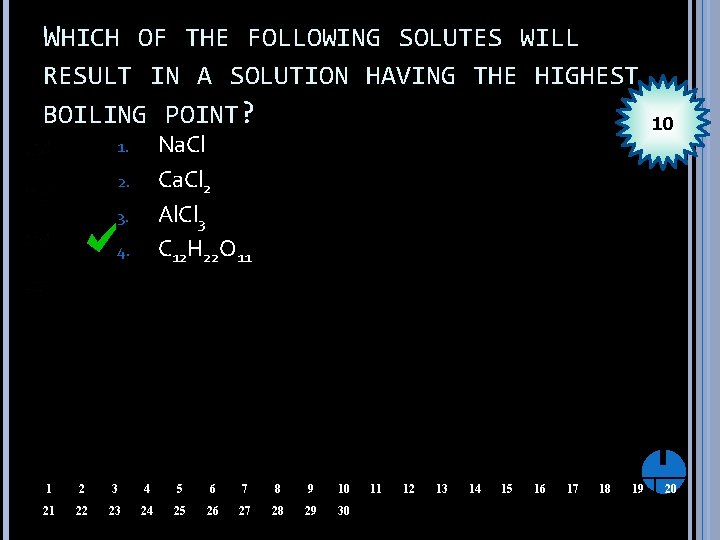
BOILING POINT ELEVATION The boiling point of a solution is higher than the boiling point of the pure solvent. Example: Saltwater boils at a higher temperature than pure water (at a temperature above 100 degrees Celsius). The greater the number of ions in the solution, the higher the boiling point. Which boils at a higher temperature; a solution of Na. Cl or a solution of Ca. Cl 2
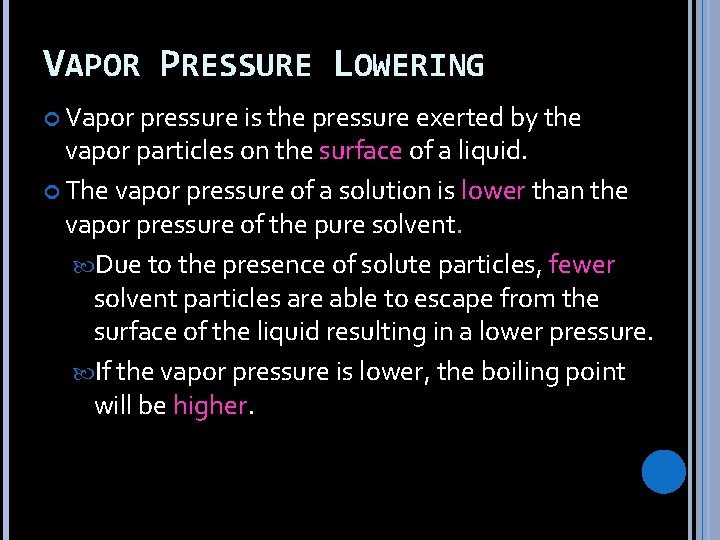
VAPOR PRESSURE LOWERING Vapor pressure is the pressure exerted by the vapor particles on the surface of a liquid. The vapor pressure of a solution is lower than the vapor pressure of the pure solvent. Due to the presence of solute particles, fewer solvent particles are able to escape from the surface of the liquid resulting in a lower pressure. If the vapor pressure is lower, the boiling point will be higher.
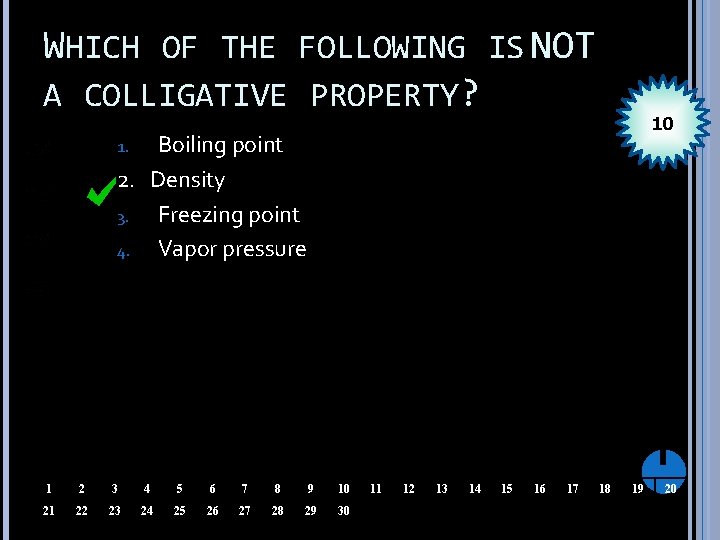
WHICH OF THE FOLLOWING IS NOT A COLLIGATIVE PROPERTY? 10 Boiling point 2. Density 3. Freezing point 4. Vapor pressure 1. 1 2 3 4 5 6 7 8 9 10 21 22 23 24 25 26 27 28 29 30 11 12 13 14 15 16 17 18 19 20
THE FREEZING POINT OF A SOLVENT WILL ____ WHEN A SOLUTE IS ADDED. 10 go up go down remain the same 1. 2. 3. 1 2 3 4 5 6 7 8 9 10 21 22 23 24 25 26 27 28 29 30 11 12 13 14 15 16 17 18 19 20
THE BOILING POINT OF A SOLVENT WILL ____ WHEN A SOLUTE IS ADDED. 10 go up go down remain the same 1. 2. 3. 1 2 3 4 5 6 7 8 9 10 21 22 23 24 25 26 27 28 29 30 11 12 13 14 15 16 17 18 19 20
WHICH OF THE FOLLOWING SOLUTES WILL RESULT IN A SOLUTION HAVING THE HIGHEST BOILING POINT? Na. Cl Ca. Cl 2 Al. Cl 3 C 12 H 22 O 11 1. 2. 3. 4. 1 2 3 4 5 6 7 8 9 10 21 22 23 24 25 26 27 28 29 30 11 12 13 14 15 16 17 18 19 10 20
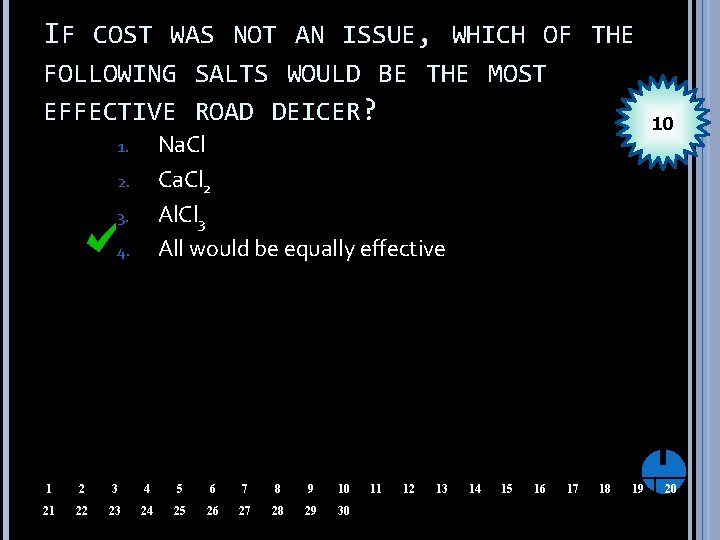
IF COST WAS NOT AN ISSUE, WHICH OF THE FOLLOWING SALTS WOULD BE THE MOST EFFECTIVE ROAD DEICER? 10 Na. Cl Ca. Cl 2 Al. Cl 3 All would be equally effective 1. 2. 3. 4. 1 2 3 4 5 6 7 8 9 10 21 22 23 24 25 26 27 28 29 30 11 12 13 14 15 16 17 18 19 20
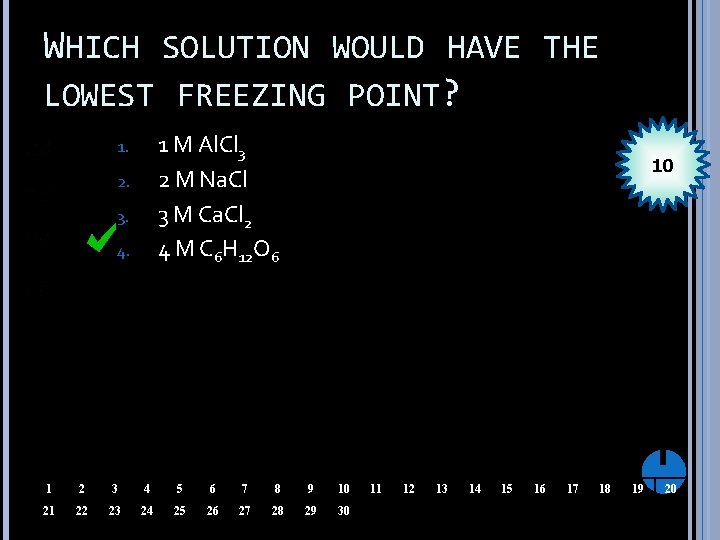
WHICH SOLUTION WOULD HAVE THE LOWEST FREEZING POINT? 1 M Al. Cl 3 2 M Na. Cl 3 M Ca. Cl 2 4 M C 6 H 12 O 6 1. 2. 3. 4. 10 1 2 3 4 5 6 7 8 9 10 21 22 23 24 25 26 27 28 29 30 11 12 13 14 15 16 17 18 19 20
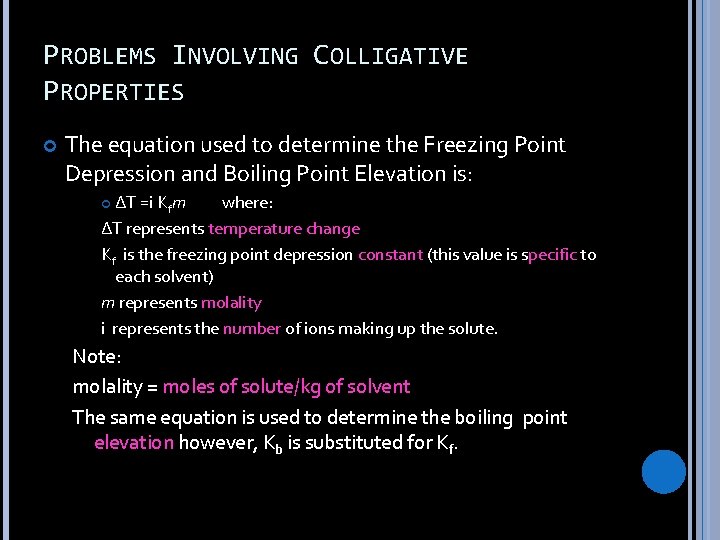
PROBLEMS INVOLVING COLLIGATIVE PROPERTIES The equation used to determine the Freezing Point Depression and Boiling Point Elevation is: ∆T =i Kfm where: ∆T represents temperature change Kf is the freezing point depression constant (this value is specific to each solvent) m represents molality i represents the number of ions making up the solute. Note: molality = moles of solute/kg of solvent The same equation is used to determine the boiling point elevation however, Kb is substituted for Kf.
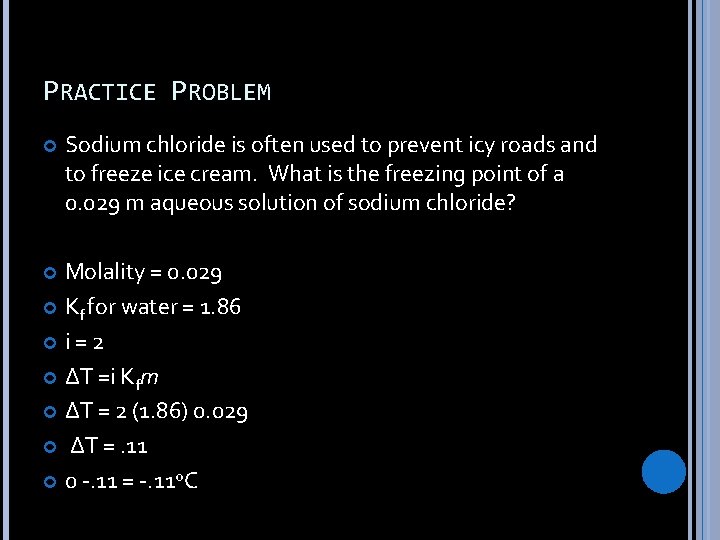
PRACTICE PROBLEM Sodium chloride is often used to prevent icy roads and to freeze ice cream. What is the freezing point of a 0. 029 m aqueous solution of sodium chloride? Molality = 0. 029 Kf for water = 1. 86 i=2 ∆T =i Kfm ∆T = 2 (1. 86) 0. 029 ∆T =. 11 0 -. 11 = -. 11 o. C
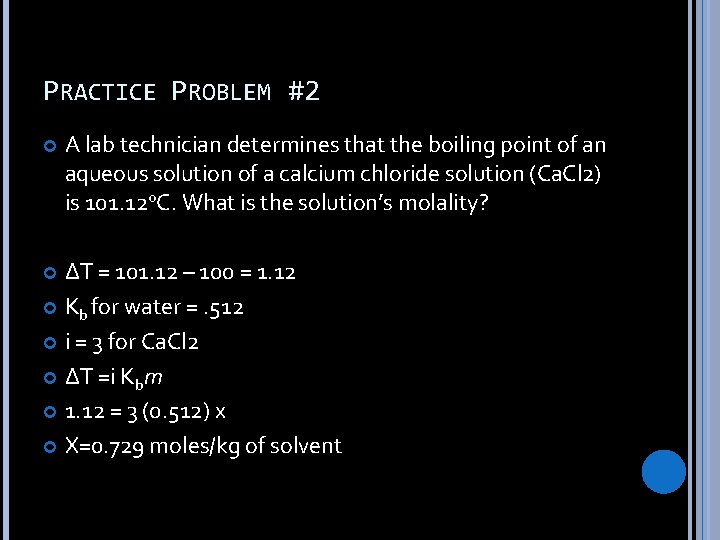
PRACTICE PROBLEM #2 A lab technician determines that the boiling point of an aqueous solution of a calcium chloride solution (Ca. Cl 2) is 101. 12 o. C. What is the solution’s molality? ∆T = 101. 12 – 100 = 1. 12 Kb for water =. 512 i = 3 for Ca. Cl 2 ∆T =i Kbm 1. 12 = 3 (0. 512) x X=0. 729 moles/kg of solvent
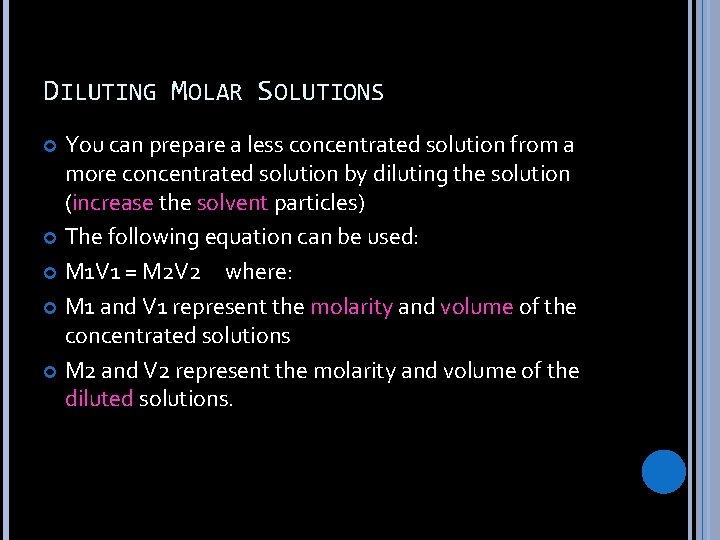
DILUTING MOLAR SOLUTIONS You can prepare a less concentrated solution from a more concentrated solution by diluting the solution (increase the solvent particles) The following equation can be used: M 1 V 1 = M 2 V 2 where: M 1 and V 1 represent the molarity and volume of the concentrated solutions M 2 and V 2 represent the molarity and volume of the diluted solutions.
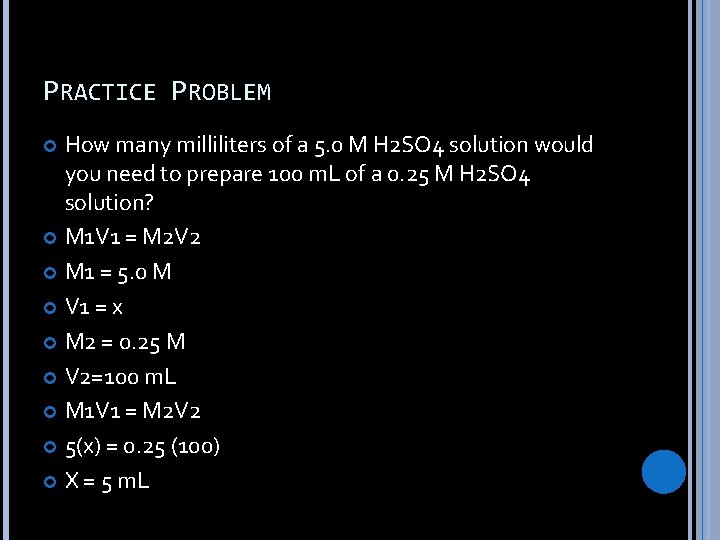
PRACTICE PROBLEM How many milliliters of a 5. 0 M H 2 SO 4 solution would you need to prepare 100 m. L of a 0. 25 M H 2 SO 4 solution? M 1 V 1 = M 2 V 2 M 1 = 5. 0 M V 1 = x M 2 = 0. 25 M V 2=100 m. L M 1 V 1 = M 2 V 2 5(x) = 0. 25 (100) X = 5 m. L