
SOLUTIONS OF THE REACTOR EQUATION We shall need
- Slides: 14
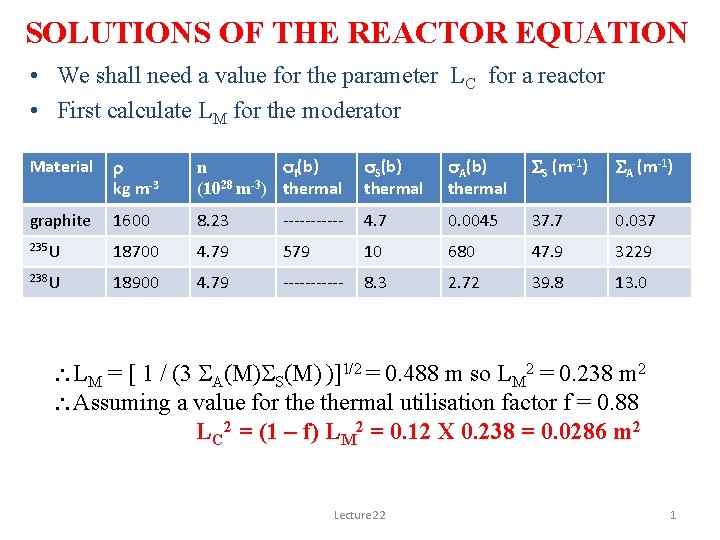
SOLUTIONS OF THE REACTOR EQUATION • We shall need a value for the parameter LC for a reactor • First calculate LM for the moderator Material r kg m-3 sf(b) n (1028 m-3) thermal s. S(b) thermal s. A(b) thermal SS (m-1) SA (m-1) graphite 1600 8. 23 ------ 4. 7 0. 0045 37. 7 0. 037 235 U 18700 4. 79 579 10 680 47. 9 3229 238 U 18900 4. 79 ------ 8. 3 2. 72 39. 8 13. 0 LM = [ 1 / (3 SA(M)SS(M) )]1/2 = 0. 488 m so LM 2 = 0. 238 m 2 Assuming a value for thermal utilisation factor f = 0. 88 LC 2 = (1 – f) LM 2 = 0. 12 X 0. 238 = 0. 0286 m 2 Lecture 22 1
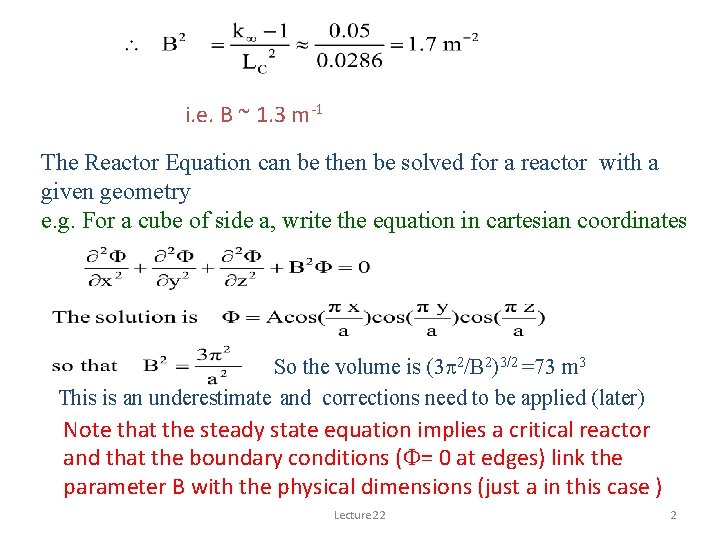
i. e. B ~ 1. 3 m-1 The Reactor Equation can be then be solved for a reactor with a given geometry e. g. For a cube of side a, write the equation in cartesian coordinates So the volume is (3 p 2/B 2)3/2 =73 m 3 This is an underestimate and corrections need to be applied (later) Note that the steady state equation implies a critical reactor and that the boundary conditions (F= 0 at edges) link the parameter B with the physical dimensions (just a in this case ) Lecture 22 2
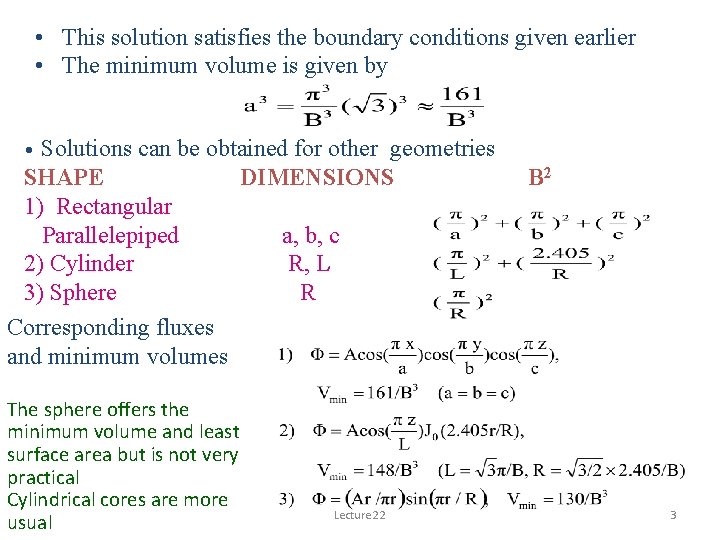
• This solution satisfies the boundary conditions given earlier • The minimum volume is given by Solutions can be obtained for other geometries SHAPE DIMENSIONS 1) Rectangular Parallelepiped a, b, c 2) Cylinder R, L 3) Sphere R Corresponding fluxes and minimum volumes • The sphere offers the minimum volume and least surface area but is not very practical Cylindrical cores are more usual Lecture 22 B 2 3
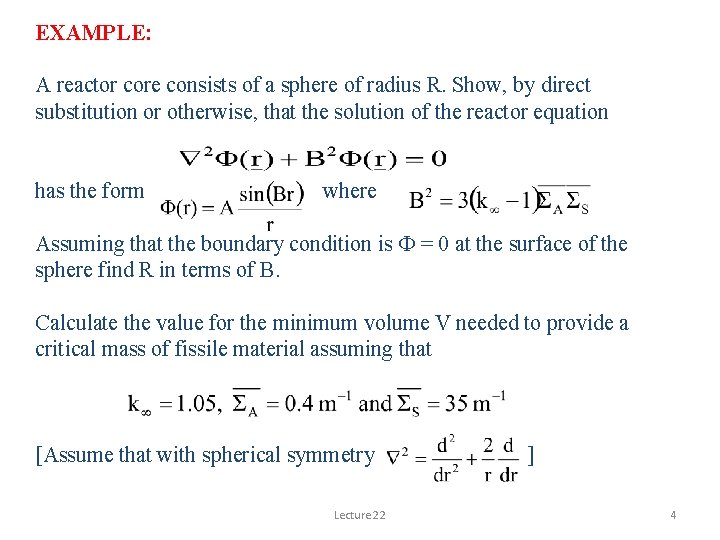
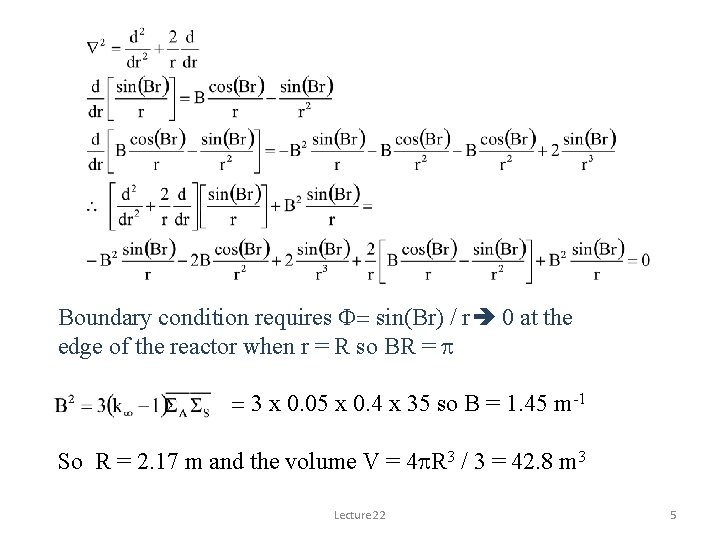
EXAMPLE: A reactor core consists of a sphere of radius R. Show, by direct substitution or otherwise, that the solution of the reactor equation has the form where Assuming that the boundary condition is F = 0 at the surface of the sphere find R in terms of B. Calculate the value for the minimum volume V needed to provide a critical mass of fissile material assuming that [Assume that with spherical symmetry Lecture 22 ] 4
Boundary condition requires F= sin(Br) / r 0 at the edge of the reactor when r = R so BR = p = 3 x 0. 05 x 0. 4 x 35 so B = 1. 45 m-1 So R = 2. 17 m and the volume V = 4 p. R 3 / 3 = 42. 8 m 3 Lecture 22 5
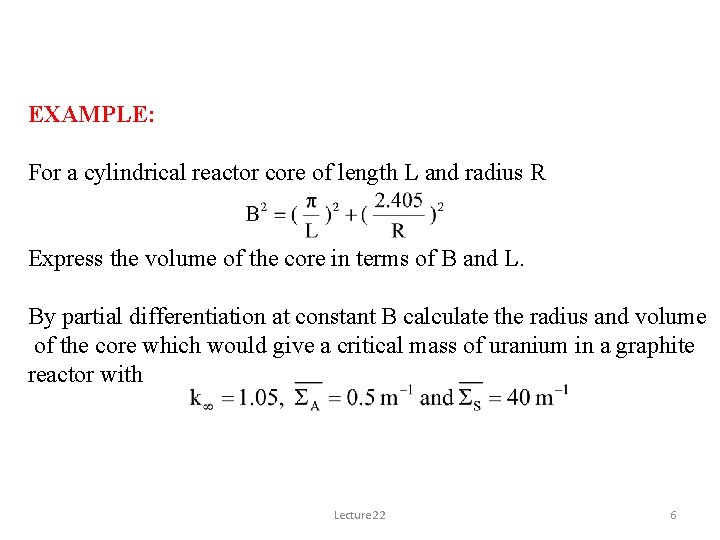
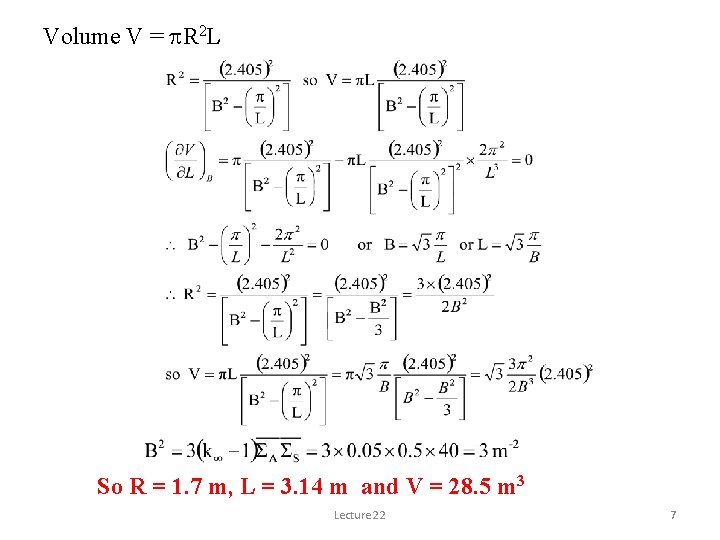
EXAMPLE: For a cylindrical reactor core of length L and radius R Express the volume of the core in terms of B and L. By partial differentiation at constant B calculate the radius and volume of the core which would give a critical mass of uranium in a graphite reactor with Lecture 22 6
Volume V = p. R 2 L So R = 1. 7 m, L = 3. 14 m and V = 28. 5 m 3 Lecture 22 7
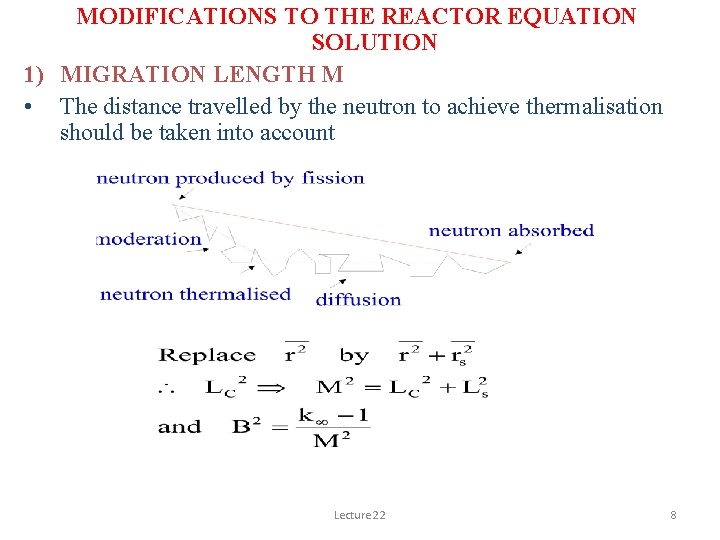
MODIFICATIONS TO THE REACTOR EQUATION SOLUTION 1) MIGRATION LENGTH M • The distance travelled by the neutron to achieve thermalisation should be taken into account Lecture 22 8
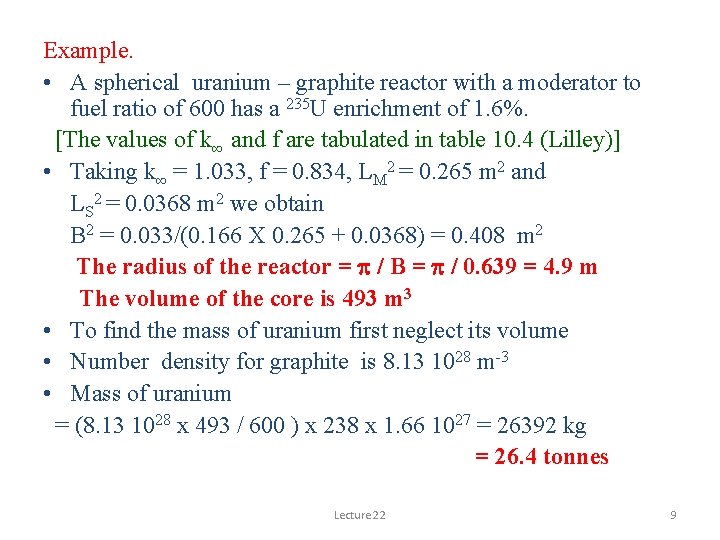
Example. • A spherical uranium – graphite reactor with a moderator to fuel ratio of 600 has a 235 U enrichment of 1. 6%. [The values of k∞ and f are tabulated in table 10. 4 (Lilley)] • Taking k∞ = 1. 033, f = 0. 834, LM 2 = 0. 265 m 2 and LS 2 = 0. 0368 m 2 we obtain B 2 = 0. 033/(0. 166 X 0. 265 + 0. 0368) = 0. 408 m 2 The radius of the reactor = p / B = p / 0. 639 = 4. 9 m The volume of the core is 493 m 3 • To find the mass of uranium first neglect its volume • Number density for graphite is 8. 13 1028 m-3 • Mass of uranium = (8. 13 1028 x 493 / 600 ) x 238 x 1. 66 1027 = 26392 kg = 26. 4 tonnes Lecture 22 9
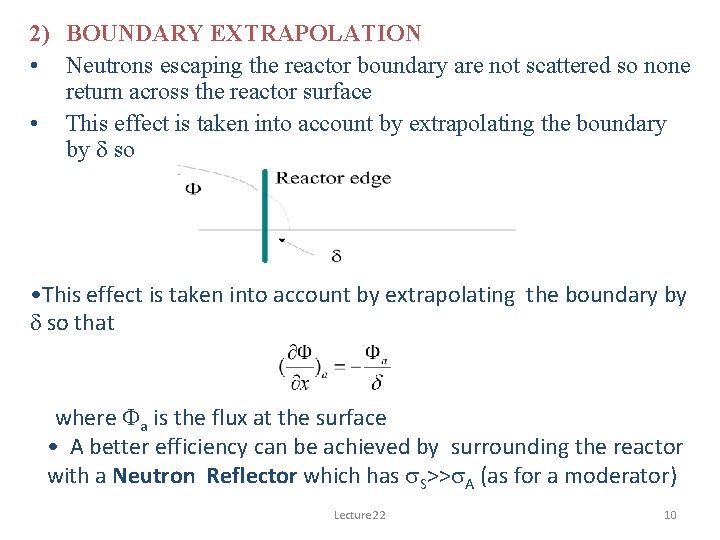
2) BOUNDARY EXTRAPOLATION • Neutrons escaping the reactor boundary are not scattered so none return across the reactor surface • This effect is taken into account by extrapolating the boundary by d so that where Fa is the flux at the surface • A better efficiency can be achieved by surrounding the reactor with a Neutron Reflector which has s. S>>s. A (as for a moderator) Lecture 22 10
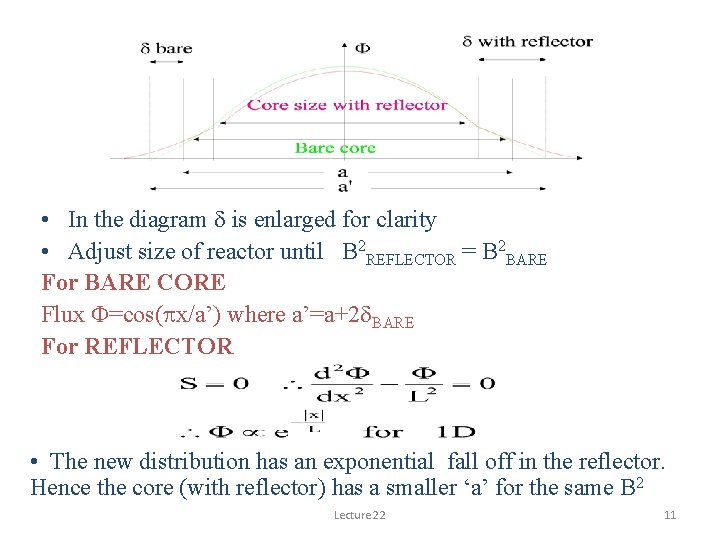
• In the diagram d is enlarged for clarity • Adjust size of reactor until B 2 REFLECTOR = B 2 BARE For BARE CORE Flux F=cos(px/a’) where a’=a+2 d. BARE For REFLECTOR • The new distribution has an exponential fall off in the reflector. Hence the core (with reflector) has a smaller ‘a’ for the same B 2 Lecture 22 11
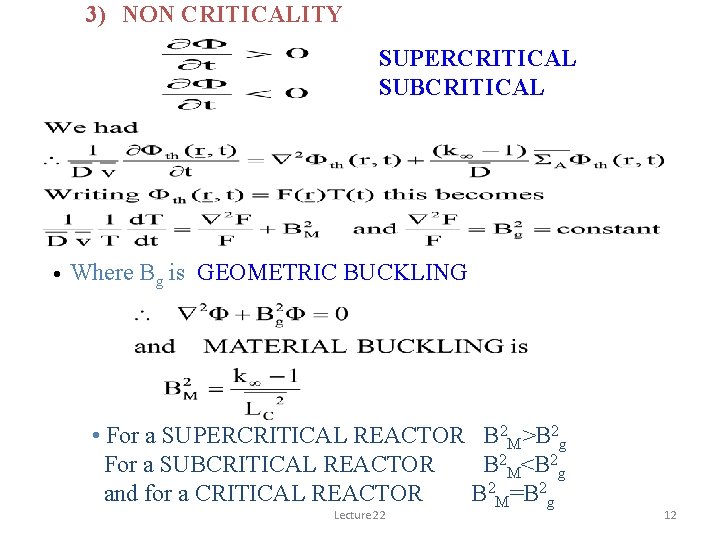
3) NON CRITICALITY SUPERCRITICAL SUBCRITICAL • Where Bg is GEOMETRIC BUCKLING • For a SUPERCRITICAL REACTOR B 2 M>B 2 g For a SUBCRITICAL REACTOR B 2 M<B 2 g and for a CRITICAL REACTOR B 2 M=B 2 g Lecture 22 12
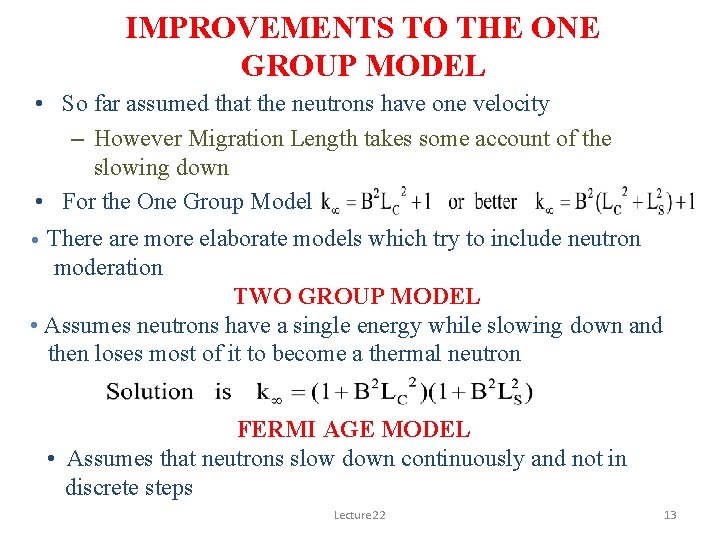
IMPROVEMENTS TO THE ONE GROUP MODEL • So far assumed that the neutrons have one velocity – However Migration Length takes some account of the slowing down • For the One Group Model There are more elaborate models which try to include neutron moderation TWO GROUP MODEL • Assumes neutrons have a single energy while slowing down and then loses most of it to become a thermal neutron • FERMI AGE MODEL • Assumes that neutrons slow down continuously and not in discrete steps Lecture 22 13
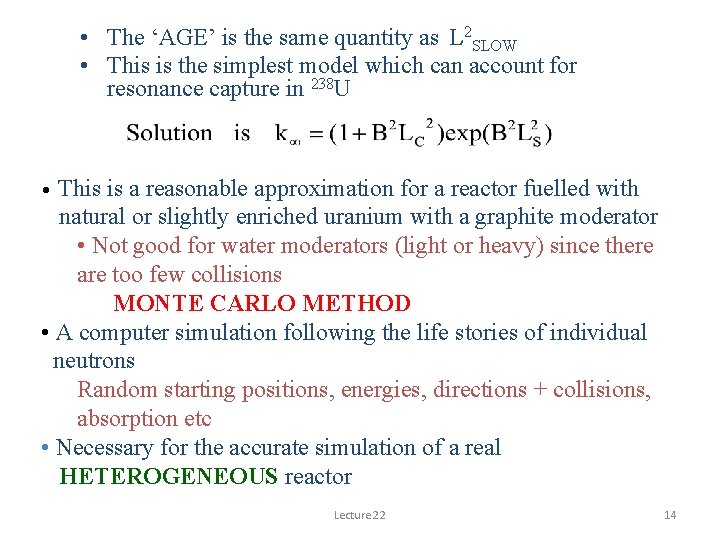
• The ‘AGE’ is the same quantity as L 2 SLOW • This is the simplest model which can account for resonance capture in 238 U This is a reasonable approximation for a reactor fuelled with natural or slightly enriched uranium with a graphite moderator • Not good for water moderators (light or heavy) since there are too few collisions MONTE CARLO METHOD • A computer simulation following the life stories of individual neutrons Random starting positions, energies, directions + collisions, absorption etc • Necessary for the accurate simulation of a real HETEROGENEOUS reactor • Lecture 22 14