
Solutions How can one differentiate between saturated unsaturated
Solutions How can one differentiate between saturated, unsaturated, and supersaturated solutions?
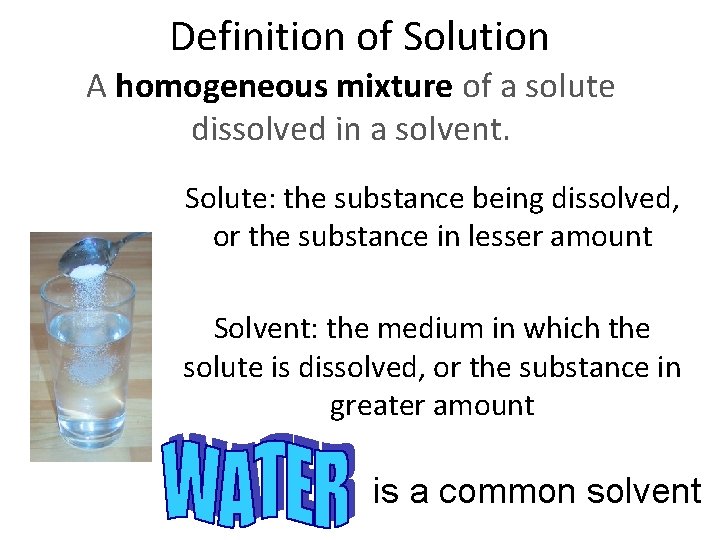
Definition of Solution A homogeneous mixture of a solute dissolved in a solvent. Solute: the substance being dissolved, or the substance in lesser amount Solvent: the medium in which the solute is dissolved, or the substance in greater amount is a common solvent
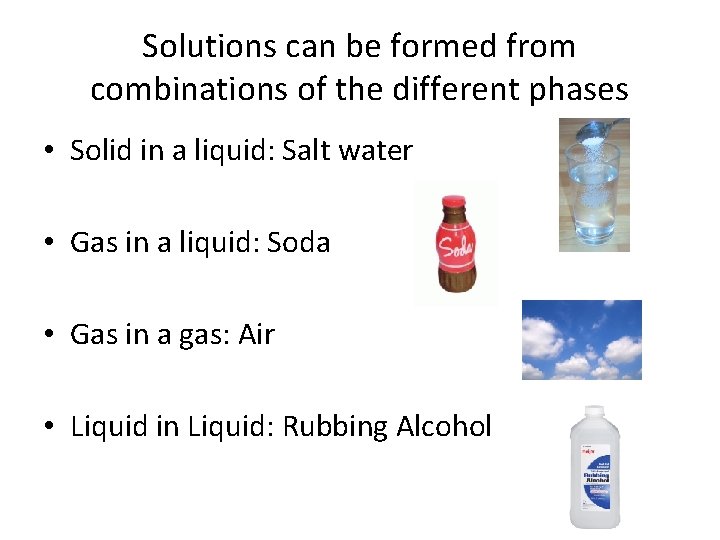
Solutions can be formed from combinations of the different phases • Solid in a liquid: Salt water • Gas in a liquid: Soda • Gas in a gas: Air • Liquid in Liquid: Rubbing Alcohol
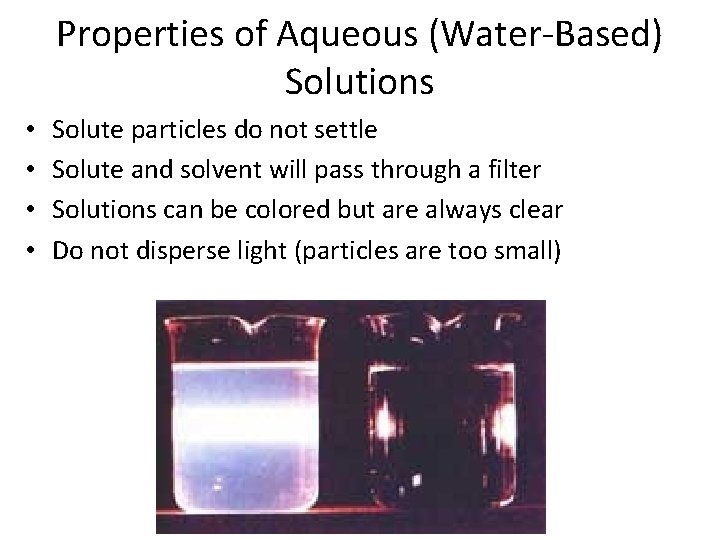
Properties of Aqueous (Water-Based) Solutions • • Solute particles do not settle Solute and solvent will pass through a filter Solutions can be colored but are always clear Do not disperse light (particles are too small)
“Like Dissolves Like” • Water is a polar molecule • Other polar molecules and ionic compounds can typically dissolve well in water • Non-polar molecules cannot dissolve well in water • Non-polar molecules dissolve well in non-polar solvents (like benzene, C 6 H 6, or carbon tetrachloride, CCl 4)
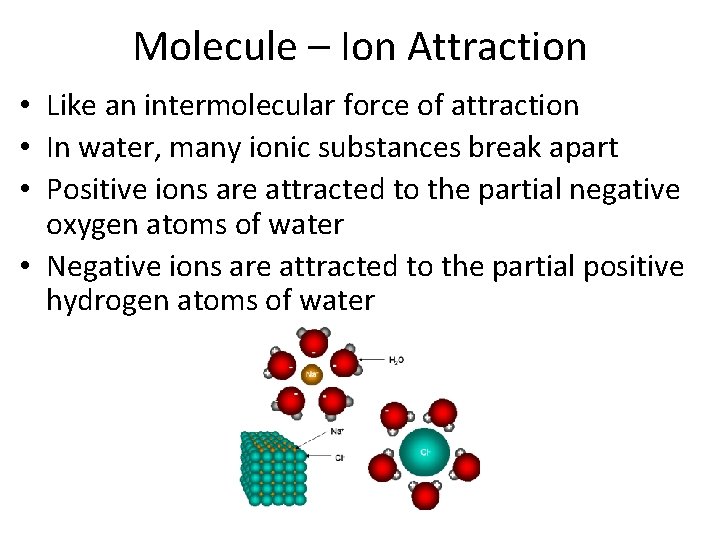
Molecule – Ion Attraction • Like an intermolecular force of attraction • In water, many ionic substances break apart • Positive ions are attracted to the partial negative oxygen atoms of water • Negative ions are attracted to the partial positive hydrogen atoms of water
Solubility • Describes how much of a solute can be dissolved in a solvent • Depends on temperature, pressure, and the chemical nature of substances • Solids in water: as temp. increases, solubility generally increases. • Gases in water: as temp. increases, solubility decreases.
Solubility • Changes in pressure do not affect the solubility of a solid in a liquid • As pressure increases, the solubility of a gas in a liquid increases • Under what conditions of temperature and pressure is a gas most soluble?
Types of Solutions Saturated • contains the maximum amount of solute allowed under the given conditions • If the solute is a solid, one more added crystal will not dissolve • “on the curve” (Table G)
Types of Solutions Unsaturated • contains less than the maximum amount of solute allowed under the given conditions (more can dissolve) • Ex. Watered down Kool-Aid • If the solute is a solid, one more added crystal will dissolve • “below the curve” (Table G)
Types of Solutions Supersaturated • contains more than the maximum amount of solute allowed under the given conditions • Ex. Honey and solutions used for making rock candy • If the solute is a solid, one more added crystal will cause other solute particles to come out of solution (sometimes rapidly) • “above the curve” (Table G)

Comparing Different Solutions • The words concentrated and dilute are relative terms used to describe solutions • A solution that is “concentrated” has a relatively large amount of solute per unit solvent • A solution that is “dilute” has a relatively small amount of solute per unit solvent
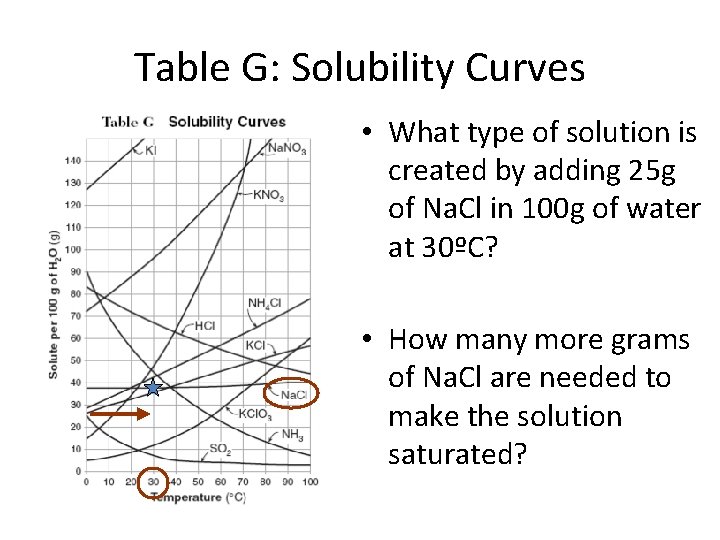
Table G: Solubility Curves • What type of solution is created by adding 25 g of Na. Cl in 100 g of water at 30ºC? • How many more grams of Na. Cl are needed to make the solution saturated?

Table G: Solubility Curves • How many grams of NH 4 Cl can dissolve in 100 g of water at 85ºC? How many in 200 g of water? 50 g of water? • What is more soluble in water at 50ºC? Na. NO 3 or KNO 3? At what temperature is the solubility the same?

Table G: Solubility Curves • Which is more soluble at 70ºC? Na. Cl or KCl. O 3? • Which is less soluble at 25ºC? HCl or NH 3?

Table F: Solubility Guidelines
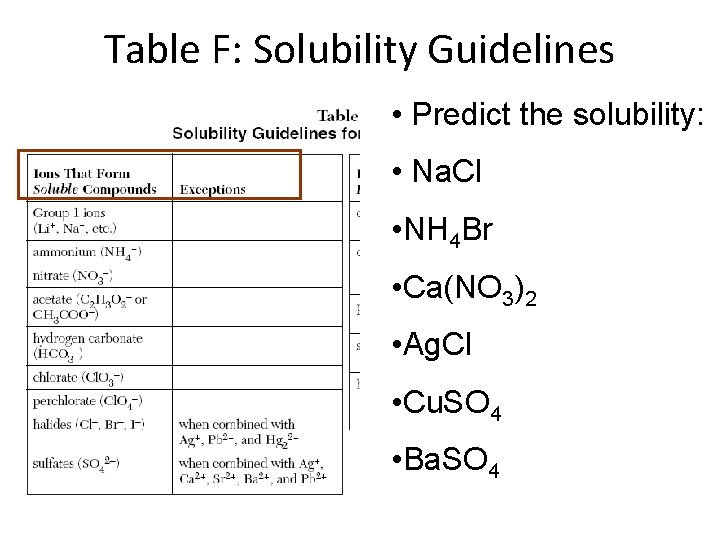
Table F: Solubility Guidelines • Predict the solubility: • Na. Cl • NH 4 Br • Ca(NO 3)2 • Ag. Cl • Cu. SO 4 • Ba. SO 4
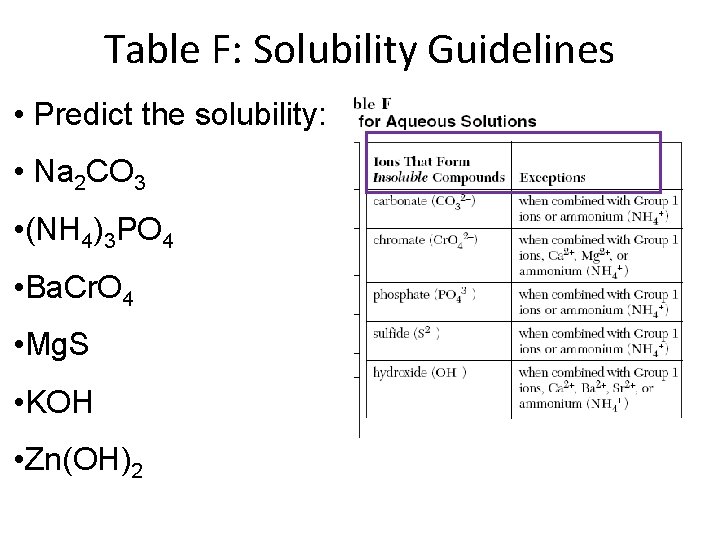
Table F: Solubility Guidelines • Predict the solubility: • Na 2 CO 3 • (NH 4)3 PO 4 • Ba. Cr. O 4 • Mg. S • KOH • Zn(OH)2
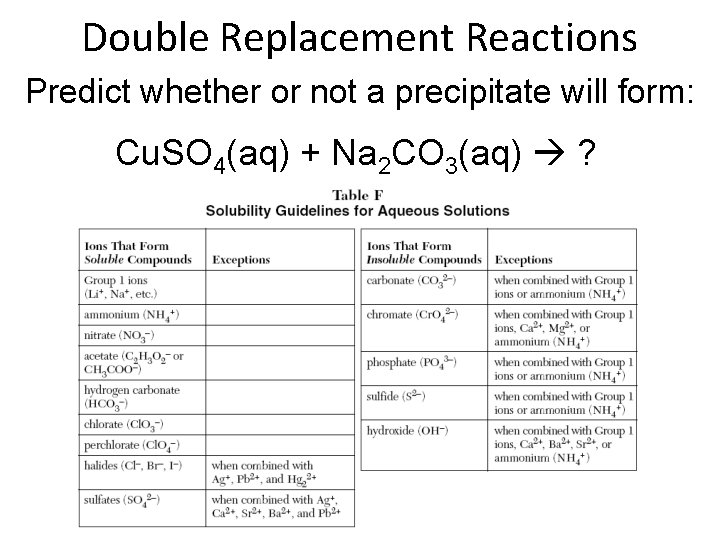
Double Replacement Reactions Predict whether or not a precipitate will form: Cu. SO 4(aq) + Na 2 CO 3(aq) ?
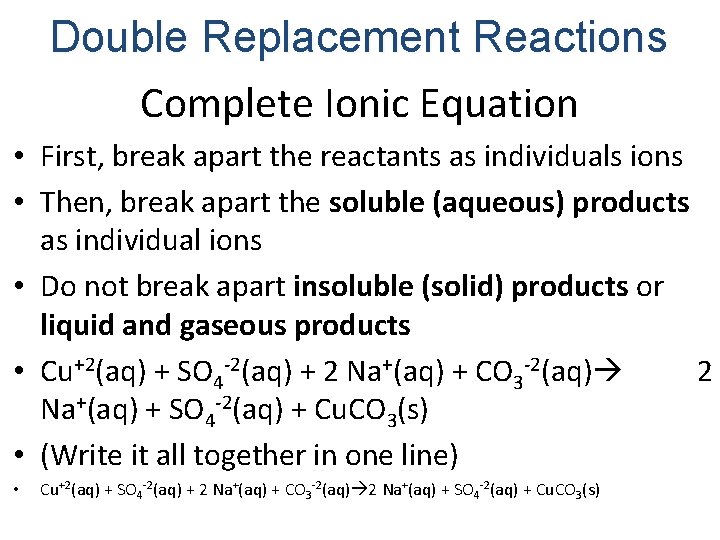
Double Replacement Reactions Complete Ionic Equation • First, break apart the reactants as individuals ions • Then, break apart the soluble (aqueous) products as individual ions • Do not break apart insoluble (solid) products or liquid and gaseous products • Cu+2(aq) + SO 4 -2(aq) + 2 Na+(aq) + CO 3 -2(aq) 2 Na+(aq) + SO 4 -2(aq) + Cu. CO 3(s) • (Write it all together in one line) • Cu+2(aq) + SO 4 -2(aq) + 2 Na+(aq) + CO 3 -2(aq) 2 Na+(aq) + SO 4 -2(aq) + Cu. CO 3(s)
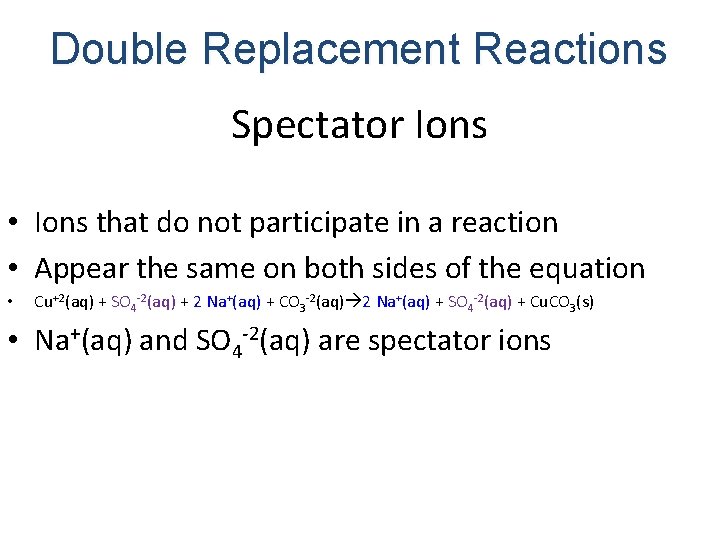
Double Replacement Reactions Spectator Ions • Ions that do not participate in a reaction • Appear the same on both sides of the equation • Cu+2(aq) + SO 4 -2(aq) + 2 Na+(aq) + CO 3 -2(aq) 2 Na+(aq) + SO 4 -2(aq) + Cu. CO 3(s) • Na+(aq) and SO 4 -2(aq) are spectator ions
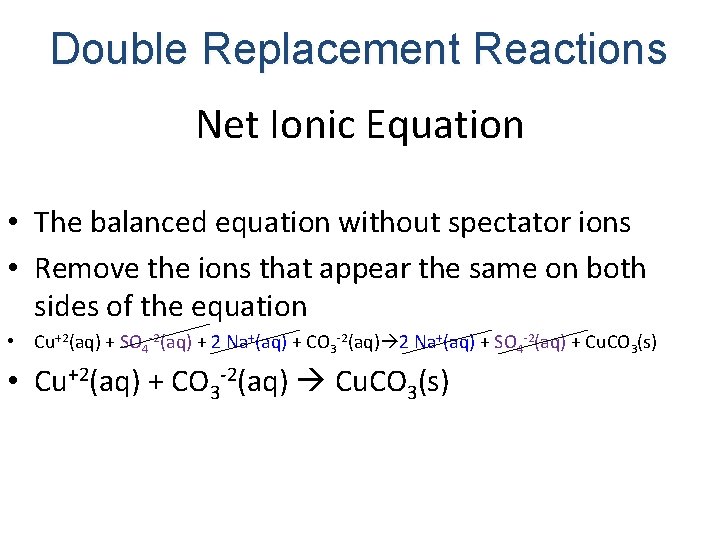
Double Replacement Reactions Net Ionic Equation • The balanced equation without spectator ions • Remove the ions that appear the same on both sides of the equation • Cu+2(aq) + SO 4 -2(aq) + 2 Na+(aq) + CO 3 -2(aq) 2 Na+(aq) + SO 4 -2(aq) + Cu. CO 3(s) • Cu+2(aq) + CO 3 -2(aq) Cu. CO 3(s)
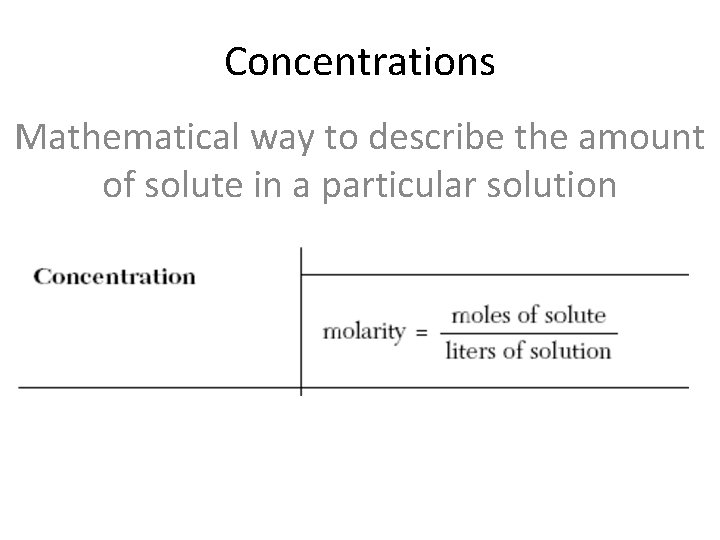
Concentrations Mathematical way to describe the amount of solute in a particular solution
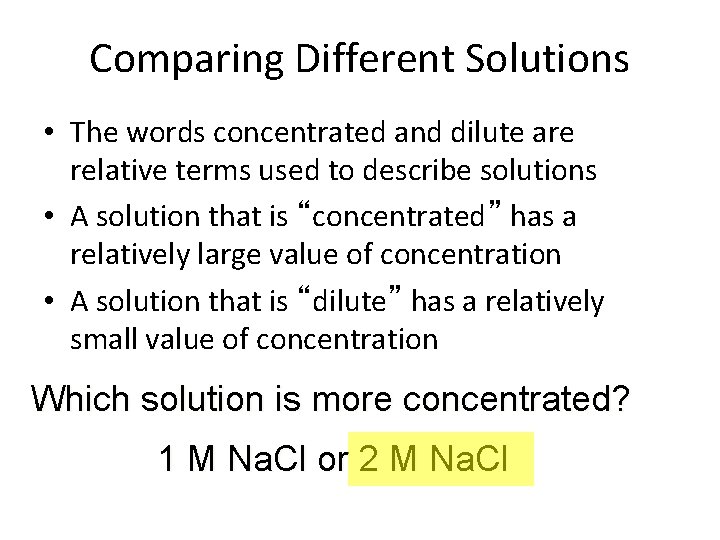
Comparing Different Solutions • The words concentrated and dilute are relative terms used to describe solutions • A solution that is “concentrated” has a relatively large value of concentration • A solution that is “dilute” has a relatively small value of concentration Which solution is more concentrated? 1 M Na. Cl or 2 M Na. Cl
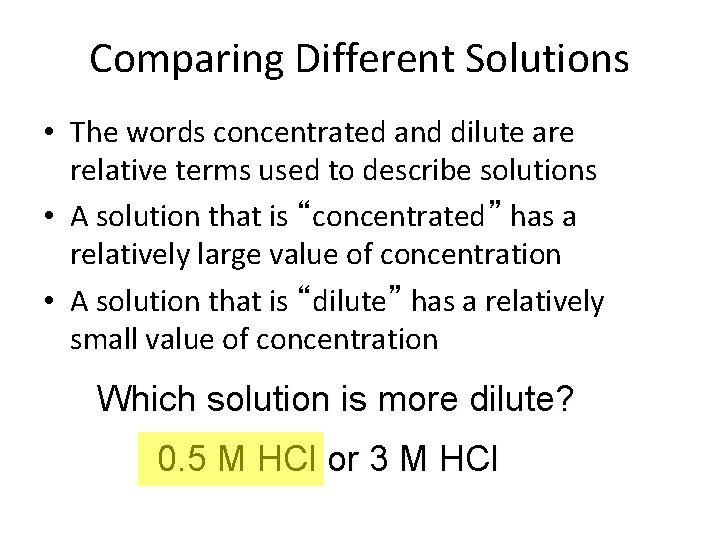
Comparing Different Solutions • The words concentrated and dilute are relative terms used to describe solutions • A solution that is “concentrated” has a relatively large value of concentration • A solution that is “dilute” has a relatively small value of concentration Which solution is more dilute? 0. 5 M HCl or 3 M HCl
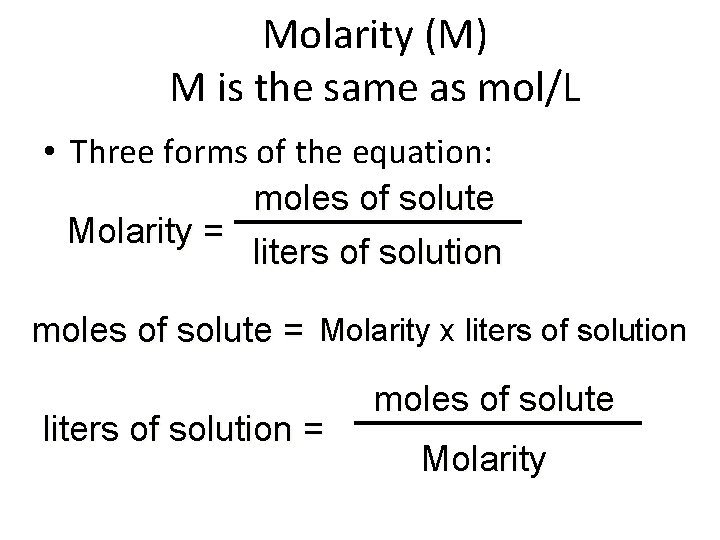
Molarity (M) M is the same as mol/L • Three forms of the equation: moles of solute Molarity = liters of solution moles of solute = Molarity x liters of solution = moles of solute Molarity
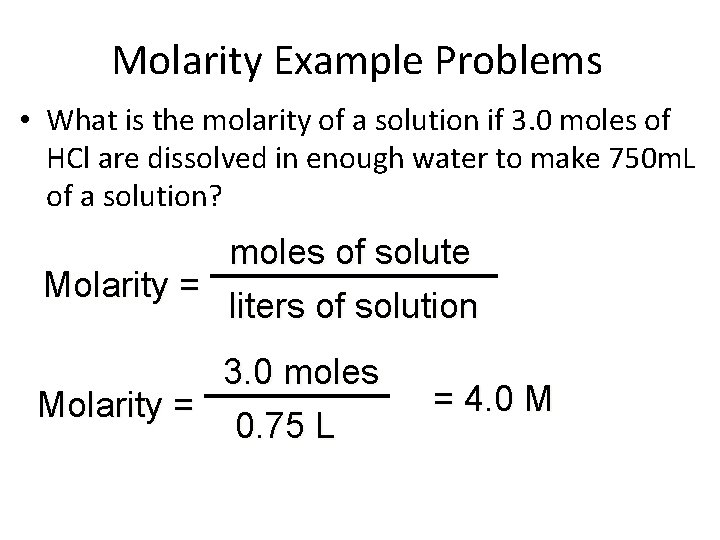
Molarity Example Problems • What is the molarity of a solution if 3. 0 moles of HCl are dissolved in enough water to make 750 m. L of a solution? moles of solute Molarity = liters of solution 3. 0 moles Molarity = 0. 75 L = 4. 0 M
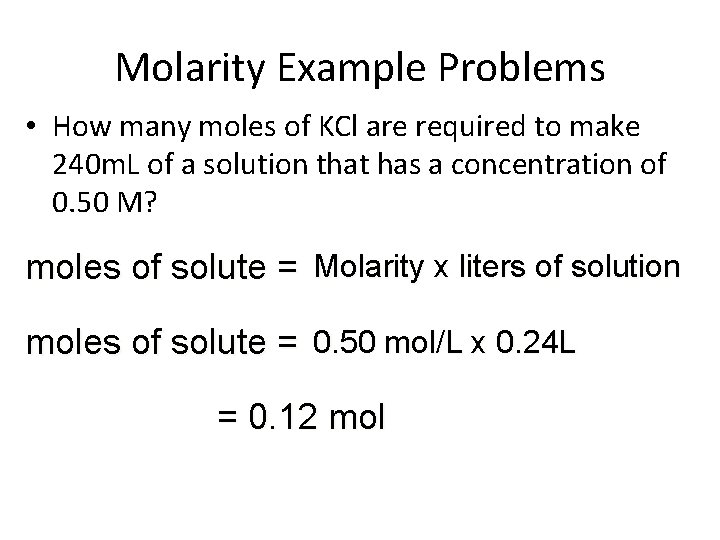
Molarity Example Problems • How many moles of KCl are required to make 240 m. L of a solution that has a concentration of 0. 50 M? moles of solute = Molarity x liters of solution moles of solute = 0. 50 mol/L x 0. 24 L = 0. 12 mol
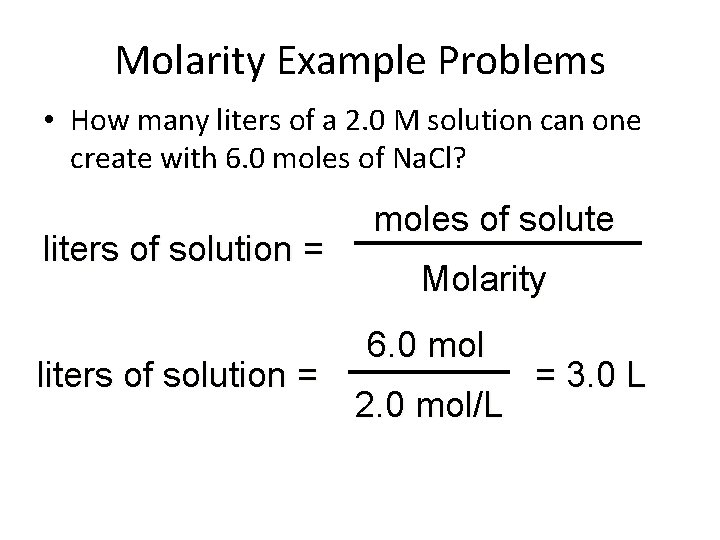
Molarity Example Problems • How many liters of a 2. 0 M solution can one create with 6. 0 moles of Na. Cl? liters of solution = moles of solute Molarity 6. 0 mol 2. 0 mol/L = 3. 0 L
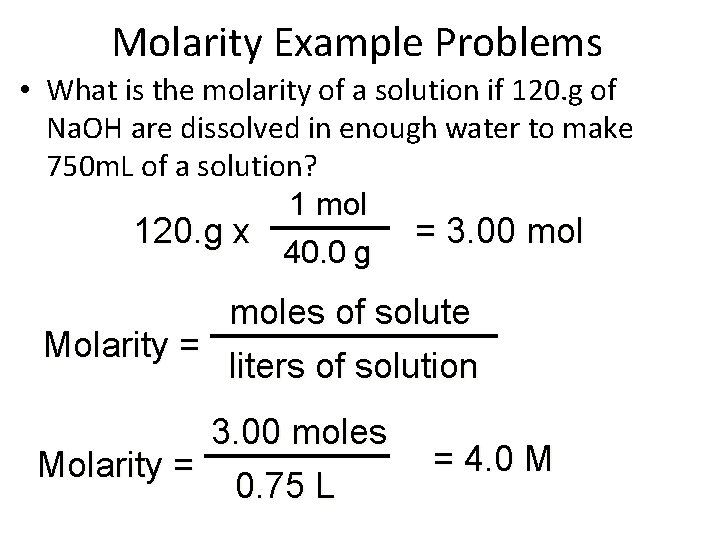
Molarity Example Problems • What is the molarity of a solution if 120. g of Na. OH are dissolved in enough water to make 750 m. L of a solution? 1 mol 120. g x = 3. 00 mol 40. 0 g moles of solute Molarity = liters of solution 3. 00 moles Molarity = 0. 75 L = 4. 0 M
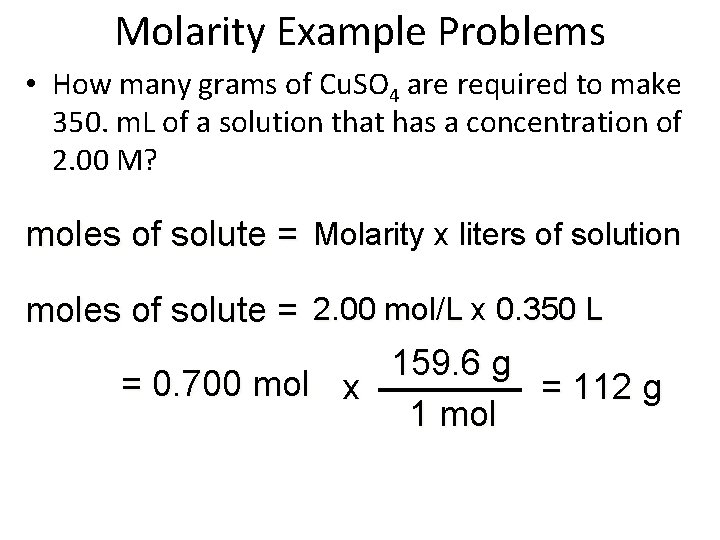
Molarity Example Problems • How many grams of Cu. SO 4 are required to make 350. m. L of a solution that has a concentration of 2. 00 M? moles of solute = Molarity x liters of solution moles of solute = 2. 00 mol/L x 0. 350 L 159. 6 g = 0. 700 mol x = 112 g 1 mol
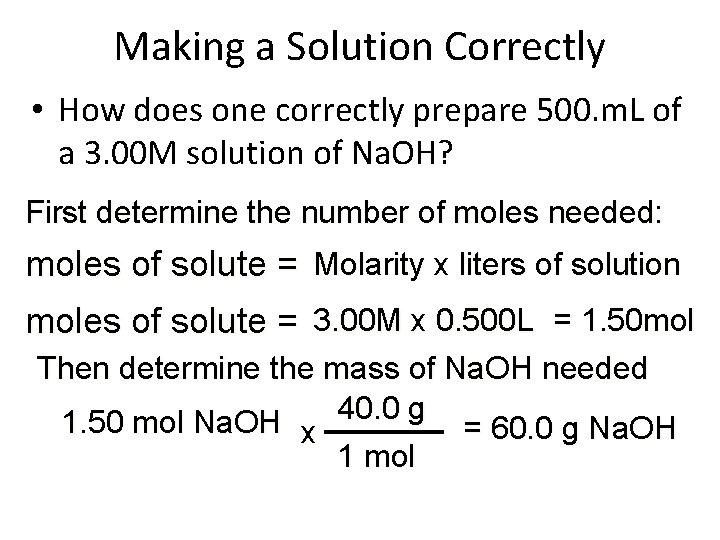
Making a Solution Correctly • How does one correctly prepare 500. m. L of a 3. 00 M solution of Na. OH? First determine the number of moles needed: moles of solute = Molarity x liters of solution moles of solute = 3. 00 M x 0. 500 L = 1. 50 mol Then determine the mass of Na. OH needed 40. 0 g 1. 50 mol Na. OH x = 60. 0 g Na. OH 1 mol
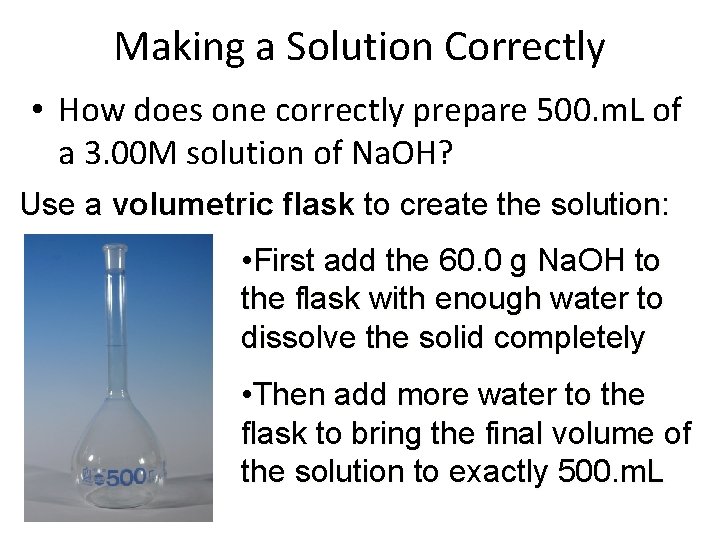
Making a Solution Correctly • How does one correctly prepare 500. m. L of a 3. 00 M solution of Na. OH? Use a volumetric flask to create the solution: • First add the 60. 0 g Na. OH to the flask with enough water to dissolve the solid completely • Then add more water to the flask to bring the final volume of the solution to exactly 500. m. L
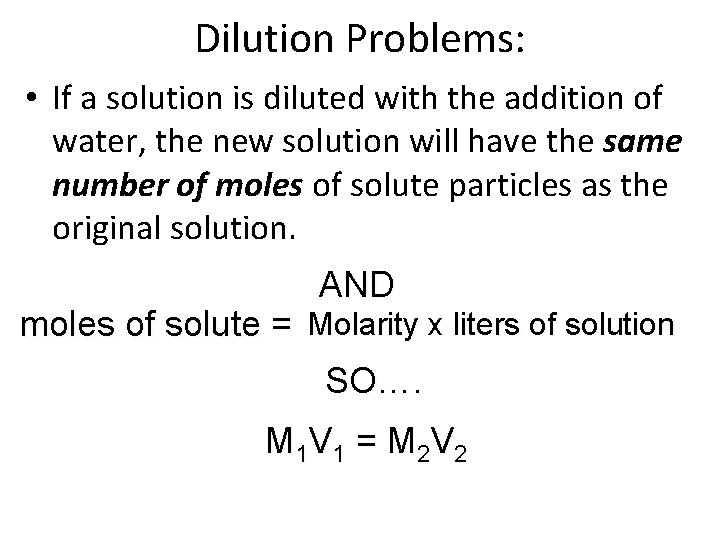
Dilution Problems: • If a solution is diluted with the addition of water, the new solution will have the same number of moles of solute particles as the original solution. AND moles of solute = Molarity x liters of solution SO…. M 1 V 1 = M 2 V 2
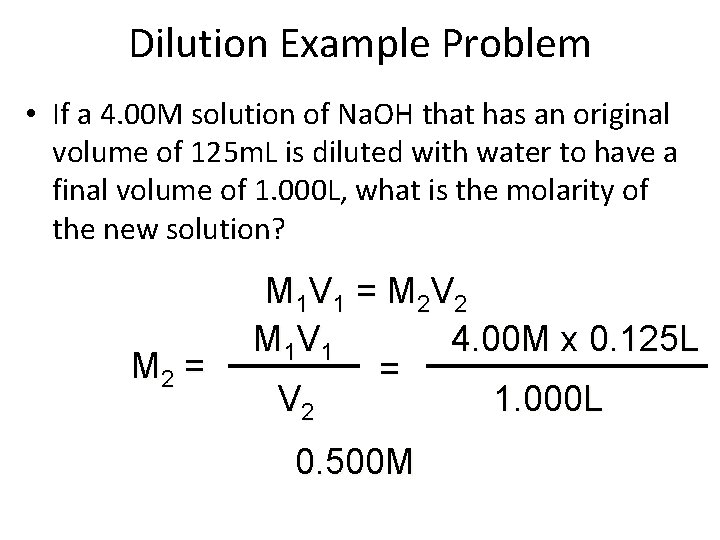
Dilution Example Problem • If a 4. 00 M solution of Na. OH that has an original volume of 125 m. L is diluted with water to have a final volume of 1. 000 L, what is the molarity of the new solution? M 2 = M 1 V 1 = M 2 V 2 M 1 V 1 4. 00 M x 0. 125 L = V 2 1. 000 L 0. 500 M
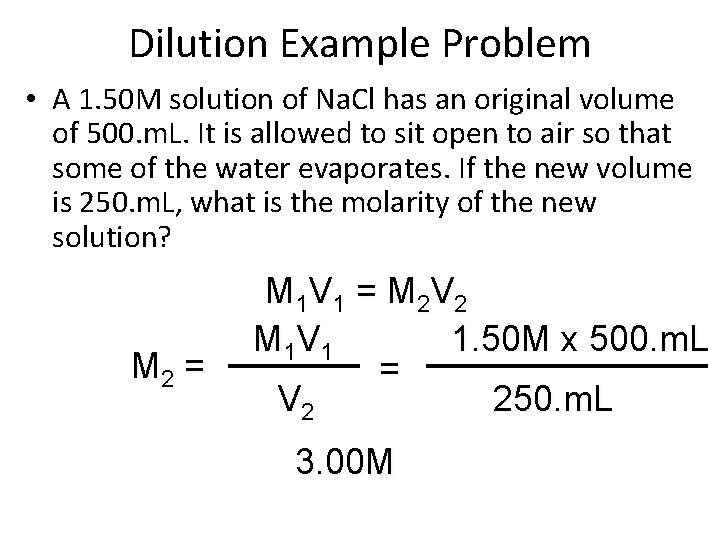
Dilution Example Problem • A 1. 50 M solution of Na. Cl has an original volume of 500. m. L. It is allowed to sit open to air so that some of the water evaporates. If the new volume is 250. m. L, what is the molarity of the new solution? M 2 = M 1 V 1 = M 2 V 2 M 1 V 1 1. 50 M x 500. m. L = V 2 250. m. L 3. 00 M
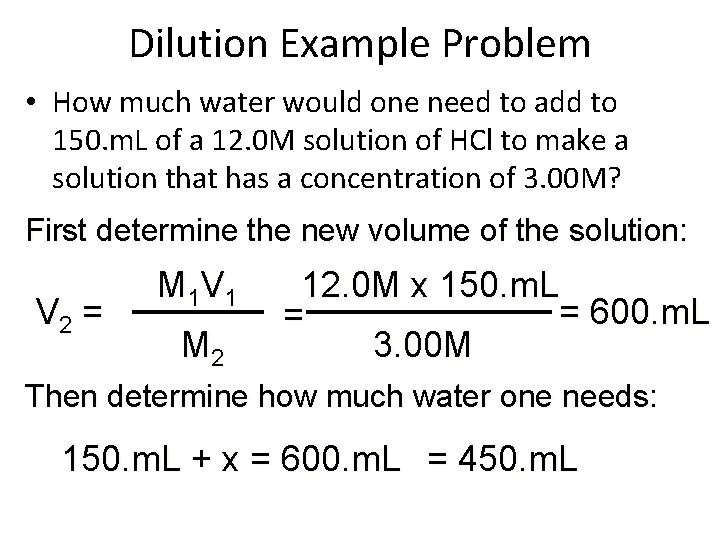
Dilution Example Problem • How much water would one need to add to 150. m. L of a 12. 0 M solution of HCl to make a solution that has a concentration of 3. 00 M? First determine the new volume of the solution: V 2 = M 1 V 1 M 2 12. 0 M x 150. m. L = 600. m. L = 3. 00 M Then determine how much water one needs: 150. m. L + x = 600. m. L = 450. m. L
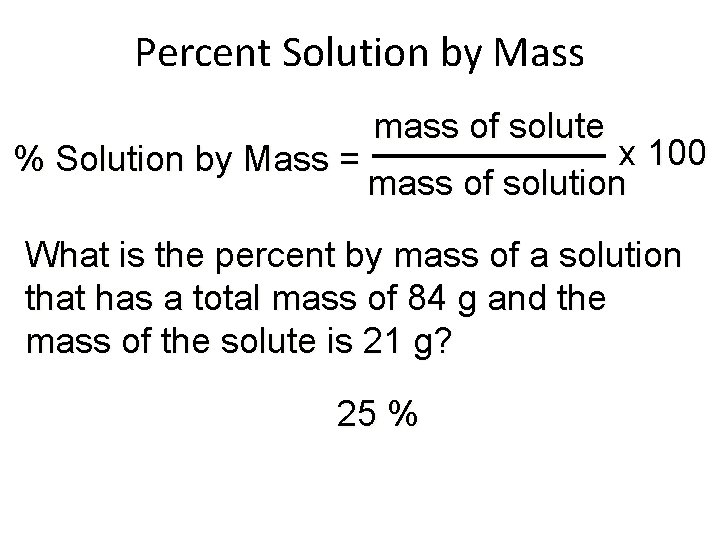
Percent Solution by Mass % Solution by Mass = mass of solute x 100 mass of solution What is the percent by mass of a solution that has a total mass of 84 g and the mass of the solute is 21 g? 25 %
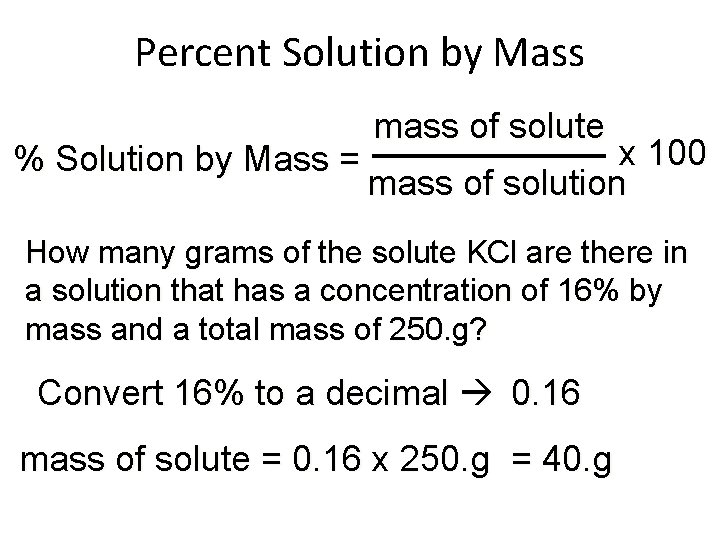
Percent Solution by Mass % Solution by Mass = mass of solute x 100 mass of solution How many grams of the solute KCl are there in a solution that has a concentration of 16% by mass and a total mass of 250. g? Convert 16% to a decimal 0. 16 mass of solute = 0. 16 x 250. g = 40. g
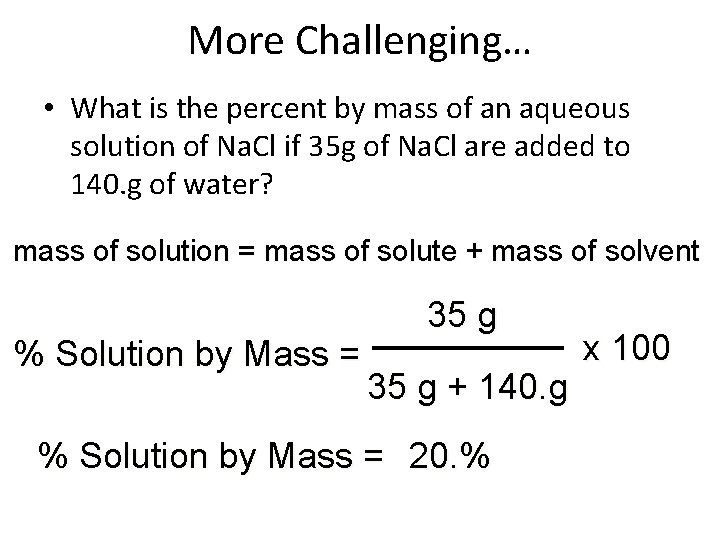
More Challenging… • What is the percent by mass of an aqueous solution of Na. Cl if 35 g of Na. Cl are added to 140. g of water? mass of solution = mass of solute + mass of solvent % Solution by Mass = 35 g + 140. g % Solution by Mass = 20. % x 100
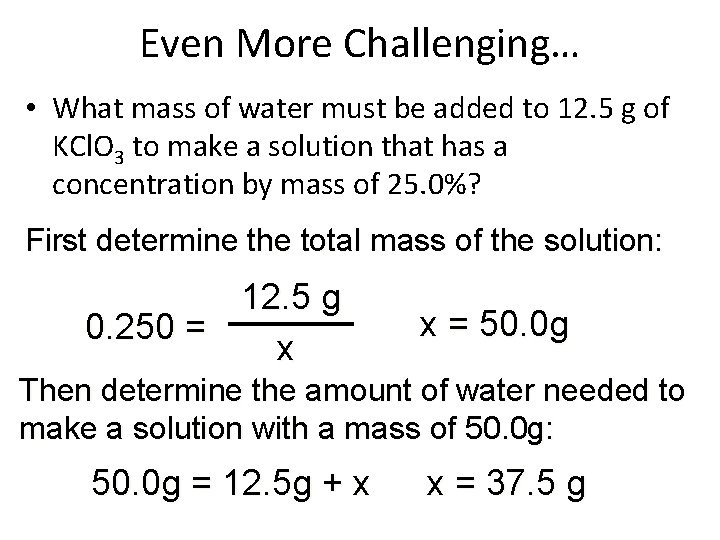
Even More Challenging… • What mass of water must be added to 12. 5 g of KCl. O 3 to make a solution that has a concentration by mass of 25. 0%? First determine the total mass of the solution: 12. 5 g 0. 250 = x x = 50. 0 g Then determine the amount of water needed to make a solution with a mass of 50. 0 g: 50. 0 g = 12. 5 g + x x = 37. 5 g
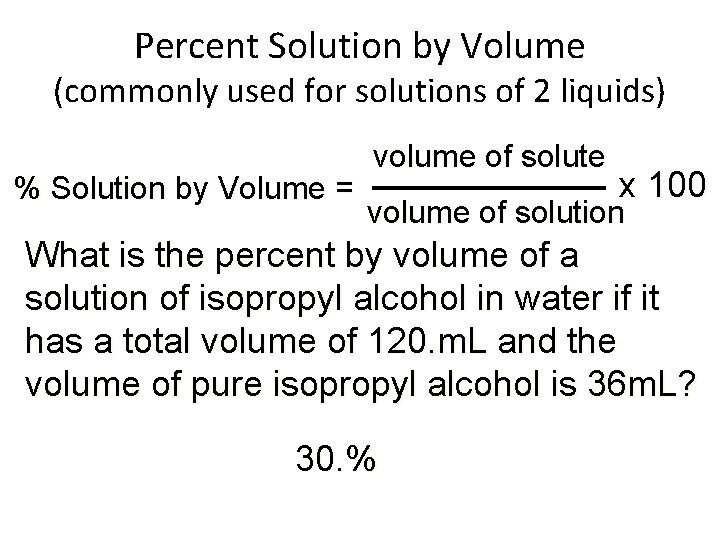
Percent Solution by Volume (commonly used for solutions of 2 liquids) % Solution by Volume = volume of solute x 100 volume of solution What is the percent by volume of a solution of isopropyl alcohol in water if it has a total volume of 120. m. L and the volume of pure isopropyl alcohol is 36 m. L? 30. %
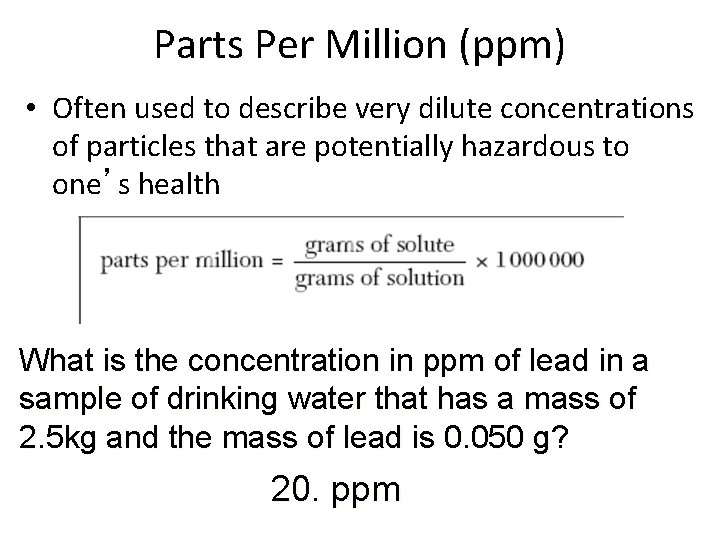
Parts Per Million (ppm) • Often used to describe very dilute concentrations of particles that are potentially hazardous to one’s health What is the concentration in ppm of lead in a sample of drinking water that has a mass of 2. 5 kg and the mass of lead is 0. 050 g? 20. ppm
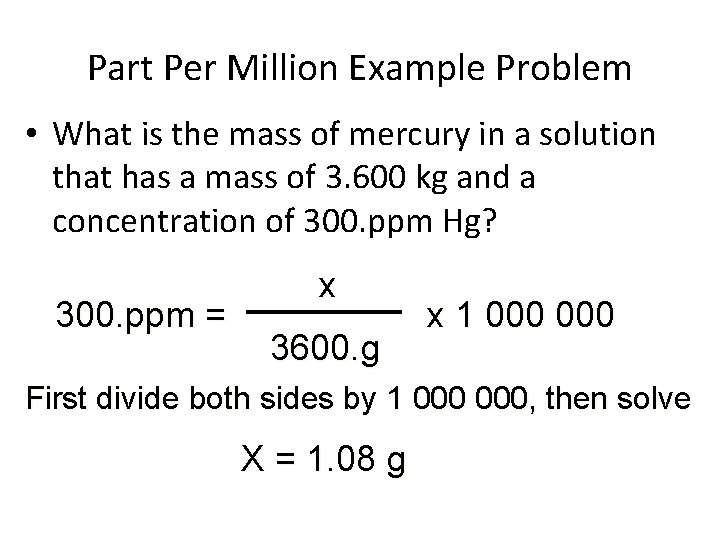
Part Per Million Example Problem • What is the mass of mercury in a solution that has a mass of 3. 600 kg and a concentration of 300. ppm Hg? 300. ppm = x 3600. g x 1 000 First divide both sides by 1 000, then solve X = 1. 08 g
Colligative Properties How do the physical properties of water change when a non-volatile solute is added?
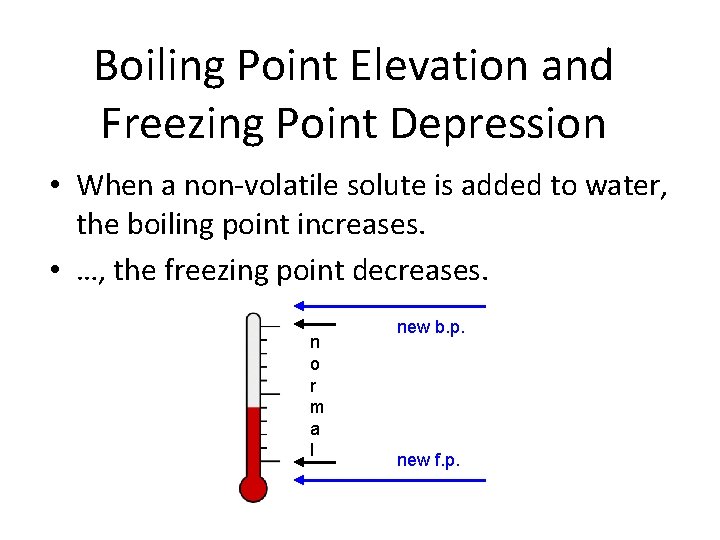
Boiling Point Elevation and Freezing Point Depression • When a non-volatile solute is added to water, the boiling point increases. • …, the freezing point decreases. n o r m a l new b. p. new f. p.
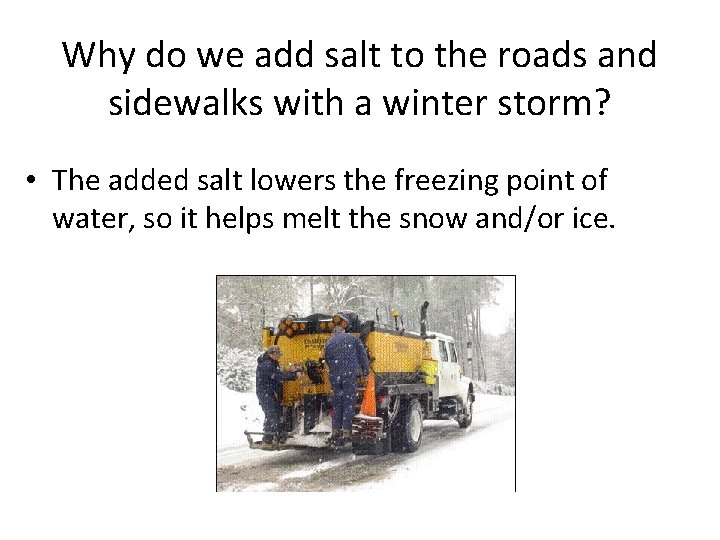
Why do we add salt to the roads and sidewalks with a winter storm? • The added salt lowers the freezing point of water, so it helps melt the snow and/or ice.
The amount of temperature change is influenced by concentration. • A more concentrated solution would have more of an effect than a less concentrated one. • More concentrated higher boiling point • More concentrated lower freezing point Which solution would have A: 2 M Na. Cl (aq) the higher boiling point? B: 3 M Na. Cl (aq)
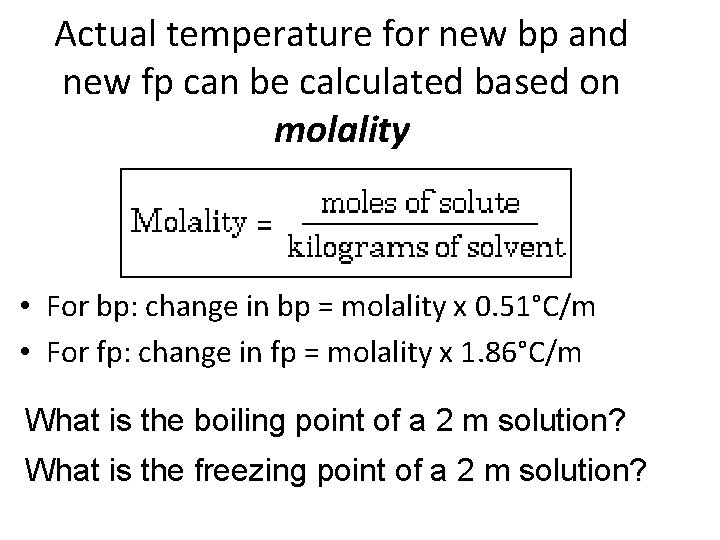
Actual temperature for new bp and new fp can be calculated based on molality • For bp: change in bp = molality x 0. 51°C/m • For fp: change in fp = molality x 1. 86°C/m What is the boiling point of a 2 m solution? What is the freezing point of a 2 m solution?
Electrolyte vs. Non-electrolyte • Ionic substances, acids, and bases are electrolytes because they break apart into ions when dissolved. • Covalent substances are non-electrolytes because they do not break apart in water. • Helpful Hint: Ionic compounds have a metal or a polyatomic ion, and covalent compounds have all nonmetals.
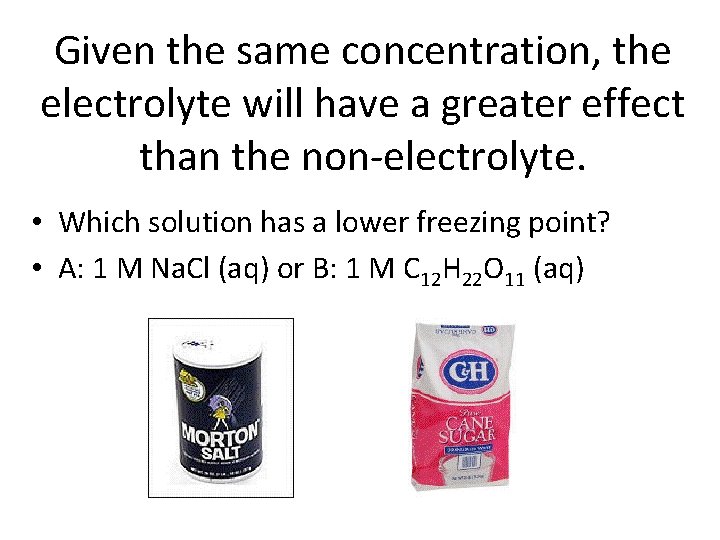
Given the same concentration, the electrolyte will have a greater effect than the non-electrolyte. • Which solution has a lower freezing point? • A: 1 M Na. Cl (aq) or B: 1 M C 12 H 22 O 11 (aq)
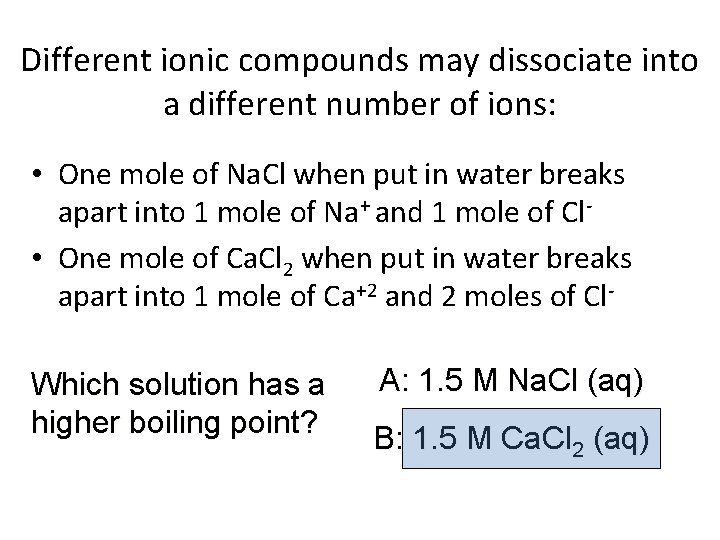
Different ionic compounds may dissociate into a different number of ions: • One mole of Na. Cl when put in water breaks apart into 1 mole of Na+ and 1 mole of Cl • One mole of Ca. Cl 2 when put in water breaks apart into 1 mole of Ca+2 and 2 moles of Cl. Which solution has a higher boiling point? A: 1. 5 M Na. Cl (aq) B: 1. 5 M Ca. Cl 2 (aq)
Be careful for tricky questions: Which solution has the lowest boiling point? A: 1 M Na. Cl or B: 2 M Na. Cl • First, ask does boiling point inc or dec? • Then, will the correct answer be the solution that is more or less concentrated?
Be careful for tricky questions: Which solution has the highest melting point? A: 1 M Na. Cl B: 2 M Na. Cl C: 1 M C 12 H 22 O 11 D: 2 M C 12 H 22 O 11 • First, ask does fp/mp inc or dec? • Then, will the correct answer be the solution that is more or less concentrated? • And, will the correct answer be the electrolyte or the non-electrolyte?
- Slides: 54