
Solutions Homogeneous mixtures containing two or more substances
Solutions • Homogeneous mixtures containing two or more substances. –Solvent- The substance that dissolves –Solute- The substance being dissolved
Solutions • May exist as a solid, liquid, or a gas • Water is the most prevalent solvent for solutions
Solubility • Soluble- Can be dissolved • Insoluble- Cannot be dissolved • Immiscible- When one liquid will not dissolve in another • Miscible- When one liquid will dissolve in another liquid
Solvation • The act of dissolving a solute • A solute will dissolve when the attractive forces between the solute and the solvent are greater than the attractive forces holding the molecule together

Solvation Na Cl Water Molecules Cl Hydration Sphere Na Hydration Sphere
Ionic Solutions • As you recall H 2 O is a polar molecule (charged on each end) • An ionic compound is composed of a + and – Ion. These ions are attracted to the oppositely charged end of the water molecule, pulling the ionic compound apart.
Ionic Solutions • The water surrounds the ions, dissolving the compound.
Covalent Molecules • Water is also a good solvent for some molecular compounds. • Sucrose is a polar molecular compound. Water is also a polar molecule attracts the oppositely charged end of the sugar molecule. • This pulls them apart causing solvation by water
Factors that Affect the Rate of Solvation • Increasing the collisions of solvent and solute increases the solvation rate – Ways to increase collisions • Increase the surface area of the solute • Increase the temperature of the solution • Agitate the mixture
Heat of Solution • The amount of energy required to form a solution –It takes energy to overcome the attractive forces that hold solute molecules together
Solubility • The maximum amount of solute that can be dissolved at a given temperature and pressure • Expressed in grams of solute per 100 g of solvent
Types of Solutions • Saturated Solution- A solution that contains the maximum amount of solute that it can hold. • Unsaturated Solution- A solution that can dissolve more solute • Supersaturated Solution- A solution that contains more solute than can normally be held in solution
Factors That Effect Solubility • Temperature- As temperature increases –solubility increases for solid substances –Solubility decreases for gaseous substances
Factors the Effect Solubility • Pressure- As pressure increases –Solubility for gases increases
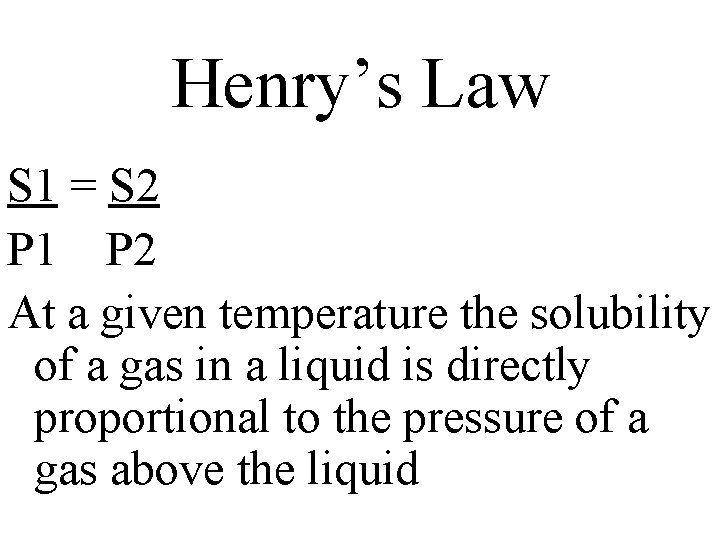
Henry’s Law S 1 = S 2 P 1 P 2 At a given temperature the solubility of a gas in a liquid is directly proportional to the pressure of a gas above the liquid
Practice Problem On Board
Concentration • A measure of how much solute is dissolved in a specific amount of solvent –Concentrated- Lots of solute per volume –Dilute- Little solute per volume
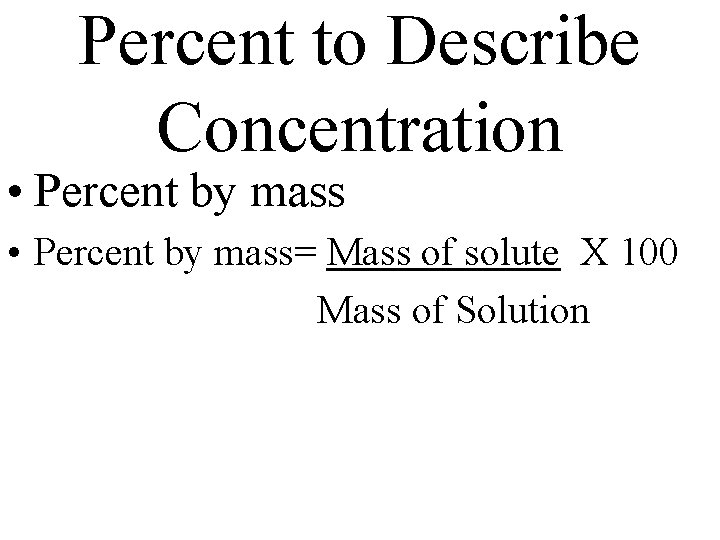
Percent to Describe Concentration • Percent by mass= Mass of solute X 100 Mass of Solution
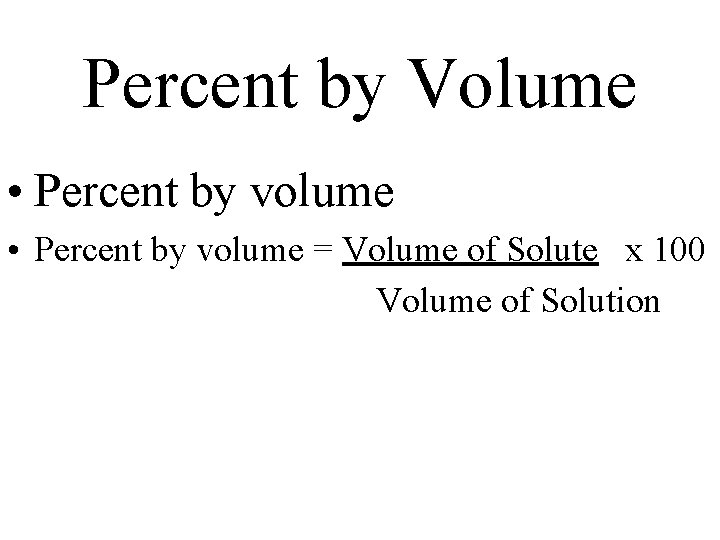
Percent by Volume • Percent by volume = Volume of Solute x 100 Volume of Solution
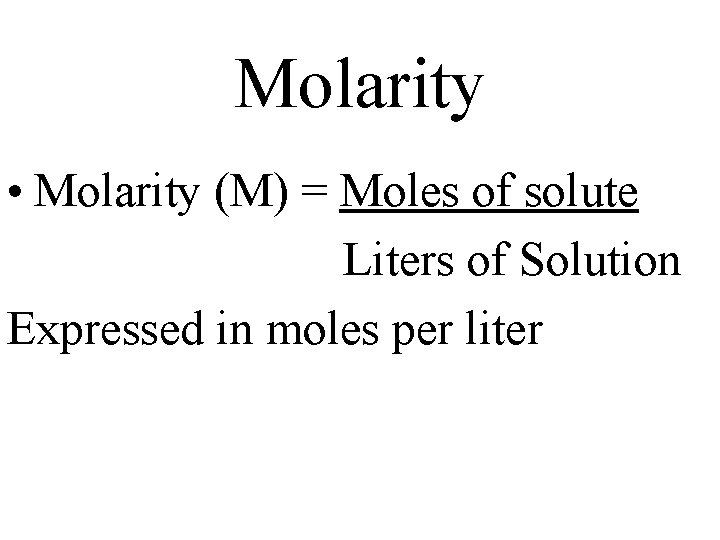
Molarity • Molarity (M) = Moles of solute Liters of Solution Expressed in moles per liter
Assignment • P. 463 8 -10 • P. 464 11 -13 • P. 465 14 -16
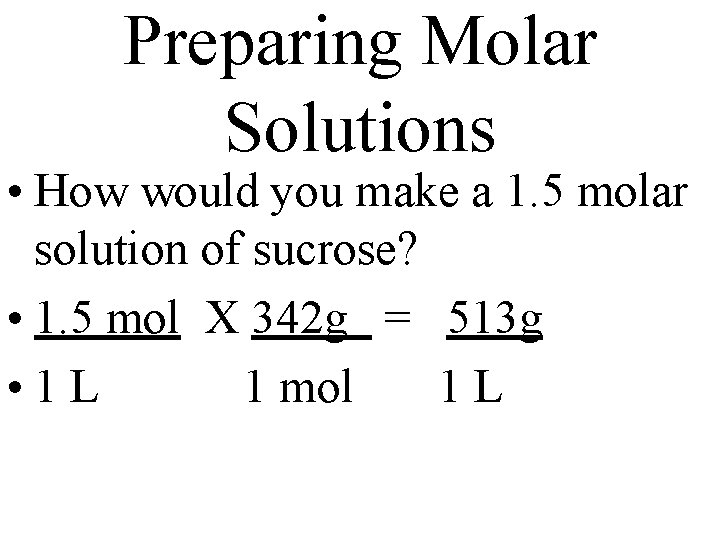
Preparing Molar Solutions • How would you make a 1. 5 molar solution of sucrose? • 1. 5 mol X 342 g = 513 g • 1 L 1 mol 1 L
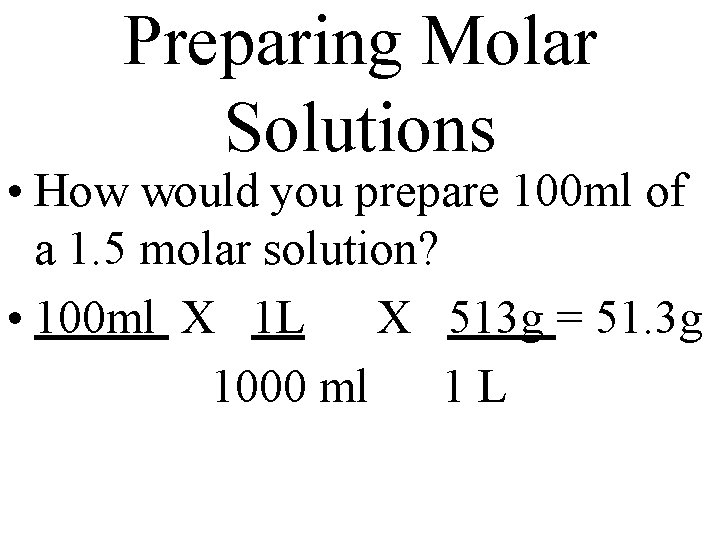
Preparing Molar Solutions • How would you prepare 100 ml of a 1. 5 molar solution? • 100 ml X 1 L X 513 g = 51. 3 g 1000 ml 1 L
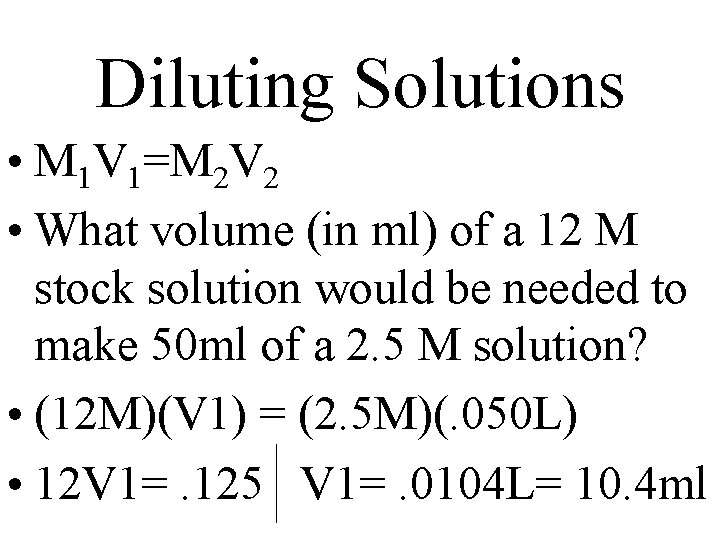
Diluting Solutions • M 1 V 1=M 2 V 2 • What volume (in ml) of a 12 M stock solution would be needed to make 50 ml of a 2. 5 M solution? • (12 M)(V 1) = (2. 5 M)(. 050 L) • 12 V 1=. 125 V 1=. 0104 L= 10. 4 ml
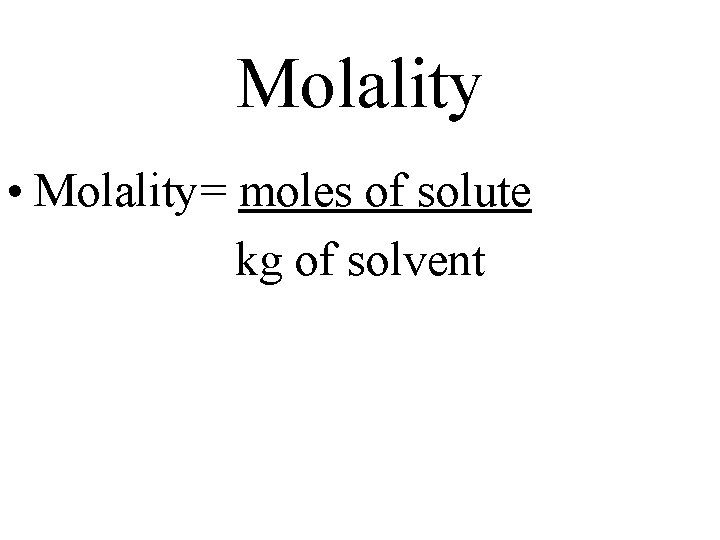
Molality • Molality= moles of solute kg of solvent
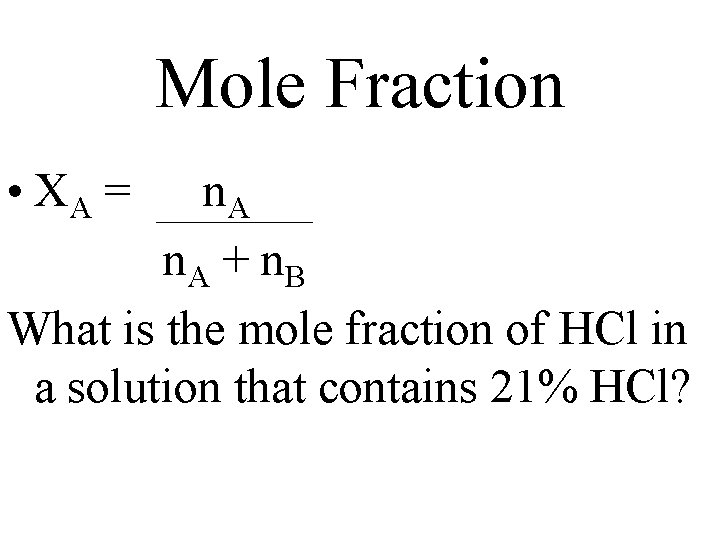
Mole Fraction • XA = n. A + n. B What is the mole fraction of HCl in a solution that contains 21% HCl?
Mole Fraction • Assume there is 100 g of solution • This means that 21 g of the solution is HCl and that 79 g of the solution is water • Convert both to moles
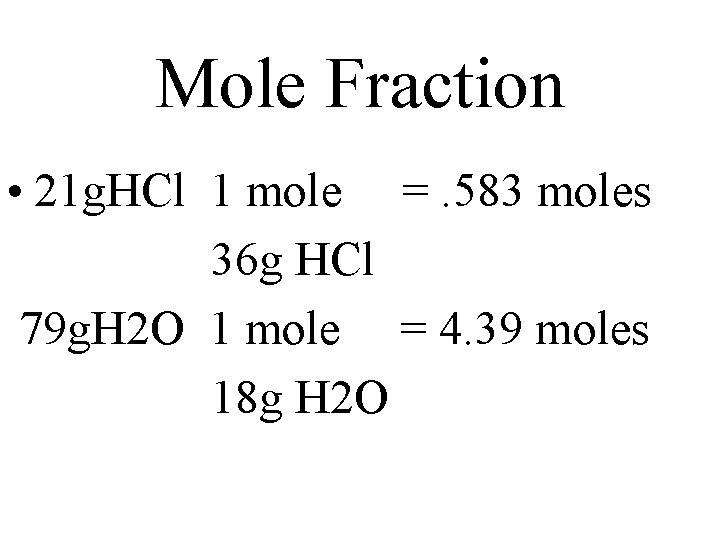
Mole Fraction • 21 g. HCl 1 mole =. 583 moles 36 g HCl 79 g. H 2 O 1 mole = 4. 39 moles 18 g H 2 O
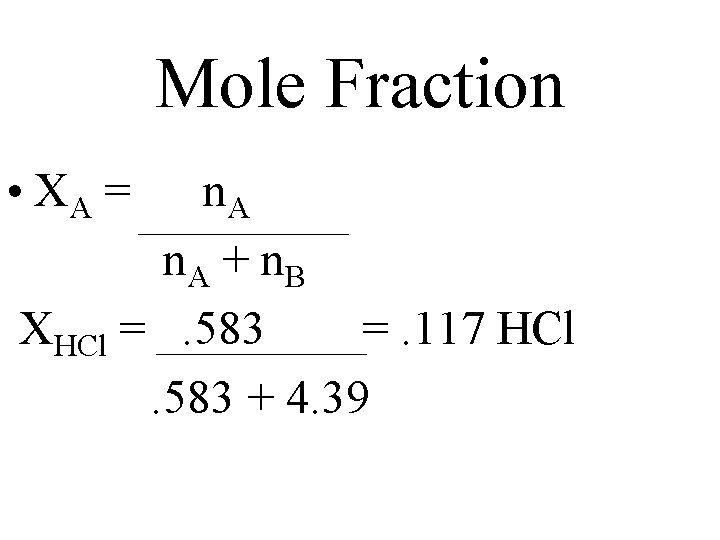
Mole Fraction • XA = n. A + n. B XHCl =. 583 =. 117 HCl. 583 + 4. 39
Colligative Properties • Properties that depend on the number of particles in the solution but not the identity of the particles – Freezing point depression – Vapor pressure lowering – Boiling point elevation – Osmotic pressure
Electrolytes and Nonelectrolytes • Electrolytes- Compounds that completely ionize in solution causing it to conduct electricity – Usually ionic compounds • Nonelectrolytes- Compounds that do not ionize in solution and do not conduct electricity – Usually molecular compounds
Vapor Pressure Lowering • When a solute is dissolved in a liquid the vapor pressure is lower above the solution than the vapor pressure of the pure solvent • This is due to fewer solvent particles at the interface between the air and the surface of the solvent • See diagram on p. 472
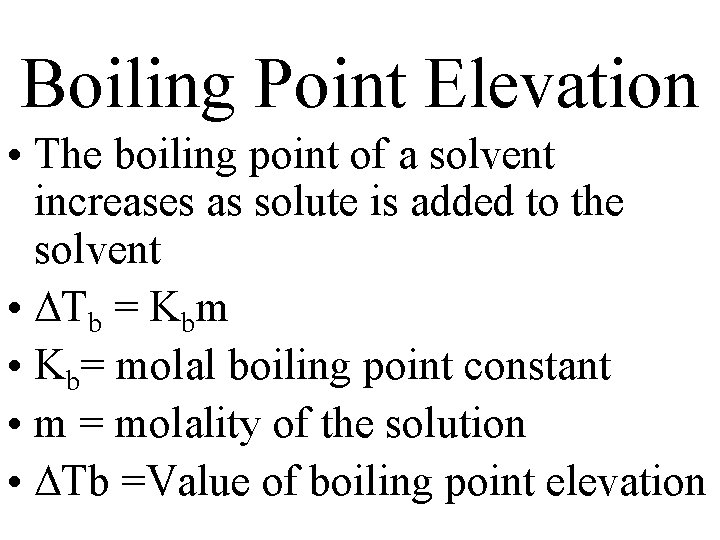
Boiling Point Elevation • The boiling point of a solvent increases as solute is added to the solvent • Tb = Kbm • Kb= molal boiling point constant • m = molality of the solution • Tb =Value of boiling point elevation

Freezing Point Depression • As solute is added to a solvent the freezing point is lowered • Tf = Kfm • Kf= molal freezing point constant • m = molality of the solution • Tf =Value of freezing point depression
Osmosis and Osmotic Pressure • Osmotic pressure increases with increase in amount of solvent • Solute increases the number of solvent molecules that move across a membrane increasing the pressure
Assignment • P. 466 17 -20 • P. 468 21 -23 • P. 469 24 -25 • P. 470 26 -30 • P. 475 33 -39
- Slides: 36