
Solutions Definitions Colligative Properties Much more WARNING These










- Slides: 104
Solutions Definitions Colligative Properties Much more!
WARNING! • These slides are just sketches of what I shall say in lecture. • I shall expand on much of this verbally. • That is why we have you come to class and take notes! • Also, I am trying to slow things down and avoid drowning you in Power Points!
Types of solutions • Basic definitions: – Solute – Solvent – Species – Components
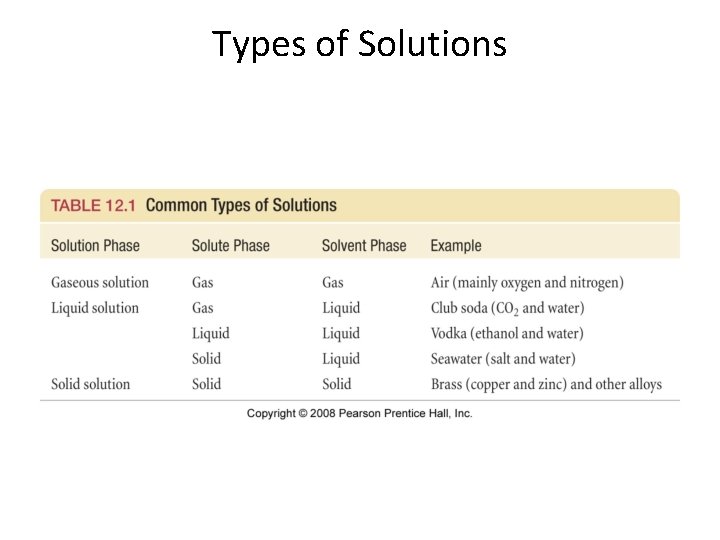
Types of Solutions
Solubility • How would we define this? – “The solubility of a substance is the amount of the substance that will dissolve in a given amount of solvent. ” • What is a quick explanation of why things dissolve? – “Like dissolves like. ” – More about this latter topic later!
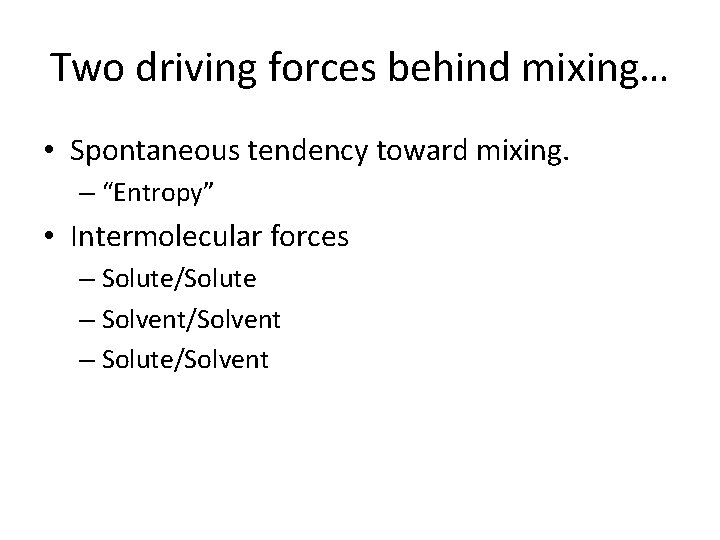
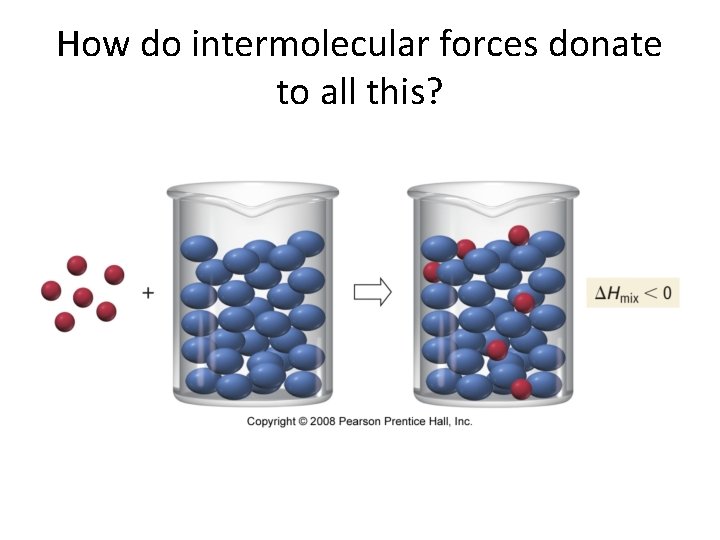
Two driving forces behind mixing… • Spontaneous tendency toward mixing. – “Entropy” • Intermolecular forces – Solute/Solute – Solvent/Solvent – Solute/Solvent
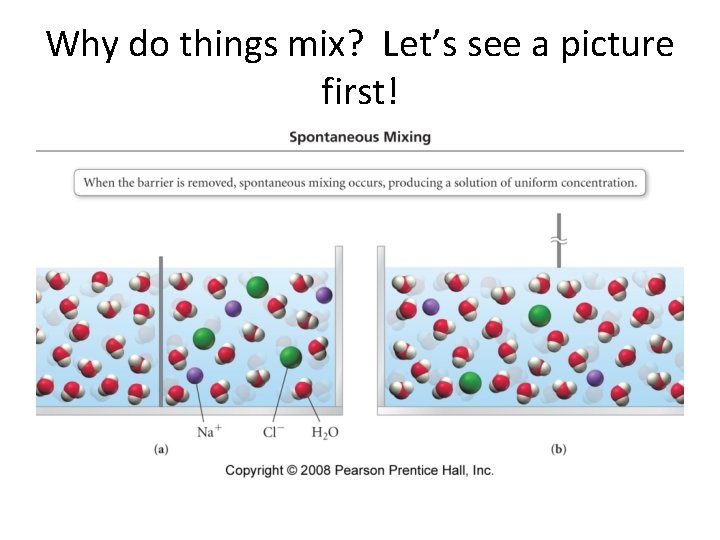
Why do things mix? Let’s see a picture first!
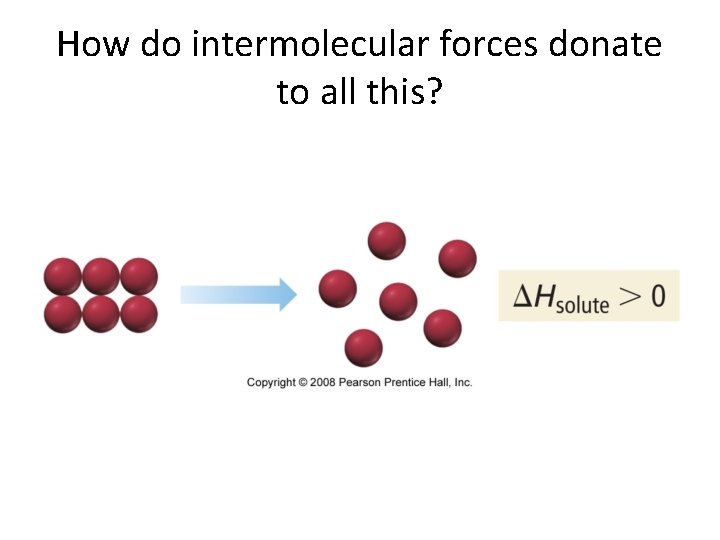
How do intermolecular forces donate to all this?
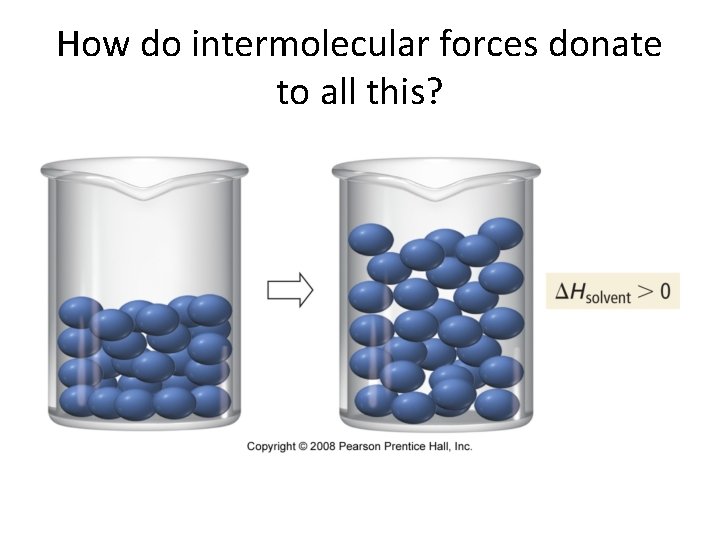
How do intermolecular forces donate to all this?
How do intermolecular forces donate to all this?
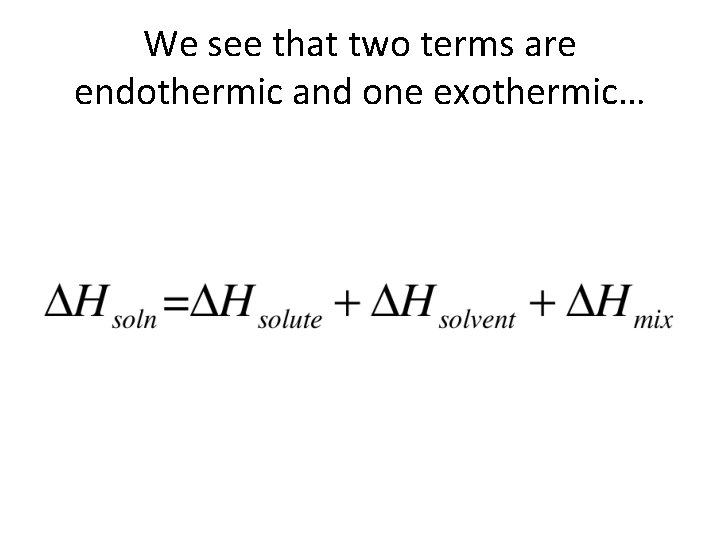
We see that two terms are endothermic and one exothermic…
We compare these verbally… • What happens if the heat of mixing is much larger than the other two? • What happens if the heat of solution is close to zero? • What happens if the heat of mixing is endothermic and small? • What happens if the heat of mixing is endothermic and large?
Think of things this way: • When is dissolving entropy driven? • When is dissolving enthalpy driven?
Let’s think in “graphic” terms…
Another classification of solutions • Aqueous • Nonaqueous Water is such an important solvent that it dictates many of the most important ways we think of chemistry. • Organic chemistry is mostly nonaqueous. • Biochemistry is nearly all aqueous chemistry!
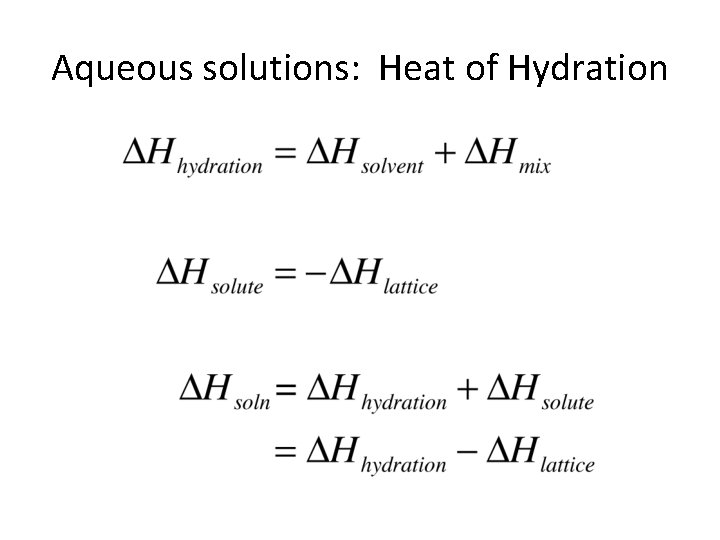
Aqueous solutions: Heat of Hydration
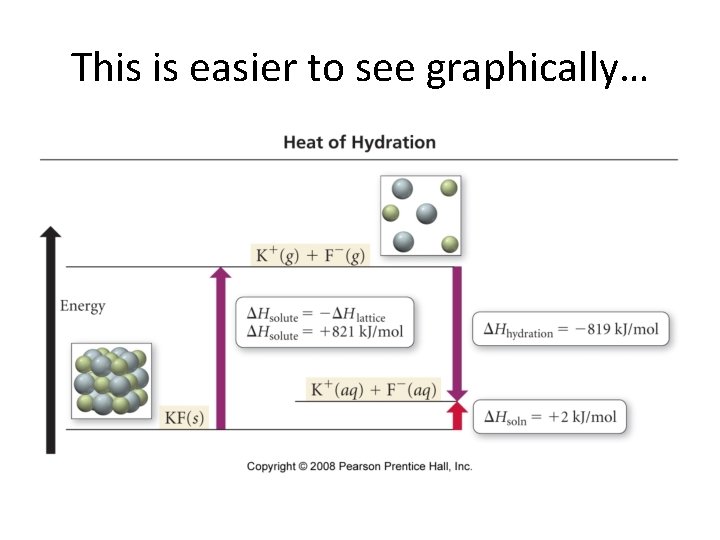
This is easier to see graphically…
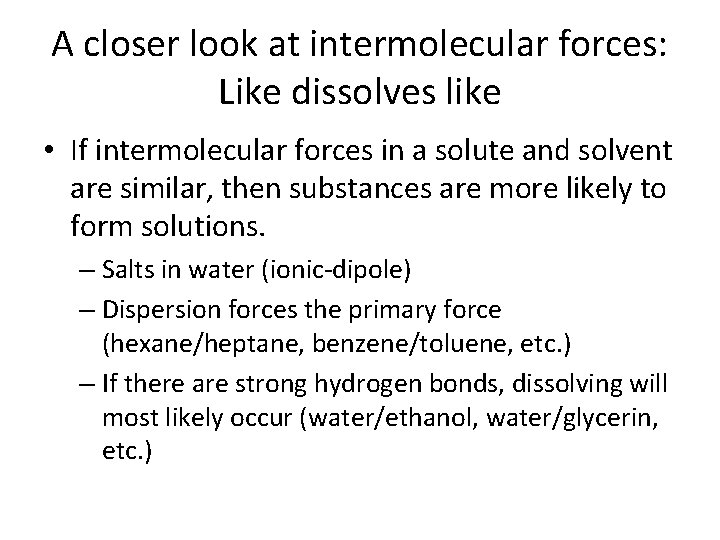
A closer look at intermolecular forces: Like dissolves like • If intermolecular forces in a solute and solvent are similar, then substances are more likely to form solutions. – Salts in water (ionic-dipole) – Dispersion forces the primary force (hexane/heptane, benzene/toluene, etc. ) – If there are strong hydrogen bonds, dissolving will most likely occur (water/ethanol, water/glycerin, etc. )
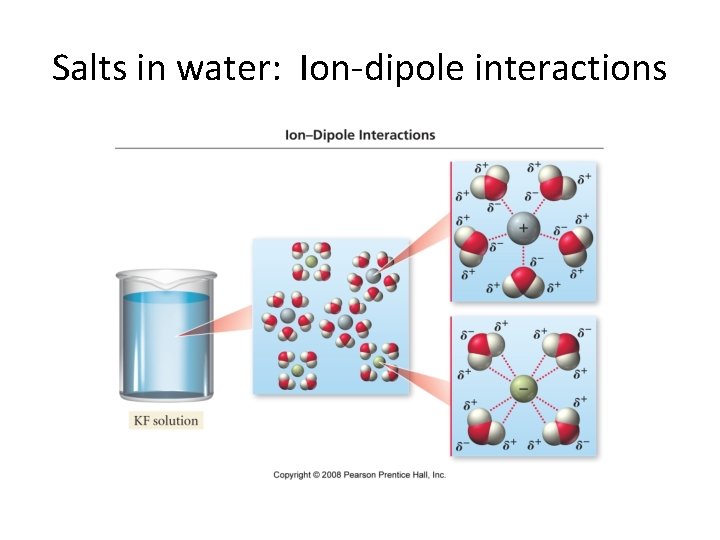
Salts in water: Ion-dipole interactions
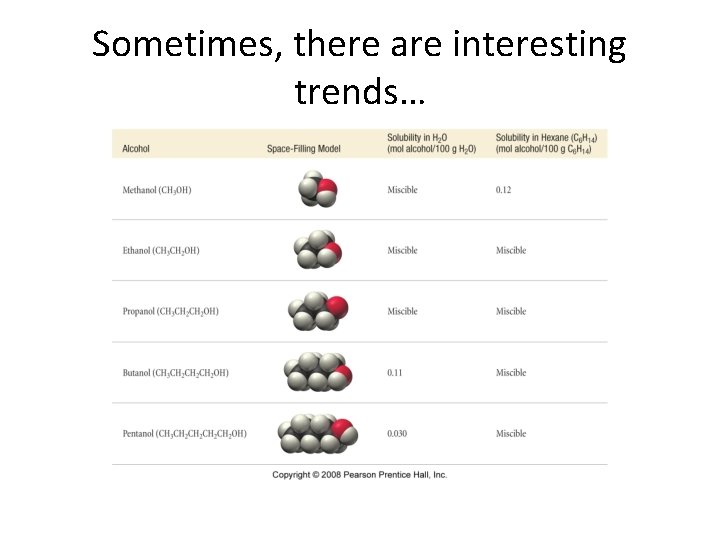
Sometimes, there are interesting trends…
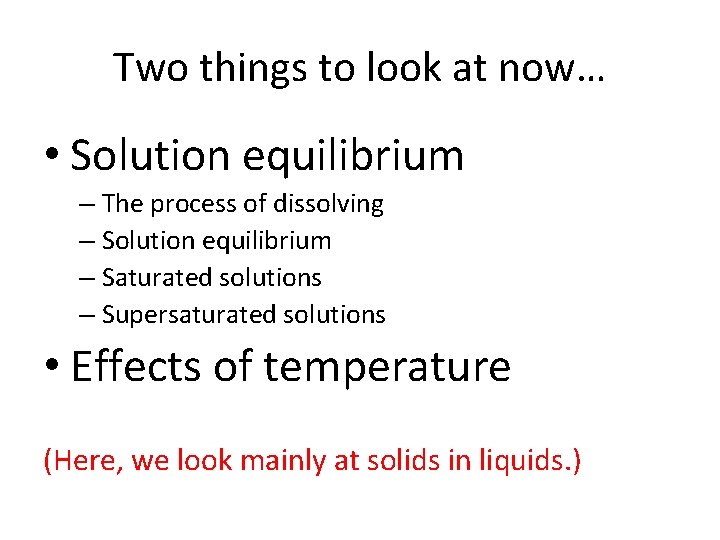
Two things to look at now… • Solution equilibrium – The process of dissolving – Solution equilibrium – Saturated solutions – Supersaturated solutions • Effects of temperature (Here, we look mainly at solids in liquids. )
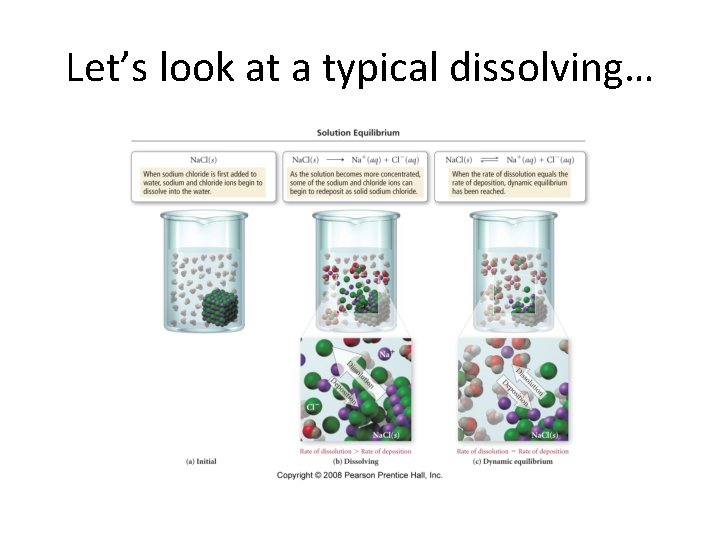
Let’s look at a typical dissolving…
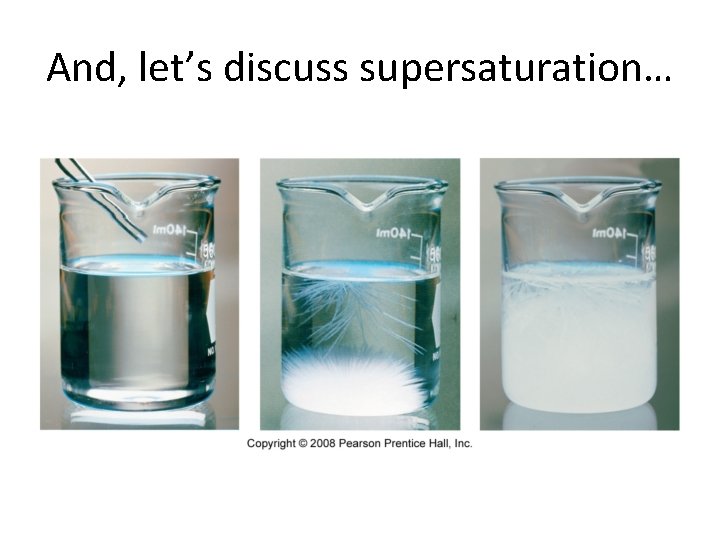
And, let’s discuss supersaturation…
Let’s watch this! Here is the link: www. youtube. com/watch? v=0 wif. Fb. GDv 4 I
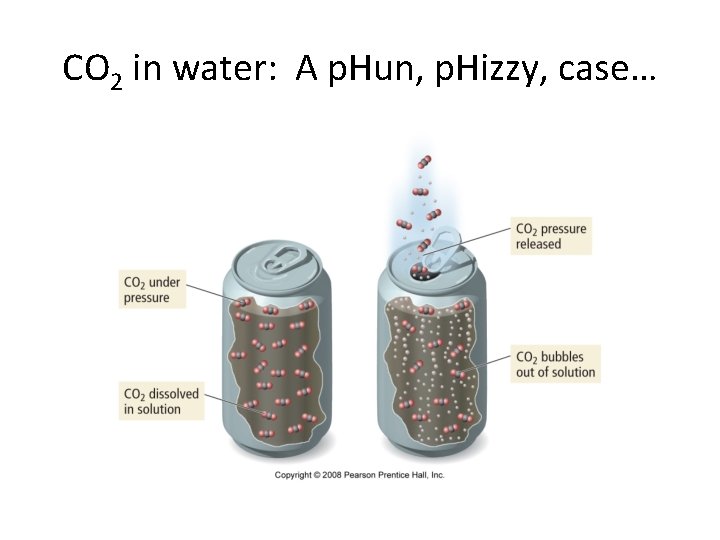
Gases in water (and other solvents, for that matter)… • How does temperature affect gas solubility? • How does pressure affect gas solubility? • When are chemical interactions important?
Temperature vs. Gas Solubility • All common gases become less soluble as T increases! • WHY?
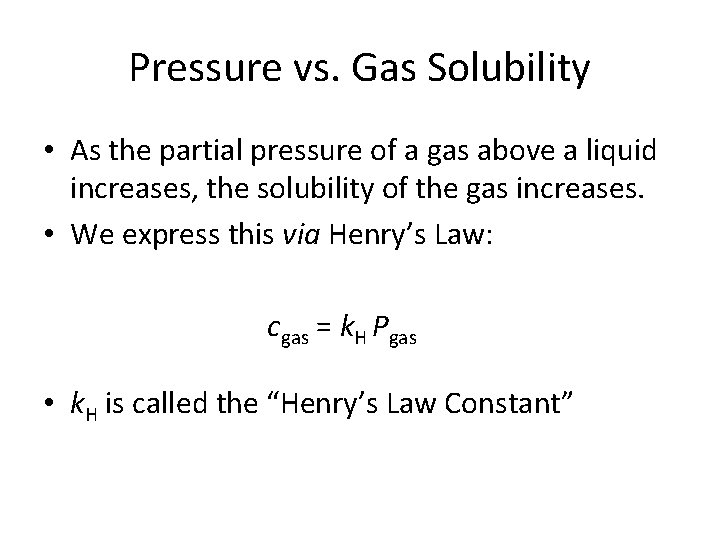
Pressure vs. Gas Solubility • As the partial pressure of a gas above a liquid increases, the solubility of the gas increases. • We express this via Henry’s Law: cgas = k. H Pgas • k. H is called the “Henry’s Law Constant”
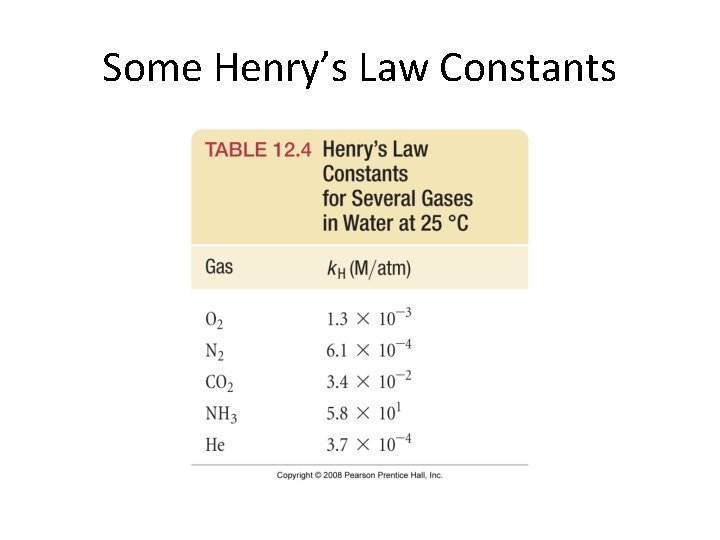
Some Henry’s Law Constants
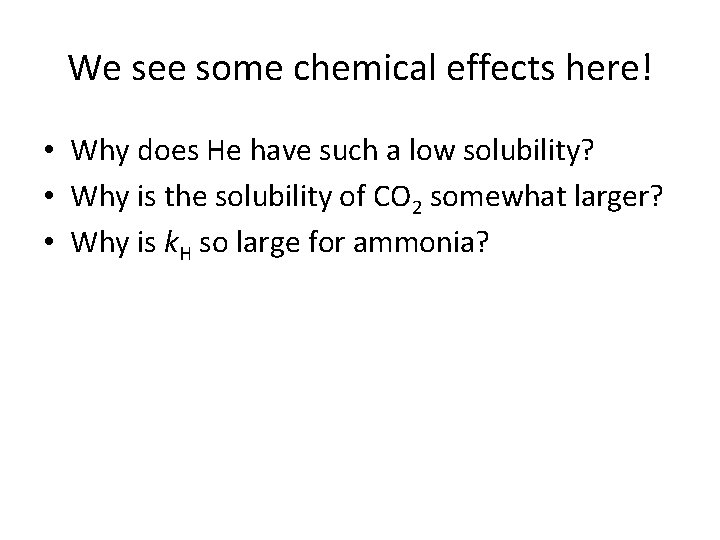
We see some chemical effects here! • Why does He have such a low solubility? • Why is the solubility of CO 2 somewhat larger? • Why is k. H so large for ammonia?
CO 2 in water: A p. Hun, p. Hizzy, case…
A Look at a Very Large k. H. . . The following link is a depiction of the wellknown “ammonia fountain” experiment: http: //www. youtube. com/watch? v=-z 4 li. Rirdv 0
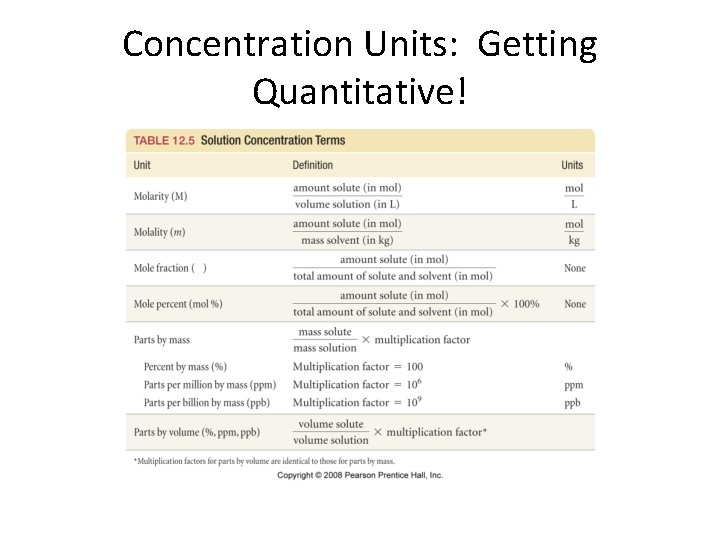
Concentration Units: Getting Quantitative!
Graphics make things simple?
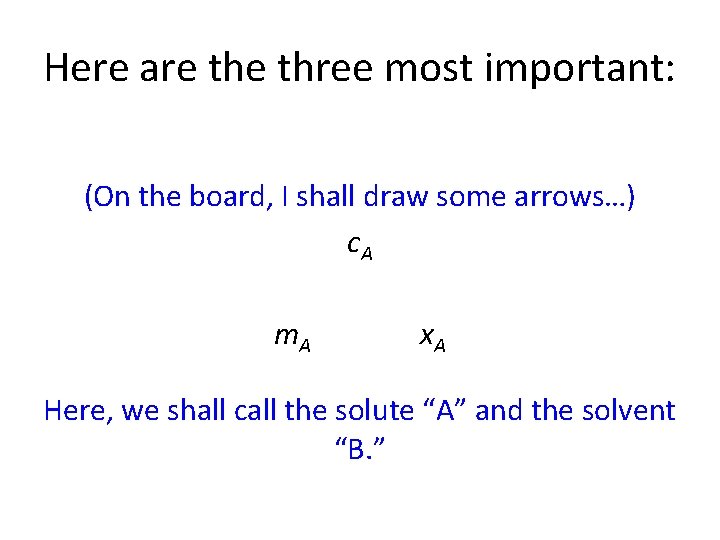
Here are three most important: (On the board, I shall draw some arrows…) c. A m. A x. A Here, we shall call the solute “A” and the solvent “B. ”
We now digress from the book! • Let’s look at • Molarity, • Molality, • And mole fraction • From a more universal point of view and also in terms of • Concentrated and • Dilute solutions! Tro: Chemistry: A Molecular Approach 35
Basic Strategy Here (for math wizards)… • Find the mole (define all symbols as you go) – This is central to many chemical problems • Identify any other needed chemical or physical properties – Molecular weight and density here! • Write and understand algebraic expressions for all these • After derivation, look at special cases.
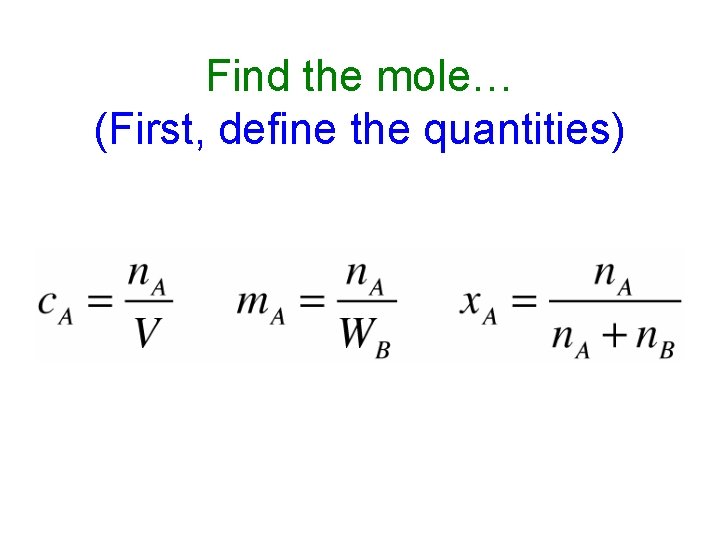
Find the mole… (First, define the quantities)
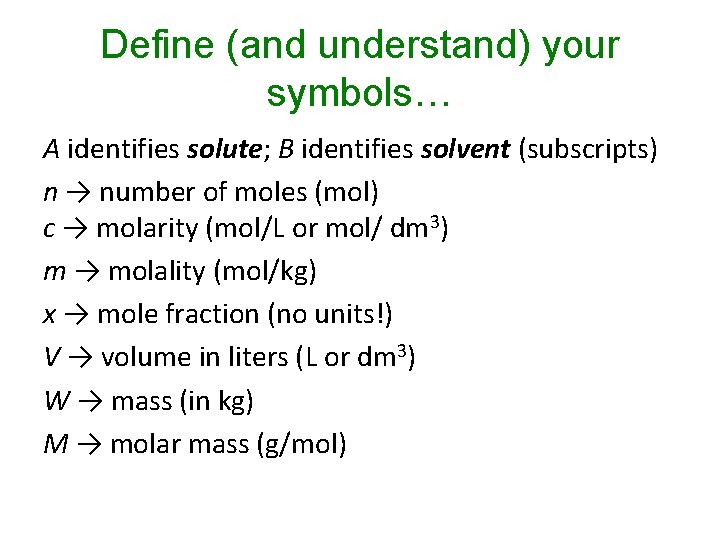
Define (and understand) your symbols… A identifies solute; B identifies solvent (subscripts) n → number of moles (mol) c → molarity (mol/L or mol/ dm 3) m → molality (mol/kg) x → mole fraction (no units!) V → volume in liters (L or dm 3) W → mass (in kg) M → molar mass (g/mol)
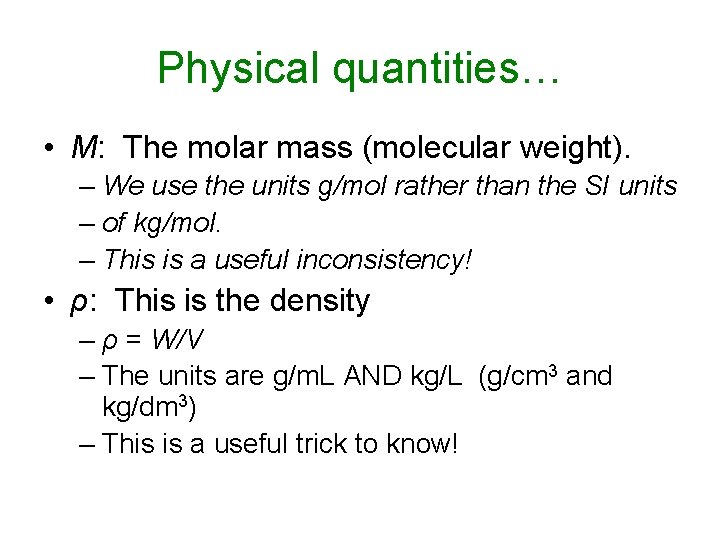
Physical quantities… • M: The molar mass (molecular weight). – We use the units g/mol rather than the SI units – of kg/mol. – This is a useful inconsistency! • ρ: This is the density – ρ = W/V – The units are g/m. L AND kg/L (g/cm 3 and kg/dm 3) – This is a useful trick to know!
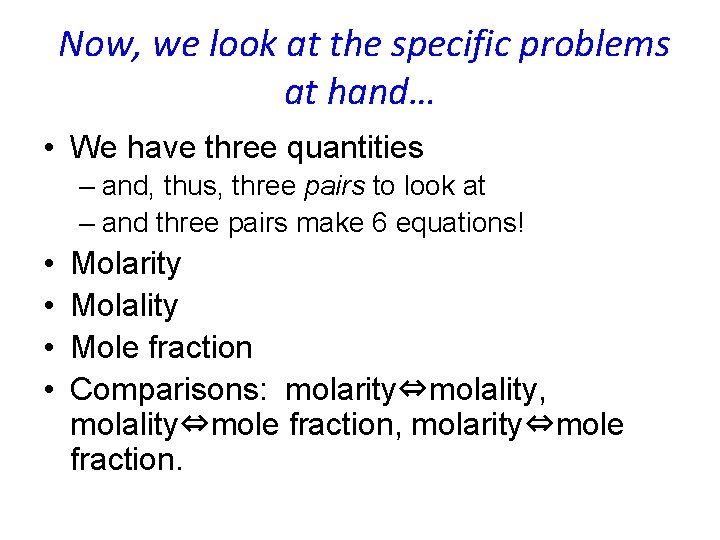
Now, we look at the specific problems at hand… • We have three quantities – and, thus, three pairs to look at – and three pairs make 6 equations! • • Molarity Molality Mole fraction Comparisons: molarity⇔molality, molality⇔mole fraction, molarity⇔mole fraction.
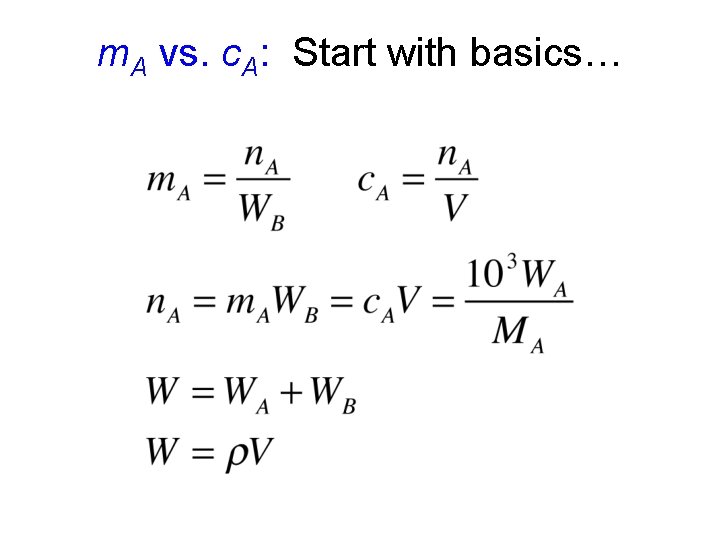
m. A vs. c. A: Start with basics…
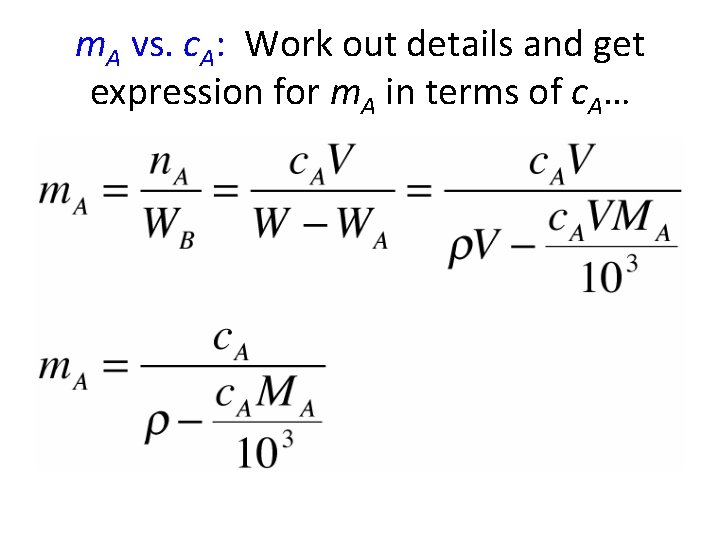
m. A vs. c. A: Work out details and get expression for m. A in terms of c. A…
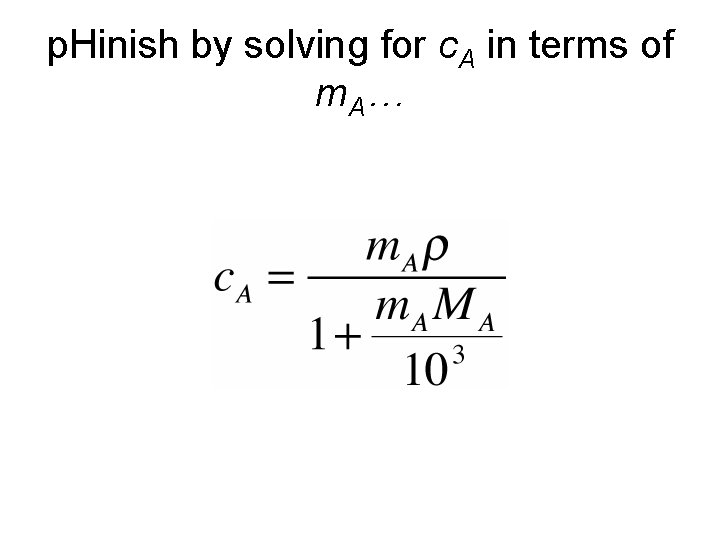
p. Hinish by solving for c. A in terms of m. A …
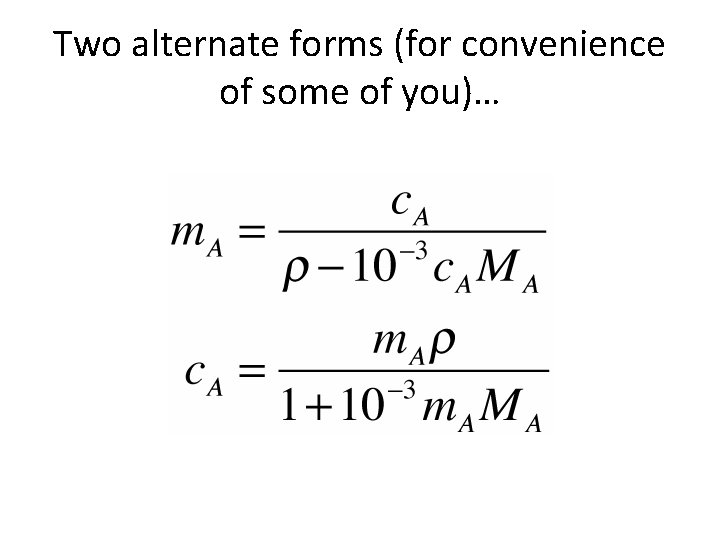
Two alternate forms (for convenience of some of you)…
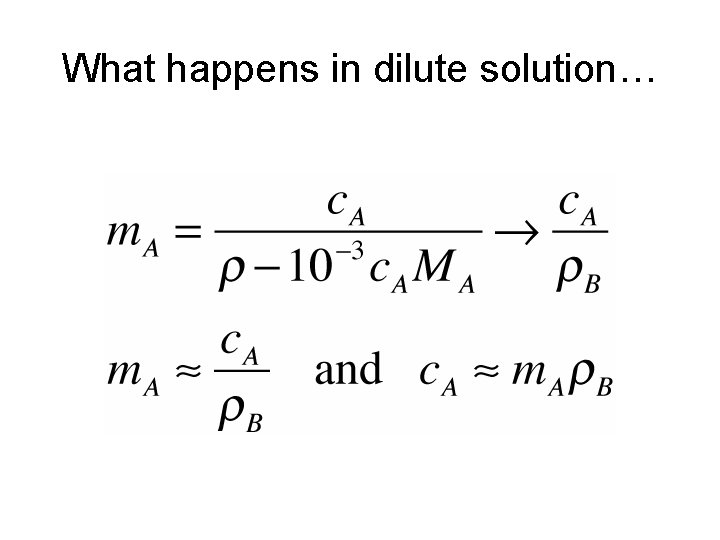
What happens in dilute solution…
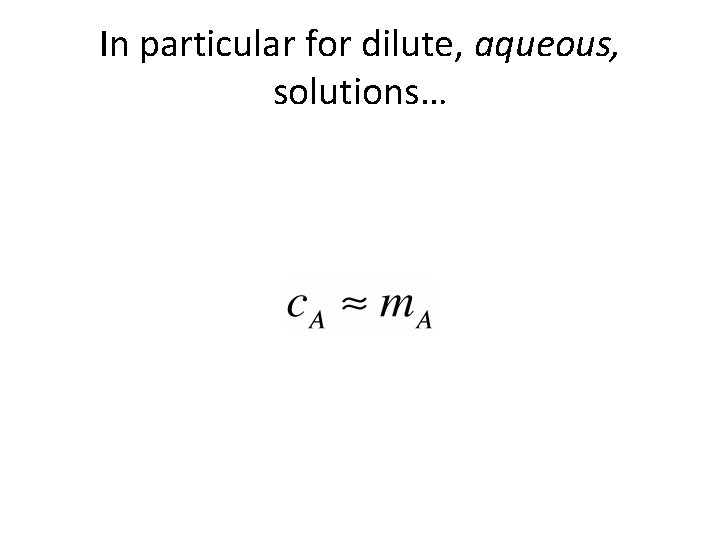
In particular for dilute, aqueous, solutions…
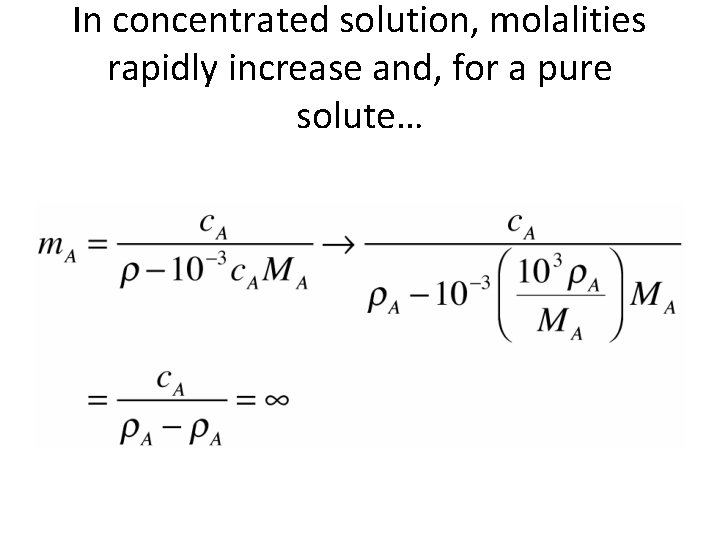
In concentrated solution, molalities rapidly increase and, for a pure solute…
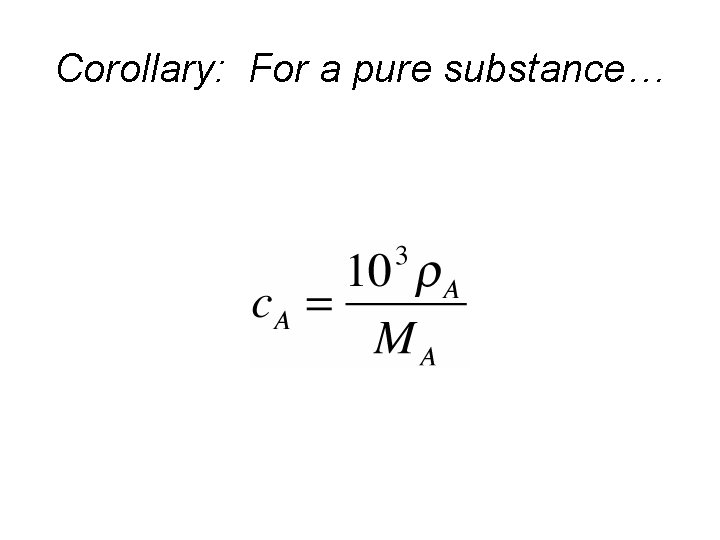
Corollary: For a pure substance…
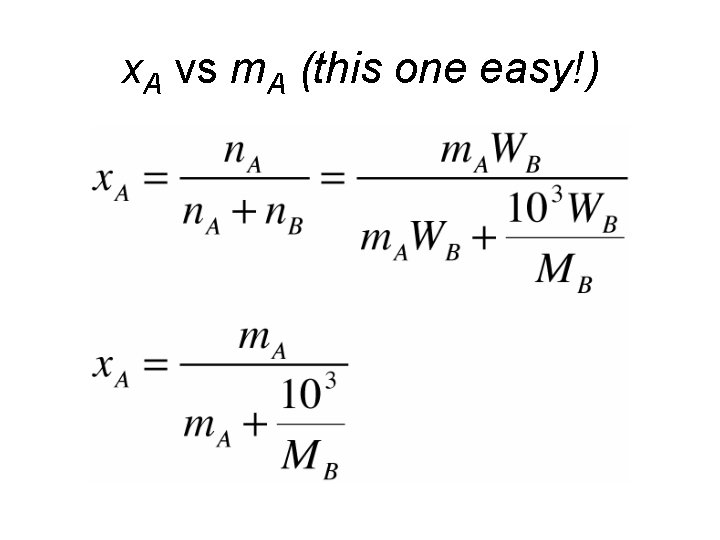
x. A vs m. A (this one easy!)
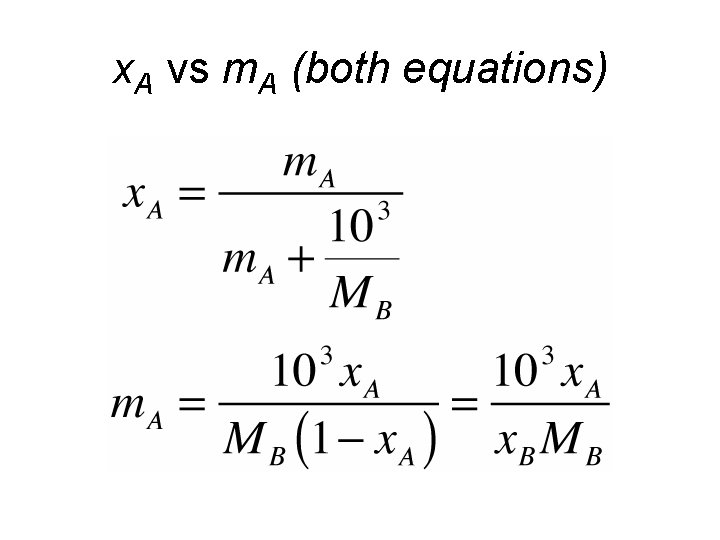
x. A vs m. A (both equations)
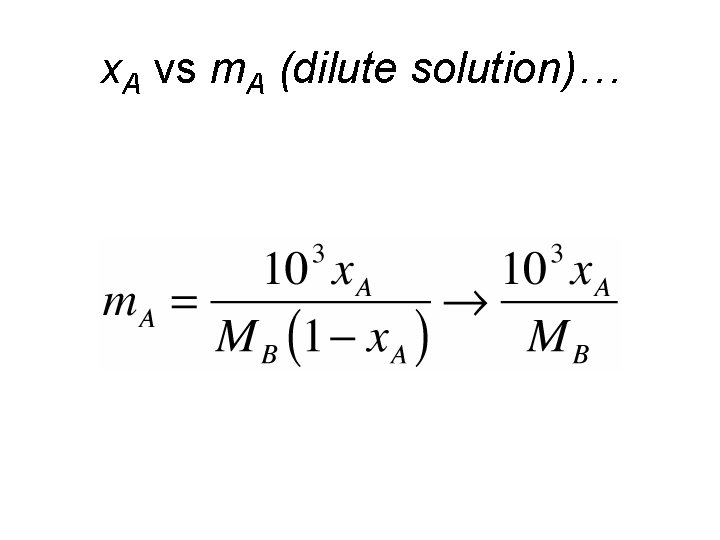
x. A vs m. A (dilute solution)…
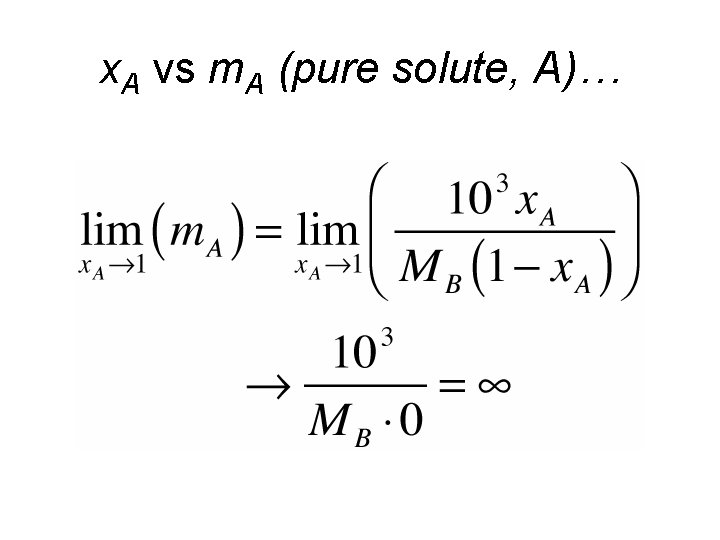
x. A vs m. A (pure solute, A)…
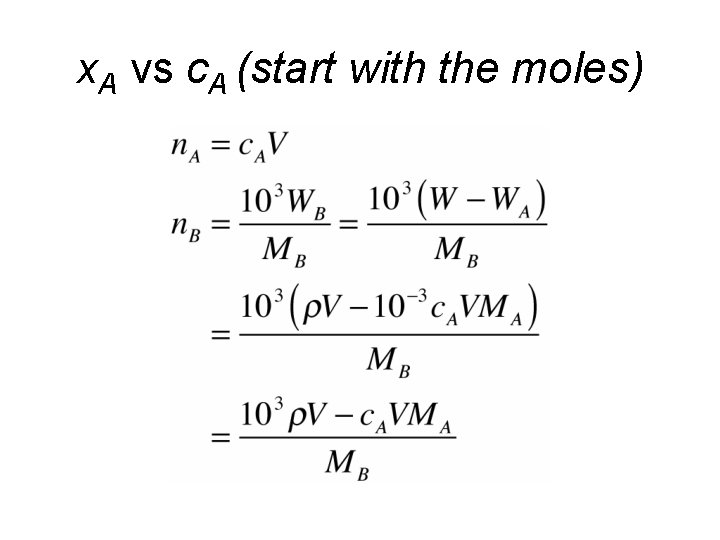
x. A vs c. A (start with the moles)
x. A vs c. A (then get x. A)…
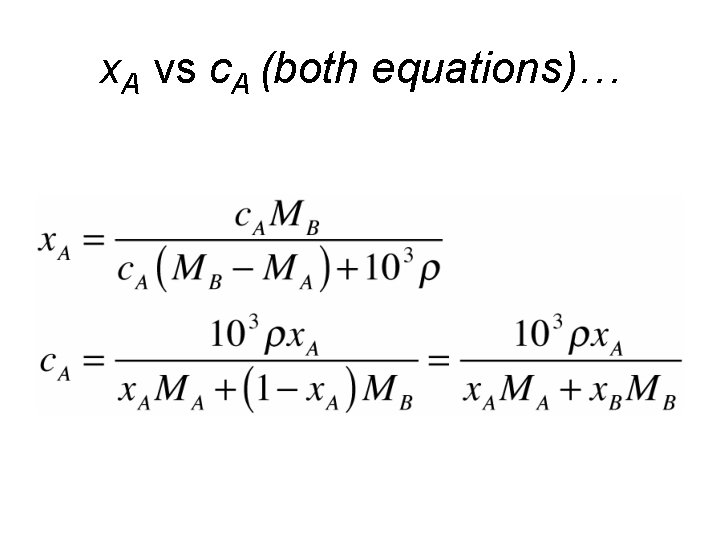
x. A vs c. A (both equations)…
x. A vs c. A (dilute solutions)…
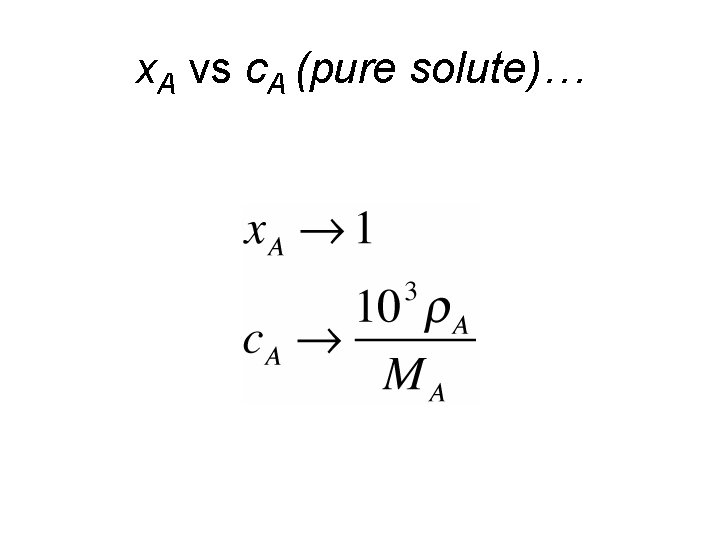
x. A vs c. A (pure solute)…
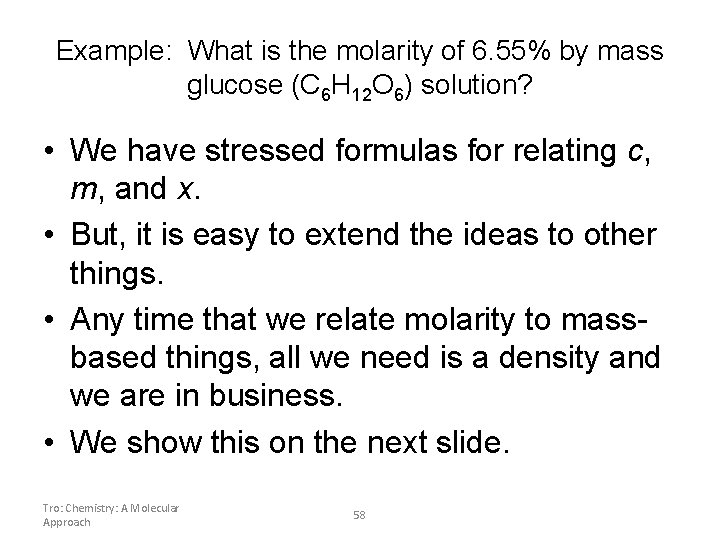
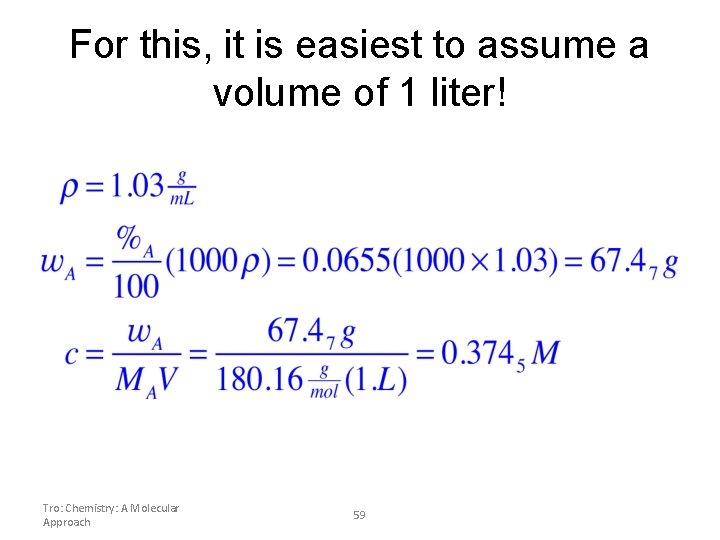
Example: What is the molarity of 6. 55% by mass glucose (C 6 H 12 O 6) solution? • We have stressed formulas for relating c, m, and x. • But, it is easy to extend the ideas to other things. • Any time that we relate molarity to massbased things, all we need is a density and we are in business. • We show this on the next slide. Tro: Chemistry: A Molecular Approach 58
For this, it is easiest to assume a volume of 1 liter! Tro: Chemistry: A Molecular Approach 59
Practice – Calculate the molality of 16. 2 M H 2 SO 4(aq) (MMH 2 SO 4 = 98. 08 g/mol, dsol’n = 1. 80 g/m. L) • • This one I shall not do for you. This really is for YOUR practice. Try it with the plug-in formula. See if you can get the answer yourself using straightforward reasoning after using the formula! • Hint: This is done in the unadulterated Tro slides! Tro: Chemistry: A Molecular Approach, 2/e 60
An Intermission… Before we start colligative properties, we shall look at Raoult’s Law
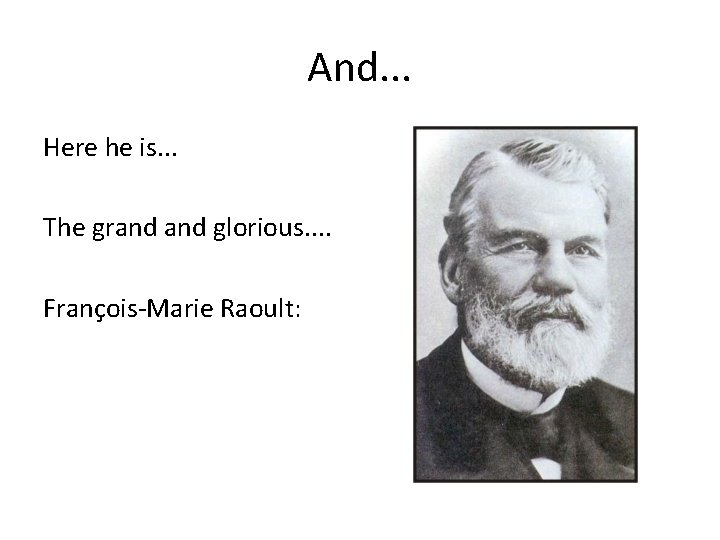
And. . . Here he is. . . The grand glorious. . François-Marie Raoult:
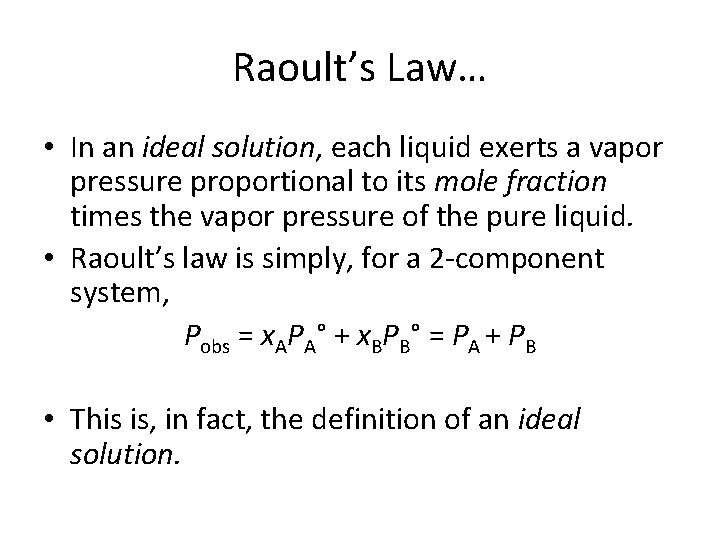
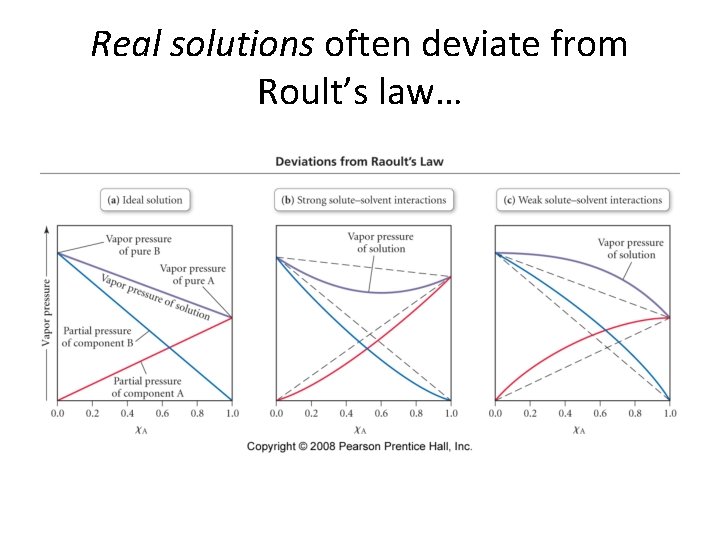
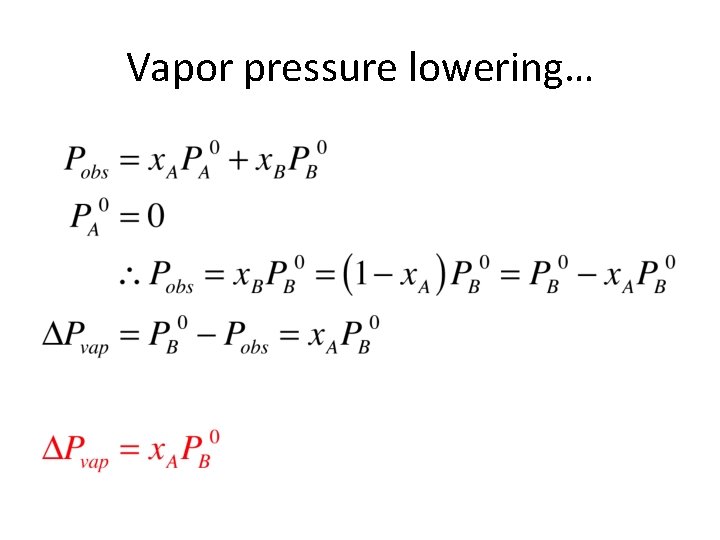
Raoult’s Law… • In an ideal solution, each liquid exerts a vapor pressure proportional to its mole fraction times the vapor pressure of the pure liquid. • Raoult’s law is simply, for a 2 -component system, Pobs = x. APA° + x. BPB° = PA + PB • This is, in fact, the definition of an ideal solution.
Real solutions often deviate from Roult’s law…
Dilute solutions… • obey Raoult’s Law. • Hence, dilute solutions are close to ideal. • This has a direct application to COLLIGATIVE PROPERTIES
COLLIGATIVE PROPERTIES • These usually involve a dilute solution of solute in the solvent. • Usually, the solute is nonvolatile (i. e. , PA° = 0). • The identity of the solute is otherwise irrelevant. • The colligative property is an observed change in a solvent property.
Colligative properties are… • proportional to the number of solute particles (molecules or ions) in solution. • We usually express the properties as Coll. Property = (conc)A x Solvent property • Colligative properties are always positive numbers!
The Four Colligative Properties 1) 2) 3) 4) Vapor pressure lowering Boiling point elevation Freezing point lowering Osmotic pressure (my favorite!)
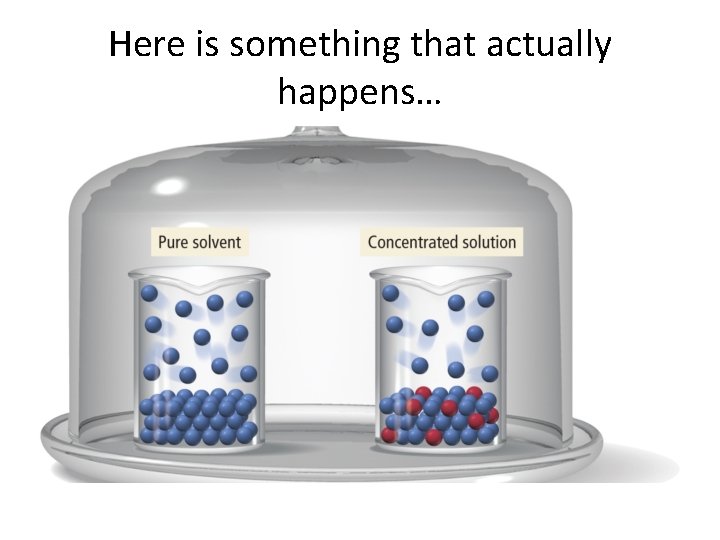
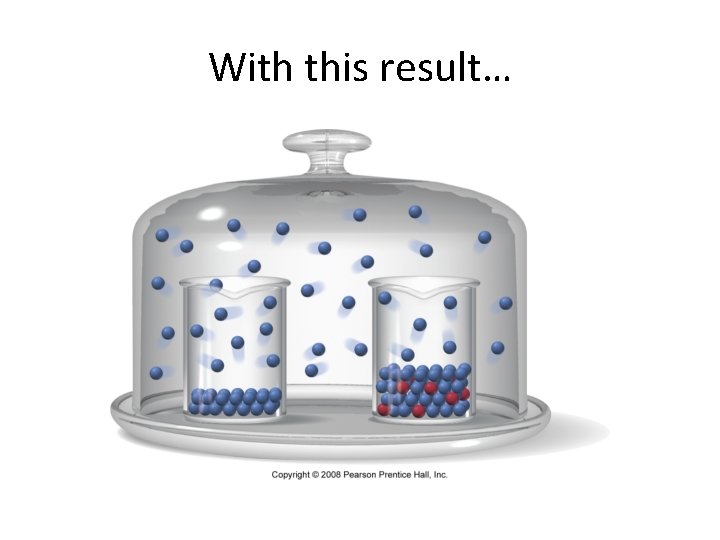
Vapor pressure lowering…
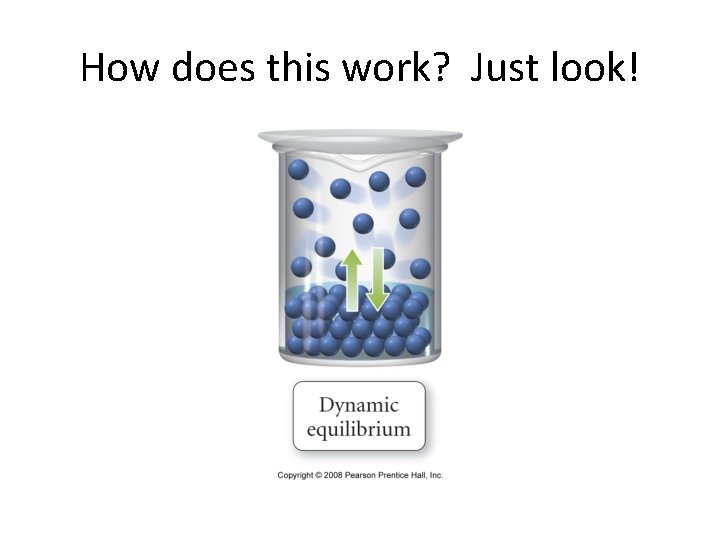
How does this work? Just look!
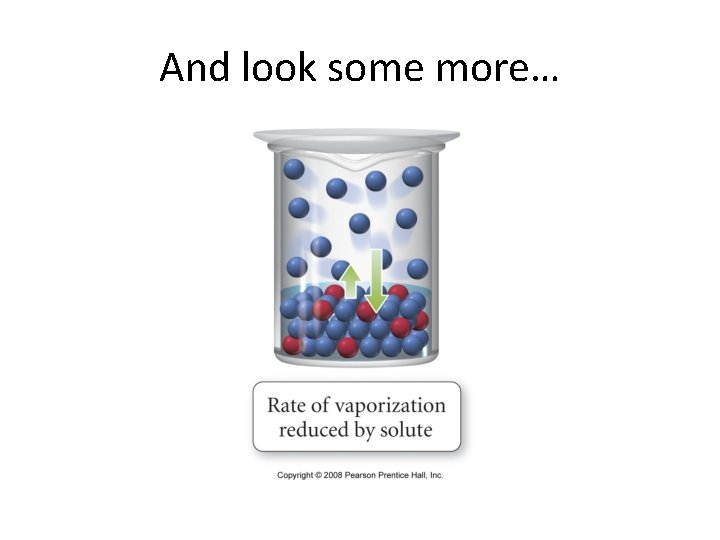
And look some more…
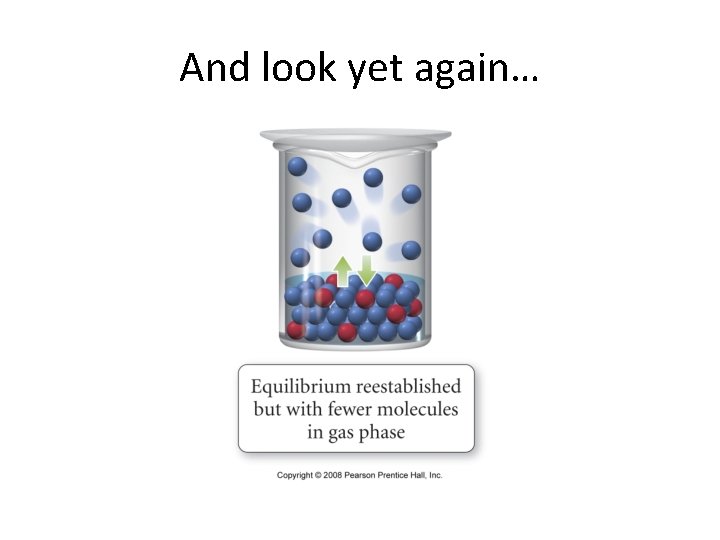
And look yet again…
Here is something that actually happens…
With this result…
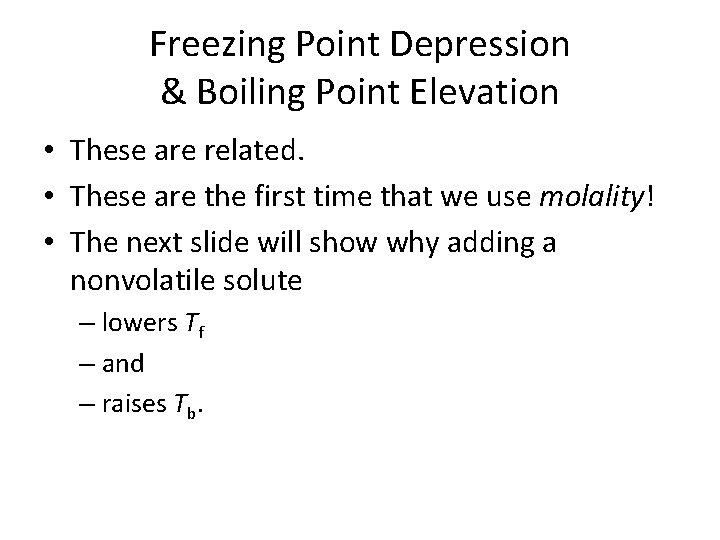
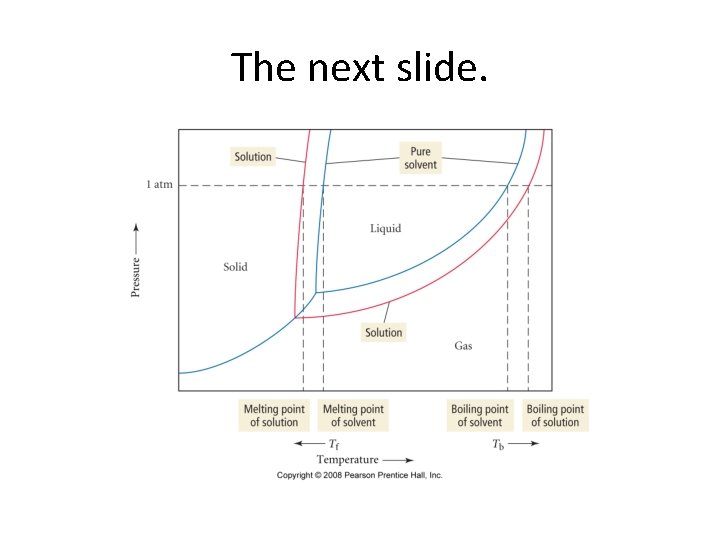
Freezing Point Depression & Boiling Point Elevation • These are related. • These are the first time that we use molality! • The next slide will show why adding a nonvolatile solute – lowers Tf – and – raises Tb.
The next slide.
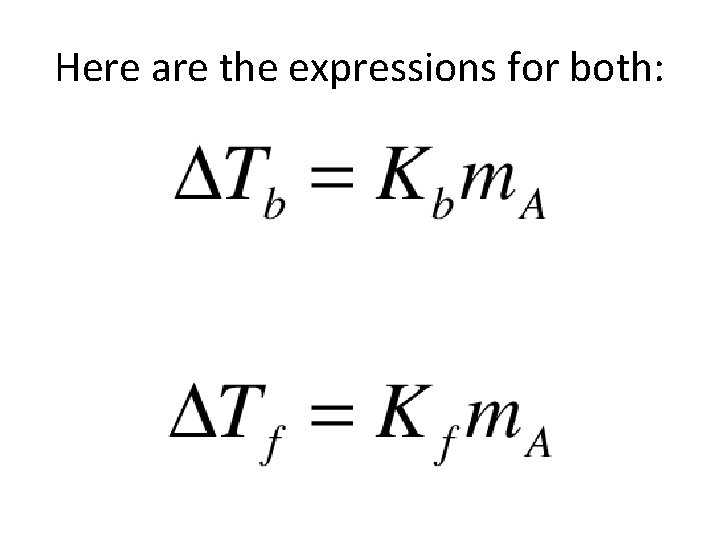
Here are the expressions for both:
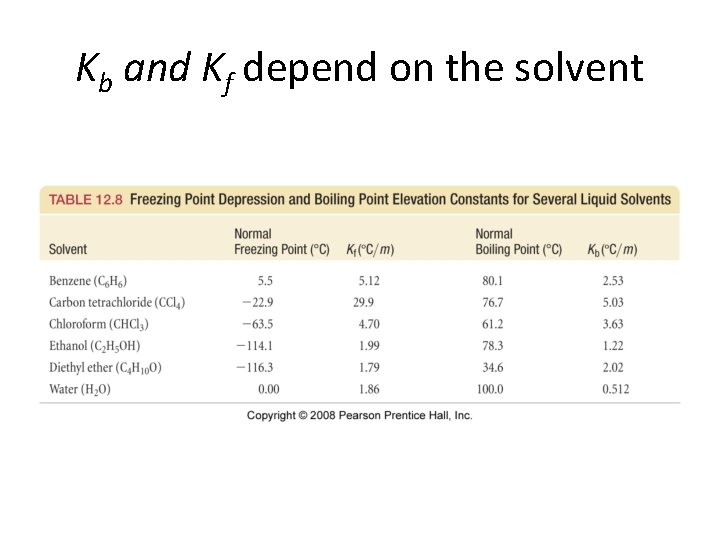
Kb and Kf depend on the solvent
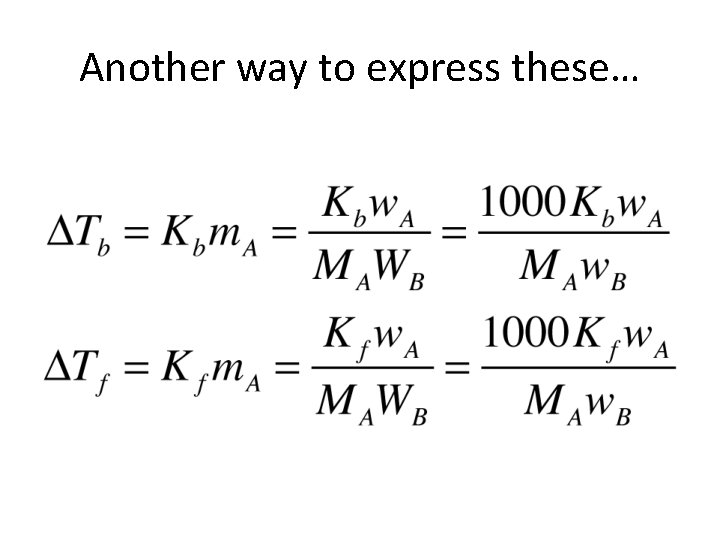
Another way to express these…
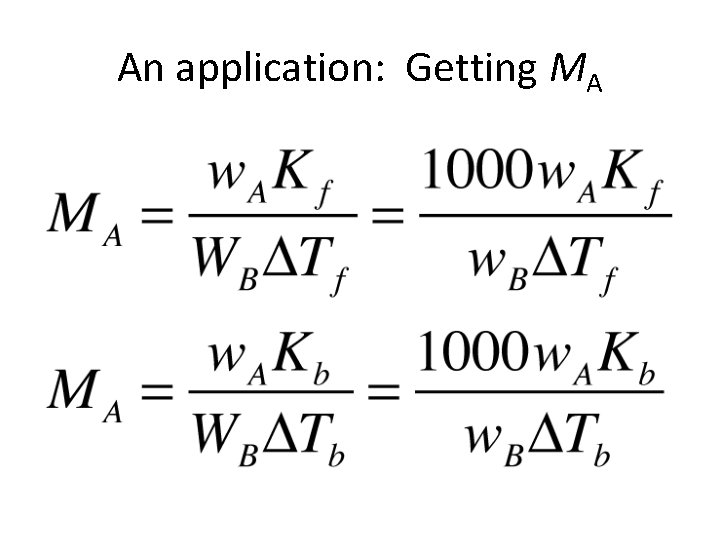
An application: Getting MA
A note on getting molar masses… • Freezing point depression the best method so far since… • …the numbers are larger. • But, the next (and last) colligative property is the best since… • …those numbers can be… • …HUGE!
Osmotic Pressure • This is not just an important colligative property but also… • …very important in nature. • There are numerous applications that we shall discuss shortly. • We now give some short slides that I shall give meaning to verbally!
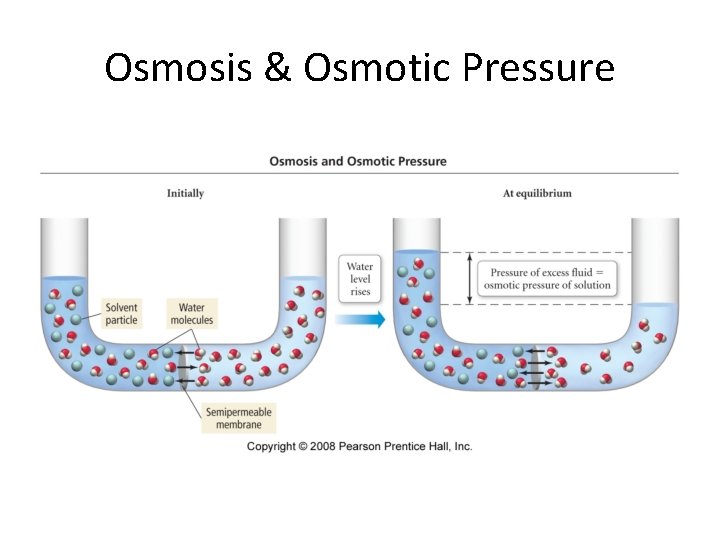
Osmosis & Osmotic Pressure
Special Points • What is a semipermeable membrane? • Water is usually the solvent. • Osmotic pressure, though, is actually independent both solute and solvent identities. • The only trick is finding a semipermeable membrane for a given solvent.
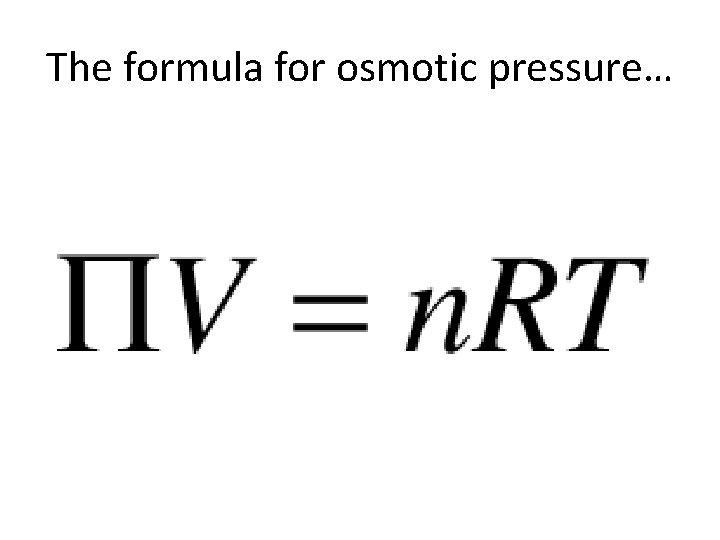
The formula for osmotic pressure…
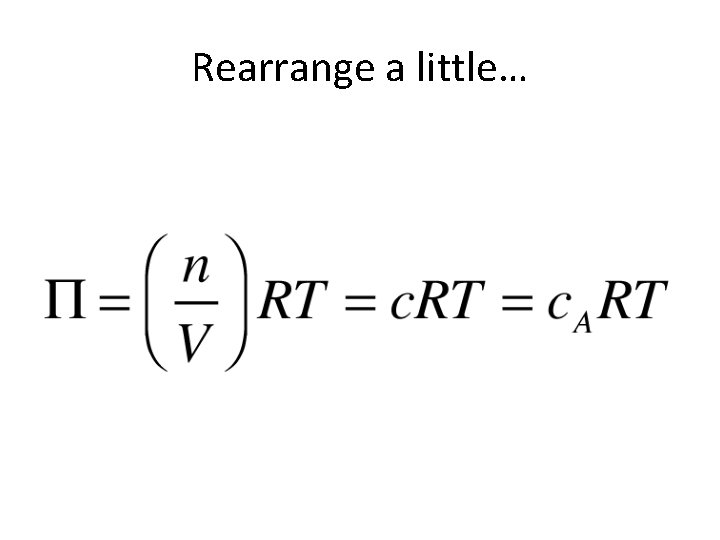
Rearrange a little…
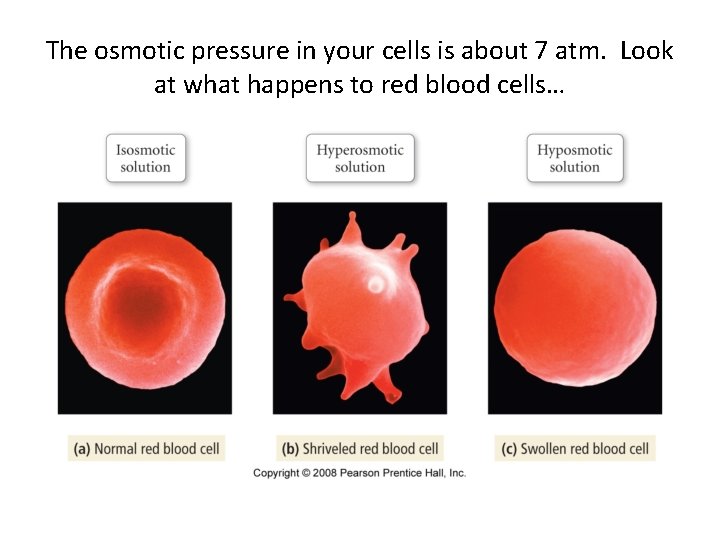
The osmotic pressure in your cells is about 7 atm. Look at what happens to red blood cells…
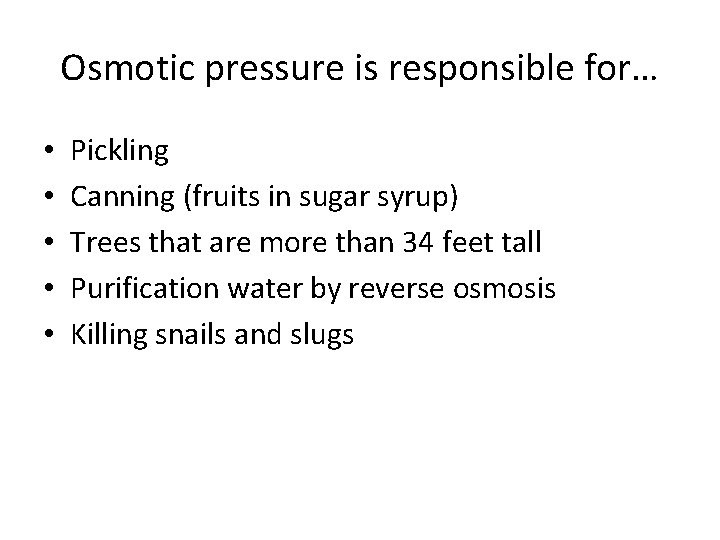
Osmotic pressure is responsible for… • • • Pickling Canning (fruits in sugar syrup) Trees that are more than 34 feet tall Purification water by reverse osmosis Killing snails and slugs
A message from a snail…
A tree also would like to say…
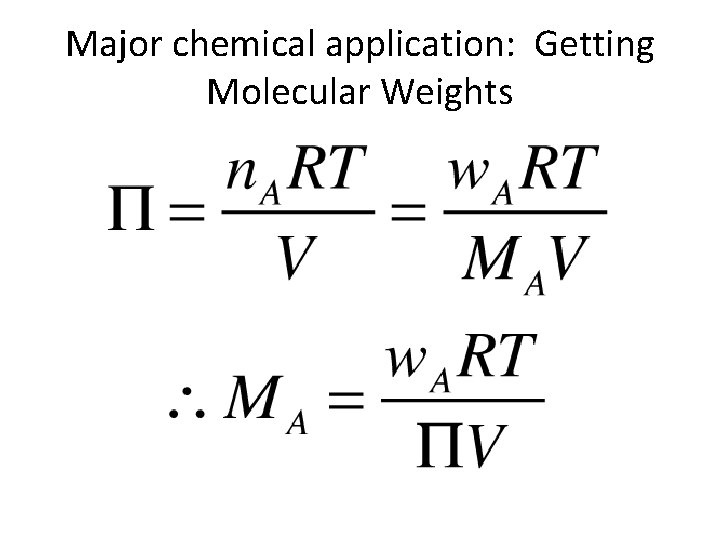
Major chemical application: Getting Molecular Weights
A correction for ionic compounds • Colligative properties are proportional to the number of solute particles present. • For instance, a mole of Na. Cl releases two moles of particles, one mole each of Na+ and Cl ions. • We correct this with what is called a van’t Hoff Factor.
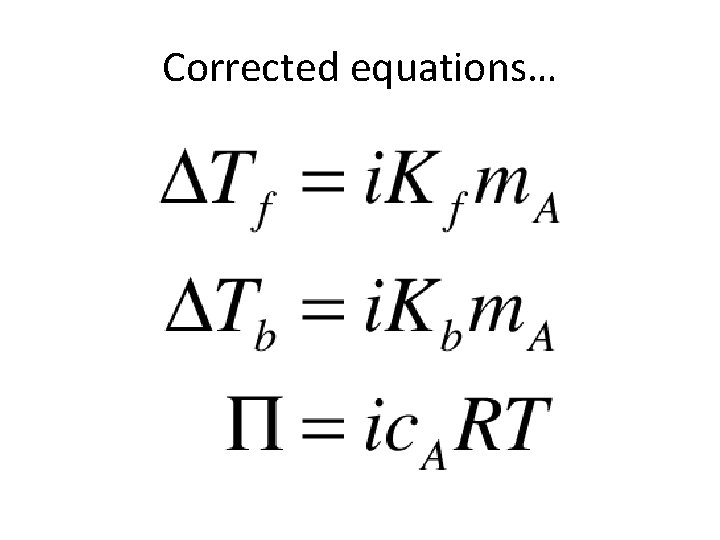
Corrected equations…
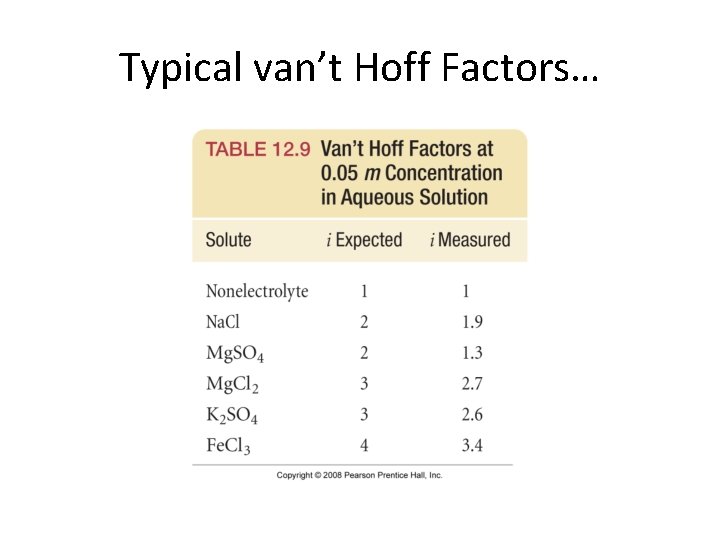
In dilute solutions… …the van’t Hoff factor is simply the number of ions per compound formula unit.
In more concentrated solutions… …this must be corrected to take into account ion pairing.
Typical van’t Hoff Factors…
COLLOIDS • These are sometimes called “colloidal solutions” or “colloidal suspensions. ” • They are like a solution in that the particles do not settle (except in ultracentrifuges). • But, the particles are big enough to scatter light (the Tyndall effect).
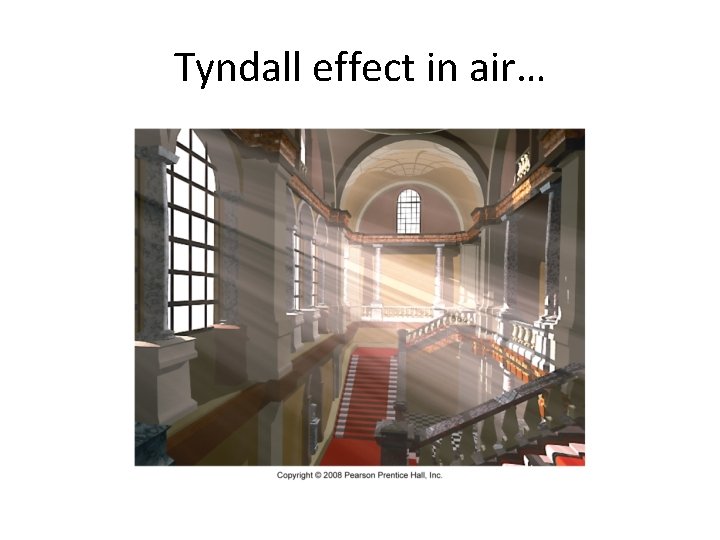
Tyndall effect in air…
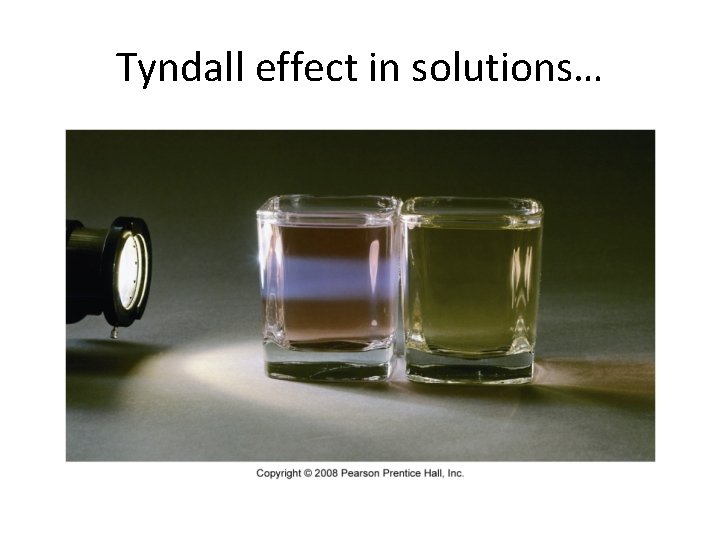
Tyndall effect in solutions…
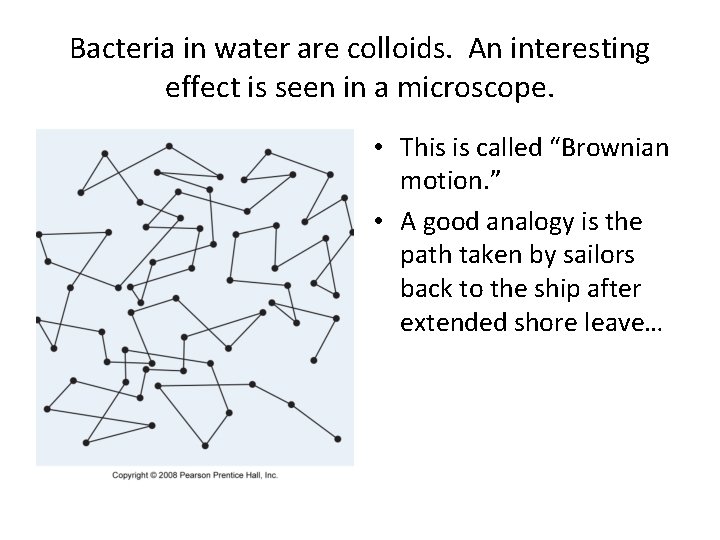
Bacteria in water are colloids. An interesting effect is seen in a microscope. • This is called “Brownian motion. ” • A good analogy is the path taken by sailors back to the ship after extended shore leave…
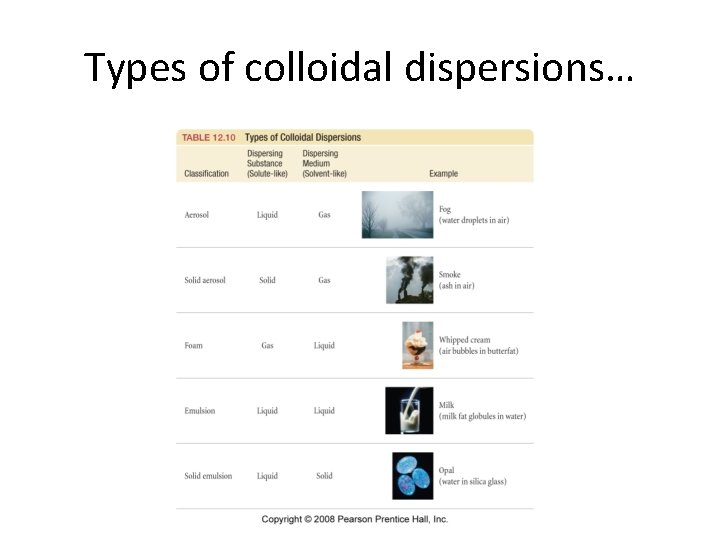
Types of colloidal dispersions…
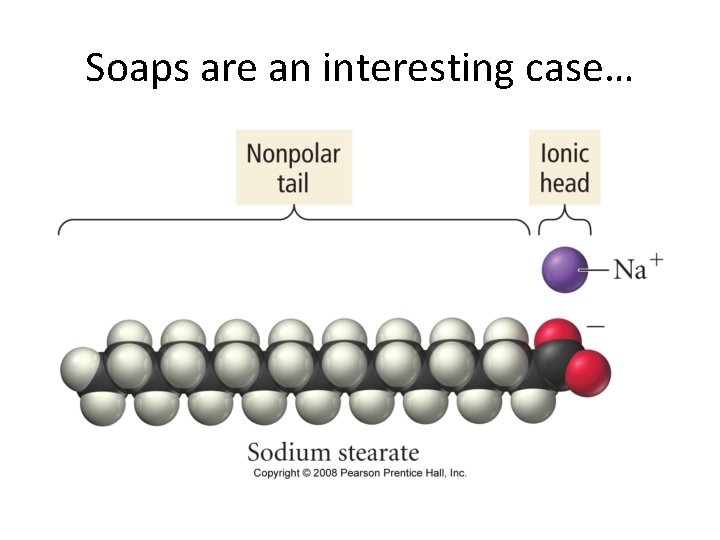
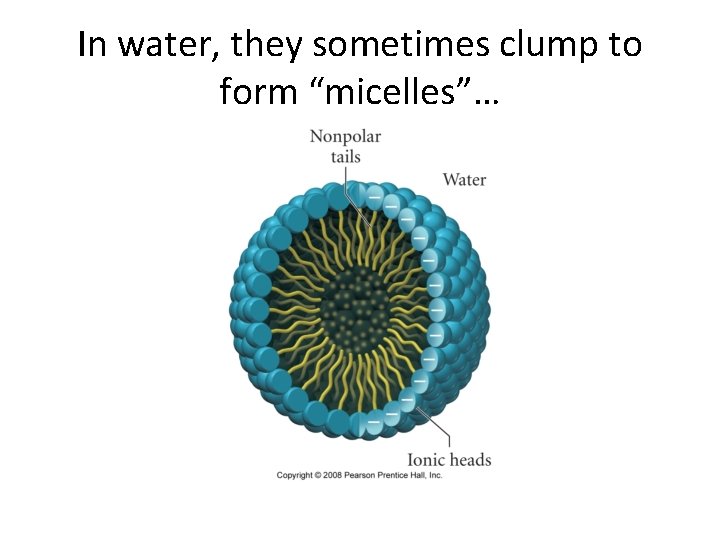
Soaps are an interesting case…
In water, they sometimes clump to form “micelles”…
Finis