
SOLUTIONS Class 1 Objective Describing what solutions are
SOLUTIONS Class #1 Objective: Describing what solutions are, how they form, and how are they’re strength is measured.
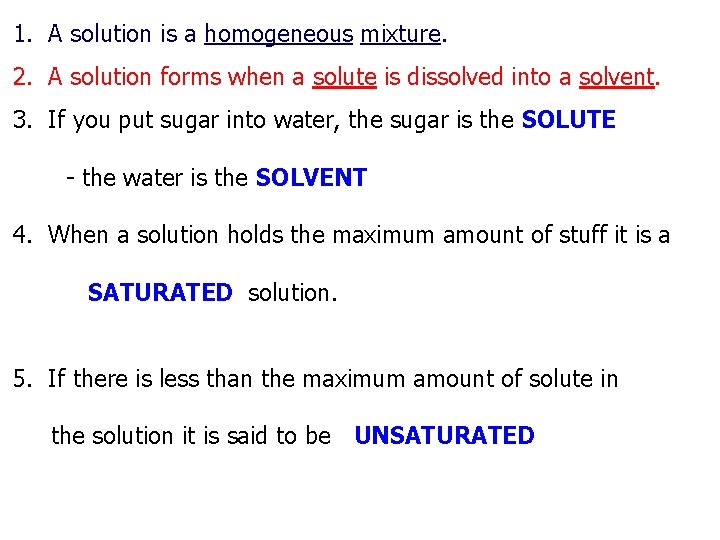
1. A solution is a homogeneous mixture. 2. A solution forms when a solute is dissolved into a solvent. 3. If you put sugar into water, the sugar is the SOLUTE - the water is the SOLVENT 4. When a solution holds the maximum amount of stuff it is a SATURATED solution. 5. If there is less than the maximum amount of solute in the solution it is said to be UNSATURATED
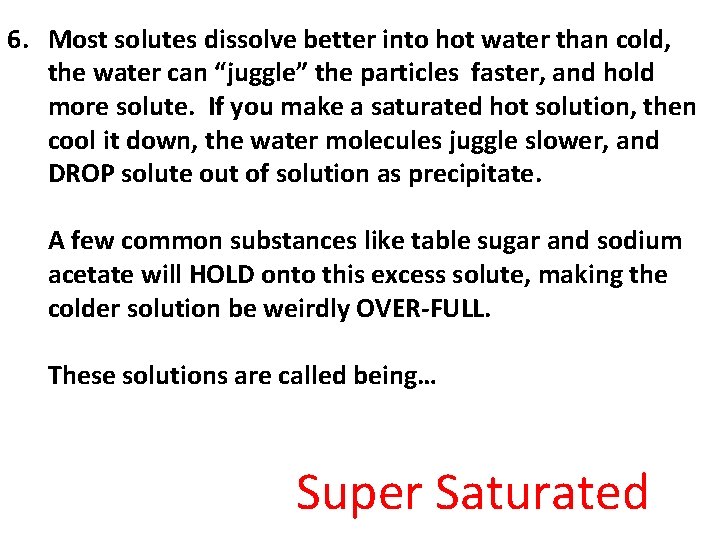
6. Most solutes dissolve better into hot water than cold, the water can “juggle” the particles faster, and hold more solute. If you make a saturated hot solution, then cool it down, the water molecules juggle slower, and DROP solute out of solution as precipitate. A few common substances like table sugar and sodium acetate will HOLD onto this excess solute, making the colder solution be weirdly OVER-FULL. These solutions are called being… Super Saturated
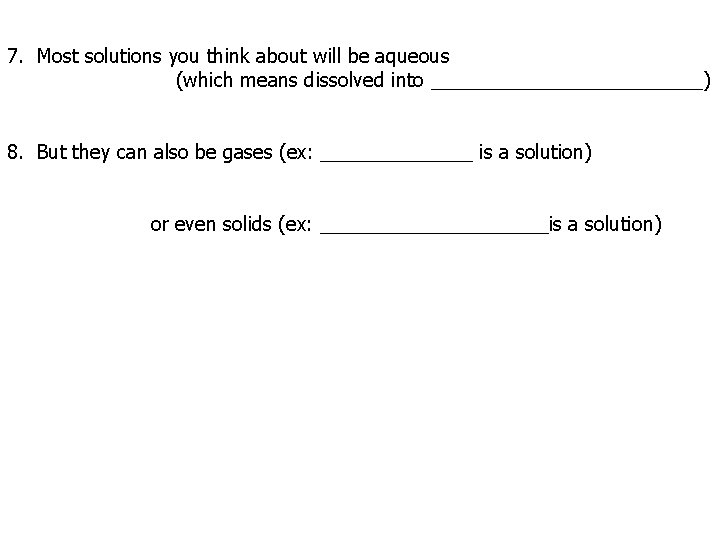
7. Most solutions you think about will be aqueous (which means dissolved into _____________) 8. But they can also be gases (ex: _______ is a solution) or even solids (ex: ___________is a solution)
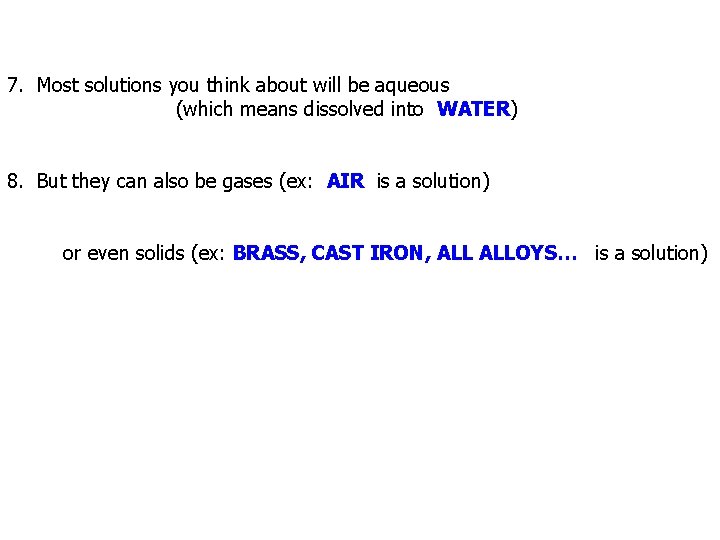
7. Most solutions you think about will be aqueous (which means dissolved into WATER) 8. But they can also be gases (ex: AIR is a solution) or even solids (ex: BRASS, CAST IRON, ALLOYS… is a solution)
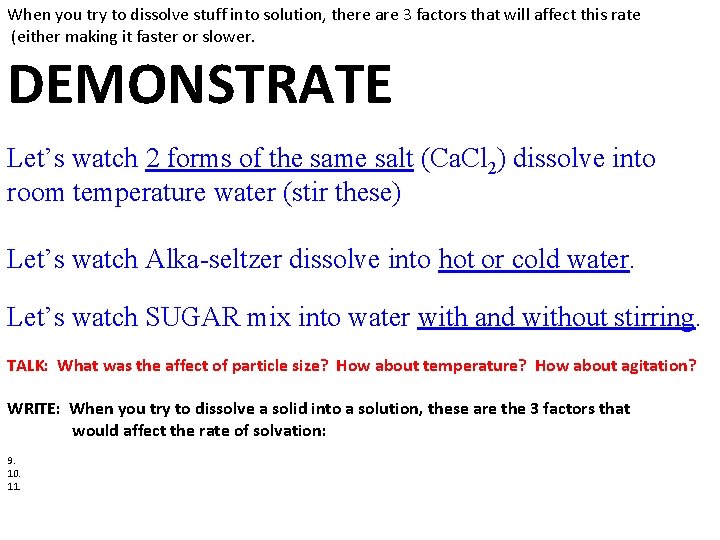
When you try to dissolve stuff into solution, there are 3 factors that will affect this rate (either making it faster or slower. DEMONSTRATE Let’s watch 2 forms of the same salt (Ca. Cl 2) dissolve into room temperature water (stir these) Let’s watch Alka-seltzer dissolve into hot or cold water. Let’s watch SUGAR mix into water with and without stirring. TALK: What was the affect of particle size? How about temperature? How about agitation? WRITE: When you try to dissolve a solid into a solution, these are the 3 factors that would affect the rate of solvation: 9. 10. 11.
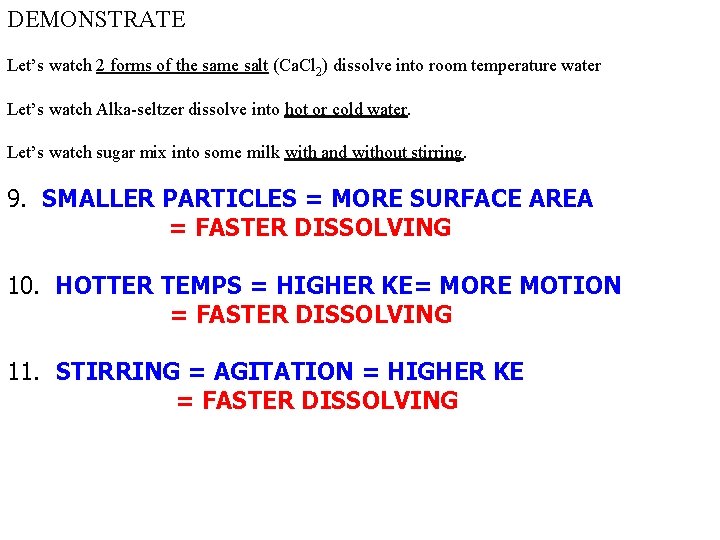
DEMONSTRATE Let’s watch 2 forms of the same salt (Ca. Cl 2) dissolve into room temperature water Let’s watch Alka-seltzer dissolve into hot or cold water. Let’s watch sugar mix into some milk with and without stirring. 9. SMALLER PARTICLES = MORE SURFACE AREA = FASTER DISSOLVING 10. HOTTER TEMPS = HIGHER KE= MORE MOTION = FASTER DISSOLVING 11. STIRRING = AGITATION = HIGHER KE = FASTER DISSOLVING
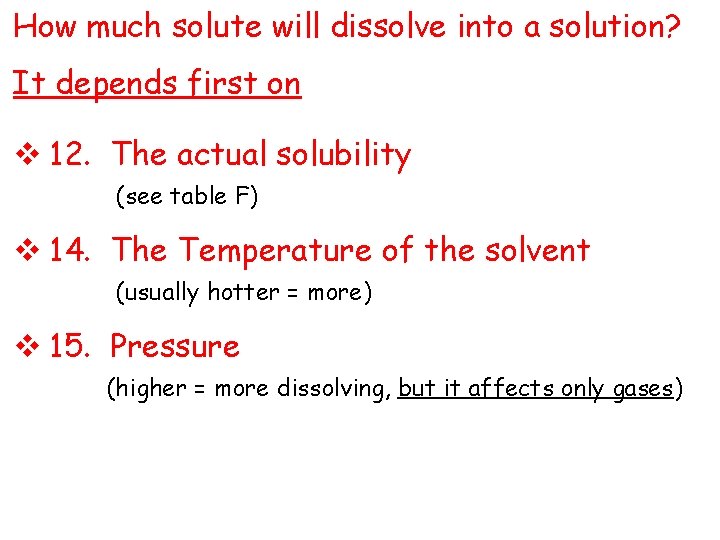
How much solute will dissolve into a solution? It depends first on v 12. The actual solubility (see table F) v 14. The Temperature of the solvent (usually hotter = more) v 15. Pressure (higher = more dissolving, but it affects only gases)
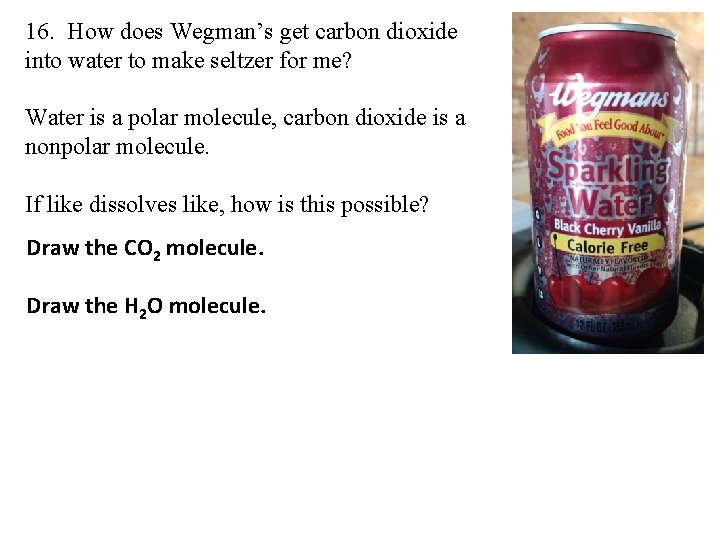
16. How does Wegman’s get carbon dioxide into water to make seltzer for me? Water is a polar molecule, carbon dioxide is a nonpolar molecule. If like dissolves like, how is this possible? Draw the CO 2 molecule. Draw the H 2 O molecule.
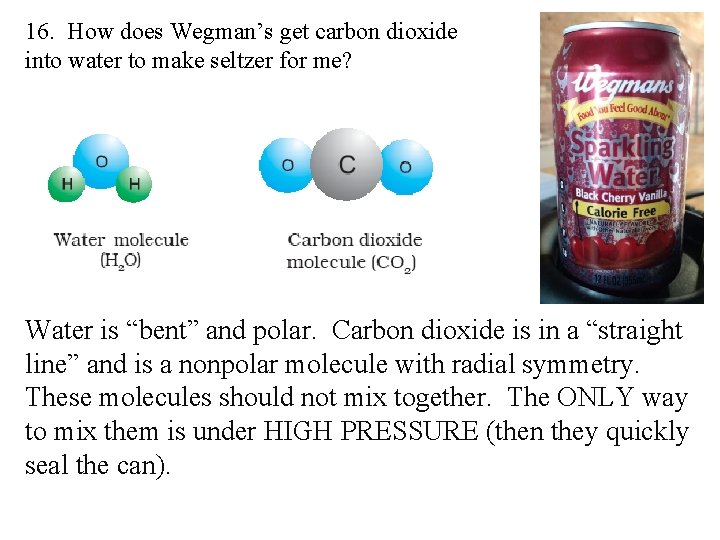
16. How does Wegman’s get carbon dioxide into water to make seltzer for me? Water is “bent” and polar. Carbon dioxide is in a “straight line” and is a nonpolar molecule with radial symmetry. These molecules should not mix together. The ONLY way to mix them is under HIGH PRESSURE (then they quickly seal the can).
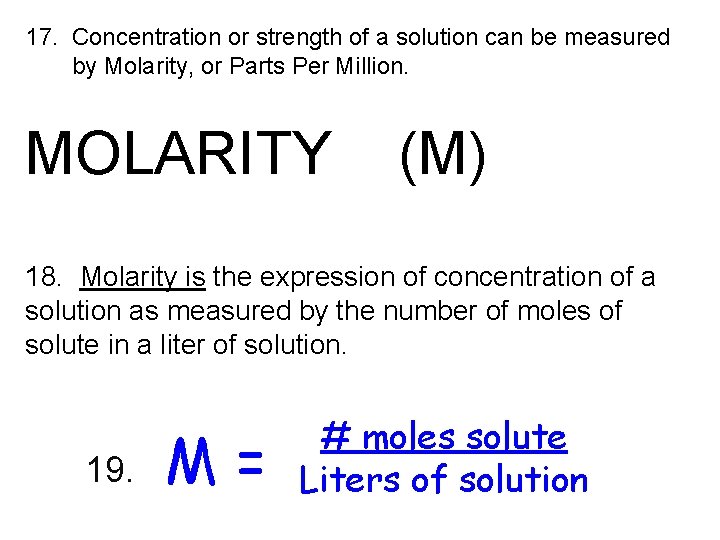
17. Concentration or strength of a solution can be measured by Molarity, or Parts Per Million. MOLARITY (M) 18. Molarity is the expression of concentration of a solution as measured by the number of moles of solute in a liter of solution. 19. M= # moles solute Liters of solution
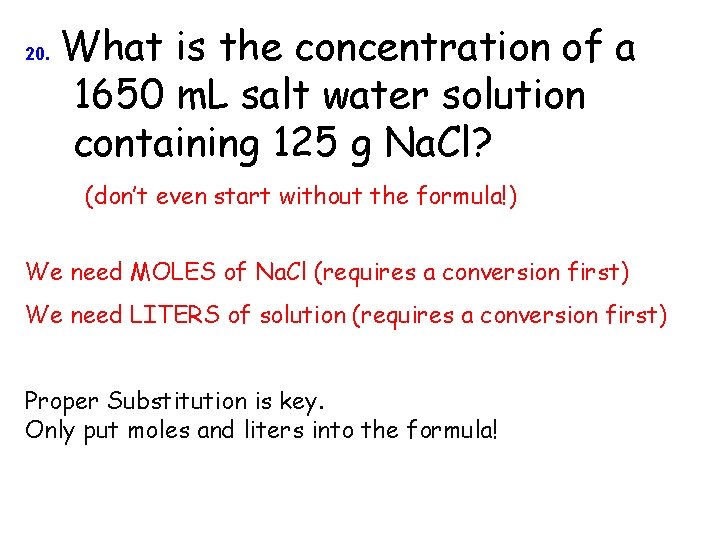
20. What is the concentration of a 1650 m. L salt water solution containing 125 g Na. Cl? (don’t even start without the formula!) We need MOLES of Na. Cl (requires a conversion first) We need LITERS of solution (requires a conversion first) Proper Substitution is key. Only put moles and liters into the formula!
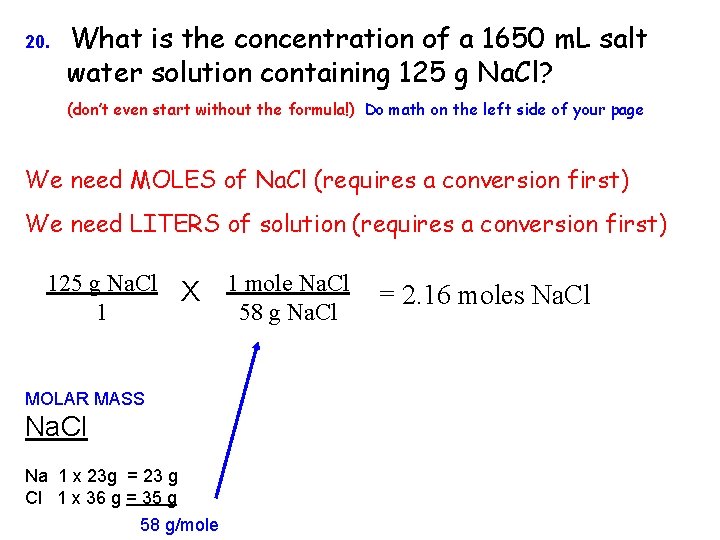
20. What is the concentration of a 1650 m. L salt water solution containing 125 g Na. Cl? (don’t even start without the formula!) Do math on the left side of your page We need MOLES of Na. Cl (requires a conversion first) We need LITERS of solution (requires a conversion first) 125 g Na. Cl X 1 MOLAR MASS Na. Cl Na 1 x 23 g = 23 g Cl 1 x 36 g = 35 g 58 g/mole 1 mole Na. Cl 58 g Na. Cl = 2. 16 moles Na. Cl
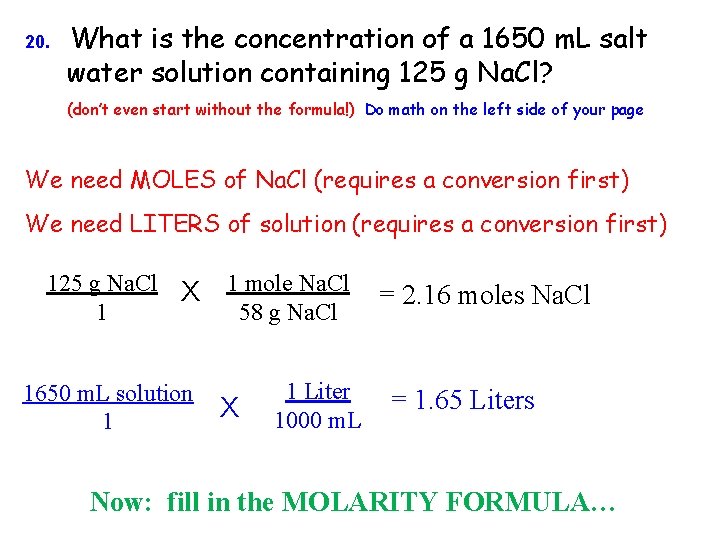
20. What is the concentration of a 1650 m. L salt water solution containing 125 g Na. Cl? (don’t even start without the formula!) Do math on the left side of your page We need MOLES of Na. Cl (requires a conversion first) We need LITERS of solution (requires a conversion first) 125 g Na. Cl X 1 1650 m. L solution 1 1 mole Na. Cl 58 g Na. Cl X 1 Liter 1000 m. L = 2. 16 moles Na. Cl = 1. 65 Liters Now: fill in the MOLARITY FORMULA…
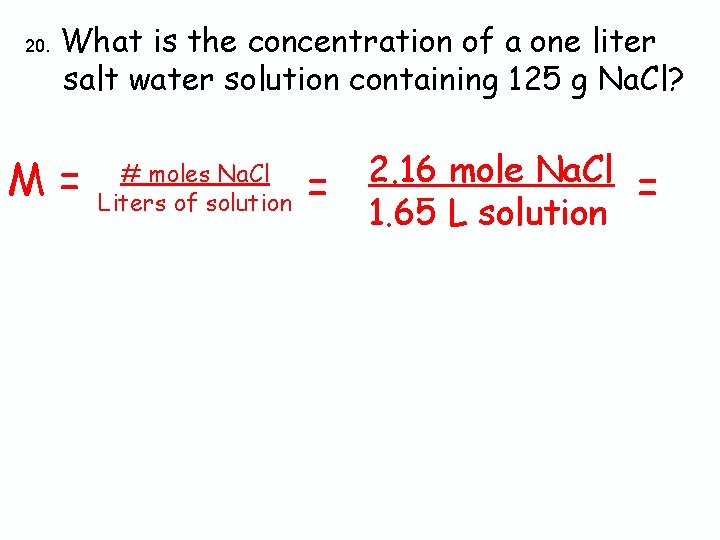
20. What is the concentration of a one liter salt water solution containing 125 g Na. Cl? M= # moles Na. Cl Liters of solution = 2. 16 mole Na. Cl 1. 65 L solution =
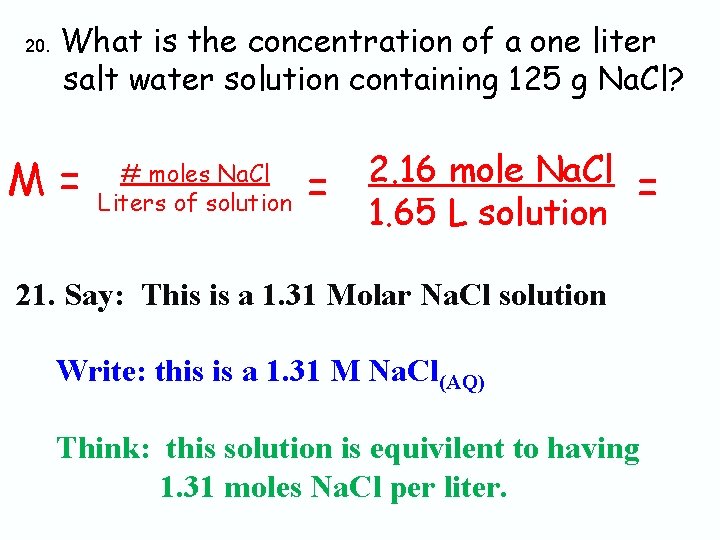
20. What is the concentration of a one liter salt water solution containing 125 g Na. Cl? M= # moles Na. Cl Liters of solution = 2. 16 mole Na. Cl 1. 65 L solution = 21. Say: This is a 1. 31 Molar Na. Cl solution Write: this is a 1. 31 M Na. Cl(AQ) Think: this solution is equivilent to having 1. 31 moles Na. Cl per liter.
22. If you add 43. 5 g Na. Cl to enough water to form a 648 m. L solution, what is it’s concentration? (figure out moles, and liters first, then write the formula, or else) M=
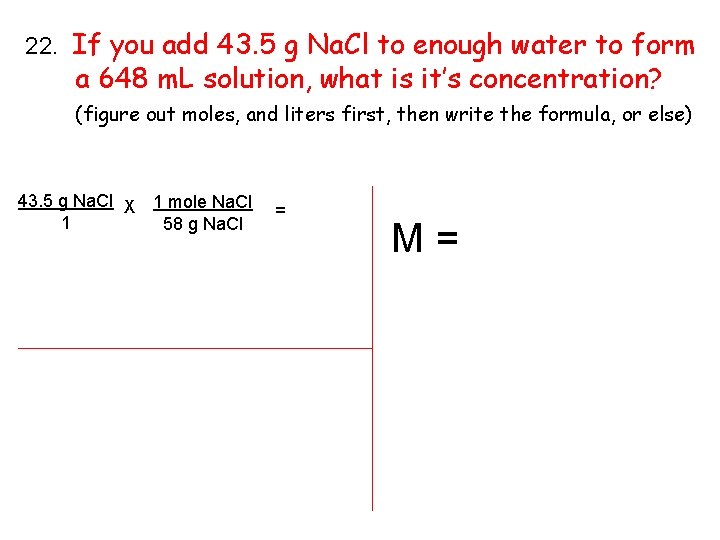
22. If you add 43. 5 g Na. Cl to enough water to form a 648 m. L solution, what is it’s concentration? (figure out moles, and liters first, then write the formula, or else) 43. 5 g Na. Cl X 1 mole Na. Cl 1 58 g Na. Cl = M=
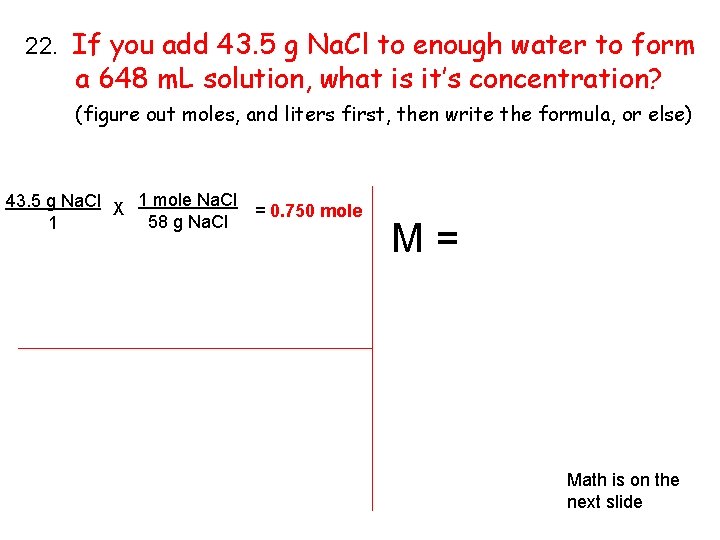
22. If you add 43. 5 g Na. Cl to enough water to form a 648 m. L solution, what is it’s concentration? (figure out moles, and liters first, then write the formula, or else) 43. 5 g Na. Cl X 1 mole Na. Cl = 0. 750 mole 58 g Na. Cl 1 M= Math is on the next slide
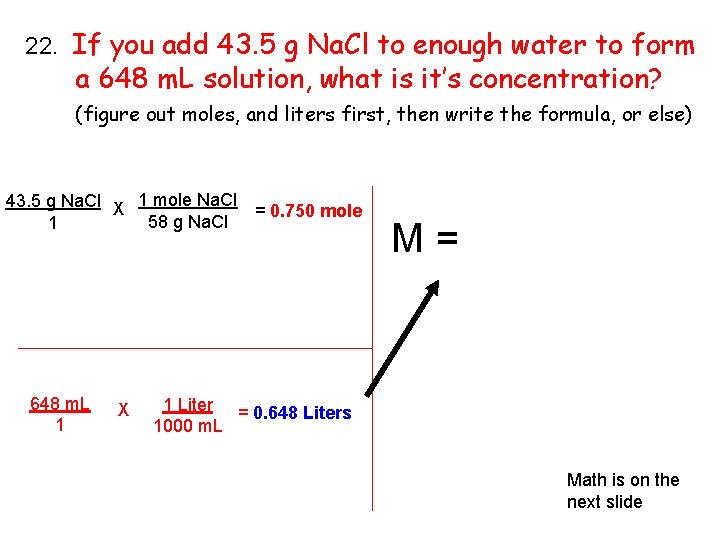
22. If you add 43. 5 g Na. Cl to enough water to form a 648 m. L solution, what is it’s concentration? (figure out moles, and liters first, then write the formula, or else) 43. 5 g Na. Cl X 1 mole Na. Cl = 0. 750 mole 58 g Na. Cl 1 648 m. L 1 X M= 1 Liter = 0. 648 Liters 1000 m. L Math is on the next slide
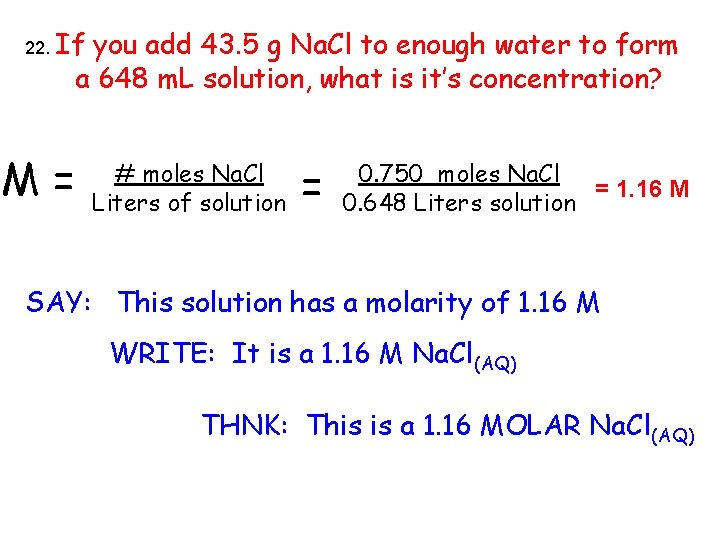
22. If you add 43. 5 g Na. Cl to enough water to form a 648 m. L solution, what is it’s concentration? M= # moles Na. Cl Liters of solution = 0. 750 moles Na. Cl = 1. 16 M 0. 648 Liters solution SAY: This solution has a molarity of 1. 16 M WRITE: It is a 1. 16 M Na. Cl(AQ) THNK: This is a 1. 16 MOLAR Na. Cl (AQ)
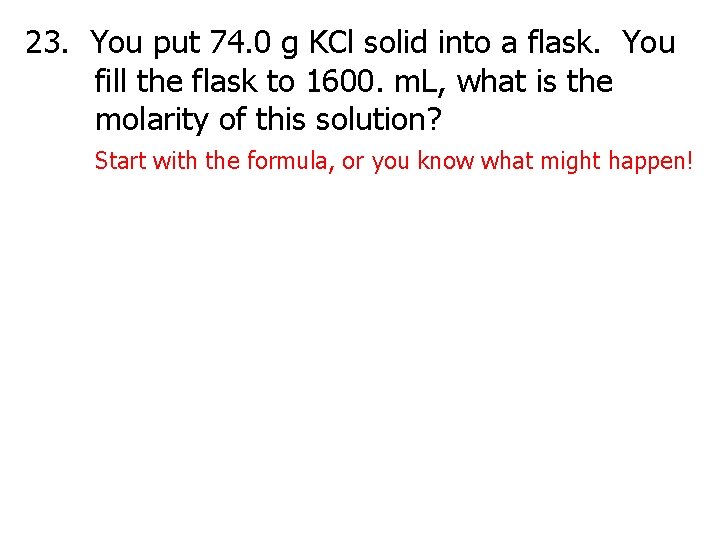
23. You put 74. 0 g KCl solid into a flask. You fill the flask to 1600. m. L, what is the molarity of this solution? Start with the formula, or you know what might happen!
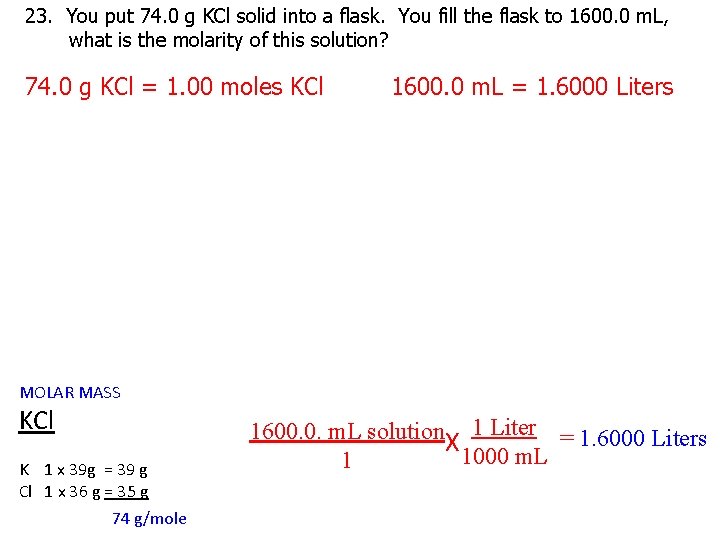
23. You put 74. 0 g KCl solid into a flask. You fill the flask to 1600. 0 m. L, what is the molarity of this solution? 74. 0 g KCl = 1. 00 moles KCl 1600. 0 m. L = 1. 6000 Liters MOLAR MASS KCl K 1 x 39 g = 39 g Cl 1 x 36 g = 35 g 74 g/mole 1600. 0. m. L solution X 1 Liter = 1. 6000 Liters 1000 m. L 1
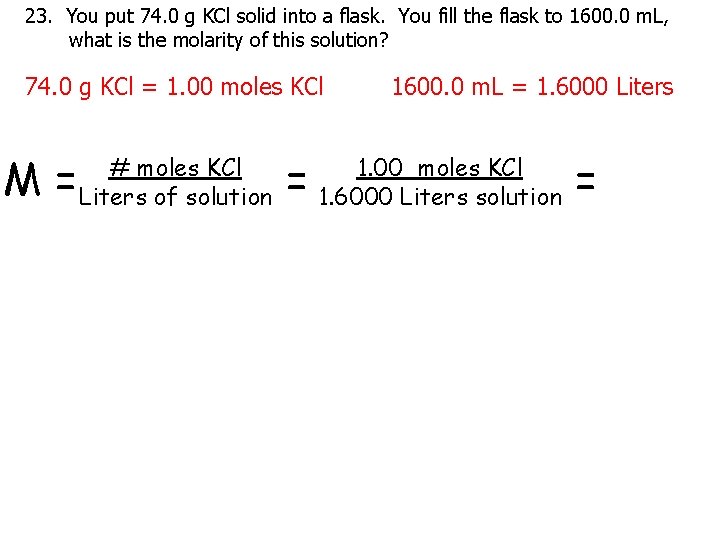
23. You put 74. 0 g KCl solid into a flask. You fill the flask to 1600. 0 m. L, what is the molarity of this solution? 74. 0 g KCl = 1. 00 moles KCl M= # moles KCl Liters of solution = 1600. 0 m. L = 1. 6000 Liters 1. 00 moles KCl 1. 6000 Liters solution =
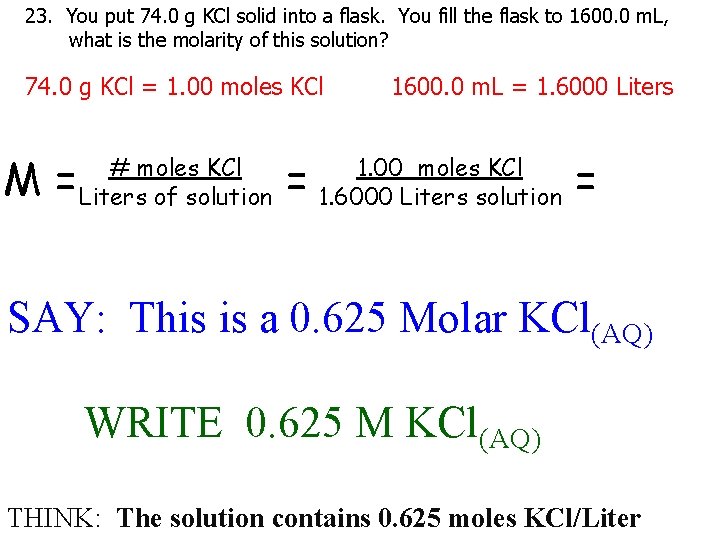
23. You put 74. 0 g KCl solid into a flask. You fill the flask to 1600. 0 m. L, what is the molarity of this solution? 74. 0 g KCl = 1. 00 moles KCl M= # moles KCl Liters of solution = 1600. 0 m. L = 1. 6000 Liters 1. 00 moles KCl 1. 6000 Liters solution = SAY: This is a 0. 625 Molar KCl(AQ) WRITE 0. 625 M KCl(AQ) THINK: The solution contains 0. 625 moles KCl/Liter

Read the Solutions BASICS tonight. Really, it’s your job to read and to think. It’s 4 th quarter, let’s ALL try to be excellent students starting from now on.
24. Calculate the molarity of a 750. m. L KCl(AQ) solution containing 148 g KCl. Write a formula or else go directly to jail, do not pass GO!, do not collect $200 Please get a calculator out now
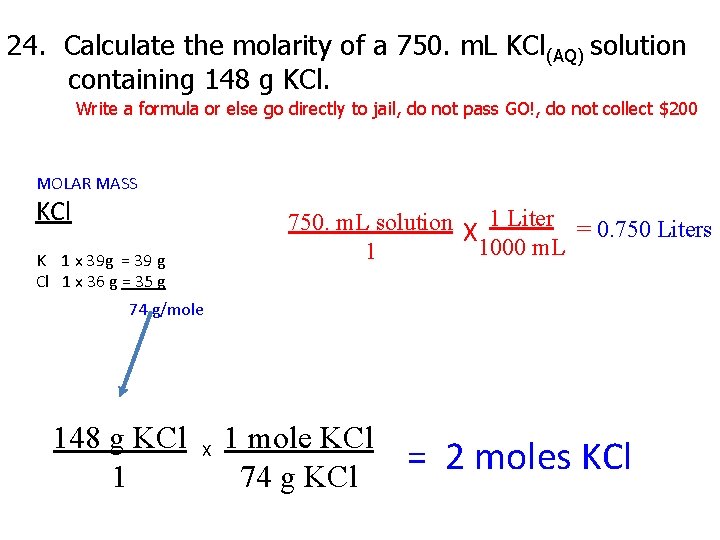
24. Calculate the molarity of a 750. m. L KCl(AQ) solution containing 148 g KCl. Write a formula or else go directly to jail, do not pass GO!, do not collect $200 MOLAR MASS KCl 750. m. L solution X 1 Liter = 0. 750 Liters 1000 m. L 1 K 1 x 39 g = 39 g Cl 1 x 36 g = 35 g 74 g/mole 148 g KCl 1 X 1 mole KCl 74 g KCl = 2 moles KCl
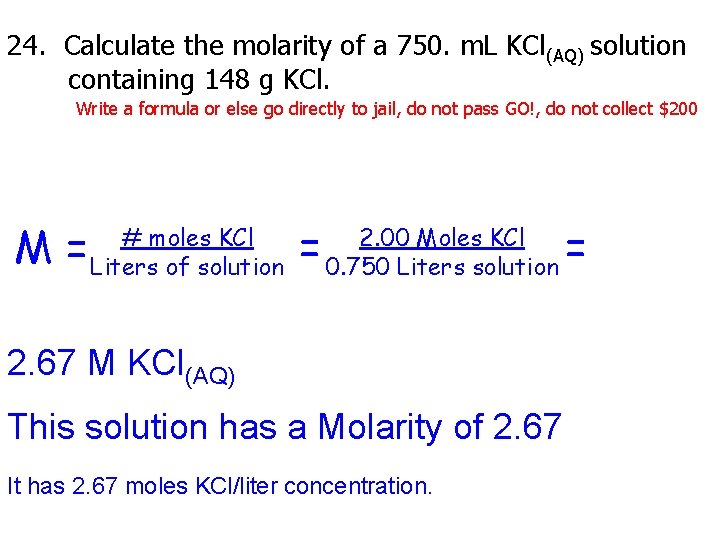
24. Calculate the molarity of a 750. m. L KCl(AQ) solution containing 148 g KCl. Write a formula or else go directly to jail, do not pass GO!, do not collect $200 M= # moles KCl Liters of solution = 2. 00 Moles KCl 0. 750 Liters solution 2. 67 M KCl(AQ) This solution has a Molarity of 2. 67 It has 2. 67 moles KCl/liter concentration. =
Let’s totally change gears now. We have a table called the SOLUBILITY CURVES at STP In the reference tables, it’s Table G (for Garbarini!)
Read the graph How many grams of sodium nitrate are in a 100 m. L aqueous solution that is saturated at 10°C? Find Na. NO 3 curve. Find 10°C. Slide Upwards until you find their meeting point. (80 grams)
25. How many grams of Na. NO 3 fit into 325 m. L of water at 10°C? 80 g in 100 m. L
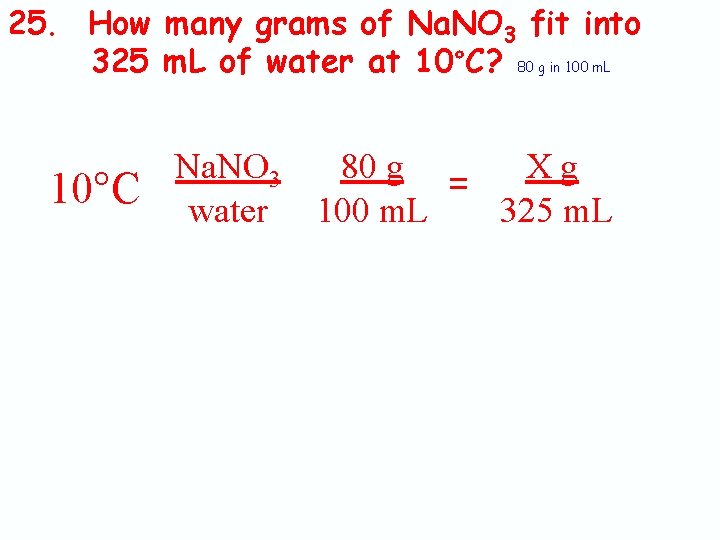
25. How many grams of Na. NO 3 fit into 325 m. L of water at 10°C? 80 g in 100 m. L 10°C Na. NO 3 80 g = Xg water 100 m. L 325 m. L
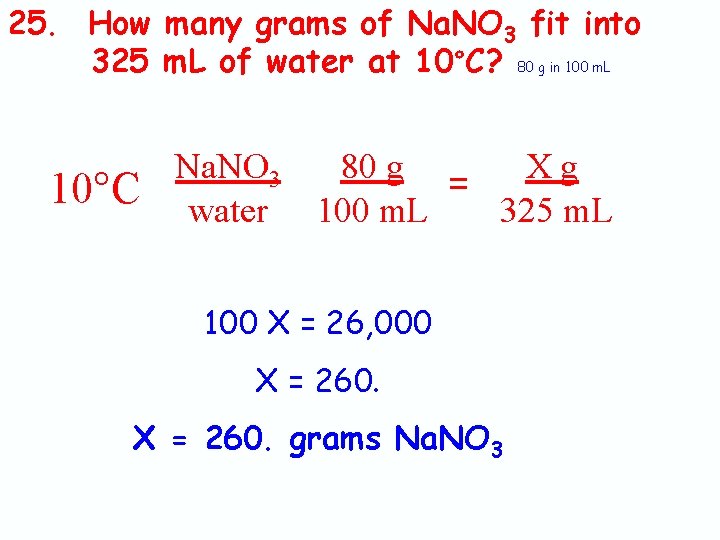
25. How many grams of Na. NO 3 fit into 325 m. L of water at 10°C? 80 g in 100 m. L 10°C Na. NO 3 80 g = Xg water 100 m. L 325 m. L 100 X = 26, 000 X = 260. grams Na. NO 3
26. How do we calculate MOLARITY of this solution of 260. g Na. NO 3 in 325 m. L?
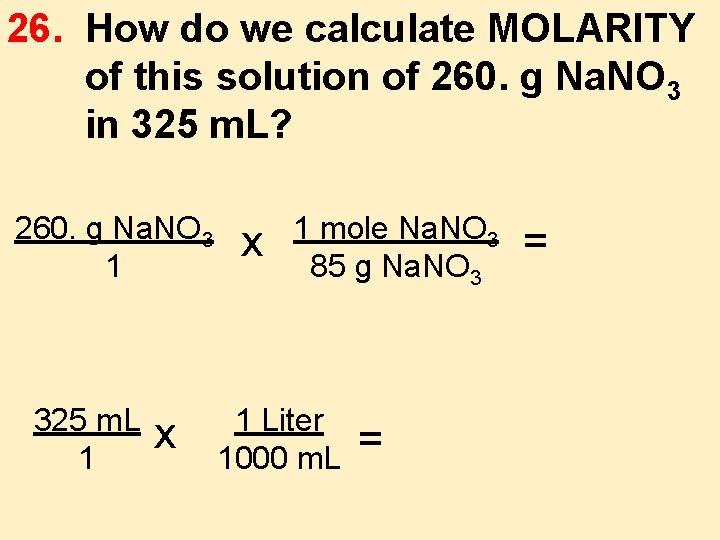
26. How do we calculate MOLARITY of this solution of 260. g Na. NO 3 in 325 m. L? 260. g Na. NO 3 1 325 m. L 1 x x 1 mole Na. NO 3 85 g Na. NO 3 1 Liter 1000 m. L = =
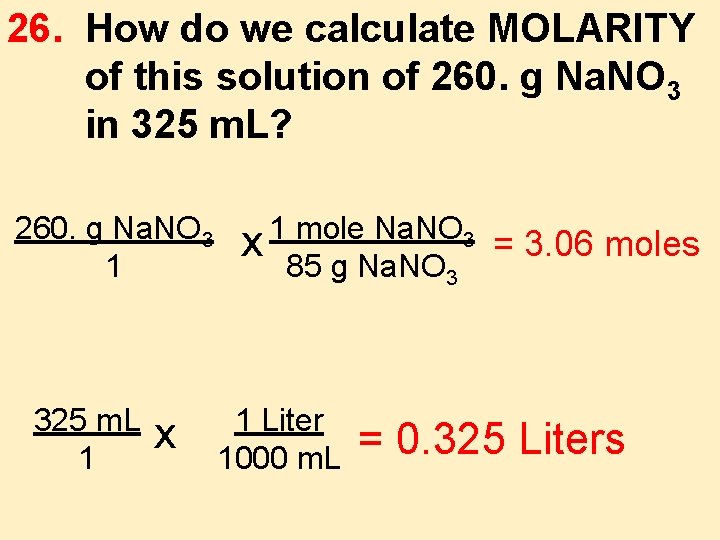
26. How do we calculate MOLARITY of this solution of 260. g Na. NO 3 in 325 m. L? 260. g Na. NO 3 1 325 m. L 1 x 1 mole Na. NO 3 x 85 g Na. NO = 3. 06 moles 3 1 Liter 1000 m. L = 0. 325 Liters
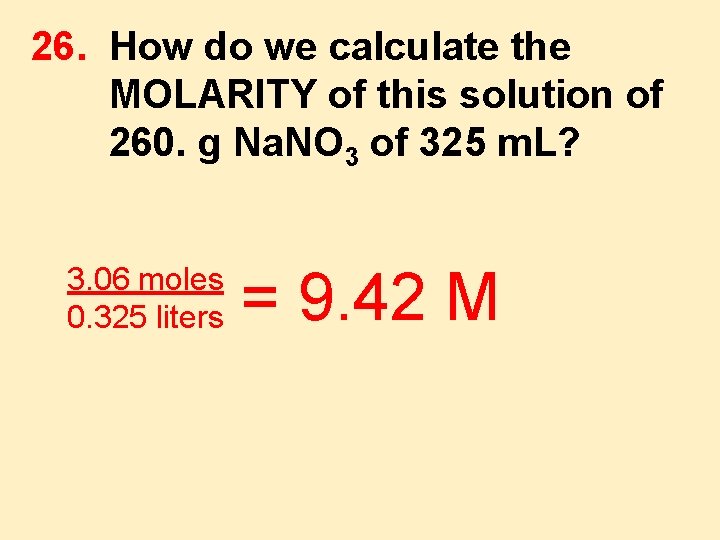
26. How do we calculate the MOLARITY of this solution of 260. g Na. NO 3 of 325 m. L? 3. 06 moles 0. 325 liters = 9. 42 M
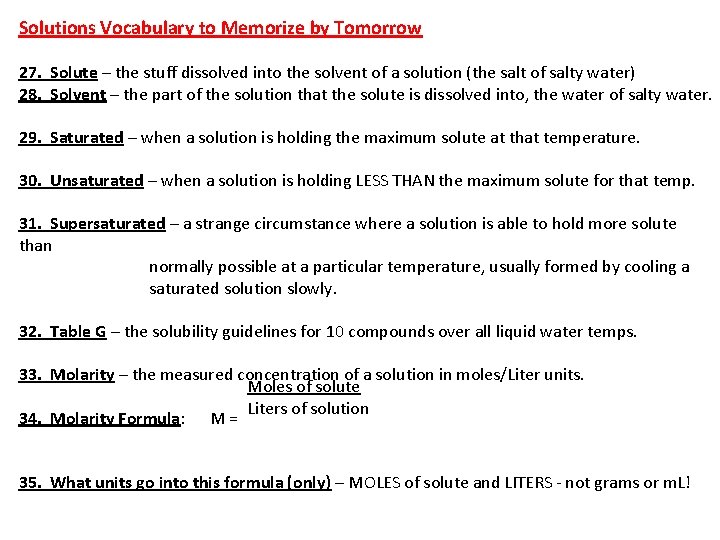
Solutions Vocabulary to Memorize by Tomorrow 27. Solute – the stuff dissolved into the solvent of a solution (the salt of salty water) 28. Solvent – the part of the solution that the solute is dissolved into, the water of salty water. 29. Saturated – when a solution is holding the maximum solute at that temperature. 30. Unsaturated – when a solution is holding LESS THAN the maximum solute for that temp. 31. Supersaturated – a strange circumstance where a solution is able to hold more solute than normally possible at a particular temperature, usually formed by cooling a saturated solution slowly. 32. Table G – the solubility guidelines for 10 compounds over all liquid water temps. 33. Molarity – the measured concentration of a solution in moles/Liter units. Moles of solute Liters of solution 34. Molarity Formula: M = 35. What units go into this formula (only) – MOLES of solute and LITERS - not grams or m. L!
Solutions Class #2 Objective: More practice with solution concentration, different molarity problems; how to make a solution properly (and wrong!), and then – how to make a new solution from a solution that you have in the stock room on a shelf.
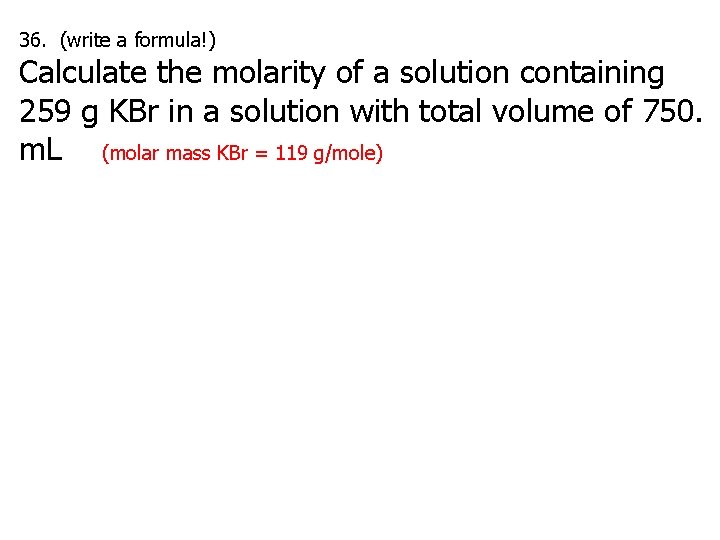
36. (write a formula!) Calculate the molarity of a solution containing 259 g KBr in a solution with total volume of 750. m. L (molar mass KBr = 119 g/mole)
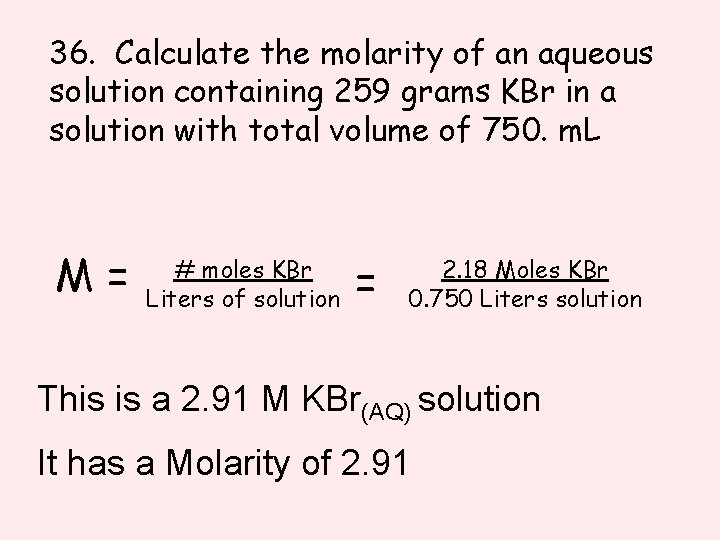
36. Calculate the molarity of an aqueous solution containing 259 grams KBr in a solution with total volume of 750. m. L M= # moles KBr Liters of solution = 2. 18 Moles KBr 0. 750 Liters solution This is a 2. 91 M KBr(AQ) solution It has a Molarity of 2. 91
37. How many grams of sodium chloride are in an 885 m. L aqueous solution that is saturated at 90°C?
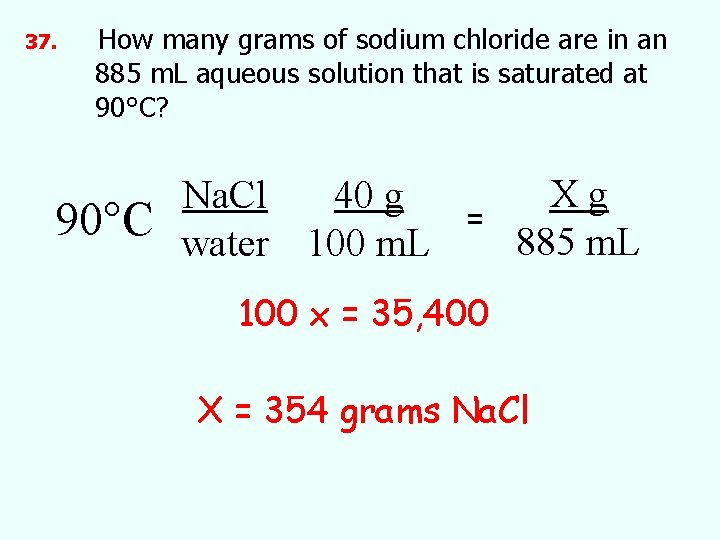
37. How many grams of sodium chloride are in an 885 m. L aqueous solution that is saturated at 90°C? 90°C Xg Na. Cl 40 g = 885 m. L water 100 m. L 100 x = 35, 400 X = 354 grams Na. Cl
38. What’s the molarity of this saturated solution of Na. Cl(AQ) ? (First convert these 354 grams of Na. Cl into moles)
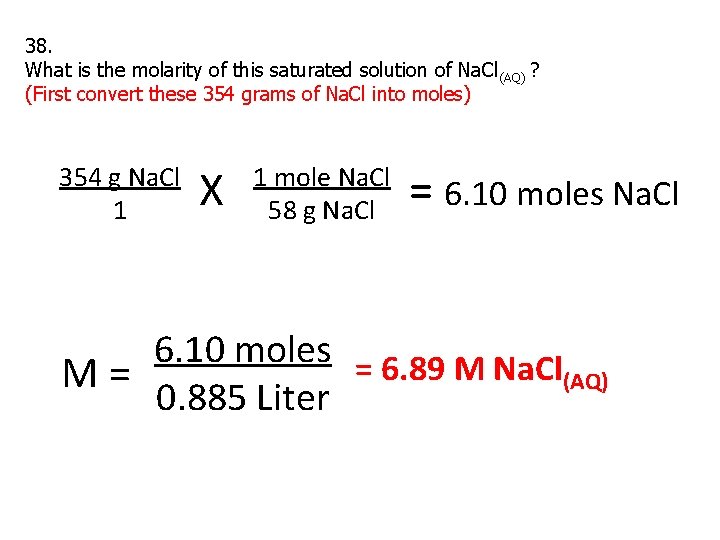
38. What is the molarity of this saturated solution of Na. Cl (AQ) ? (First convert these 354 grams of Na. Cl into moles) 354 g Na. Cl 1 X 1 mole Na. Cl 58 g Na. Cl = 6. 10 moles Na. Cl 6. 10 moles = 6. 89 M Na. Cl M= (AQ) 0. 885 Liter
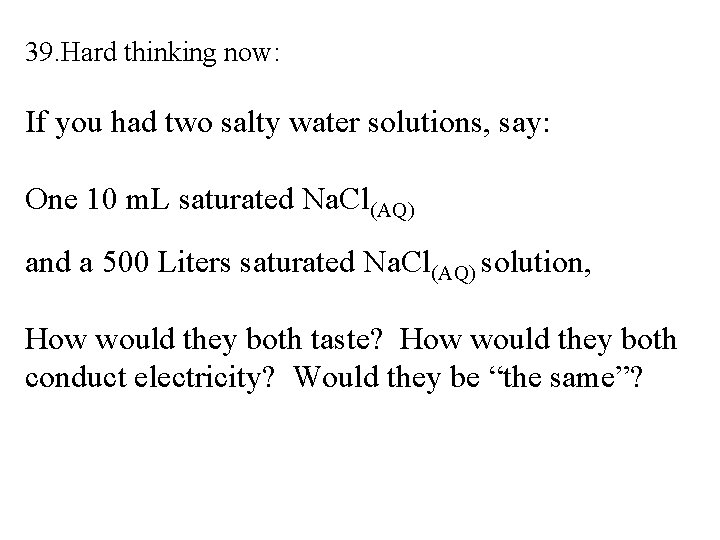
39. Hard thinking now: If you had two salty water solutions, say: One 10 m. L saturated Na. Cl(AQ) and a 500 Liters saturated Na. Cl(AQ) solution, How would they both taste? How would they both conduct electricity? Would they be “the same”?
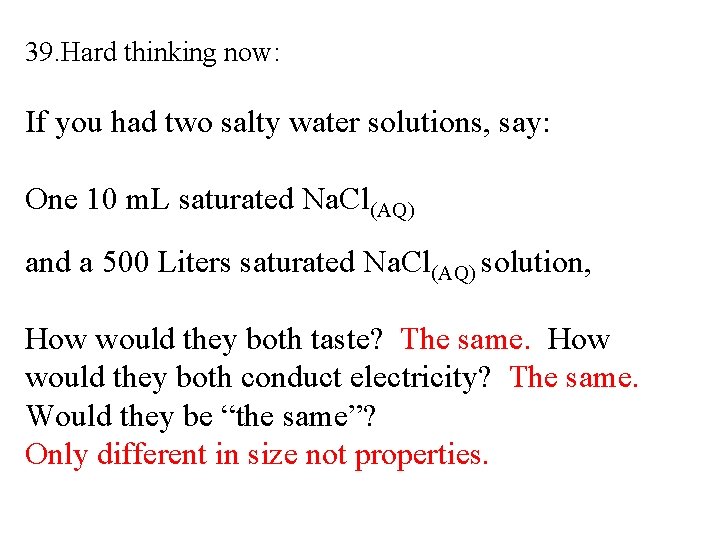
39. Hard thinking now: If you had two salty water solutions, say: One 10 m. L saturated Na. Cl(AQ) and a 500 Liters saturated Na. Cl(AQ) solution, How would they both taste? The same. How would they both conduct electricity? The same. Would they be “the same”? Only different in size not properties.
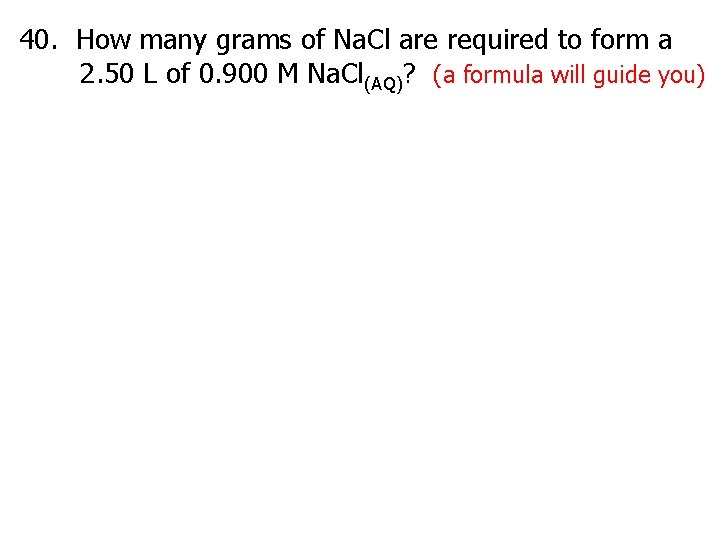
40. How many grams of Na. Cl are required to form a 2. 50 L of 0. 900 M Na. Cl(AQ)? (a formula will guide you)
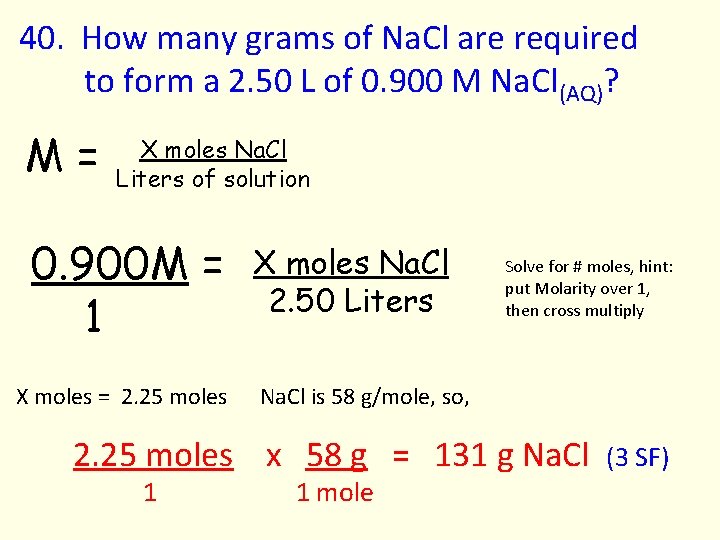
40. How many grams of Na. Cl are required to form a 2. 50 L of 0. 900 M Na. Cl(AQ)? M= X moles Na. Cl Liters of solution 0. 900 M = 1 X moles = 2. 25 moles X moles Na. Cl 2. 50 Liters Solve for # moles, hint: put Molarity over 1, then cross multiply Na. Cl is 58 g/mole, so, 2. 25 moles x 58 g = 131 g Na. Cl 1 1 mole (3 SF)
41. Calculate the grams of KOH required to make a 3. 20 Liter solution of KOH(AQ) with a 1. 20 M concentration. (always write a formula)
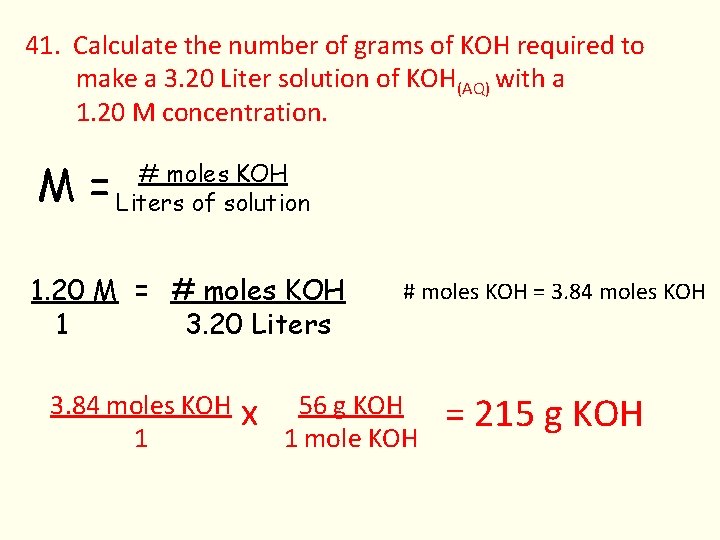
41. Calculate the number of grams of KOH required to make a 3. 20 Liter solution of KOH(AQ) with a 1. 20 M concentration. M= # moles KOH Liters of solution 1. 20 M = # moles KOH 1 3. 20 Liters 3. 84 moles KOH 1 x # moles KOH = 3. 84 moles KOH 56 g KOH 1 mole KOH = 215 g KOH
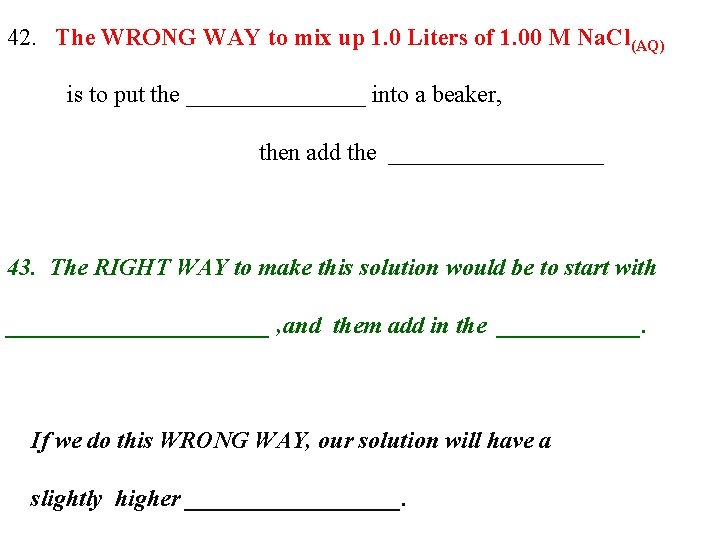
42. The WRONG WAY to mix up 1. 0 Liters of 1. 00 M Na. Cl(AQ) is to put the ________ into a beaker, then add the _________ 43. The RIGHT WAY to make this solution would be to start with ___________ , and them add in the ______. If we do this WRONG WAY, our solution will have a slightly higher _________.
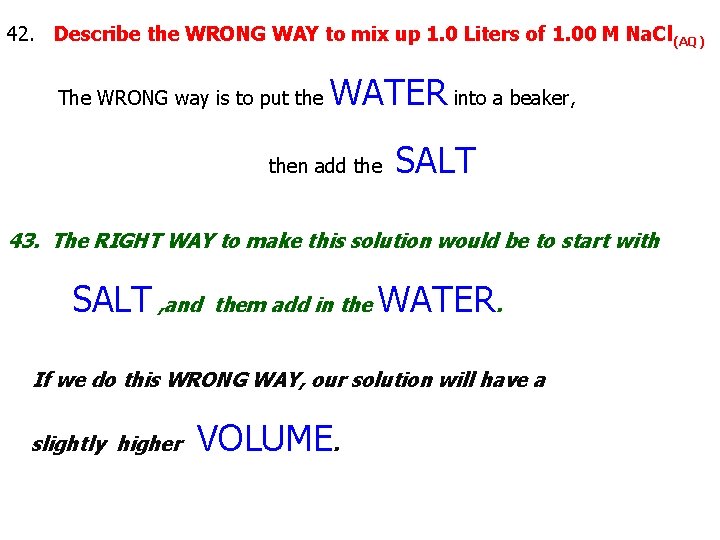
42. Describe the WRONG WAY to mix up 1. 0 Liters of 1. 00 M Na. Cl (AQ) The WRONG way is to put the WATER into a beaker, then add the SALT 43. The RIGHT WAY to make this solution would be to start with SALT , and them add in the WATER. If we do this WRONG WAY, our solution will have a slightly higher VOLUME.
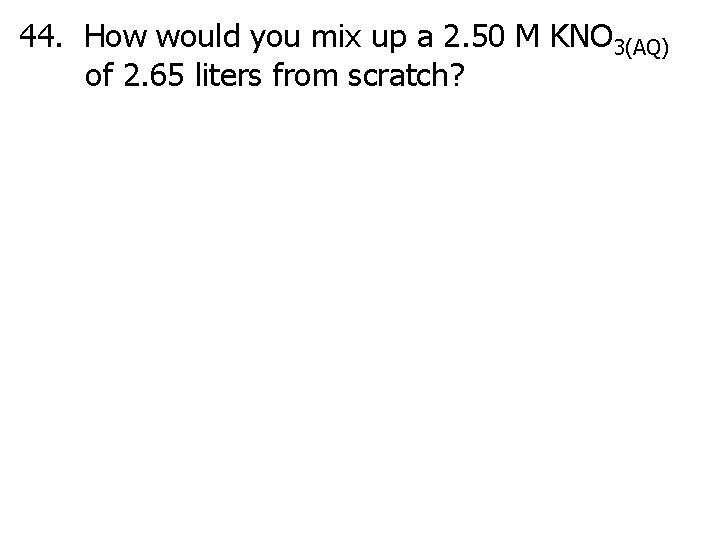
44. How would you mix up a 2. 50 M KNO 3(AQ) of 2. 65 liters from scratch?
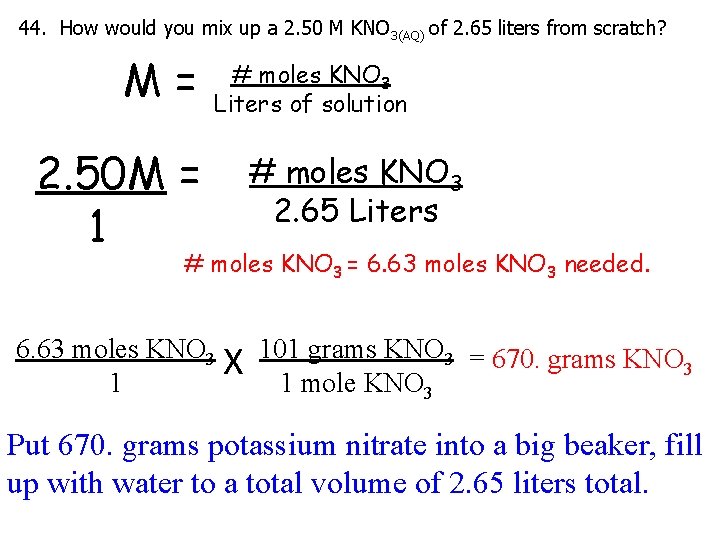
44. How would you mix up a 2. 50 M KNO 3(AQ) of 2. 65 liters from scratch? M= 2. 50 M = 1 # moles KNO 3 Liters of solution # moles KNO 3 2. 65 Liters # moles KNO 3 = 6. 63 moles KNO 3 needed. 6. 63 moles KNO 3 101 grams KNO 3 = 670. grams KNO X 3 1 1 mole KNO 3 Put 670. grams potassium nitrate into a big beaker, fill up with water to a total volume of 2. 65 liters total.
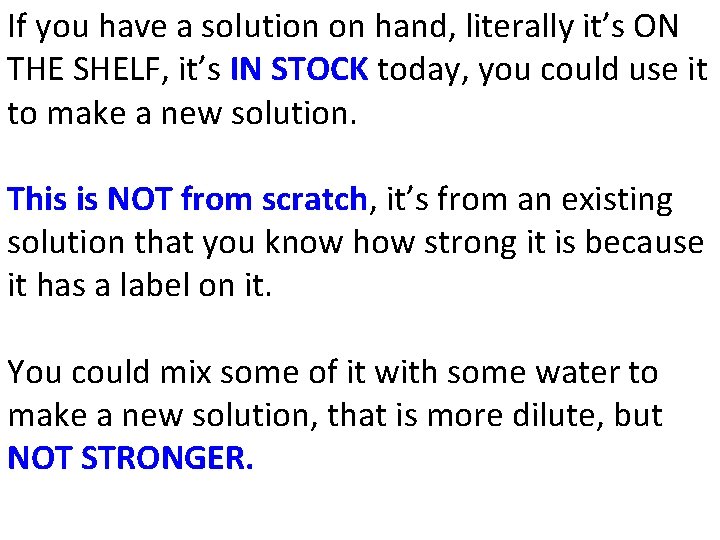
If you have a solution on hand, literally it’s ON THE SHELF, it’s IN STOCK today, you could use it to make a new solution. This is NOT from scratch, it’s from an existing solution that you know how strong it is because it has a label on it. You could mix some of it with some water to make a new solution, that is more dilute, but NOT STRONGER.
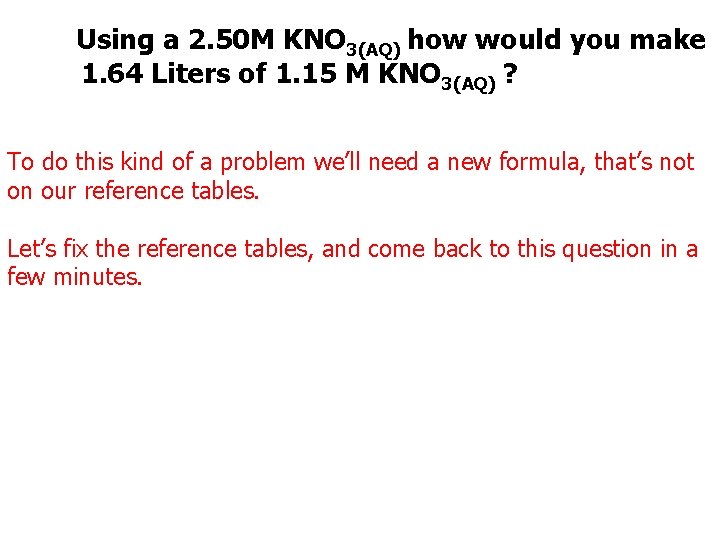
Using a 2. 50 M KNO 3(AQ) how would you make 1. 64 Liters of 1. 15 M KNO 3(AQ) ? To do this kind of a problem we’ll need a new formula, that’s not on our reference tables. Let’s fix the reference tables, and come back to this question in a few minutes.
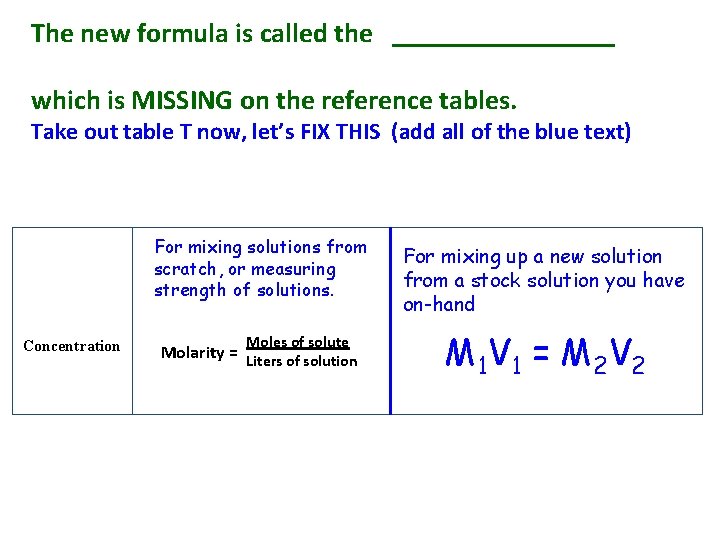
The new formula is called the ________ which is MISSING on the reference tables. Take out table T now, let’s FIX THIS (add all of the blue text) For mixing solutions from scratch, or measuring strength of solutions. Concentration Moles of solute Molarity = Liters of solution For mixing up a new solution from a stock solution you have on-hand M 1 V 1 = M 2 V 2
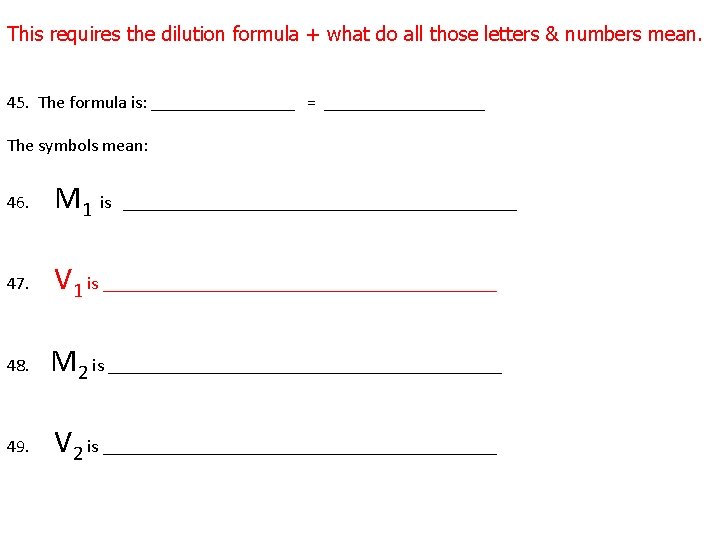
This requires the dilution formula + what do all those letters & numbers mean. 45. The formula is: ________ = _________ The symbols mean: 46. M 1 is 47. V 1 is ______________________ 48. M 2 is ______________________ 49. V 2 is ____________________________________________
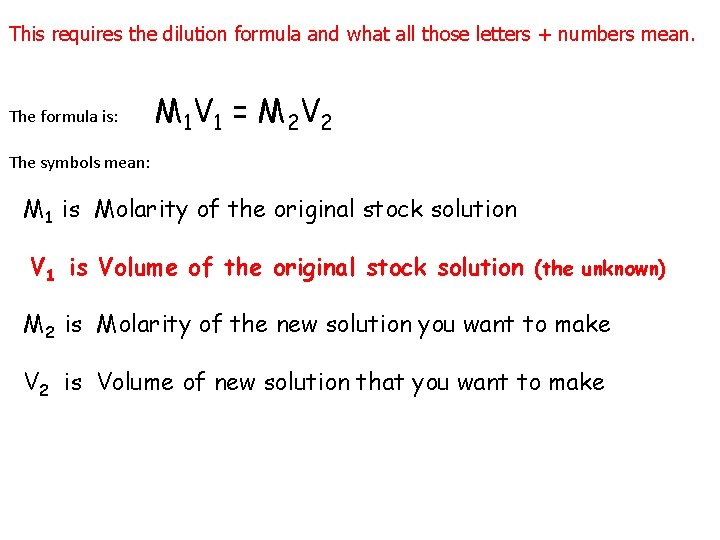
This requires the dilution formula and what all those letters + numbers mean. The formula is: M 1 V 1 = M 2 V 2 The symbols mean: M 1 is Molarity of the original stock solution V 1 is Volume of the original stock solution (the unknown) M 2 is Molarity of the new solution you want to make V 2 is Volume of new solution that you want to make
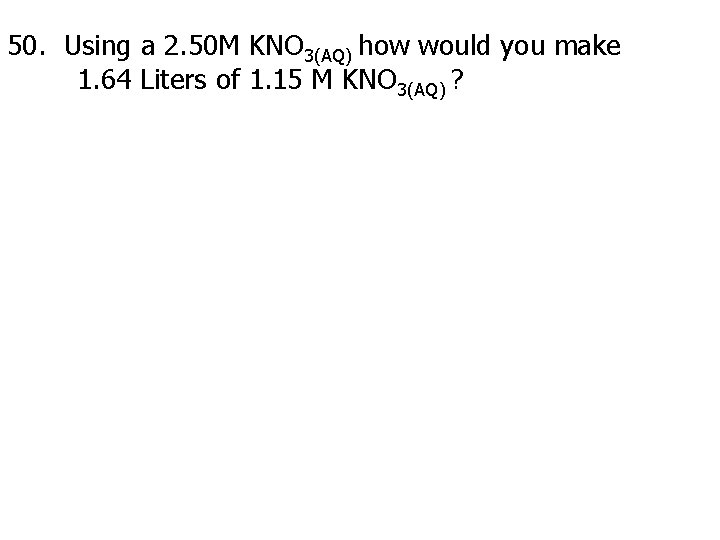
50. Using a 2. 50 M KNO 3(AQ) how would you make 1. 64 Liters of 1. 15 M KNO 3(AQ) ?
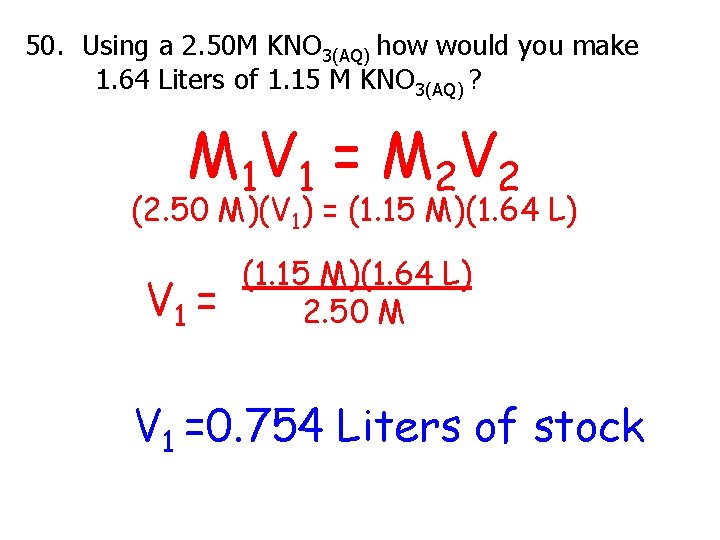
50. Using a 2. 50 M KNO 3(AQ) how would you make 1. 64 Liters of 1. 15 M KNO 3(AQ) ? M 1 V 1 = M 2 V 2 (2. 50 M)(V 1) = (1. 15 M)(1. 64 L) V 1 = (1. 15 M)(1. 64 L) 2. 50 M V 1 =0. 754 Liters of stock
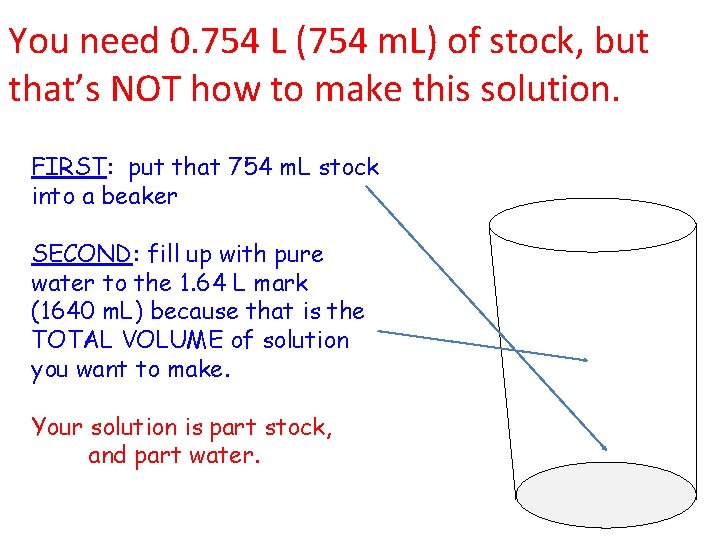
You need 0. 754 L (754 m. L) of stock, but that’s NOT how to make this solution. FIRST: put that 754 m. L stock into a beaker SECOND: fill up with pure water to the 1. 64 L mark (1640 m. L) because that is the TOTAL VOLUME of solution you want to make. Your solution is part stock, and part water.
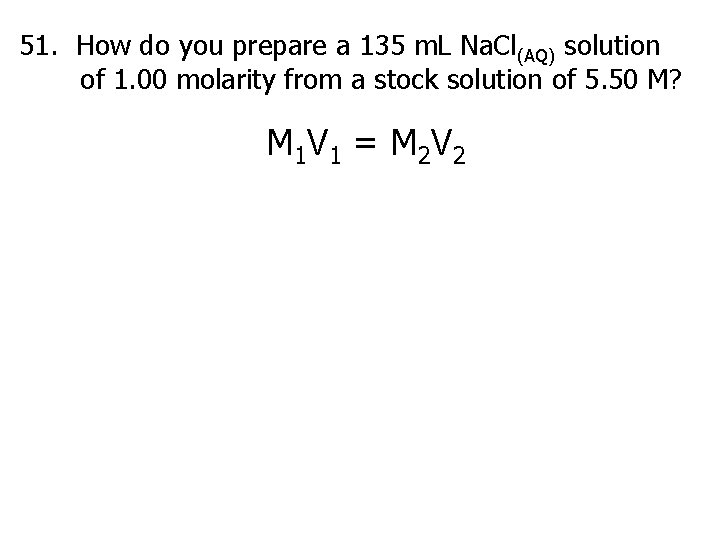
51. How do you prepare a 135 m. L Na. Cl(AQ) solution of 1. 00 molarity from a stock solution of 5. 50 M? M 1 V 1 = M 2 V 2
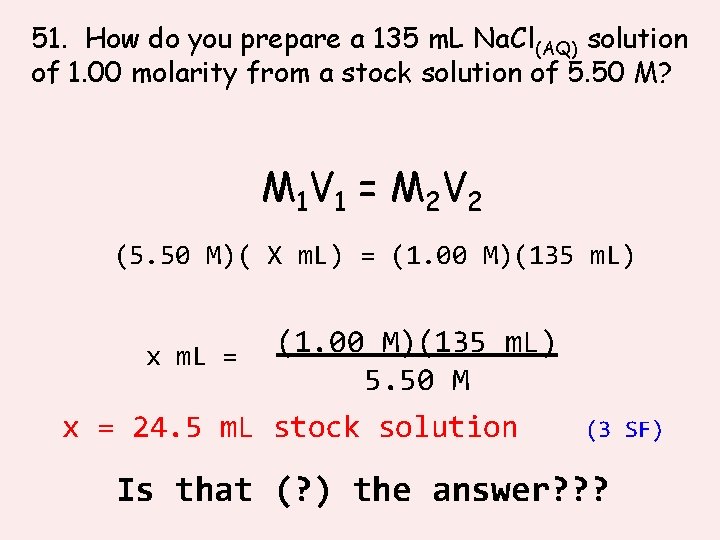
51. How do you prepare a 135 m. L Na. Cl(AQ) solution of 1. 00 molarity from a stock solution of 5. 50 M? M 1 V 1 = M 2 V 2 (5. 50 M)( X m. L) = (1. 00 M)(135 m. L) x m. L = 5. 50 M x = 24. 5 m. L stock solution (3 SF) Is that (? ) the answer? ? ?
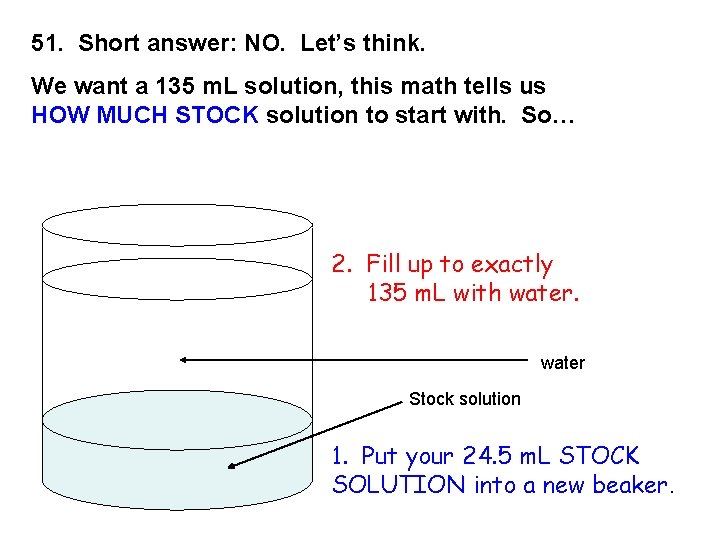
51. Short answer: NO. Let’s think. We want a 135 m. L solution, this math tells us HOW MUCH STOCK solution to start with. So… 2. Fill up to exactly 135 m. L with water Stock solution 1. Put your 24. 5 m. L STOCK SOLUTION into a new beaker.
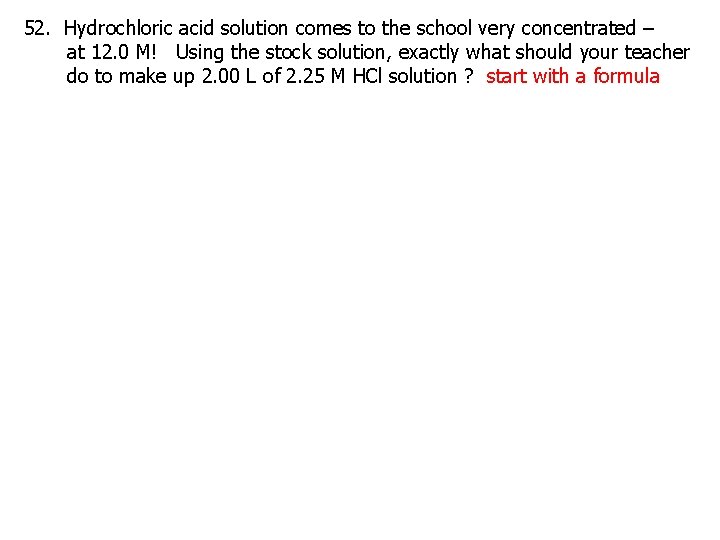
52. Hydrochloric acid solution comes to the school very concentrated – at 12. 0 M! Using the stock solution, exactly what should your teacher do to make up 2. 00 L of 2. 25 M HCl solution ? start with a formula
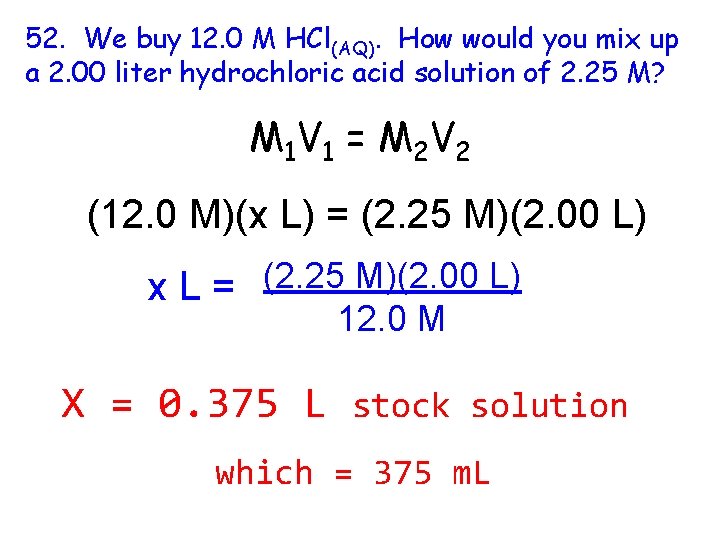
52. We buy 12. 0 M HCl(AQ). How would you mix up a 2. 00 liter hydrochloric acid solution of 2. 25 M? M 1 V 1 = M 2 V 2 (12. 0 M)(x L) = (2. 25 M)(2. 00 L) x L = (2. 25 M)(2. 00 L) 12. 0 M X = 0. 375 L stock solution which = 375 m. L
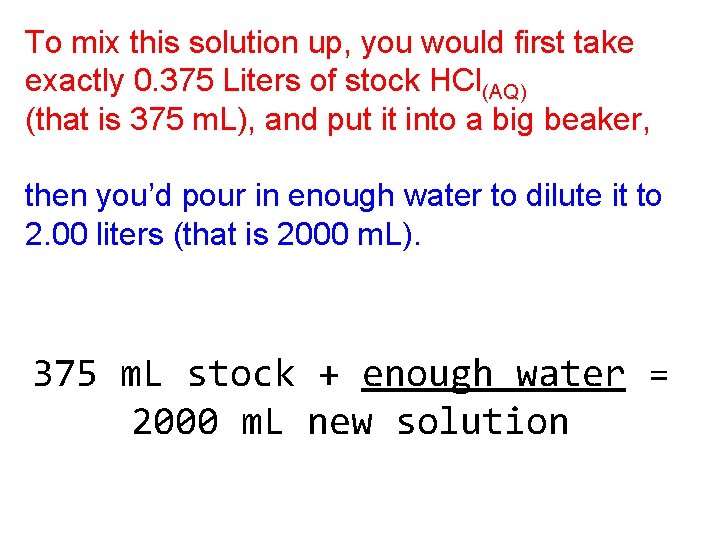
To mix this solution up, you would first take exactly 0. 375 Liters of stock HCl(AQ) (that is 375 m. L), and put it into a big beaker, then you’d pour in enough water to dilute it to 2. 00 liters (that is 2000 m. L). 375 m. L stock + enough water = 2000 m. L new solution
Solutions Class #3 Objective: Another way to measure low concentrations of very weak solutions called PARTS PER MILLION, + working with the 3 colligative properties of water
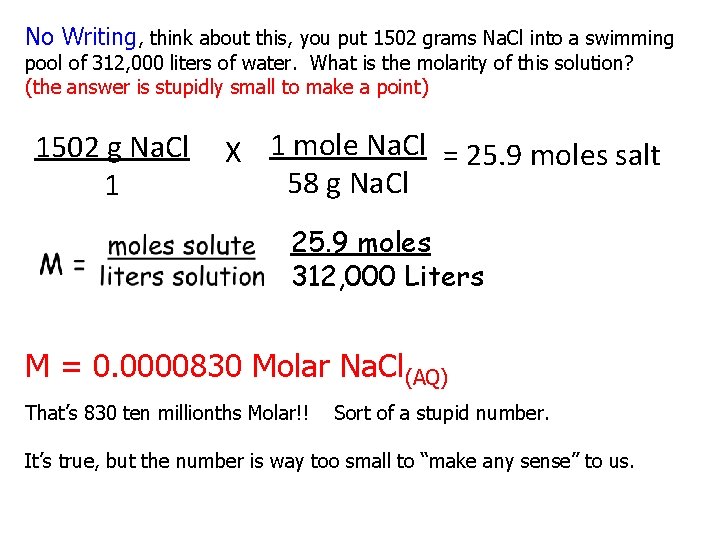
No Writing, think about this, you put 1502 grams Na. Cl into a swimming pool of 312, 000 liters of water. What is the molarity of this solution? (the answer is stupidly small to make a point) 1502 g Na. Cl 1 X 1 mole Na. Cl = 25. 9 moles salt 58 g Na. Cl 25. 9 moles 312, 000 Liters M = 0. 0000830 Molar Na. Cl(AQ) That’s 830 ten millionths Molar!! Sort of a stupid number. It’s true, but the number is way too small to “make any sense” to us.
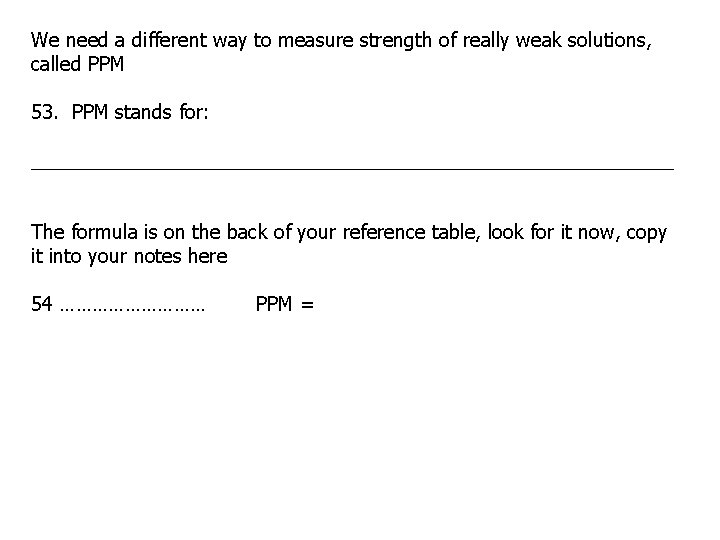
We need a different way to measure strength of really weak solutions, called PPM 53. PPM stands for: ______________________________ The formula is on the back of your reference table, look for it now, copy it into your notes here 54 …………… PPM =
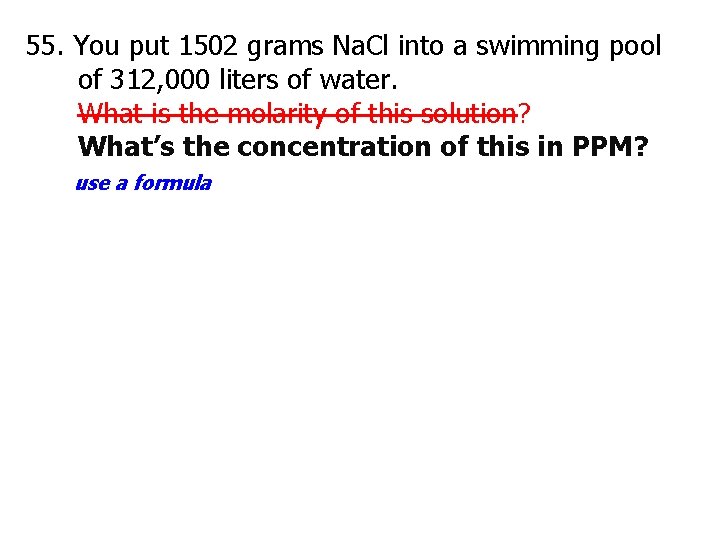
55. You put 1502 grams Na. Cl into a swimming pool of 312, 000 liters of water. What is the molarity of this solution? What’s the concentration of this in PPM? use a formula
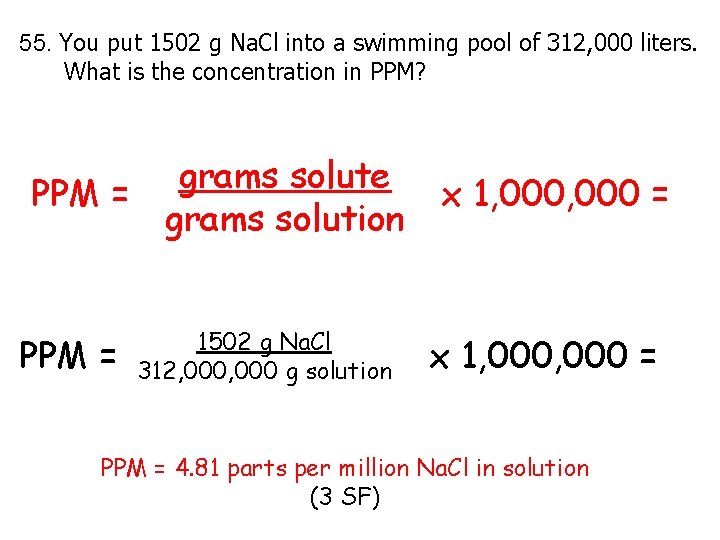
55. You put 1502 g Na. Cl into a swimming pool of 312, 000 liters. What is the concentration in PPM? grams solute PPM = x 1, 000 = grams solution PPM = 1502 g Na. Cl 312, 000 g solution x 1, 000 = PPM = 4. 81 parts per million Na. Cl in solution (3 SF)
56. PPM is used when molarity is silly small, but you need a measurement that you can easily grasp. 57. Sometimes low concentration environmental poisons are measured this way. MOLARITY AND PPM are interchangeable, but we like to use “normal” numbers. We will do another problem later, try to remember this formula.
58. There are 3 properties of water that are called the colligative properties. 59. They are the properties that are affected by dissolving solutes into the solvent (IN OUR CLASS THAT’S WATER). All solutions will have colligative properties, but we will ONLY use water in our class The 3 colligative properties of water are: 60. ________________ 61. ________________ 62. ________________
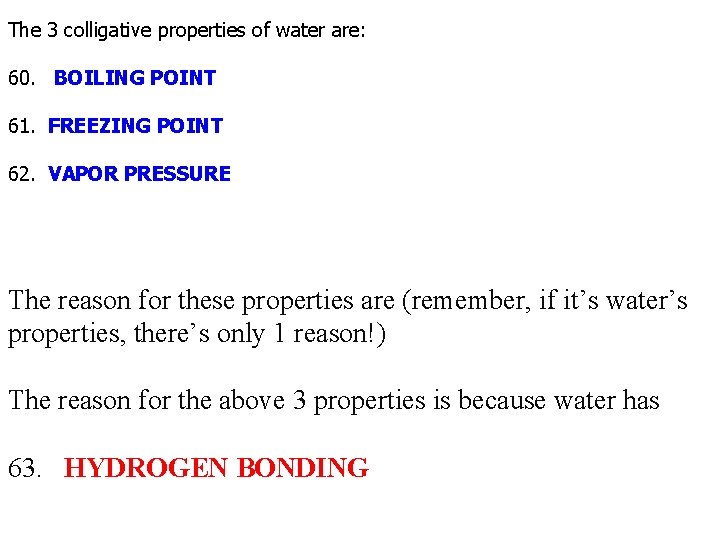
The 3 colligative properties of water are: 60. BOILING POINT 61. FREEZING POINT 62. VAPOR PRESSURE The reason for these properties are (remember, if it’s water’s properties, there’s only 1 reason!) The reason for the above 3 properties is because water has 63. HYDROGEN BONDING
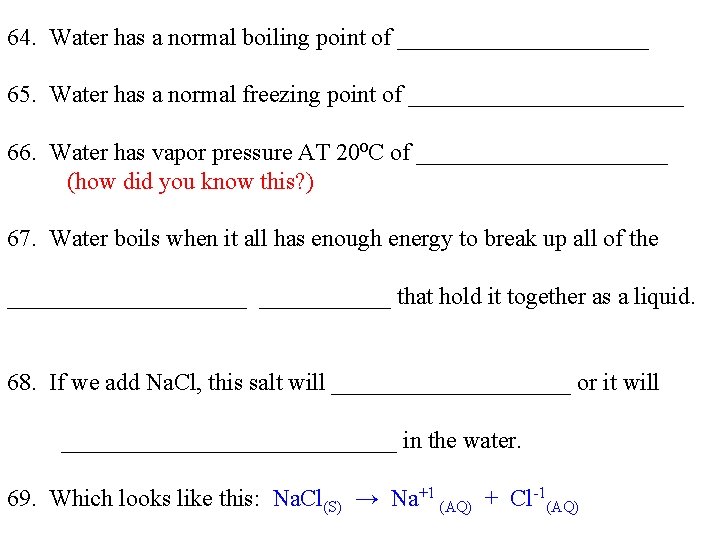
64. Water has a normal boiling point of ___________ 65. Water has a normal freezing point of ____________ 66. Water has vapor pressure AT 20⁰C of ___________ (how did you know this? ) 67. Water boils when it all has enough energy to break up all of the __________ that hold it together as a liquid. 68. If we add Na. Cl, this salt will __________ or it will ______________ in the water. 69. Which looks like this: Na. Cl(S) → Na+1 (AQ) + Cl-1(AQ)
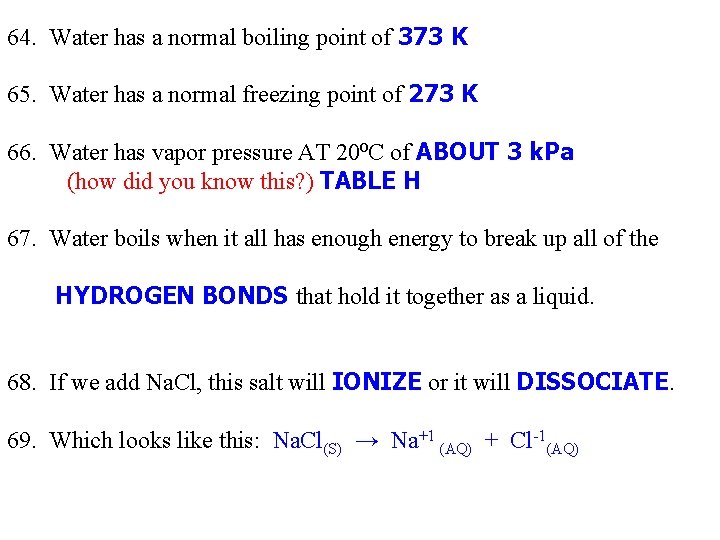
64. Water has a normal boiling point of 373 K 65. Water has a normal freezing point of 273 K 66. Water has vapor pressure AT 20⁰C of ABOUT 3 k. Pa (how did you know this? ) TABLE H 67. Water boils when it all has enough energy to break up all of the HYDROGEN BONDS that hold it together as a liquid. 68. If we add Na. Cl, this salt will IONIZE or it will DISSOCIATE. 69. Which looks like this: Na. Cl(S) → Na+1 (AQ) + Cl-1(AQ)
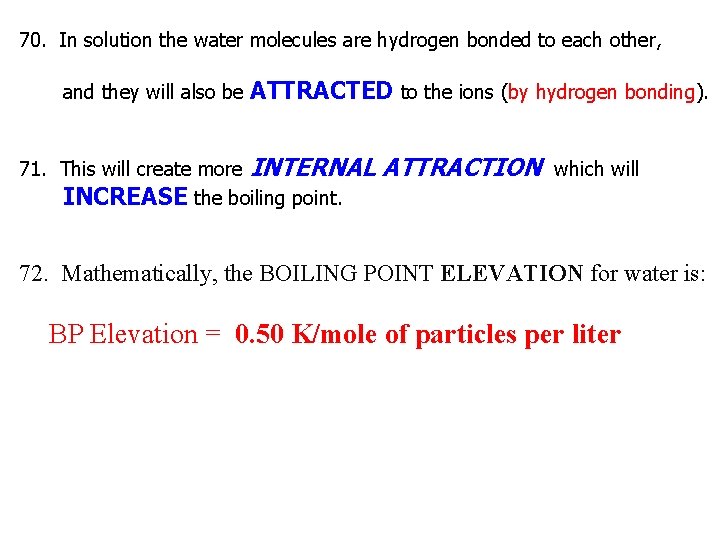
70. In solution the water molecules are hydrogen bonded to each other, and they will also be ATTRACTED to the ions (by hydrogen bonding). 71. This will create more INTERNAL INCREASE the boiling point. ATTRACTION which will 72. Mathematically, the BOILING POINT ELEVATION for water is: BP Elevation = 0. 50 K/mole of particles per liter
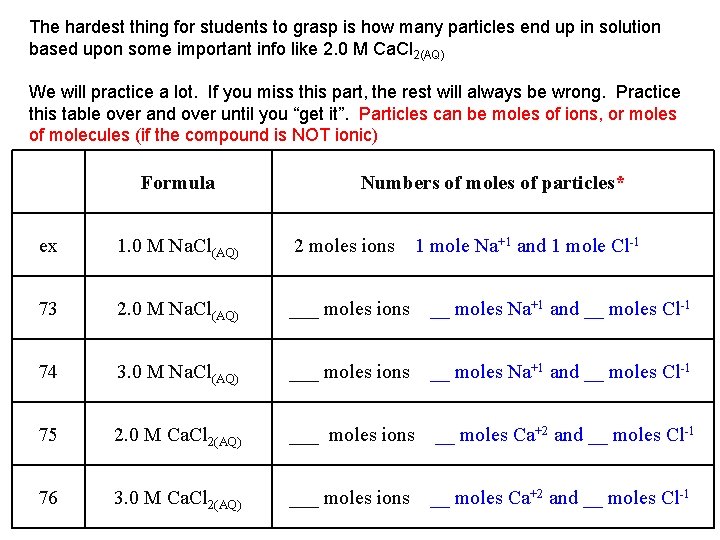
The hardest thing for students to grasp is how many particles end up in solution based upon some important info like 2. 0 M Ca. Cl 2(AQ) We will practice a lot. If you miss this part, the rest will always be wrong. Practice this table over and over until you “get it”. Particles can be moles of ions, or moles of molecules (if the compound is NOT ionic) Formula Numbers of moles of particles* ex 1. 0 M Na. Cl(AQ) 2 moles ions 1 mole Na+1 and 1 mole Cl-1 73 2. 0 M Na. Cl(AQ) ___ moles ions __ moles Na+1 and __ moles Cl-1 74 3. 0 M Na. Cl(AQ) ___ moles ions __ moles Na+1 and __ moles Cl-1 75 2. 0 M Ca. Cl 2(AQ) ___ moles ions __ moles Ca+2 and __ moles Cl-1 76 3. 0 M Ca. Cl 2(AQ) ___ moles ions __ moles Ca+2 and __ moles Cl-1
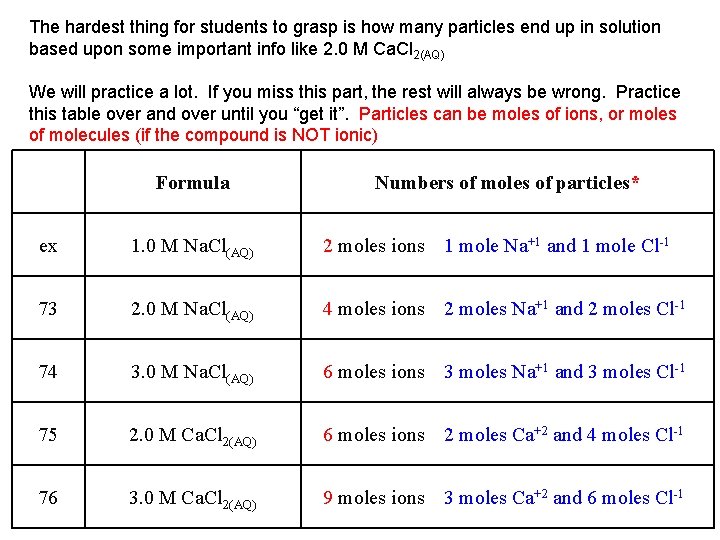
The hardest thing for students to grasp is how many particles end up in solution based upon some important info like 2. 0 M Ca. Cl 2(AQ) We will practice a lot. If you miss this part, the rest will always be wrong. Practice this table over and over until you “get it”. Particles can be moles of ions, or moles of molecules (if the compound is NOT ionic) Formula Numbers of moles of particles* ex 1. 0 M Na. Cl(AQ) 2 moles ions 1 mole Na+1 and 1 mole Cl-1 73 2. 0 M Na. Cl(AQ) 4 moles ions 2 moles Na+1 and 2 moles Cl-1 74 3. 0 M Na. Cl(AQ) 6 moles ions 3 moles Na+1 and 3 moles Cl-1 75 2. 0 M Ca. Cl 2(AQ) 6 moles ions 2 moles Ca+2 and 4 moles Cl-1 76 3. 0 M Ca. Cl 2(AQ) 9 moles ions 3 moles Ca+2 and 6 moles Cl-1
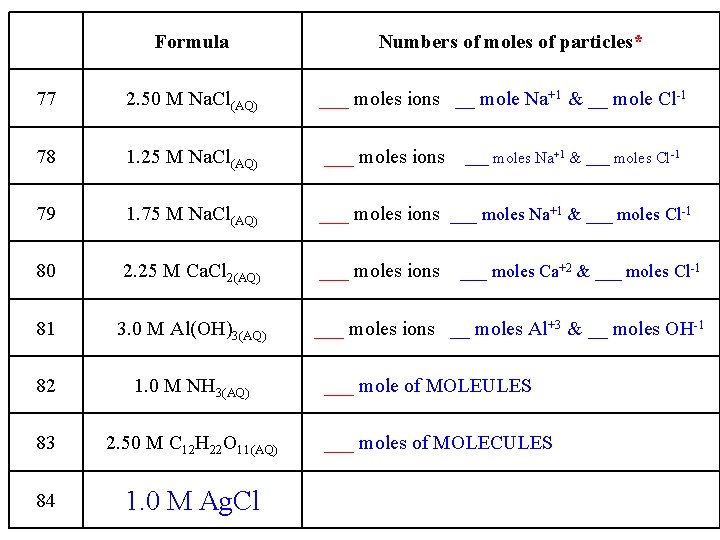
Formula Numbers of moles of particles* 77 2. 50 M Na. Cl(AQ) ___ moles ions __ mole Na+1 & __ mole Cl-1 78 1. 25 M Na. Cl(AQ) ___ moles ions 79 1. 75 M Na. Cl(AQ) ___ moles ions ___ moles Na+1 & ___ moles Cl-1 80 2. 25 M Ca. Cl 2(AQ) ___ moles ions 81 3. 0 M Al(OH)3(AQ) ___ moles ions __ moles Al+3 & __ moles OH-1 82 1. 0 M NH 3(AQ) 83 2. 50 M C 12 H 22 O 11(AQ) 84 1. 0 M Ag. Cl ___ moles Na+1 & ___ moles Cl-1 ___ moles Ca+2 & ___ moles Cl-1 ___ mole of MOLEULES ___ moles of MOLECULES
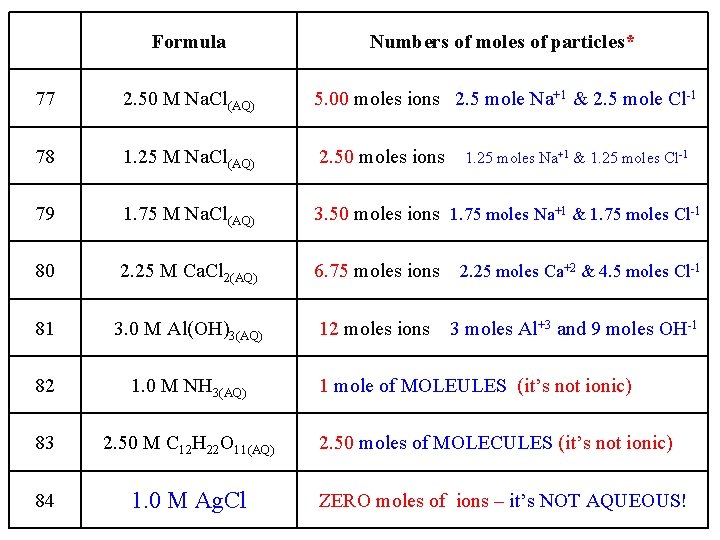
Formula Numbers of moles of particles* 77 2. 50 M Na. Cl(AQ) 5. 00 moles ions 2. 5 mole Na+1 & 2. 5 mole Cl-1 78 1. 25 M Na. Cl(AQ) 2. 50 moles ions 79 1. 75 M Na. Cl(AQ) 3. 50 moles ions 1. 75 moles Na+1 & 1. 75 moles Cl-1 80 2. 25 M Ca. Cl 2(AQ) 6. 75 moles ions 81 3. 0 M Al(OH)3(AQ) 12 moles ions 82 1. 0 M NH 3(AQ) 83 2. 50 M C 12 H 22 O 11(AQ) 84 1. 0 M Ag. Cl 1. 25 moles Na+1 & 1. 25 moles Cl-1 2. 25 moles Ca+2 & 4. 5 moles Cl-1 3 moles Al+3 and 9 moles OH-1 1 mole of MOLEULES (it’s not ionic) 2. 50 moles of MOLECULES (it’s not ionic) ZERO moles of ions – it’s NOT AQUEOUS!
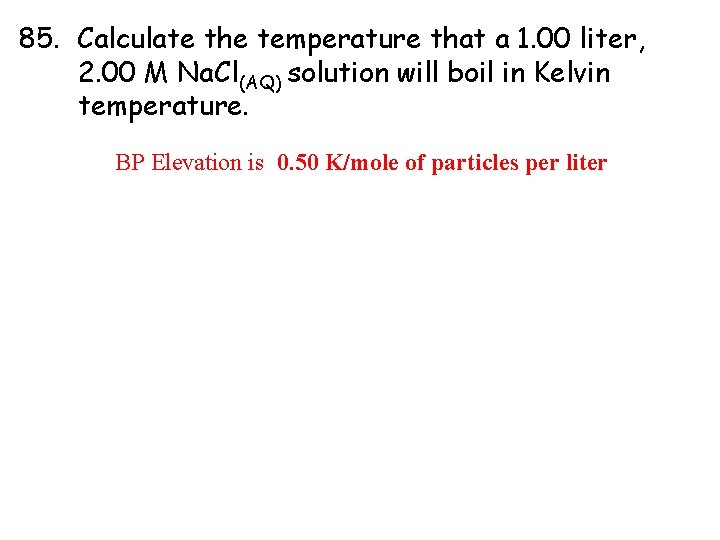
85. Calculate the temperature that a 1. 00 liter, 2. 00 M Na. Cl(AQ) solution will boil in Kelvin temperature. BP Elevation is 0. 50 K/mole of particles per liter
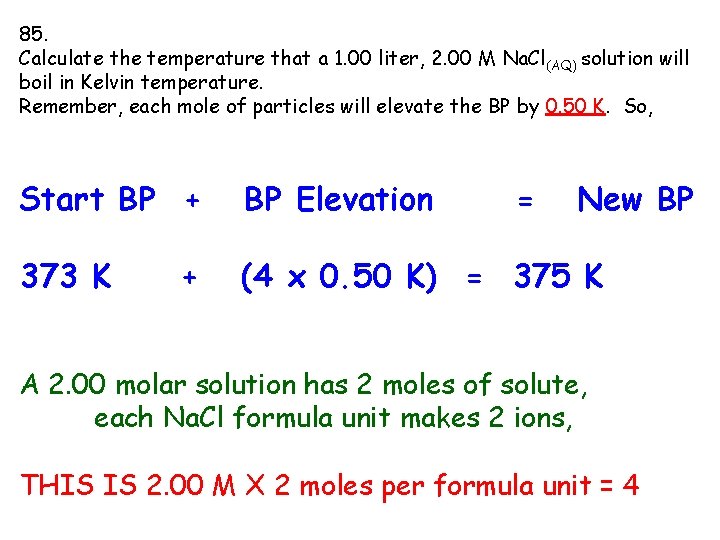
85. Calculate the temperature that a 1. 00 liter, 2. 00 M Na. Cl (AQ) solution will boil in Kelvin temperature. Remember, each mole of particles will elevate the BP by 0. 50 K. So, Start BP + BP Elevation 373 K (4 x 0. 50 K) = 375 K + = New BP A 2. 00 molar solution has 2 moles of solute, each Na. Cl formula unit makes 2 ions, THIS IS 2. 00 M X 2 moles per formula unit = 4
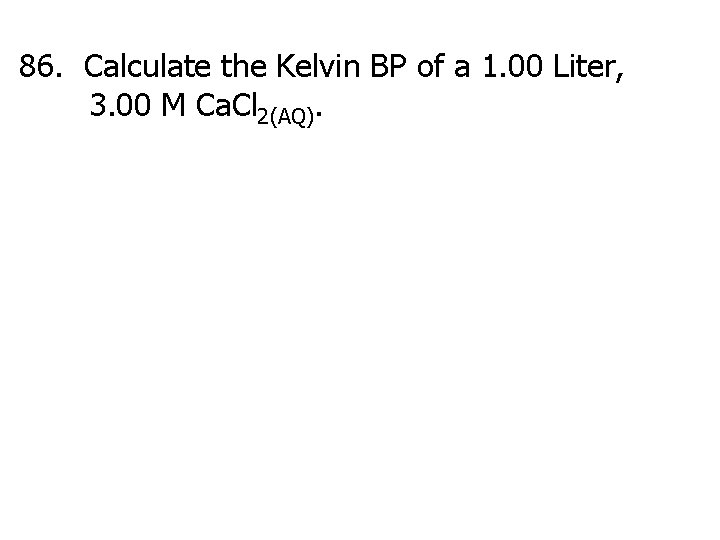
86. Calculate the Kelvin BP of a 1. 00 Liter, 3. 00 M Ca. Cl 2(AQ).
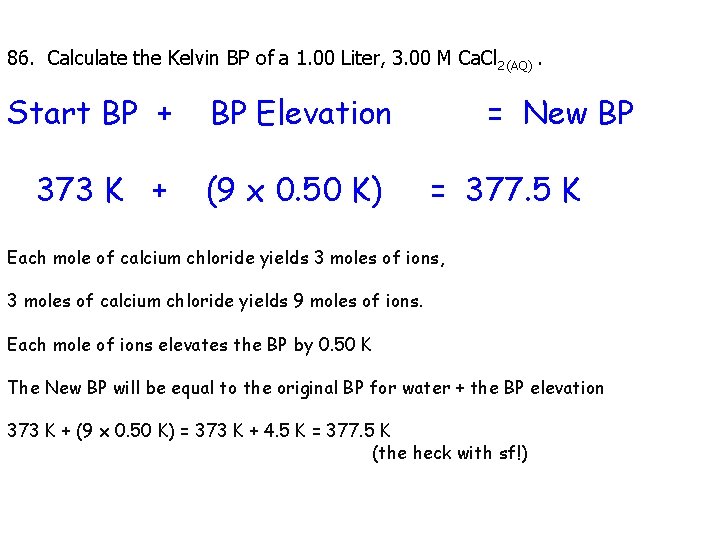
86. Calculate the Kelvin BP of a 1. 00 Liter, 3. 00 M Ca. Cl 2(AQ). Start BP + 373 K + BP Elevation (9 x 0. 50 K) = New BP = 377. 5 K Each mole of calcium chloride yields 3 moles of ions, 3 moles of calcium chloride yields 9 moles of ions. Each mole of ions elevates the BP by 0. 50 K The New BP will be equal to the original BP for water + the BP elevation 373 K + (9 x 0. 50 K) = 373 K + 4. 5 K = 377. 5 K (the heck with sf!)
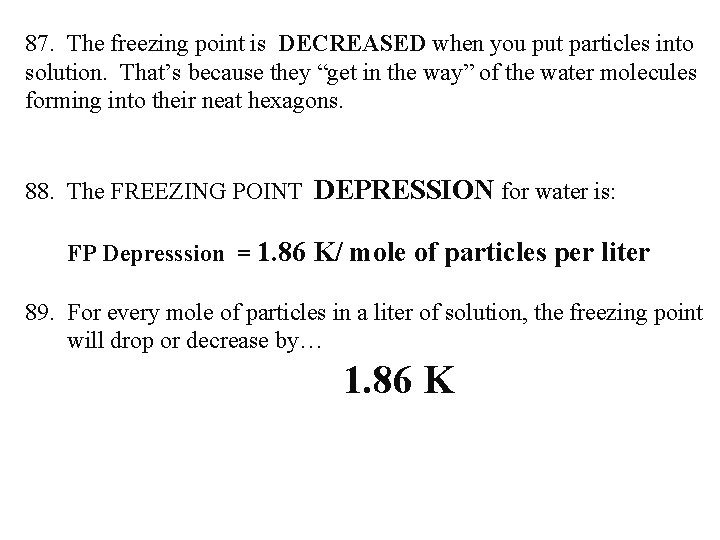
87. The freezing point is DECREASED when you put particles into solution. That’s because they “get in the way” of the water molecules forming into their neat hexagons. 88. The FREEZING POINT DEPRESSION for water is: FP Depresssion = 1. 86 K/ mole of particles per liter 89. For every mole of particles in a liter of solution, the freezing point will drop or decrease by… 1. 86 K
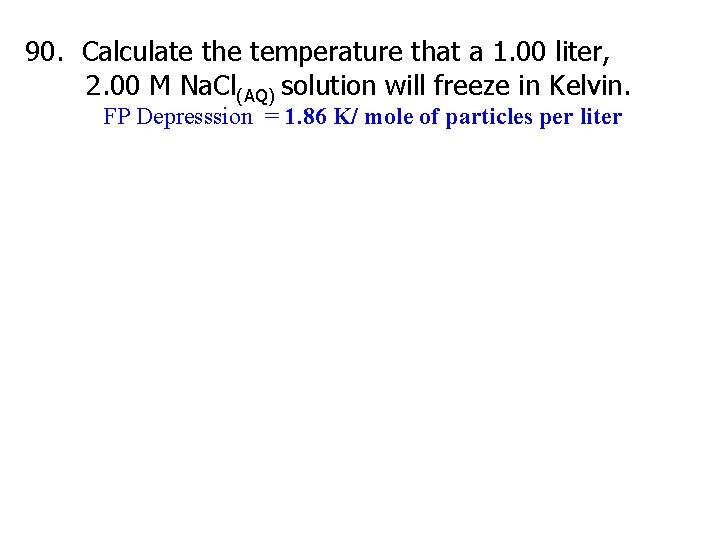
90. Calculate the temperature that a 1. 00 liter, 2. 00 M Na. Cl(AQ) solution will freeze in Kelvin. FP Depresssion = 1. 86 K/ mole of particles per liter
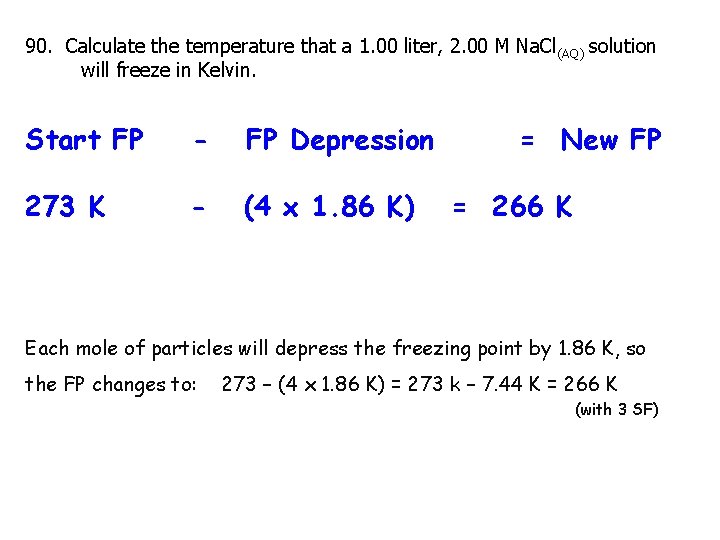
90. Calculate the temperature that a 1. 00 liter, 2. 00 M Na. Cl (AQ) solution will freeze in Kelvin. Start FP - FP Depression 273 K - (4 x 1. 86 K) = New FP = 266 K Each mole of particles will depress the freezing point by 1. 86 K, so the FP changes to: 273 – (4 x 1. 86 K) = 273 k – 7. 44 K = 266 K (with 3 SF)
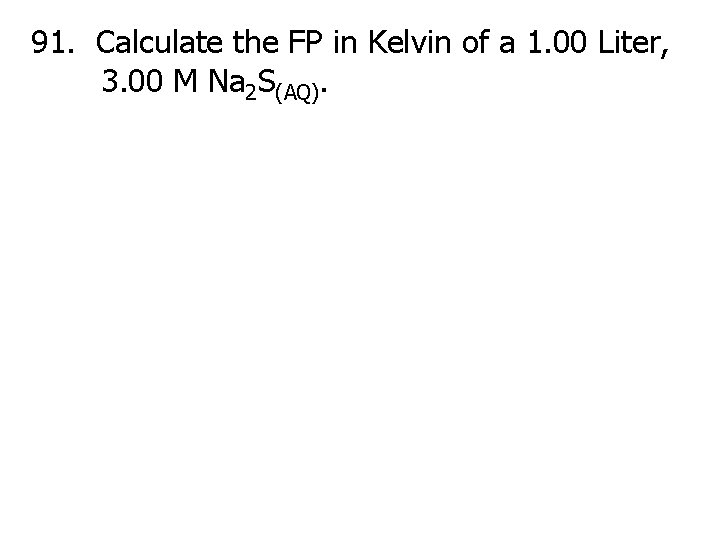
91. Calculate the FP in Kelvin of a 1. 00 Liter, 3. 00 M Na 2 S(AQ).
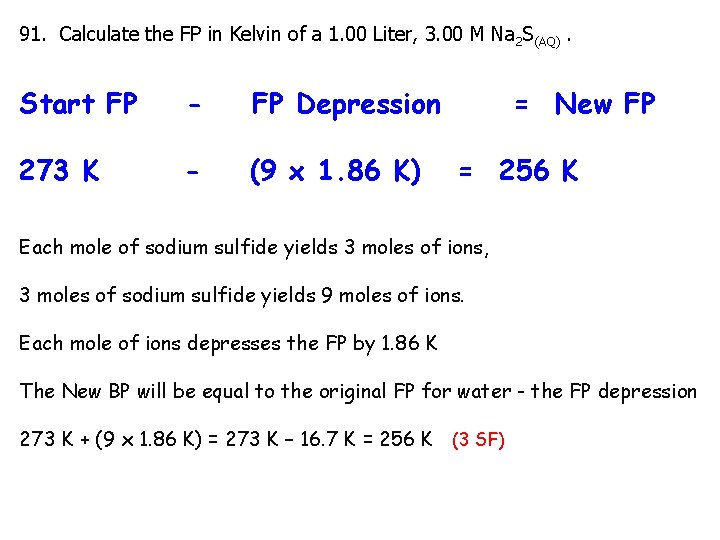
91. Calculate the FP in Kelvin of a 1. 00 Liter, 3. 00 M Na 2 S(AQ). Start FP - FP Depression 273 K - (9 x 1. 86 K) = New FP = 256 K Each mole of sodium sulfide yields 3 moles of ions, 3 moles of sodium sulfide yields 9 moles of ions. Each mole of ions depresses the FP by 1. 86 K The New BP will be equal to the original FP for water - the FP depression 273 K + (9 x 1. 86 K) = 273 K – 16. 7 K = 256 K (3 SF)
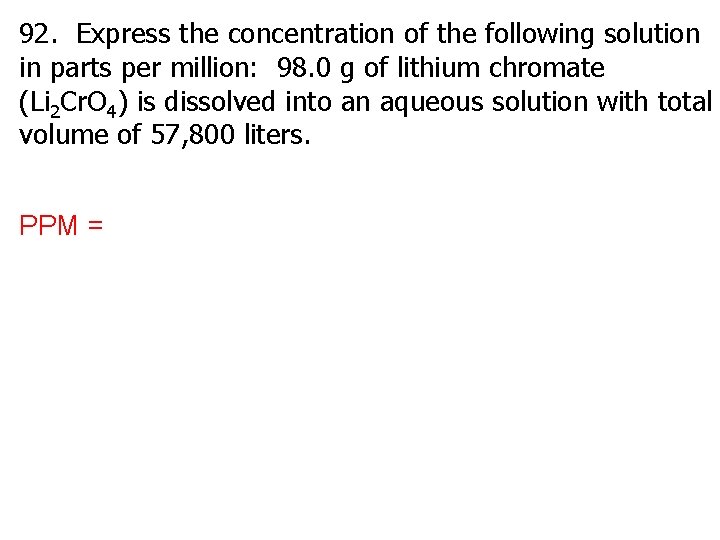
92. Express the concentration of the following solution in parts per million: 98. 0 g of lithium chromate (Li 2 Cr. O 4) is dissolved into an aqueous solution with total volume of 57, 800 liters. PPM =
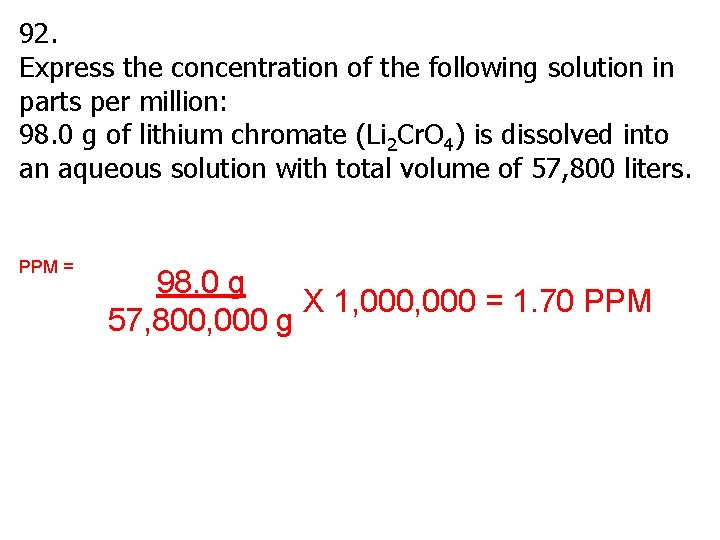
92. Express the concentration of the following solution in parts per million: 98. 0 g of lithium chromate (Li 2 Cr. O 4) is dissolved into an aqueous solution with total volume of 57, 800 liters. PPM = 98. 0 g X 1, 000 = 1. 70 PPM 57, 800, 000 g
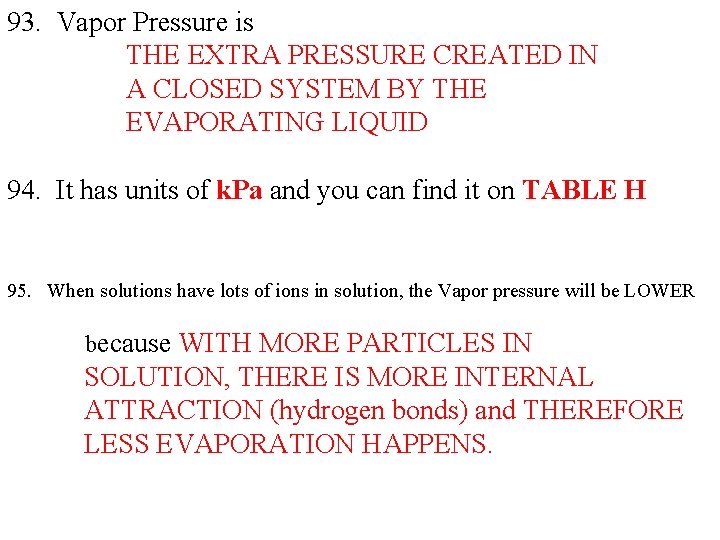
93. Vapor Pressure is THE EXTRA PRESSURE CREATED IN A CLOSED SYSTEM BY THE EVAPORATING LIQUID 94. It has units of k. Pa and you can find it on TABLE H 95. When solutions have lots of ions in solution, the Vapor pressure will be LOWER because WITH MORE PARTICLES IN SOLUTION, THERE IS MORE INTERNAL ATTRACTION (hydrogen bonds) and THEREFORE LESS EVAPORATION HAPPENS.
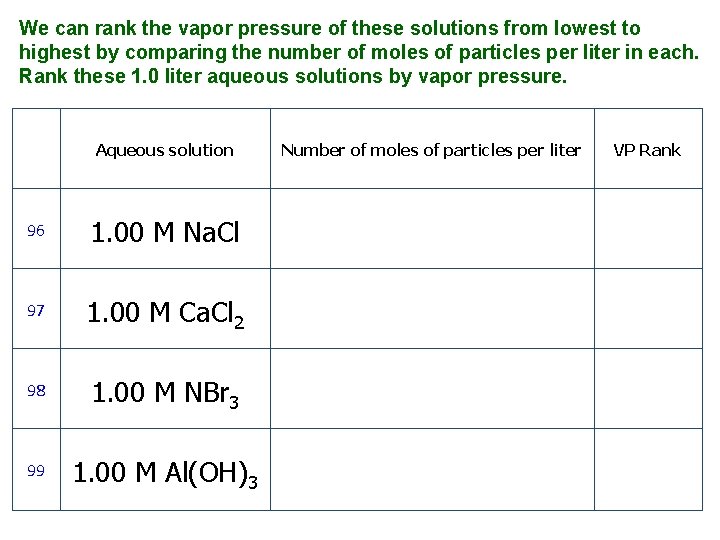
We can rank the vapor pressure of these solutions from lowest to highest by comparing the number of moles of particles per liter in each. Rank these 1. 0 liter aqueous solutions by vapor pressure. Aqueous solution 96 1. 00 M Na. Cl 97 1. 00 M Ca. Cl 2 98 1. 00 M NBr 3 99 1. 00 M Al(OH)3 Number of moles of particles per liter VP Rank
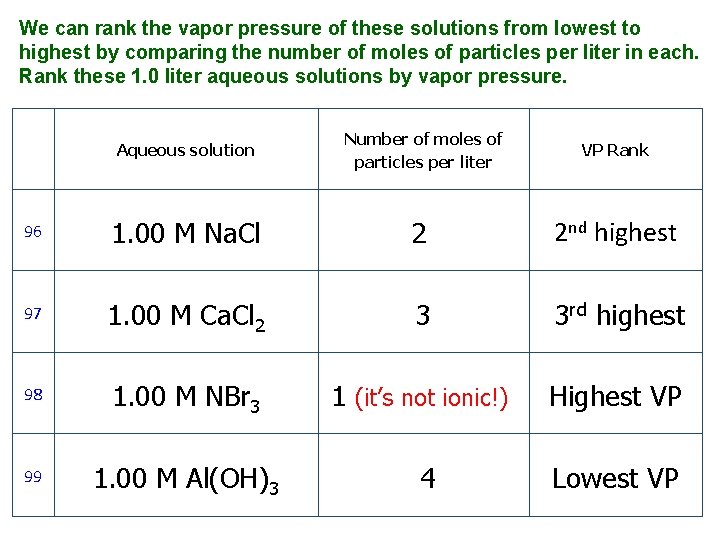
We can rank the vapor pressure of these solutions from lowest to highest by comparing the number of moles of particles per liter in each. Rank these 1. 0 liter aqueous solutions by vapor pressure. Aqueous solution Number of moles of particles per liter VP Rank 96 1. 00 M Na. Cl 2 2 nd highest 97 1. 00 M Ca. Cl 2 3 3 rd highest 98 1. 00 M NBr 3 1 (it’s not ionic!) Highest VP 99 1. 00 M Al(OH)3 4 Lowest VP
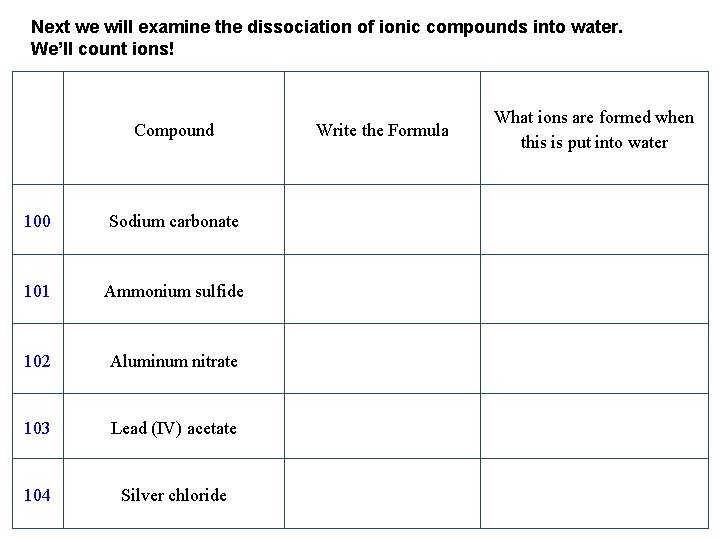
Next we will examine the dissociation of ionic compounds into water. We’ll count ions! Compound 100 Sodium carbonate 101 Ammonium sulfide 102 Aluminum nitrate 103 Lead (IV) acetate 104 Silver chloride Write the Formula What ions are formed when this is put into water
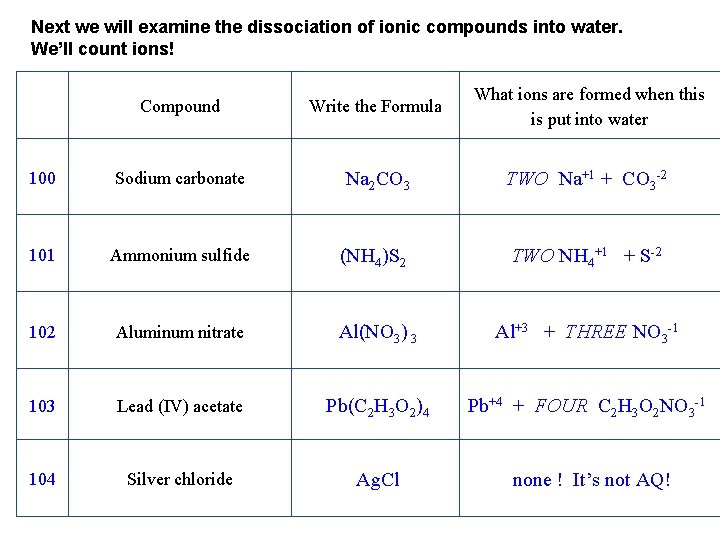
Next we will examine the dissociation of ionic compounds into water. We’ll count ions! Compound Write the Formula What ions are formed when this is put into water 100 Sodium carbonate Na 2 CO 3 TWO Na+1 + CO 3 -2 101 Ammonium sulfide (NH 4)S 2 TWO NH 4+1 + S-2 102 Aluminum nitrate Al(NO 3) 3 Al+3 + THREE NO 3 -1 103 Lead (IV) acetate Pb(C 2 H 3 O 2)4 Pb+4 + FOUR C 2 H 3 O 2 NO 3 -1 104 Silver chloride Ag. Cl none ! It’s not AQ!
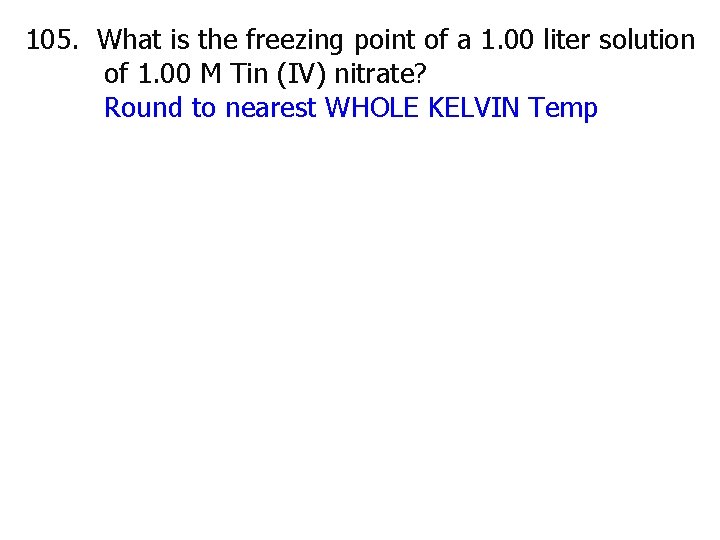
105. What is the freezing point of a 1. 00 liter solution of 1. 00 M Tin (IV) nitrate? Round to nearest WHOLE KELVIN Temp
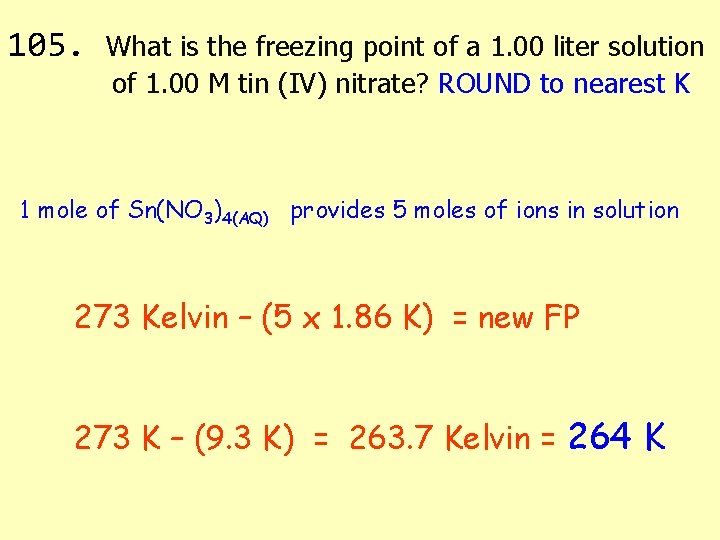
105. What is the freezing point of a 1. 00 liter solution of 1. 00 M tin (IV) nitrate? ROUND to nearest K 1 mole of Sn(NO 3)4(AQ) provides 5 moles of ions in solution 273 Kelvin – (5 x 1. 86 K) = new FP 273 K – (9. 3 K) = 263. 7 Kelvin = 264 K
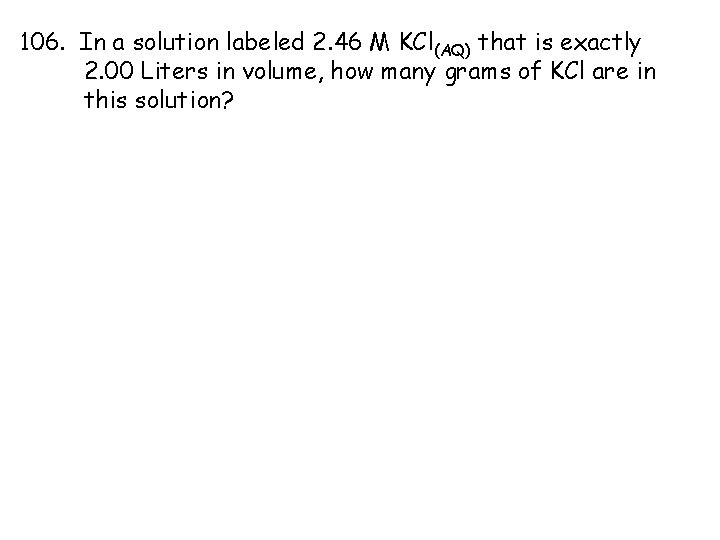
106. In a solution labeled 2. 46 M KCl(AQ) that is exactly 2. 00 Liters in volume, how many grams of KCl are in this solution?
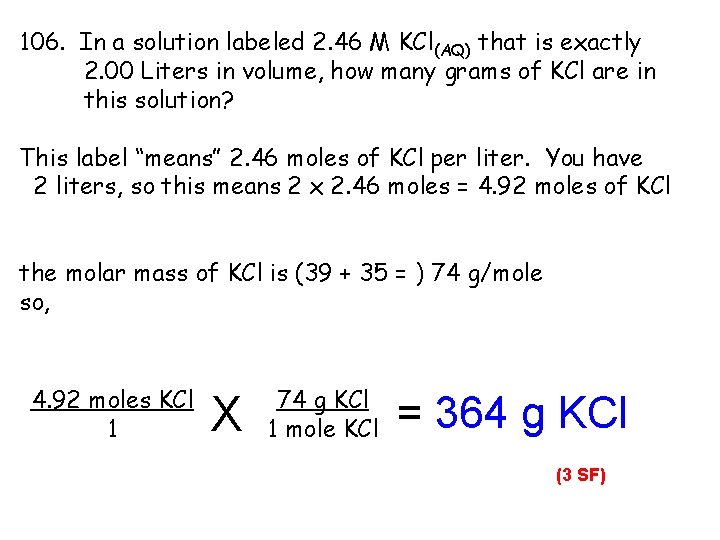
106. In a solution labeled 2. 46 M KCl(AQ) that is exactly 2. 00 Liters in volume, how many grams of KCl are in this solution? This label “means” 2. 46 moles of KCl per liter. You have 2 liters, so this means 2 x 2. 46 moles = 4. 92 moles of KCl the molar mass of KCl is (39 + 35 = ) 74 g/mole so, 4. 92 moles KCl 1 X 74 g KCl 1 mole KCl = 364 g KCl (3 SF)
According to an article in the New England Journal of Medicine, mercury toxicity begins at 0. 100 PPM. 107. If a crazy person dropped 125 grams of Hg(L) into the school pool, that is 102, 900 liters, would you be able to safely swim in there?
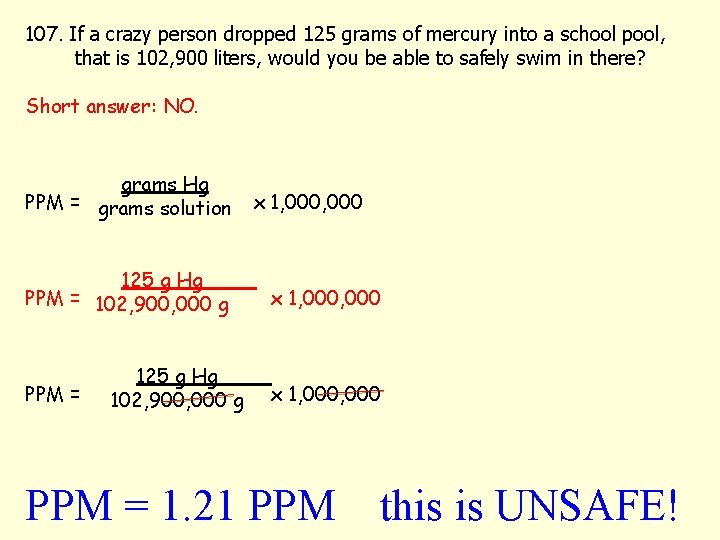
107. If a crazy person dropped 125 grams of mercury into a school pool, that is 102, 900 liters, would you be able to safely swim in there? Short answer: NO. grams Hg PPM = grams solution 125 g Hg PPM = 102, 900, 000 g PPM = 125 g Hg 102, 900, 000 g x 1, 000, 000 x 1, 000 PPM = 1. 21 PPM this is UNSAFE!
108. What is the molarity of a solution where 278 g KCl is dissolved into a solution of 5000. m. L total volume? (you better start with a formula if you know what’s good for you!)
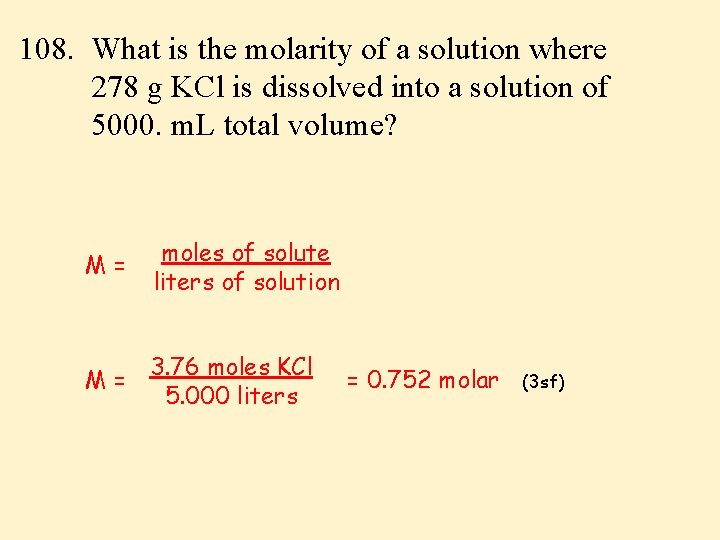
108. What is the molarity of a solution where 278 g KCl is dissolved into a solution of 5000. m. L total volume? M= moles of solute liters of solution 3. 76 moles KCl M= 5. 000 liters = 0. 752 molar (3 sf)
109. How do you prepare a 25. 5 m. L 0. 850 Molar Na. OH(AQ), if you start with a stock solution of 6. 40 M? Then draw a diagram to show to “make” this solution.
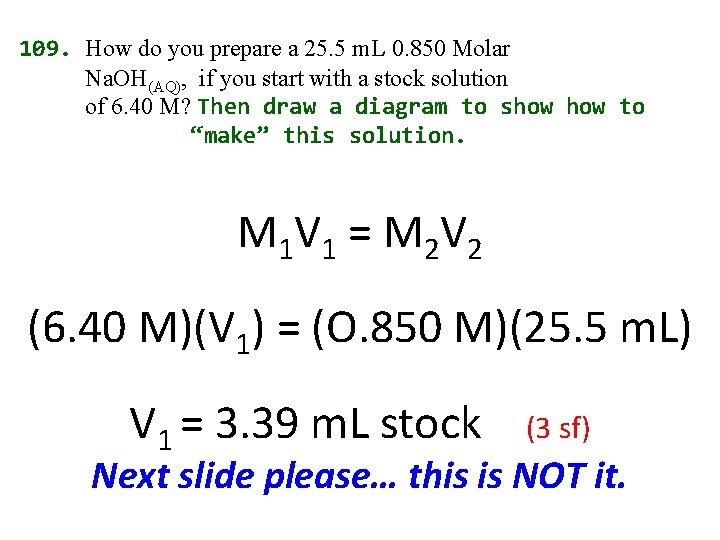
109. How do you prepare a 25. 5 m. L 0. 850 Molar Na. OH(AQ), if you start with a stock solution of 6. 40 M? Then draw a diagram to show to “make” this solution. M 1 V 1 = M 2 V 2 (6. 40 M)(V 1) = (O. 850 M)(25. 5 m. L) V 1 = 3. 39 m. L stock (3 sf) Next slide please… this is NOT it.
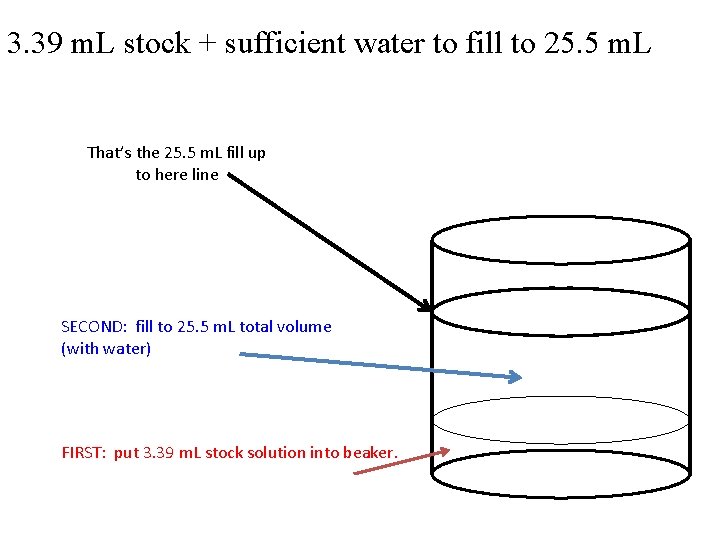
3. 39 m. L stock + sufficient water to fill to 25. 5 m. L That’s the 25. 5 m. L fill up to here line SECOND: fill to 25. 5 m. L total volume (with water) FIRST: put 3. 39 m. L stock solution into beaker.
110. You dissolve 2. 25 moles of KBr into water forming a 1. 00 liter solution. What is this solution’s boiling and freezing point? (Round to nearest WHOLE Kelvin temperature) BP FP
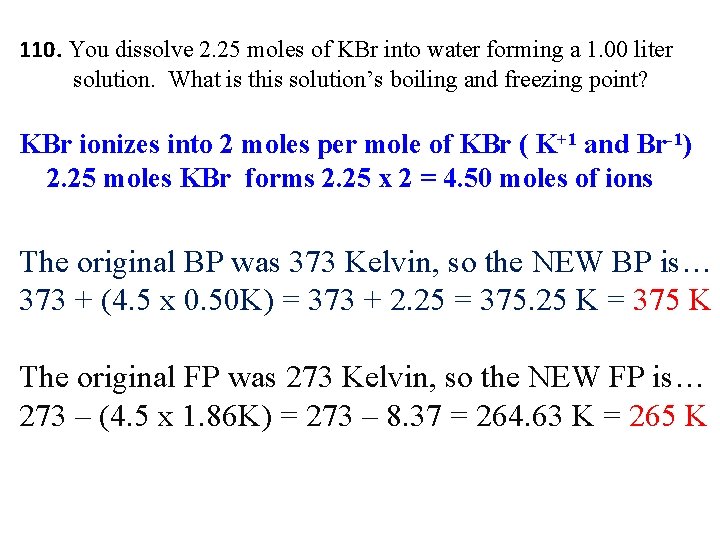
110. You dissolve 2. 25 moles of KBr into water forming a 1. 00 liter solution. What is this solution’s boiling and freezing point? KBr ionizes into 2 moles per mole of KBr ( K+1 and Br-1) 2. 25 moles KBr forms 2. 25 x 2 = 4. 50 moles of ions The original BP was 373 Kelvin, so the NEW BP is… 373 + (4. 5 x 0. 50 K) = 373 + 2. 25 = 375. 25 K = 375 K The original FP was 273 Kelvin, so the NEW FP is… 273 – (4. 5 x 1. 86 K) = 273 – 8. 37 = 264. 63 K = 265 K
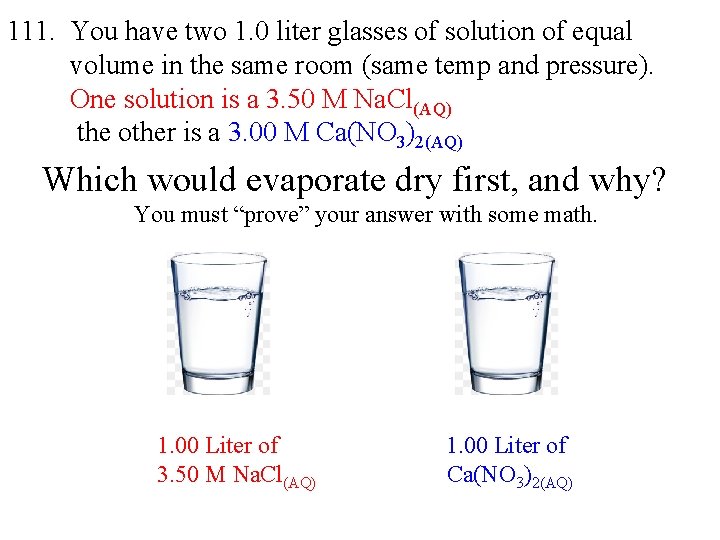
111. You have two 1. 0 liter glasses of solution of equal volume in the same room (same temp and pressure). One solution is a 3. 50 M Na. Cl(AQ) the other is a 3. 00 M Ca(NO 3)2(AQ) Which would evaporate dry first, and why? You must “prove” your answer with some math. 1. 00 Liter of 3. 50 M Na. Cl(AQ) 1. 00 Liter of Ca(NO 3)2(AQ)
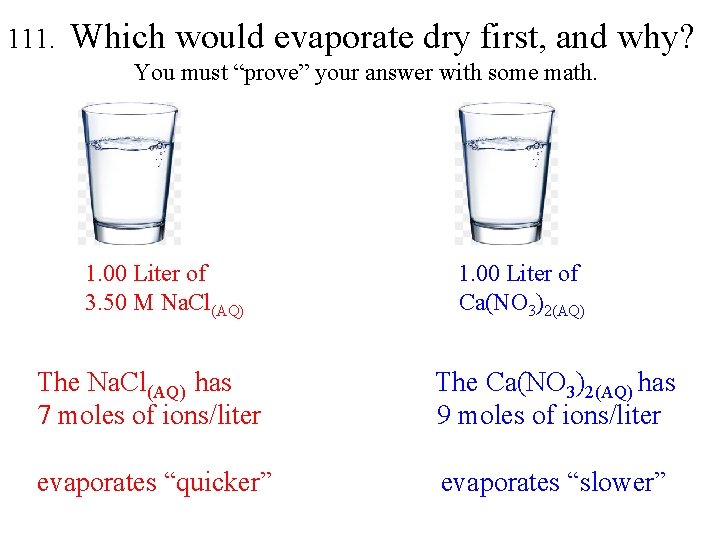
111. Which would evaporate dry first, and why? You must “prove” your answer with some math. 1. 00 Liter of 3. 50 M Na. Cl(AQ) 1. 00 Liter of Ca(NO 3)2(AQ) The Na. Cl(AQ) has 7 moles of ions/liter The Ca(NO 3)2(AQ) has 9 moles of ions/liter evaporates “quicker” evaporates “slower”
112. If you have a 2. 40 M HCl stock solution, how do you make a 50. 0 m. L of 3. 00 M HCl solution from it? A diagram might help you think through this math.
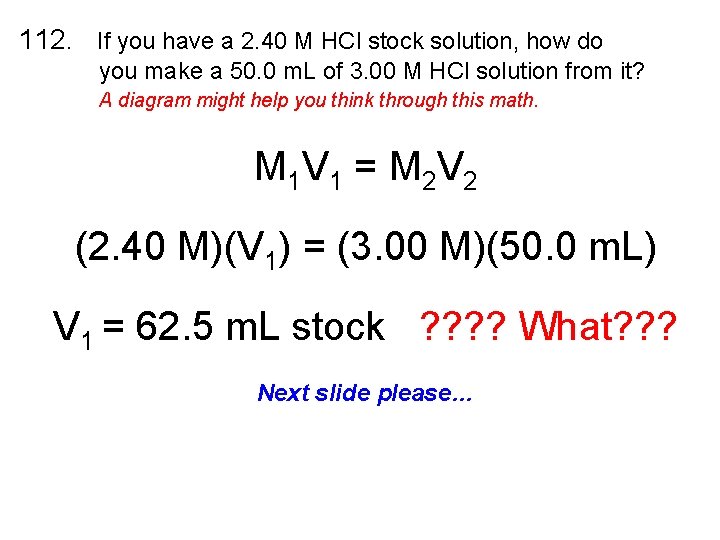
112. If you have a 2. 40 M HCl stock solution, how do you make a 50. 0 m. L of 3. 00 M HCl solution from it? A diagram might help you think through this math. M 1 V 1 = M 2 V 2 (2. 40 M)(V 1) = (3. 00 M)(50. 0 m. L) V 1 = 62. 5 m. L stock ? ? What? ? ? Next slide please…
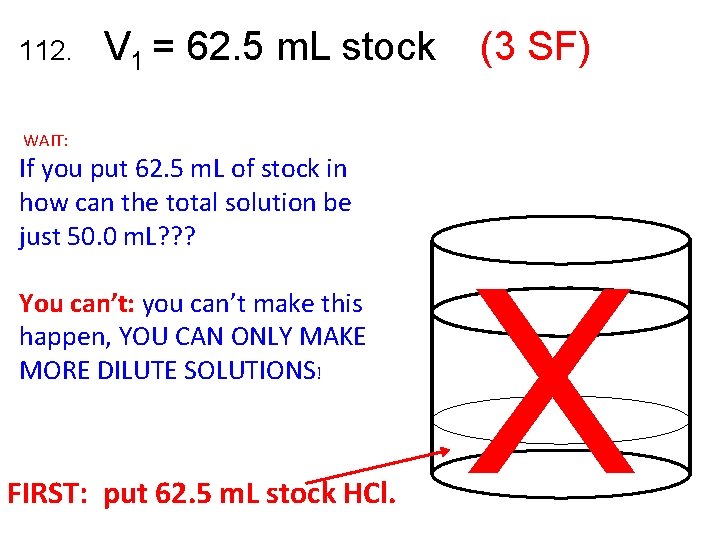
112. V 1 = 62. 5 m. L stock (3 SF) WAIT: If you put 62. 5 m. L of stock in how can the total solution be just 50. 0 m. L? ? ? You can’t: you can’t make this happen, YOU CAN ONLY MAKE MORE DILUTE SOLUTIONS! FIRST: put 62. 5 m. L stock HCl. X
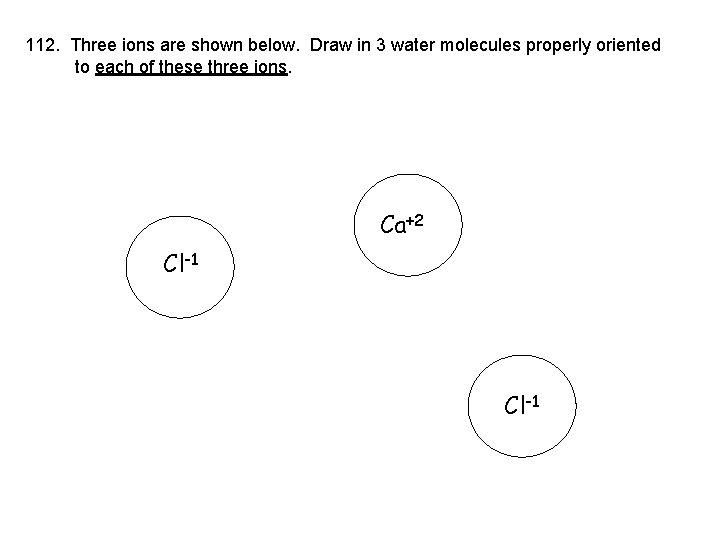
112. Three ions are shown below. Draw in 3 water molecules properly oriented to each of these three ions. Ca+2 Cl-1
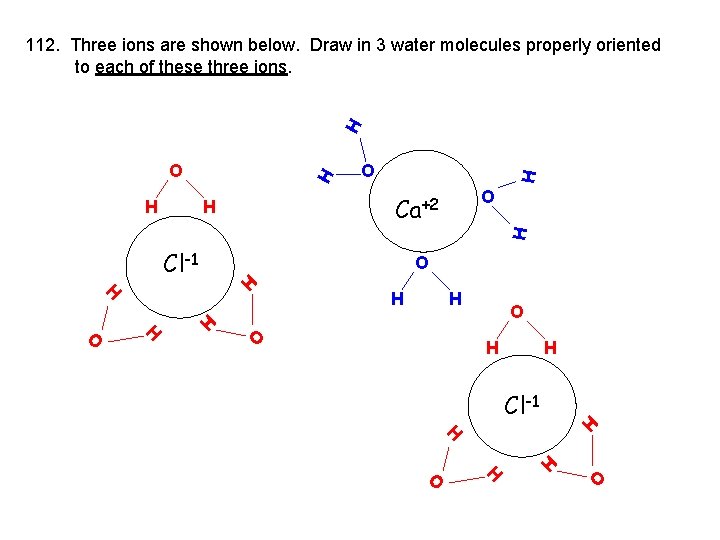
112. Three ions are shown below. Draw in 3 water molecules properly oriented to each of these three ions. H H O O Ca+2 H H O Cl-1 O H H H O O H H Cl-1 H H H O
113. You prepare a 235 m. L saturated solution of ammonium chloride at 20. °C. You go to lunch and come back in an hour. The room temperature has warmed up this solution by 5. 0°C. How would you best describe this solution at 25. °C ? A. Saturated at 25. °C C. Unsaturated at 25. °C B. Supersaturated at 25. °C D. Still saturated at 20. °C
113. You prepare a 235 m. L saturated solution of ammonium chloride at 20. °C. You go to lunch and come back in an hour. The room temperature has warmed up this solution by 5. 0°C. How would you best describe this solution at 25. °C ? C. Unsaturated at 25. °C The solution becomes unsaturated because at 25. 0°C this amount of water can hold more NH 4 Cl than when it was at a cooler temp. Think: the Molarity is constant
114. If you have lots of sulfur solid floating on your pond (or lots of water strider bugs), and you wanted to clear the surface, you could add some soap. Explain in a decent English sentence how this works.
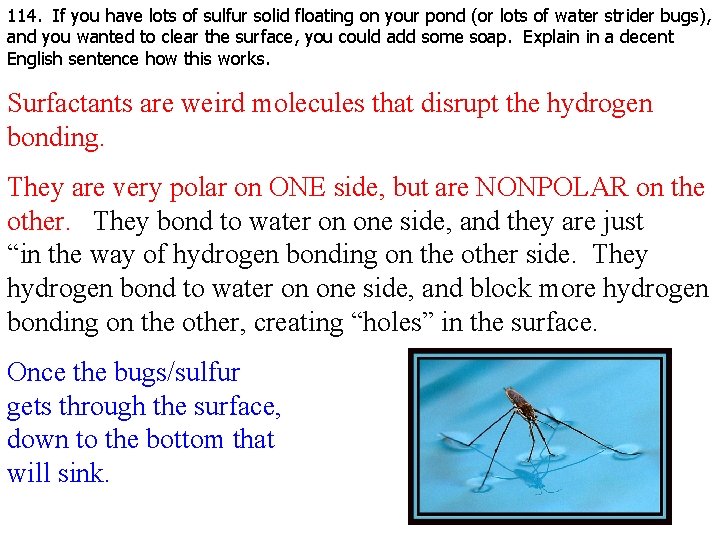
114. If you have lots of sulfur solid floating on your pond (or lots of water strider bugs), and you wanted to clear the surface, you could add some soap. Explain in a decent English sentence how this works. Surfactants are weird molecules that disrupt the hydrogen bonding. They are very polar on ONE side, but are NONPOLAR on the other. They bond to water on one side, and they are just “in the way of hydrogen bonding on the other side. They hydrogen bond to water on one side, and block more hydrogen bonding on the other, creating “holes” in the surface. Once the bugs/sulfur gets through the surface, down to the bottom that will sink.
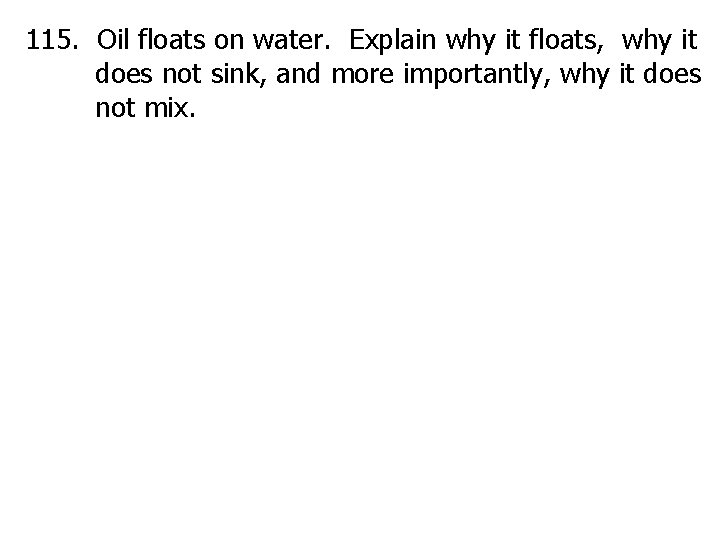
115. Oil floats on water. Explain why it floats, why it does not sink, and more importantly, why it does not mix.
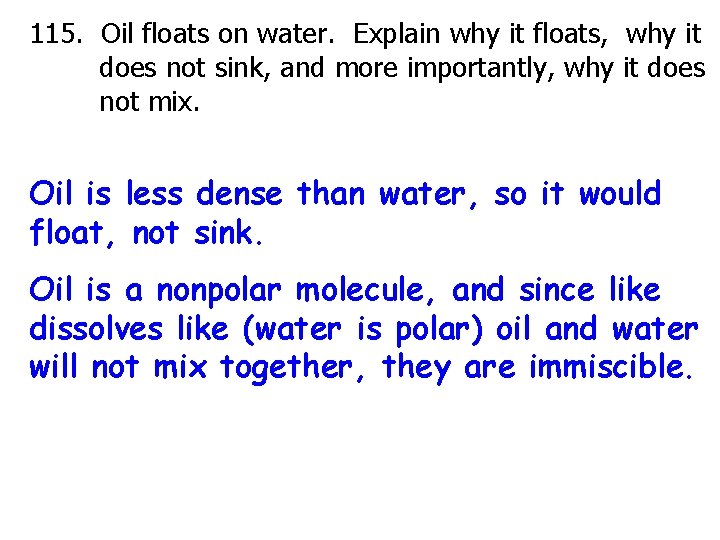
115. Oil floats on water. Explain why it floats, why it does not sink, and more importantly, why it does not mix. Oil is less dense than water, so it would float, not sink. Oil is a nonpolar molecule, and since like dissolves like (water is polar) oil and water will not mix together, they are immiscible.
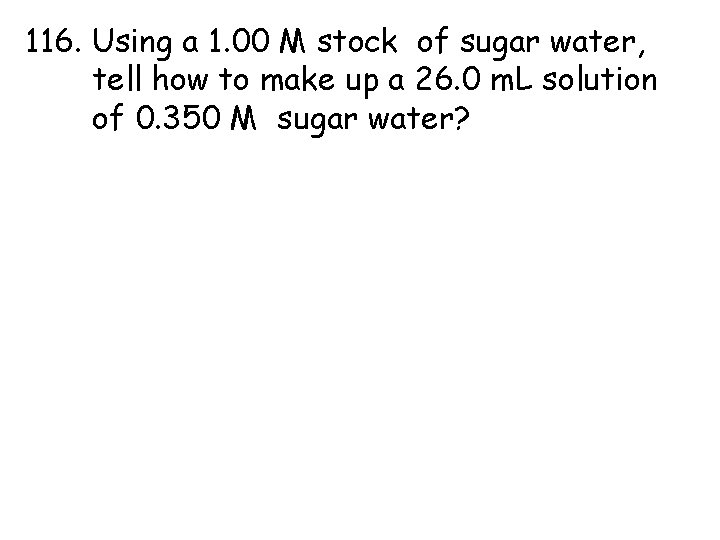
116. Using a 1. 00 M stock of sugar water, tell how to make up a 26. 0 m. L solution of 0. 350 M sugar water?
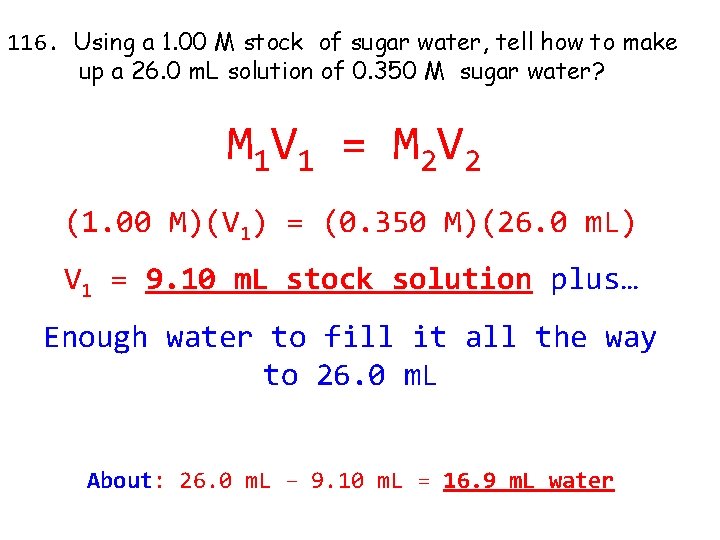
116. Using a 1. 00 M stock of sugar water, tell how to make up a 26. 0 m. L solution of 0. 350 M sugar water? M 1 V 1 = M 2 V 2 (1. 00 M)(V 1) = (0. 350 M)(26. 0 m. L) V 1 = 9. 10 m. L stock solution plus… Enough water to fill it all the way to 26. 0 m. L About: 26. 0 m. L – 9. 10 m. L = 16. 9 m. L water
- Slides: 129