
Solutions Chapter 12 Solubility and the Solution Process

Solutions Chapter 12
Solubility and the Solution Process Unsaturated, Saturated, and Supersaturated Solutions Ø unsaturated: contains less than the maximum amount of solute that a solvent can hold at specific temperature Ø saturated: contains the maximum amount of solute that a solvent can hold at specific temperature Ø supersaturated: contains more than the maximum amount of solute that a solvent can hold at specific temperature
How? Ø At higher temperature, solvents can hold more solute than at lower temperature. If a given amount of solute is dissolved in a solvent at a higher temperature, then allowed to cool without being disturbed, the solute will remain in solution. Ø The solution is unstable, though, and the solute will fall out of solution if the solution is disturbed. Ø This is the principle behind hot and cold packs. Hot packs are made from substances that recrystallize in an exothermic reaction; cold packs are made from substances that recrystallize in an endothermic reaction.
Factors in Explaining Solubility Three types of interactions to consider for solutions: Consider the solution process taking place in three distinct steps: 1. solvent-solvent interaction 2. solute-solute interaction 3. solvent-solute interaction 1. separation of solvent molecules 2. separation of solute molecules 3. mixing of solvent and solute molecules
So why don't all liquids mix and all solids dissolve in liquids? Ø If solvent-solute interaction can't compete with solute-solute and solvent-solvent interactions, they remain separated. When solute-solute or solvent-solvent interactions are stronger than solutesolvent interactions, solute and solvent stay separated. When solute-solvent interactions are as strong as solute-solute and solvent-solvent interactions , solute and solvent mix.
Liquid-Liquid Solutions "Like dissolves like" rule Ø polar molecules will mix (be miscible with) other polar molecules Ø nonpolar molecules will mix (be miscible with) other nonpolar molecules Ø polar molecules will not mix (be with) nonpolar molecules immiscible
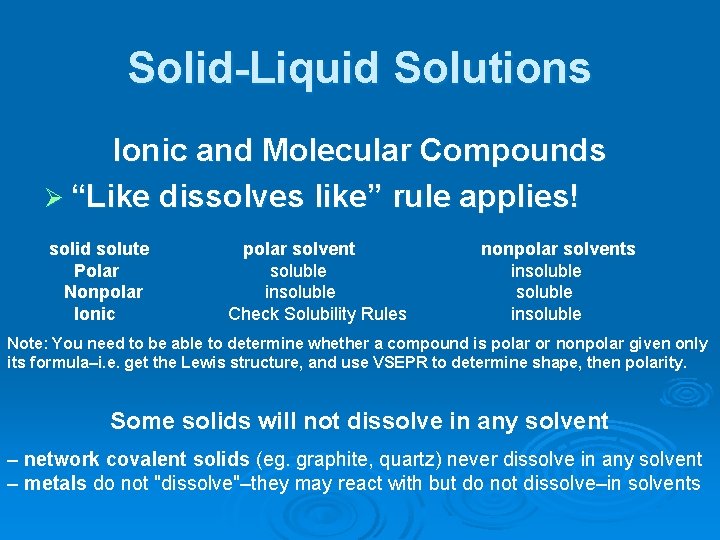
Solid-Liquid Solutions Ionic and Molecular Compounds Ø “Like dissolves like” rule applies! solid solute Polar Nonpolar Ionic polar solvent soluble insoluble Check Solubility Rules nonpolar solvents insoluble Note: You need to be able to determine whether a compound is polar or nonpolar given only its formula–i. e. get the Lewis structure, and use VSEPR to determine shape, then polarity. Some solids will not dissolve in any solvent – network covalent solids (eg. graphite, quartz) never dissolve in any solvent – metals do not "dissolve"–they may react with but do not dissolve–in solvents
Effects of Temperature and Pressure on Solublility Ø Gas solubility and Temperature: l As T ↑, solubility of a gas in a liquid ↓ (in most cases) • a glass of soda quickly goes flat if left out on a hot summer day • why bubbles form when water heated in open pan (dissolved air escaping) Why? At higher T, gas molecules are moving more quickly l l l they have a higher tendency to find the surface (b/w liquid and air) they escape more quickly fewer gas molecules in the liquid!
Effects of Temperature and Pressure on Solublility cont. Ø Gas solubility and Pressure: l Henry’s Law: Solubility of gas is proportional to partial P of gas above liquid Why? Greater gas pressure = more gas molecules over solution l l more gas molecules encounter liquid surface more gas molecules go into the liquid phase!
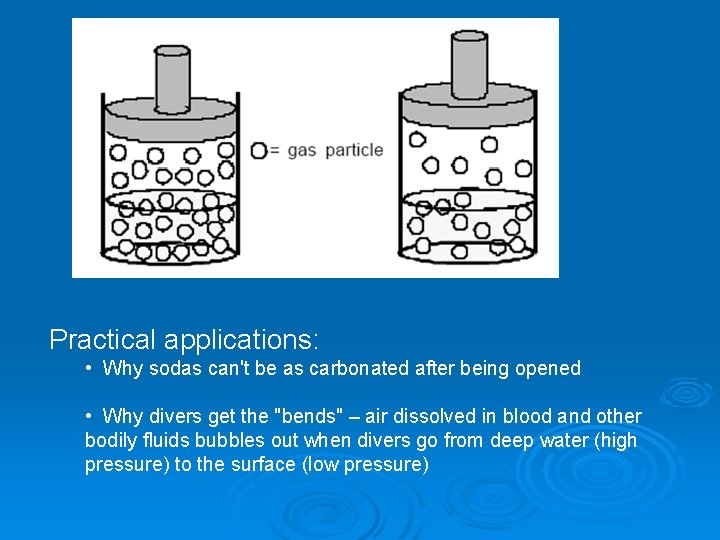
Practical applications: • Why sodas can't be as carbonated after being opened • Why divers get the "bends" – air dissolved in blood and other bodily fluids bubbles out when divers go from deep water (high pressure) to the surface (low pressure)
Effects of Temperature and Pressure on Solublility cont. Ø Solid solubility and Temperature: l As T ↑, solubility of a solid in a liquid ↑ (in most cases) • e. g. we can dissolve more sugar in a cup of hot tea than in glass of iced tea
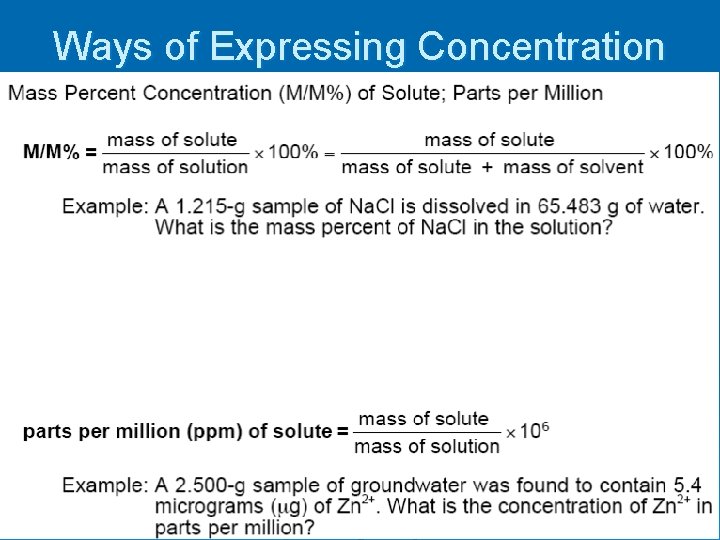
Ways of Expressing Concentration
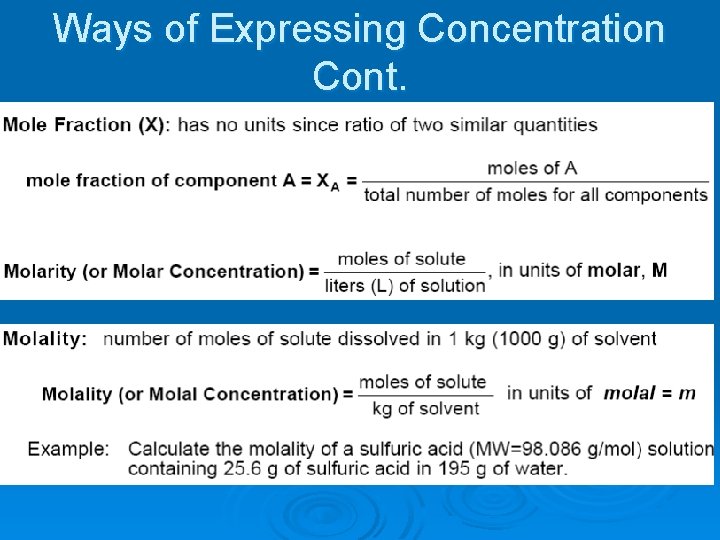
Ways of Expressing Concentration Cont.
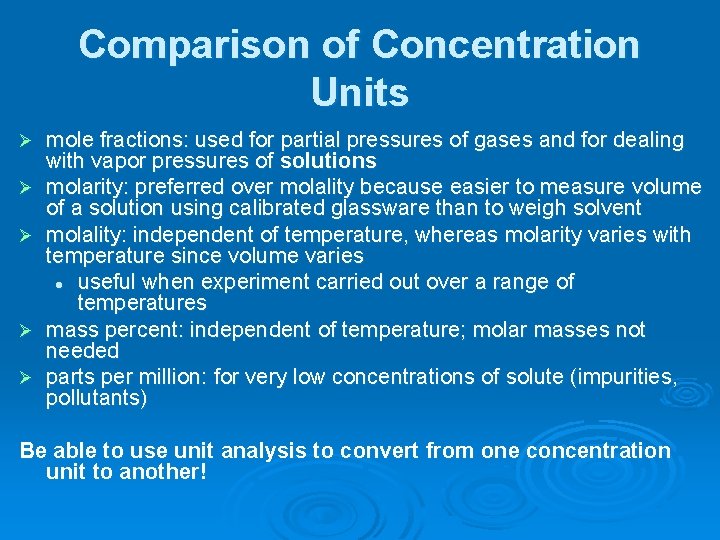
Comparison of Concentration Units Ø Ø Ø mole fractions: used for partial pressures of gases and for dealing with vapor pressures of solutions molarity: preferred over molality because easier to measure volume of a solution using calibrated glassware than to weigh solvent molality: independent of temperature, whereas molarity varies with temperature since volume varies l useful when experiment carried out over a range of temperatures mass percent: independent of temperature; molar masses not needed parts per million: for very low concentrations of solute (impurities, pollutants) Be able to use unit analysis to convert from one concentration unit to another!



- Slides: 17