
Solutions and Thermobarometry Lecture 12 Plagioclase Solution Unlike
Solutions and Thermobarometry Lecture 12
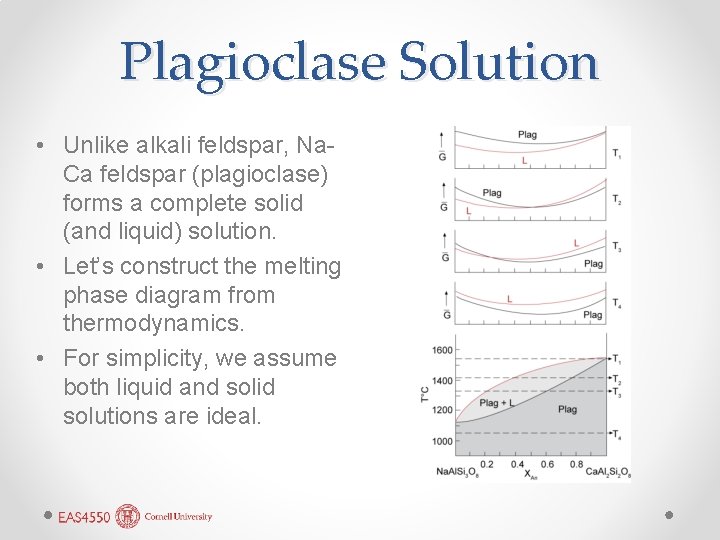
Plagioclase Solution • Unlike alkali feldspar, Na. Ca feldspar (plagioclase) forms a complete solid (and liquid) solution. • Let’s construct the melting phase diagram from thermodynamics. • For simplicity, we assume both liquid and solid solutions are ideal.
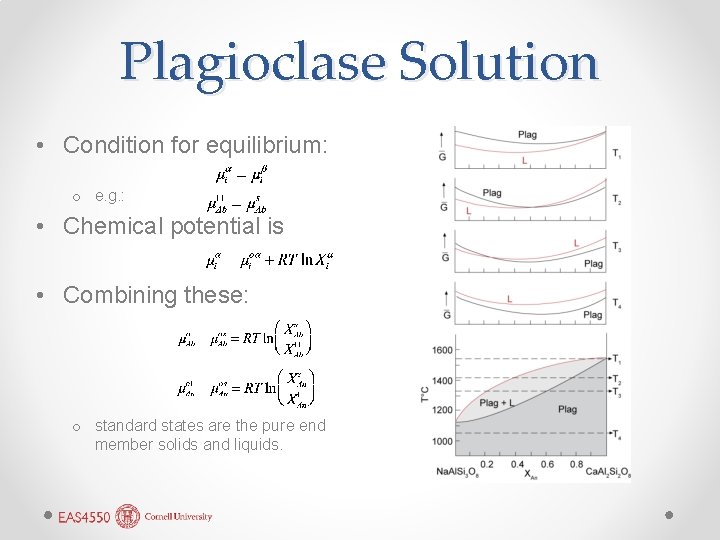
Plagioclase Solution • Condition for equilibrium: o e. g. : • Chemical potential is • Combining these: o standard states are the pure end member solids and liquids.
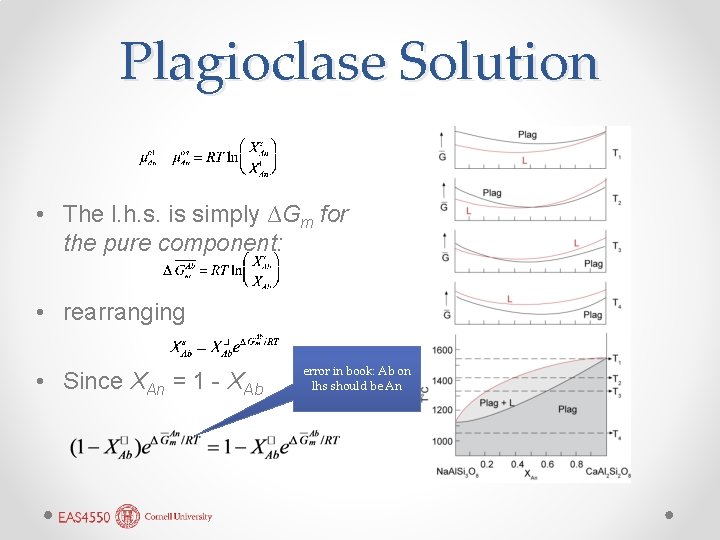
Plagioclase Solution • The l. h. s. is simply ∆Gm for the pure component: • rearranging • Since XAn = 1 - XAb error in book: Ab on lhs should be An
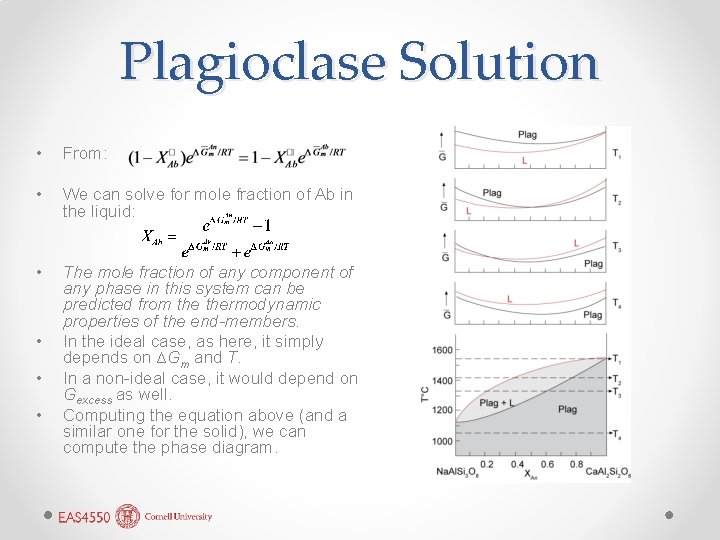
Plagioclase Solution • From: • We can solve for mole fraction of Ab in the liquid: • The mole fraction of any component of any phase in this system can be predicted from thermodynamic properties of the end-members. In the ideal case, as here, it simply depends on ∆Gm and T. In a non-ideal case, it would depend on Gexcess as well. Computing the equation above (and a similar one for the solid), we can compute the phase diagram. • • •
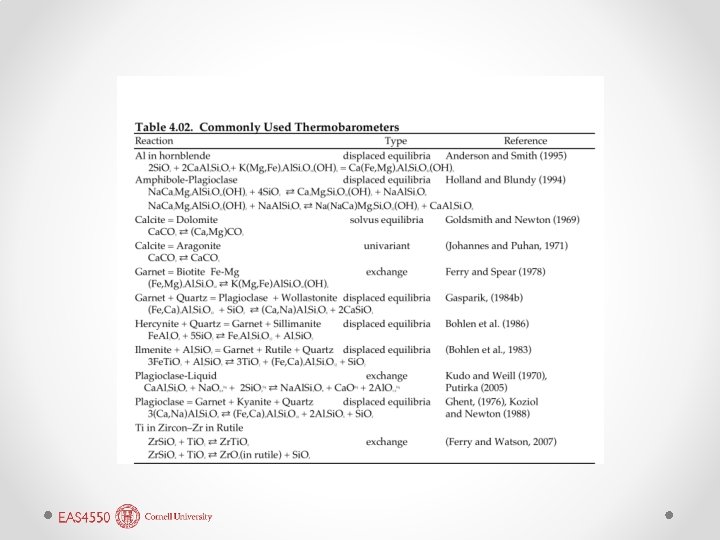
We now have enough thermodynamics to put it to some real use: calculating the temperatures and pressures at which mineral assemblages (i. e. , rocks) equilibrated within the Earth.
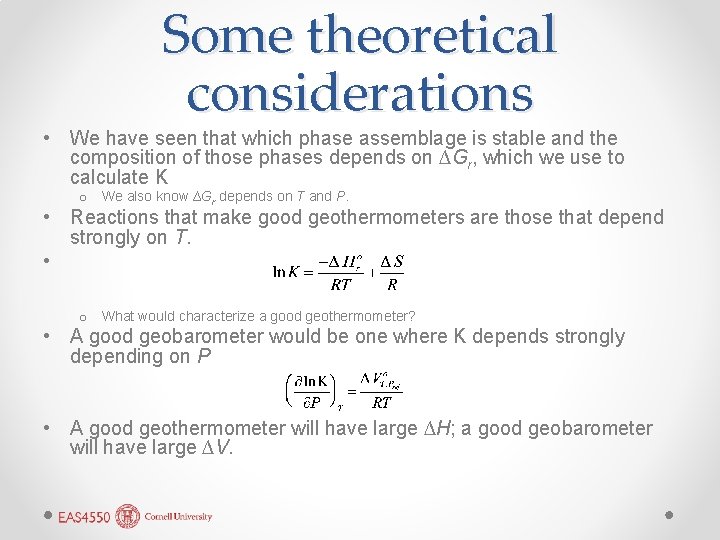
Some theoretical considerations • We have seen that which phase assemblage is stable and the composition of those phases depends on ∆Gr, which we use to calculate K o We also know ∆Gr depends on T and P. • Reactions that make good geothermometers are those that depend strongly on T. • o What would characterize a good geothermometer? • A good geobarometer would be one where K depends strongly depending on P • A good geothermometer will have large ∆H; a good geobarometer will have large ∆V.
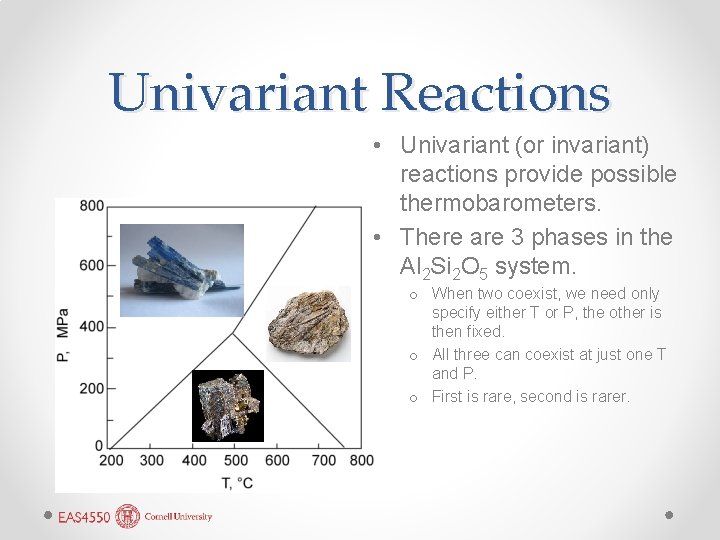
Univariant Reactions • Univariant (or invariant) reactions provide possible thermobarometers. • There are 3 phases in the Al 2 Si 2 O 5 system. o When two coexist, we need only specify either T or P, the other is then fixed. o All three can coexist at just one T and P. o First is rare, second is rarer.
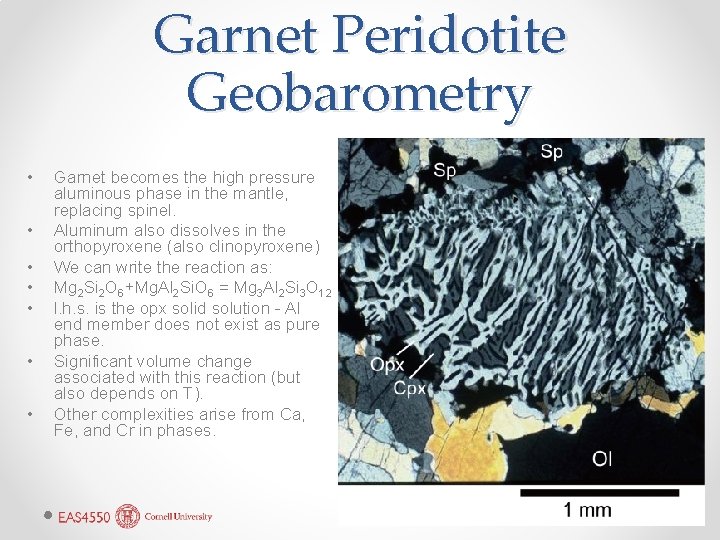
Garnet Peridotite Geobarometry • • Garnet becomes the high pressure aluminous phase in the mantle, replacing spinel. Aluminum also dissolves in the orthopyroxene (also clinopyroxene) We can write the reaction as: Mg 2 Si 2 O 6+Mg. Al 2 Si. O 6 = Mg 3 Al 2 Si 3 O 12 l. h. s. is the opx solid solution - Al end member does not exist as pure phase. Significant volume change associated with this reaction (but also depends on T). Other complexities arise from Ca, Fe, and Cr in phases. Original approach of Wood and Banno generally assumed ideal solution
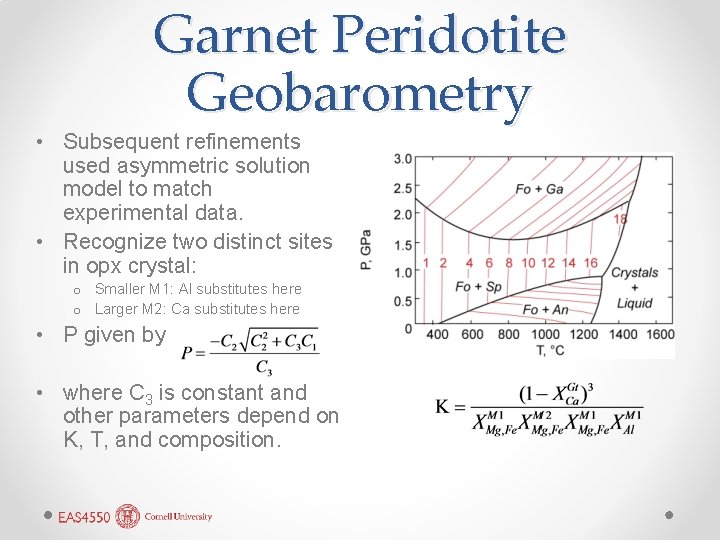
Garnet Peridotite Geobarometry • Subsequent refinements used asymmetric solution model to match experimental data. • Recognize two distinct sites in opx crystal: o Smaller M 1: Al substitutes here o Larger M 2: Ca substitutes here • P given by • where C 3 is constant and other parameters depend on K, T, and composition.
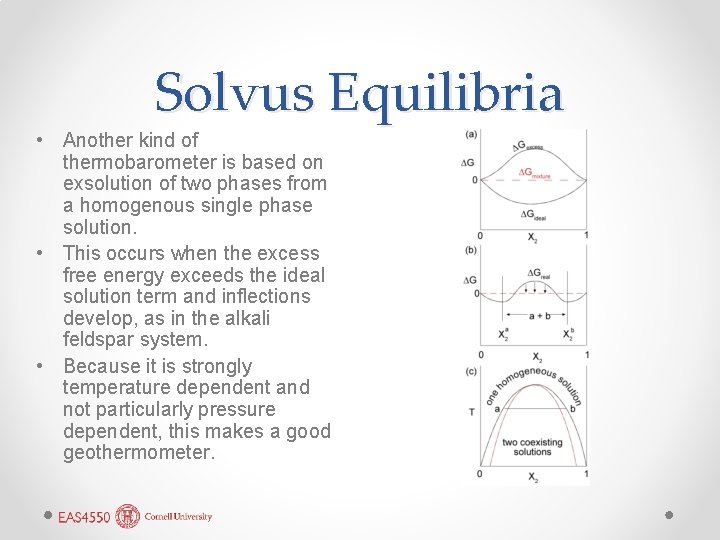
Solvus Equilibria • Another kind of thermobarometer is based on exsolution of two phases from a homogenous single phase solution. • This occurs when the excess free energy exceeds the ideal solution term and inflections develop, as in the alkali feldspar system. • Because it is strongly temperature dependent and not particularly pressure dependent, this makes a good geothermometer.
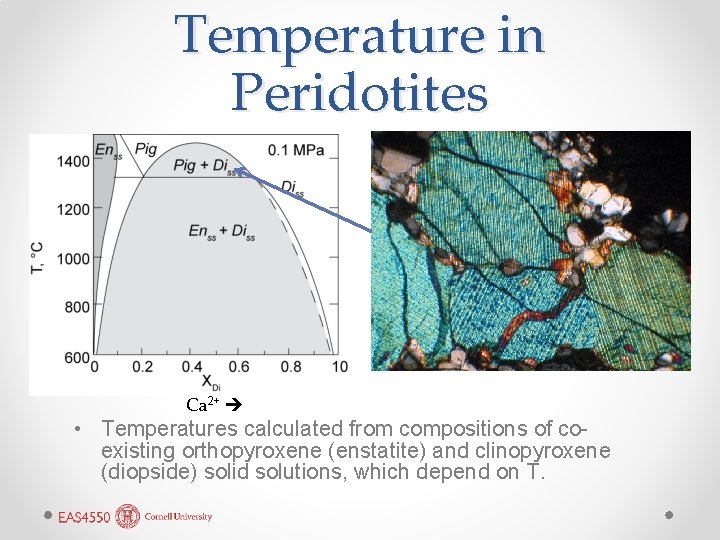
Temperature in Peridotites Ca 2+ • Temperatures calculated from compositions of coexisting orthopyroxene (enstatite) and clinopyroxene (diopside) solid solutions, which depend on T.
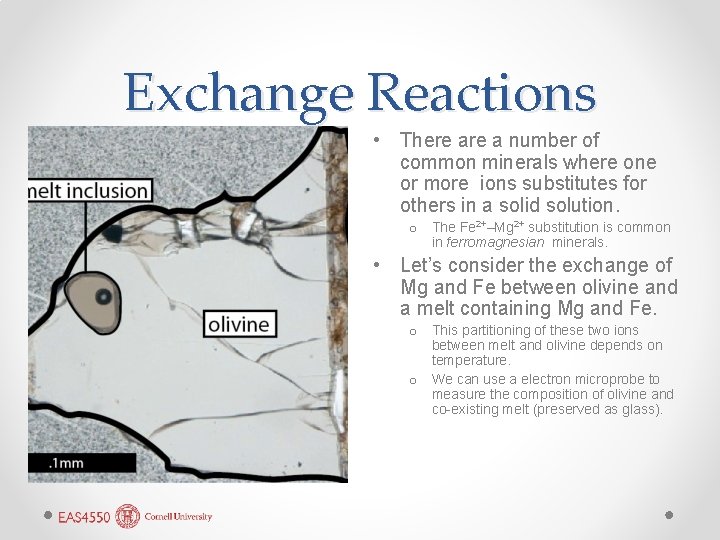
Exchange Reactions • There a number of common minerals where one or more ions substitutes for others in a solid solution. o The Fe 2+–Mg 2+ substitution is common in ferromagnesian minerals. • Let’s consider the exchange of Mg and Fe between olivine and a melt containing Mg and Fe. o This partitioning of these two ions between melt and olivine depends on temperature. o We can use a electron microprobe to measure the composition of olivine and co-existing melt (preserved as glass).
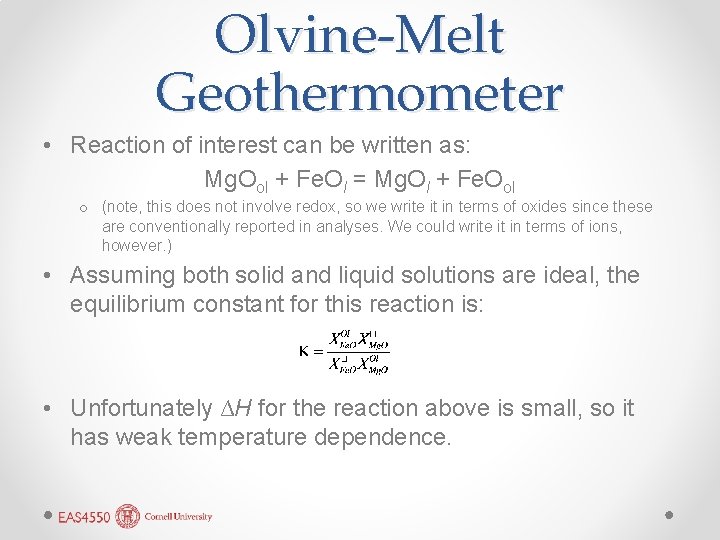
Olvine-Melt Geothermometer • Reaction of interest can be written as: Mg. Ool + Fe. Ol = Mg. Ol + Fe. Ool o (note, this does not involve redox, so we write it in terms of oxides since these are conventionally reported in analyses. We could write it in terms of ions, however. ) • Assuming both solid and liquid solutions are ideal, the equilibrium constant for this reaction is: • Unfortunately ∆H for the reaction above is small, so it has weak temperature dependence.
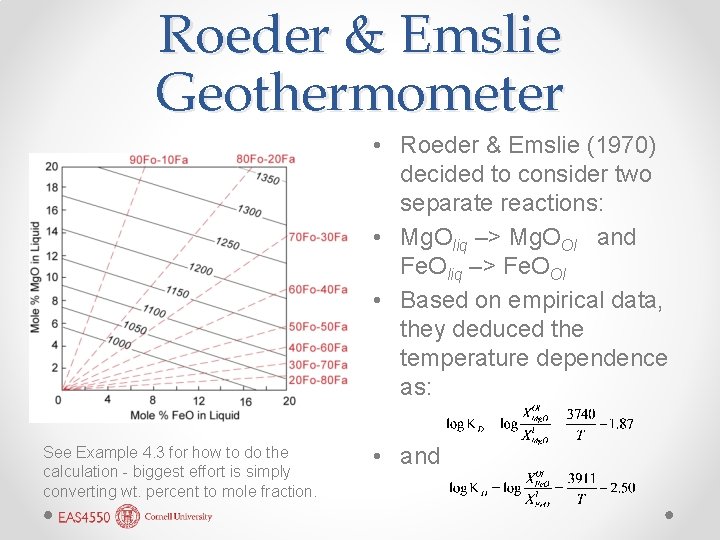
Roeder & Emslie Geothermometer • Roeder & Emslie (1970) decided to consider two separate reactions: • Mg. Oliq –> Mg. OOl and Fe. Oliq –> Fe. OOl • Based on empirical data, they deduced the temperature dependence as: See Example 4. 3 for how to do the calculation - biggest effort is simply converting wt. percent to mole fraction. • and
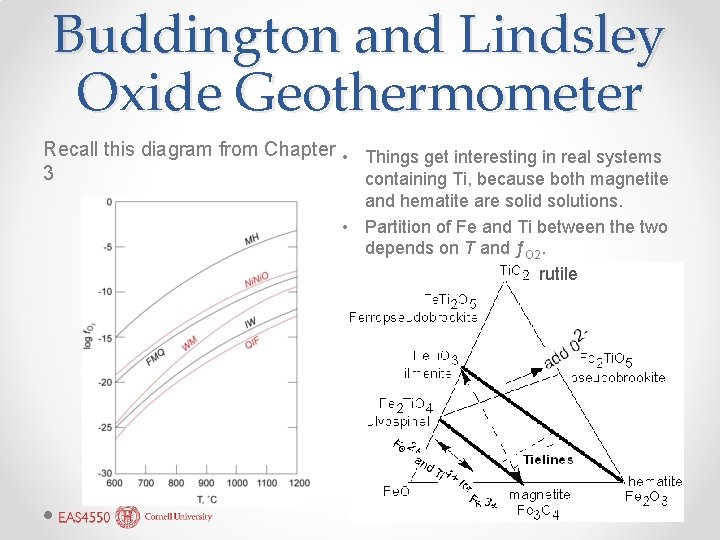
Buddington and Lindsley Oxide Geothermometer Recall this diagram from Chapter • Things get interesting in real systems 3 containing Ti, because both magnetite and hematite are solid solutions. • Partition of Fe and Ti between the two depends on T and ƒO 2. rutile
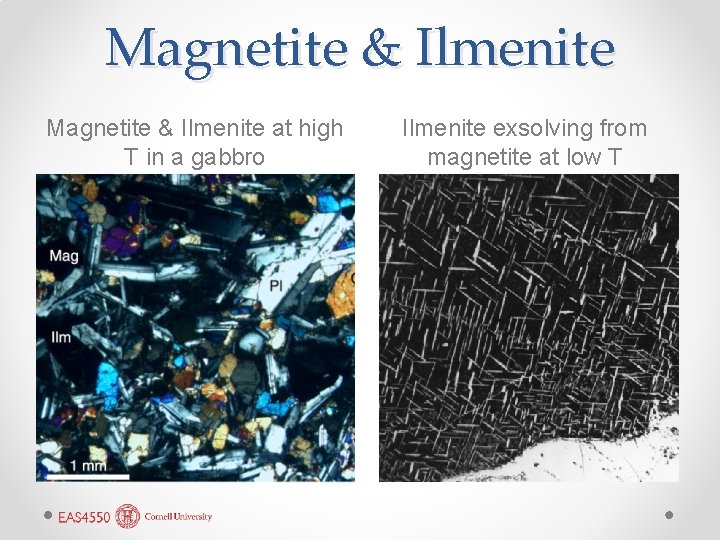
Magnetite & Ilmenite at high T in a gabbro Ilmenite exsolving from magnetite at low T
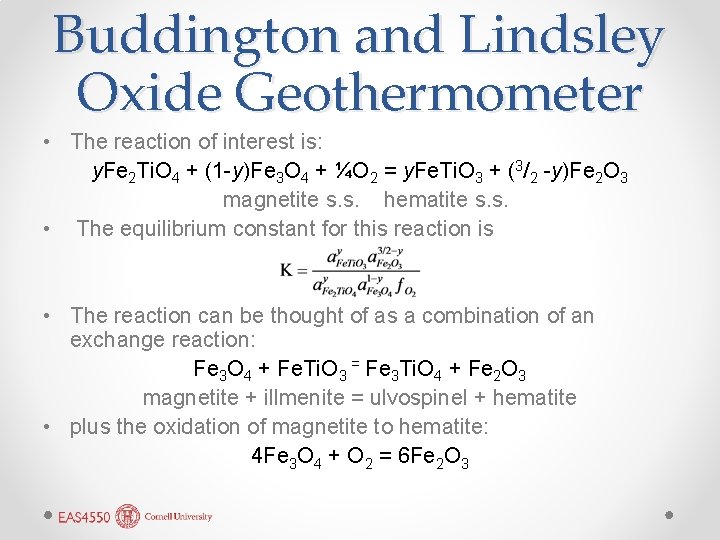
Buddington and Lindsley Oxide Geothermometer • The reaction of interest is: y. Fe 2 Ti. O 4 + (1 -y)Fe 3 O 4 + ¼O 2 = y. Fe. Ti. O 3 + (3/2 -y)Fe 2 O 3 magnetite s. s. hematite s. s. • The equilibrium constant for this reaction is • The reaction can be thought of as a combination of an exchange reaction: Fe 3 O 4 + Fe. Ti. O 3 = Fe 3 Ti. O 4 + Fe 2 O 3 magnetite + illmenite = ulvospinel + hematite • plus the oxidation of magnetite to hematite: 4 Fe 3 O 4 + O 2 = 6 Fe 2 O 3
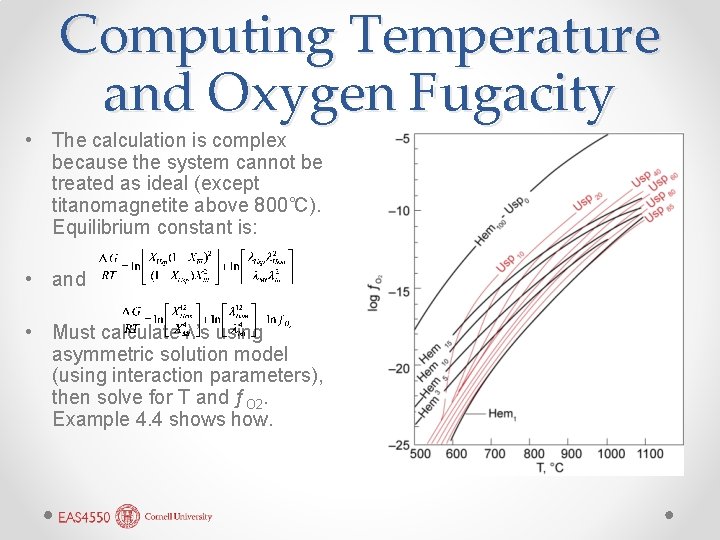
Computing Temperature and Oxygen Fugacity • The calculation is complex because the system cannot be treated as ideal (except titanomagnetite above 800˚C). Equilibrium constant is: • and • Must calculate λ’s using asymmetric solution model (using interaction parameters), then solve for T and ƒO 2. Example 4. 4 shows how.
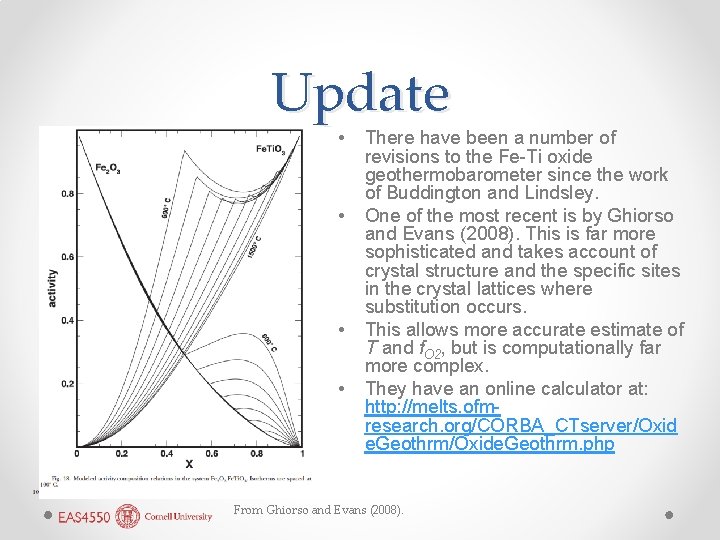
Update • • There have been a number of revisions to the Fe-Ti oxide geothermobarometer since the work of Buddington and Lindsley. One of the most recent is by Ghiorso and Evans (2008). This is far more sophisticated and takes account of crystal structure and the specific sites in the crystal lattices where substitution occurs. This allows more accurate estimate of T and f. O 2, but is computationally far more complex. They have an online calculator at: http: //melts. ofmresearch. org/CORBA_CTserver/Oxid e. Geothrm/Oxide. Geothrm. php From Ghiorso and Evans (2008).
Next up: MELTS modelling • Visit the MELTS web page http: //melts. ofm-research. org to find out more about this software. Several possible downloads from here, including Rhyolite-Melts (for Mac, but you need an X-Windows system) and Rhyolite_MELTS for Excel (Windows only). o We will run some examples on this site. • Visit the Cal. Tech magmasource web site: http: //magmasource. caltech. edu/alphamelts/. o Read about installing alpha. MELTS. o Download and install the latest version (1. 5) and any necessary virtual machine program (for Windows).
- Slides: 22