
Solution Proposal Presentation Name DepartmentInstitution Course Instructor Due
- Slides: 11
Solution Proposal Presentation Name Department/Institution Course Instructor Due Date
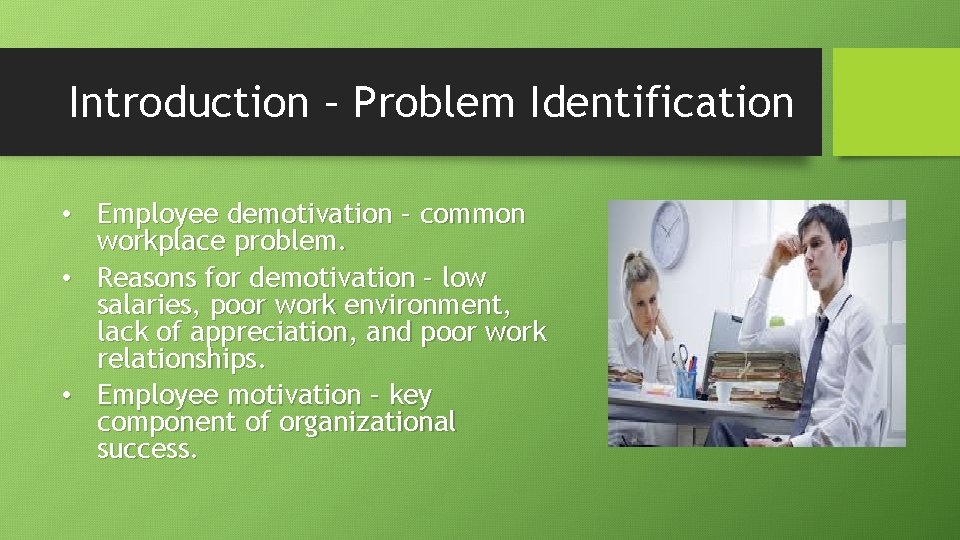
Introduction – Problem Identification • Employee demotivation – common workplace problem. • Reasons for demotivation – low salaries, poor work environment, lack of appreciation, and poor work relationships. • Employee motivation – key component of organizational success.
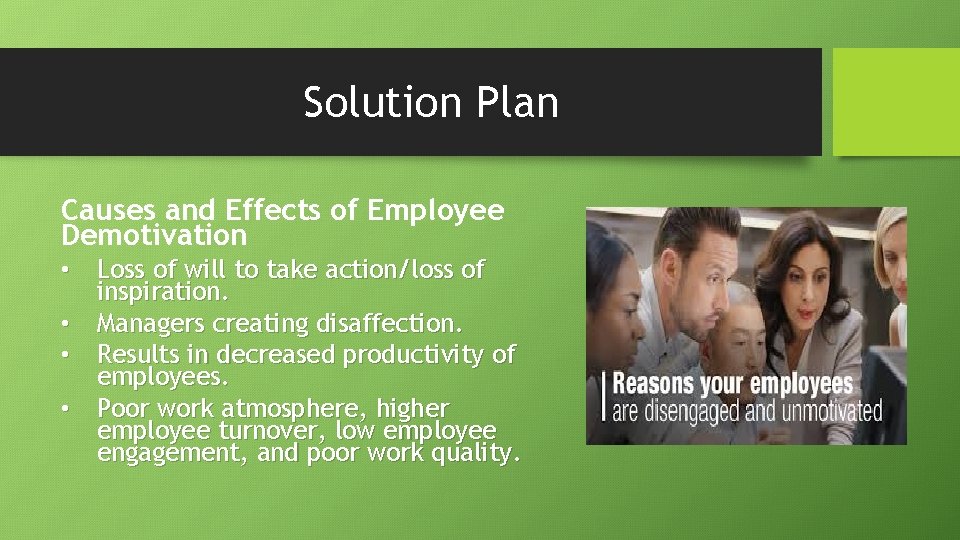
Solution Plan Causes and Effects of Employee Demotivation • Loss of will to take action/loss of inspiration. • Managers creating disaffection. • Results in decreased productivity of employees. • Poor work atmosphere, higher employee turnover, low employee engagement, and poor work quality.
Solution Plan Stakeholder Involvement • Sponsor stakeholder group – HR heads, CEOs, COOs, and CFOs. • Implementation stakeholder group – HR departments and Departmental managers. • Evaluation stakeholder group – HR departments and Company executives. • Customers – for evaluation purposes.
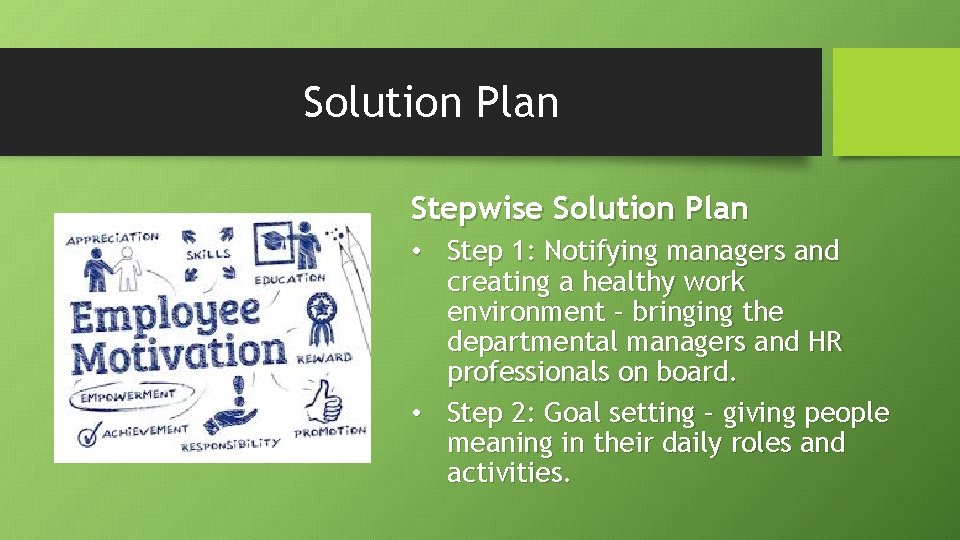
Solution Plan Stepwise Solution Plan • Step 1: Notifying managers and creating a healthy work environment – bringing the departmental managers and HR professionals on board. • Step 2: Goal setting – giving people meaning in their daily roles and activities.
Solution Plan Stepwise Solution Plan • Step 3: Developing a Culture of Celebrating Achievements, Providing Rewards, and Provision of Feedback – recognizing employees’ achievements. • Step 4: Encouraging Creativity, Teamwork, and Open Communication – building effective work teams.
Measurement Plan Expected Outcomes • Improved productivity. • Reduced level of absenteeism. • Lower levels of employee turnover. • Improved product quality and customer service. • Improved work attitudes and relationships.
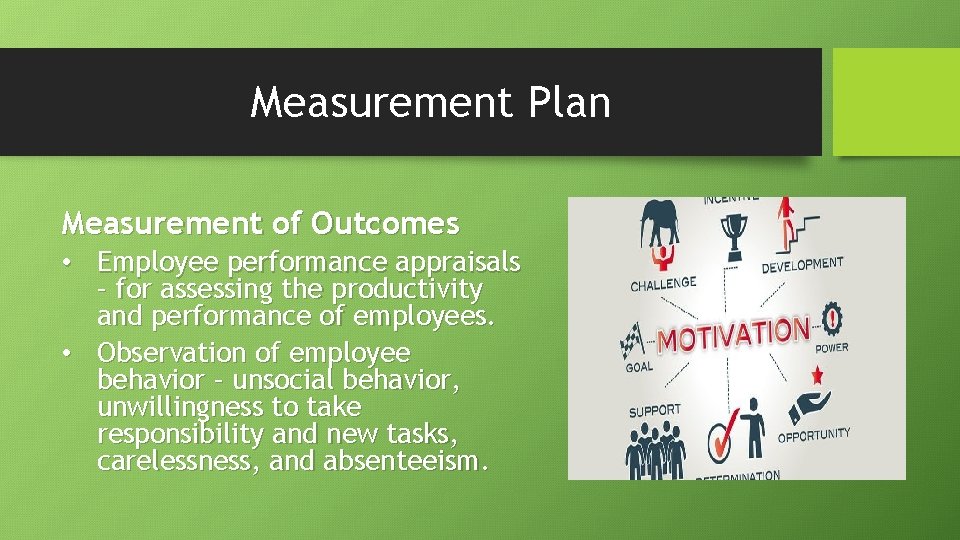
Measurement Plan Measurement of Outcomes • Employee performance appraisals – for assessing the productivity and performance of employees. • Observation of employee behavior – unsocial behavior, unwillingness to take responsibility and new tasks, carelessness, and absenteeism.
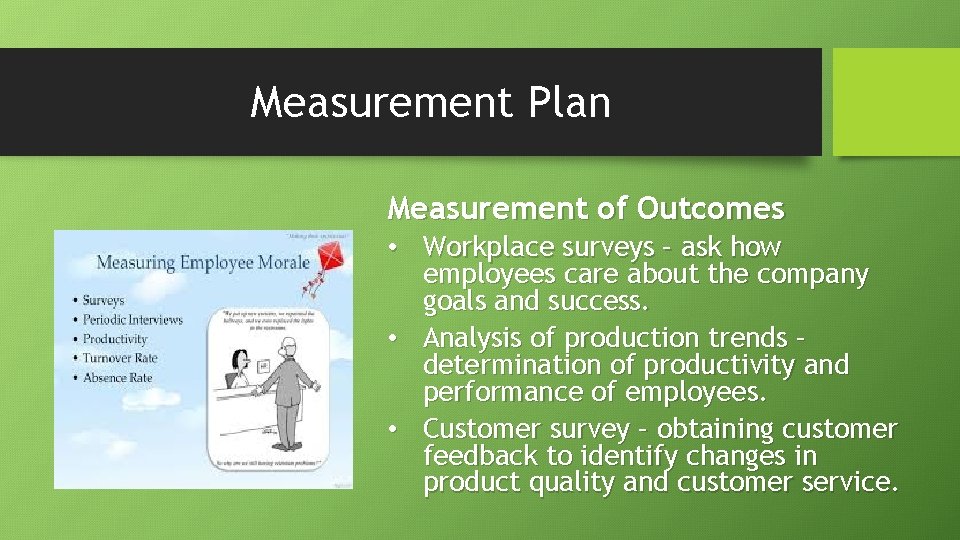
Measurement Plan Measurement of Outcomes • Workplace surveys – ask how employees care about the company goals and success. • Analysis of production trends – determination of productivity and performance of employees. • Customer survey – obtaining customer feedback to identify changes in product quality and customer service.
Conclusion • Implementation of the proposed solution plan – improvement of employee motivation. • Evaluation stakeholder group – evaluation of solution plan implementation outcomes. • Assessment of outcomes will reveal the effectiveness of the solution plan. • Compare outcomes with previous productivity of the company.
References • Halushchak, O. , & Halushchak, M. (2016). The causes of appearance and ways of staff’s demotivation solving in organizations. Соціально-економічні проблеми і держава, 14(1), 138 -144. • Iravani, M. (2012). Demotivating factors influencing rubber production workers. Management Science Letters, 2(1), 273 -278. • Lee, M. T. , & Raschke, R. L. (2016). Understanding employee motivation and organizational performance: Arguments for a set-theoretic approach. Journal of Innovation & Knowledge, 1(3), 162 -169. • Sanyal, M. K. , & Biswas, S. B. (2014). Employee motivation from performance appraisal implications: Test of a theory in the software industry in West Bengal (India). Procedia Economics and Finance, 11(14), 182 -196. • Scandura, T. A. (2019). Essentials of organizational behavior: An evidence-based approach (2 nd Ed. ). Thousand Oaks, CA: Sage Publications, Inc. • Shaikh, M. , Shah, A. B. , & Shaikh, S. (2018). Analysis of Employee Motivation Factors: A Case Study of Jamshoro Joint Venture Limited (Jjvl). Grassroots, 52(1), 78 -89. • Smithers, G. L. , & Walker, D. H. (2000). The effect of the workplace on motivation and demotivation of construction professionals. Construction management and economics, 18(7), 833 -841. • Zámečník, R. (2014). The measurement of employee motivation by using multi-factor statistical analysis. Procedia. Social and Behavioral Sciences, 109, 851 -857.