
Solution properties matter impure at least two substances

Solution properties
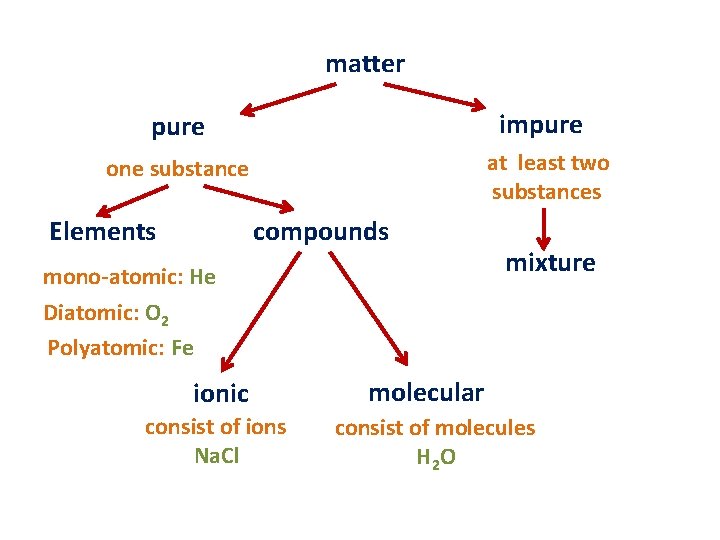
matter impure at least two substances one substance Elements compounds mono-atomic: He Diatomic: O 2 Polyatomic: Fe ionic consist of ions Na. Cl mixture molecular consist of molecules H 2 O
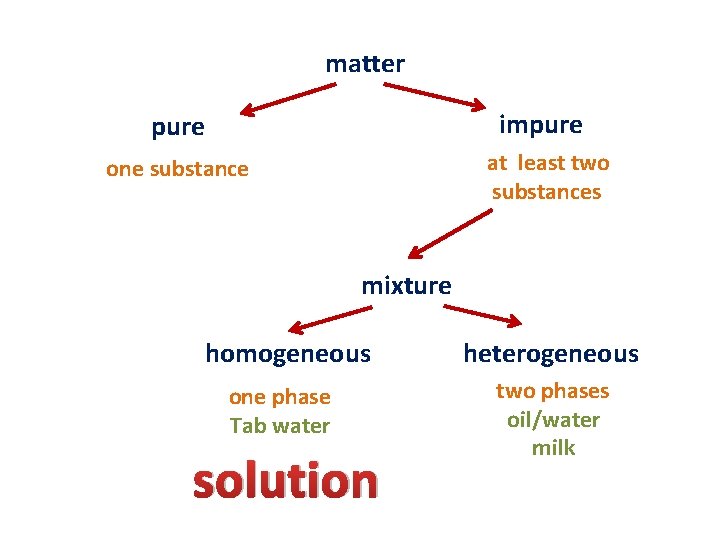
matter impure at least two substances one substance mixture homogeneous one phase Tab water solution heterogeneous two phases oil/water milk
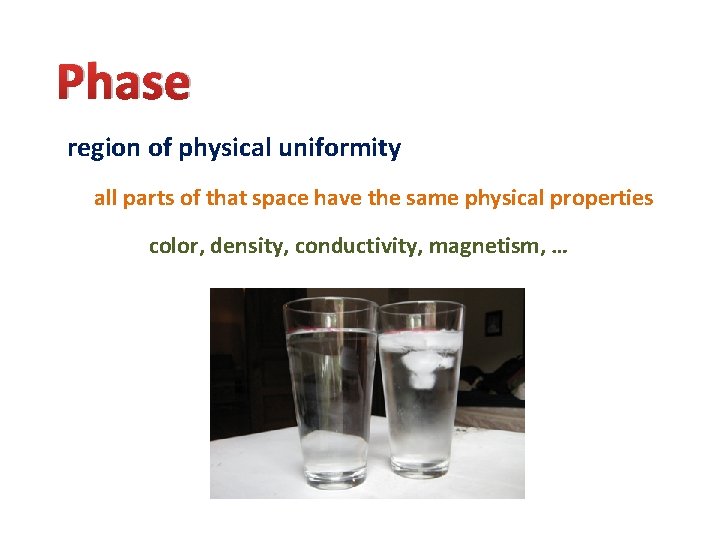
Phase region of physical uniformity all parts of that space have the same physical properties color, density, conductivity, magnetism, …
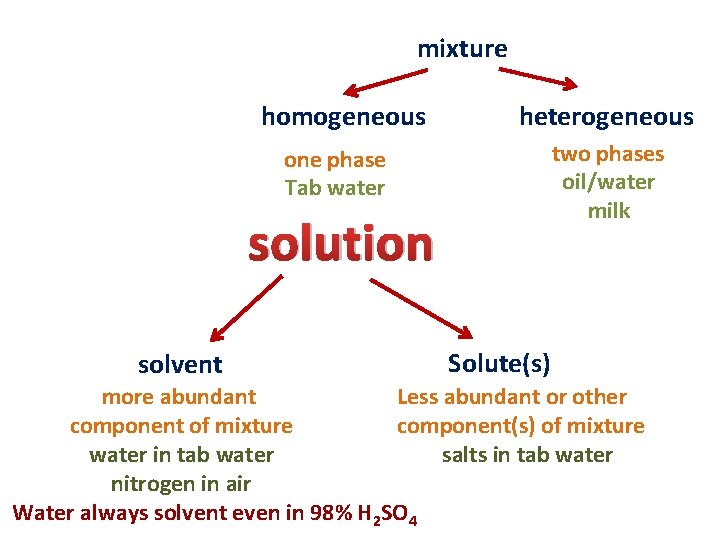
mixture homogeneous heterogeneous two phases oil/water milk one phase Tab water solution solvent Solute(s) Less abundant or other more abundant component(s) of mixture component of mixture salts in tab water nitrogen in air Water always solvent even in 98% H 2 SO 4
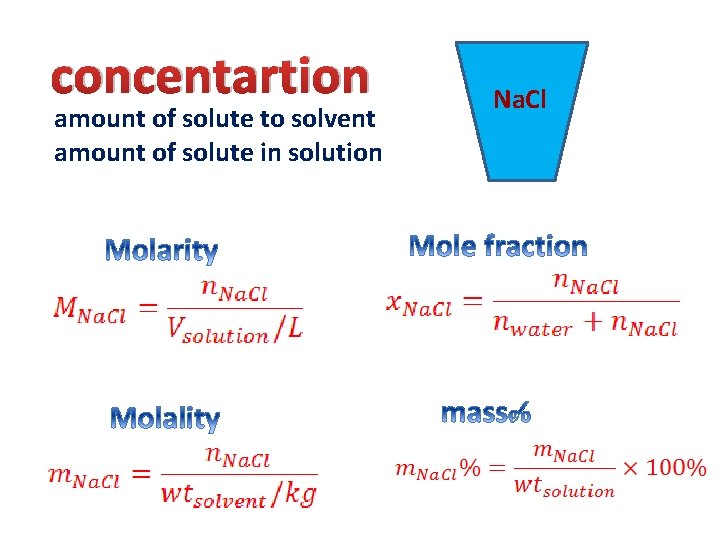
concentartion amount of solute to solvent amount of solute in solution Na. Cl
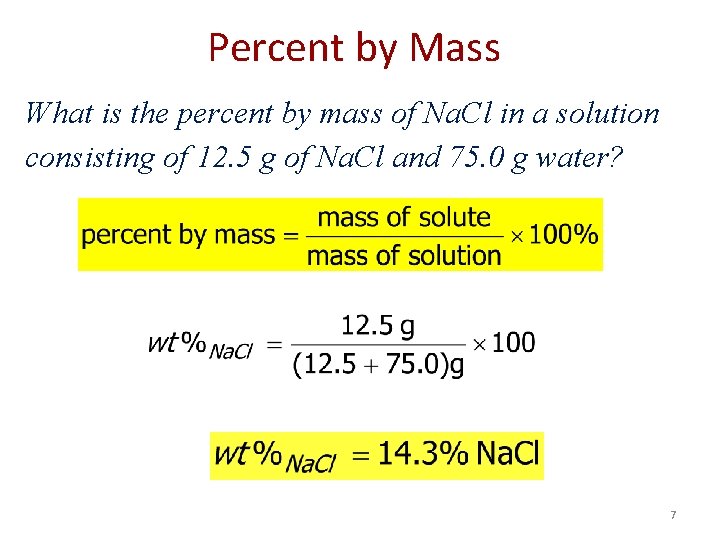
Percent by Mass What is the percent by mass of Na. Cl in a solution consisting of 12. 5 g of Na. Cl and 75. 0 g water? 7
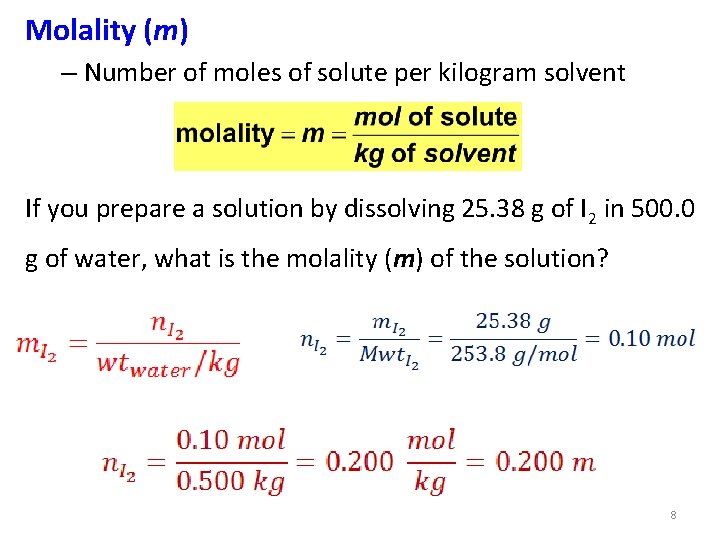
Molality (m) – Number of moles of solute per kilogram solvent If you prepare a solution by dissolving 25. 38 g of I 2 in 500. 0 g of water, what is the molality (m) of the solution? 8
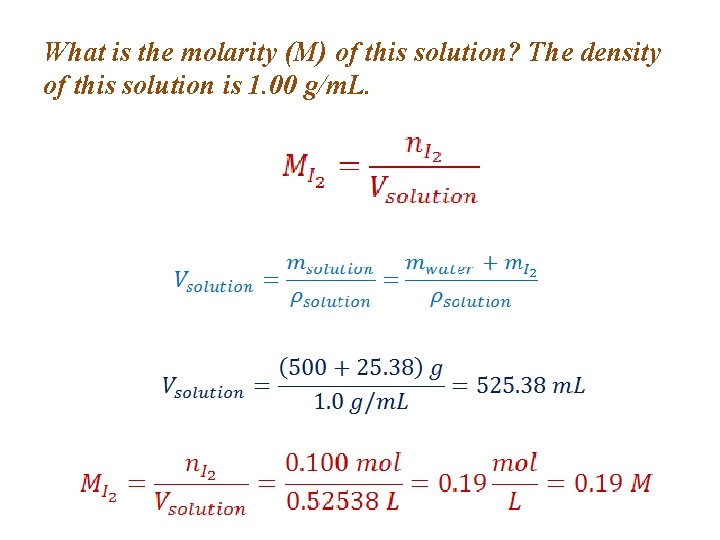
What is the molarity (M) of this solution? The density of this solution is 1. 00 g/m. L.
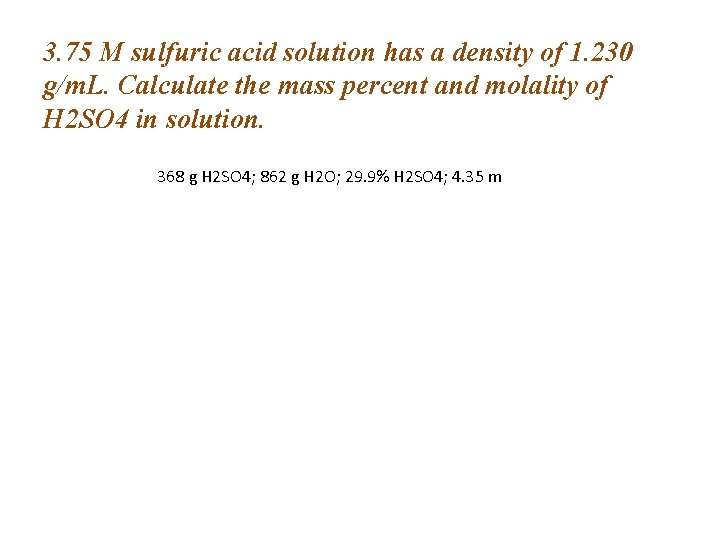
3. 75 M sulfuric acid solution has a density of 1. 230 g/m. L. Calculate the mass percent and molality of H 2 SO 4 in solution. 368 g H 2 SO 4; 862 g H 2 O; 29. 9% H 2 SO 4; 4. 35 m
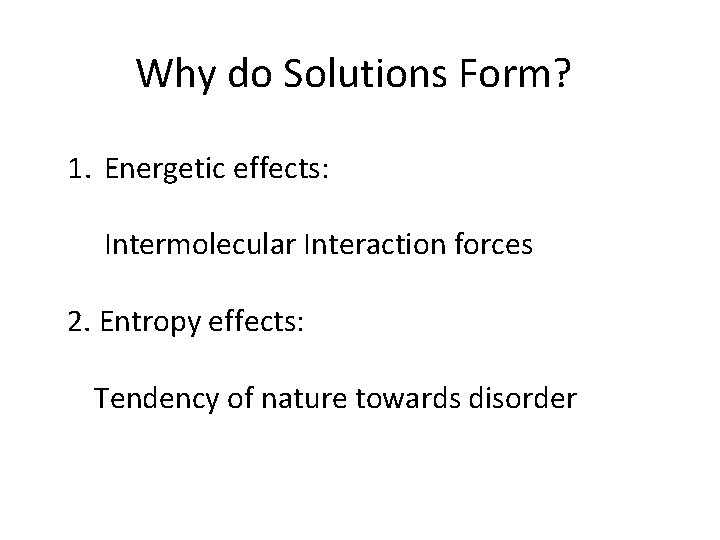
Why do Solutions Form? 1. Energetic effects: Intermolecular Interaction forces 2. Entropy effects: Tendency of nature towards disorder
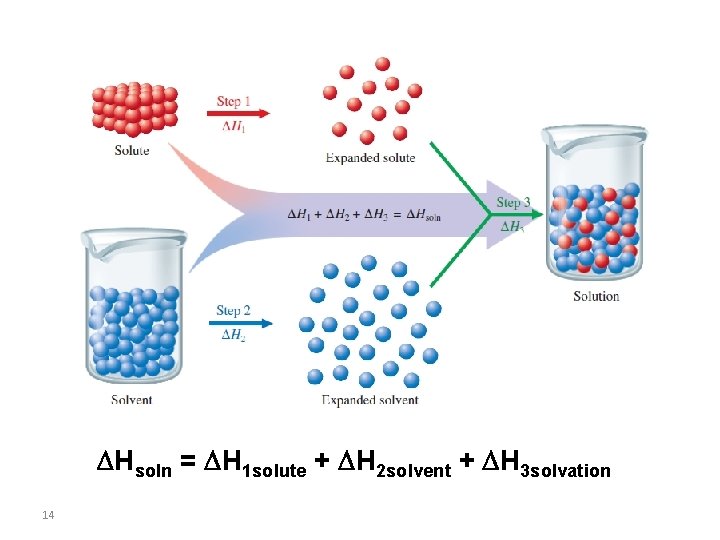
Hsoln = H 1 solute + H 2 solvent + H 3 solvation 14

• Hsoln < 0 (negative) – Energy given off when solution is made – Exothermic – PE of system • Hsoln > 0 (positive) – Costs energy to make solution – Endothermic – PE of system
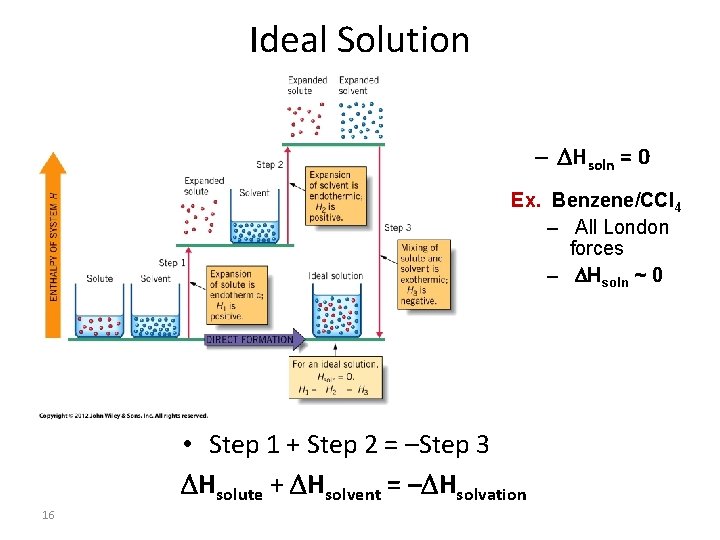
Ideal Solution – Hsoln = 0 Ex. Benzene/CCl 4 – All London forces – Hsoln ~ 0 • Step 1 + Step 2 = –Step 3 Hsolute + Hsolvent = – Hsolvation 16
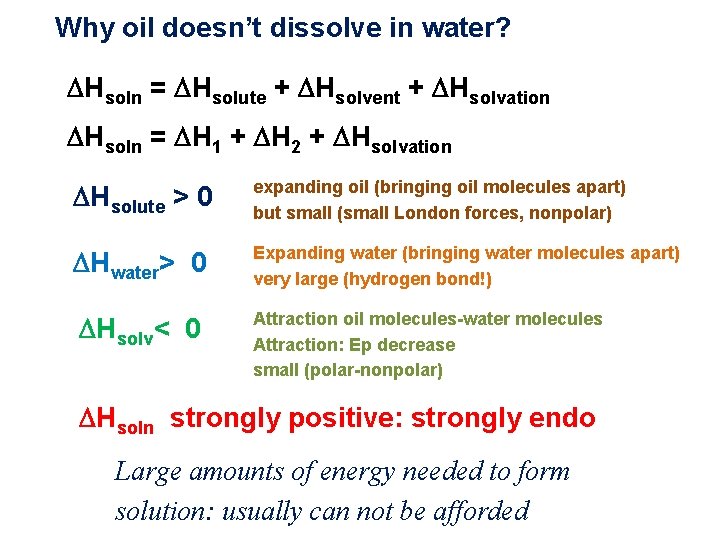
Why oil doesn’t dissolve in water? Hsoln = Hsolute + Hsolvent + Hsolvation Hsoln = H 1 + H 2 + Hsolvation Hsolute > 0 expanding oil (bringing oil molecules apart) but small (small London forces, nonpolar) Hwater> 0 Expanding water (bringing water molecules apart) very large (hydrogen bond!) Hsolv< 0 Attraction oil molecules-water molecules Attraction: Ep decrease small (polar-nonpolar) Hsoln strongly positive: strongly endo Large amounts of energy needed to form solution: usually can not be afforded
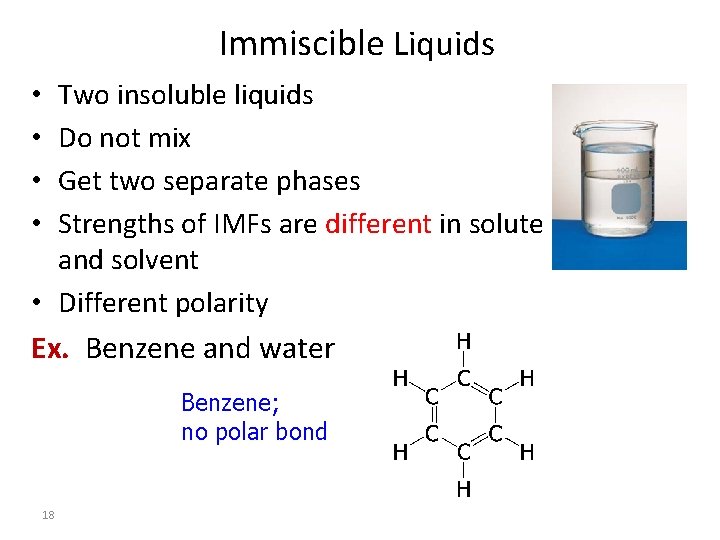
Immiscible Liquids Two insoluble liquids Do not mix Get two separate phases Strengths of IMFs are different in solute and solvent • Different polarity • • Ex. Benzene and water Benzene; no polar bond 18
Rule of Thumb • “Like dissolves Like” – Use polar solvent for polar solute – Use Nonpolar solvent for nonpolar solute 19
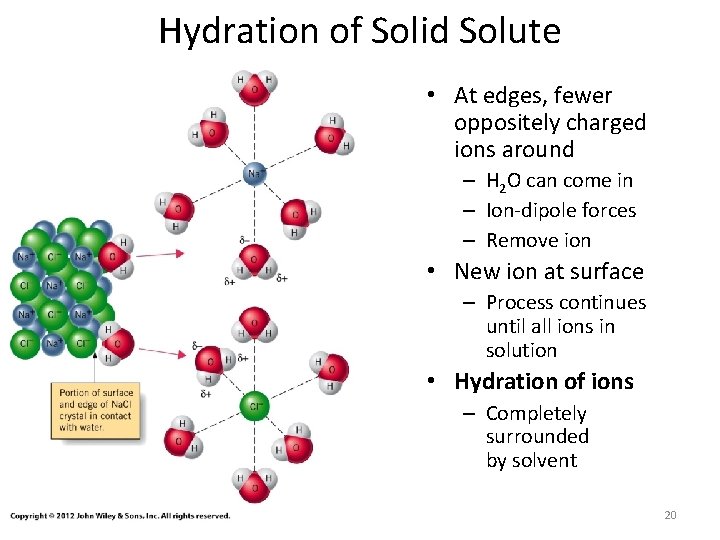
Hydration of Solid Solute • At edges, fewer oppositely charged ions around – H 2 O can come in – Ion-dipole forces – Remove ion • New ion at surface – Process continues until all ions in solution • Hydration of ions – Completely surrounded by solvent 20
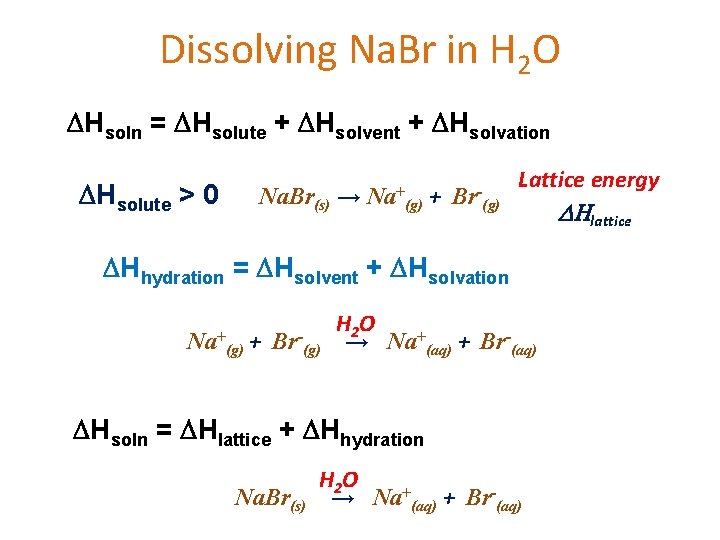
Dissolving Na. Br in H 2 O Hsoln = Hsolute + Hsolvent + Hsolvation Hsolute > 0 Na. Br(s) → Na+ (g) + Br- Lattice energy (g) Hhydration = Hsolvent + Hsolvation Na+ (g) + Br- (g) H 2 O → Na+(aq) + Br-(aq) Hsoln = Hlattice + Hhydration Na. Br(s) H 2 O → Na+(aq) + Br-(aq) DHlattice
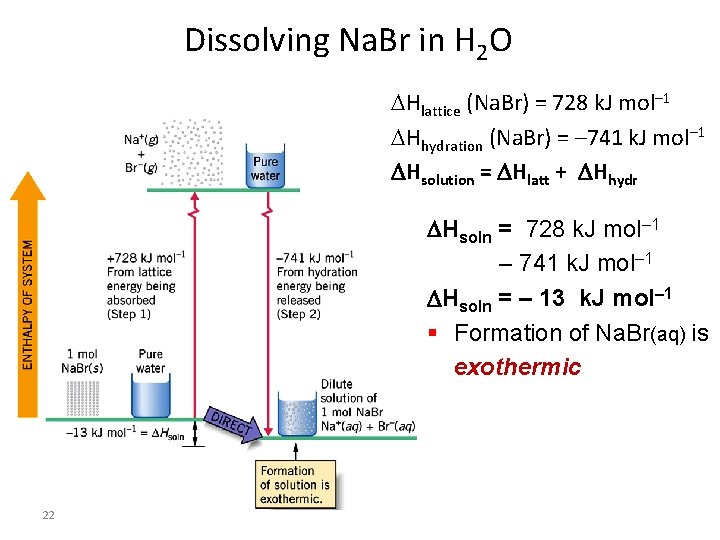
Dissolving Na. Br in H 2 O Hlattice (Na. Br) = 728 k. J mol– 1 Hhydration (Na. Br) = – 741 k. J mol– 1 Hsolution = Hlatt + Hhydr Hsoln = 728 k. J mol– 1 – 741 k. J mol– 1 Hsoln = – 13 k. J mol– 1 § Formation of Na. Br(aq) is exothermic 22
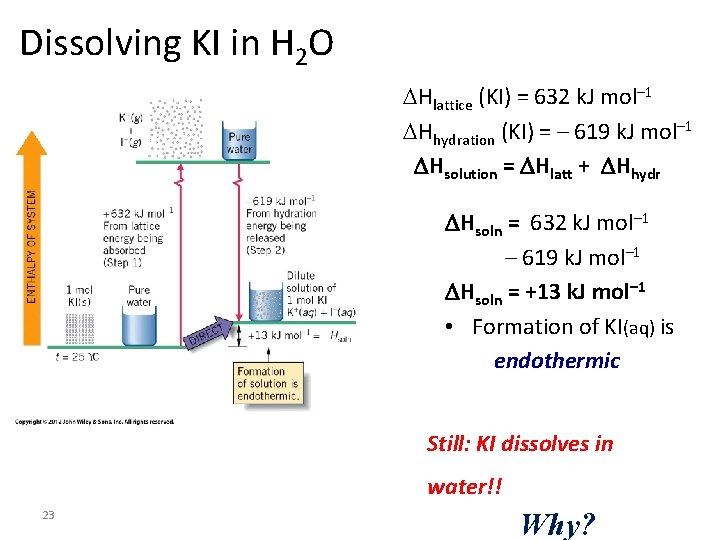
Dissolving KI in H 2 O Hlattice (KI) = 632 k. J mol– 1 Hhydration (KI) = – 619 k. J mol– 1 Hsolution = Hlatt + Hhydr Hsoln = 632 k. J mol– 1 – 619 k. J mol– 1 Hsoln = +13 k. J mol– 1 • Formation of KI(aq) is endothermic Still: KI dissolves in water!! 23 Why?
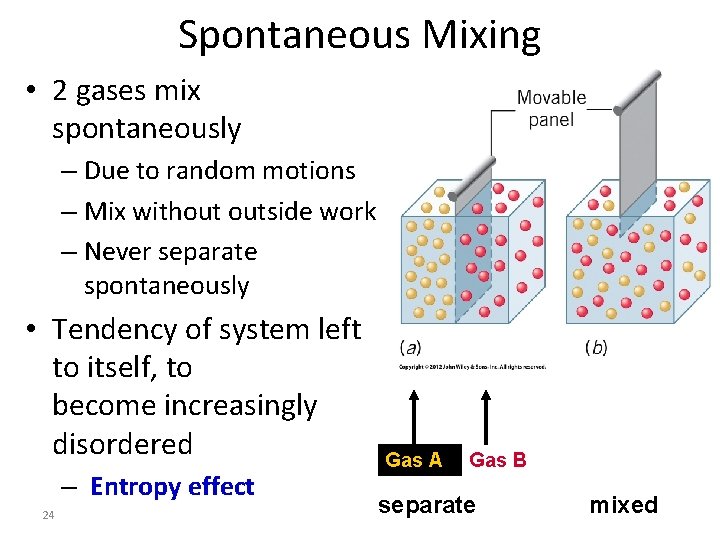
Spontaneous Mixing • 2 gases mix spontaneously – Due to random motions – Mix without outside work – Never separate spontaneously • Tendency of system left to itself, to become increasingly disordered – Entropy effect 24 Gas A Gas B separate mixed
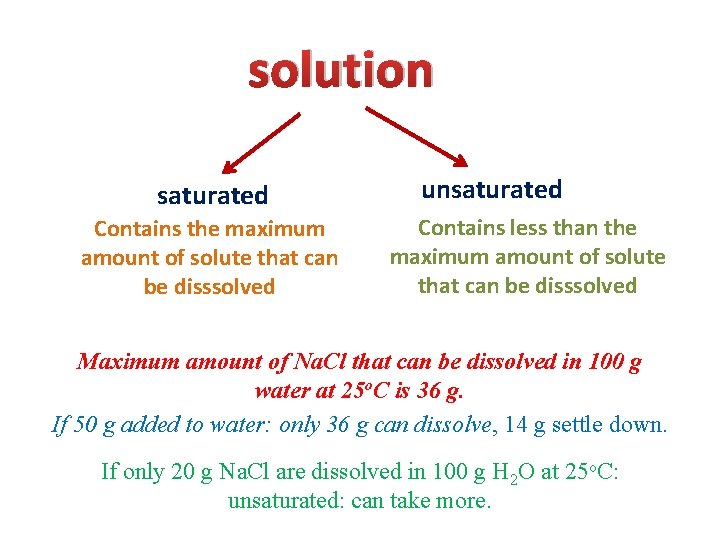
solution saturated Contains the maximum amount of solute that can be disssolved unsaturated Contains less than the maximum amount of solute that can be disssolved Maximum amount of Na. Cl that can be dissolved in 100 g water at 25 o. C is 36 g. If 50 g added to water: only 36 g can dissolve, 14 g settle down. If only 20 g Na. Cl are dissolved in 100 g H 2 O at 25 o. C: unsaturated: can take more.
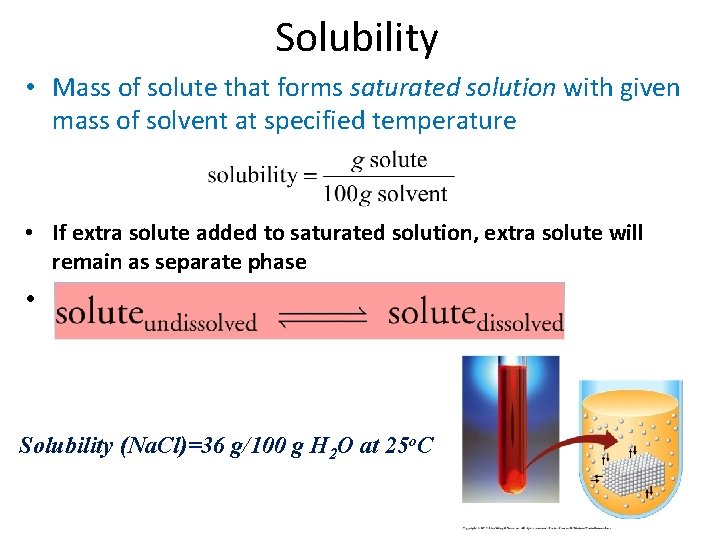
Solubility • Mass of solute that forms saturated solution with given mass of solvent at specified temperature • If extra solute added to saturated solution, extra solute will remain as separate phase • Solubility (Na. Cl)=36 g/100 g H 2 O at 25 o. C 26
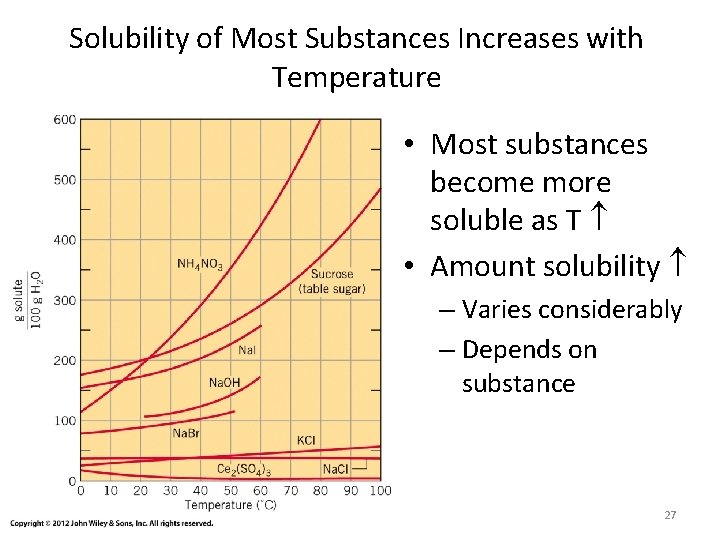
Solubility of Most Substances Increases with Temperature • Most substances become more soluble as T • Amount solubility – Varies considerably – Depends on substance 27
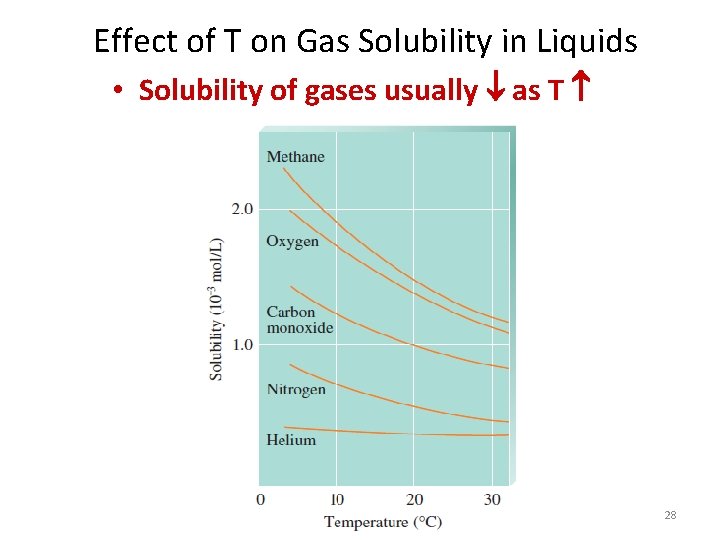
Effect of T on Gas Solubility in Liquids • Solubility of gases usually as T 28
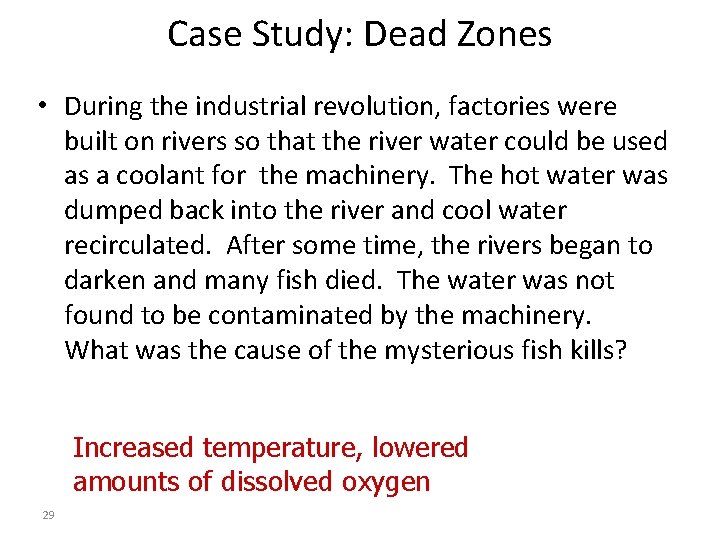
Case Study: Dead Zones • During the industrial revolution, factories were built on rivers so that the river water could be used as a coolant for the machinery. The hot water was dumped back into the river and cool water recirculated. After some time, the rivers began to darken and many fish died. The water was not found to be contaminated by the machinery. What was the cause of the mysterious fish kills? Increased temperature, lowered amounts of dissolved oxygen 29
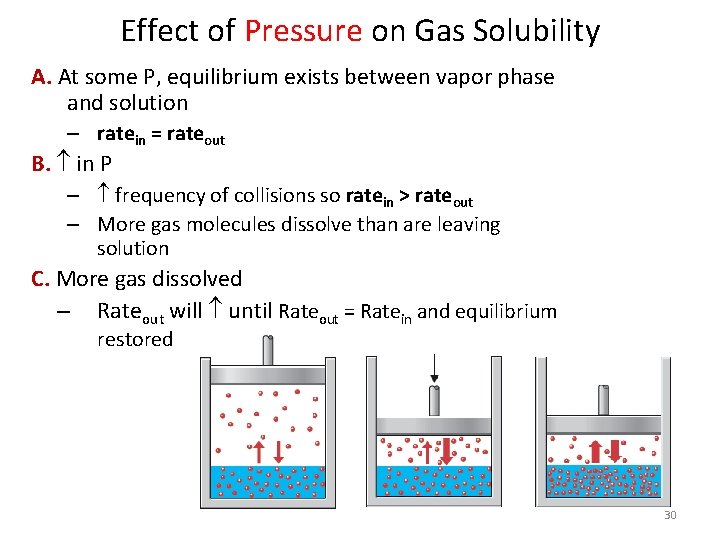
Effect of Pressure on Gas Solubility A. At some P, equilibrium exists between vapor phase and solution – ratein = rateout B. in P – frequency of collisions so ratein > rateout – More gas molecules dissolve than are leaving solution C. More gas dissolved – Rateout will until Rateout = Ratein and equilibrium restored 30
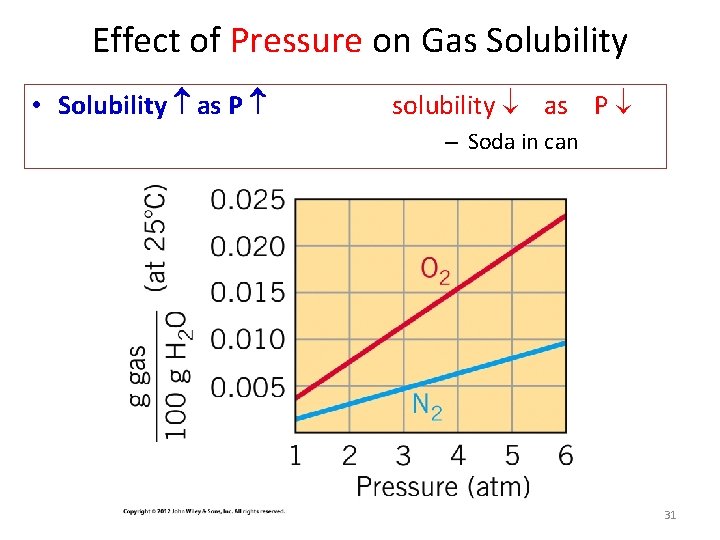
Effect of Pressure on Gas Solubility • Solubility as P solubility as P – Soda in can 31
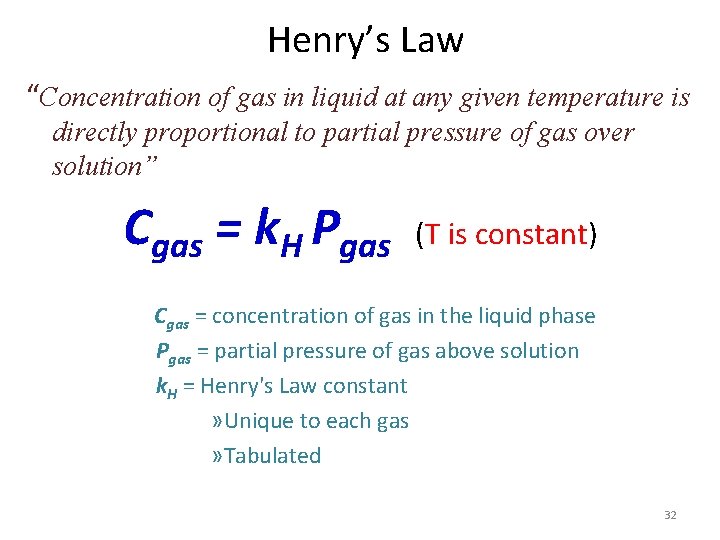
Henry’s Law “Concentration of gas in liquid at any given temperature is directly proportional to partial pressure of gas over solution” Cgas = k. H Pgas (T is constant) Cgas = concentration of gas in the liquid phase Pgas = partial pressure of gas above solution k. H = Henry's Law constant » Unique to each gas » Tabulated 32
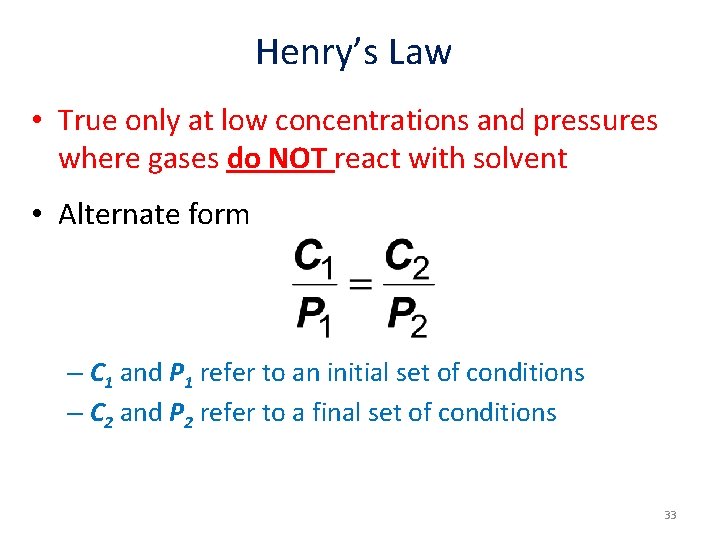
Henry’s Law • True only at low concentrations and pressures where gases do NOT react with solvent • Alternate form – C 1 and P 1 refer to an initial set of conditions – C 2 and P 2 refer to a final set of conditions 33
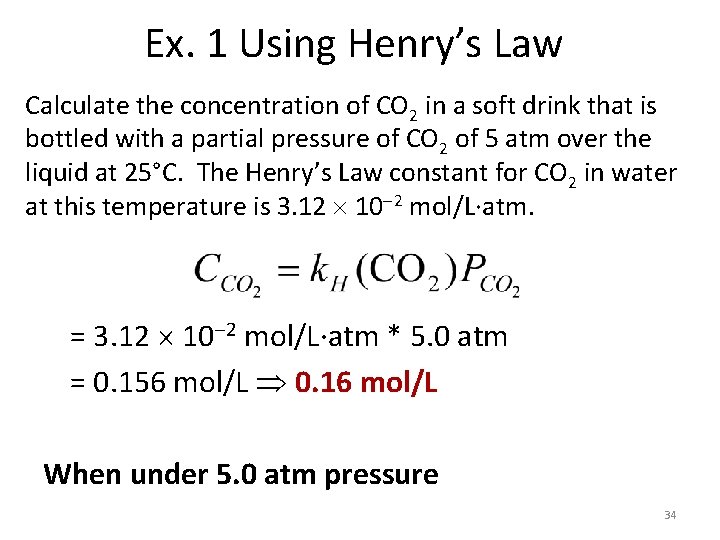
Ex. 1 Using Henry’s Law Calculate the concentration of CO 2 in a soft drink that is bottled with a partial pressure of CO 2 of 5 atm over the liquid at 25°C. The Henry’s Law constant for CO 2 in water at this temperature is 3. 12 10 2 mol/L·atm. = 3. 12 10 2 mol/L·atm * 5. 0 atm = 0. 156 mol/L 0. 16 mol/L When under 5. 0 atm pressure 34
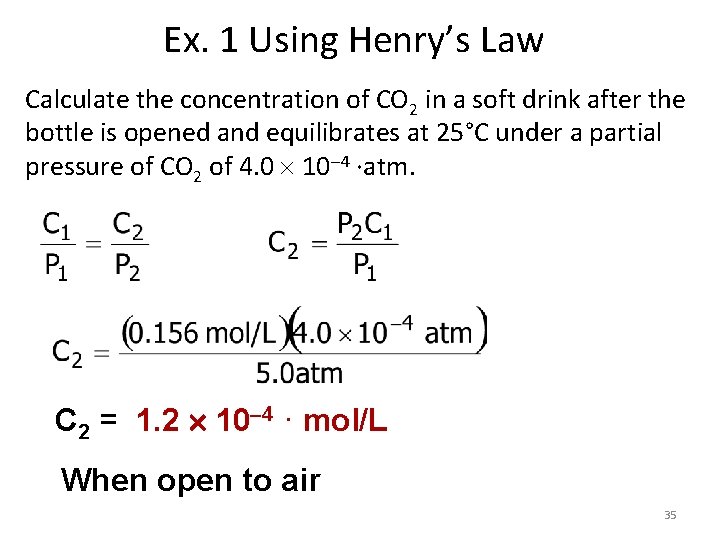
Ex. 1 Using Henry’s Law Calculate the concentration of CO 2 in a soft drink after the bottle is opened and equilibrates at 25°C under a partial pressure of CO 2 of 4. 0 10 4 ·atm. C 2 = 1. 2 10 4 · mol/L When open to air 35
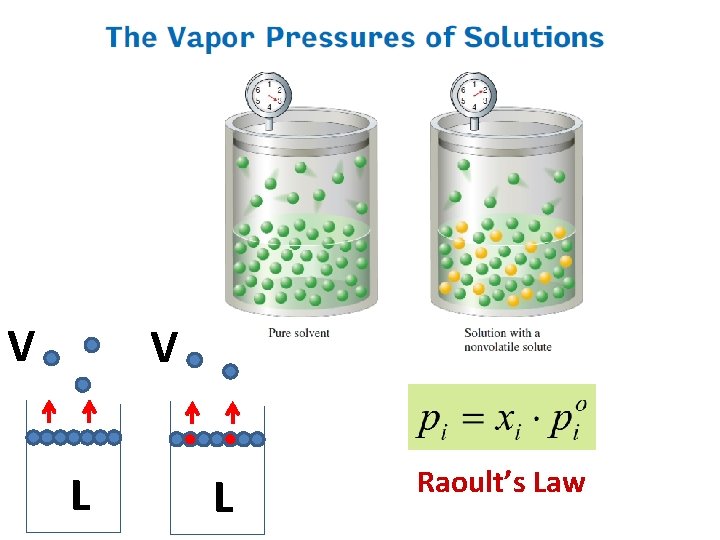
V V L L Raoult’s Law
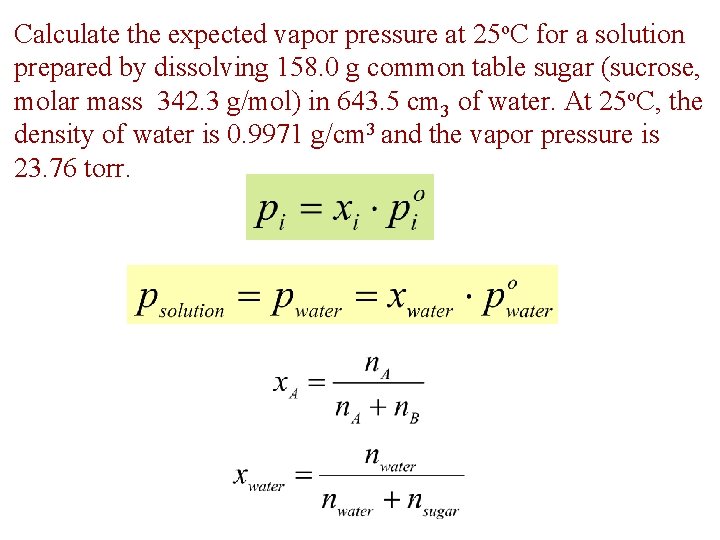
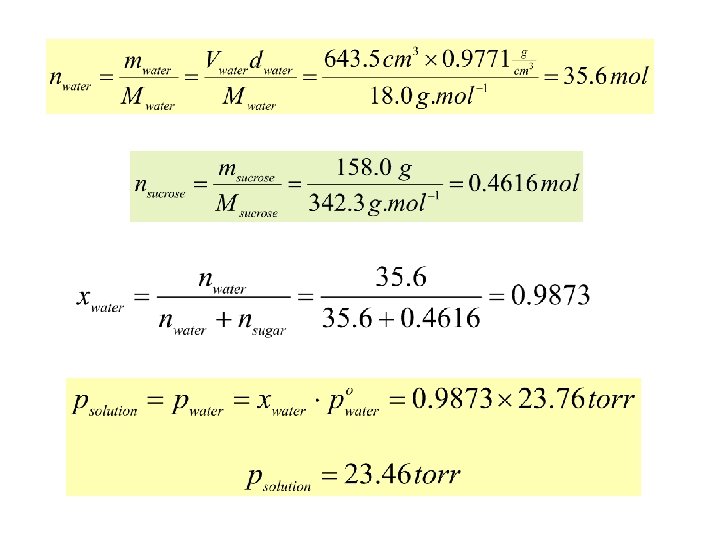
Calculate the expected vapor pressure at 25 o. C for a solution prepared by dissolving 158. 0 g common table sugar (sucrose, molar mass 342. 3 g/mol) in 643. 5 cm 3 of water. At 25 o. C, the density of water is 0. 9971 g/cm 3 and the vapor pressure is 23. 76 torr.
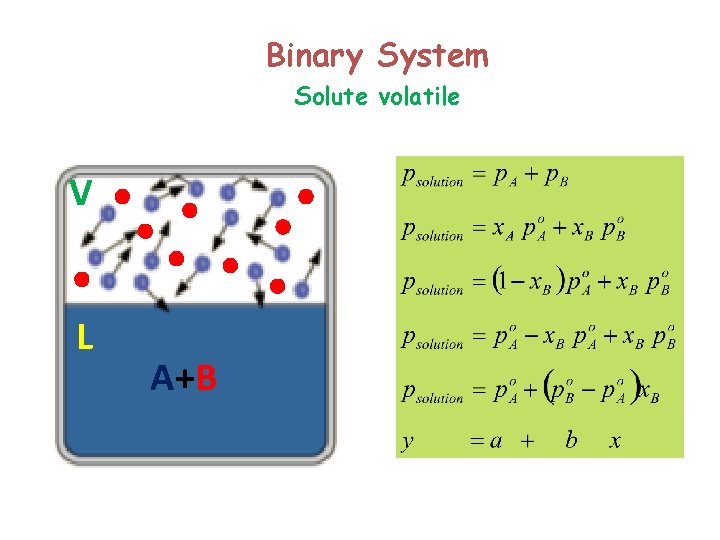
Binary System Solute volatile V L A+B
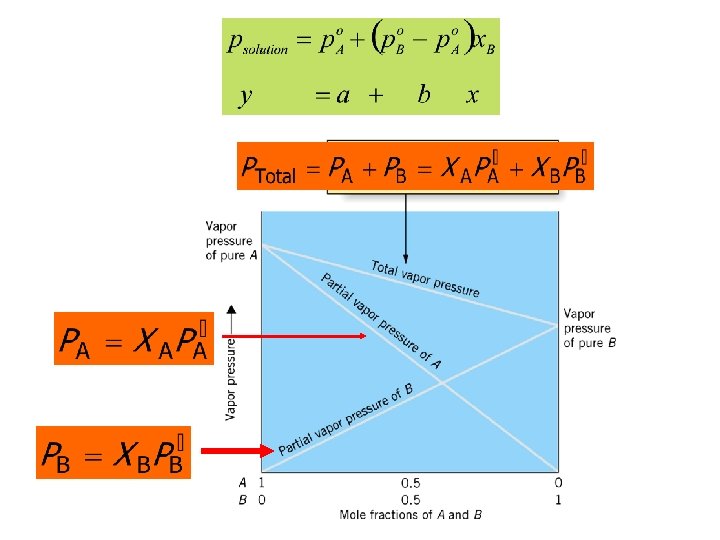
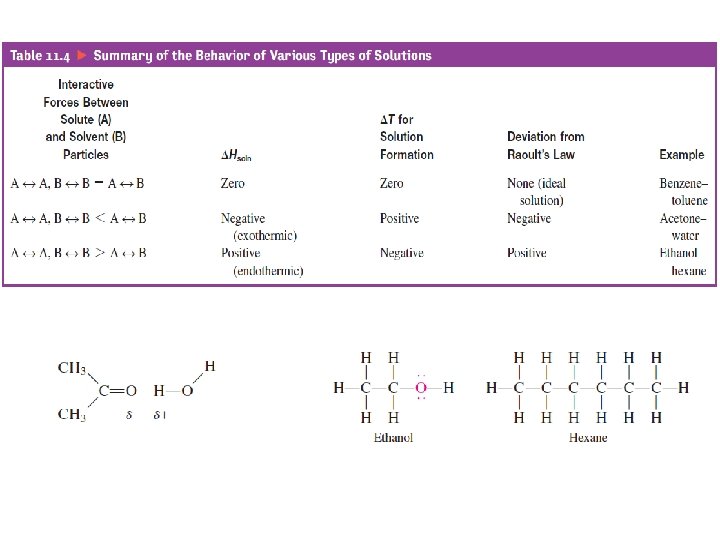

positive deviation negative deviation P > Pideal P < Pideal
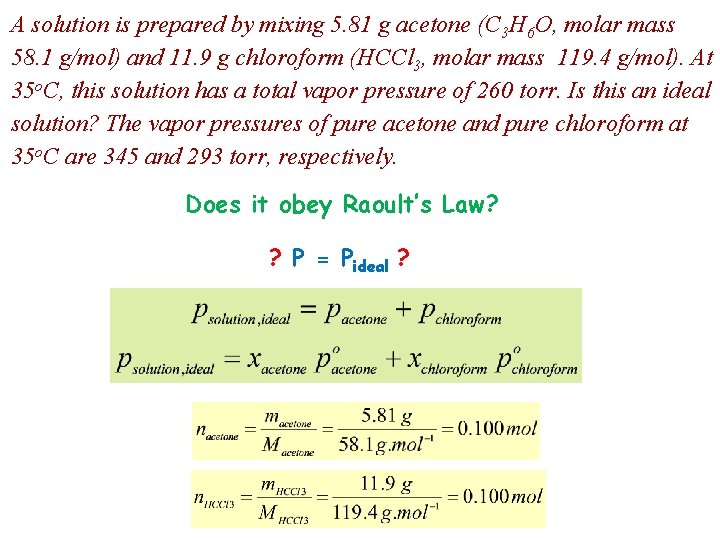
A solution is prepared by mixing 5. 81 g acetone (C 3 H 6 O, molar mass 58. 1 g/mol) and 11. 9 g chloroform (HCCl 3, molar mass 119. 4 g/mol). At 35 o. C, this solution has a total vapor pressure of 260 torr. Is this an ideal solution? The vapor pressures of pure acetone and pure chloroform at 35 o. C are 345 and 293 torr, respectively. Does it obey Raoult’s Law? ? P = Pideal ?

P < Pideal 260 < 319 negative deviation
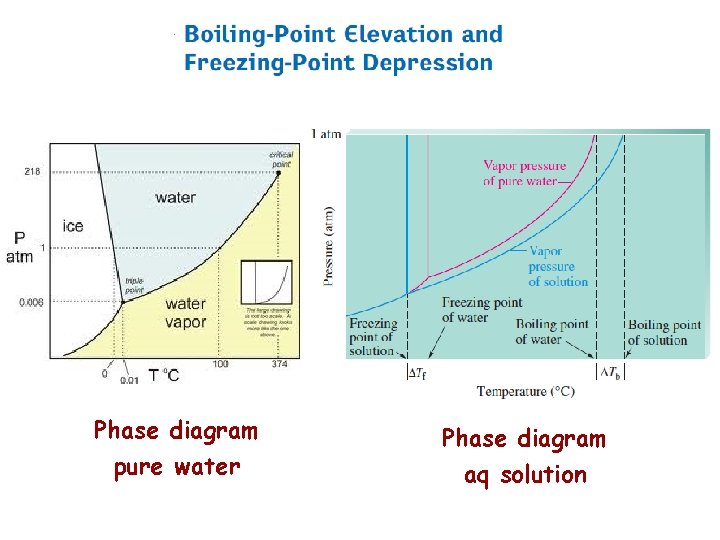
Phase diagram pure water Phase diagram aq solution
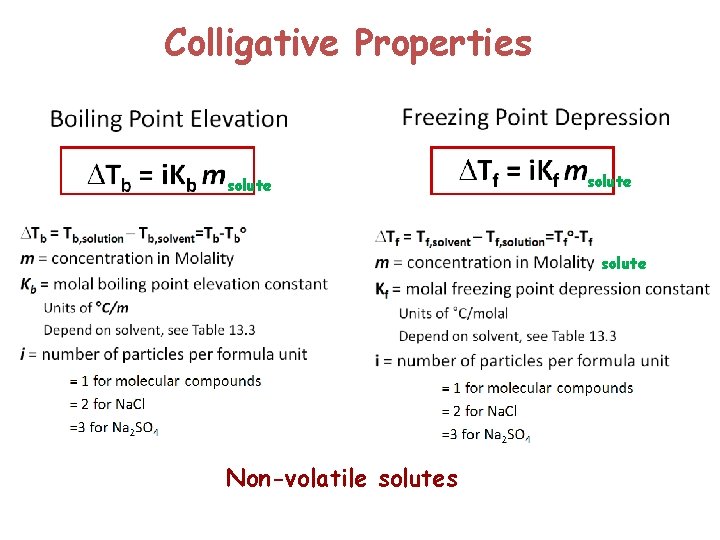
Colligative Properties solute Non-volatile solutes
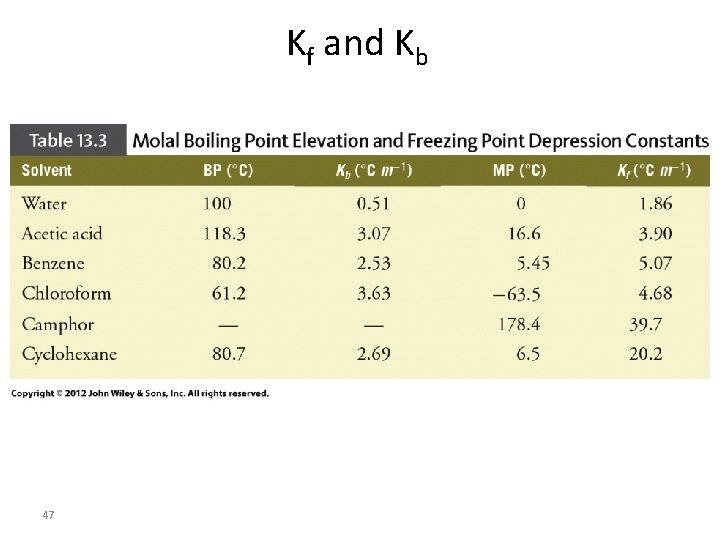
Kf and Kb 47
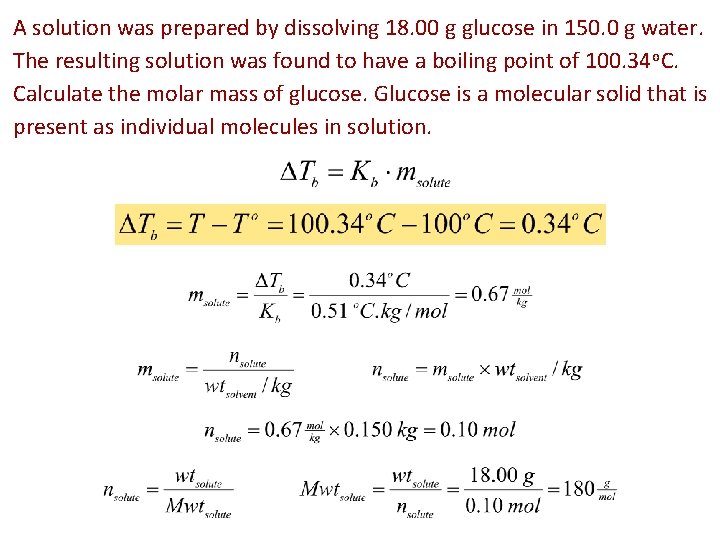
A solution was prepared by dissolving 18. 00 g glucose in 150. 0 g water. The resulting solution was found to have a boiling point of 100. 34 o. C. Calculate the molar mass of glucose. Glucose is a molecular solid that is present as individual molecules in solution.
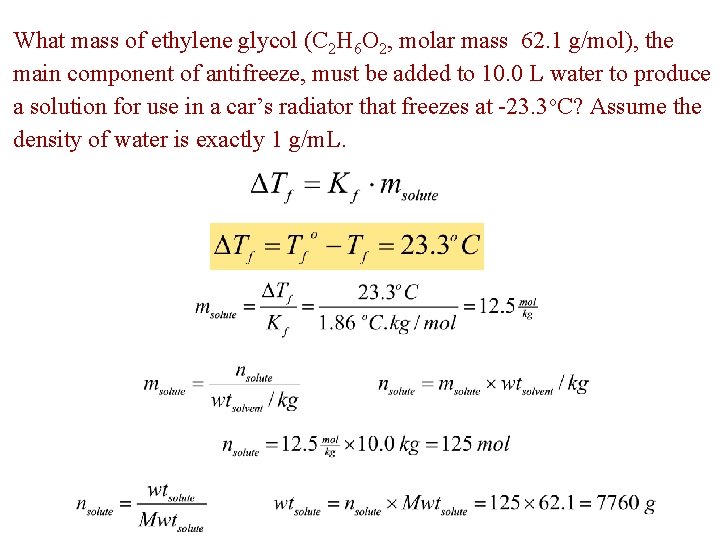
What mass of ethylene glycol (C 2 H 6 O 2, molar mass 62. 1 g/mol), the main component of antifreeze, must be added to 10. 0 L water to produce a solution for use in a car’s radiator that freezes at -23. 3 o. C? Assume the density of water is exactly 1 g/m. L.
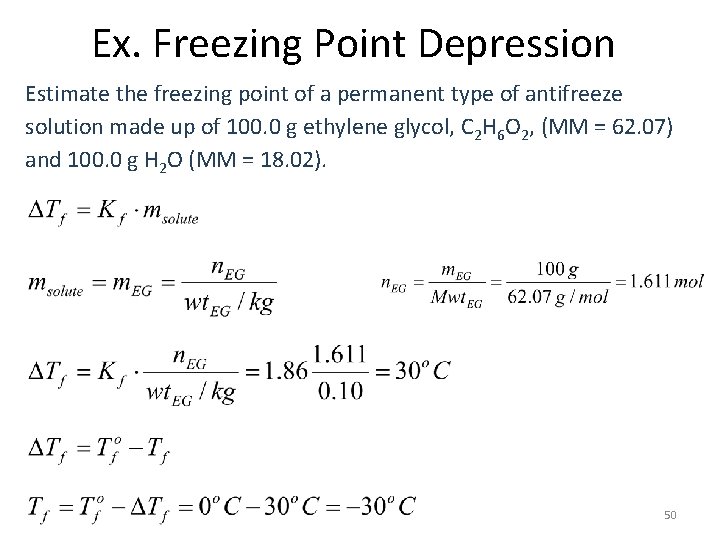
Ex. Freezing Point Depression Estimate the freezing point of a permanent type of antifreeze solution made up of 100. 0 g ethylene glycol, C 2 H 6 O 2, (MM = 62. 07) and 100. 0 g H 2 O (MM = 18. 02). 50
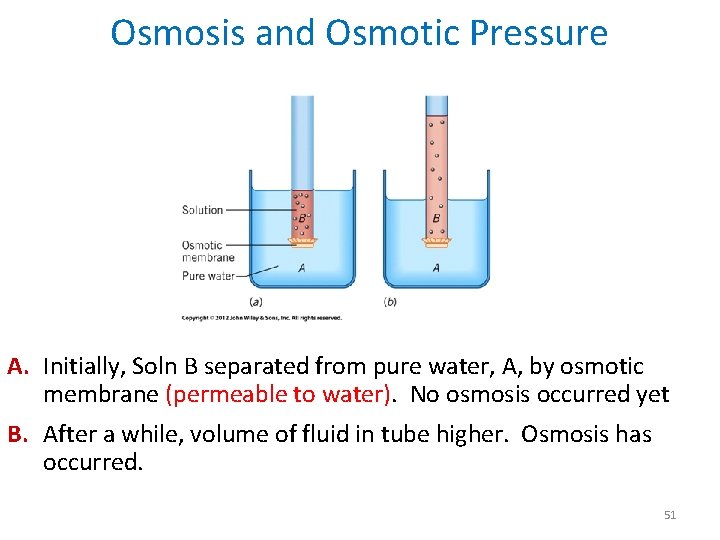
Osmosis and Osmotic Pressure A. Initially, Soln B separated from pure water, A, by osmotic membrane (permeable to water). No osmosis occurred yet B. After a while, volume of fluid in tube higher. Osmosis has occurred. 51
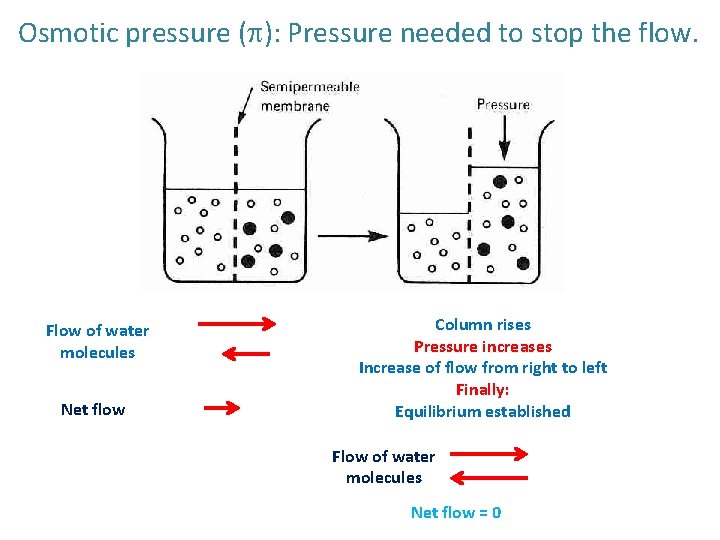
Osmotic pressure (p): Pressure needed to stop the flow. Flow of water molecules Net flow Column rises Pressure increases Increase of flow from right to left Finally: Equilibrium established Flow of water molecules Net flow = 0
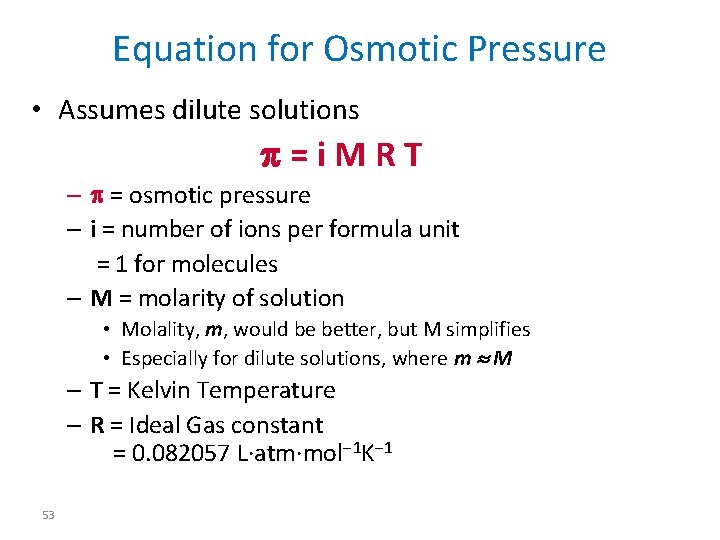
Equation for Osmotic Pressure • Assumes dilute solutions p=i. MRT – p = osmotic pressure – i = number of ions per formula unit = 1 for molecules – M = molarity of solution • Molality, m, would be better, but M simplifies • Especially for dilute solutions, where m M – T = Kelvin Temperature – R = Ideal Gas constant = 0. 082057 L·atm·mol 1 K 1 53
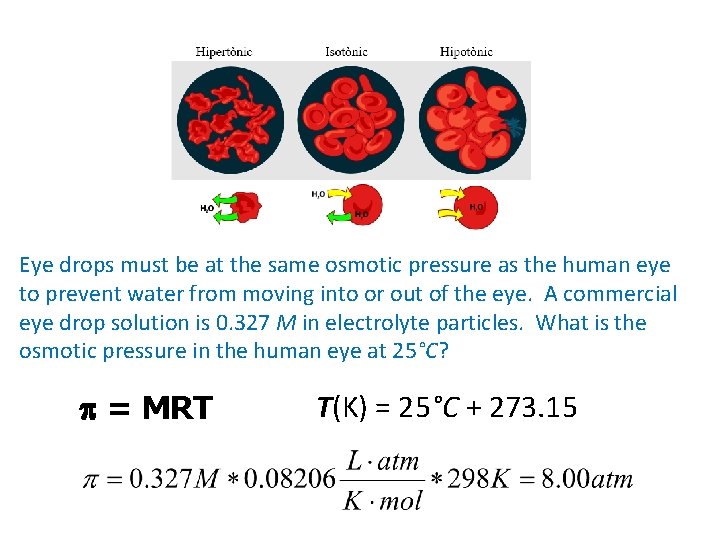
Eye drops must be at the same osmotic pressure as the human eye to prevent water from moving into or out of the eye. A commercial eye drop solution is 0. 327 M in electrolyte particles. What is the osmotic pressure in the human eye at 25°C? p = MRT T(K) = 25°C + 273. 15
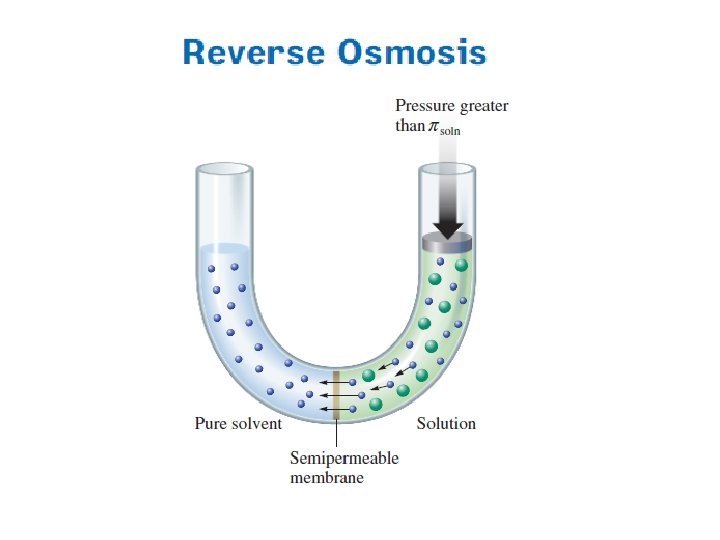
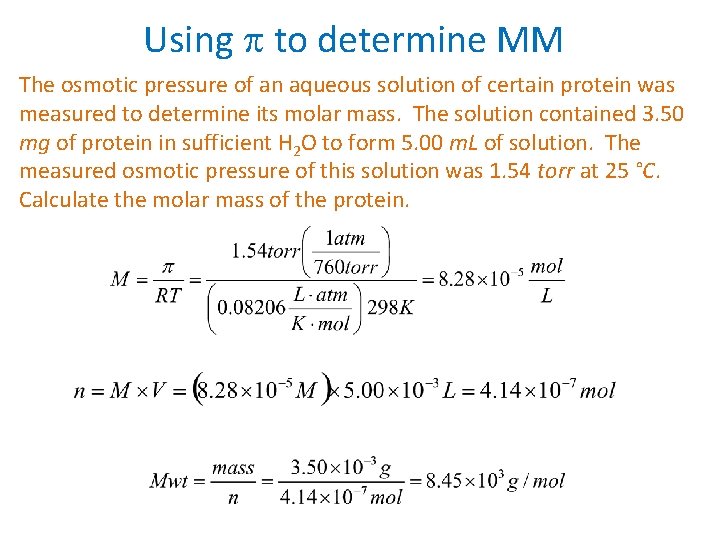
Using p to determine MM The osmotic pressure of an aqueous solution of certain protein was measured to determine its molar mass. The solution contained 3. 50 mg of protein in sufficient H 2 O to form 5. 00 m. L of solution. The measured osmotic pressure of this solution was 1. 54 torr at 25 °C. Calculate the molar mass of the protein.
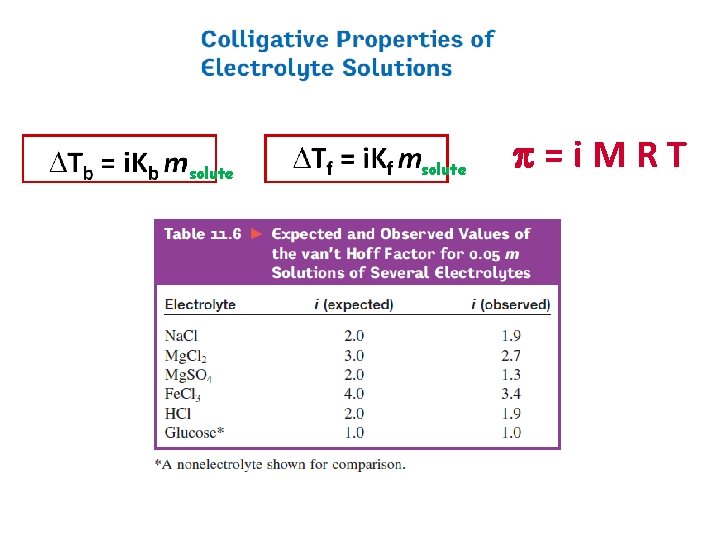
solute p=i. MRT
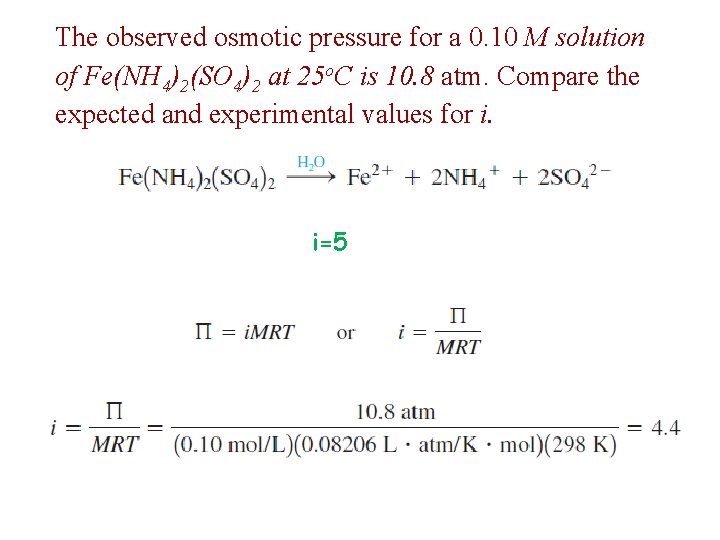
The observed osmotic pressure for a 0. 10 M solution of Fe(NH 4)2(SO 4)2 at 25 o. C is 10. 8 atm. Compare the expected and experimental values for i. i=5
- Slides: 58