
Solution for HKOI 2010 Junior Q 4 By

Solution for HKOI 2010 Junior Q 4 By Gary Sham INSECT GALORE 豐富的昆蟲
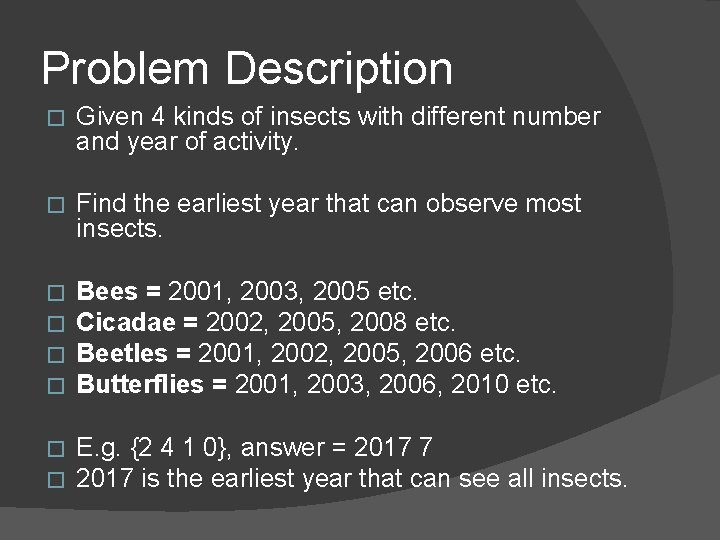
Problem Description � Given 4 kinds of insects with different number and year of activity. � Find the earliest year that can observe most insects. � � Bees = 2001, 2003, 2005 etc. Cicadae = 2002, 2005, 2008 etc. Beetles = 2001, 2002, 2005, 2006 etc. Butterflies = 2001, 2003, 2006, 2010 etc. � � E. g. {2 4 1 0}, answer = 2017 7 2017 is the earliest year that can see all insects.
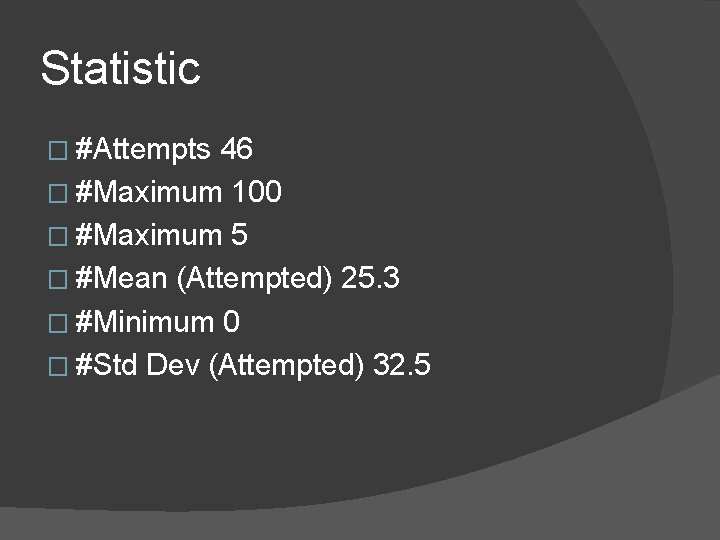
Statistic � #Attempts 46 � #Maximum 100 � #Maximum 5 � #Mean (Attempted) 25. 3 � #Minimum 0 � #Std Dev (Attempted) 32. 5

Question � How to know which kind of insects will appear that year? � Mathematics � Or simulation and array. � Another question : When to stop? ?
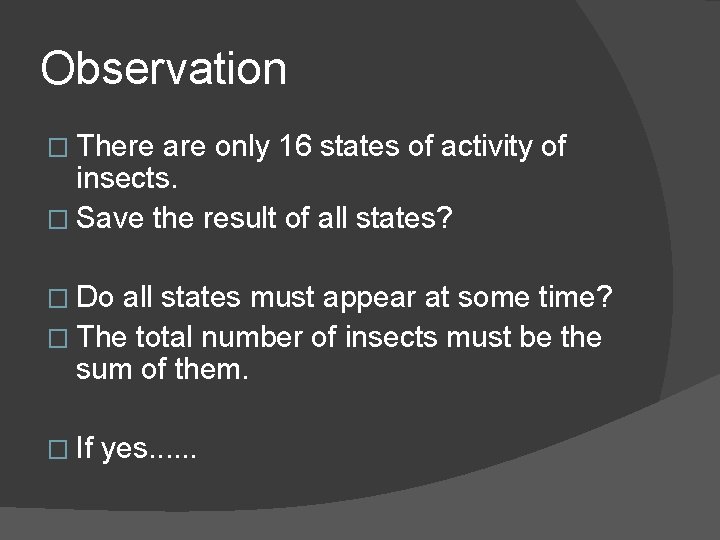
Observation � There are only 16 states of activity of insects. � Save the result of all states? � Do all states must appear at some time? � The total number of insects must be the sum of them. � If yes. . .
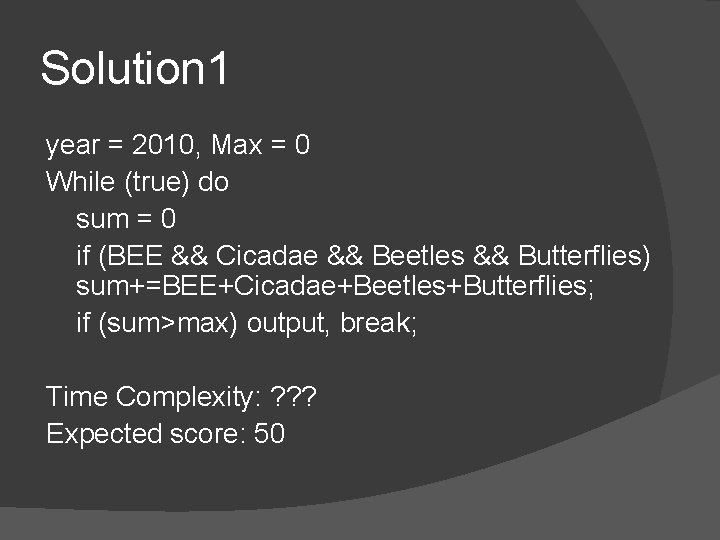
Solution 1 year = 2010, Max = 0 While (true) do sum = 0 if (BEE && Cicadae && Beetles && Butterflies) sum+=BEE+Cicadae+Beetles+Butterflies; if (sum>max) output, break; Time Complexity: ? ? ? Expected score: 50
In fact…… � NO! � The problem is Butterflies. � Butterflies and Cicadae will not appear at the same time. � Prove by Mathematics.

Full Solution � For each state, there are only one answer: YEAR and HOW TO ADD THE NUMBER will not change. Hardcode � We have to consider whether we choose Butterflies or Cicadae. Maximum 2021 � Time Complexity: O(1) � Expected Score: 100 �

Skills � Observation � Mathematics � Hardcode

END
- Slides: 10