
Solubility Product Constant Ksp Chapter 17 I Ba

Solubility Product Constant Ksp Chapter 17
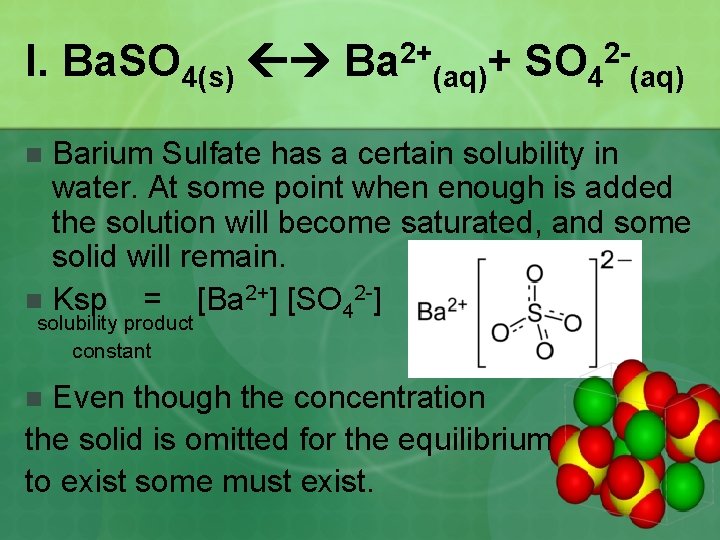
I. Ba. SO 4(s) 2+ Ba (aq)+ SO 4 2 - (aq) Barium Sulfate has a certain solubility in water. At some point when enough is added the solution will become saturated, and some solid will remain. n Ksp = [Ba 2+] [SO 42 -] n solubility product constant Even though the concentration the solid is omitted for the equilibrium to exist some must exist. n
II. Solubility and Ksp The smaller the value of Ksp the lower the solubility n Solubility – the amount of a substance that dissolves when producing a saturated solution is often expressed in grams of solute /liter of solution at saturation point. n Solubility product constant (Ksp) – describes the concentrations) of dissolved ions, or substances at saturated equilibrium and is a unit less expression. n
Solubility and Ksp n Solubility of a substance may change as the concentrations of various ions change ( including H+), however the value of Ksp is unique for a given solute at a specific temperature.
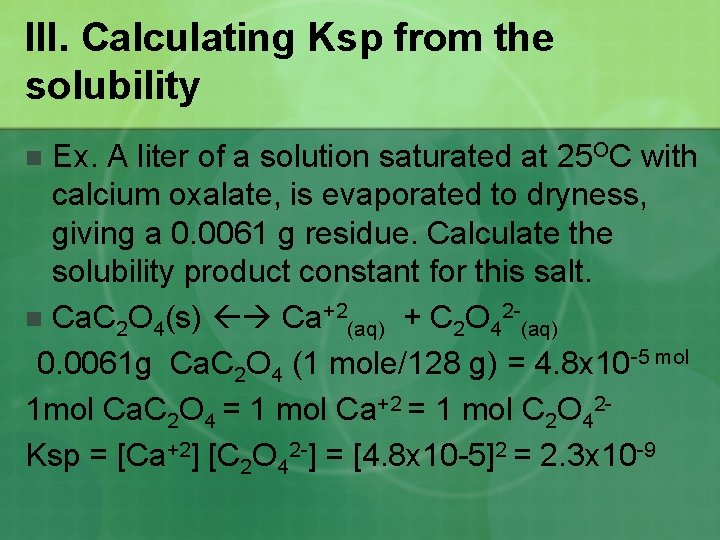
III. Calculating Ksp from the solubility Ex. A liter of a solution saturated at 25 OC with calcium oxalate, is evaporated to dryness, giving a 0. 0061 g residue. Calculate the solubility product constant for this salt. n Ca. C 2 O 4(s) Ca+2(aq) + C 2 O 42 -(aq) -5 mol 0. 0061 g Ca. C O (1 mole/128 g) = 4. 8 x 10 2 4 1 mol Ca. C 2 O 4 = 1 mol Ca+2 = 1 mol C 2 O 42 Ksp = [Ca+2] [C 2 O 42 -] = [4. 8 x 10 -5]2 = 2. 3 x 10 -9 n
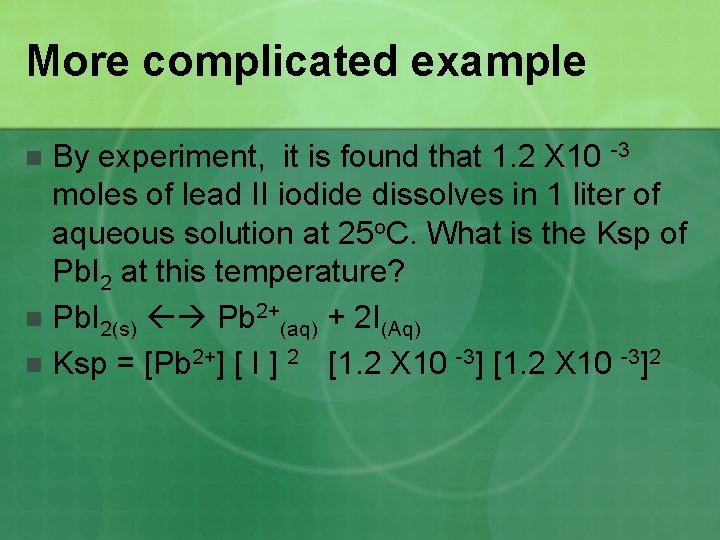
More complicated example By experiment, it is found that 1. 2 X 10 -3 moles of lead II iodide dissolves in 1 liter of aqueous solution at 25 o. C. What is the Ksp of Pb. I 2 at this temperature? n Pb. I 2(s) Pb 2+(aq) + 2 I(Aq) n Ksp = [Pb 2+] [ I ] 2 [1. 2 X 10 -3]2 n
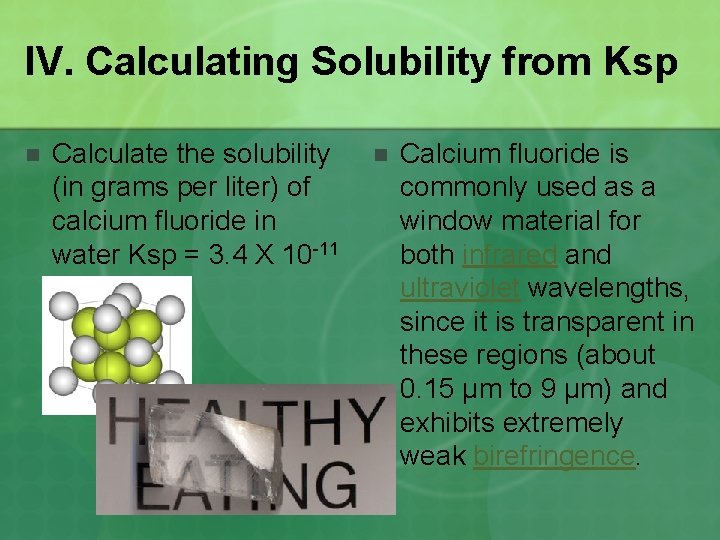
IV. Calculating Solubility from Ksp n Calculate the solubility (in grams per liter) of calcium fluoride in water Ksp = 3. 4 X 10 -11 n Calcium fluoride is commonly used as a window material for both infrared and ultraviolet wavelengths, since it is transparent in these regions (about 0. 15 µm to 9 µm) and exhibits extremely weak birefringence.
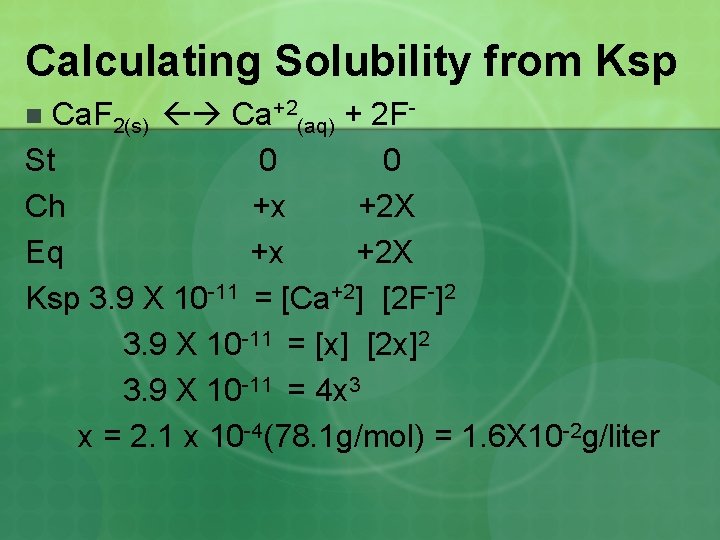
Calculating Solubility from Ksp Ca. F 2(s) Ca+2(aq) + 2 F- St 0 0 Ch +x +2 X Eq +x +2 X Ksp 3. 9 X 10 -11 = [Ca+2] [2 F-]2 3. 9 X 10 -11 = [x] [2 x]2 3. 9 X 10 -11 = 4 x 3 x = 2. 1 x 10 -4(78. 1 g/mol) = 1. 6 X 10 -2 g/liter n
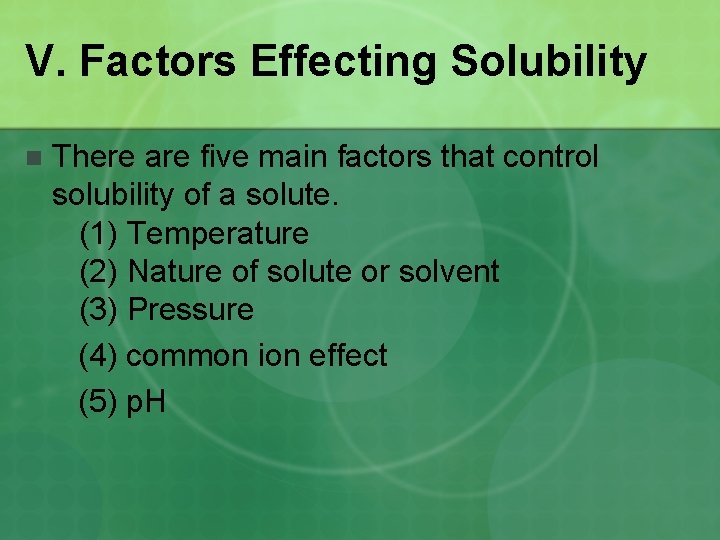
V. Factors Effecting Solubility There are five main factors that control solubility of a solute. (1) Temperature (2) Nature of solute or solvent (3) Pressure (4) common ion effect (5) p. H n
Temperature Generally solubility increases with the rise in temperature and decreases with the fall of temperature but not in all cases. n In endothermic process solubility increases with the increase in temperature and vice versa. n In exothermic process solubility decrease with the increase in temperature. n Gases are more soluble in cold solvent than in hot solvent. n
NATURE OF SOLUTE AND SOLVENT A polar solute dissolved in polar solvent. n Solubility of a non-polar solute in a solvent is large. n A polar solute has low solubility or insoluble in a non-polar solvent. n In general like dissolves like n
EFFECT OF PRESSURE The effect of pressure is observed only in the case of gases. n An increase in pressure increases of solubility of a gas in a liquid. n For example carbon dioxide is filled in cold drink bottles (such as coca cola, Pepsi 7 up etc. ) under pressure. n
Common Ion Effect The presence of other solutes can also influence solubility – although they do not effect Ksp n Ca. F 2(s) Ca+2(aq) + 2 F addition of calcium or fluoride ion will shift the equilibrium left favoring solid formation and decreasing solubility of the compound n
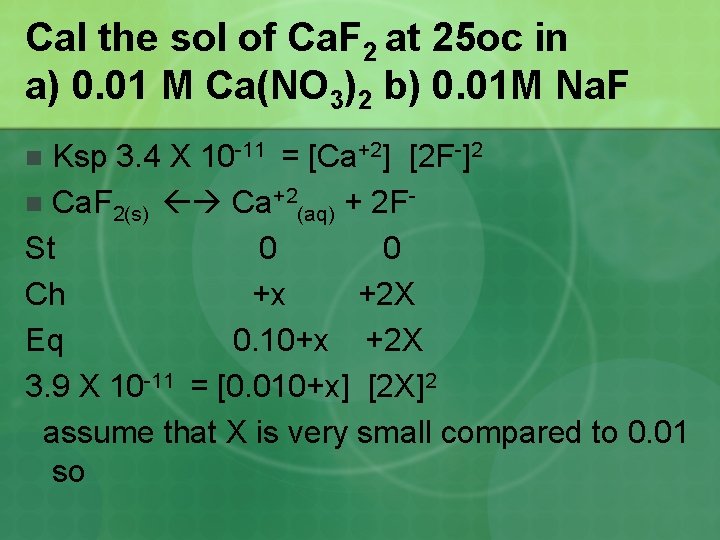
Cal the sol of Ca. F 2 at 25 oc in a) 0. 01 M Ca(NO 3)2 b) 0. 01 M Na. F Ksp 3. 4 X 10 -11 = [Ca+2] [2 F-]2 n Ca. F 2(s) Ca+2(aq) + 2 F- St 0 0 Ch +x +2 X Eq 0. 10+x +2 X 3. 9 X 10 -11 = [0. 010+x] [2 X]2 assume that X is very small compared to 0. 01 so n
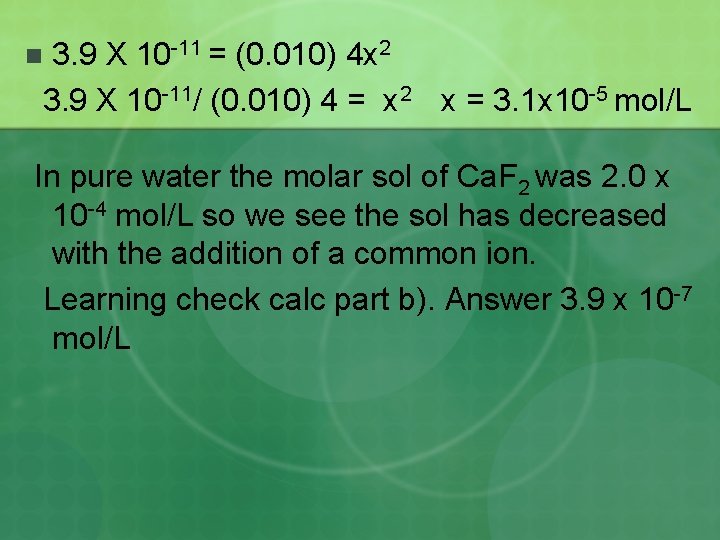
3. 9 X 10 -11 = (0. 010) 4 x 2 3. 9 X 10 -11/ (0. 010) 4 = x 2 x = 3. 1 x 10 -5 mol/L n In pure water the molar sol of Ca. F 2 was 2. 0 x 10 -4 mol/L so we see the sol has decreased with the addition of a common ion. Learning check calc part b). Answer 3. 9 x 10 -7 mol/L
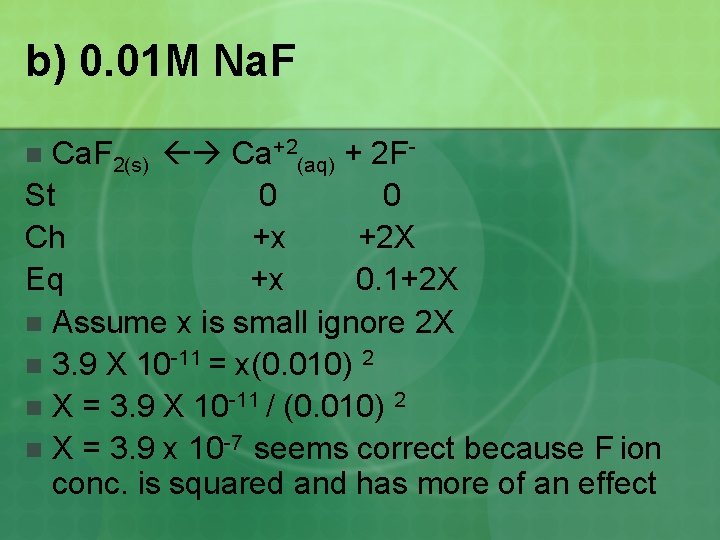
b) 0. 01 M Na. F Ca. F 2(s) Ca+2(aq) + 2 F- St 0 0 Ch +x +2 X Eq +x 0. 1+2 X n Assume x is small ignore 2 X n 3. 9 X 10 -11 = x(0. 010) 2 n X = 3. 9 X 10 -11 / (0. 010) 2 n X = 3. 9 x 10 -7 seems correct because F ion conc. is squared and has more of an effect n
- Slides: 16