
Solubility Product and Complexion Effect 1 Material was
Solubility Product and Complex-ion Effect 1 Material was developed by combining Janusa’s material with the lecture outline provided with Ebbing, D. D. ; Gammon, S. D. General Chemistry, 8 th ed. , Houghton Mifflin, New York, NY, 2005. Majority of figures/tables are from the Ebbing lecture outline.
Solubility Equilibria • Many natural processes depend on the precipitation or dissolving of a slightly soluble salt. – In the next section, we look at the equilibria of slightly soluble, or nearly insoluble, ionic compounds. – Their equilibrium constants can be used to answer questions regarding solubility and precipitation. 2 Material was developed by combining Janusa’s material with the lecture outline provided with Ebbing, D. D. ; Gammon, S. D. General Chemistry, 8 th ed. , Houghton Mifflin, New York, NY, 2005. Majority of figures/tables are from the Ebbing lecture outline.
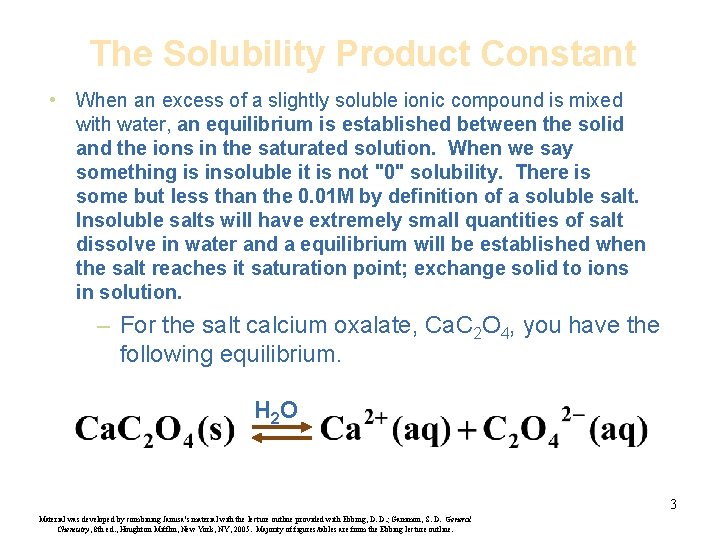
The Solubility Product Constant • When an excess of a slightly soluble ionic compound is mixed with water, an equilibrium is established between the solid and the ions in the saturated solution. When we say something is insoluble it is not "0" solubility. There is some but less than the 0. 01 M by definition of a soluble salt. Insoluble salts will have extremely small quantities of salt dissolve in water and a equilibrium will be established when the salt reaches it saturation point; exchange solid to ions in solution. – For the salt calcium oxalate, Ca. C 2 O 4, you have the following equilibrium. H 2 O 3 Material was developed by combining Janusa’s material with the lecture outline provided with Ebbing, D. D. ; Gammon, S. D. General Chemistry, 8 th ed. , Houghton Mifflin, New York, NY, 2005. Majority of figures/tables are from the Ebbing lecture outline.
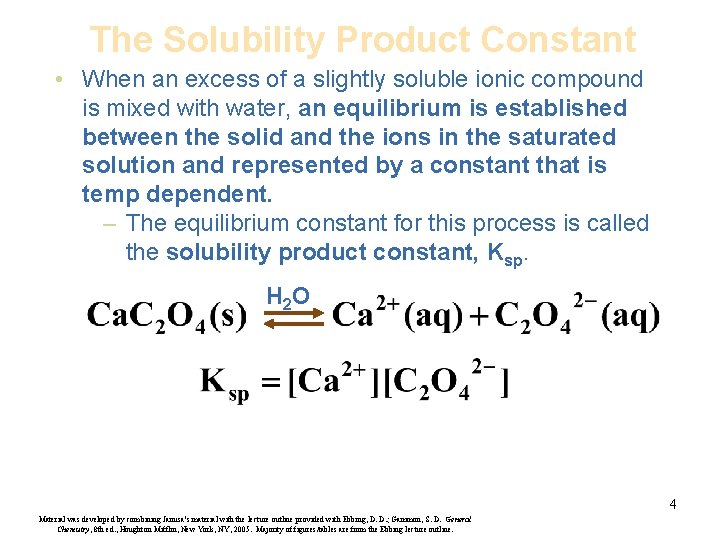
The Solubility Product Constant • When an excess of a slightly soluble ionic compound is mixed with water, an equilibrium is established between the solid and the ions in the saturated solution and represented by a constant that is temp dependent. – The equilibrium constant for this process is called the solubility product constant, Ksp. H 2 O 4 Material was developed by combining Janusa’s material with the lecture outline provided with Ebbing, D. D. ; Gammon, S. D. General Chemistry, 8 th ed. , Houghton Mifflin, New York, NY, 2005. Majority of figures/tables are from the Ebbing lecture outline.
The Solubility Product Constant • In general, the solubility product constant, Ksp, is the equilibrium constant for the solubility equilibrium of a slightly soluble (or nearly insoluble) ionic compound. It is a constant that relates to amount of substance that is dissolve in solution at saturation point not amount in flask (solid not dissolve) – It equals the product of the equilibrium concentrations of the ions in the compound. Solids activity of 1. – Each concentration is raised to a power equal to the number of such ions in the formula of the compound. Material was developed by combining Janusa’s material with the lecture outline provided with Ebbing, D. D. ; Gammon, S. D. General Chemistry, 8 th ed. , Houghton Mifflin, New York, NY, 2005. Majority of figures/tables are from the Ebbing lecture outline. 5
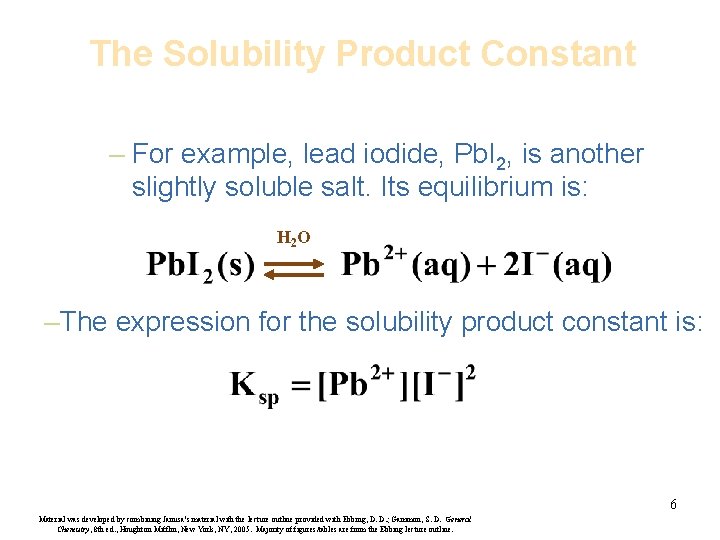
The Solubility Product Constant – For example, lead iodide, Pb. I 2, is another slightly soluble salt. Its equilibrium is: H 2 O –The expression for the solubility product constant is: 6 Material was developed by combining Janusa’s material with the lecture outline provided with Ebbing, D. D. ; Gammon, S. D. General Chemistry, 8 th ed. , Houghton Mifflin, New York, NY, 2005. Majority of figures/tables are from the Ebbing lecture outline.
Calculating Ksp from the Solubility • A 1. 0 -L sample of a saturated calcium oxalate solution, Ca. C 2 O 4, contains 0. 0061 -g of the salt at 25°C. Calculate the Ksp for this salt at 25°C. – We must first convert the solubility of calcium oxalate from 0. 0061 g/liter to moles per liter. Note to calculate the Ksp must have data on a saturated solution, if below saturation point can't determine Ksp. 7 Material was developed by combining Janusa’s material with the lecture outline provided with Ebbing, D. D. ; Gammon, S. D. General Chemistry, 8 th ed. , Houghton Mifflin, New York, NY, 2005. Majority of figures/tables are from the Ebbing lecture outline.
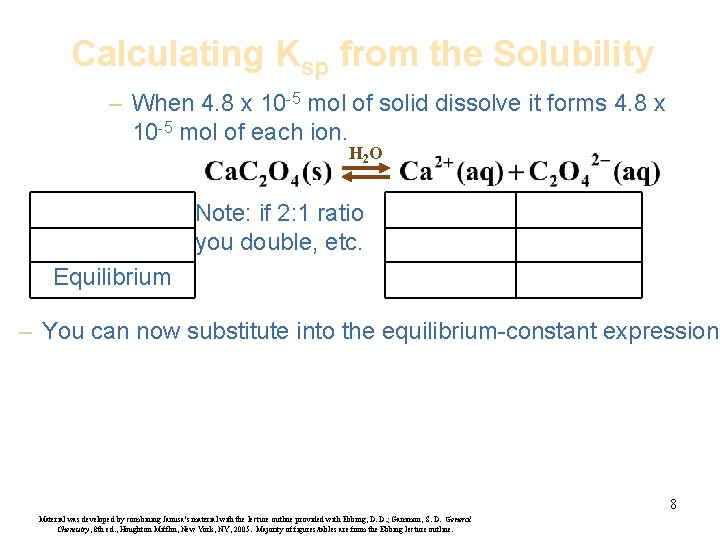
Calculating Ksp from the Solubility – When 4. 8 x 10 -5 mol of solid dissolve it forms 4. 8 x 10 -5 mol of each ion. H 2 O Note: if 2: 1 ratio you double, etc. Equilibrium – You can now substitute into the equilibrium-constant expression. 8 Material was developed by combining Janusa’s material with the lecture outline provided with Ebbing, D. D. ; Gammon, S. D. General Chemistry, 8 th ed. , Houghton Mifflin, New York, NY, 2005. Majority of figures/tables are from the Ebbing lecture outline.
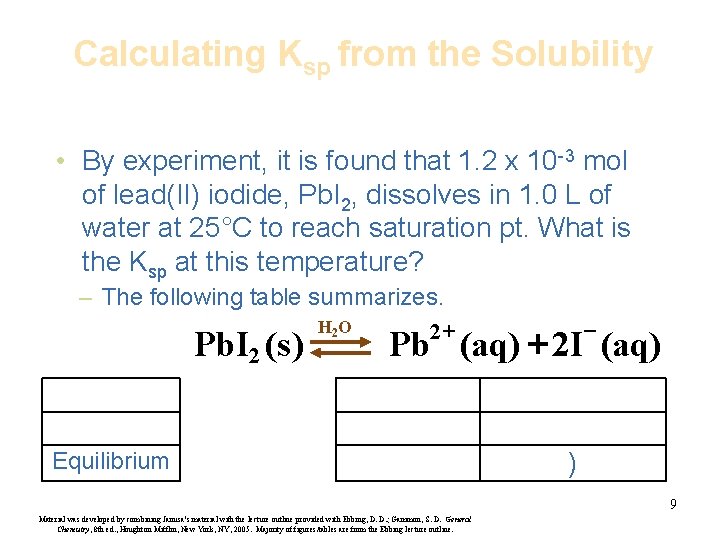
Calculating Ksp from the Solubility • By experiment, it is found that 1. 2 x 10 -3 mol of lead(II) iodide, Pb. I 2, dissolves in 1. 0 L of water at 25°C to reach saturation pt. What is the Ksp at this temperature? – The following table summarizes. Pb. I 2 (s ) H 2 O 2+ - Pb (aq) + 2 I (aq) Equilibrium ) 9 Material was developed by combining Janusa’s material with the lecture outline provided with Ebbing, D. D. ; Gammon, S. D. General Chemistry, 8 th ed. , Houghton Mifflin, New York, NY, 2005. Majority of figures/tables are from the Ebbing lecture outline.
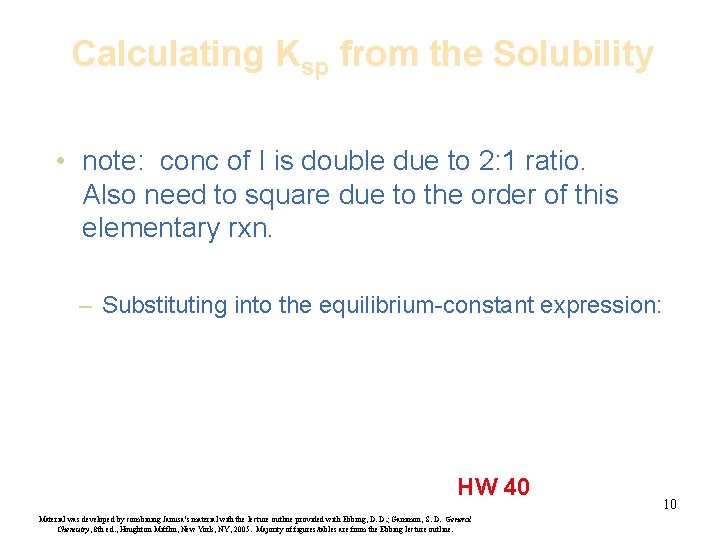
Calculating Ksp from the Solubility • note: conc of I is double due to 2: 1 ratio. Also need to square due to the order of this elementary rxn. – Substituting into the equilibrium-constant expression: HW 40 Material was developed by combining Janusa’s material with the lecture outline provided with Ebbing, D. D. ; Gammon, S. D. General Chemistry, 8 th ed. , Houghton Mifflin, New York, NY, 2005. Majority of figures/tables are from the Ebbing lecture outline. 10
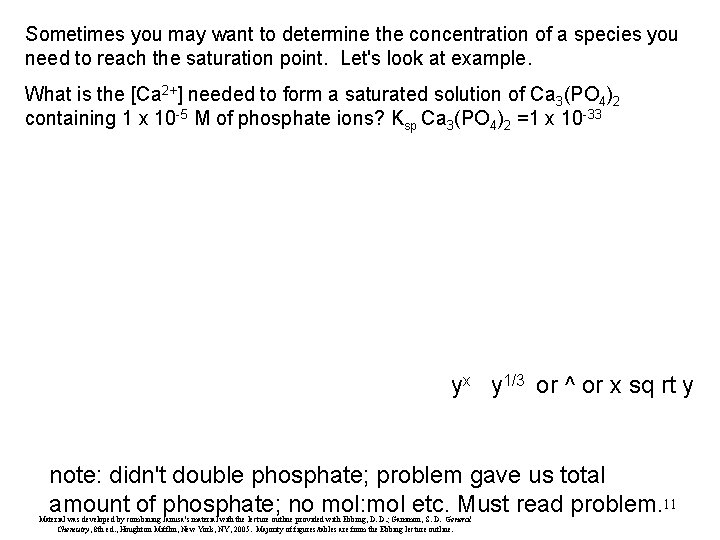
Sometimes you may want to determine the concentration of a species you need to reach the saturation point. Let's look at example. What is the [Ca 2+] needed to form a saturated solution of Ca 3(PO 4)2 containing 1 x 10 -5 M of phosphate ions? Ksp Ca 3(PO 4)2 =1 x 10 -33 yx y 1/3 or ^ or x sq rt y note: didn't double phosphate; problem gave us total amount of phosphate; no mol: mol etc. Must read problem. 11 Material was developed by combining Janusa’s material with the lecture outline provided with Ebbing, D. D. ; Gammon, S. D. General Chemistry, 8 th ed. , Houghton Mifflin, New York, NY, 2005. Majority of figures/tables are from the Ebbing lecture outline.
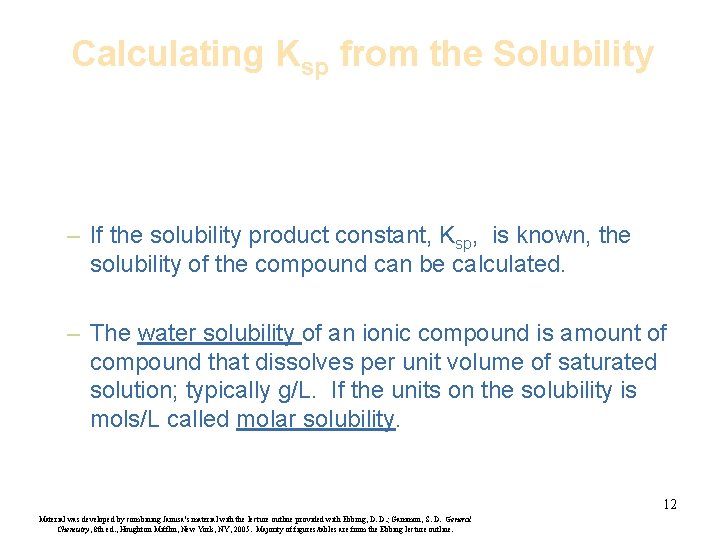
Calculating Ksp from the Solubility – If the solubility product constant, Ksp, is known, the solubility of the compound can be calculated. – The water solubility of an ionic compound is amount of compound that dissolves per unit volume of saturated solution; typically g/L. If the units on the solubility is mols/L called molar solubility. 12 Material was developed by combining Janusa’s material with the lecture outline provided with Ebbing, D. D. ; Gammon, S. D. General Chemistry, 8 th ed. , Houghton Mifflin, New York, NY, 2005. Majority of figures/tables are from the Ebbing lecture outline.
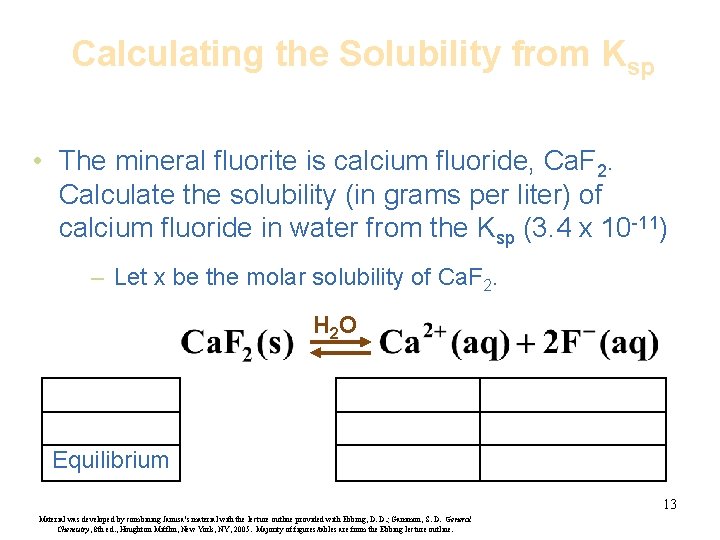
Calculating the Solubility from Ksp • The mineral fluorite is calcium fluoride, Ca. F 2. Calculate the solubility (in grams per liter) of calcium fluoride in water from the Ksp (3. 4 x 10 -11) – Let x be the molar solubility of Ca. F 2. H 2 O Equilibrium 13 Material was developed by combining Janusa’s material with the lecture outline provided with Ebbing, D. D. ; Gammon, S. D. General Chemistry, 8 th ed. , Houghton Mifflin, New York, NY, 2005. Majority of figures/tables are from the Ebbing lecture outline.
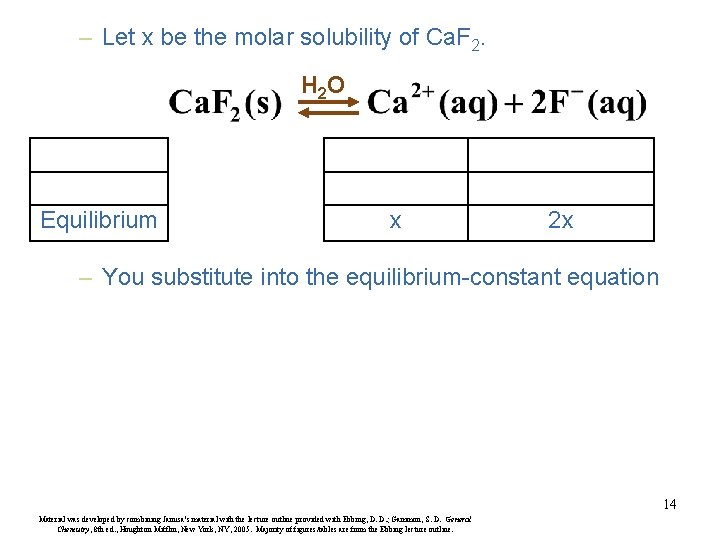
– Let x be the molar solubility of Ca. F 2. H 2 O Equilibrium x 2 x – You substitute into the equilibrium-constant equation 14 Material was developed by combining Janusa’s material with the lecture outline provided with Ebbing, D. D. ; Gammon, S. D. General Chemistry, 8 th ed. , Houghton Mifflin, New York, NY, 2005. Majority of figures/tables are from the Ebbing lecture outline.
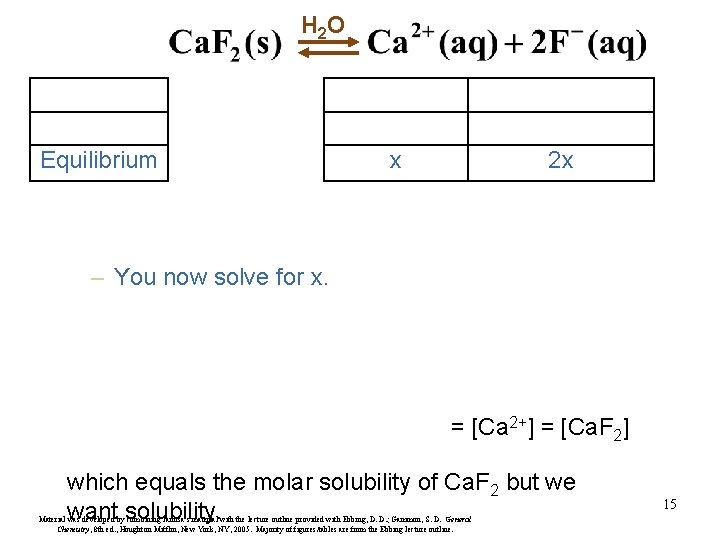
H 2 O Equilibrium x 2 x – You now solve for x. = [Ca 2+] = [Ca. F 2] which equals the molar solubility of Ca. F 2 but we want solubility. Material was developed by combining Janusa’s material with the lecture outline provided with Ebbing, D. D. ; Gammon, S. D. General Chemistry, 8 th ed. , Houghton Mifflin, New York, NY, 2005. Majority of figures/tables are from the Ebbing lecture outline. 15
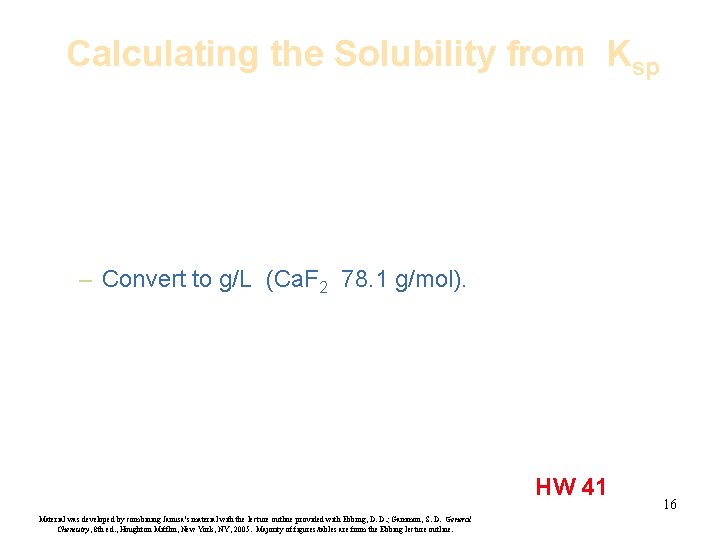
Calculating the Solubility from Ksp – Convert to g/L (Ca. F 2 78. 1 g/mol). HW 41 Material was developed by combining Janusa’s material with the lecture outline provided with Ebbing, D. D. ; Gammon, S. D. General Chemistry, 8 th ed. , Houghton Mifflin, New York, NY, 2005. Majority of figures/tables are from the Ebbing lecture outline. 16
Solubility and the Common-Ion Effect • In this section we will look at calculating solubilities in the presence of other ions. • Common ion problem similar to buffer. – The importance of the Ksp becomes apparent when you consider the solubility of one salt in the solution of another having the same cation or anion. – By having a common ion, the equil will shift to the left causing more to ppt out and decrease the solubility of the substance. We take advantage of this to get species to ppt out completely from a solution. 17 Material was developed by combining Janusa’s material with the lecture outline provided with Ebbing, D. D. ; Gammon, S. D. General Chemistry, 8 th ed. , Houghton Mifflin, New York, NY, 2005. Majority of figures/tables are from the Ebbing lecture outline.
Solubility and the Common-Ion Effect – For example, suppose you wish to know the solubility of calcium fluoride in a solution of sodium fluoride (soluble salt). – The salt contributes the fluoride to the system and shifts the equil causing the solubility of calcium fluoride to be less – The effect is that calcium fluoride will be less soluble than it would be in pure water. 18 Material was developed by combining Janusa’s material with the lecture outline provided with Ebbing, D. D. ; Gammon, S. D. General Chemistry, 8 th ed. , Houghton Mifflin, New York, NY, 2005. Majority of figures/tables are from the Ebbing lecture outline.
A Problem To Consider • What is the molar solubility of calcium fluoride in 0. 15 M sodium fluoride? The Ksp for calcium fluoride is 3. 4 x 10 -11. HW 42 Material was developed by combining Janusa’s material with the lecture outline provided with Ebbing, D. D. ; Gammon, S. D. General Chemistry, 8 th ed. , Houghton Mifflin, New York, NY, 2005. Majority of figures/tables are from the Ebbing lecture outline. 19
Precipitation Calculations • Precipitation is merely another way of looking at solubility equilibrium. – Rather than considering how much of a substance will dissolve, we ask: Will precipitation occur for a given starting ion concentration? 20 Material was developed by combining Janusa’s material with the lecture outline provided with Ebbing, D. D. ; Gammon, S. D. General Chemistry, 8 th ed. , Houghton Mifflin, New York, NY, 2005. Majority of figures/tables are from the Ebbing lecture outline.
Criteria for Precipitation • To determine whether an equilibrium system will go in the forward or reverse direction requires that we evaluate the reaction quotient, Q (or IP or P). – To predict the direction of reaction, you compare Q with Ksp. – The reaction quotient has the same form as the Ksp expression, but the concentrations of products are starting values not necessarily saturated conc. 21 Material was developed by combining Janusa’s material with the lecture outline provided with Ebbing, D. D. ; Gammon, S. D. General Chemistry, 8 th ed. , Houghton Mifflin, New York, NY, 2005. Majority of figures/tables are from the Ebbing lecture outline.
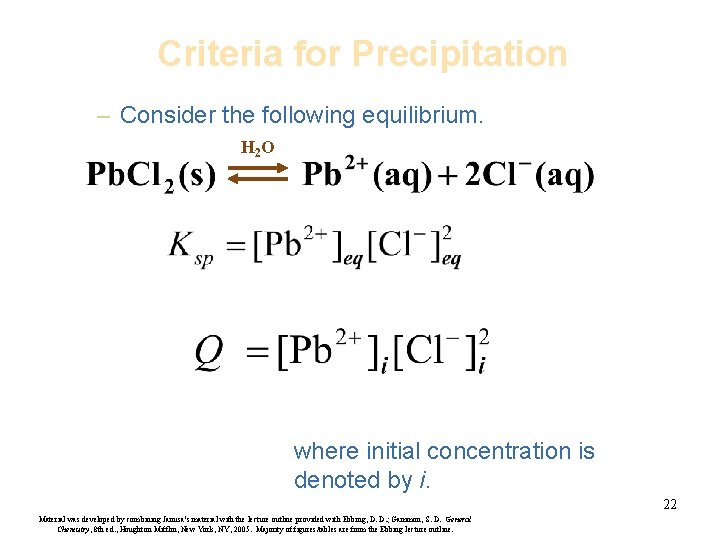
Criteria for Precipitation – Consider the following equilibrium. H 2 O where initial concentration is denoted by i. 22 Material was developed by combining Janusa’s material with the lecture outline provided with Ebbing, D. D. ; Gammon, S. D. General Chemistry, 8 th ed. , Houghton Mifflin, New York, NY, 2005. Majority of figures/tables are from the Ebbing lecture outline.
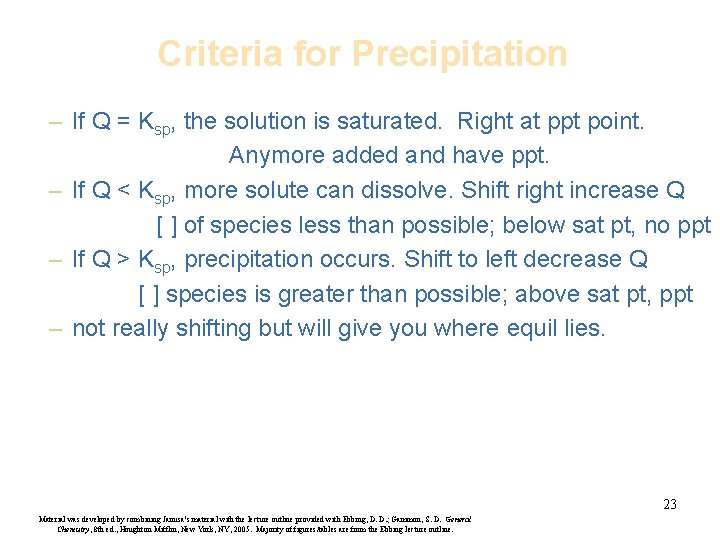
Criteria for Precipitation – If Q = Ksp, the solution is saturated. Right at ppt point. Anymore added and have ppt. – If Q < Ksp, more solute can dissolve. Shift right increase Q [ ] of species less than possible; below sat pt, no ppt – If Q > Ksp, precipitation occurs. Shift to left decrease Q [ ] species is greater than possible; above sat pt, ppt – not really shifting but will give you where equil lies. 23 Material was developed by combining Janusa’s material with the lecture outline provided with Ebbing, D. D. ; Gammon, S. D. General Chemistry, 8 th ed. , Houghton Mifflin, New York, NY, 2005. Majority of figures/tables are from the Ebbing lecture outline.
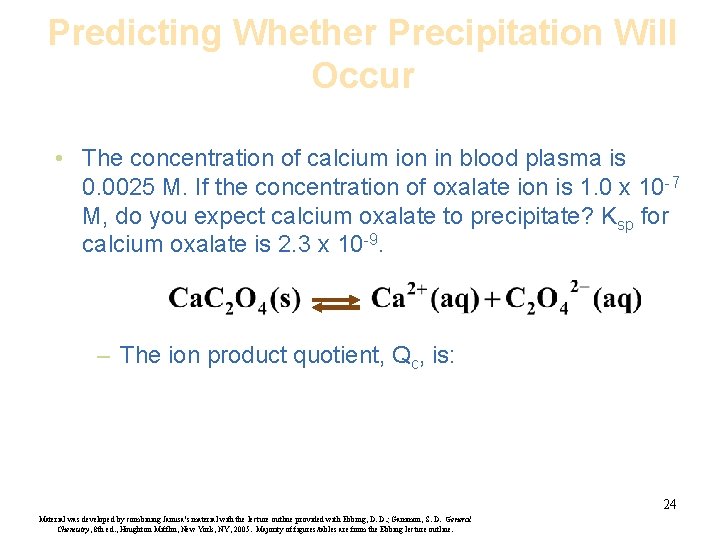
Predicting Whether Precipitation Will Occur • The concentration of calcium ion in blood plasma is 0. 0025 M. If the concentration of oxalate ion is 1. 0 x 10 -7 M, do you expect calcium oxalate to precipitate? Ksp for calcium oxalate is 2. 3 x 10 -9. – The ion product quotient, Qc, is: 24 Material was developed by combining Janusa’s material with the lecture outline provided with Ebbing, D. D. ; Gammon, S. D. General Chemistry, 8 th ed. , Houghton Mifflin, New York, NY, 2005. Majority of figures/tables are from the Ebbing lecture outline.
Predicting Whether Precipitation Will Occur – This value is smaller than the Ksp, so you do not expect precipitation to occur. 25 Material was developed by combining Janusa’s material with the lecture outline provided with Ebbing, D. D. ; Gammon, S. D. General Chemistry, 8 th ed. , Houghton Mifflin, New York, NY, 2005. Majority of figures/tables are from the Ebbing lecture outline.
example: A student mixes 0. 200 L of 0. 0060 M Sr(NO 3)2 solution with 0. 100 L of 0. 015 M K 2 Cr. O 4 solution to give a final volume of 0. 300 L. Will a precipitate form under these conditions? Ksp Sr. Cr. O 4 = 3. 6 x 10 -5 Material was developed by combining Janusa’s material with the lecture outline provided with Ebbing, D. D. ; Gammon, S. D. General Chemistry, 8 th ed. , Houghton Mifflin, New York, NY, 2005. Majority of figures/tables are from the Ebbing lecture outline. HW 43 26
Fractional Precipitation • Fractional precipitation is the technique of separating two or more ions from a solution by adding a reactant that precipitates first one ion, then another, and so forth. – For example, when you slowly add potassium chromate, K 2 Cr. O 4, to a solution containing Ba 2+ and Sr 2+, barium chromate precipitates first due to its lower solubility than Sr. Cr. O 4. 27 Material was developed by combining Janusa’s material with the lecture outline provided with Ebbing, D. D. ; Gammon, S. D. General Chemistry, 8 th ed. , Houghton Mifflin, New York, NY, 2005. Majority of figures/tables are from the Ebbing lecture outline.
Fractional Precipitation – After most of the Ba 2+ ion has precipitated, strontium chromate begins to precipitate. – It is therefore possible to separate Ba 2+ from Sr 2+ by fractional precipitation using K 2 Cr. O 4. – Take advantage in qual/quan type analysis. 28 Material was developed by combining Janusa’s material with the lecture outline provided with Ebbing, D. D. ; Gammon, S. D. General Chemistry, 8 th ed. , Houghton Mifflin, New York, NY, 2005. Majority of figures/tables are from the Ebbing lecture outline.
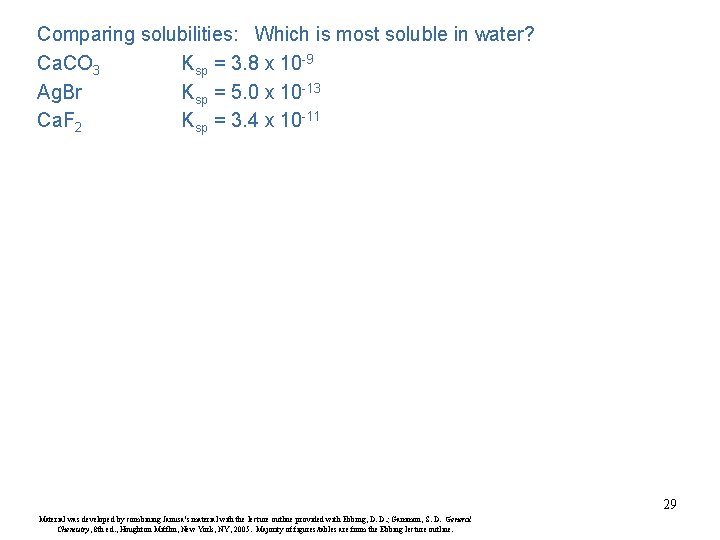
Comparing solubilities: Which is most soluble in water? Ca. CO 3 Ksp = 3. 8 x 10 -9 Ag. Br Ksp = 5. 0 x 10 -13 Ca. F 2 Ksp = 3. 4 x 10 -11 29 Material was developed by combining Janusa’s material with the lecture outline provided with Ebbing, D. D. ; Gammon, S. D. General Chemistry, 8 th ed. , Houghton Mifflin, New York, NY, 2005. Majority of figures/tables are from the Ebbing lecture outline.
Effect of p. H on Solubility • Sometimes it is necessary to account for other reactions aqueous ions might undergo. – For example, if the anion is the conjugate base of a weak acid, it will react with H 3 O+. – You should expect the solubility to be affected by p. H. By adding and complexing out ions you can affect the p. H of solution which could affect ppt reactions. 30 Material was developed by combining Janusa’s material with the lecture outline provided with Ebbing, D. D. ; Gammon, S. D. General Chemistry, 8 th ed. , Houghton Mifflin, New York, NY, 2005. Majority of figures/tables are from the Ebbing lecture outline.
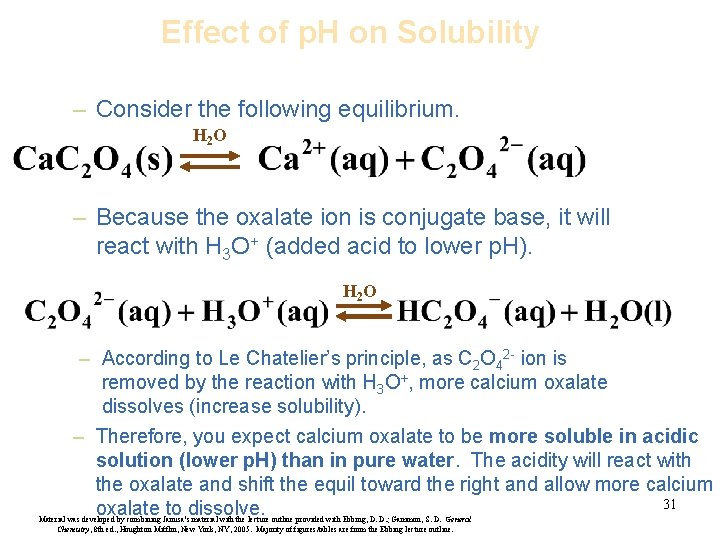
Effect of p. H on Solubility – Consider the following equilibrium. H 2 O – Because the oxalate ion is conjugate base, it will react with H 3 O+ (added acid to lower p. H). H 2 O – According to Le Chatelier’s principle, as C 2 O 42 - ion is removed by the reaction with H 3 O+, more calcium oxalate dissolves (increase solubility). – Therefore, you expect calcium oxalate to be more soluble in acidic solution (lower p. H) than in pure water. The acidity will react with the oxalate and shift the equil toward the right and allow more calcium 31 oxalate to dissolve. Material was developed by combining Janusa’s material with the lecture outline provided with Ebbing, D. D. ; Gammon, S. D. General Chemistry, 8 th ed. , Houghton Mifflin, New York, NY, 2005. Majority of figures/tables are from the Ebbing lecture outline.
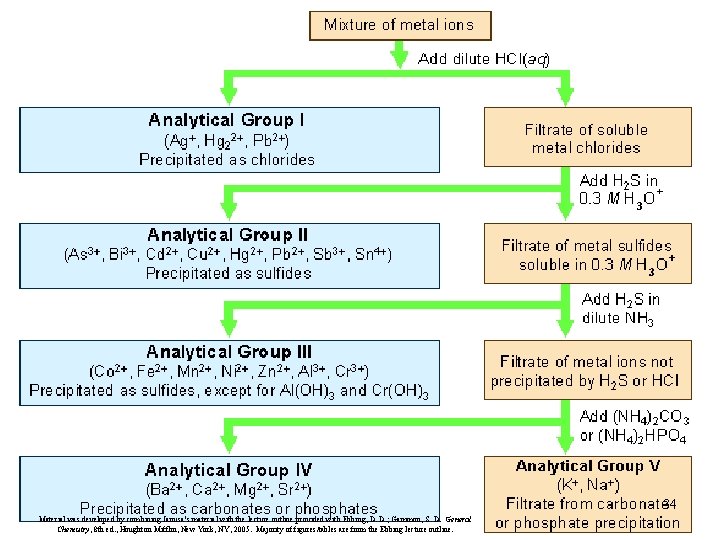
Separation of Metal Ions by Sulfide Precipitation • Many metal sulfides are insoluble in water but dissolve in acidic solution. – Qualitative analysis uses this change in solubility of the metal sulfides with p. H to separate a mixture of metal ions. – By adjusting the p. H in an aqueous solution of H 2 S, you adjust the sulfide concentration to precipitate the least soluble metal sulfide first. – We do this in lab this semester. 32 Material was developed by combining Janusa’s material with the lecture outline provided with Ebbing, D. D. ; Gammon, S. D. General Chemistry, 8 th ed. , Houghton Mifflin, New York, NY, 2005. Majority of figures/tables are from the Ebbing lecture outline.
Qualitative Analysis • Qualitative analysis involves the determination of the identity of substances present in a mixture. – In the qualitative analysis scheme for metal ions, a cation is usually detected by the presence of a characteristic precipitate. – Next slide shows a figure that summarizes how metal ions in an aqueous solution are separated into five analytical groups. 33 Material was developed by combining Janusa’s material with the lecture outline provided with Ebbing, D. D. ; Gammon, S. D. General Chemistry, 8 th ed. , Houghton Mifflin, New York, NY, 2005. Majority of figures/tables are from the Ebbing lecture outline.
34 Material was developed by combining Janusa’s material with the lecture outline provided with Ebbing, D. D. ; Gammon, S. D. General Chemistry, 8 th ed. , Houghton Mifflin, New York, NY, 2005. Majority of figures/tables are from the Ebbing lecture outline.
Complex-Ion Equilibria • Many metal ions, especially transition metals, form coordinate covalent bonds with molecules or anions having a lone pair of electrons. – This type of bond formation is essentially a Lewis acid-base reaction. 35 Material was developed by combining Janusa’s material with the lecture outline provided with Ebbing, D. D. ; Gammon, S. D. General Chemistry, 8 th ed. , Houghton Mifflin, New York, NY, 2005. Majority of figures/tables are from the Ebbing lecture outline.
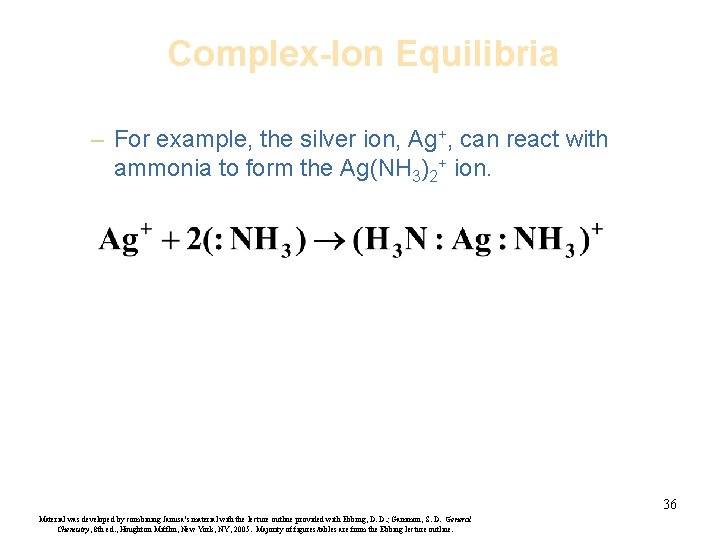
Complex-Ion Equilibria – For example, the silver ion, Ag+, can react with ammonia to form the Ag(NH 3)2+ ion. 36 Material was developed by combining Janusa’s material with the lecture outline provided with Ebbing, D. D. ; Gammon, S. D. General Chemistry, 8 th ed. , Houghton Mifflin, New York, NY, 2005. Majority of figures/tables are from the Ebbing lecture outline.
Complex-Ion Equilibria • A complex ion is an ion formed from a metal ion with a Lewis base attached to it by a coordinate covalent bond. – A complex is defined as a compound containing complex ions. – A ligand is a Lewis base (makes electron pair available) that bonds to a metal ion to form a complex ion. Lewis Acid is the cation. 37 Material was developed by combining Janusa’s material with the lecture outline provided with Ebbing, D. D. ; Gammon, S. D. General Chemistry, 8 th ed. , Houghton Mifflin, New York, NY, 2005. Majority of figures/tables are from the Ebbing lecture outline.
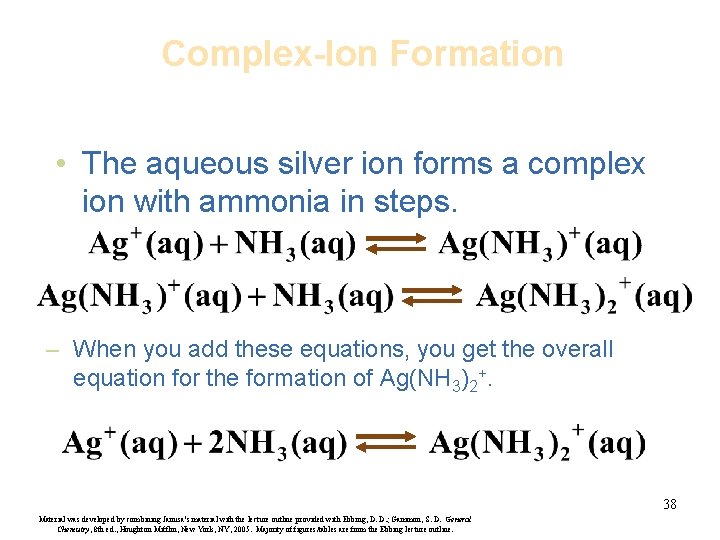
Complex-Ion Formation • The aqueous silver ion forms a complex ion with ammonia in steps. – When you add these equations, you get the overall equation for the formation of Ag(NH 3)2+. 38 Material was developed by combining Janusa’s material with the lecture outline provided with Ebbing, D. D. ; Gammon, S. D. General Chemistry, 8 th ed. , Houghton Mifflin, New York, NY, 2005. Majority of figures/tables are from the Ebbing lecture outline.
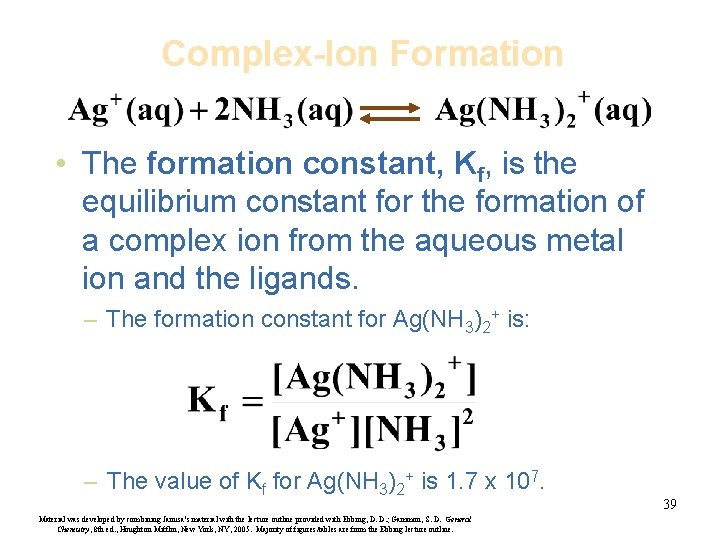
Complex-Ion Formation • The formation constant, Kf, is the equilibrium constant for the formation of a complex ion from the aqueous metal ion and the ligands. – The formation constant for Ag(NH 3)2+ is: – The value of Kf for Ag(NH 3)2+ is 1. 7 x 10⁷. Material was developed by combining Janusa’s material with the lecture outline provided with Ebbing, D. D. ; Gammon, S. D. General Chemistry, 8 th ed. , Houghton Mifflin, New York, NY, 2005. Majority of figures/tables are from the Ebbing lecture outline. 39
Complex-Ion Formation – The large value means that the complex ion is quite stable. – When a large amount of NH 3 is added to a solution of Ag+, you expect most of the Ag+ ion to react to form the complex ion (large Kf - equil lies far to right). – Handle calculations same way as any other K 40 Material was developed by combining Janusa’s material with the lecture outline provided with Ebbing, D. D. ; Gammon, S. D. General Chemistry, 8 th ed. , Houghton Mifflin, New York, NY, 2005. Majority of figures/tables are from the Ebbing lecture outline.
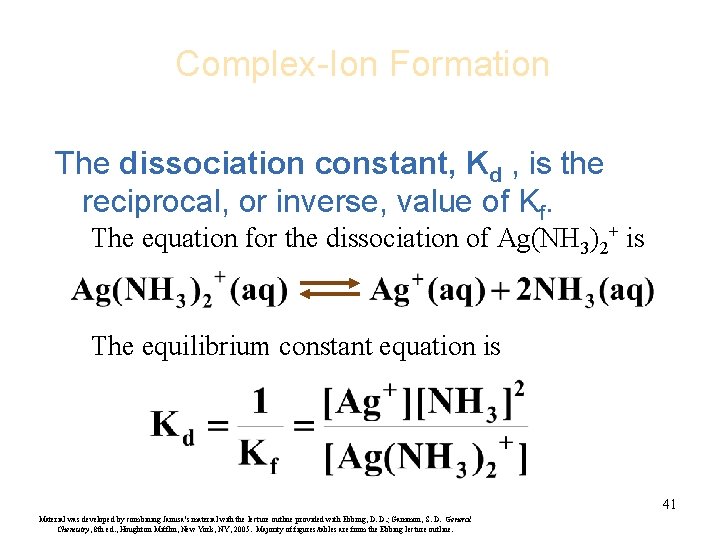
Complex-Ion Formation The dissociation constant, Kd , is the reciprocal, or inverse, value of Kf. The equation for the dissociation of Ag(NH 3)2+ is The equilibrium constant equation is 41 Material was developed by combining Janusa’s material with the lecture outline provided with Ebbing, D. D. ; Gammon, S. D. General Chemistry, 8 th ed. , Houghton Mifflin, New York, NY, 2005. Majority of figures/tables are from the Ebbing lecture outline.
Equilibrium Calculations with Kf What is the concentration of Ag+(aq) ion in 1. 00 liters of solution that is 0. 010 M Ag. NO 3 and 1. 00 M NH 3? The Kf for Ag(NH 3)2+ is 1. 7 x 10⁷. 42 Material was developed by combining Janusa’s material with the lecture outline provided with Ebbing, D. D. ; Gammon, S. D. General Chemistry, 8 th ed. , Houghton Mifflin, New York, NY, 2005. Majority of figures/tables are from the Ebbing lecture outline.
• continue 43 Material was developed by combining Janusa’s material with the lecture outline provided with Ebbing, D. D. ; Gammon, S. D. General Chemistry, 8 th ed. , Houghton Mifflin, New York, NY, 2005. Majority of figures/tables are from the Ebbing lecture outline.
- Slides: 43