
Solubility Practical Chemistry Key Stage 3 Particles Lesson

Solubility Practical Chemistry - Key Stage 3 Particles - Lesson 14 Miss Mason 1
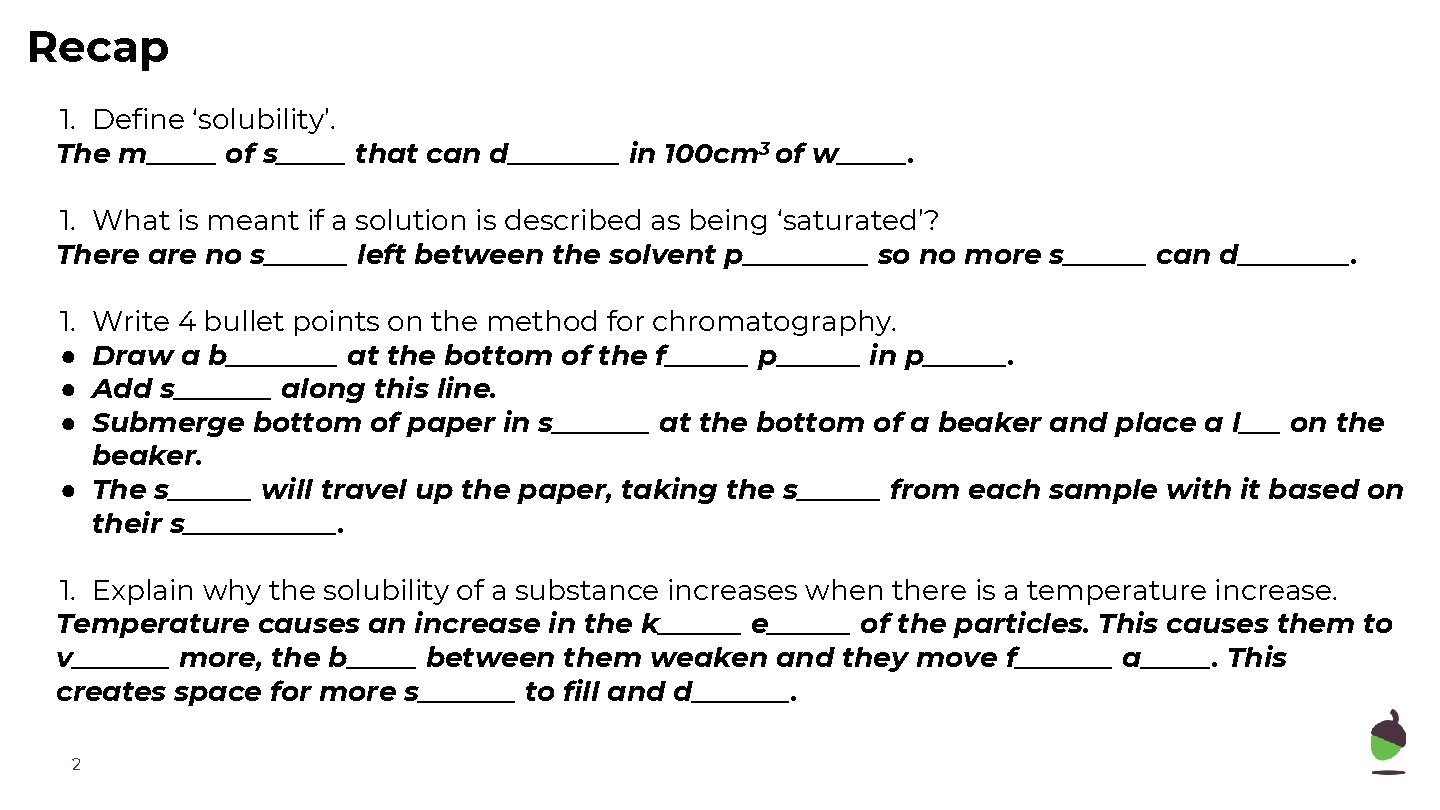
Recap 1. Define ‘solubility’. The m_____ of s_____ that can d____ in 100 cm 3 of w_____. 1. What is meant if a solution is described as being ‘saturated’? There are no s______ left between the solvent p_____ so no more s______ can d____. 1. ● ● ● Write 4 bullet points on the method for chromatography. Draw a b____ at the bottom of the f______ p______ in p______. Add s_______ along this line. Submerge bottom of paper in s_______ at the bottom of a beaker and place a l___ on the beaker. ● The s______ will travel up the paper, taking the s______ from each sample with it based on their s______. 1. Explain why the solubility of a substance increases when there is a temperature increase. Temperature causes an increase in the k______ e______ of the particles. This causes them to v_______ more, the b_____ between them weaken and they move f_______ a_____. This creates space for more s_______ to fill and d_______. 2
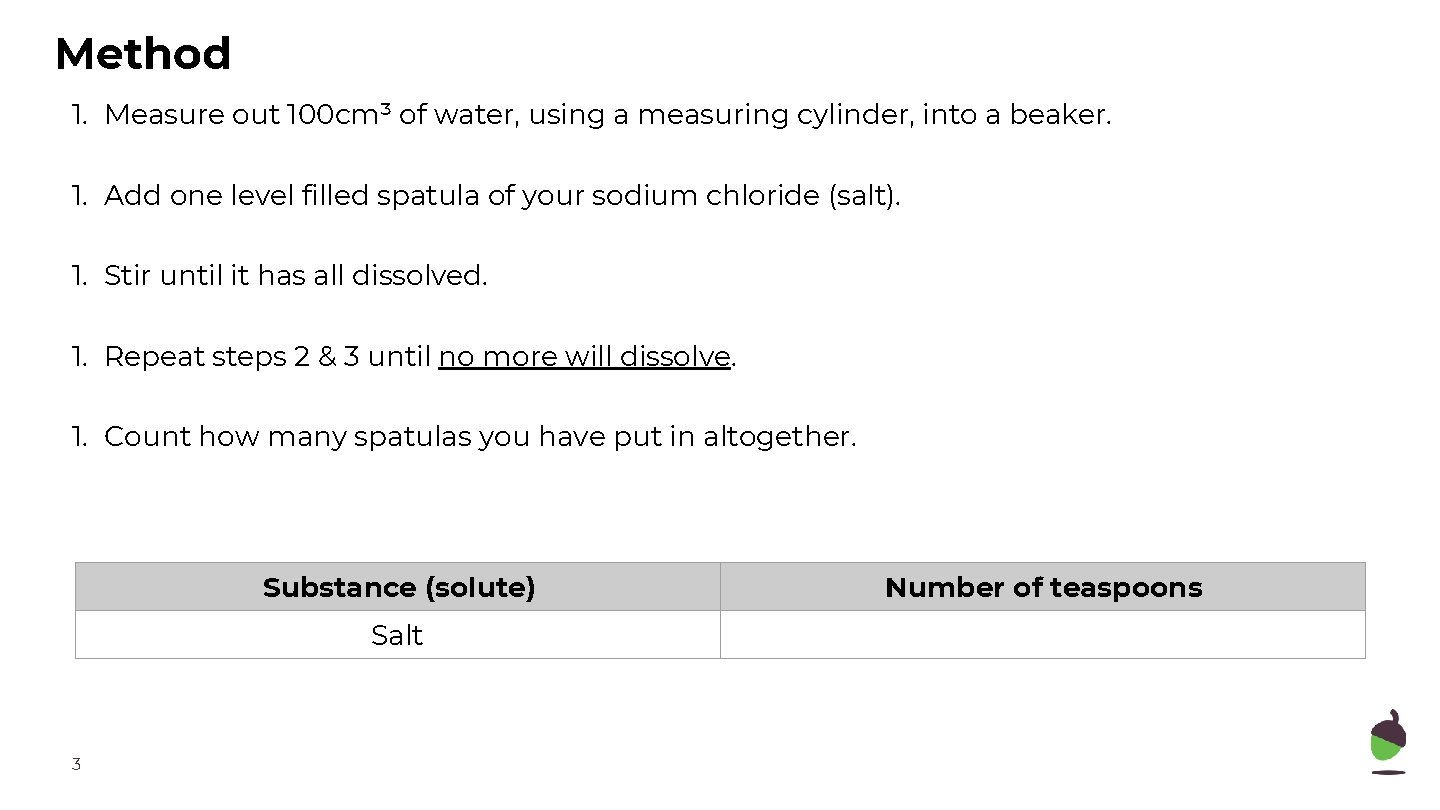
Method 1. Measure out 100 cm³ of water, using a measuring cylinder, into a beaker. 1. Add one level filled spatula of your sodium chloride (salt). 1. Stir until it has all dissolved. 1. Repeat steps 2 & 3 until no more will dissolve. 1. Count how many spatulas you have put in altogether. Substance (solute) Salt 3 Number of teaspoons
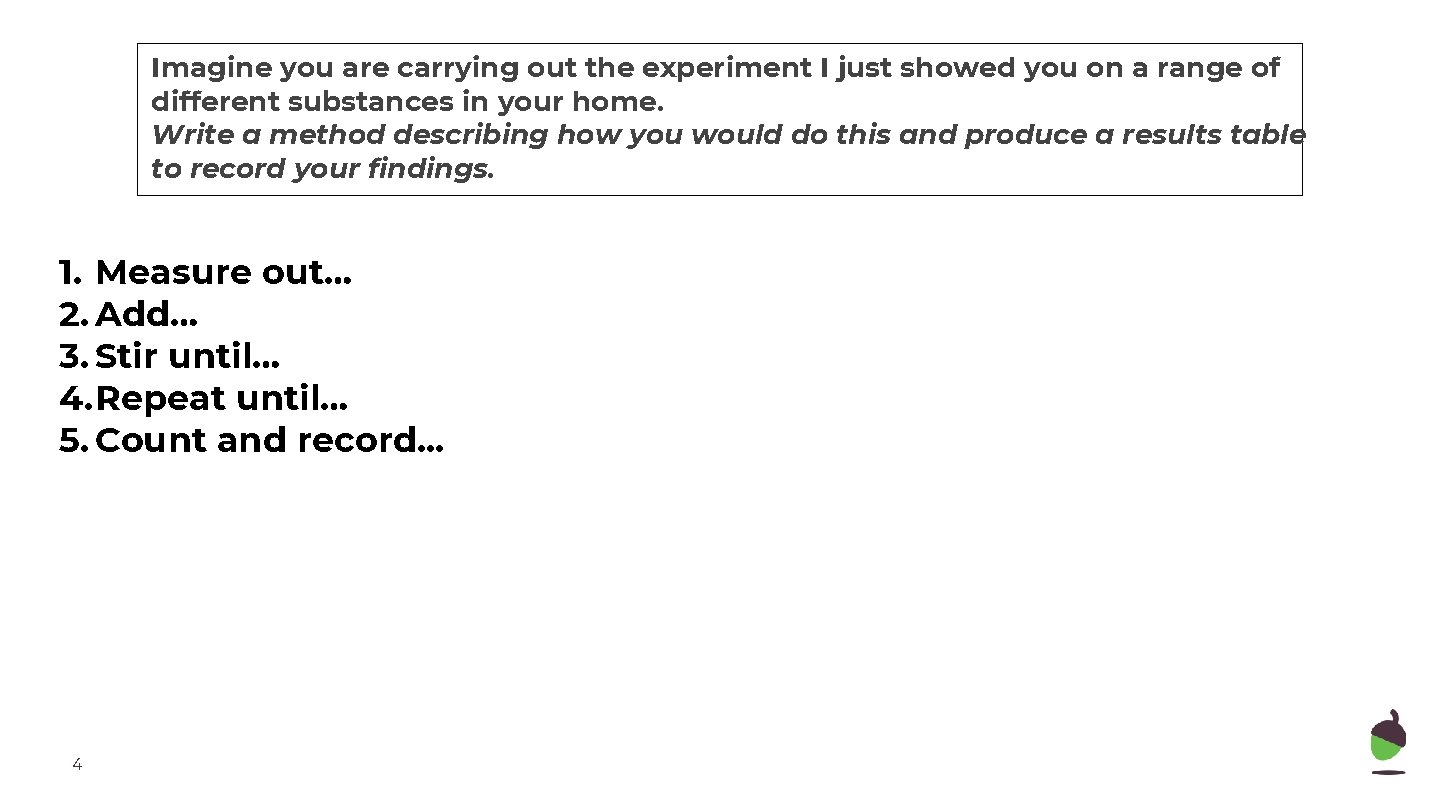
Imagine you are carrying out the experiment I just showed you on a range of different substances in your home. Write a method describing how you would do this and produce a results table to record your findings. 1. Measure out… 2. Add… 3. Stir until… 4. Repeat until… 5. Count and record. . . 4
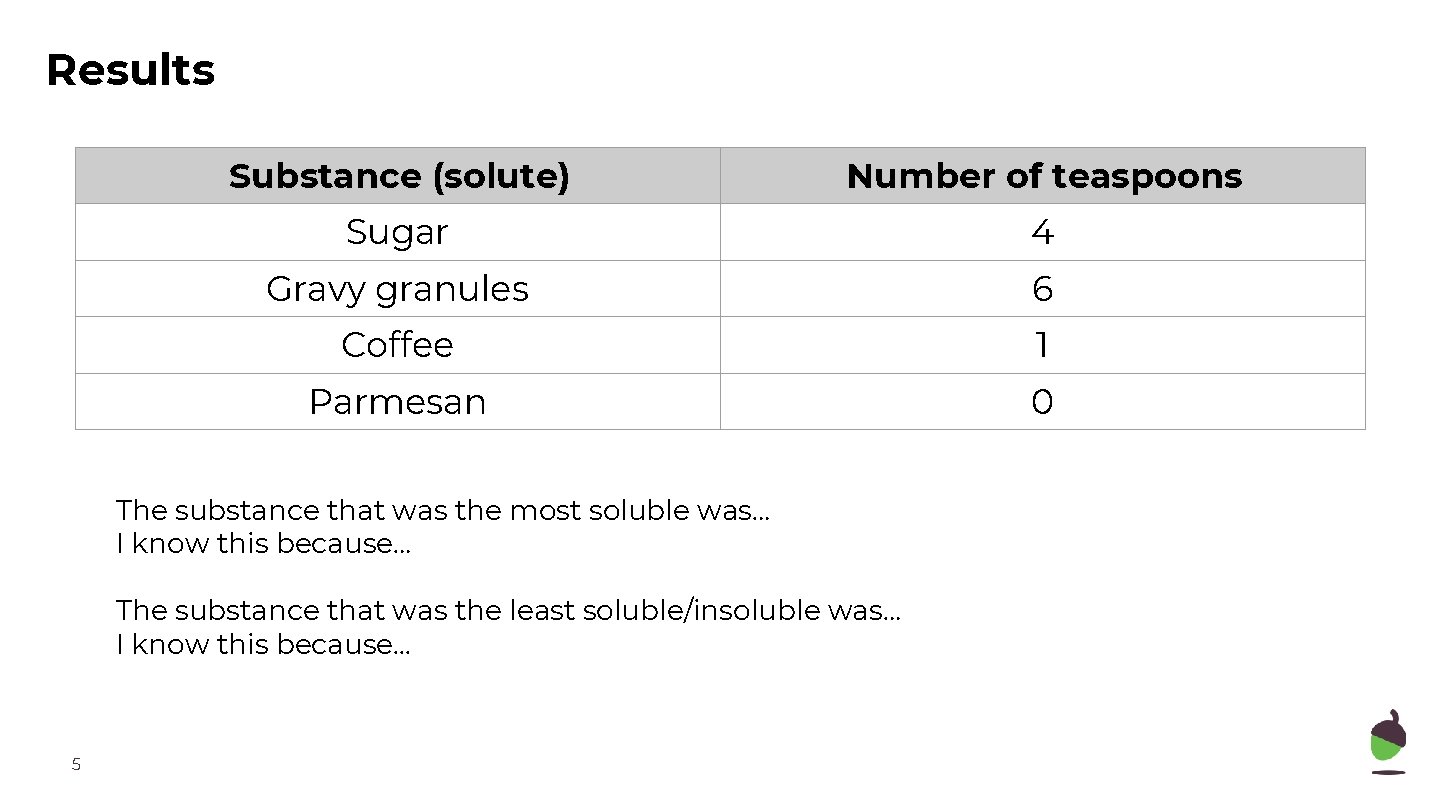
Results Substance (solute) Number of teaspoons Sugar 4 Gravy granules 6 Coffee 1 Parmesan 0 The substance that was the most soluble was… I know this because… The substance that was the least soluble/insoluble was… I know this because. . . 5
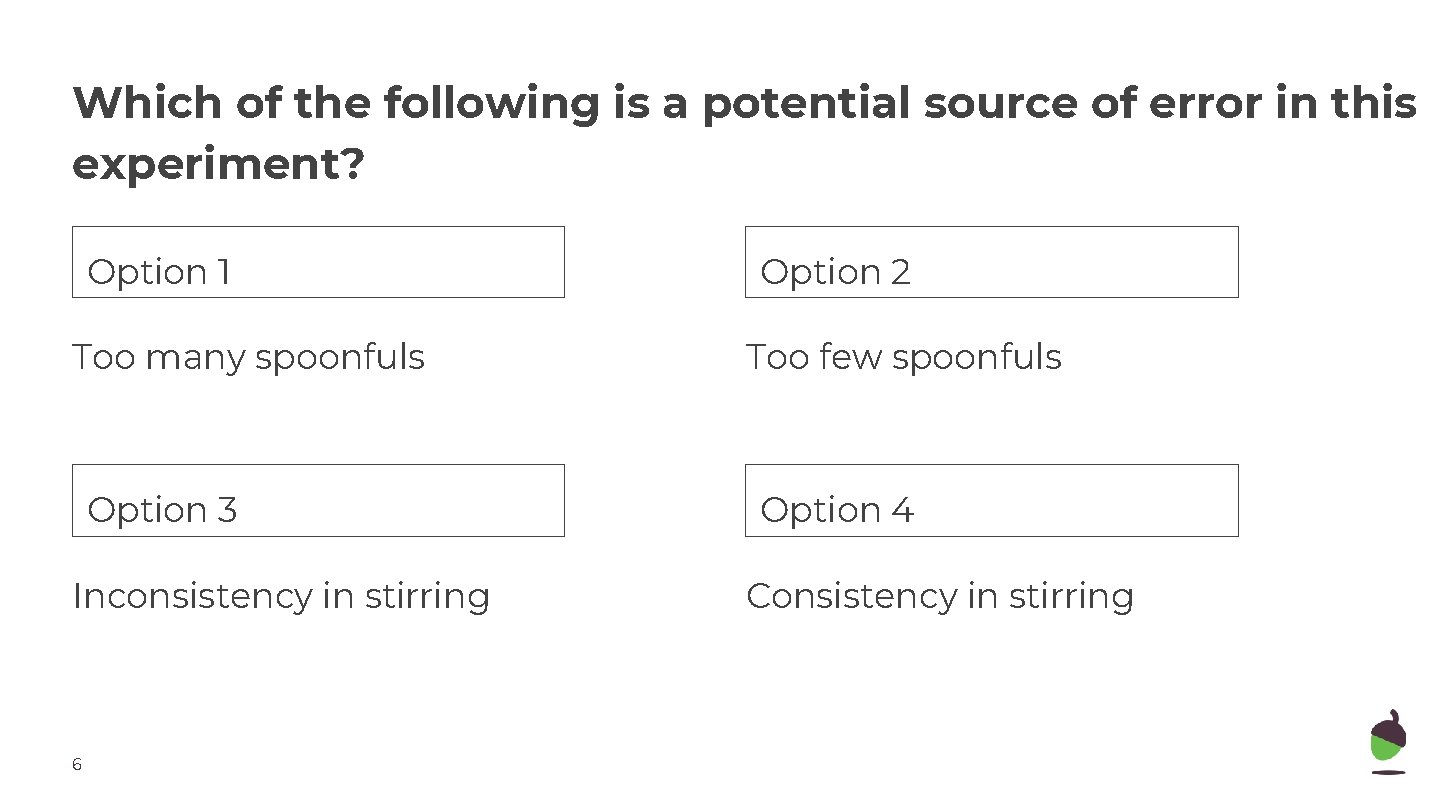
Which of the following is a potential source of error in this experiment? Option 1 Option 2 Too many spoonfuls Too few spoonfuls Option 33 Option 44 Inconsistency in stirring Consistency in stirring 6
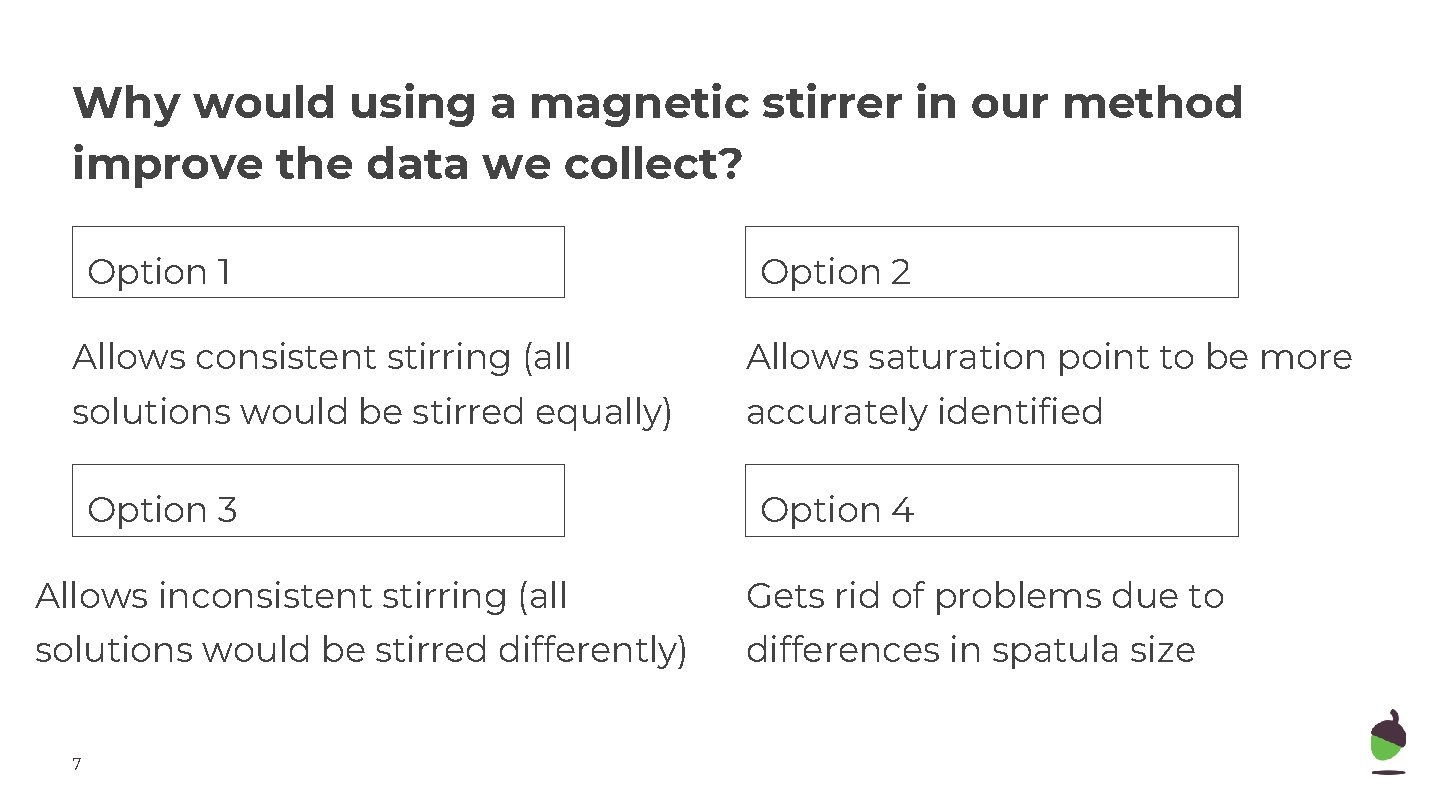
Why would using a magnetic stirrer in our method improve the data we collect? Option 1 Option 2 Allows consistent stirring (all Allows saturation point to be more solutions would be stirred equally) accurately identified Option 33 Option 44 Allows inconsistent stirring (all Gets rid of problems due to solutions would be stirred differently) differences in spatula size 7
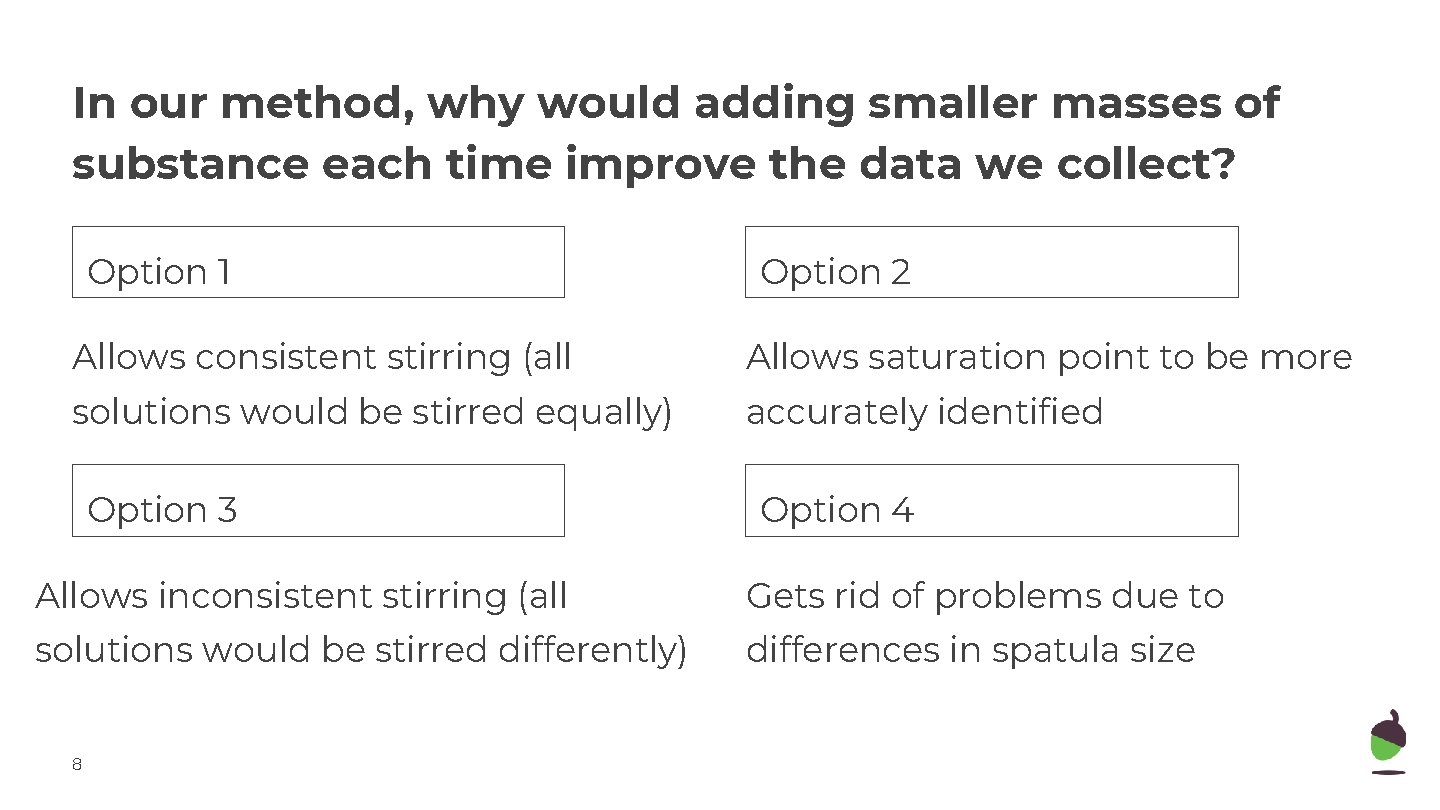
In our method, why would adding smaller masses of substance each time improve the data we collect? Option 1 Option 2 Allows consistent stirring (all Allows saturation point to be more solutions would be stirred equally) accurately identified Option 33 Option 44 Allows inconsistent stirring (all Gets rid of problems due to solutions would be stirred differently) differences in spatula size 8

In our method, why would measuring the mass of the solvent before and after adding the solute improve the data we collect? Option 1 Option 2 Allows consistent stirring (all Allows saturation point to be more solutions would be stirred equally) accurately identified Option 33 Option 44 Allows inconsistent stirring (all Gets rid of problems due to solutions would be stirred differently) differences in spatula size 9

From your experiment, identify what the potential sources of error could have been and how improvements could have been made to the method to improve the data collected. One potential error in the experiment could have been… (Repeat this for 3 potential errors) One way we could have improved would have been to… This should have improved our data because… (Repeat this for 1 more method improvement) 10
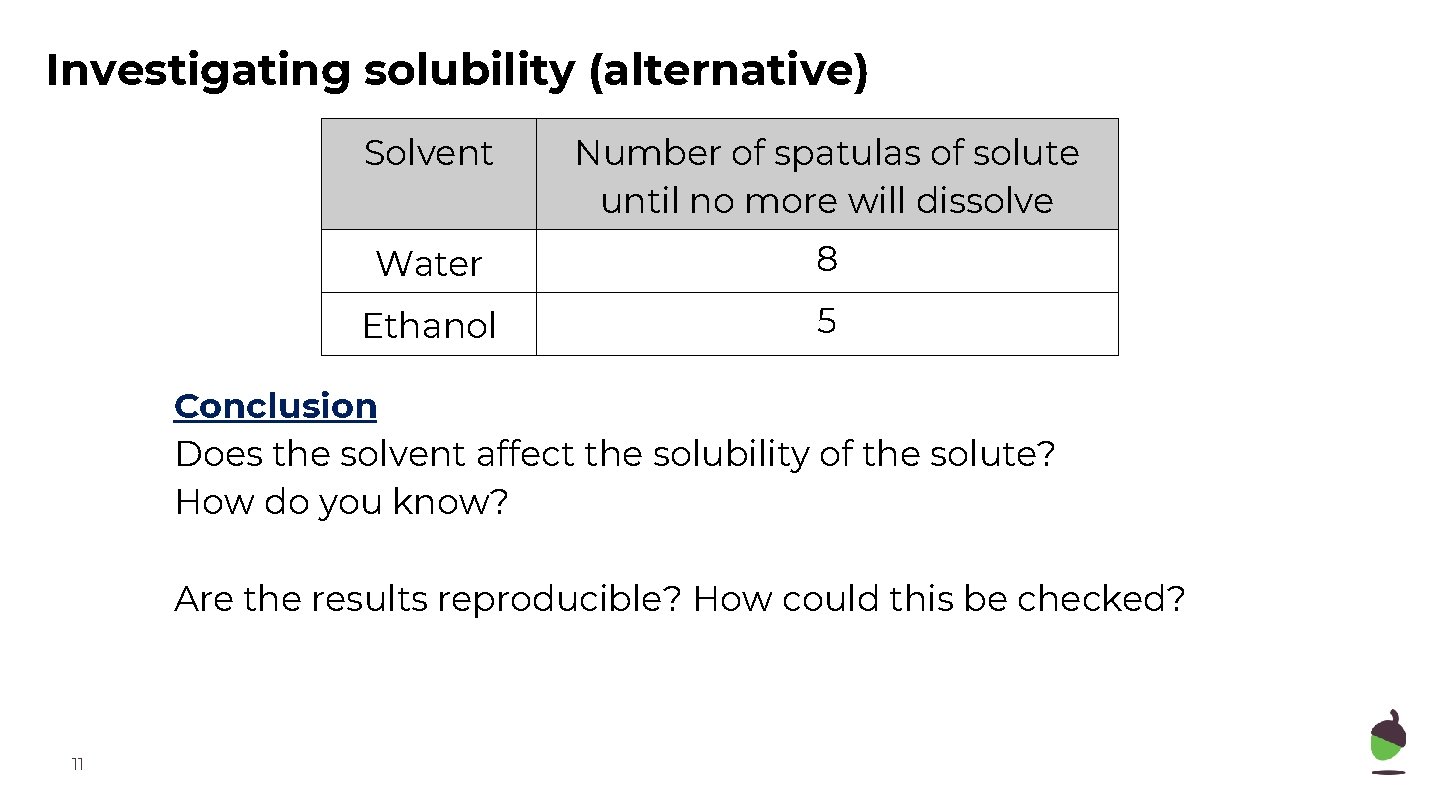
Investigating solubility (alternative) Solvent Number of spatulas of solute until no more will dissolve Water 8 Ethanol 5 Conclusion Does the solvent affect the solubility of the solute? How do you know? Are the results reproducible? How could this be checked? 11
- Slides: 11