
Solubility Equilibria Tro Chapter 17 Aqueous Ionic Equilibrium
Solubility Equilibria Tro Chapter 17 – Aqueous Ionic Equilibrium Section 17. 5 – Solubility Equilibria and the Solubility Product Constant
Solubility Equilibria • All ionic compounds dissolve in water to some degree. • However, many compounds have such low solubility in water that we classify them as insoluble. • We can apply the concepts of equilibrium to salts dissolving, and use the equilibrium constant for the process to measure relative solubilities in water.

Solubility Product • The equilibrium constant for the dissociation of a solid salt into its aqueous ions is called the solubility product, Ksp. • The dissociation reaction for Ag. Cl is Ag. Cl(s) Ag+(aq) + Cl−(aq). • And its solubility product constant is Ksp = [Ag+][Cl−].
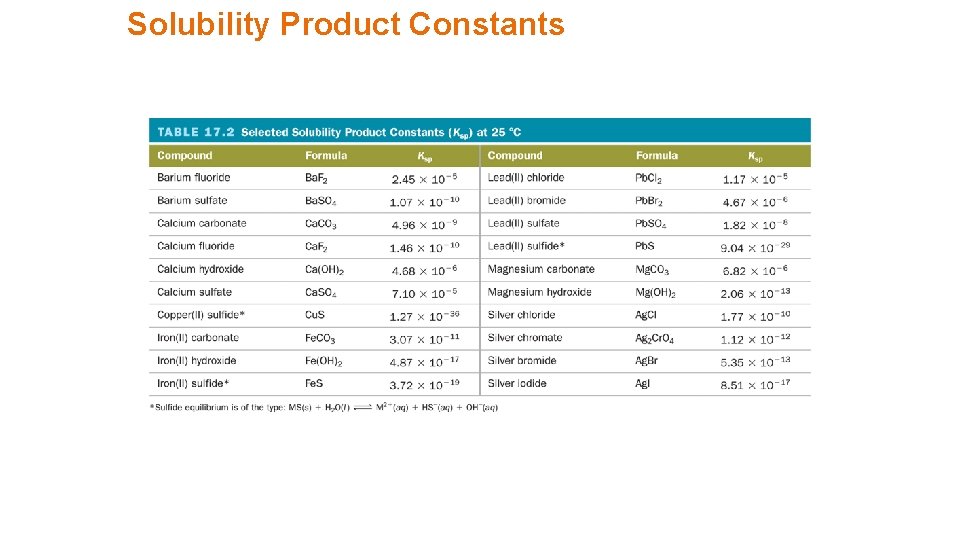
Solubility Product Constants
Molar Solubility • Solubility is the amount of solute that will dissolve in a given amount of solution at a particular temperature. • Generally grams of dissolved solute per 100 grams of solvent in a saturated solution • The molar solubility is the number of moles of solute that will dissolve in a liter of solution. • The molarity of the dissolved solute in a saturated solution
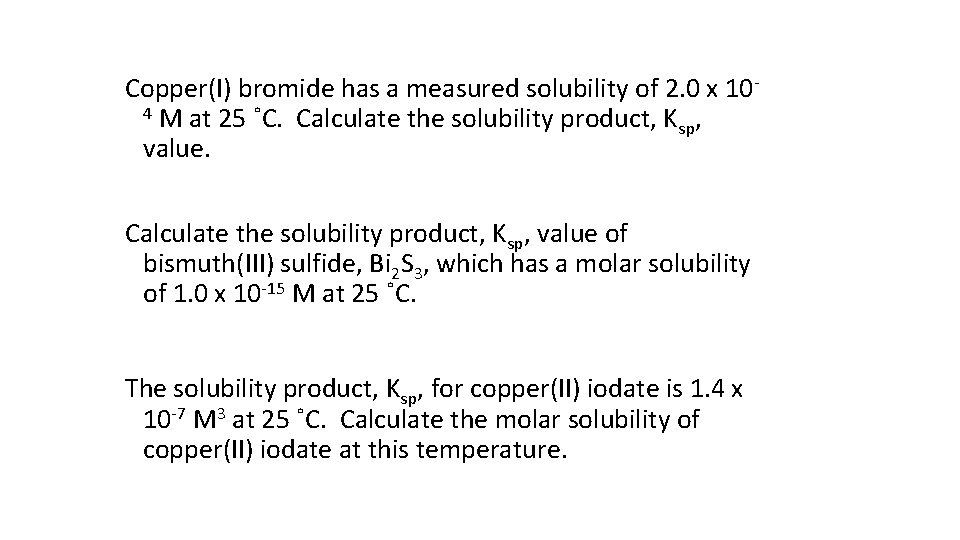
Copper(I) bromide has a measured solubility of 2. 0 x 104 M at 25 ˚C. Calculate the solubility product, K , sp value. Calculate the solubility product, Ksp, value of bismuth(III) sulfide, Bi 2 S 3, which has a molar solubility of 1. 0 x 10 -15 M at 25 ˚C. The solubility product, Ksp, for copper(II) iodate is 1. 4 x 10 -7 M 3 at 25 ˚C. Calculate the molar solubility of copper(II) iodate at this temperature.
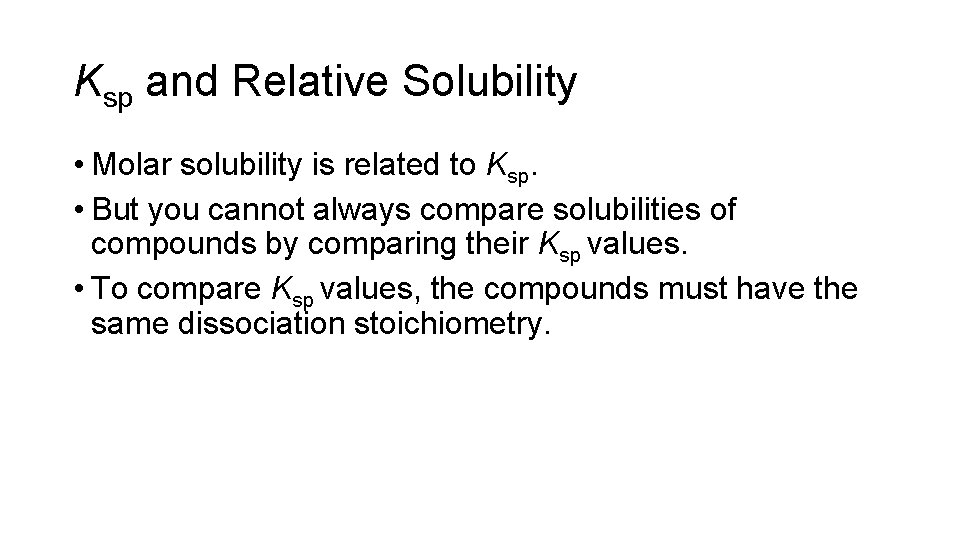
Ksp and Relative Solubility • Molar solubility is related to Ksp. • But you cannot always compare solubilities of compounds by comparing their Ksp values. • To compare Ksp values, the compounds must have the same dissociation stoichiometry.
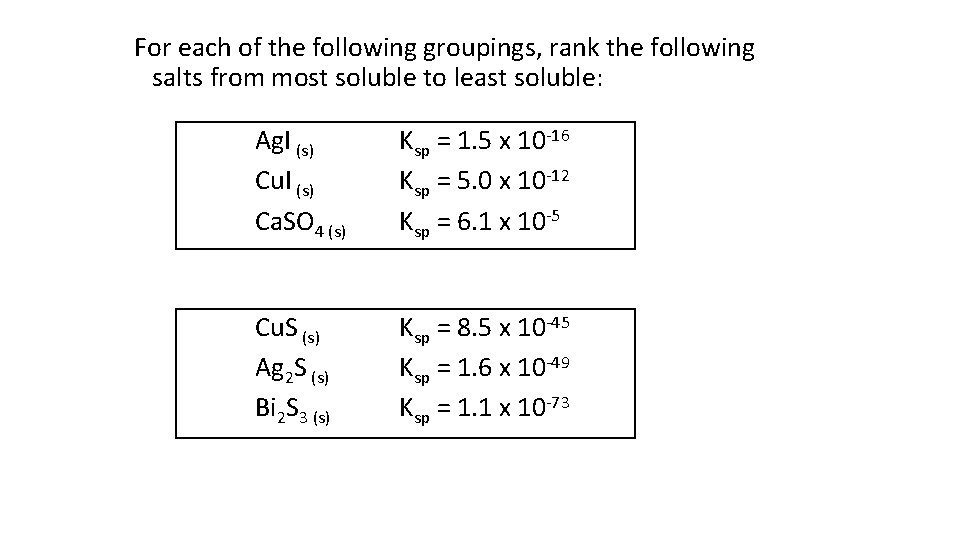
For each of the following groupings, rank the following salts from most soluble to least soluble: Ag. I (s) Cu. I (s) Ca. SO 4 (s) Ksp = 1. 5 x 10 -16 Ksp = 5. 0 x 10 -12 Ksp = 6. 1 x 10 -5 Cu. S (s) Ag 2 S (s) Bi 2 S 3 (s) Ksp = 8. 5 x 10 -45 Ksp = 1. 6 x 10 -49 Ksp = 1. 1 x 10 -73
Factors that Affect Solubility • Common ion • p. H for salts that contain basic anions: • Formation of complex ions (Kf)
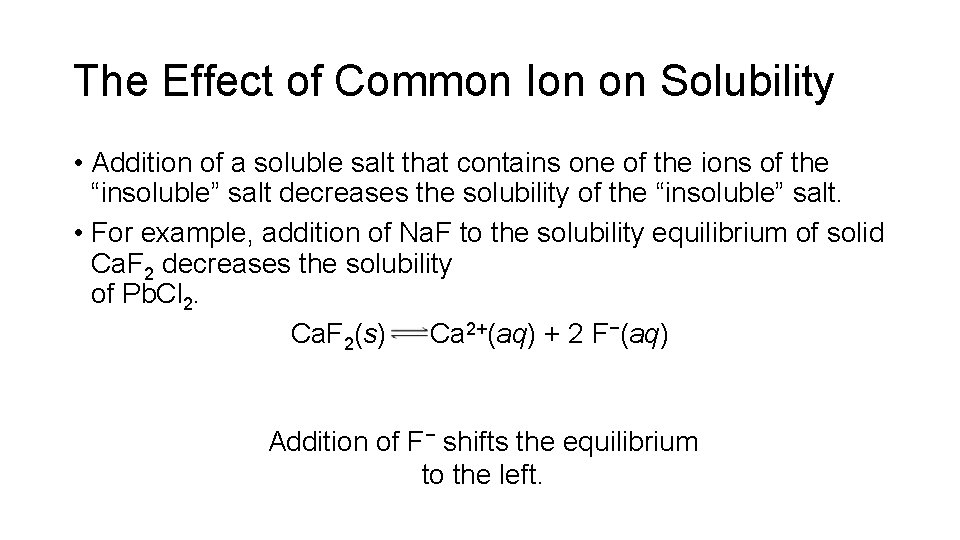
The Effect of Common Ion on Solubility • Addition of a soluble salt that contains one of the ions of the “insoluble” salt decreases the solubility of the “insoluble” salt. • For example, addition of Na. F to the solubility equilibrium of solid Ca. F 2 decreases the solubility of Pb. Cl 2. Ca. F 2(s) Ca 2+(aq) + 2 F−(aq) Addition of F− shifts the equilibrium to the left.

Common Ion
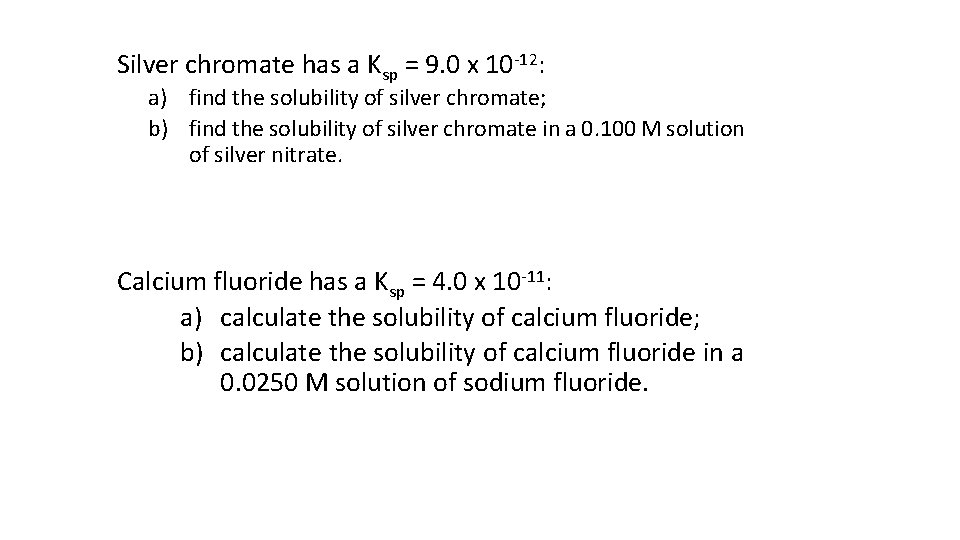
Silver chromate has a Ksp = 9. 0 x 10 -12: a) find the solubility of silver chromate; b) find the solubility of silver chromate in a 0. 100 M solution of silver nitrate. Calcium fluoride has a Ksp = 4. 0 x 10 -11: a) calculate the solubility of calcium fluoride; b) calculate the solubility of calcium fluoride in a 0. 0250 M solution of sodium fluoride.
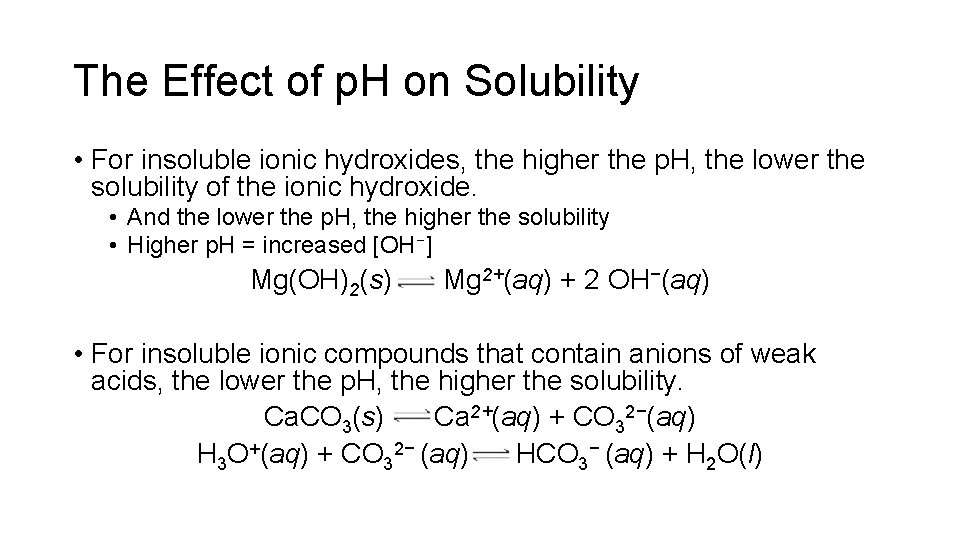
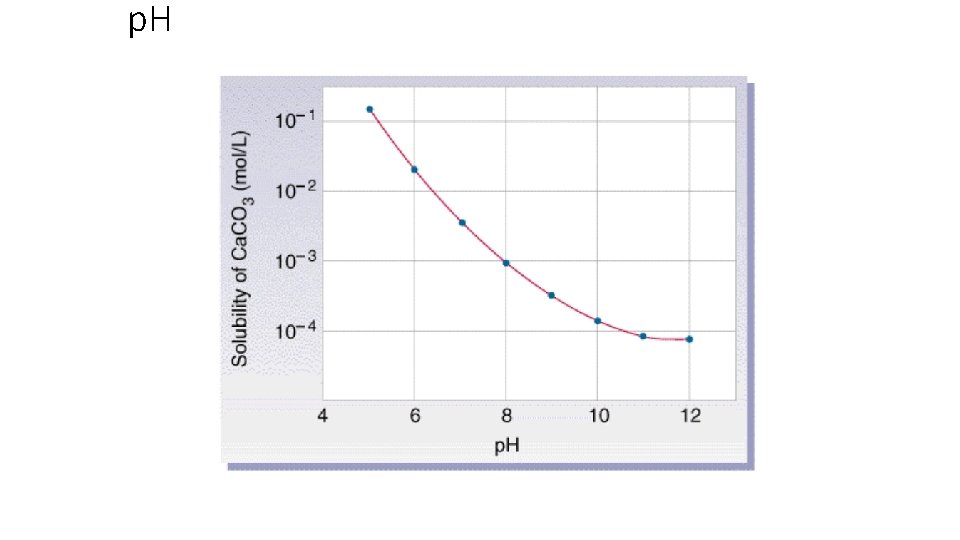
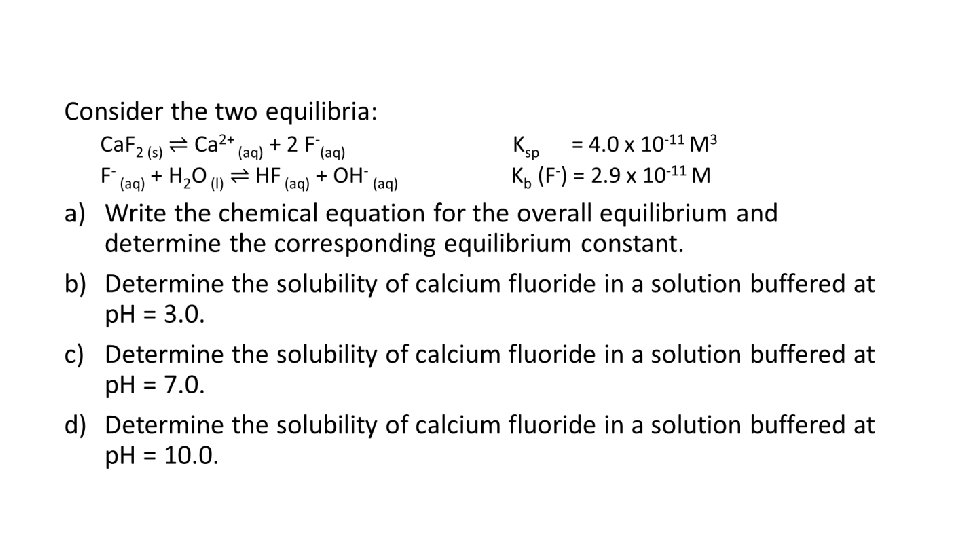
The Effect of p. H on Solubility • For insoluble ionic hydroxides, the higher the p. H, the lower the solubility of the ionic hydroxide. • And the lower the p. H, the higher the solubility • Higher p. H = increased [OH−] Mg(OH)2(s) Mg 2+(aq) + 2 OH−(aq) • For insoluble ionic compounds that contain anions of weak acids, the lower the p. H, the higher the solubility. Ca. CO 3(s) Ca 2+(aq) + CO 32−(aq) H 3 O+(aq) + CO 32− (aq) HCO 3− (aq) + H 2 O(l)
p. H
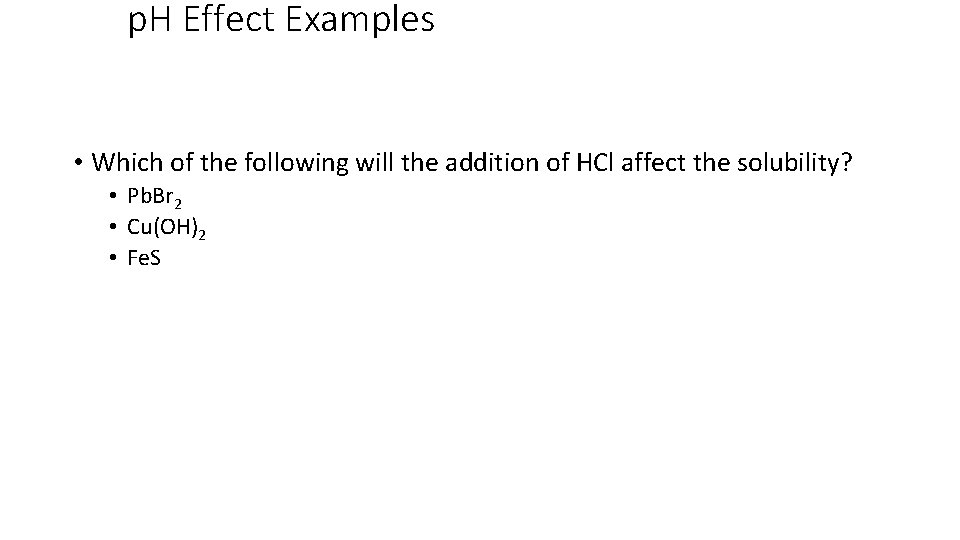
p. H Effect Examples • Which of the following will the addition of HCl affect the solubility? • Pb. Br 2 • Cu(OH)2 • Fe. S
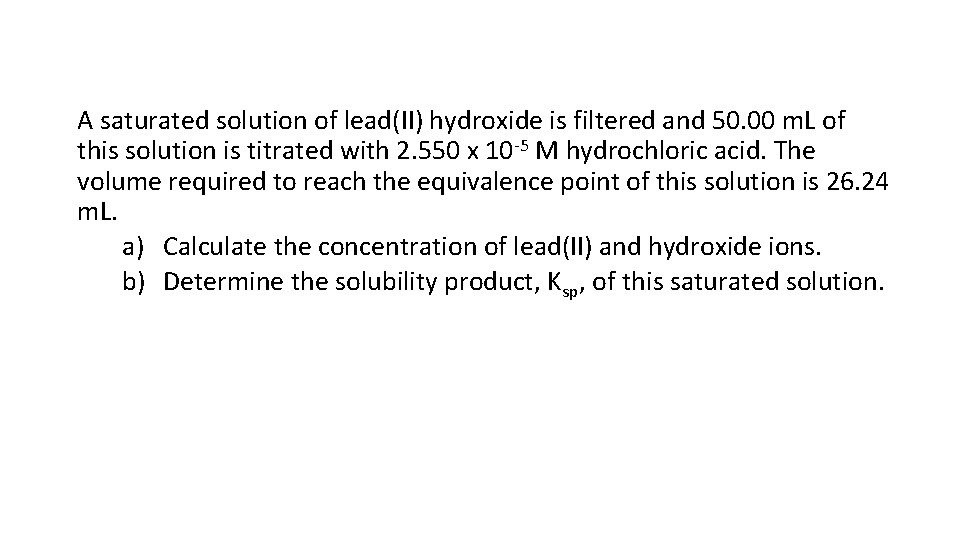
A saturated solution of lead(II) hydroxide is filtered and 50. 00 m. L of this solution is titrated with 2. 550 x 10 -5 M hydrochloric acid. The volume required to reach the equivalence point of this solution is 26. 24 m. L. a) Calculate the concentration of lead(II) and hydroxide ions. b) Determine the solubility product, Ksp, of this saturated solution.
- Slides: 17