
Solubility Equilibria The Reality Behind the Solubility Rules

Solubility Equilibria The Reality Behind the Solubility Rules
Solubility Rules- Qualitative solubility Equilibrium- Quantitative • Stating that the insoluble salts from the solubility rules do not dissolve is not entirely accurate. Very minute quantities of these “insoluble” salts do in fact dissolve, and the amount that dissolve does so completely, as they are ionic compounds and therefore strong electrolytes.
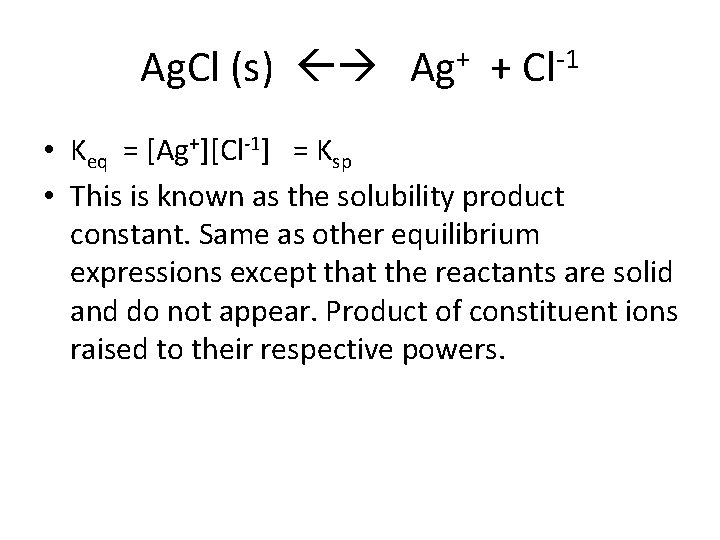
Ag. Cl (s) Ag+ + Cl-1 • Keq = [Ag+][Cl-1] = Ksp • This is known as the solubility product constant. Same as other equilibrium expressions except that the reactants are solid and do not appear. Product of constituent ions raised to their respective powers.
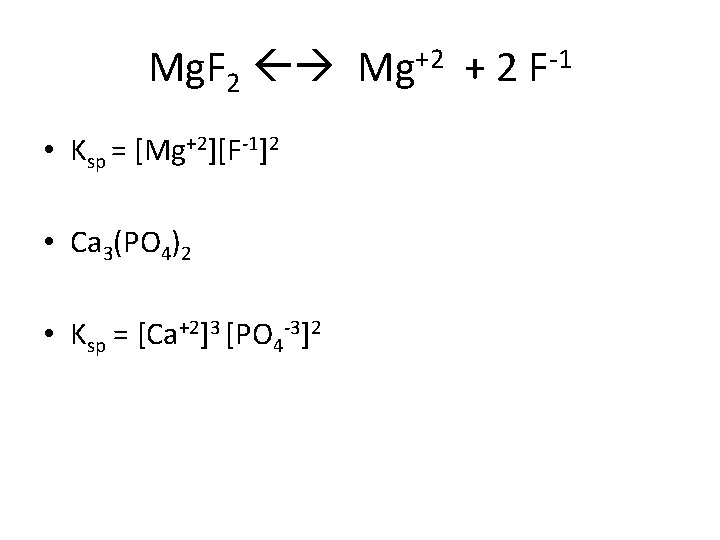
Mg. F 2 Mg+2 + 2 F-1 • Ksp = [Mg+2][F-1]2 • Ca 3(PO 4)2 • Ksp = [Ca+2]3 [PO 4 -3]2
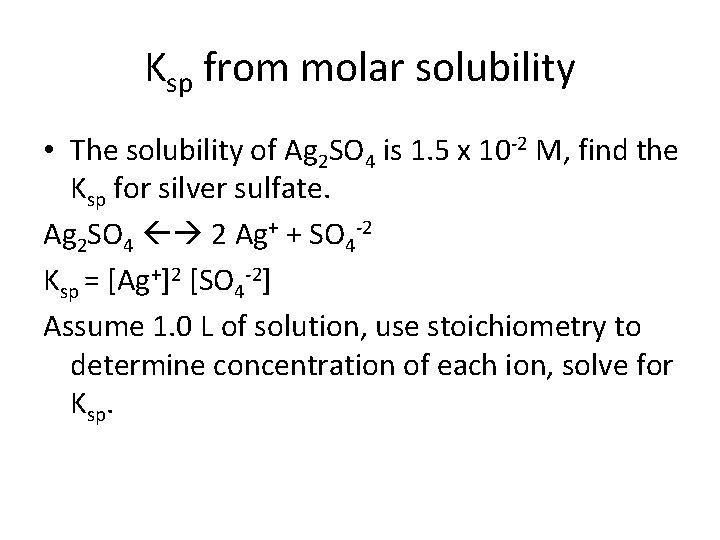
Ksp from molar solubility • The solubility of Ag 2 SO 4 is 1. 5 x 10 -2 M, find the Ksp for silver sulfate. Ag 2 SO 4 2 Ag+ + SO 4 -2 Ksp = [Ag+]2 [SO 4 -2] Assume 1. 0 L of solution, use stoichiometry to determine concentration of each ion, solve for Ksp.
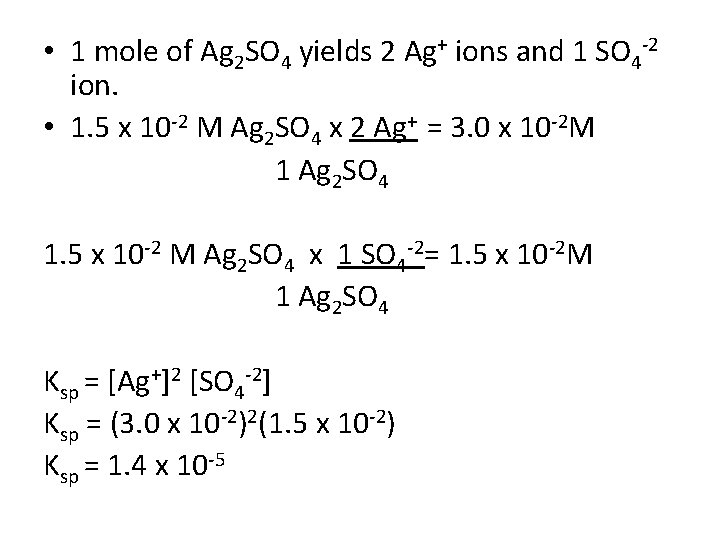
• 1 mole of Ag 2 SO 4 yields 2 Ag+ ions and 1 SO 4 -2 ion. • 1. 5 x 10 -2 M Ag 2 SO 4 x 2 Ag+ = 3. 0 x 10 -2 M 1 Ag 2 SO 4 1. 5 x 10 -2 M Ag 2 SO 4 x 1 SO 4 -2= 1. 5 x 10 -2 M 1 Ag 2 SO 4 Ksp = [Ag+]2 [SO 4 -2] Ksp = (3. 0 x 10 -2)2(1. 5 x 10 -2) Ksp = 1. 4 x 10 -5
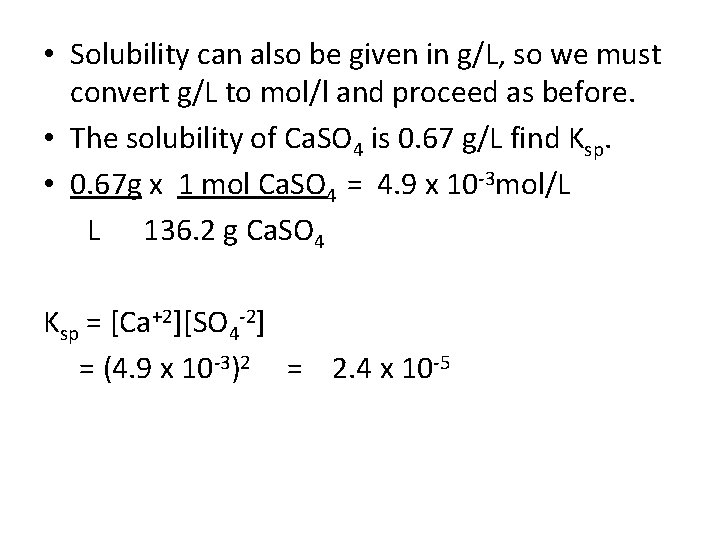
• Solubility can also be given in g/L, so we must convert g/L to mol/l and proceed as before. • The solubility of Ca. SO 4 is 0. 67 g/L find Ksp. • 0. 67 g x 1 mol Ca. SO 4 = 4. 9 x 10 -3 mol/L L 136. 2 g Ca. SO 4 Ksp = [Ca+2][SO 4 -2] = (4. 9 x 10 -3)2 = 2. 4 x 10 -5
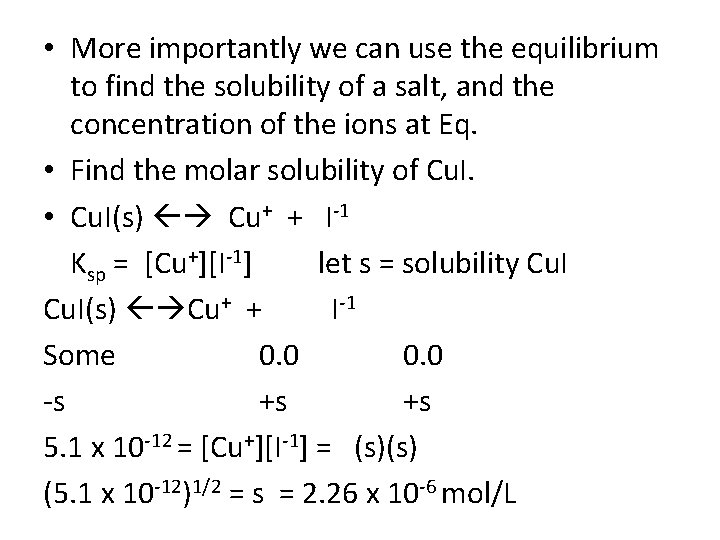
• More importantly we can use the equilibrium to find the solubility of a salt, and the concentration of the ions at Eq. • Find the molar solubility of Cu. I. • Cu. I(s) Cu+ + I-1 Ksp = [Cu+][I-1] let s = solubility Cu. I(s) Cu+ + I-1 Some 0. 0 -s +s +s 5. 1 x 10 -12 = [Cu+][I-1] = (s)(s) (5. 1 x 10 -12)1/2 = s = 2. 26 x 10 -6 mol/L
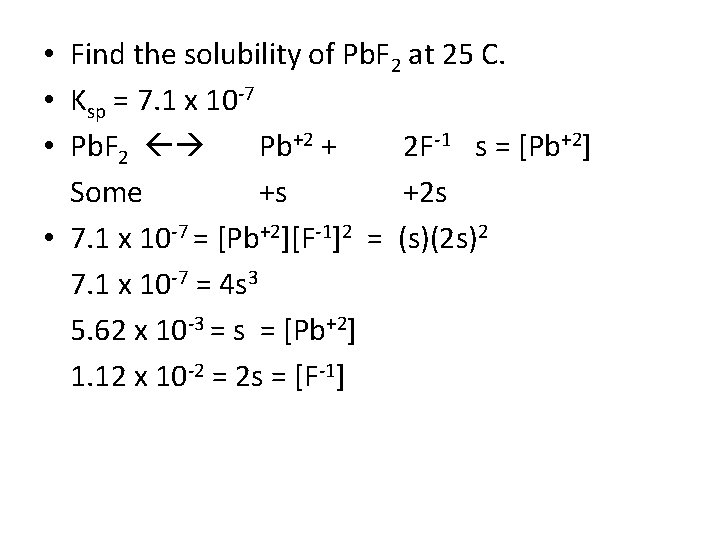
• Find the solubility of Pb. F 2 at 25 C. • Ksp = 7. 1 x 10 -7 • Pb. F 2 Pb+2 + 2 F-1 s = [Pb+2] Some +s +2 s • 7. 1 x 10 -7 = [Pb+2][F-1]2 = (s)(2 s)2 7. 1 x 10 -7 = 4 s 3 5. 62 x 10 -3 = s = [Pb+2] 1. 12 x 10 -2 = 2 s = [F-1]
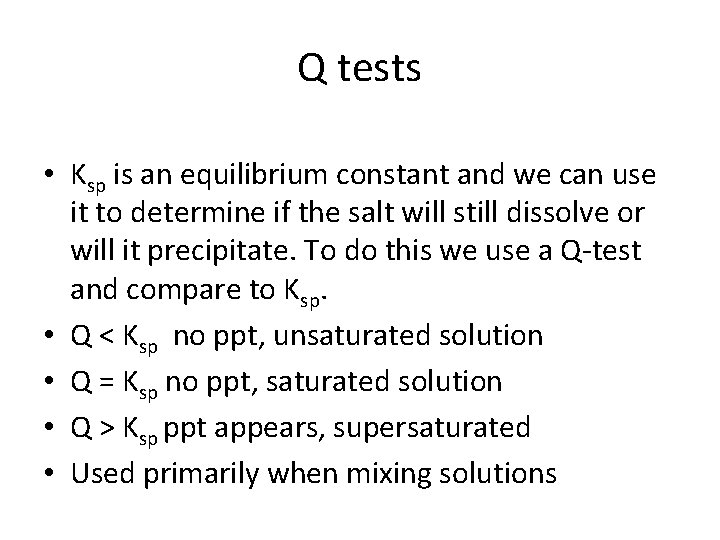
Q tests • Ksp is an equilibrium constant and we can use it to determine if the salt will still dissolve or will it precipitate. To do this we use a Q-test and compare to Ksp. • Q < Ksp no ppt, unsaturated solution • Q = Ksp no ppt, saturated solution • Q > Ksp ppt appears, supersaturated • Used primarily when mixing solutions
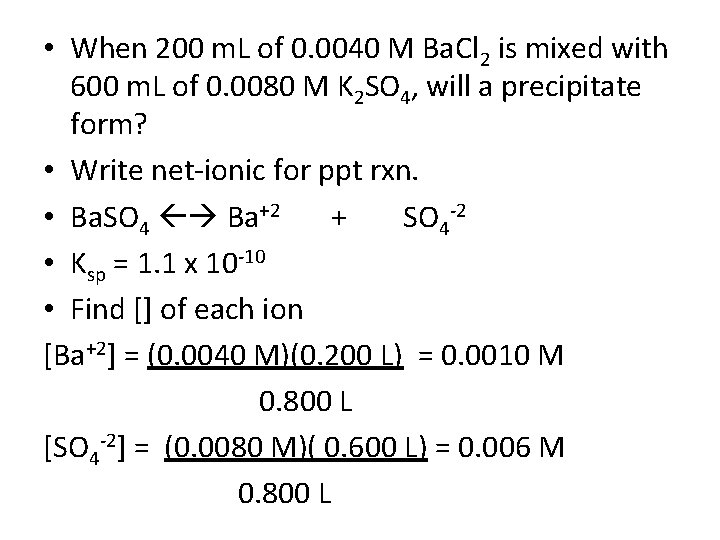
• When 200 m. L of 0. 0040 M Ba. Cl 2 is mixed with 600 m. L of 0. 0080 M K 2 SO 4, will a precipitate form? • Write net-ionic for ppt rxn. • Ba. SO 4 Ba+2 + SO 4 -2 • Ksp = 1. 1 x 10 -10 • Find [] of each ion [Ba+2] = (0. 0040 M)(0. 200 L) = 0. 0010 M 0. 800 L [SO 4 -2] = (0. 0080 M)( 0. 600 L) = 0. 006 M 0. 800 L
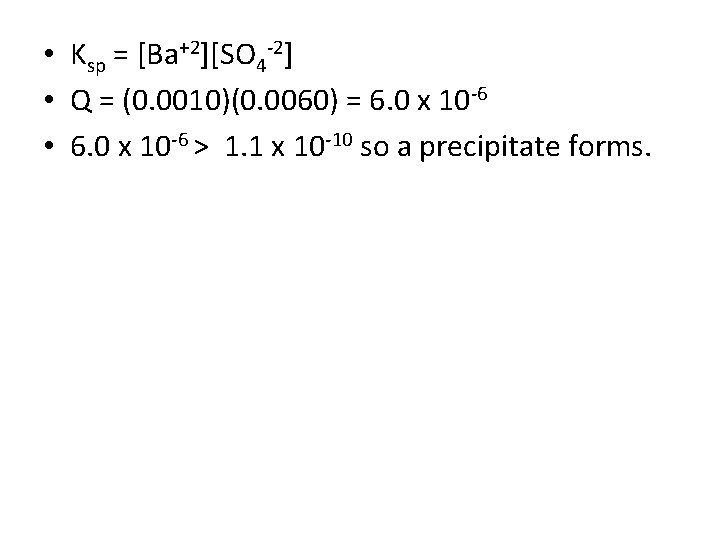
• Ksp = [Ba+2][SO 4 -2] • Q = (0. 0010)(0. 0060) = 6. 0 x 10 -6 • 6. 0 x 10 -6 > 1. 1 x 10 -10 so a precipitate forms.
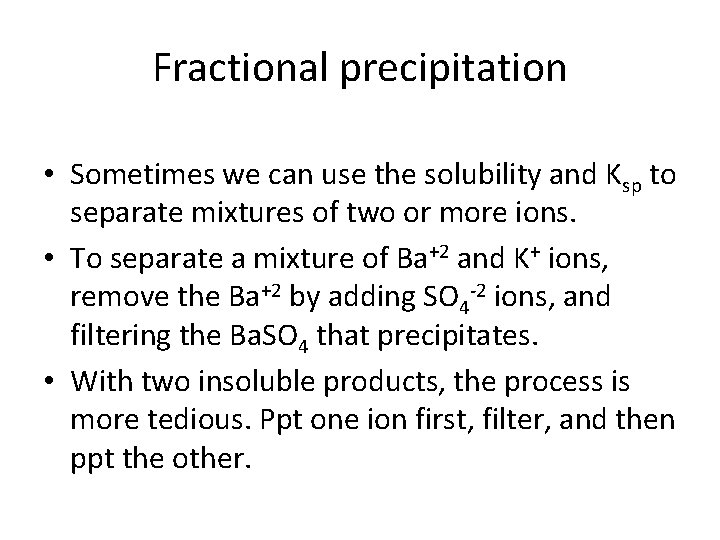
Fractional precipitation • Sometimes we can use the solubility and Ksp to separate mixtures of two or more ions. • To separate a mixture of Ba+2 and K+ ions, remove the Ba+2 by adding SO 4 -2 ions, and filtering the Ba. SO 4 that precipitates. • With two insoluble products, the process is more tedious. Ppt one ion first, filter, and then ppt the other.
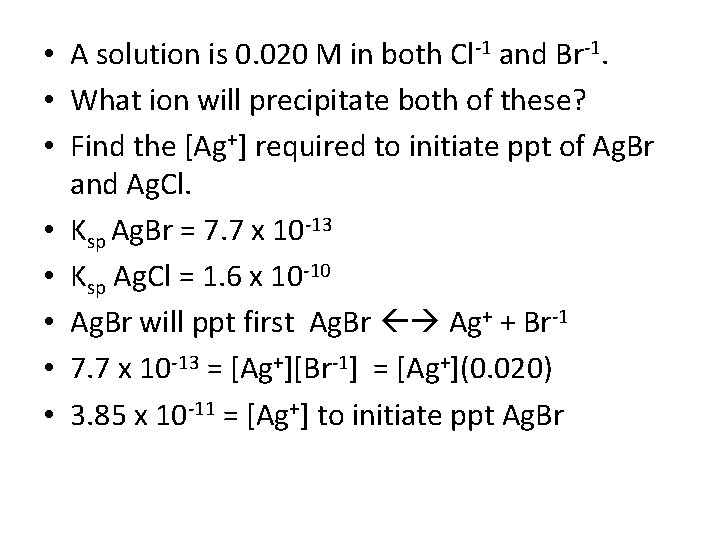
• A solution is 0. 020 M in both Cl-1 and Br-1. • What ion will precipitate both of these? • Find the [Ag+] required to initiate ppt of Ag. Br and Ag. Cl. • Ksp Ag. Br = 7. 7 x 10 -13 • Ksp Ag. Cl = 1. 6 x 10 -10 • Ag. Br will ppt first Ag. Br Ag+ + Br-1 • 7. 7 x 10 -13 = [Ag+][Br-1] = [Ag+](0. 020) • 3. 85 x 10 -11 = [Ag+] to initiate ppt Ag. Br
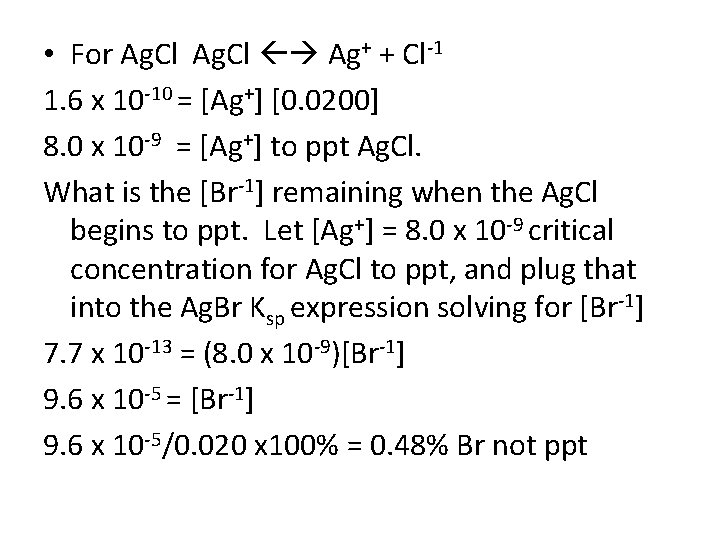
• For Ag. Cl Ag+ + Cl-1 1. 6 x 10 -10 = [Ag+] [0. 0200] 8. 0 x 10 -9 = [Ag+] to ppt Ag. Cl. What is the [Br-1] remaining when the Ag. Cl begins to ppt. Let [Ag+] = 8. 0 x 10 -9 critical concentration for Ag. Cl to ppt, and plug that into the Ag. Br Ksp expression solving for [Br-1] 7. 7 x 10 -13 = (8. 0 x 10 -9)[Br-1] 9. 6 x 10 -5 = [Br-1] 9. 6 x 10 -5/0. 020 x 100% = 0. 48% Br not ppt
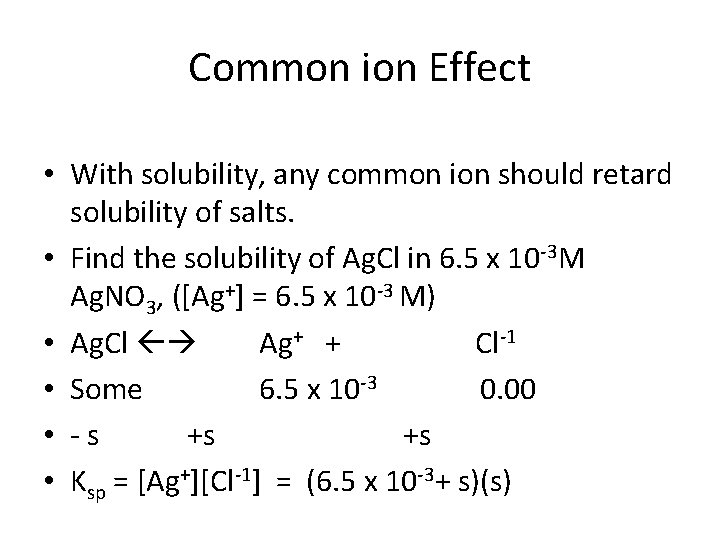
Common ion Effect • With solubility, any common ion should retard solubility of salts. • Find the solubility of Ag. Cl in 6. 5 x 10 -3 M Ag. NO 3, ([Ag+] = 6. 5 x 10 -3 M) • Ag. Cl Ag+ + Cl-1 • Some 6. 5 x 10 -3 0. 00 • -s +s +s • Ksp = [Ag+][Cl-1] = (6. 5 x 10 -3+ s)(s)
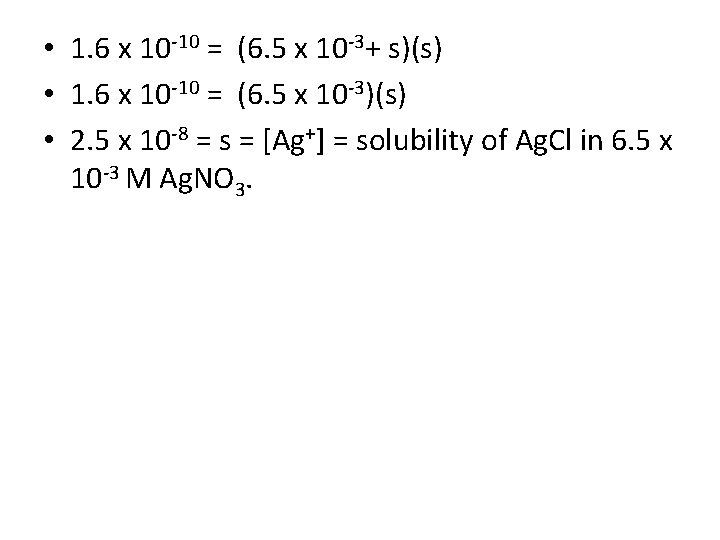
• 1. 6 x 10 -10 = (6. 5 x 10 -3+ s)(s) • 1. 6 x 10 -10 = (6. 5 x 10 -3)(s) • 2. 5 x 10 -8 = s = [Ag+] = solubility of Ag. Cl in 6. 5 x 10 -3 M Ag. NO 3.
- Slides: 17