
Solubility Equilibria Chem 30 S ReviewSolubility Rules n

Solubility Equilibria
Chem 30 S Review…Solubility Rules n n n Salts are generally more soluble in HOT water (Gases are more soluble in COLD water) Alkali Metal salts are very soluble in water. Na. Cl, KOH, Li 3 PO 4, Na 2 SO 4 etc. . . Ammonium salts are very soluble in water. NH 4 Br, (NH 4)2 CO 3 etc… Salts containing the nitrate ion, NO 3 -, are very soluble in water. Most salts of Cl-, Br- and I- are very soluble in water exceptions are salts containing Ag+ and Pb 2+. soluble salts: Fe. Cl 2, Al. Br 3, Mg. I 2 etc. . . “insoluble” salts: Ag. Cl, Pb. Br 2 etc. . .
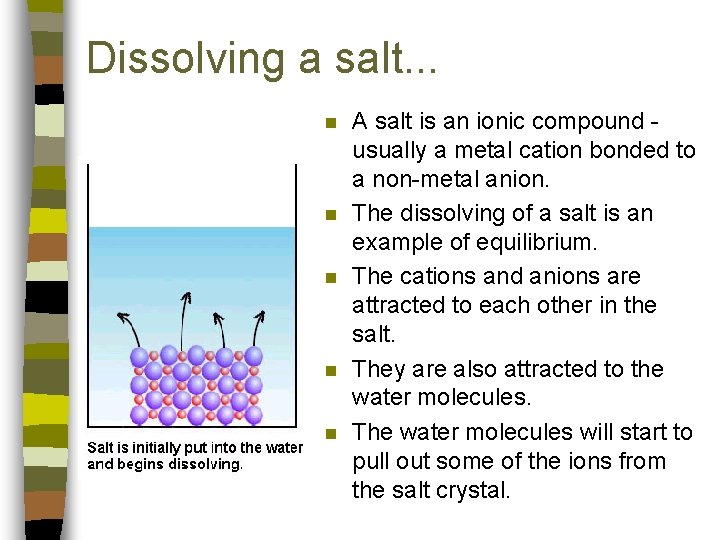
Dissolving a salt. . . n n n A salt is an ionic compound usually a metal cation bonded to a non-metal anion. The dissolving of a salt is an example of equilibrium. The cations and anions are attracted to each other in the salt. They are also attracted to the water molecules. The water molecules will start to pull out some of the ions from the salt crystal.
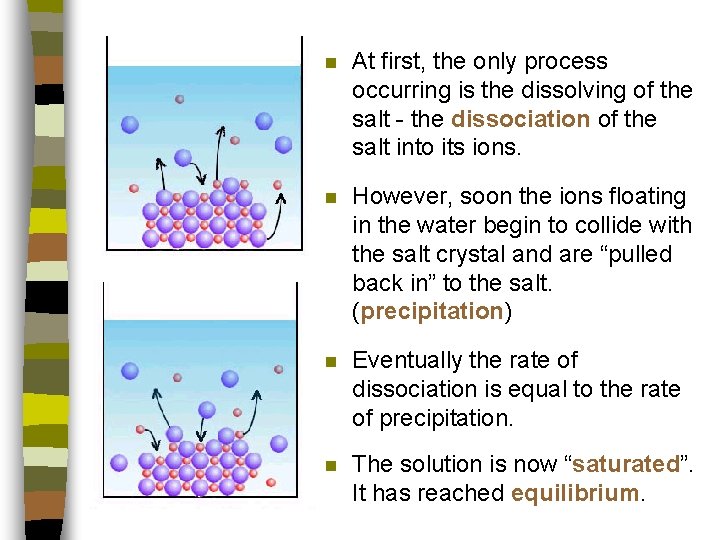
n At first, the only process occurring is the dissolving of the salt - the dissociation of the salt into its ions. n However, soon the ions floating in the water begin to collide with the salt crystal and are “pulled back in” to the salt. (precipitation) n Eventually the rate of dissociation is equal to the rate of precipitation. n The solution is now “saturated”. It has reached equilibrium.
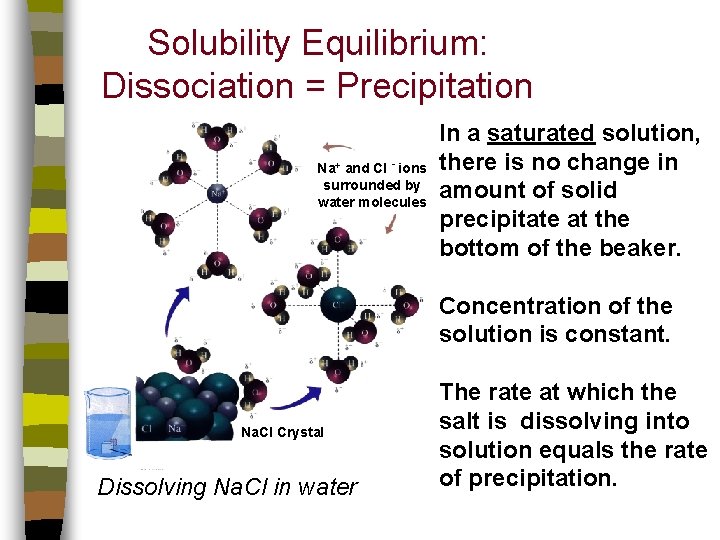
Solubility Equilibrium: Dissociation = Precipitation Na+ and Cl - ions surrounded by water molecules In a saturated solution, there is no change in amount of solid precipitate at the bottom of the beaker. Concentration of the solution is constant. Na. Cl Crystal Dissolving Na. Cl in water The rate at which the salt is dissolving into solution equals the rate of precipitation.
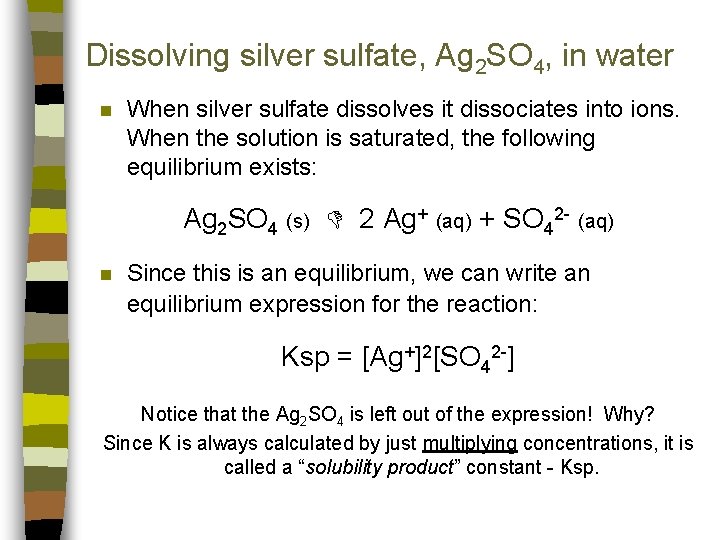
Dissolving silver sulfate, Ag 2 SO 4, in water n When silver sulfate dissolves it dissociates into ions. When the solution is saturated, the following equilibrium exists: Ag 2 SO 4 (s) 2 Ag+ (aq) + SO 42 - (aq) n Since this is an equilibrium, we can write an equilibrium expression for the reaction: Ksp = [Ag+]2[SO 42 -] Notice that the Ag 2 SO 4 is left out of the expression! Why? Since K is always calculated by just multiplying concentrations, it is called a “solubility product” constant - Ksp.
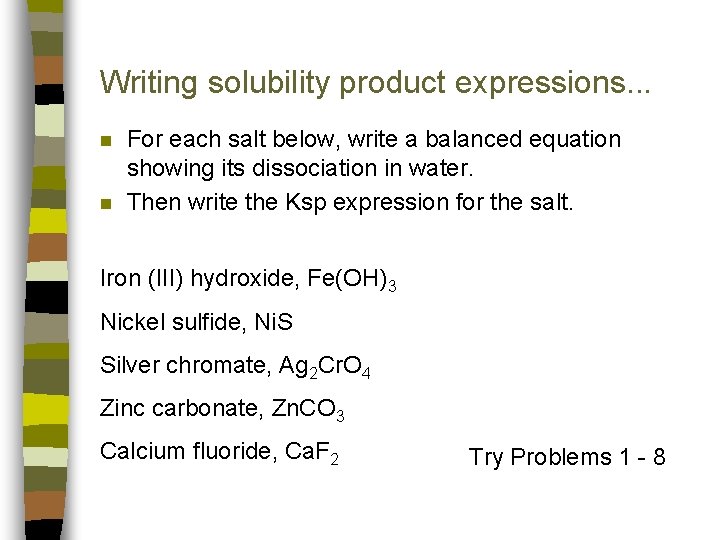
Writing solubility product expressions. . . n n For each salt below, write a balanced equation showing its dissociation in water. Then write the Ksp expression for the salt. Iron (III) hydroxide, Fe(OH)3 Nickel sulfide, Ni. S Silver chromate, Ag 2 Cr. O 4 Zinc carbonate, Zn. CO 3 Calcium fluoride, Ca. F 2 Try Problems 1 - 8
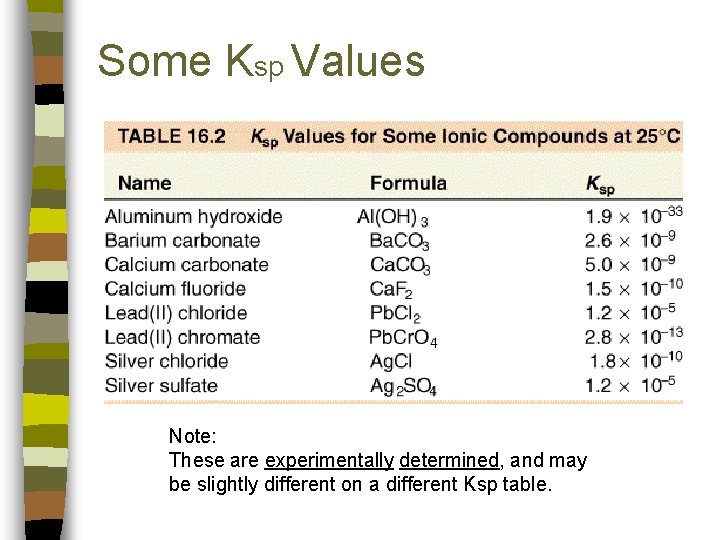
Some Ksp Values Note: These are experimentally determined, and may be slightly different on a different Ksp table.
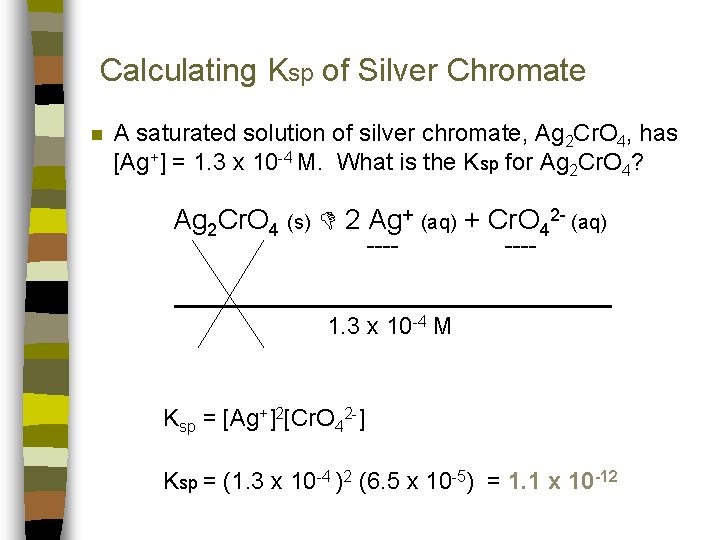
Calculating Ksp of Silver Chromate n A saturated solution of silver chromate, Ag 2 Cr. O 4, has [Ag+] = 1. 3 x 10 -4 M. What is the Ksp for Ag 2 Cr. O 4? Ag 2 Cr. O 4 (s) 2 Ag+ (aq) + Cr. O 42 - (aq) ---- 1. 3 x 10 -4 M Ksp = [Ag+]2[Cr. O 42 -] Ksp = (1. 3 x 10 -4 )2 (6. 5 x 10 -5) = 1. 1 x 10 -12
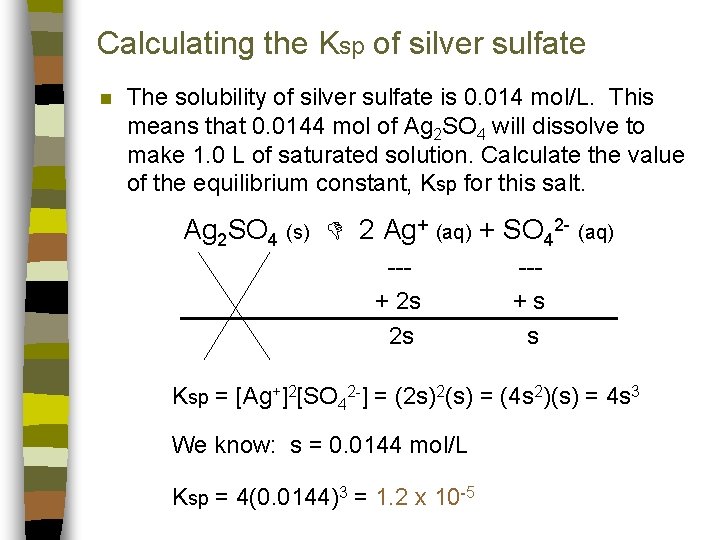
Calculating the Ksp of silver sulfate n The solubility of silver sulfate is 0. 014 mol/L. This means that 0. 0144 mol of Ag 2 SO 4 will dissolve to make 1. 0 L of saturated solution. Calculate the value of the equilibrium constant, Ksp for this salt. Ag 2 SO 4 (s) 2 Ag+ (aq) + SO 42 - (aq) --+ 2 s 2 s --+s s Ksp = [Ag+]2[SO 42 -] = (2 s)2(s) = (4 s 2)(s) = 4 s 3 We know: s = 0. 0144 mol/L Ksp = 4(0. 0144)3 = 1. 2 x 10 -5
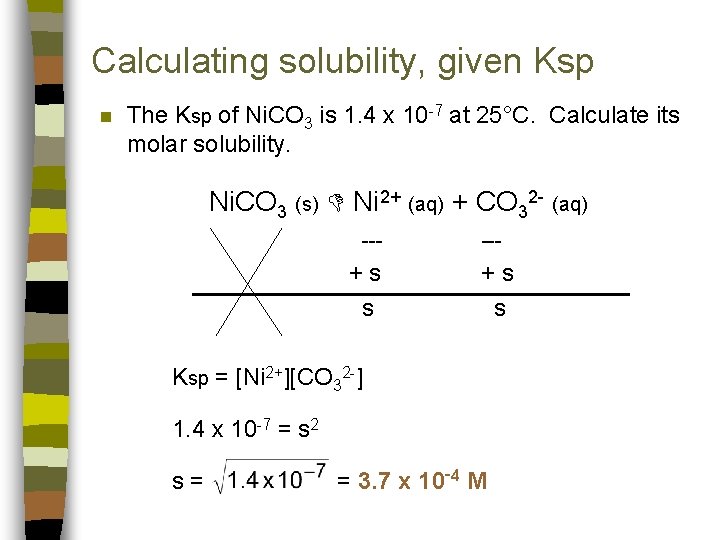
Calculating solubility, given Ksp n The Ksp of Ni. CO 3 is 1. 4 x 10 -7 at 25°C. Calculate its molar solubility. Ni. CO 3 (s) Ni 2+ (aq) + CO 32 - (aq) --- +s s Ksp = [Ni 2+][CO 32 -] 1. 4 x 10 -7 = s 2 s= = 3. 7 x 10 -4 M
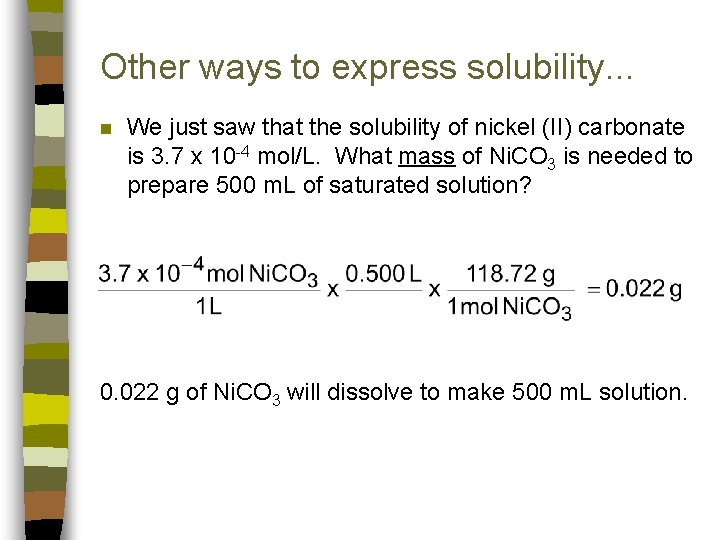
Other ways to express solubility. . . n We just saw that the solubility of nickel (II) carbonate is 3. 7 x 10 -4 mol/L. What mass of Ni. CO 3 is needed to prepare 500 m. L of saturated solution? 0. 022 g of Ni. CO 3 will dissolve to make 500 m. L solution.
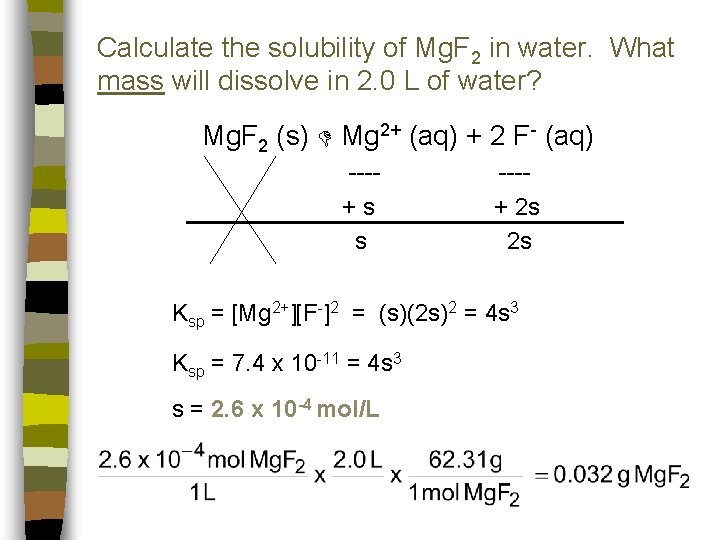
Calculate the solubility of Mg. F 2 in water. What mass will dissolve in 2. 0 L of water? Mg. F 2 (s) Mg 2+ (aq) + 2 F- (aq) ---+s s ---+ 2 s 2 s Ksp = [Mg 2+][F-]2 = (s)(2 s)2 = 4 s 3 Ksp = 7. 4 x 10 -11 = 4 s 3 s = 2. 6 x 10 -4 mol/L
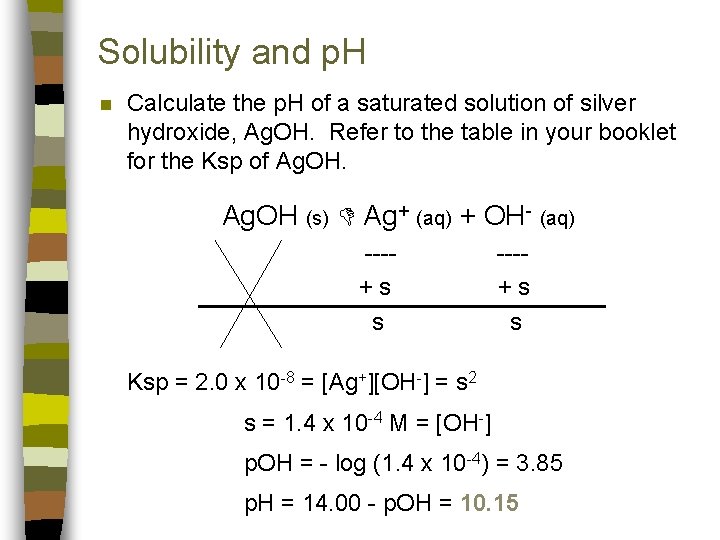
Solubility and p. H n Calculate the p. H of a saturated solution of silver hydroxide, Ag. OH. Refer to the table in your booklet for the Ksp of Ag. OH (s) Ag+ (aq) + OH- (aq) ---+s s Ksp = 2. 0 x 10 -8 = [Ag+][OH-] = s 2 s = 1. 4 x 10 -4 M = [OH-] p. OH = - log (1. 4 x 10 -4) = 3. 85 p. H = 14. 00 - p. OH = 10. 15
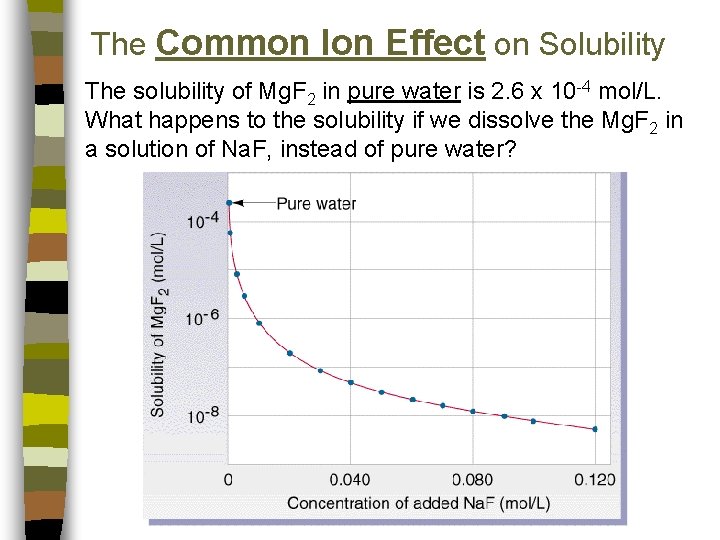
The Common Ion Effect on Solubility The solubility of Mg. F 2 in pure water is 2. 6 x 10 -4 mol/L. What happens to the solubility if we dissolve the Mg. F 2 in a solution of Na. F, instead of pure water?
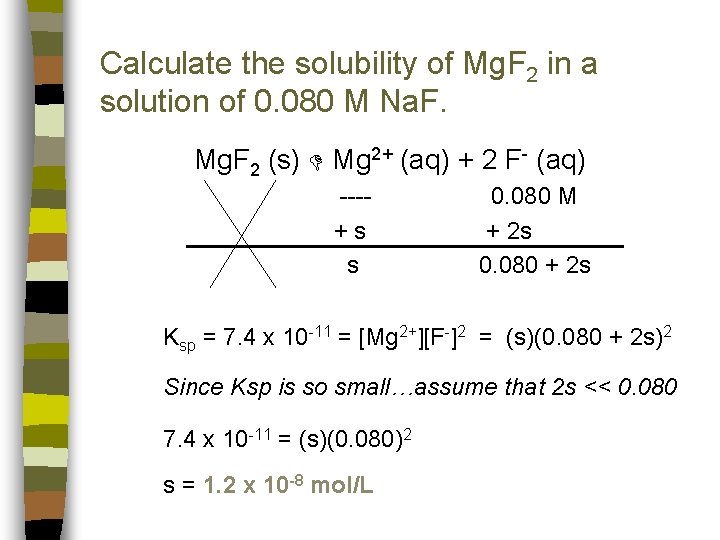
Calculate the solubility of Mg. F 2 in a solution of 0. 080 M Na. F. Mg. F 2 (s) Mg 2+ (aq) + 2 F- (aq) ---+s s 0. 080 M + 2 s 0. 080 + 2 s Ksp = 7. 4 x 10 -11 = [Mg 2+][F-]2 = (s)(0. 080 + 2 s)2 Since Ksp is so small…assume that 2 s << 0. 080 7. 4 x 10 -11 = (s)(0. 080)2 s = 1. 2 x 10 -8 mol/L
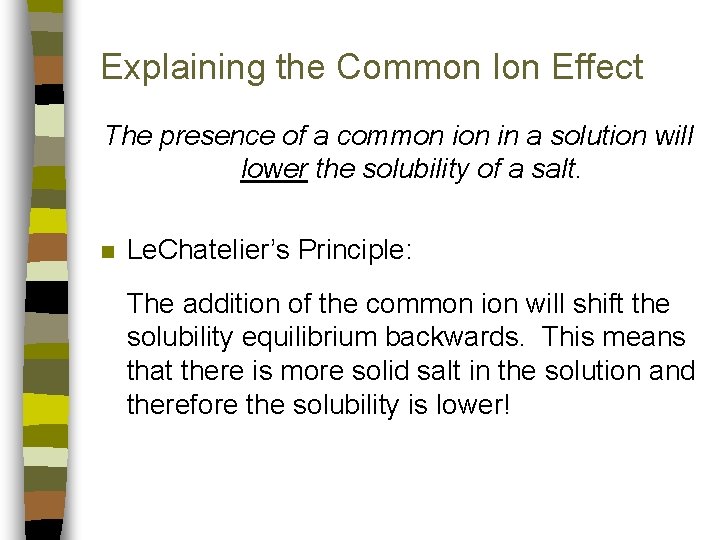
Explaining the Common Ion Effect The presence of a common in a solution will lower the solubility of a salt. n Le. Chatelier’s Principle: The addition of the common ion will shift the solubility equilibrium backwards. This means that there is more solid salt in the solution and therefore the solubility is lower!
Ksp and Solubility n Generally, it is fair to say that salts with very small solubility product constants (Ksp) are only sparingly soluble in water. n When comparing the solubilities of two salts, however, you can sometimes simply compare the relative sizes of their Ksp values. n This works if the salts have the same number of ions! n For example… Cu. I has Ksp = 5. 0 x 10 -12 and Ca. SO 4 has Ksp = 6. 1 x 10 -5. Since the Ksp for calcium sulfate is larger than that for the copper (I) iodide, we can say that calcium sulfate is more soluble.
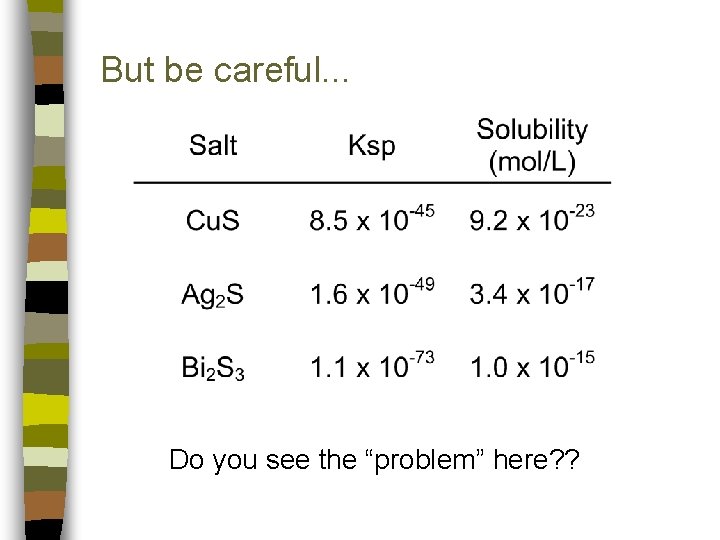
But be careful. . . Do you see the “problem” here? ?
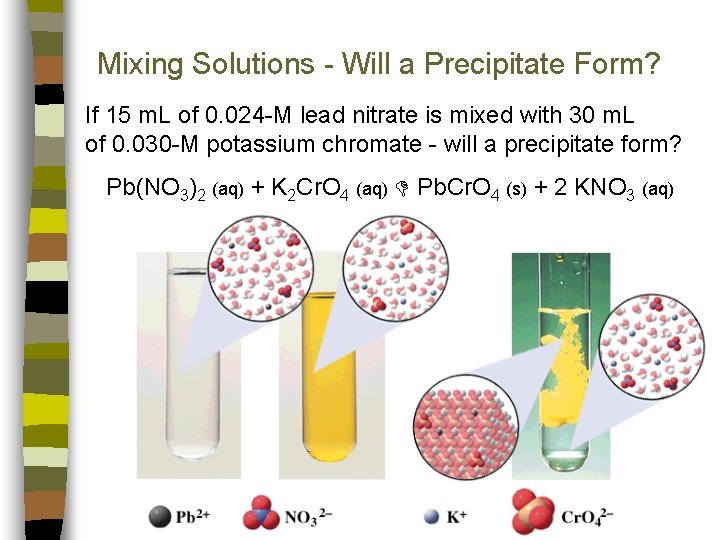
Mixing Solutions - Will a Precipitate Form? If 15 m. L of 0. 024 -M lead nitrate is mixed with 30 m. L of 0. 030 -M potassium chromate - will a precipitate form? Pb(NO 3)2 (aq) + K 2 Cr. O 4 (aq) Pb. Cr. O 4 (s) + 2 KNO 3 (aq)
Pb(NO 3)2 (aq) + K 2 Cr. O 4 (aq) Pb. Cr. O 4 (s) + 2 KNO 3 (aq) Step 1: Is a sparingly soluble salt formed? We can see that a double replacement reaction can occur and produce Pb. Cr. O 4. Since this salt has a very small Ksp, it may precipitate from the mixture. The solubility equilibrium is: Pb. Cr. O 4 (s) Pb 2+ (aq) + Cr. O 42 - (aq) Ksp = 2 x 10 -16 = [Pb 2+][Cr. O 42 -] If a precipitate forms, it means the solubility equilibrium has shifted BACKWARDS. This will happen only if Qsp > Ksp in our mixture.
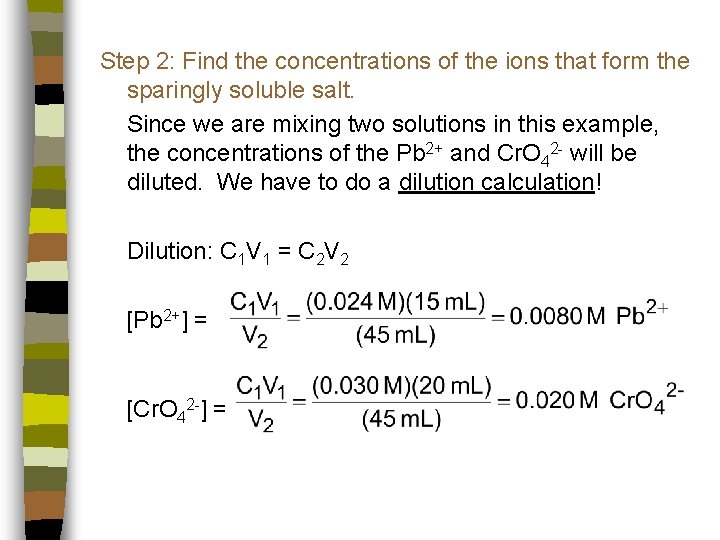
Step 2: Find the concentrations of the ions that form the sparingly soluble salt. Since we are mixing two solutions in this example, the concentrations of the Pb 2+ and Cr. O 42 - will be diluted. We have to do a dilution calculation! Dilution: C 1 V 1 = C 2 V 2 [Pb 2+] = [Cr. O 42 -] =
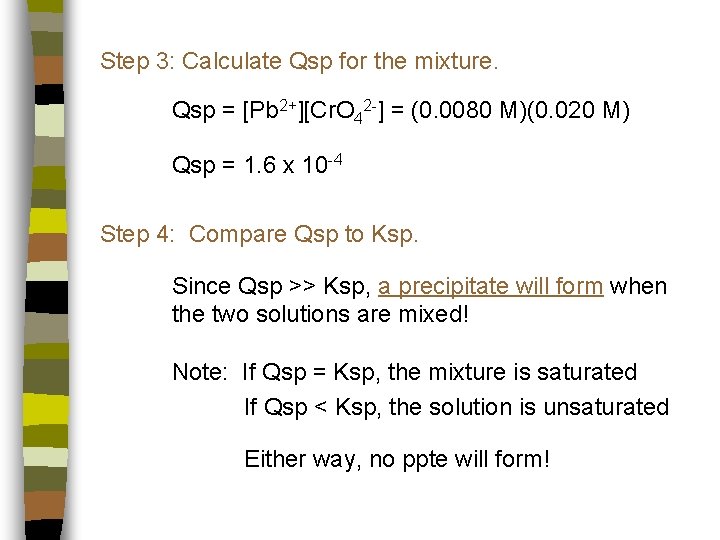
Step 3: Calculate Qsp for the mixture. Qsp = [Pb 2+][Cr. O 42 -] = (0. 0080 M)(0. 020 M) Qsp = 1. 6 x 10 -4 Step 4: Compare Qsp to Ksp. Since Qsp >> Ksp, a precipitate will form when the two solutions are mixed! Note: If Qsp = Ksp, the mixture is saturated If Qsp < Ksp, the solution is unsaturated Either way, no ppte will form!
- Slides: 23