
Solubility and Concentration Chapter 8 Section 2 Solubility
Solubility and Concentration Chapter 8 Section 2
Solubility: the maximum amount of a solute that dissolves in a given amount of solvent at a constant temperature. Solutions are described as saturated, unsaturated, or supersaturated, depending on the amount of solute in solution.
Saturated Solutions Saturated solution is one that contains as much solute as the solvent can hold at a given temperature. Example: Sugar Water
Unsaturated Solution is a solution that has less than the maximum amount of solute that can be dissolved. Example: Lemonade sweetened with a spoonful of sugar.
Supersaturated Solution Supersaturated solution is a solution that contains more solute than it can normally hold at a given temperature. Very unstable Example: A person carrying to many boxes, one wrong step and a box might fall or the person might trip.
Factors Affecting Solubility Three factors that affect the solubility of a solute are the polarity of the solvent, temperature, and pressure.
Polar and Nonpolar Solvents Solution formation is more likely to happen when the solute and solvent are either both polar or both nonpolar. Example: Soap and oil on hands. A soap molecule has a polar end, which attracts water molecules, and a nonpolar end, which attracts the oil. The soap molecule break up the oil into small droplets that are soluble in water.
Temperature When you add a large amount a sugar to a cold beverage only a small amount dissolves. When you add sugar to a hot beverage, more sugar will dissolve.
Pressure Increasing the pressure on a gas increases its solubility in a liquid. Example: CO 2 being forced to dissolve in soda.
Concentration of Solutions Concentration is the amount of solute dissolved in a specified amount of solution. Example: Frozen juice Concentration can be expressed as percent by volume, percent by mass, and molarity.
Percent by Volume
Percent by Mass
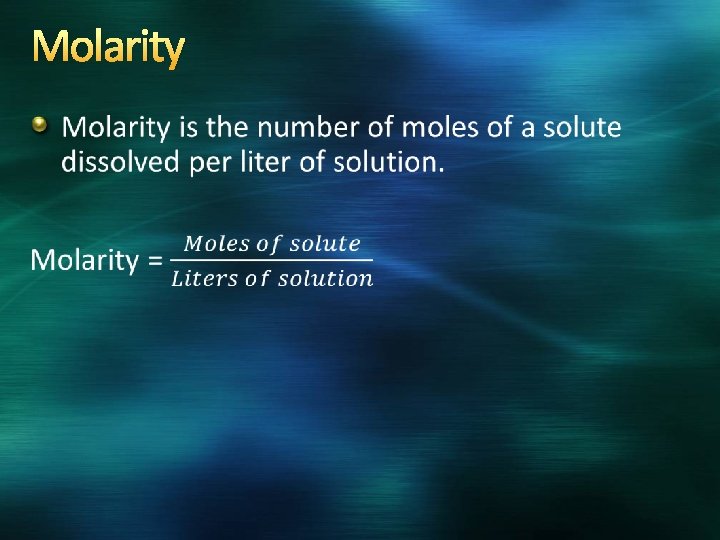
Molarity
- Slides: 13