
Solidstate Raman lasers a tutorial Jim Piper Professor
- Slides: 30
Solid-state Raman lasers: a tutorial Jim Piper Professor of Physics Centre for Lasers and Applications, Macquarie University, Sydney (Carnegie Centenary Professor, Heriot-Watt University, Edinburgh) Acknowledgements: H Pask, R Mildren, H Ogilvy, P Dekker Australian Research Council, DSTO Australia Solid-state Raman lasers
Overview of presentation • Introduction to Stimulated Raman Scattering (SRS), crystalline Raman materials, and solid-state Raman lasers (SSRL) • Raman generators (picosecond pulse conversion) • External-cavity SSRLs (nanosecond pulse conversion) • Intracavity (including self-Raman) SSRLs • Intracavity frequency-doubled SSRLs for visible outputs • CW external-cavity and intracavity SSRLs Note excellent recent reviews of solid-state Raman lasers are given by: Basiev & Powell Handbook of Laser Techn. & Applns B 1. 7 (2003) 1 -29 Cerny et al Progress in Quantum Electronics 28 (2004) 113 -143 Pask Progress in Quantum Electronics 27 (2003) 3 -56 Solid-state Raman lasers
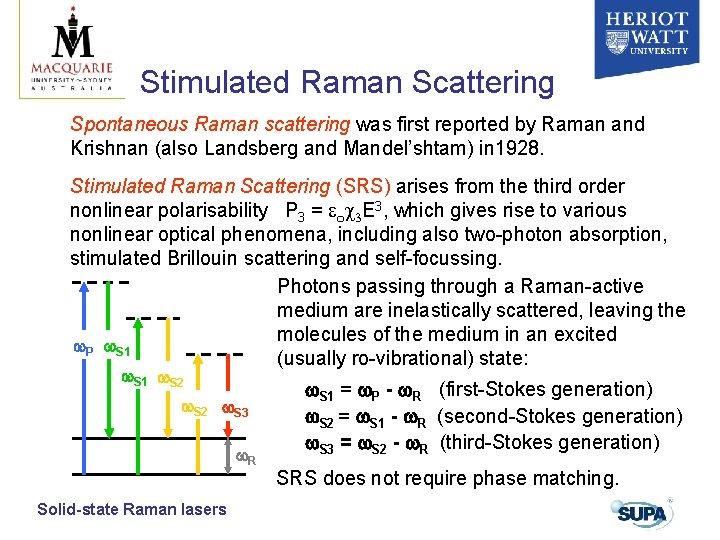
Stimulated Raman Scattering Spontaneous Raman scattering was first reported by Raman and Krishnan (also Landsberg and Mandel’shtam) in 1928. Stimulated Raman Scattering (SRS) arises from the third order nonlinear polarisability P 3 = eoc 3 E 3, which gives rise to various nonlinear optical phenomena, including also two-photon absorption, stimulated Brillouin scattering and self-focussing. Photons passing through a Raman-active medium are inelastically scattered, leaving the molecules of the medium in an excited w. P w. S 1 (usually ro-vibrational) state: w. S 1 w. S 2 w. S 3 w. R Solid-state Raman lasers w. S 1 = w. P - w. R (first-Stokes generation) w. S 2 = w. S 1 - w. R (second-Stokes generation) w. S 3 = w. S 2 - w. R (third-Stokes generation) SRS does not require phase matching.
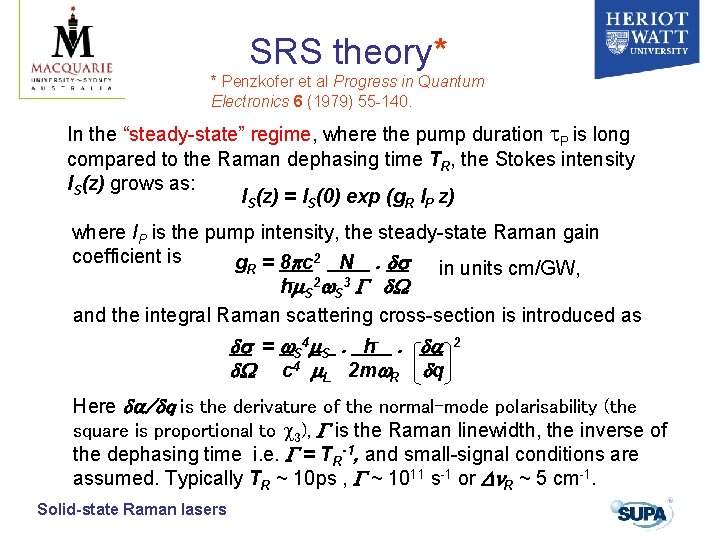
SRS theory* * Penzkofer et al Progress in Quantum Electronics 6 (1979) 55 -140. In the “steady-state” regime, where the pump duration t. P is long compared to the Raman dephasing time TR, the Stokes intensity IS(z) grows as: IS(z) = IS(0) exp (g. R IP z) where IP is the pump intensity, the steady-state Raman gain coefficient is g. R = 8 pc 2 N. ds in units cm/GW, 2 3 hm. S w. S G d. W and the integral Raman scattering cross-section is introduced as ds = w. S 4 m. S. h. da d. W c 4 m. L 2 mw. R dq 2 Here da/dq is the derivature of the normal-mode polarisability (the square is proportional to c 3), G is the Raman linewidth, the inverse of the dephasing time i. e. G = TR-1, and small-signal conditions are assumed. Typically TR ~ 10 ps , G ~ 1011 s-1 or Dn. R ~ 5 cm-1. Solid-state Raman lasers
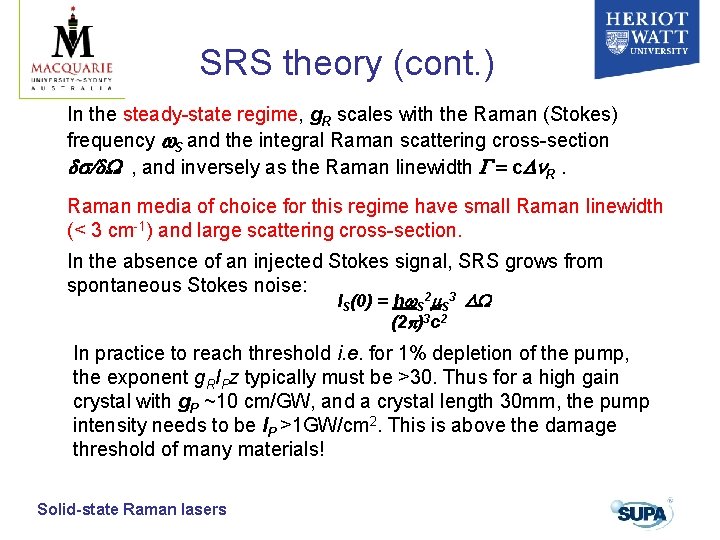
SRS theory (cont. ) In the steady-state regime, g. R scales with the Raman (Stokes) frequency w. S and the integral Raman scattering cross-section ds/d. W , and inversely as the Raman linewidth G = c. Dn. R. Raman media of choice for this regime have small Raman linewidth (< 3 cm-1) and large scattering cross-section. In the absence of an injected Stokes signal, SRS grows from spontaneous Stokes noise: IS(0) = hw. S 2 m. S 3 DW (2 p)3 c 2 In practice to reach threshold i. e. for 1% depletion of the pump, the exponent g. RIPz typically must be >30. Thus for a high gain crystal with g. P ~10 cm/GW, and a crystal length 30 mm, the pump intensity needs to be IP >1 GW/cm 2. This is above the damage threshold of many materials! Solid-state Raman lasers
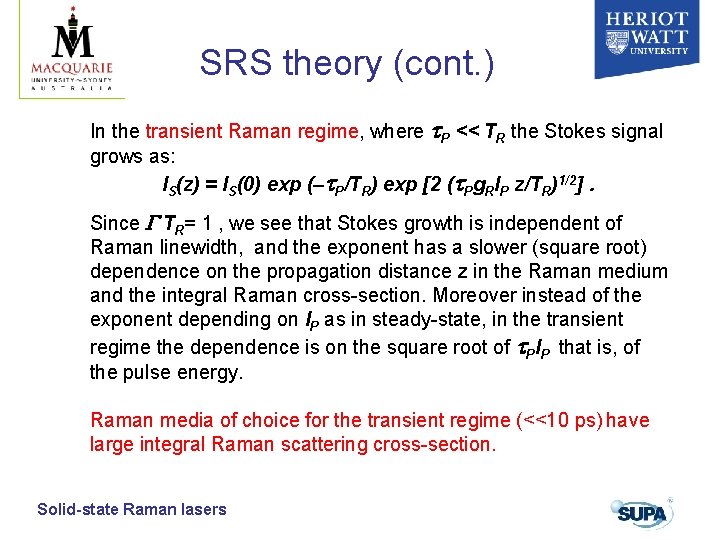
SRS theory (cont. ) In the transient Raman regime, where t. P << TR the Stokes signal grows as: IS(z) = IS(0) exp (–t. P/TR) exp [2 (t. Pg. RIP z/TR)1/2]. Since G TR= 1 , we see that Stokes growth is independent of Raman linewidth, and the exponent has a slower (square root) dependence on the propagation distance z in the Raman medium and the integral Raman cross-section. Moreover instead of the exponent depending on IP as in steady-state, in the transient regime the dependence is on the square root of t. PIP that is, of the pulse energy. Raman media of choice for the transient regime (<<10 ps) have large integral Raman scattering cross-section. Solid-state Raman lasers
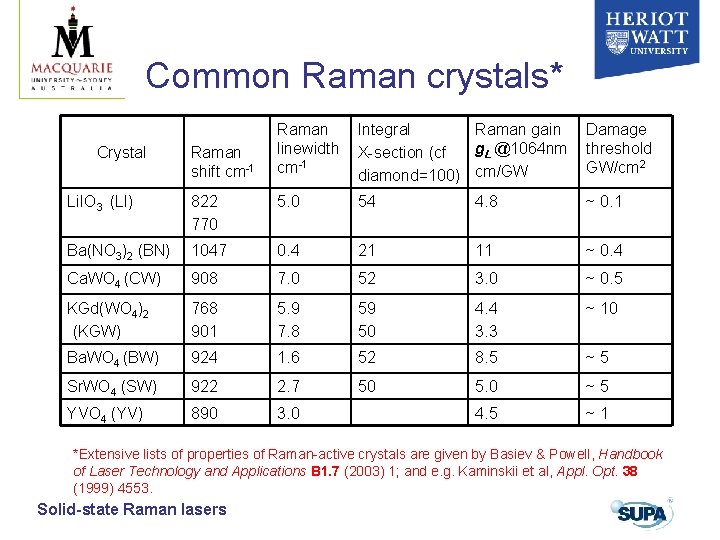
Common Raman crystals* Crystal Raman shift cm-1 Raman linewidth cm-1 Integral Raman gain g. L @1064 nm X-section (cf diamond=100) cm/GW Damage threshold GW/cm 2 Li. IO 3 (LI) 822 770 5. 0 54 4. 8 ~ 0. 1 Ba(NO 3)2 (BN) 1047 0. 4 21 11 ~ 0. 4 Ca. WO 4 (CW) 908 7. 0 52 3. 0 ~ 0. 5 KGd(WO 4)2 (KGW) 768 901 5. 9 7. 8 59 50 4. 4 3. 3 ~ 10 Ba. WO 4 (BW) 924 1. 6 52 8. 5 ~5 Sr. WO 4 (SW) 922 2. 7 50 5. 0 ~5 YVO 4 (YV) 890 3. 0 4. 5 ~1 *Extensive lists of properties of Raman-active crystals are given by Basiev & Powell, Handbook of Laser Technology and Applications B 1. 7 (2003) 1; and e. g. Kaminskii et al, Appl. Opt. 38 (1999) 4553. Solid-state Raman lasers
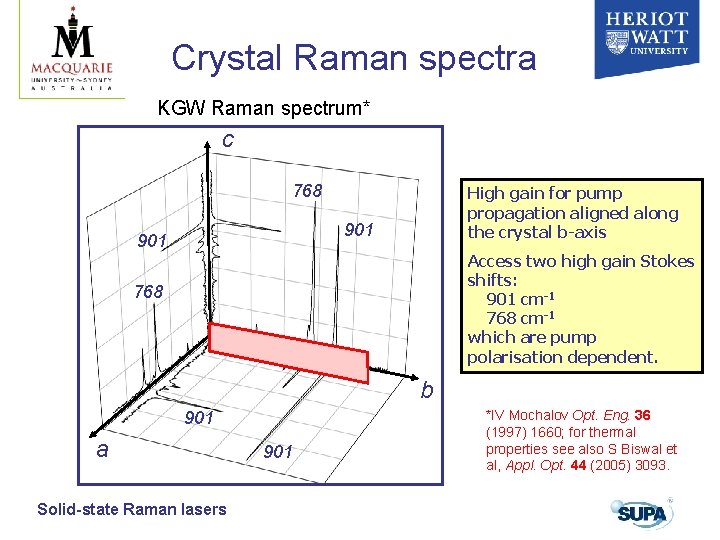
Crystal Raman spectra KGW Raman spectrum* c 768 High gain for pump propagation aligned along the crystal b-axis 901 Access two high gain Stokes shifts: 901 cm-1 768 cm-1 which are pump polarisation dependent. 768 b 901 a Solid-state Raman lasers 901 *IV Mochalov Opt. Eng. 36 (1997) 1660; for thermal properties see also S Biswal et al, Appl. Opt. 44 (2005) 3093.
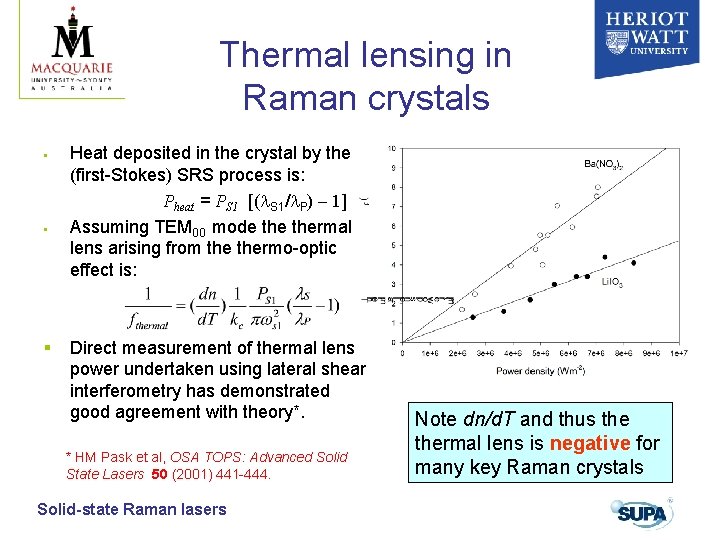
Thermal lensing in Raman crystals § § § Heat deposited in the crystal by the (first-Stokes) SRS process is: Pheat = PS 1 [(l. S 1/l. P) – 1] Assuming TEM 00 mode thermal lens arising from thermo-optic effect is: Direct measurement of thermal lens power undertaken using lateral shear interferometry has demonstrated good agreement with theory*. * HM Pask et al, OSA TOPS: Advanced Solid State Lasers 50 (2001) 441 -444. Solid-state Raman lasers Note dn/d. T and thus thermal lens is negative for many key Raman crystals
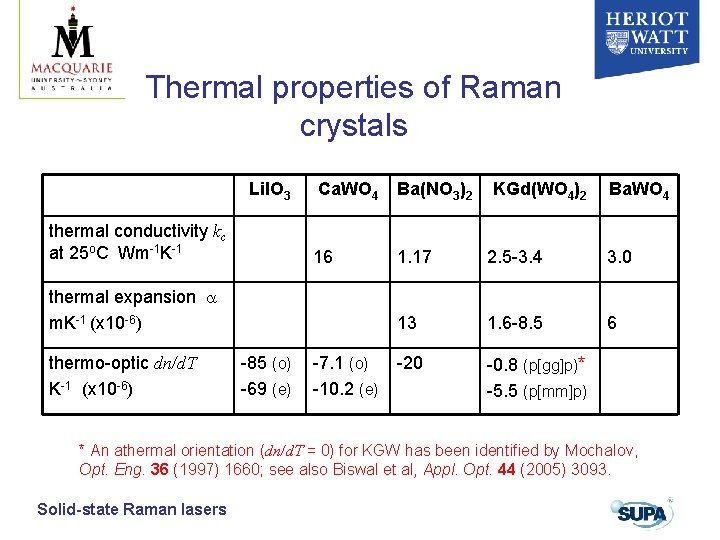
Thermal properties of Raman crystals Li. IO 3 thermal conductivity kc at 25 o. C Wm-1 K-1 Ca. WO 4 Ba(NO 3)2 16 1. 17 2. 5 -3. 4 3. 0 13 1. 6 -8. 5 6 -20 -0. 8 (p[gg]p)* -5. 5 (p[mm]p) thermal expansion a m. K-1 (x 10 -6) thermo-optic dn/d. T K-1 (x 10 -6) -85 (o) -69 (e) -7. 1 (o) -10. 2 (e) KGd(WO 4)2 Ba. WO 4 * An athermal orientation (dn/d. T = 0) for KGW has been identified by Mochalov, Opt. Eng. 36 (1997) 1660; see also Biswal et al, Appl. Opt. 44 (2005) 3093. Solid-state Raman lasers
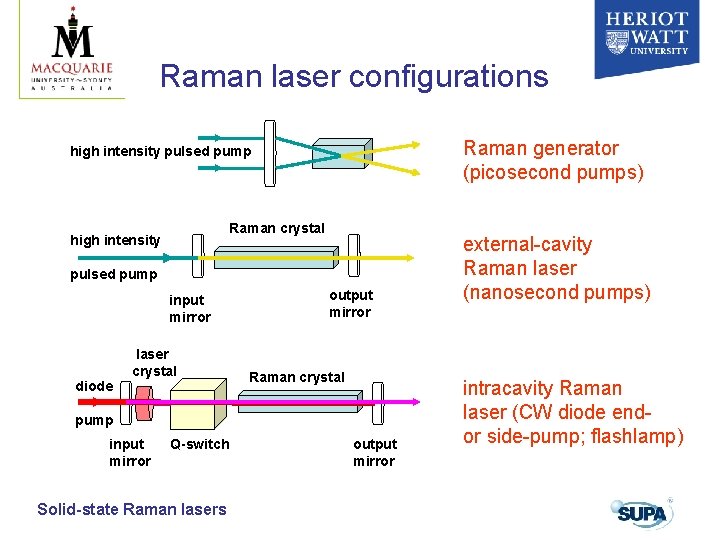
Raman laser configurations Raman generator (picosecond pumps) high intensity pulsed pump Raman crystal high intensity pulsed pump input mirror diode laser crystal output mirror Raman crystal pump input mirror Q-switch Solid-state Raman lasers output mirror external-cavity Raman laser (nanosecond pumps) intracavity Raman laser (CW diode endor side-pump; flashlamp)
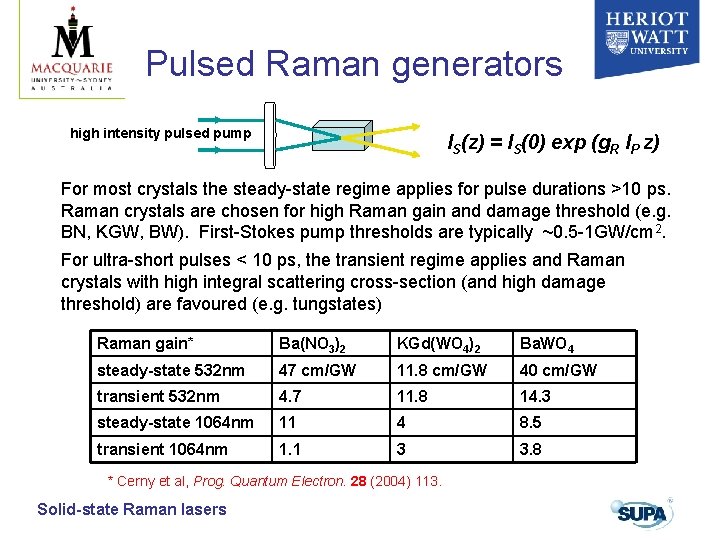
Pulsed Raman generators high intensity pulsed pump IS(z) = IS(0) exp (g. R IP z) For most crystals the steady-state regime applies for pulse durations >10 ps. Raman crystals are chosen for high Raman gain and damage threshold (e. g. BN, KGW, BW). First-Stokes pump thresholds are typically ~0. 5 -1 GW/cm 2. For ultra-short pulses < 10 ps, the transient regime applies and Raman crystals with high integral scattering cross-section (and high damage threshold) are favoured (e. g. tungstates) Raman gain* Ba(NO 3)2 KGd(WO 4)2 Ba. WO 4 steady-state 532 nm 47 cm/GW 11. 8 cm/GW 40 cm/GW transient 532 nm 4. 7 11. 8 14. 3 steady-state 1064 nm 11 4 8. 5 transient 1064 nm 1. 1 3 3. 8 * Cerny et al, Prog. Quantum Electron. 28 (2004) 113. Solid-state Raman lasers
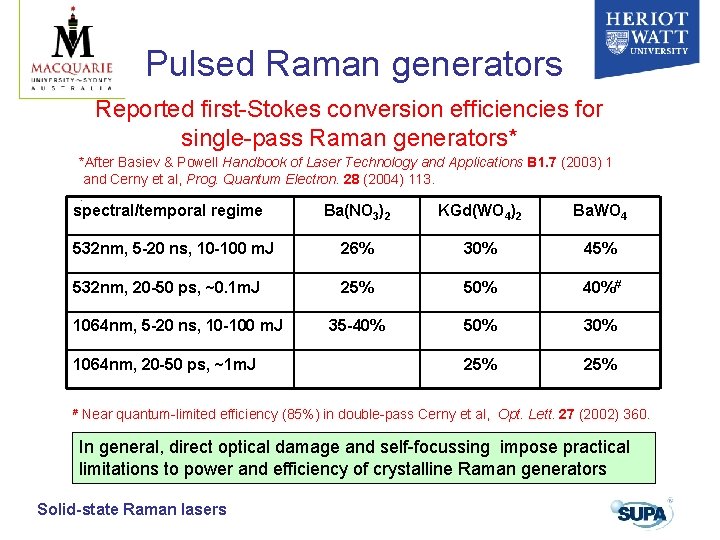
Pulsed Raman generators Reported first-Stokes conversion efficiencies for single-pass Raman generators* *After Basiev & Powell Handbook of Laser Technology and Applications B 1. 7 (2003) 1 and Cerny et al, Prog. Quantum Electron. 28 (2004) 113. . spectral/temporal regime Ba(NO 3)2 KGd(WO 4)2 Ba. WO 4 532 nm, 5 -20 ns, 10 -100 m. J 26% 30% 45% 532 nm, 20 -50 ps, ~0. 1 m. J 25% 50% 40%# 35 -40% 50% 30% 25% 1064 nm, 5 -20 ns, 10 -100 m. J 1064 nm, 20 -50 ps, ~1 m. J # Near quantum-limited efficiency (85%) in double-pass Cerny et al, Opt. Lett. 27 (2002) 360. In general, direct optical damage and self-focussing impose practical limitations to power and efficiency of crystalline Raman generators Solid-state Raman lasers
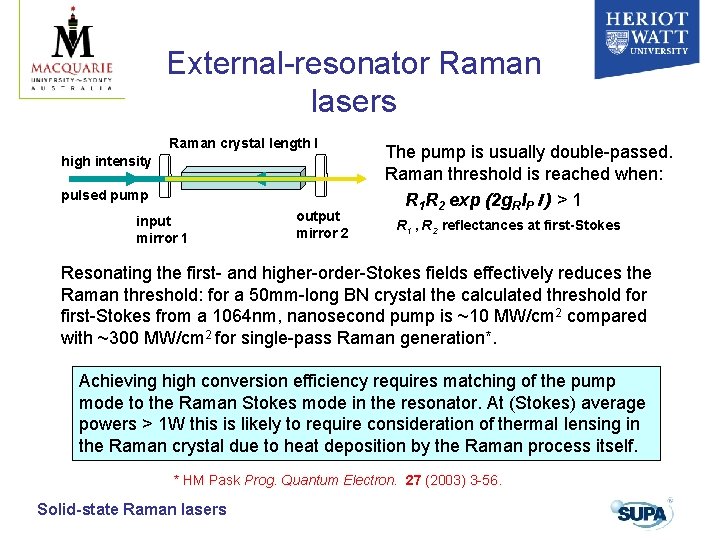
External-resonator Raman lasers Raman crystal length l high intensity pulsed pump input mirror 1 output mirror 2 The pump is usually double-passed. Raman threshold is reached when: R 1 R 2 exp (2 g. RIP l ) > 1 R 1 , R 2 reflectances at first-Stokes Resonating the first- and higher-order-Stokes fields effectively reduces the Raman threshold: for a 50 mm-long BN crystal the calculated threshold for first-Stokes from a 1064 nm, nanosecond pump is ~10 MW/cm 2 compared with ~300 MW/cm 2 for single-pass Raman generation*. Achieving high conversion efficiency requires matching of the pump mode to the Raman Stokes mode in the resonator. At (Stokes) average powers > 1 W this is likely to require consideration of thermal lensing in the Raman crystal due to heat deposition by the Raman process itself. * HM Pask Prog. Quantum Electron. 27 (2003) 3 -56. Solid-state Raman lasers
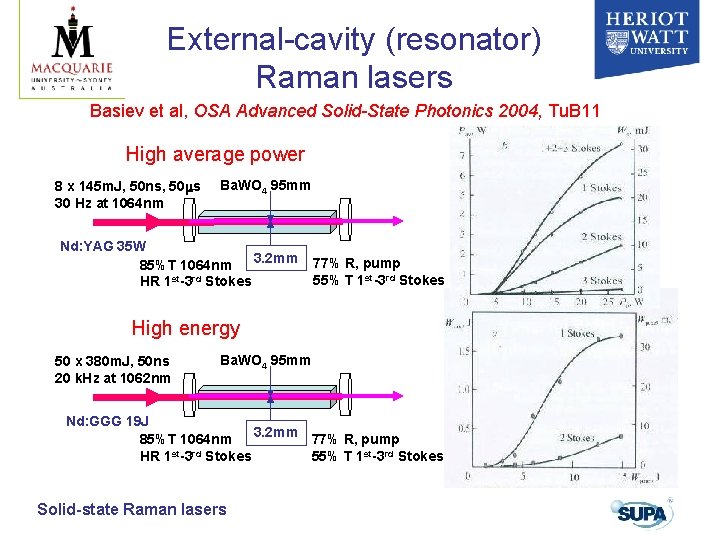
External-cavity (resonator) Raman lasers Basiev et al, OSA Advanced Solid-State Photonics 2004, Tu. B 11 High average power 8 x 145 m. J, 50 ns, 50 ms 30 Hz at 1064 nm Ba. WO 4 95 mm Nd: YAG 35 W 3. 2 mm 85%T 1064 nm HR 1 st-3 rd Stokes 77% R, pump 55% T 1 st-3 rd Stokes High energy 50 x 380 m. J, 50 ns 20 k. Hz at 1062 nm Ba. WO 4 95 mm Nd: GGG 19 J 3. 2 mm 77% R, pump 85%T 1064 nm HR 1 st-3 rd Stokes 55% T 1 st-3 rd Stokes Solid-state Raman lasers
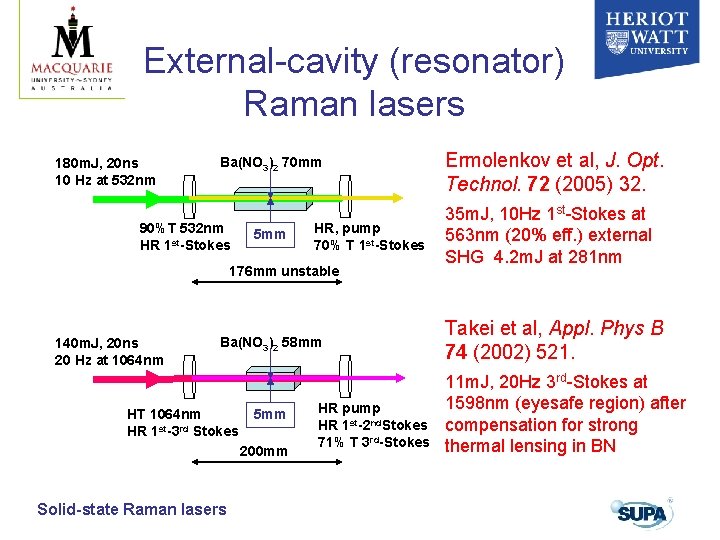
External-cavity (resonator) Raman lasers 180 m. J, 20 ns 10 Hz at 532 nm Ba(NO 3)2 70 mm 90%T 532 nm HR 1 st-Stokes 5 mm HR, pump 70% T 1 st-Stokes 176 mm unstable 140 m. J, 20 ns 20 Hz at 1064 nm Ba(NO 3)2 58 mm HT 1064 nm HR 1 st-3 rd Stokes 5 mm 200 mm Solid-state Raman lasers HR pump HR 1 st-2 nd. Stokes 71% T 3 rd-Stokes Ermolenkov et al, J. Opt. Technol. 72 (2005) 32. 35 m. J, 10 Hz 1 st-Stokes at 563 nm (20% eff. ) external SHG 4. 2 m. J at 281 nm Takei et al, Appl. Phys B 74 (2002) 521. 11 m. J, 20 Hz 3 rd-Stokes at 1598 nm (eyesafe region) after compensation for strong thermal lensing in BN
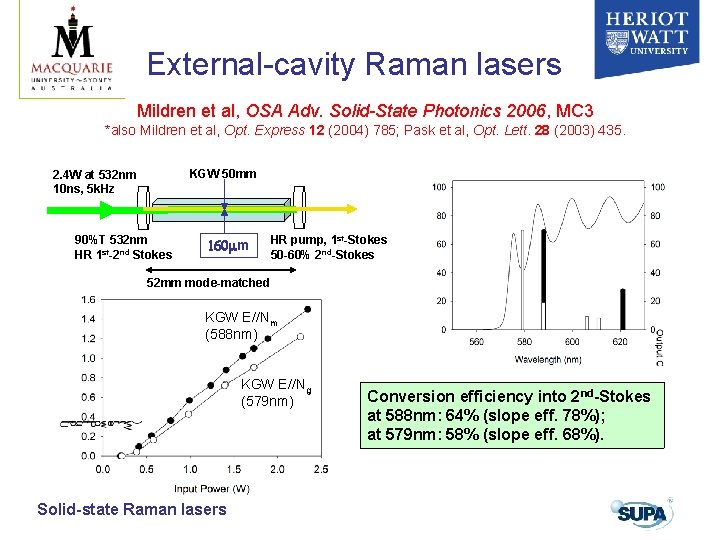
External-cavity Raman lasers Mildren et al, OSA Adv. Solid-State Photonics 2006, MC 3 *also Mildren et al, Opt. Express 12 (2004) 785; Pask et al, Opt. Lett. 28 (2003) 435. KGW 50 mm 2. 4 W at 532 nm 10 ns, 5 k. Hz 90%T 532 nm HR 1 st-2 nd Stokes 160 mm HR pump, 1 st-Stokes 50 -60% 2 nd-Stokes 52 mm mode-matched KGW E//Nm (588 nm) KGW E//Ng (579 nm) Solid-state Raman lasers Conversion efficiency into 2 nd-Stokes at 588 nm: 64% (slope eff. 78%); at 579 nm: 58% (slope eff. 68%).
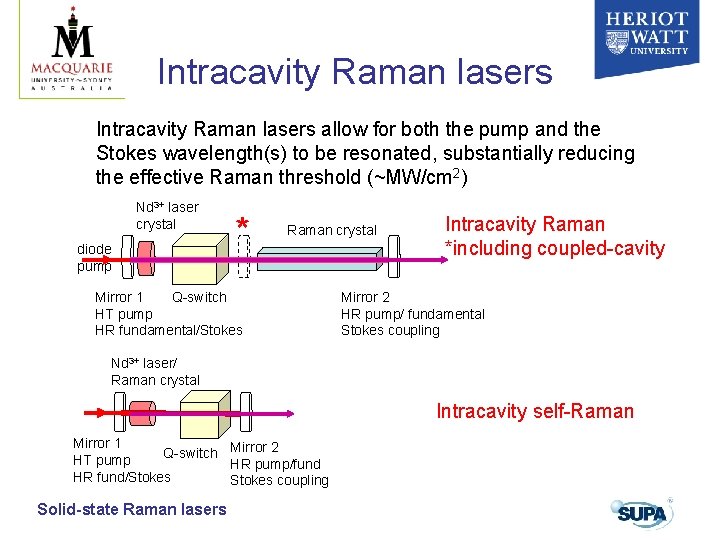
Intracavity Raman lasers allow for both the pump and the Stokes wavelength(s) to be resonated, substantially reducing the effective Raman threshold (~MW/cm 2) Nd 3+ laser crystal diode pump * Raman crystal Mirror 1 Q-switch HT pump HR fundamental/Stokes Intracavity Raman *including coupled-cavity Mirror 2 HR pump/ fundamental Stokes coupling Nd 3+ laser/ Raman crystal Intracavity self-Raman Mirror 1 Q-switch Mirror 2 HT pump HR pump/fund HR fund/Stokes coupling Solid-state Raman lasers
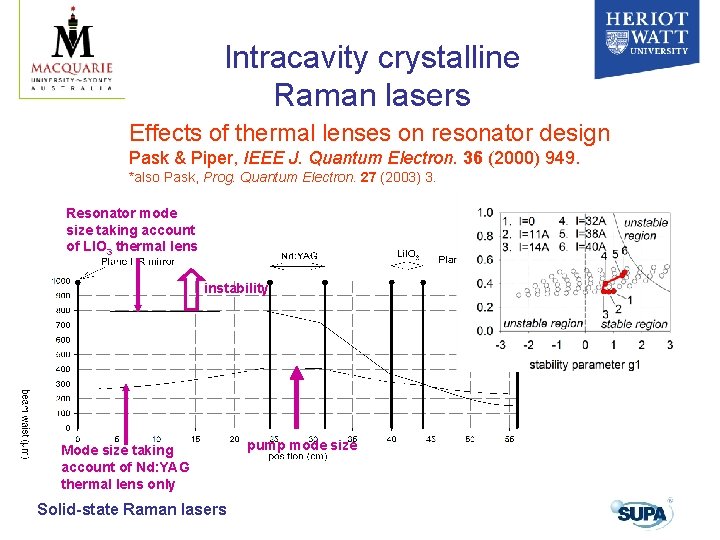
Intracavity crystalline Raman lasers Effects of thermal lenses on resonator design Pask & Piper, IEEE J. Quantum Electron. 36 (2000) 949. *also Pask, Prog. Quantum Electron. 27 (2003) 3. Resonator mode size taking account of LIO 3 thermal lens instability Mode size taking account of Nd: YAG thermal lens only Solid-state Raman lasers pump mode size
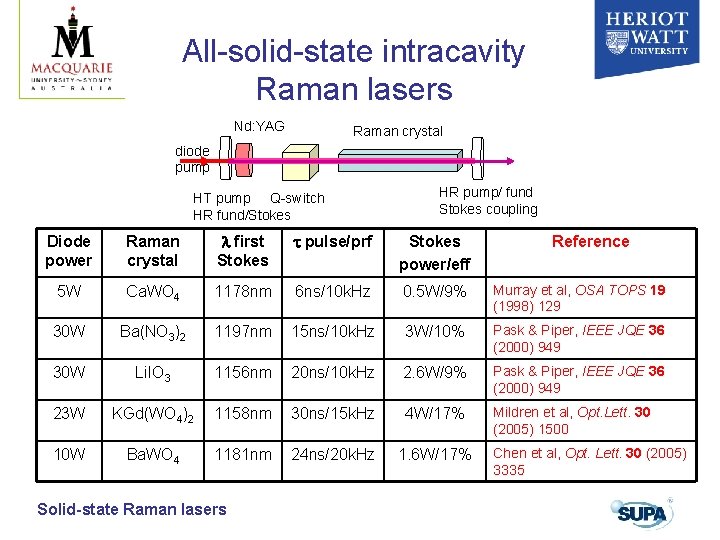
All-solid-state intracavity Raman lasers Nd: YAG Raman crystal diode pump HT pump Q-switch HR fund/Stokes HR pump/ fund Stokes coupling Diode power Raman crystal l first Stokes t pulse/prf Stokes power/eff 5 W Ca. WO 4 1178 nm 6 ns/10 k. Hz 0. 5 W/9% Murray et al, OSA TOPS 19 (1998) 129 30 W Ba(NO 3)2 1197 nm 15 ns/10 k. Hz 3 W/10% Pask & Piper, IEEE JQE 36 (2000) 949 30 W Li. IO 3 1156 nm 20 ns/10 k. Hz 2. 6 W/9% Pask & Piper, IEEE JQE 36 (2000) 949 23 W KGd(WO 4)2 1158 nm 30 ns/15 k. Hz 4 W/17% Mildren et al, Opt. Lett. 30 (2005) 1500 10 W Ba. WO 4 1181 nm 24 ns/20 k. Hz 1. 6 W/17% Solid-state Raman lasers Reference Chen et al, Opt. Lett. 30 (2005) 3335
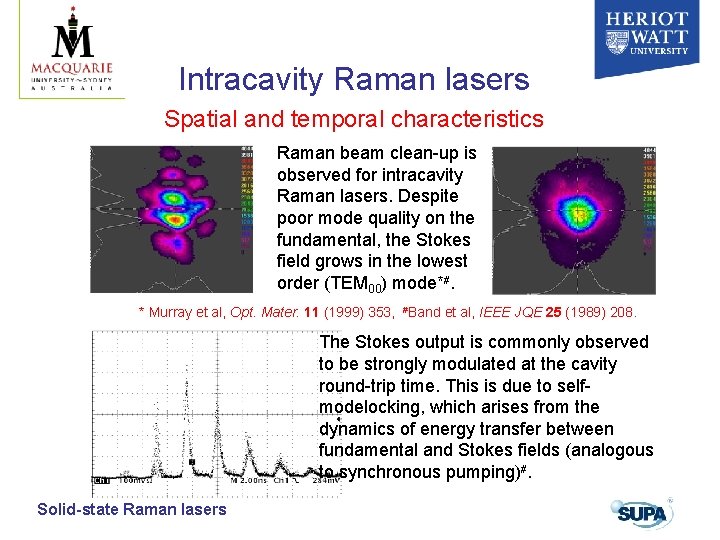
Intracavity Raman lasers Spatial and temporal characteristics Raman beam clean-up is observed for intracavity Raman lasers. Despite poor mode quality on the fundamental, the Stokes field grows in the lowest order (TEM 00) mode*#. * Murray et al, Opt. Mater. 11 (1999) 353, #Band et al, IEEE JQE 25 (1989) 208. The Stokes output is commonly observed to be strongly modulated at the cavity round-trip time. This is due to selfmodelocking, which arises from the dynamics of energy transfer between fundamental and Stokes fields (analogous to synchronous pumping)#. Solid-state Raman lasers
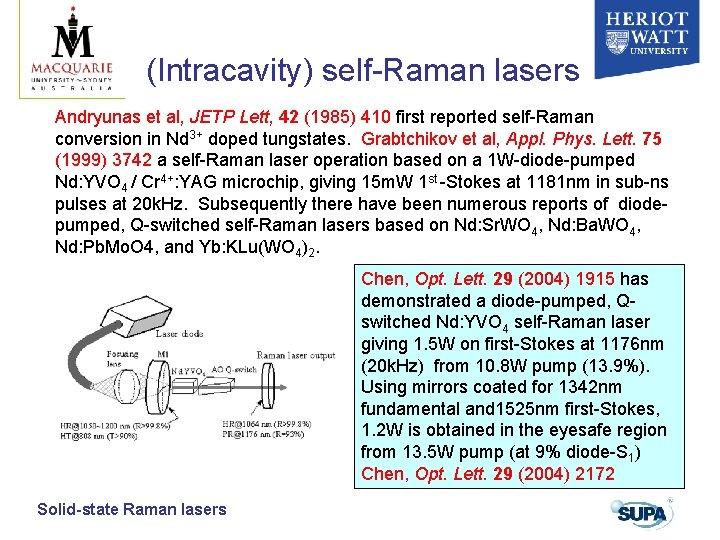
(Intracavity) self-Raman lasers Andryunas et al, JETP Lett, 42 (1985) 410 first reported self-Raman conversion in Nd 3+ doped tungstates. Grabtchikov et al, Appl. Phys. Lett. 75 (1999) 3742 a self-Raman laser operation based on a 1 W-diode-pumped Nd: YVO 4 / Cr 4+: YAG microchip, giving 15 m. W 1 st -Stokes at 1181 nm in sub-ns pulses at 20 k. Hz. Subsequently there have been numerous reports of diodepumped, Q-switched self-Raman lasers based on Nd: Sr. WO 4, Nd: Ba. WO 4, Nd: Pb. Mo. O 4, and Yb: KLu(WO 4)2. Chen, Opt. Lett. 29 (2004) 1915 has demonstrated a diode-pumped, Qswitched Nd: YVO 4 self-Raman laser giving 1. 5 W on first-Stokes at 1176 nm (20 k. Hz) from 10. 8 W pump (13. 9%). Using mirrors coated for 1342 nm fundamental and 1525 nm first-Stokes, 1. 2 W is obtained in the eyesafe region from 13. 5 W pump (at 9% diode-S 1) Chen, Opt. Lett. 29 (2004) 2172 Solid-state Raman lasers
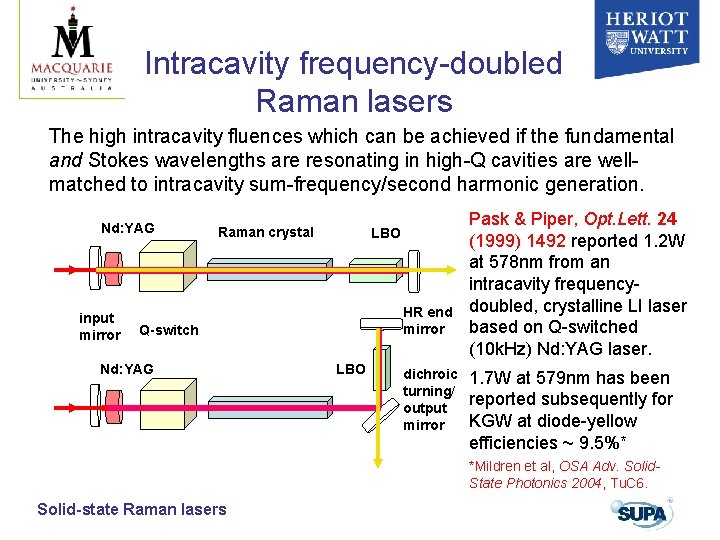
Intracavity frequency-doubled Raman lasers The high intracavity fluences which can be achieved if the fundamental and Stokes wavelengths are resonating in high-Q cavities are wellmatched to intracavity sum-frequency/second harmonic generation. Nd: YAG input mirror Raman crystal LBO HR end mirror Q-switch Nd: YAG LBO dichroic turning/ output mirror Pask & Piper, Opt. Lett. 24 (1999) 1492 reported 1. 2 W at 578 nm from an intracavity frequencydoubled, crystalline LI laser based on Q-switched (10 k. Hz) Nd: YAG laser. 1. 7 W at 579 nm has been reported subsequently for KGW at diode-yellow efficiencies ~ 9. 5%* *Mildren et al, OSA Adv. Solid. State Photonics 2004, Tu. C 6. Solid-state Raman lasers
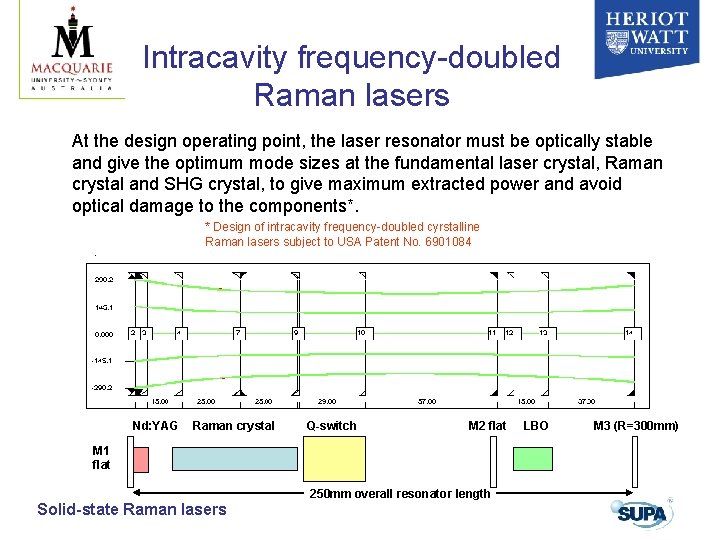
Intracavity frequency-doubled Raman lasers At the design operating point, the laser resonator must be optically stable and give the optimum mode sizes at the fundamental laser crystal, Raman crystal and SHG crystal, to give maximum extracted power and avoid optical damage to the components*. * Design of intracavity frequency-doubled cyrstalline Raman lasers subject to USA Patent No. 6901084 Nd: YAG Raman crystal Q-switch M 2 flat M 1 flat 250 mm overall resonator length Solid-state Raman lasers LBO M 3 (R=300 mm)
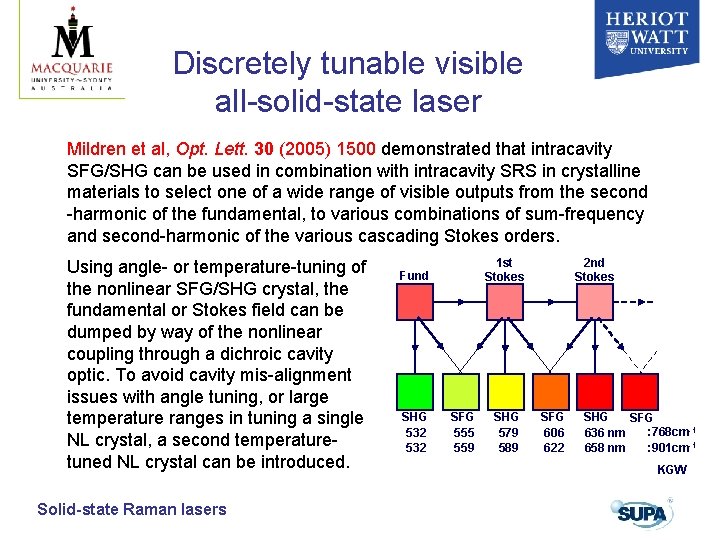
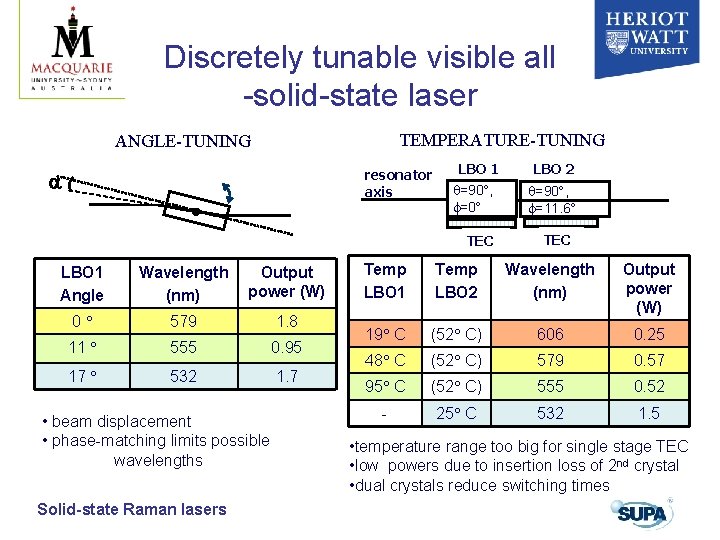
Discretely tunable visible all-solid-state laser Mildren et al, Opt. Lett. 30 (2005) 1500 demonstrated that intracavity SFG/SHG can be used in combination with intracavity SRS in crystalline materials to select one of a wide range of visible outputs from the second -harmonic of the fundamental, to various combinations of sum-frequency and second-harmonic of the various cascading Stokes orders. Using angle- or temperature-tuning of the nonlinear SFG/SHG crystal, the fundamental or Stokes field can be dumped by way of the nonlinear coupling through a dichroic cavity optic. To avoid cavity mis-alignment issues with angle tuning, or large temperature ranges in tuning a single NL crystal, a second temperaturetuned NL crystal can be introduced. Solid-state Raman lasers 1 st Stokes Fund SHG 532 SFG 555 559 SHG 579 589 2 nd Stokes SFG 606 622 SHG SFG : 768 cm-1 636 nm : 901 cm-1 658 nm KGW
Discretely tunable visible all -solid-state laser TEMPERATURE-TUNING ANGLE-TUNING resonator axis LBO 1 =90 , =0 TEC LBO 1 Angle Wavelength (nm) Output power (W) 0 579 1. 8 11 555 0. 95 17 532 1. 7 • beam displacement • phase-matching limits possible wavelengths Solid-state Raman lasers LBO 2 =90 , =11. 6 TEC Temp LBO 1 Temp LBO 2 Wavelength (nm) Output power (W) 19 C (52 C) 606 0. 25 48 C (52 C) 579 0. 57 95 C (52 C) 555 0. 52 - 25 C 532 1. 5 • temperature range too big for single stage TEC • low powers due to insertion loss of 2 nd crystal • dual crystals reduce switching times
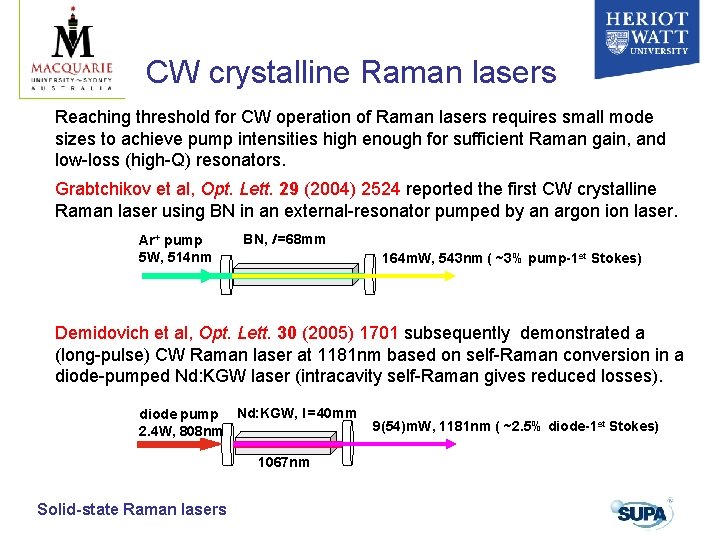
CW crystalline Raman lasers Reaching threshold for CW operation of Raman lasers requires small mode sizes to achieve pump intensities high enough for sufficient Raman gain, and low-loss (high-Q) resonators. Grabtchikov et al, Opt. Lett. 29 (2004) 2524 reported the first CW crystalline Raman laser using BN in an external-resonator pumped by an argon ion laser. Ar+ pump 5 W, 514 nm BN, l =68 mm 164 m. W, 543 nm ( ~3% pump-1 st Stokes) Demidovich et al, Opt. Lett. 30 (2005) 1701 subsequently demonstrated a (long-pulse) CW Raman laser at 1181 nm based on self-Raman conversion in a diode-pumped Nd: KGW laser (intracavity self-Raman gives reduced losses). diode pump Nd: KGW, l =40 mm 2. 4 W, 808 nm 1067 nm Solid-state Raman lasers 9(54)m. W, 1181 nm ( ~2. 5% diode-1 st Stokes)
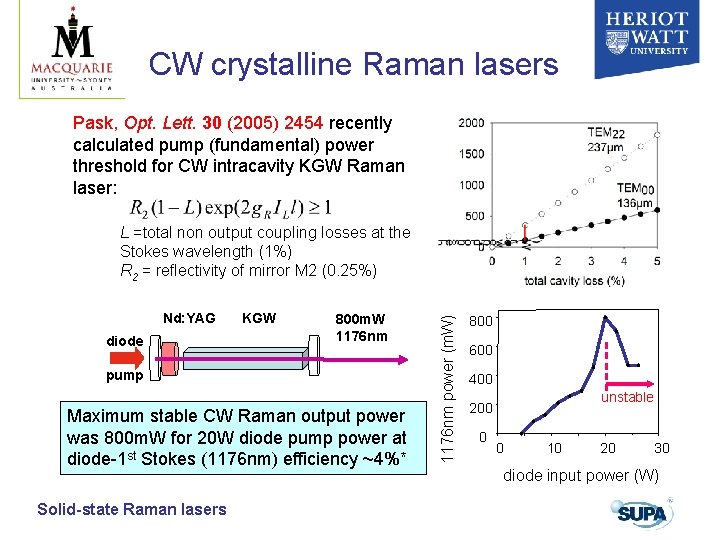
CW crystalline Raman lasers Pask, Opt. Lett. 30 (2005) 2454 recently calculated pump (fundamental) power threshold for CW intracavity KGW Raman laser: Nd: YAG diode KGW 800 m. W 1176 nm pump Maximum stable CW Raman output power was 800 m. W for 20 W diode pump power at diode-1 st Stokes (1176 nm) efficiency ~4%* Solid-state Raman lasers 1176 nm power (m. W) L =total non output coupling losses at the Stokes wavelength (1%) R 2 = reflectivity of mirror M 2 (0. 25%) 800 600 400 unstable 200 0 0 10 20 30 diode input power (W)
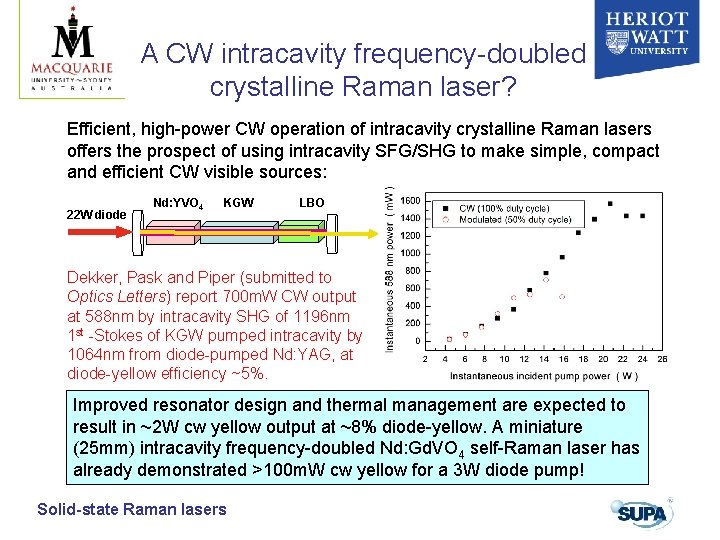
A CW intracavity frequency-doubled crystalline Raman laser? Efficient, high-power CW operation of intracavity crystalline Raman lasers offers the prospect of using intracavity SFG/SHG to make simple, compact and efficient CW visible sources: 22 W diode Nd: YVO 4 KGW LBO Dekker, Pask and Piper (submitted to Optics Letters) report 700 m. W CW output at 588 nm by intracavity SHG of 1196 nm 1 st -Stokes of KGW pumped intracavity by 1064 nm from diode-pumped Nd: YAG, at diode-yellow efficiency ~5%. Improved resonator design and thermal management are expected to result in ~2 W cw yellow output at ~8% diode-yellow. A miniature (25 mm) intracavity frequency-doubled Nd: Gd. VO 4 self-Raman laser has already demonstrated >100 m. W cw yellow for a 3 W diode pump! Solid-state Raman lasers
Solid-state Raman lasers: a tutorial Thank you for your attention! jim. piper@vc. mq. edu. au Solid-state Raman lasers