
SOLIDS LIQUIDS AND GASES Chapter Three Section One
- Slides: 17
SOLIDS, LIQUIDS, AND GASES Chapter Three Section One
Science Journal Entry 55 Make two columns and title one physical properties and the other chemical properties. Place the following characteristics in the correct column: flammability, hardness, conductivity, viscosity, precipitate, malleability, reactivity, melting or boiling points, density, burning, filtration, and distillation. There will be a lot more in the
Describing the States of Matter Materials can be classified as solids, liquids, or gases based on whether their shapes and volumes are definite or variable. � Shape and volume are clues to how the particles within a material are arranged. � You might notice that some materials have a definite shape and volume and some materials don’t. �
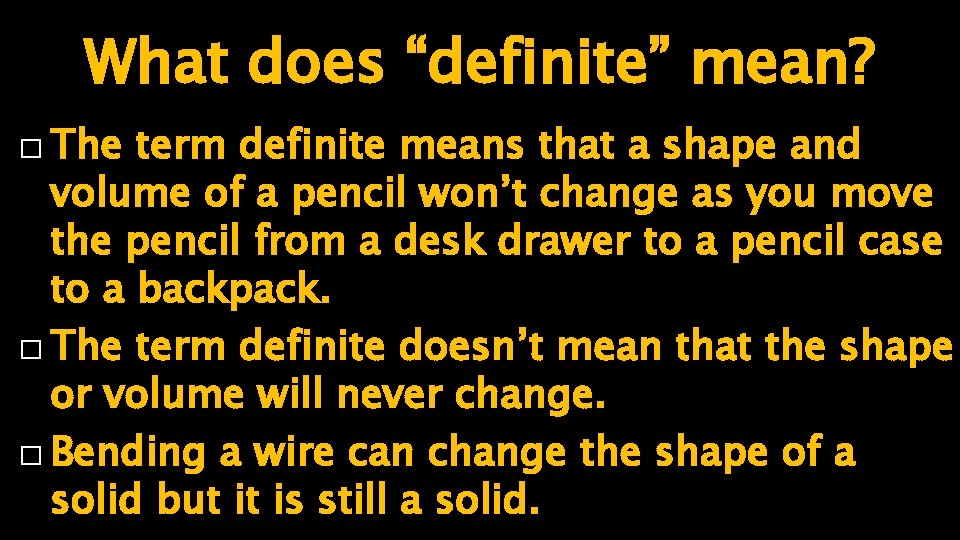
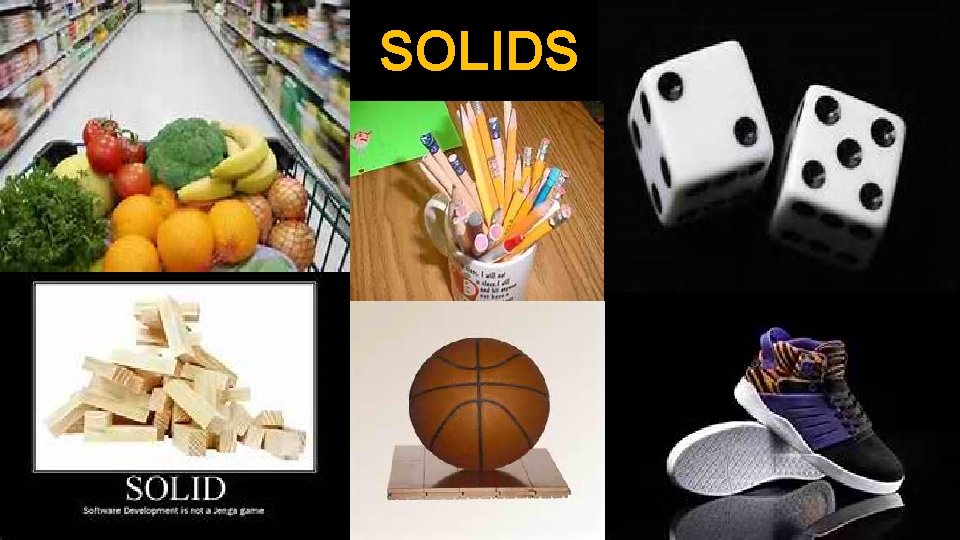
SOLIDS A pencil, a quarter, a book, and a cafeteria tray, what do they have in common? They all take up a certain amount of space. They are all solids. � A solid is a state of matter in which materials have a definite shape and a definite volume. � Solids also have some type of orderly arrangement of particles at the atomic level. �
What does “definite” mean? � The term definite means that a shape and volume of a pencil won’t change as you move the pencil from a desk drawer to a pencil case to a backpack. � The term definite doesn’t mean that the shape or volume will never change. � Bending a wire can change the shape of a solid but it is still a solid.
SOLIDS
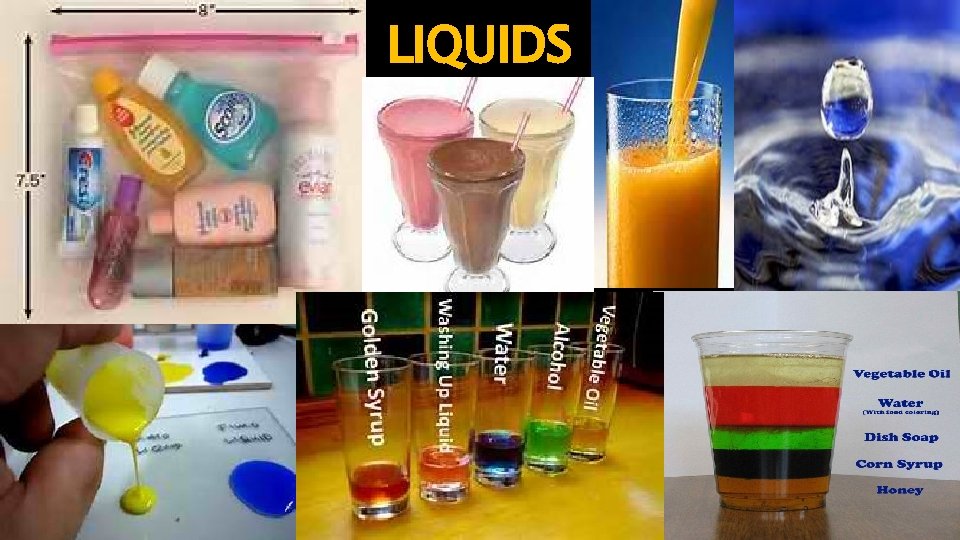
Liquids �A liquid always takes the shape of the container that is in at the time. Since it can be poured from one container to another, it doesn’t really have a shape of its own. � Liquid is the state of matter in which a material has a definite volume but not a definite shape. � Mercury and bromine are the only metals that are liquids at room temperature.
LIQUIDS
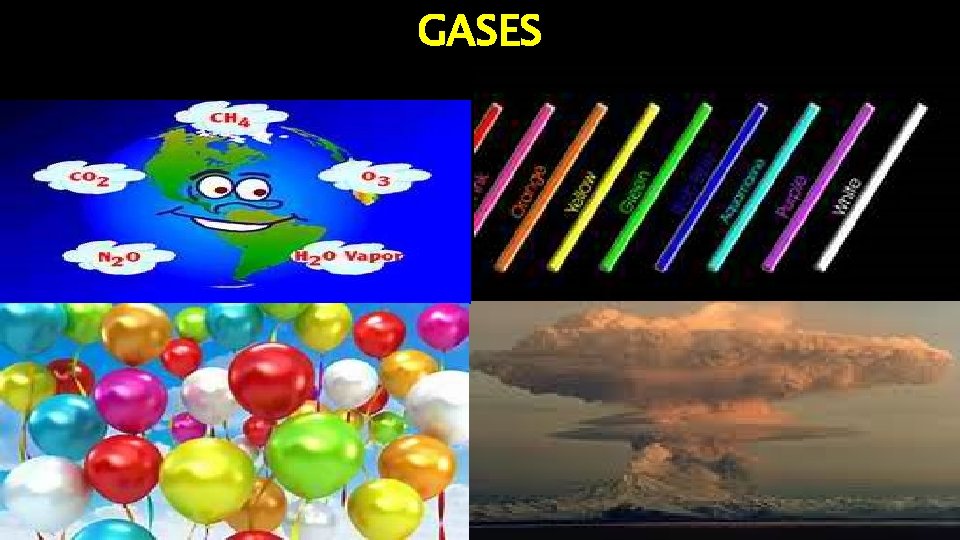
GASES Gas is the state of matter in which a material has neither a definite shape nor a definite volume. � A gas takes the shape and volume of its container. � Helium can be in different shapes of balloons because it fills the space of the balloons. � The volume of the helium in a balloon is equal to the volume of the balloon. Atoms in gases do not have a regular pattern. They are all in random locations. �
GASES
Plasma and Bose-Einstein Condensate � Plasma is a form of matter that is at extremely high temperature such as the sun, stars, and lightning. � Bose-Enstien Condensate(BEC) is a form of matter at an extremely low temperature near 237 degrees Celsius. � At this temperature, atoms behave as though they are a single particle.
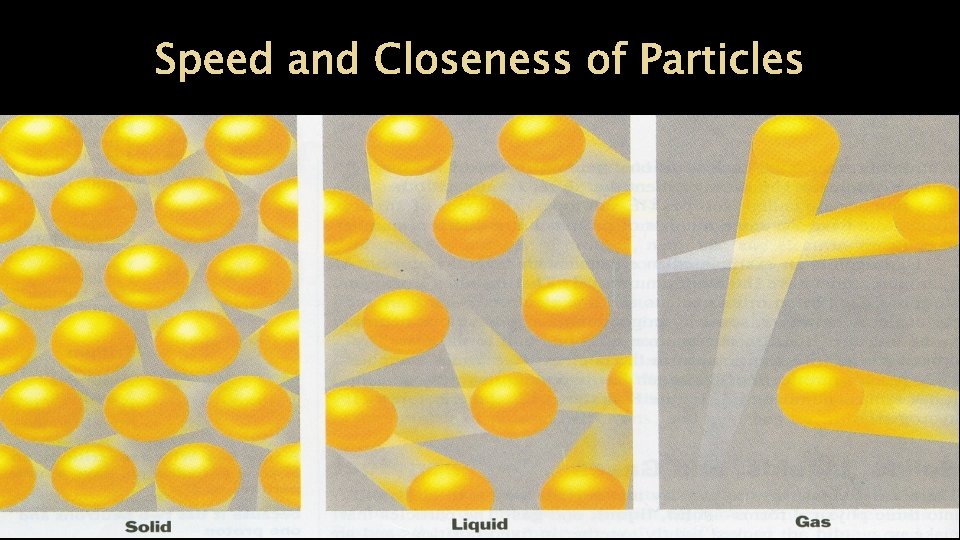
Motion in Gases � � � Particles in a gas are never at rest. At room temperature the average speed of the particles are about 1600 km per hour. When atoms collide with each other or with a wall of a container one may lose kinetic energy and slow down while the other will gain kinetic energy and speed up. There are forces of attraction among the particles in all matter. In a gas, the attractions are too weak to have an affect because the particles are far apart and moving fast.
Kinetic Theory of Gases Kinetic Energy is the energy an object has due to its motion. � The constant motion of particles in a gas allows a gas to fill a container of any shape or size. � The kinetic theory as applied to gases has three main points: 1. Particles in a gas are in constant, random motion. 2. The motion of one particle is unaffected by the motion of other parts unless the particles collide. 3. Forces of attraction among particles in a gas can be ignored under ordinary conditions. �
Behavior of Liquids A liquid takes a shape of the container because particles in a liquid can flow to new locations. � The volume of a liquid is constant because forces of attraction keep the particles close together. � The particles in a liquid are more closely packed than the particles in a gas. Therefore attractions between them do affect the movement of a particle. �
Explaining the Behavior of Solids � Solids have fixed locations and a total volume that doesn’t change. � Solids have a definite volume and shape because particles in a solid vibrate around fixed locations. � Each atom vibrates around its location but it does not exchange places with a neighboring atom.
Speed and Closeness of Particles
Pressure � � Pressure is the result of a force distributed over an area. The smaller the area of impact, the greater the pressure produced. For instance, the edge of a hockey puck striking the shatterproof glass protecting the public produces more pressure then if the face of the hockey puck hit. Force is also increased when speed is increased. Force is measured in Newtons and area in square meters. The SI unit for pressure is the pascal (Pa) which is the same as Newtons per square meter. One kilopascal (k. Pa) is equal to 1000 pascals.