
Solids Liquids and Gases Big Idea How do
Solids, Liquids, and Gases Big Idea How do solids, liquids, and gases differ? Essential Questions What are the characteristics of solids, liquids, and gases? What happens to solids, liquids, and gases when they change their physical state? How are the volume, temperature, and pressure of a gas related?
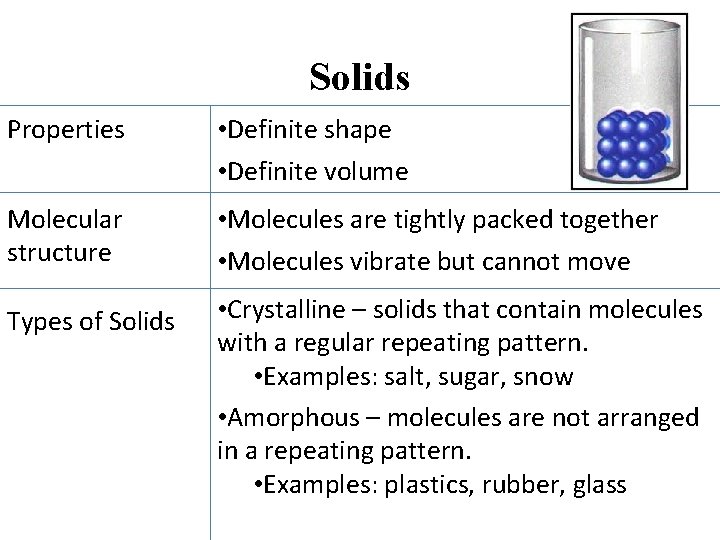
Solids Properties • Definite shape • Definite volume Molecular structure • Molecules are tightly packed together • Molecules vibrate but cannot move Types of Solids • Crystalline – solids that contain molecules with a regular repeating pattern. • Examples: salt, sugar, snow • Amorphous – molecules are not arranged in a repeating pattern. • Examples: plastics, rubber, glass
Solids to Liquids • Melting – solid changing into a liquid. • solid absorbs energy - endothermic • Freezing – liquid changing into a solid • liquid releases energy - exothermic • Melting point – different substances have different melting points. • Melting point and freezing point the same • Melting/Freezing point for water is 0°C or 32°F Molecular • energy absorbed - molecules move faster movement • energy released - molecules move slower

Liquids Properties Molecular structure Related vocabulary • No definite shape • Definite volume • Molecules are closely packed together • Molecules can move/slide around each other • Fluid – a substance that flows. Often used to describe liquids and gases. • Viscosity – a liquids resistance to flowing • Ex – water will flow faster than honey due to their viscosity • Surface tension – an inward pull on the surface that pulls molecules closer together. Allows some objects to float
Liquids to gases • Vaporization – When the particles in a liquid gain energy - endothermic • Evaporate – vaporization at the surface level • Ex. – a puddle shrinking • Boiling – liquid changes to a gas on surface and within the bubble in the liquid. • Boiling point – the temperature at which a liquid boils. • Depends on air pressure/altitude. • Water at sea level - 100°C • Water in Denver - 95°C

Liquids to gases • Condensation – When the particles in a gas lose energy turning into liquid – exothermic • Example – steam from a shower will fog up the mirror. Misconceptions • Water Vapor: • cannot be seen • Steam from pot of boiling water, clouds, or fog are actually tiny droplets of water suspended in air.
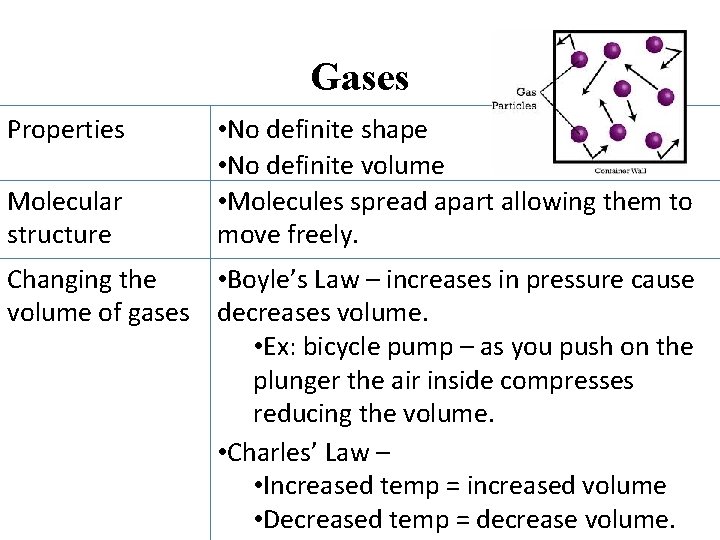
Gases Properties Molecular structure • No definite shape • No definite volume • Molecules spread apart allowing them to move freely. Changing the • Boyle’s Law – increases in pressure cause volume of gases decreases volume. • Ex: bicycle pump – as you push on the plunger the air inside compresses reducing the volume. • Charles’ Law – • Increased temp = increased volume • Decreased temp = decrease volume.
Gases Changing the • Change in temperature: pressure of gases • Increased temperature – particles move faster and increase pressure • Decreased temperature – particles move slower and decrease pressure • Example – tires: • if a car is sitting in the winter the pressure of the tire decreases. • As the car moves friction between the tire and the road creates heat increasing the pressure in the tire.
Gases Changing solids to gases • Sublimation – the process where a solid goes directly to a gas. • Skips the liquid state • Example – dry ice • Deposition – the process where a gas goes directly to a solid. • Skips the liquid state • Example – ice on a windshield during the winter
- Slides: 9