
Solidify Content Knowledge Using Vocabulary and Questioning Strategies
Solidify Content Knowledge Using Vocabulary and Questioning Strategies for Grades 5 -8 Science Arkansas Department of Education
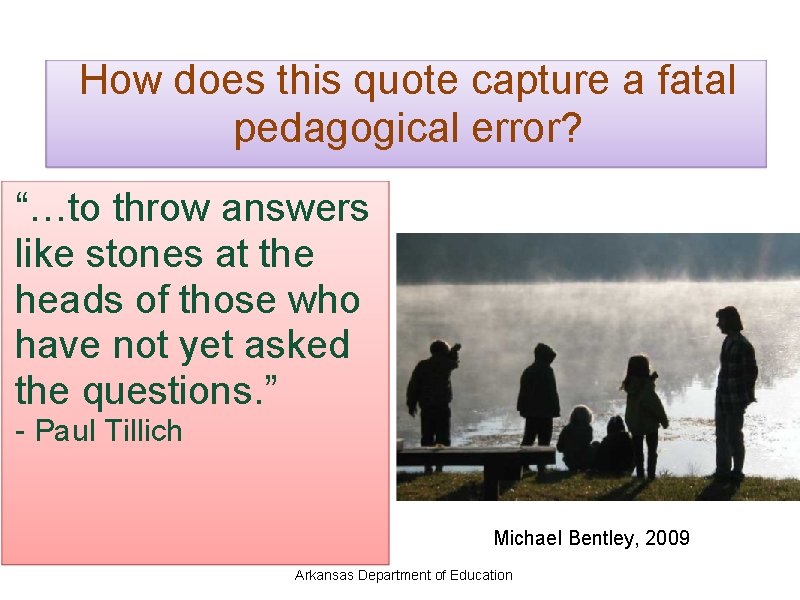
How does this quote capture a fatal pedagogical error? “…to throw answers like stones at the heads of those who have not yet asked the questions. ” - Paul Tillich Michael Bentley, 2009 Arkansas Department of Education
Expected Outcomes Participants will: • Compare and contrast content vocabulary vs. academic vocabulary • Use vocabulary strategies to deepen scientific literacy • Implement the 7 E process in science to meet the expectations of the Common Core State Standards Arkansas Department of Education
How important to you are the following on a scale of 1 -5? • personal decisionmaking • participation in civic and cultural affairs • economic productivity
Scientific Literacy: “Scientific literacy is the knowledge and understanding of scientific concepts and processes required for personal decision making, participation in civic and cultural affairs, and economic productivity. It also includes specific types of abilities. In the National Science Education Standards, the content standards define scientific literacy. ” National Science Education Standards, page 22 Arkansas Department of Education
Clarification: You are not expected to become reading interventionists, but you are the best equipped teacher to provide content area literacy support because you understand the reading and writing demands of your content. Arkansas Department of Education
Think, Write, Pair, Share • What have you used in your classroom that has been effective at teaching students content vocabulary? • In your opinion, how well do your students retain content vocabulary? Arkansas Department of Education
Distinguishing between Content & Academic Vocabulary “Vocabulary acquisition is crucial to academic development. Not only do students need a rich body of word knowledge to succeed in basic skill areas, they also need a specialized vocabulary to learn content area material. ” Words, Janet Allen, et al Arkansas Department of Education
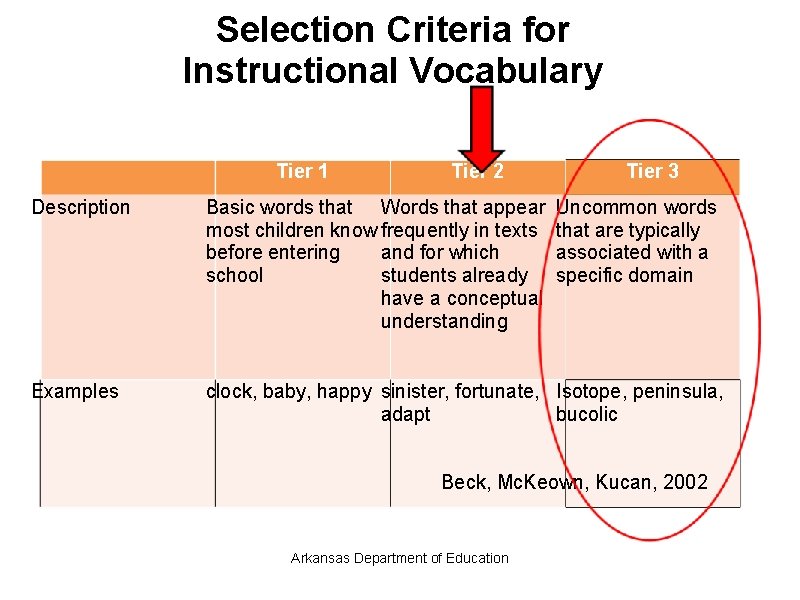
Selection Criteria for Instructional Vocabulary Tier 1 Tier 2 Tier 3 Description Basic words that Words that appear Uncommon words most children know frequently in texts that are typically before entering and for which associated with a school students already specific domain have a conceptual understanding Examples clock, baby, happy sinister, fortunate, Isotope, peninsula, adapt bucolic Beck, Mc. Keown, Kucan, 2002 Arkansas Department of Education
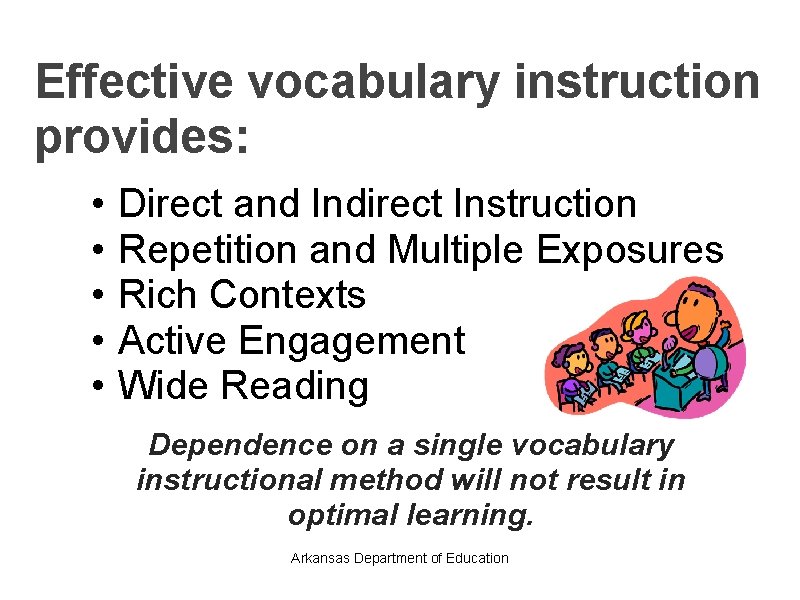
Effective vocabulary instruction provides: • • • Direct and Indirect Instruction Repetition and Multiple Exposures Rich Contexts Active Engagement Wide Reading Dependence on a single vocabulary instructional method will not result in optimal learning. NRP Report, 2000 Arkansas Department of Education
Knowing when AND how to use various vocabulary strategies is important. Arkansas Department of Education
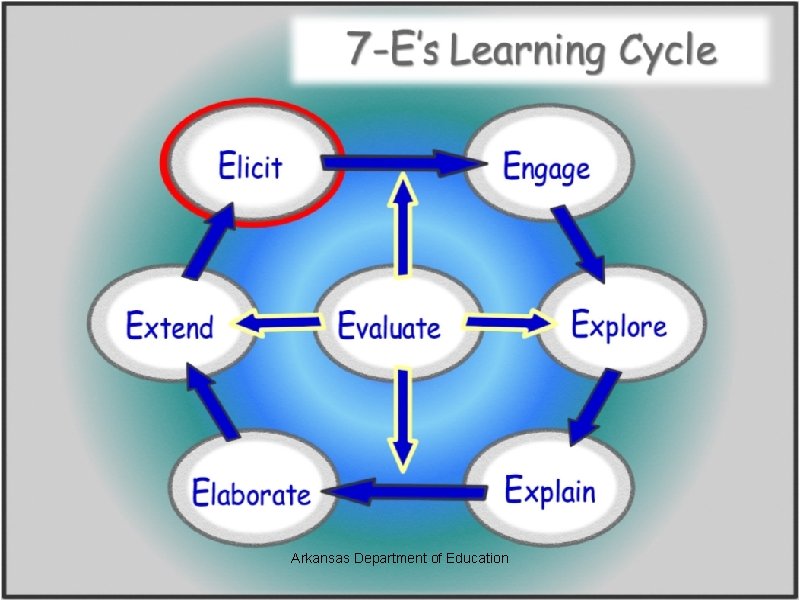
Embedding Academic Vocabulary in Science Instruction • Today, we will use the 7 -E/5 -E activity-based lesson structure with Marzano’s 6 -step process for teaching academic vocabulary.
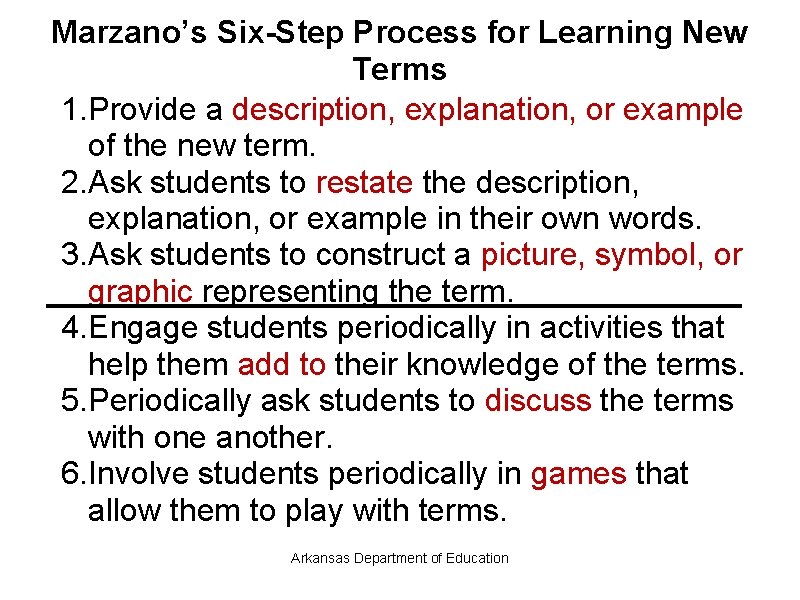
Marzano’s Six-Step Process for Learning New Terms 1. Provide a description, explanation, or example of the new term. 2. Ask students to restate the description, explanation, or example in their own words. 3. Ask students to construct a picture, symbol, or graphic representing the term. 4. Engage students periodically in activities that help them add to their knowledge of the terms. 5. Periodically ask students to discuss the terms with one another. 6. Involve students periodically in games that allow them to play with terms. Arkansas Department of Education
5 -E or 7 -E Model • is a process used in many classrooms to develop learning cycles. • is endorsed and modeled in many products/publications. • can provide multiple opportunities for vocabulary instruction. Arkansas Department of Education
Arkansas Department of Education
The 5 E Model
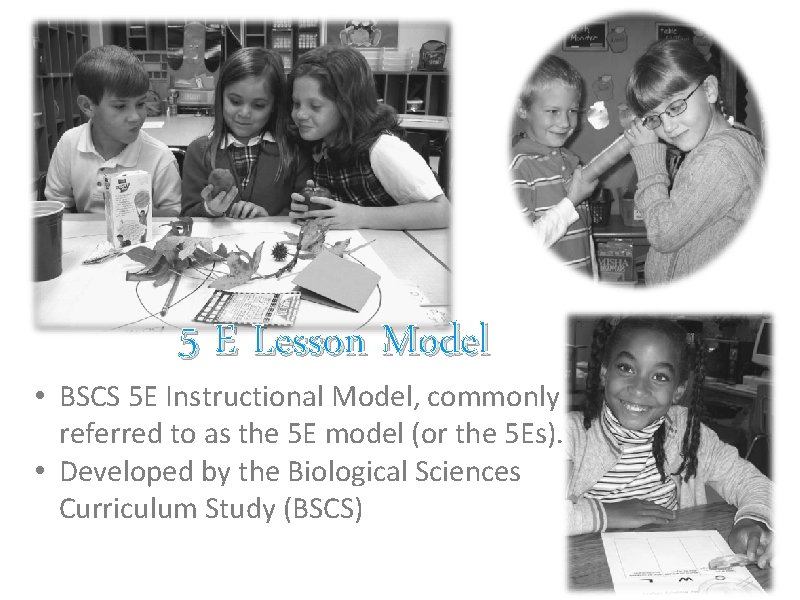
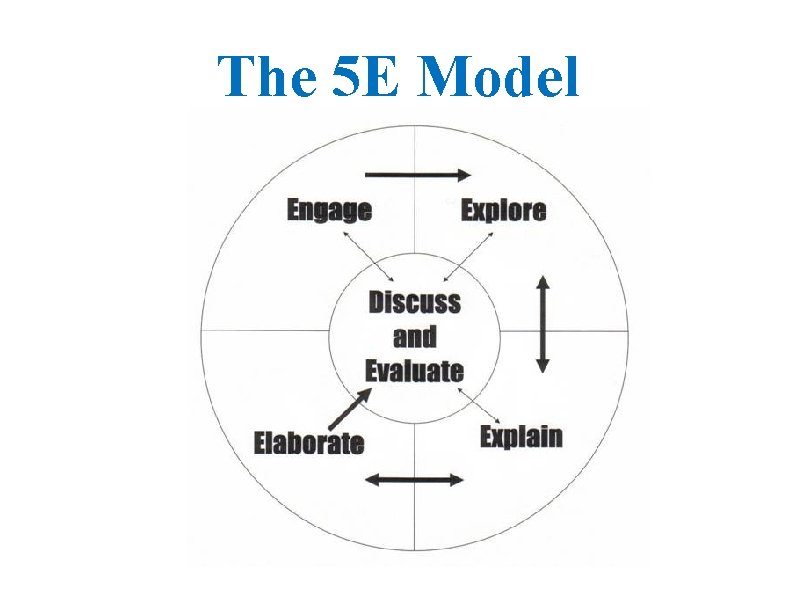
5 E Lesson Model • BSCS 5 E Instructional Model, commonly referred to as the 5 E model (or the 5 Es). • Developed by the Biological Sciences Curriculum Study (BSCS)
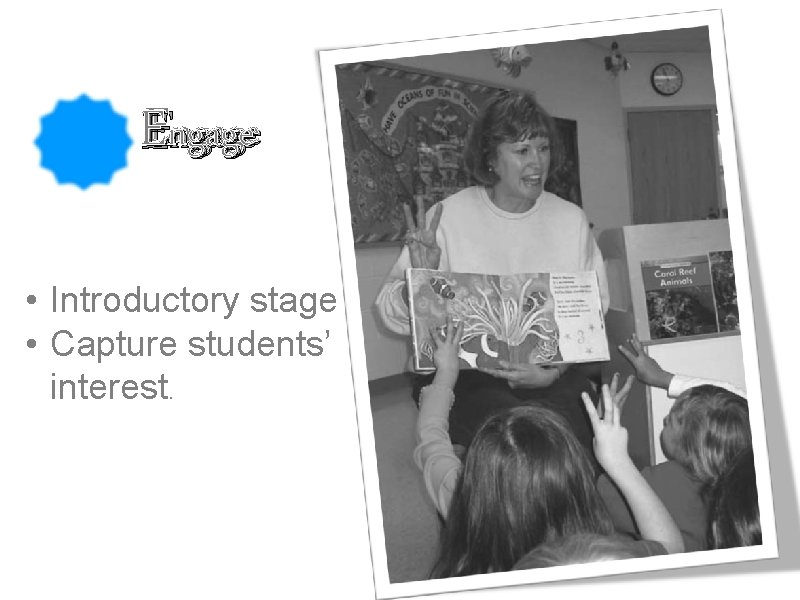
Engage • Introductory stage • Capture students’ interest.
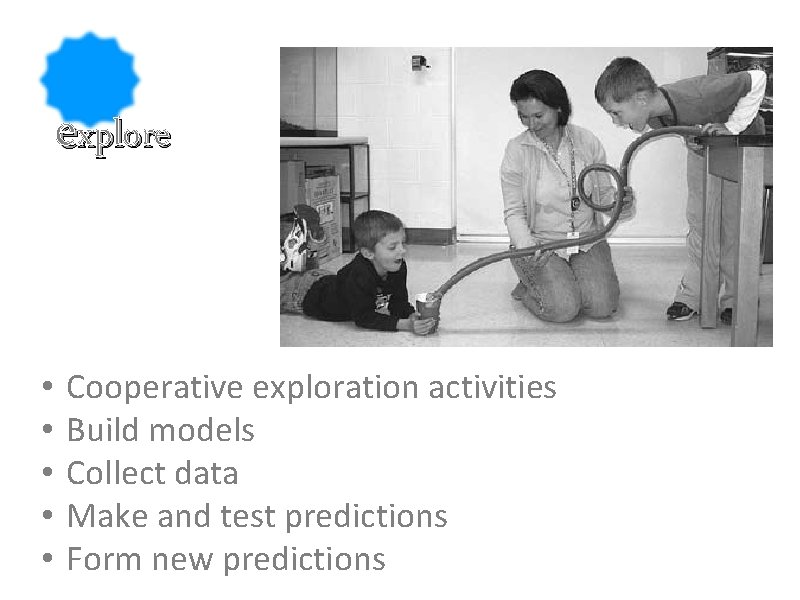
explore • • • Cooperative exploration activities Build models Collect data Make and test predictions Form new predictions
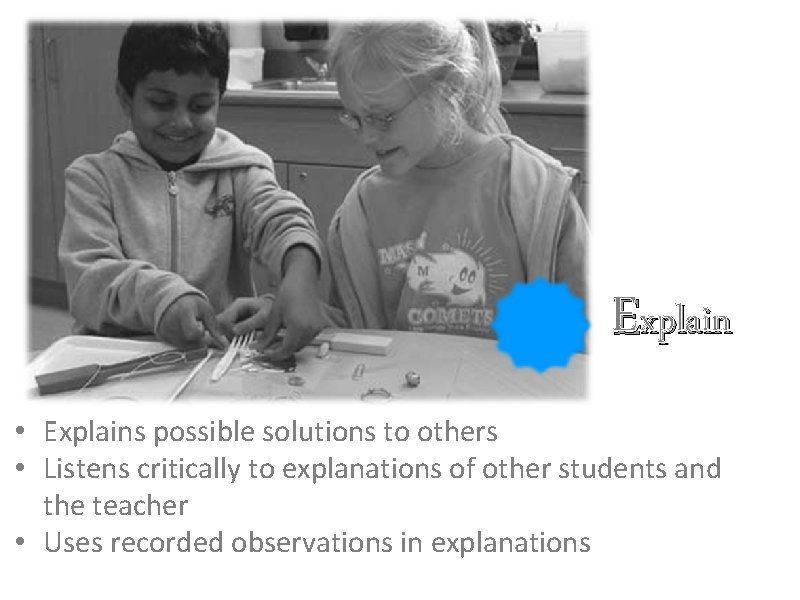
Explain • Explains possible solutions to others • Listens critically to explanations of other students and the teacher • Uses recorded observations in explanations
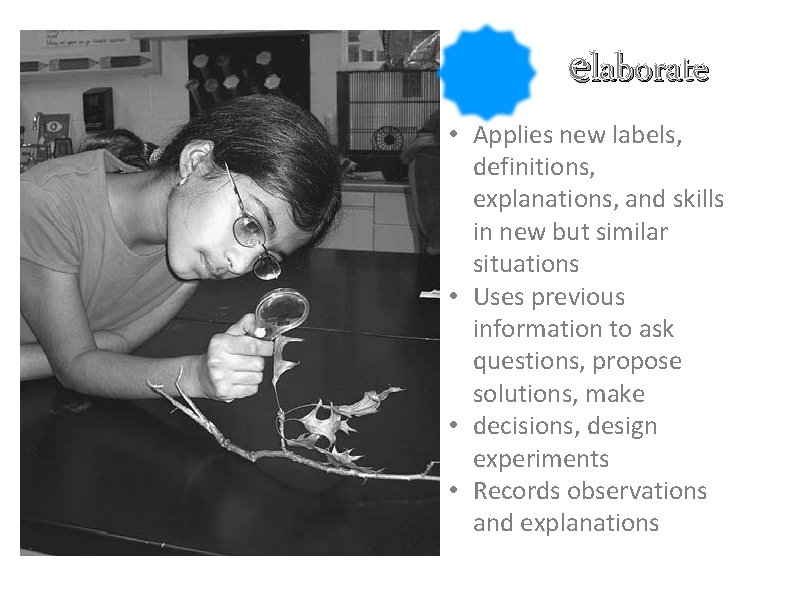
elaborate • Applies new labels, definitions, explanations, and skills in new but similar situations • Uses previous information to ask questions, propose solutions, make • decisions, design experiments • Records observations and explanations
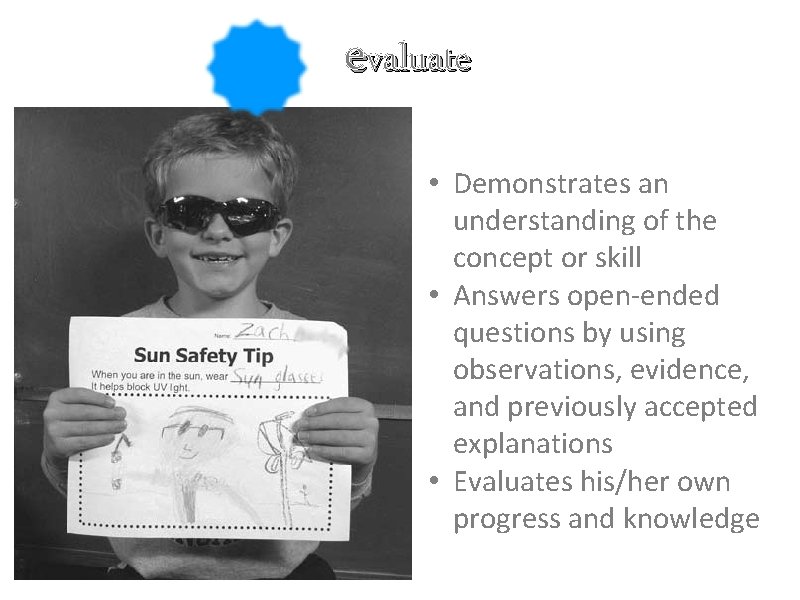
evaluate • Demonstrates an understanding of the concept or skill • Answers open-ended questions by using observations, evidence, and previously accepted explanations • Evaluates his/her own progress and knowledge
Elicit With a partner, write down all the words you associate with: Scientific MOTION Arkansas Department of Education
Marzano’s Six-Step Process for Learning New Terms 1. Provide a description, explanation, or example of the new term. 2. Ask students to restate the description, explanation, or example in their own words. 3. Ask students to construct a picture, symbol, or graphic representing the term. 4. Engage students periodically in activities that help them add to their knowledge of the terms. 5. Periodically ask students to discuss the terms with one another. 6. Involve students periodically in games that allow them to play with terms. Arkansas Department of Education
Engage Motion Videos: • Dare Devil Dogs • Spectacular 1913 Train Collision Arkansas Department of Education
Marzano’s Six-Step Process for Learning New Terms 1. Provide a description, explanation, or example of the new term. 2. Ask students to restate the description, explanation, or example in their own words. 3. Ask students to construct a picture, symbol, or graphic representing the term. 4. Engage students periodically in activities that help them add to their knowledge of the terms. 5. Periodically ask students to discuss the terms with one another. 6. Involve students periodically in games that allow them to play with terms. Arkansas Department of Education
Explore • Ball Drop Experiment • Explore the Vocabulary • Create Visual Diagrams for select terms Arkansas Department of Education
Ball Drop 1. Drop each ball individually. Observe how high each ball bounces. 2. Drop both balls simultaneously side by side and observe which, if any, ball bounces higher. 3. Final step: place the smaller of the two balls on top of the larger ball and drop at the same time.
Marzano’s Six-Step Process for Learning New Terms 1. Provide a description, explanation, or example of the new term. 2. Ask students to restate the description, explanation, or example in their own words. 3. Ask students to construct a picture, symbol, or graphic representing the term. 4. Engage students periodically in activities that help them add to their knowledge of the terms. 5. Periodically ask students to discuss the terms with one another. 6. Involve students periodically in games that allow them to play with terms. Arkansas Department of Education
Use what you have observed with “Motion” to explain and draw a picture of what you have observed.
Create visual diagrams describing your experiment using the motion terms you identified
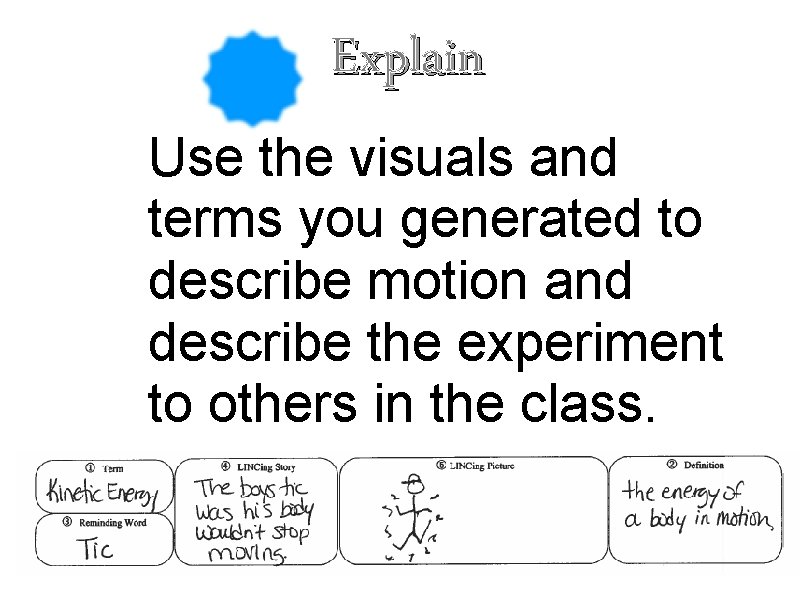
Explain Use the visuals and terms you generated to describe motion and describe the experiment to others in the class. Arkansas Department of Education
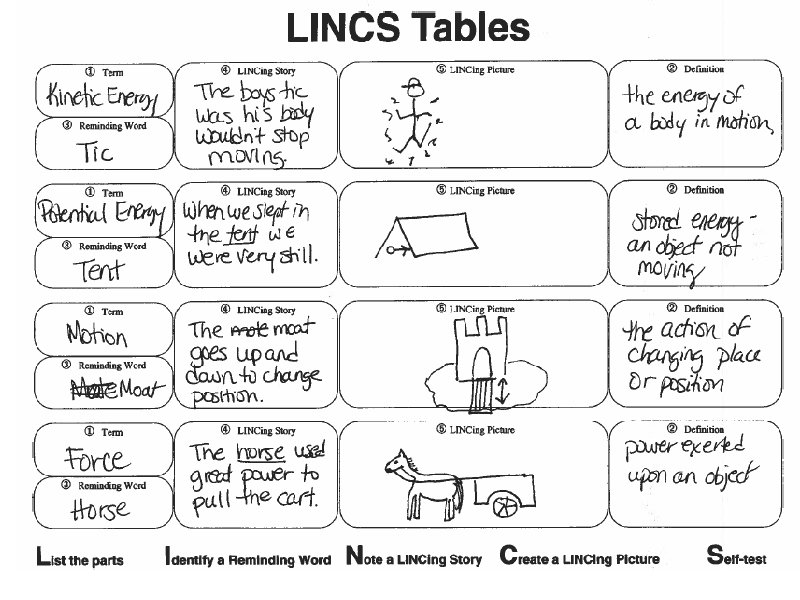
Add SIM Lincing Vocab
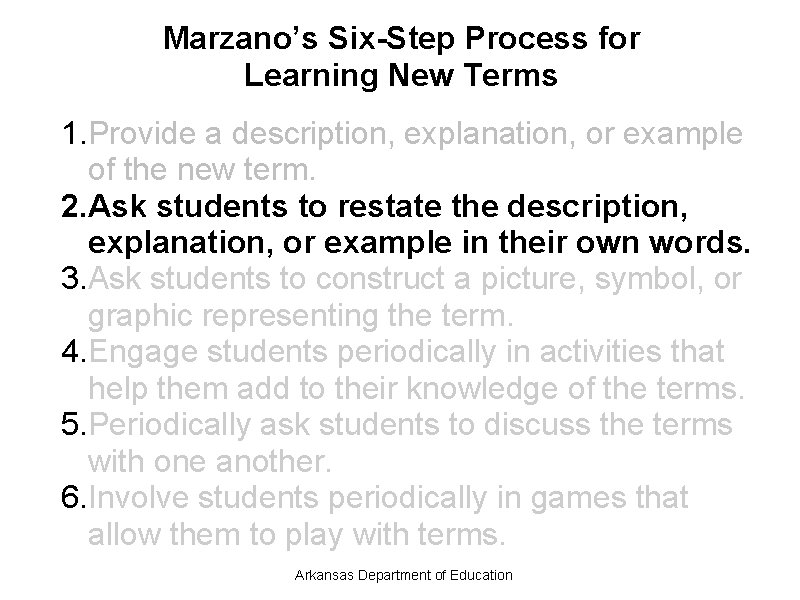
Marzano’s Six-Step Process for Learning New Terms 1. Provide a description, explanation, or example of the new term. 2. Ask students to restate the description, explanation, or example in their own words. 3. Ask students to construct a picture, symbol, or graphic representing the term. 4. Engage students periodically in activities that help them add to their knowledge of the terms. 5. Periodically ask students to discuss the terms with one another. 6. Involve students periodically in games that allow them to play with terms. Arkansas Department of Education
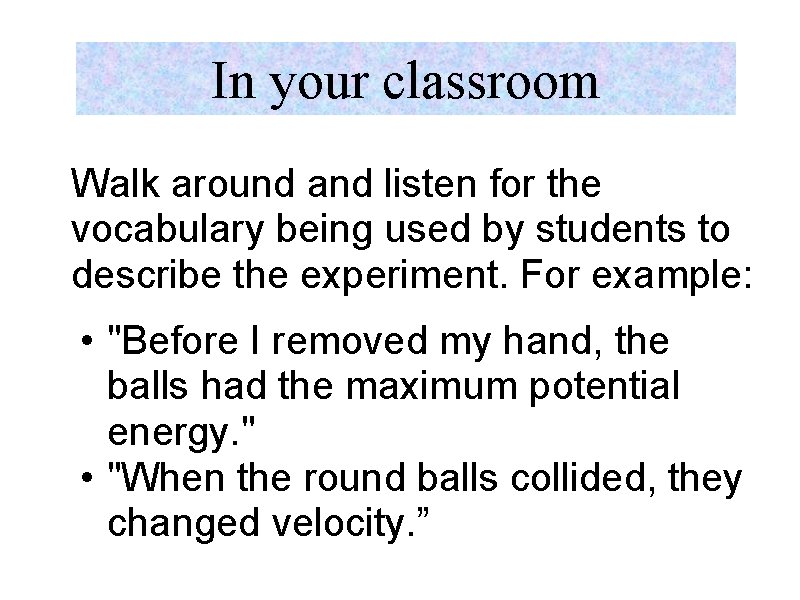
In your classroom Walk around and listen for the vocabulary being used by students to describe the experiment. For example: • "Before I removed my hand, the balls had the maximum potential energy. " • "When the round balls collided, they changed velocity. ”
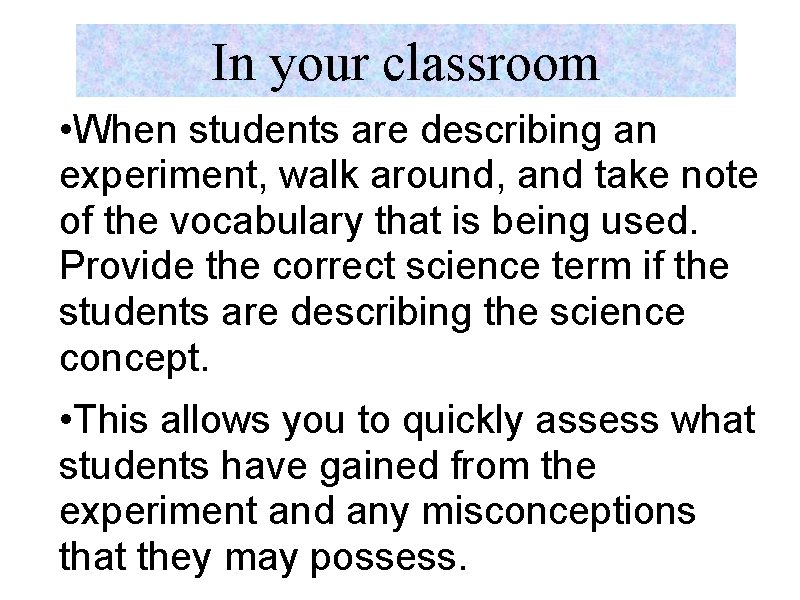
In your classroom • When students are describing an experiment, walk around, and take note of the vocabulary that is being used. Provide the correct science term if the students are describing the science concept. • This allows you to quickly assess what students have gained from the experiment and any misconceptions that they may possess.
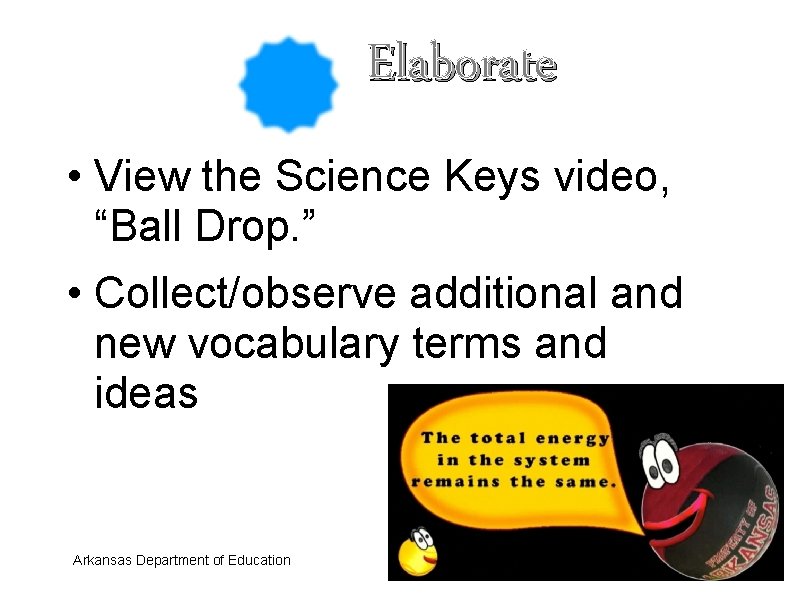
Elaborate • View the Science Keys video, “Ball Drop. ” • Collect/observe additional and new vocabulary terms and ideas Arkansas Department of Education
Elaborate Ball Drop As you view the video, think about additional questions you might have concerning the experiment. For example: • What would happen if I dropped a third ball into this scenario? • What would happen if we used non-elastic balls, such as bowling balls, instead of tennis or basketballs? Arkansas Department of Education
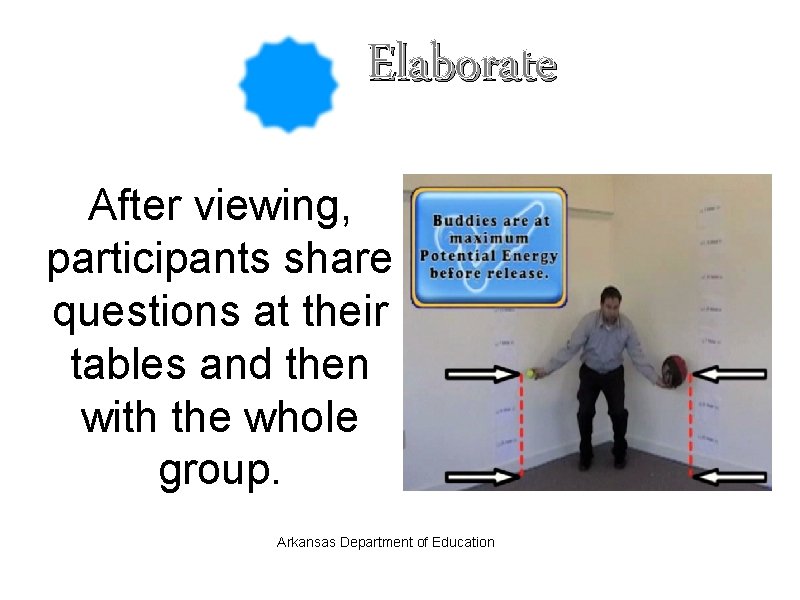
Elaborate After viewing, participants share questions at their tables and then with the whole group. Arkansas Department of Education
Marzano’s Six-Step Process for Learning New Terms 1. Provide a description, explanation, or example of the new term. 2. Ask students to restate the description, explanation, or example in their own words. 3. Ask students to construct a picture, symbol, or graphic representing the term. 4. Engage students periodically in activities that help them add to their knowledge of the terms. 5. Periodically ask students to discuss the terms with one another. 6. Involve students periodically in games that Arkansas Department of Education allow them to play with terms.
Evaluate Quick Write Individually, write/draw a reflection of the terms you learned in the context of the experiment using targeted vocabulary. Arkansas Department of Education
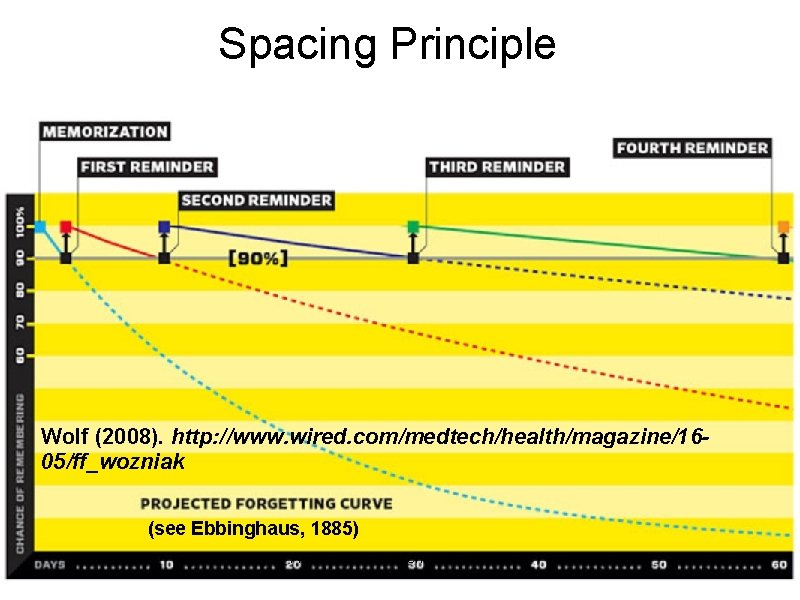
Spacing Principle Wolf (2008). http: //www. wired. com/medtech/health/magazine/1605/ff_wozniak (see Ebbinghaus, 1885) Arkansas Department of Education
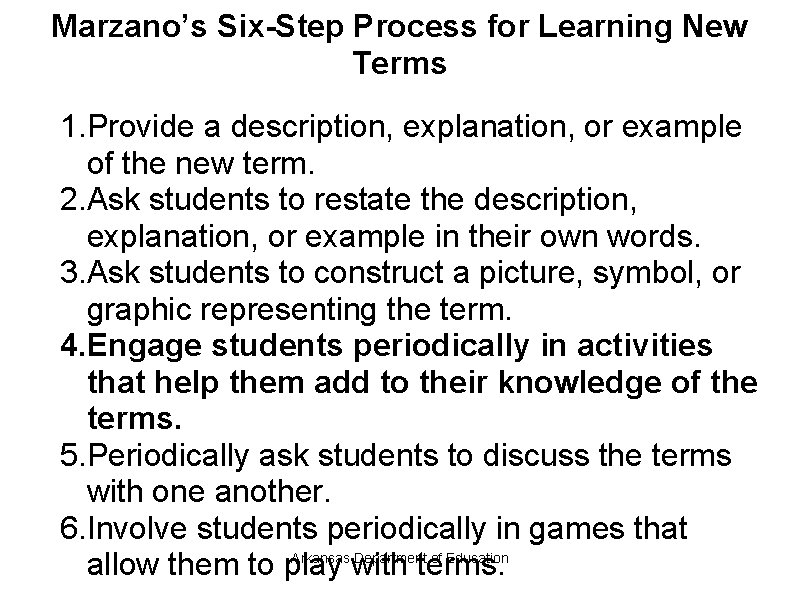
Marzano’s Six-Step Process for Learning New Terms 1. Provide a description, explanation, or example of the new term. 2. Ask students to restate the description, explanation, or example in their own words. 3. Ask students to construct a picture, symbol, or graphic representing the term. 4. Engage students periodically in activities that help them add to their knowledge of the terms. 5. Periodically ask students to discuss the terms with one another. 6. Involve students periodically in games that Arkansas Department of Education allow them to play with terms.
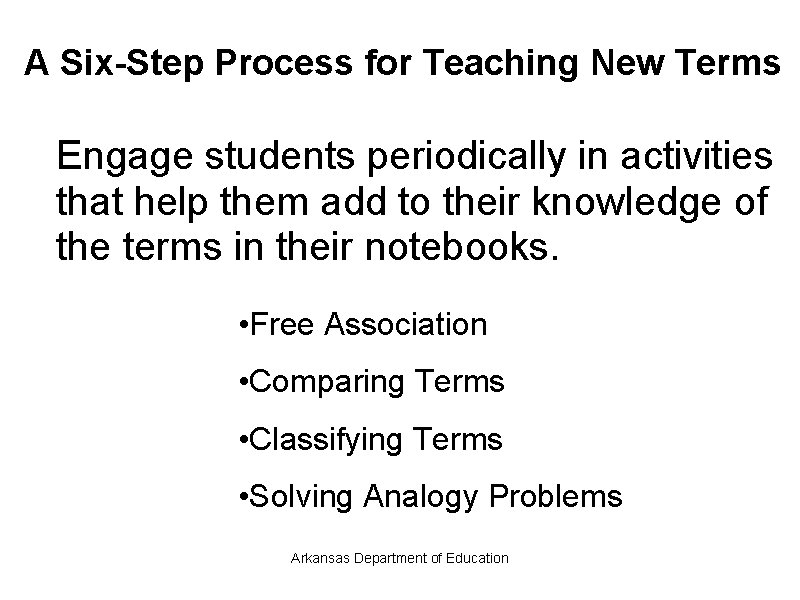
A Six-Step Process for Teaching New Terms Engage students periodically in activities that help them add to their knowledge of the terms in their notebooks. • Free Association • Comparing Terms • Classifying Terms • Solving Analogy Problems Arkansas Department of Education
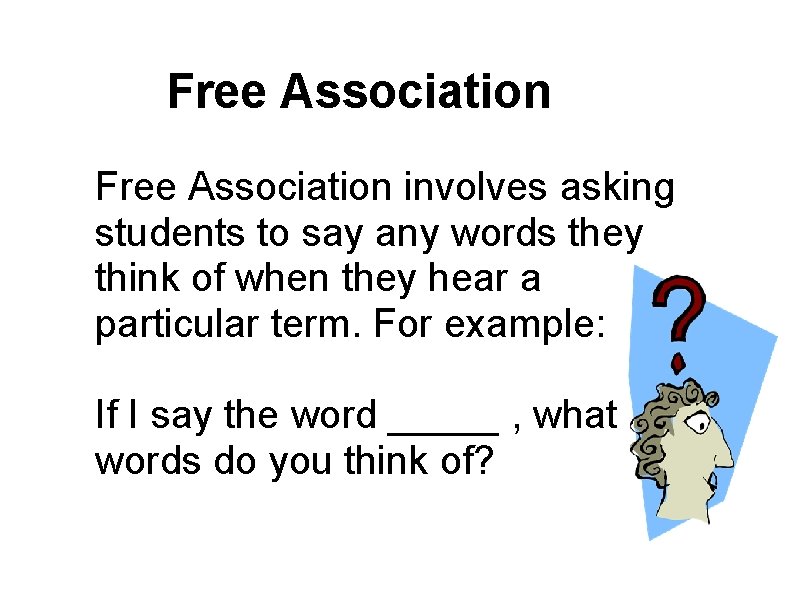
Free Association involves asking students to say any words they think of when they hear a particular term. For example: If I say the word _____ , what words do you think of?
Comparing Terms • Sentence Stems • Venn Diagrams • Double Bubble • Matrix Arkansas Department of Education
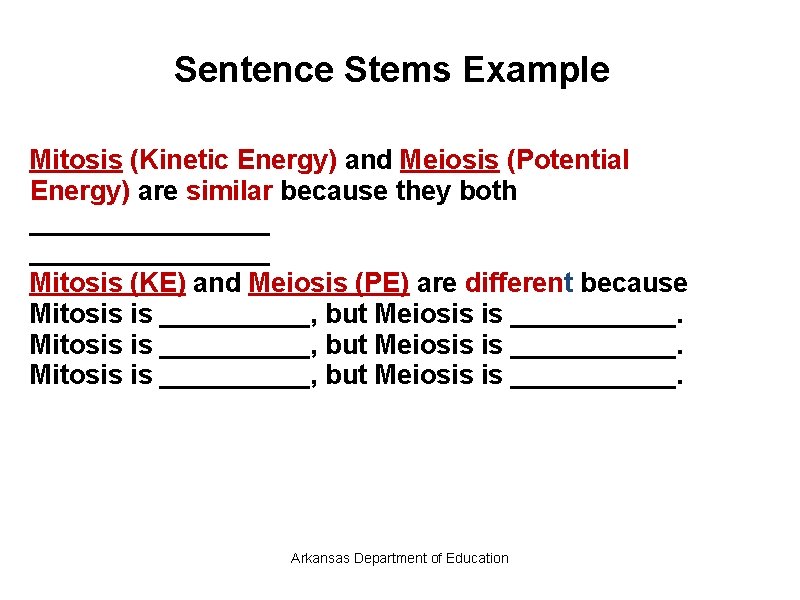
Sentence Stems Example Mitosis (Kinetic Energy) and Meiosis (Potential Energy) are similar because they both ________________ Mitosis (KE) and Meiosis (PE) are different because Mitosis is __________, but Meiosis is ___________. Mitosis is _____, but Meiosis is ______. Arkansas Department of Education
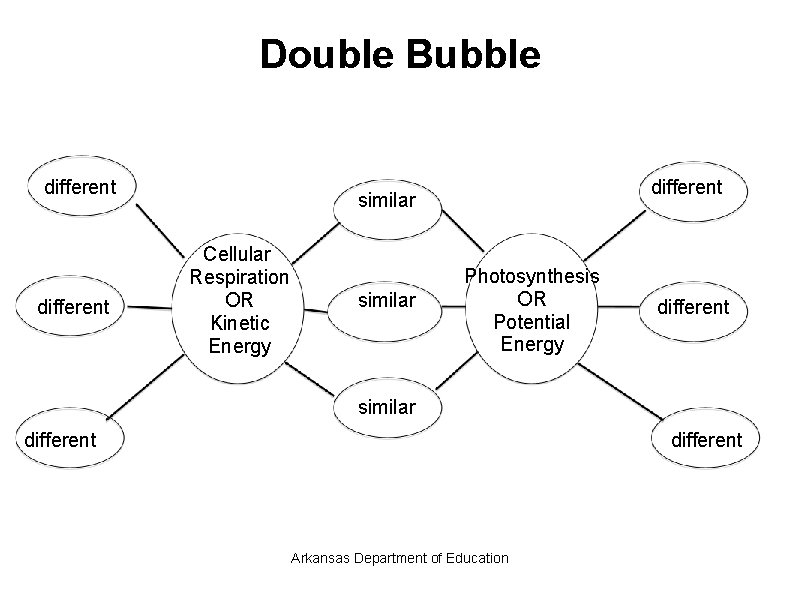
Double Bubble different similar Cellular Respiration OR Kinetic Energy similar Photosynthesis OR Potential Energy different similar different Arkansas Department of Education
Classifying Terms A process of grouping terms by similar attributes. Arkansas Department of Education
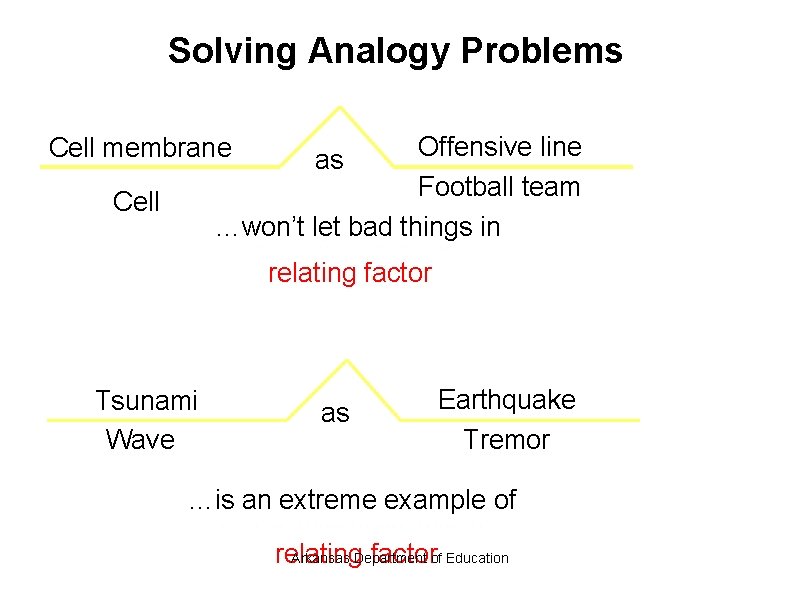
Solving Analogy Problems Offensive line as Football team …won’t let bad things in Cell membrane Cell …relating factor Tsunami Wave as Earthquake Tremor …is an extreme example of Arkansas Department of Education …relating factor
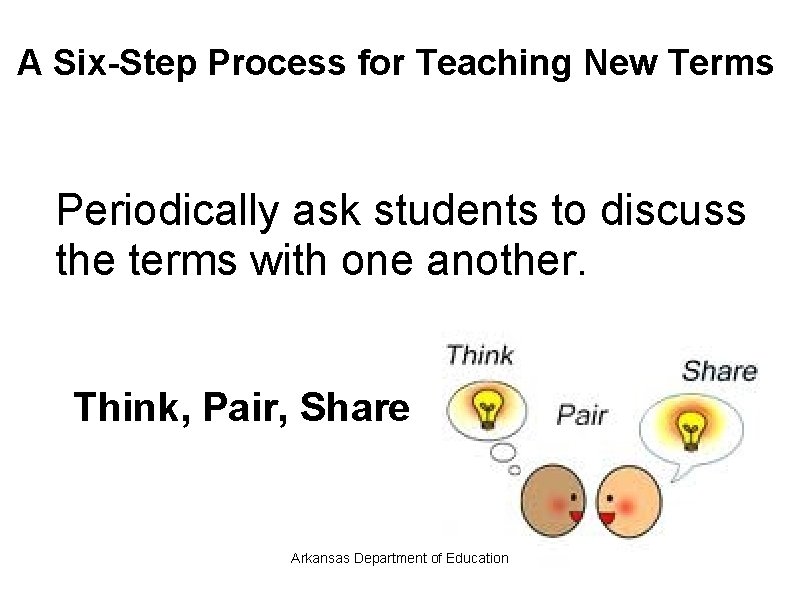
A Six-Step Process for Teaching New Terms Periodically ask students to discuss the terms with one another. Think, Pair, Share Arkansas Department of Education
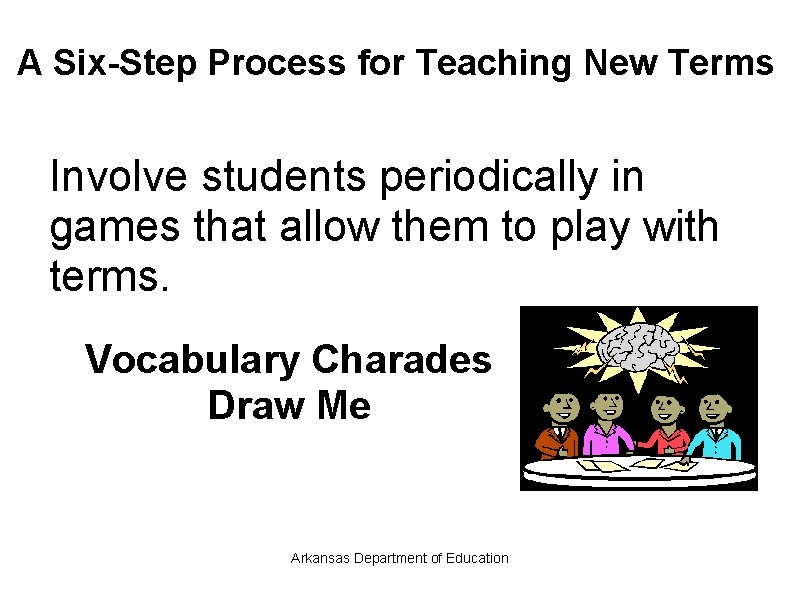
A Six-Step Process for Teaching New Terms Involve students periodically in games that allow them to play with terms. Vocabulary Charades Draw Me Arkansas Department of Education
Greek and Latin Roots • A word root is a word part that means something. • When a root appears inside a word, it lends its meaning to the word and helps create the word’s meaning. • Words related in form and meaning to another word are called cognates. • The root conveys sound and meaning. • It can stand on its own
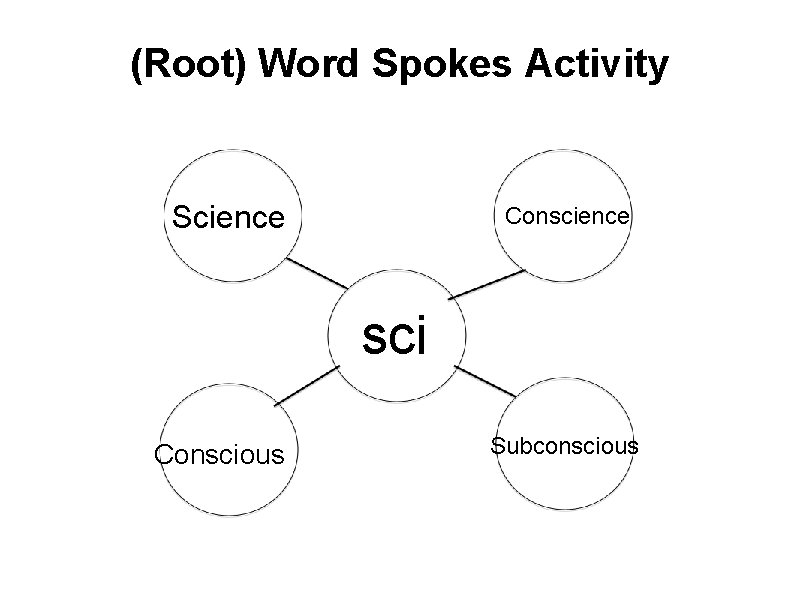
(Root) Word Spokes Activity Science Conscience sci Conscious Subconscious
Prefixes and Suffixes • Meaningful word parts • Attached to the beginning of words (prefix) • Attached to the end of words (suffix) Example: 1. endo- is a prefix meaning inner 2. -itis is a suffix meaning inflamed Arkansas Department of Education
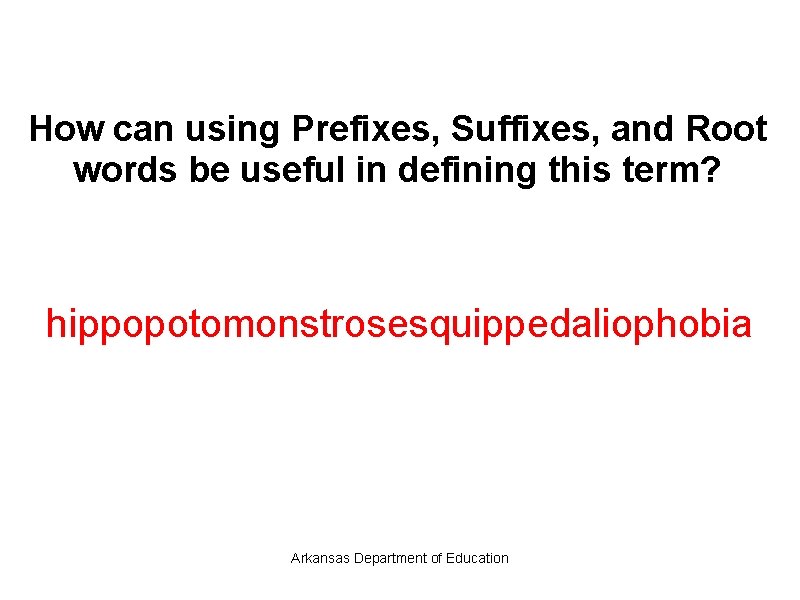
How can using Prefixes, Suffixes, and Root words be useful in defining this term? hippopotomonstrosesquippedaliophobia Arkansas Department of Education
Common Core State Standards Correlation to Content Vocabulary Strategies RST. 9 -12. 6 Analyze the author’s purpose in providing an explanation, describing a procedure, or discussing an experiment in a text, defining the question the author seeks to address/identifying important issues that remain unresolved. Arkansas Department of Education
Common Core State Standards - Writing WHST. 9 -12. 2 b and 2 d Write informative/explanatory texts, including the narration of historical events, scientific procedures/ experiments, or technical processes. b. Develop the topic with well-chosen, relevant, and sufficient facts, extended definitions, concrete details, quotations, or other information and examples appropriate to the audience’s knowledge of the topic. d. Use precise language and domain-specific vocabulary to inform about or explain the topic. Arkansas Department of Education

Questioning Strategies in Science Arkansas Department of Education
Content Literacy Professional Development is focused on supporting all middle/high school content teachers as they view their roles not as teachers of reading and writing but as teachers of how to access information from the different kinds of texts and information used in content classes. Arkansas Department of Education
Expected Outcomes: Participants will: • Examine personal and professional literacy practices, • Review scientifically-based literacy approaches and strategies for content learning, with an emphasis on Questioning the Author (Qt. A) and Question-Answer Relationships (QAR), and • Structure learning tasks using Qt. A and QAR that emphasize content, access of text, and comprehension as essential goals for students. Arkansas Department of Education

Reflecting as a Reader Arkansas Department of Education
Text Complexity “Literacy instruction at the high school level should support students to continue developing reading fluency; improving vocabulary knowledge; developing higherlevel reasoning and thinking skills; improving reading comprehension skills, and increasing student motivation and engagement. ” Torgeson et al, 2007 Arkansas Department of Education
"Rethinking the Role of Literacy in the Content Areas" Heller, R. , and Greenleaf, C. (2007). Literacy instruction in the content areas: Getting to the core of middle and high school improvement. Washington, DC: Alliance for Excellent Education. Arkansas Department of Education

Text Features in Science Arkansas Department of Education
Arkansas Department of Education
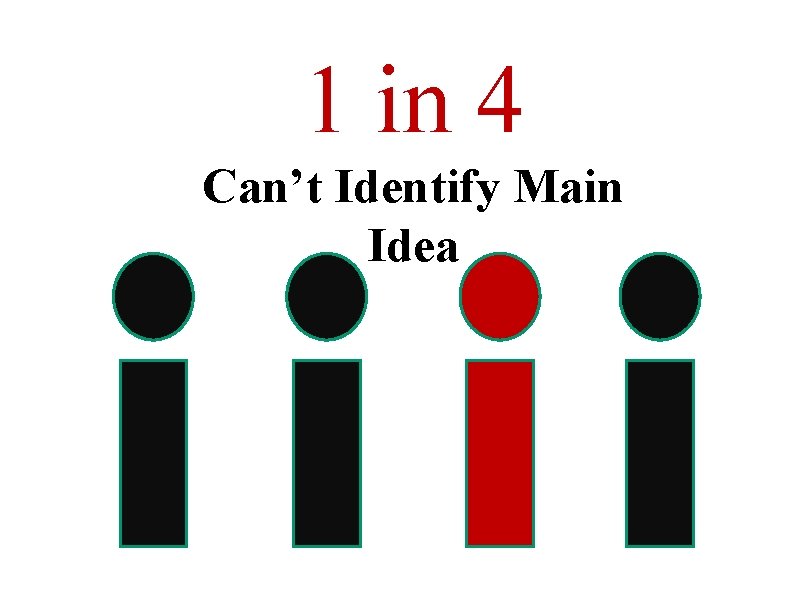
1 in 4 Can’t Identify Main Idea
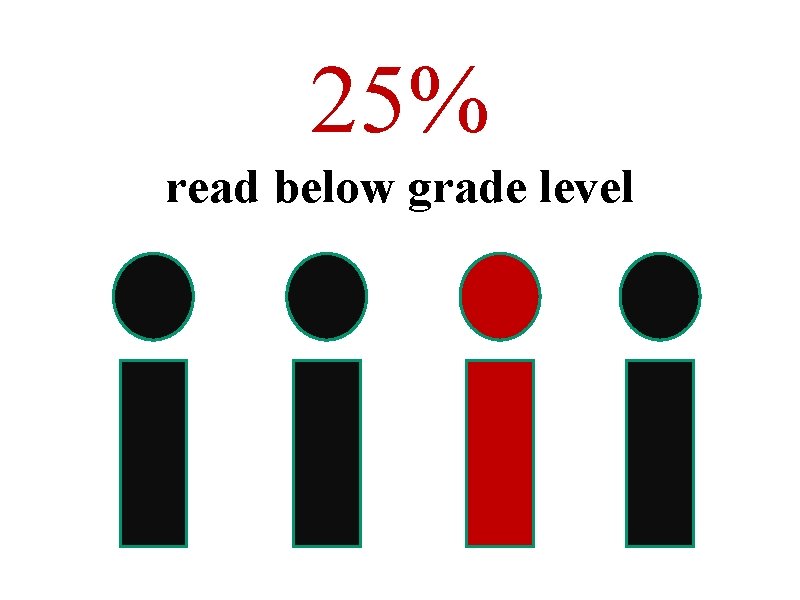
25% read below grade level
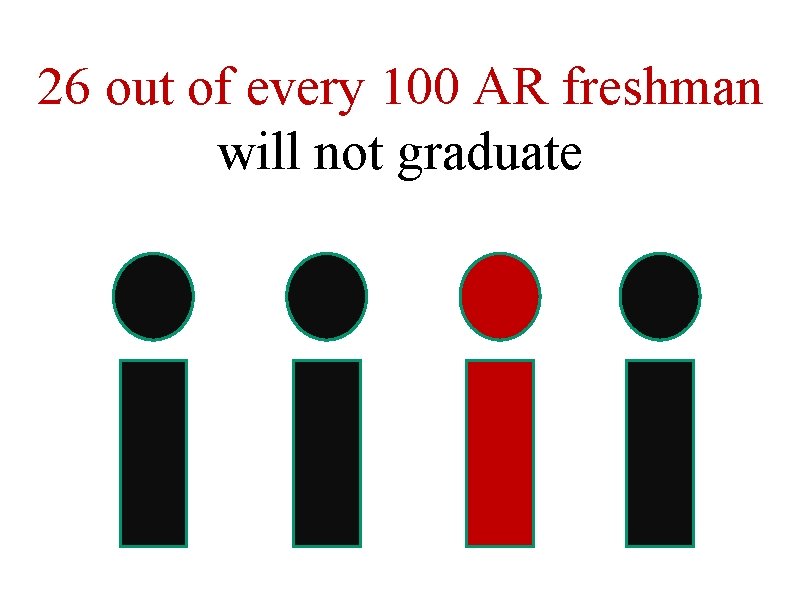
26 out of every 100 AR freshman will not graduate
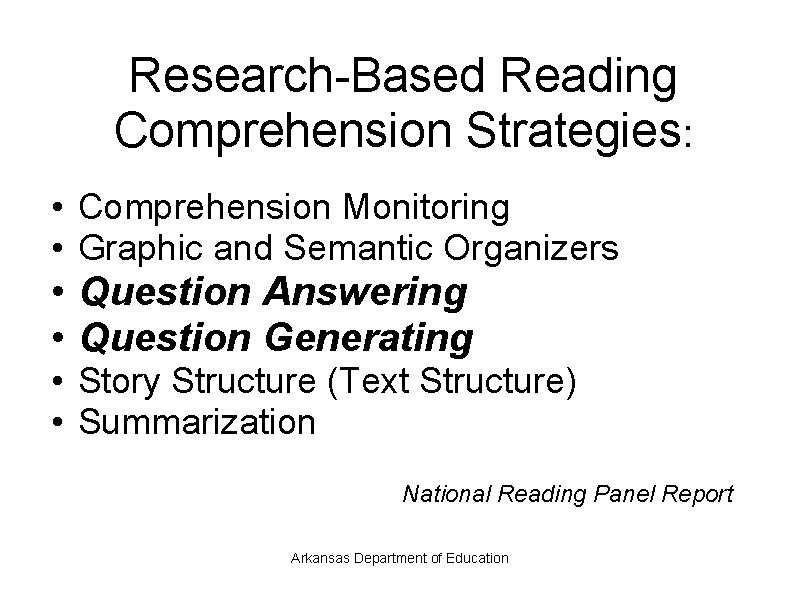
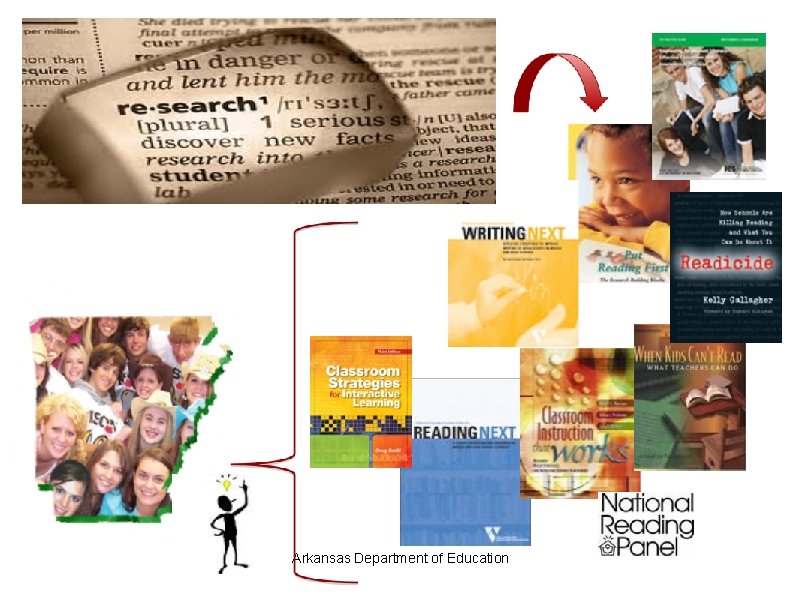
Research-Based Reading Comprehension Strategies: • Comprehension Monitoring • Graphic and Semantic Organizers • Question Answering • Question Generating • Story Structure (Text Structure) • Summarization National Reading Panel Report Arkansas Department of Education
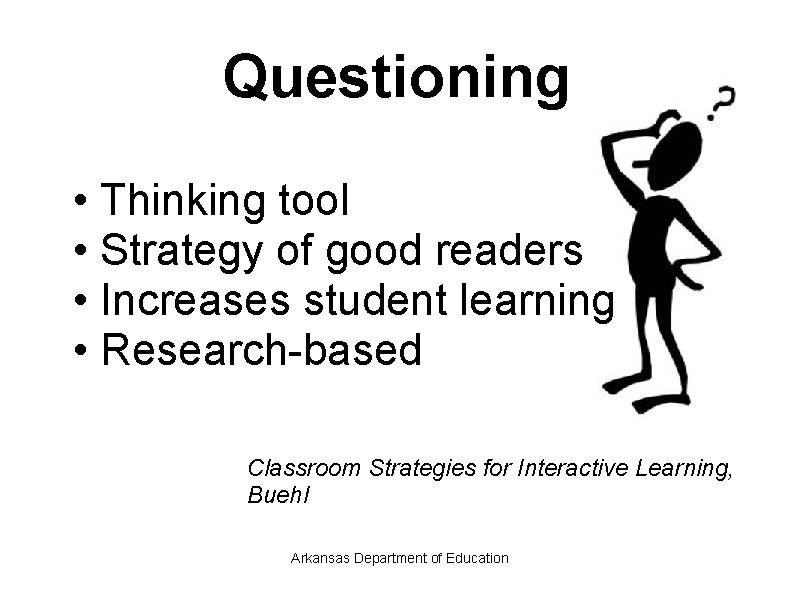
Questioning • Thinking tool • Strategy of good readers • Increases student learning • Research-based Classroom Strategies for Interactive Learning, Buehl Arkansas Department of Education
Questioning • To actively inquire • To explore uncertainties • To investigate a text adapted from Subjects Matter, Harvey Daniels and Steven Zemelman, 2004 Arkansas Department of Education
Questioning the Author (Qt. A) • Provides a setting for small group discussions (guided queries) • Improves comprehension and critical -thinking skills • Leads to students considering the author’s thinking (open-ended questions) • Offers a voice to confusion Arkansas Department of Education
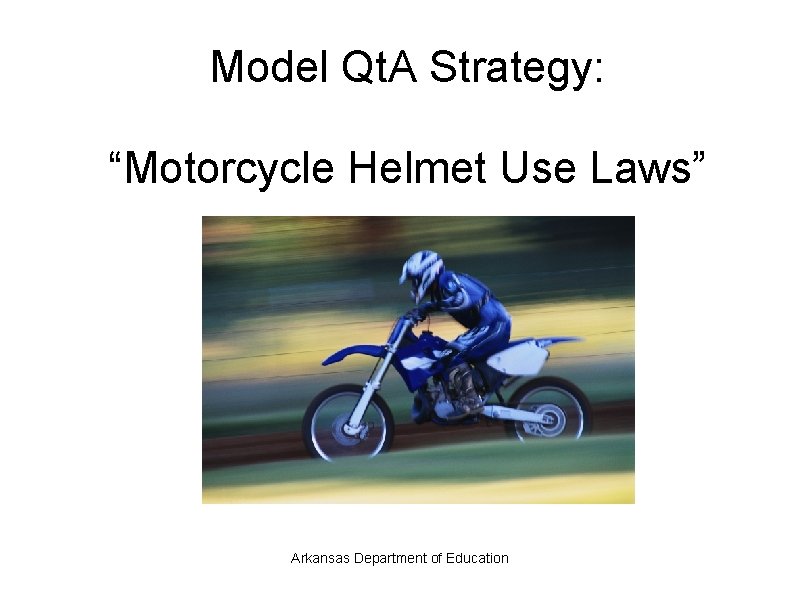
Model Qt. A Strategy: “Motorcycle Helmet Use Laws” Arkansas Department of Education
Qt. A Prompts Changes in Classroom Discourse • Teacher-generated questions • Student discourse Questioning the Author, Beck, Mc. Keown, Hamilton, and Kucan Arkansas Department of Education
Qt. A in a Thinking Device for Science: Super Helmet Safety Video. wmv Arkansas Department of Education
QAR Strategy: Question/Answer Relationships • Helps students connect the salient parts of a question with a text and the reader’s prior knowledge. • Contains four categories of relationships. Arkansas Department of Education
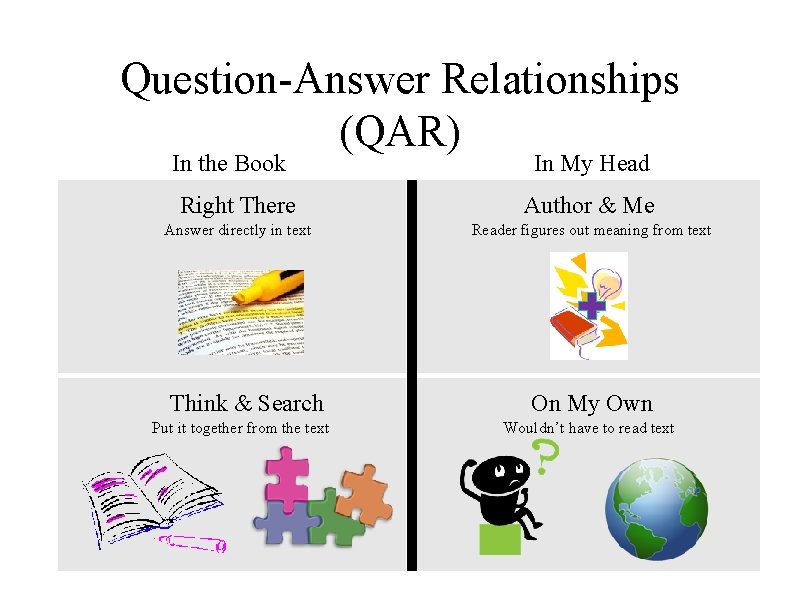
Question-Answer Relationships (QAR) In the Book In My Head Right There Author & Me Answer directly in text Reader figures out meaning from text Think & Search Put it together from the text On My Own Wouldn’t have to read text
Create Examples of Question. Answer Relationships (QARs) Right There, Think & Search, Author & Me, On My Own Arkansas Department of Education
Advantages of Qt. A and QAR: • Engagement • Motivation Arkansas Department of Education

Common Core State Standards for Literacy in History/Social Studies, Science, and Technical Subjects Arkansas Department of Education

Lesson Planning to meet the Common Core State Standards in Science and Technical Subjects
Reflection: What might vocabulary and questioning look like in your science classes? What changes would you expect to see in terms of student behaviors? Is there anything we can do to better support your learning tomorrow? Arkansas Department of Education
- Slides: 83