
SOLID WASTE TRANSFER SYSTEMS IN DEVELOPING COUNTRIES Sandra



- Slides: 24
SOLID WASTE TRANSFER SYSTEMS IN DEVELOPING COUNTRIES Sandra Cointreau
WHAT IS A TRANSFER SYSTEM? • A Transfer System Consists of a Transfer Station and a Fleet of Large Capacity Vehicles Which Provide Long Haul for Refuse -- So That the Fleet of Small Capacity Collection Vehicles Is Enabled to Focus on the Job of Collection.
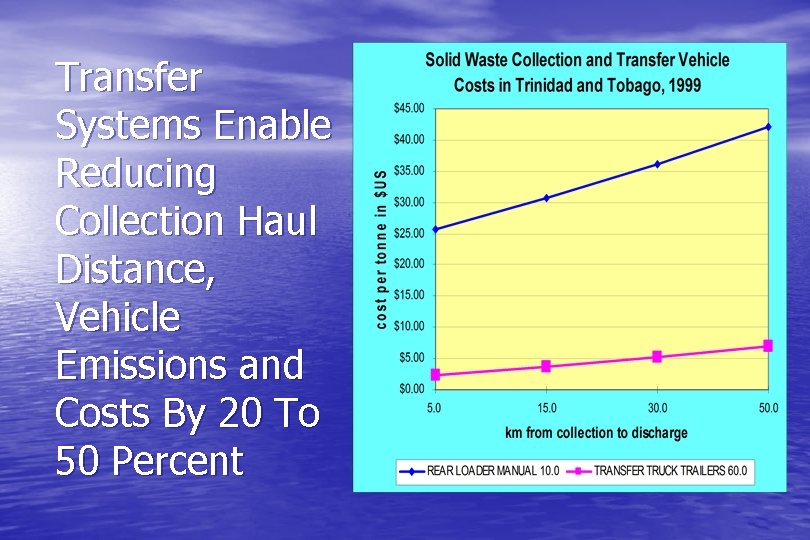
Transfer Systems Enable Reducing Collection Haul Distance, Vehicle Emissions and Costs By 20 To 50 Percent
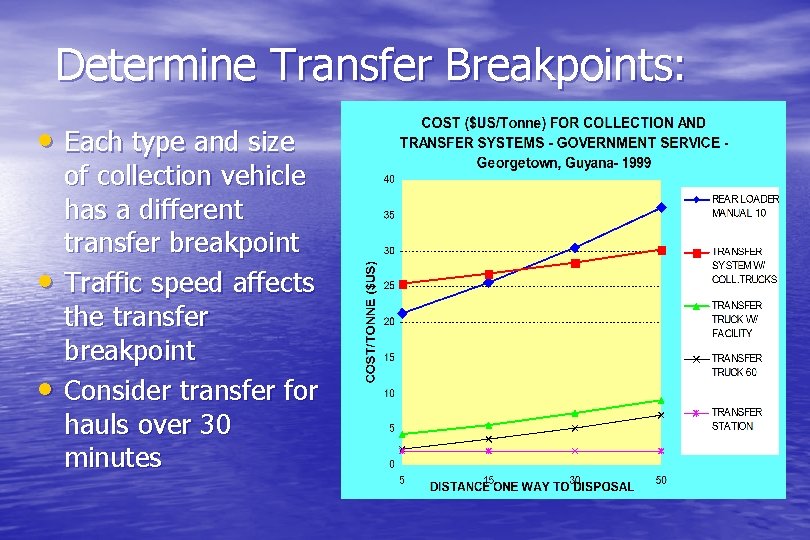
Determine Transfer Breakpoints: • Each type and size • • of collection vehicle has a different transfer breakpoint Traffic speed affects the transfer breakpoint Consider transfer for hauls over 30 minutes
Transfer Systems Enable Implementation Of Regional Safe Disposal Systems that Achieve Economies-of-Scale. • Landfills should be at least 300 tonnes/day to have • landfill bulldozers and wheeled loaders fully utilized Roads, fences, weighbridges, gatehouses, utilities are fixed costs that should be applied to large waste quantities
Landfill Economies-of-Scale
Transfer Stations have Carbon Finance Opportunities • All transfer vehicles are parked and fueled at the station and able to operate with clean fuels and upgraded emission controls. • Collection haul distances are dramatically reduced, and thus their emissions are reduced. • Reductions are easy to monitor because of weighbridges required at transfer stations.
What Are The Main Elements Of A Major Transfer Station? • Site of 2+ Hectares • Access to a Major Road Which Can Carry Long Haul • • • Vehicles of 50 C. M. Capacity Parking, Maintenance and Repair Facilities for Transfer Fleet Weigh-Bridge to Record in-Coming Payloads Multi-Level Transfer Building, Unloading on Top, Loading on Bottom
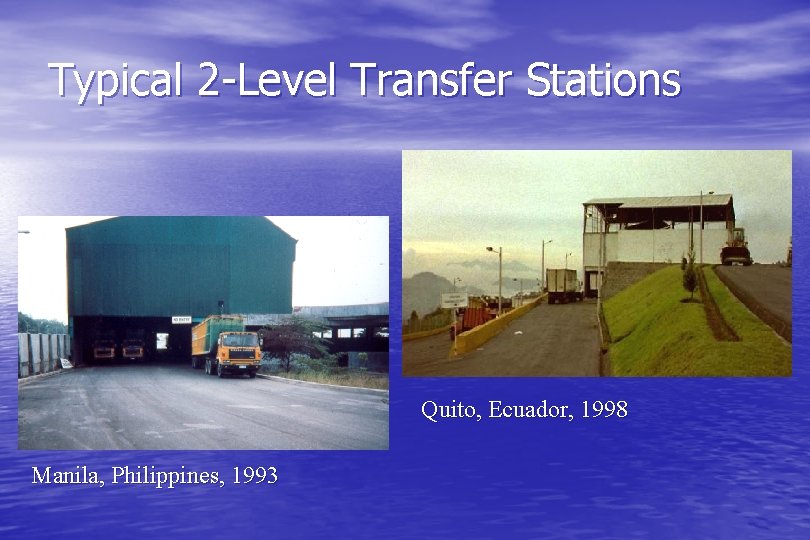
Typical 2 -Level Transfer Stations Quito, Ecuador, 1998 Manila, Philippines, 1993
Which Design Issues Need Careful Analysis? • Station Layout for Efficient Traffic Flow of Collection and Transfer Vehicles • Unloading Method from Collection Vehicles • Loading Method of Transfer Vehicles • Transfer Vehicle Style and Material • Discharge Method from Transfer Vehicles
Direct Unloading to Transfer Truck • Waste Is Discharged Directly from the Collection Vehicles into the Loading System of the Transfer Vehicles • No Waste Storage, Therefore Less Need for Odor and Vector Control • Usually Used for Small Stations Only
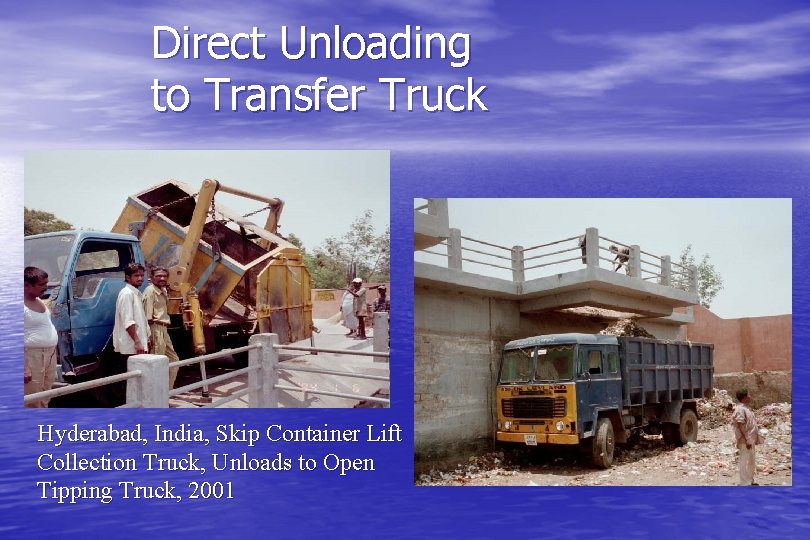
Direct Unloading to Transfer Truck Hyderabad, India, Skip Container Lift Collection Truck, Unloads to Open Tipping Truck, 2001
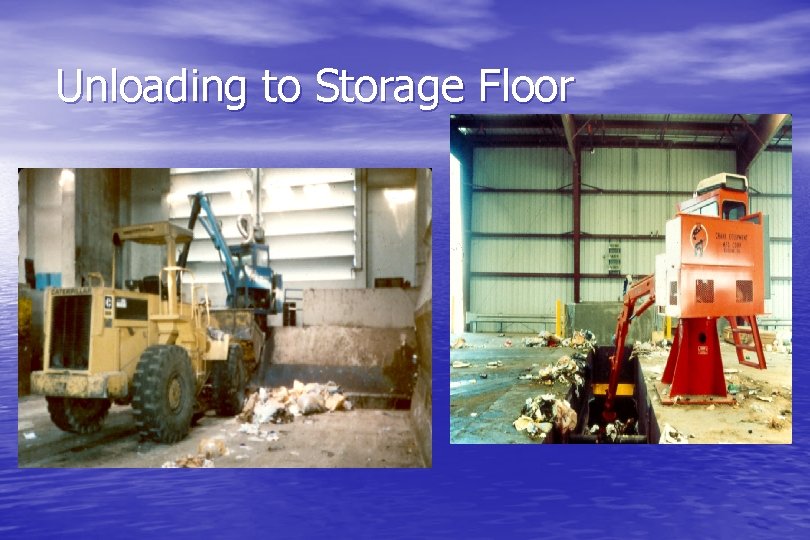
Unloading-to-Storage Area • Waste Is Discharged to a Storage Area from which It Is Then Moved into the Loading System of the Transfer Vehicles • Storage Enables Collection Vehicles to Operate on Their Optimum Schedule and Transfer Vehicles to Operate on Their Optimum Schedule • Provides a Safe-Guard if Their Is Down. Time in the Loading System for Transfer Vehicles
Unloading to Storage Floor
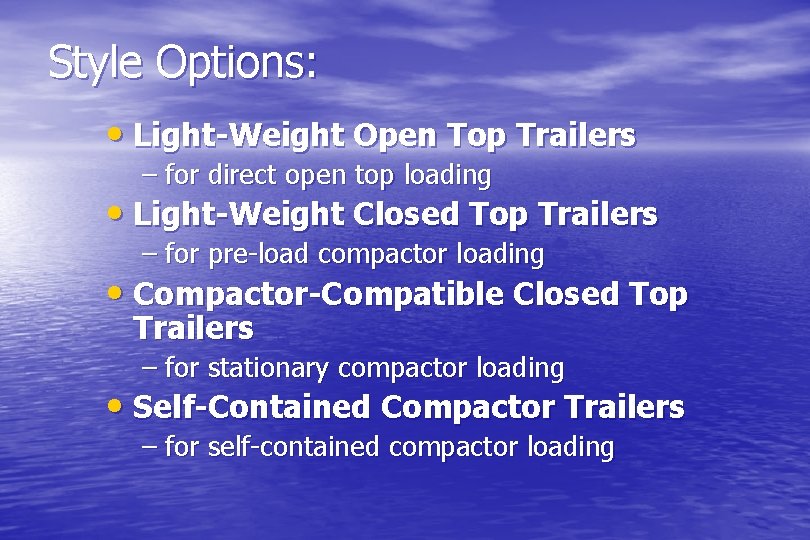
Style Options: • Light-Weight Open Top Trailers – for direct open top loading • Light-Weight Closed Top Trailers – for pre-load compactor loading • Compactor-Compatible Closed Top Trailers – for stationary compactor loading • Self-Contained Compactor Trailers – for self-contained compactor loading
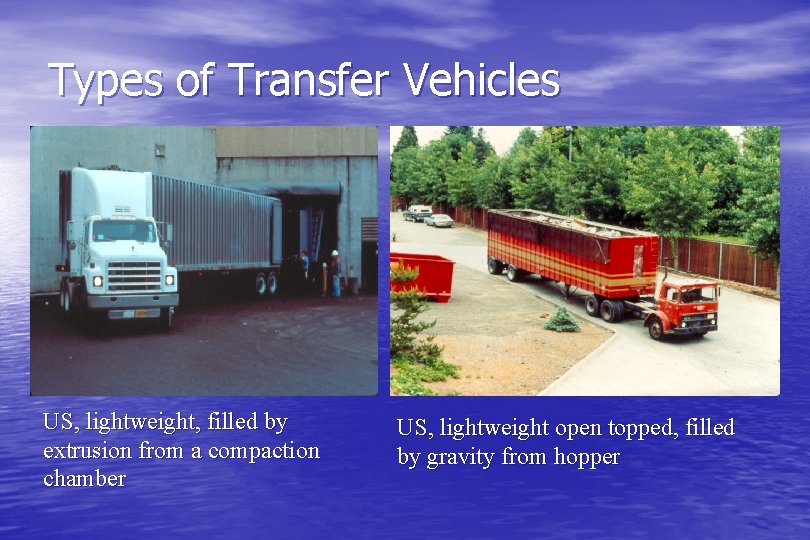
Types of Transfer Vehicles US, lightweight, filled by extrusion from a compaction chamber US, lightweight open topped, filled by gravity from hopper
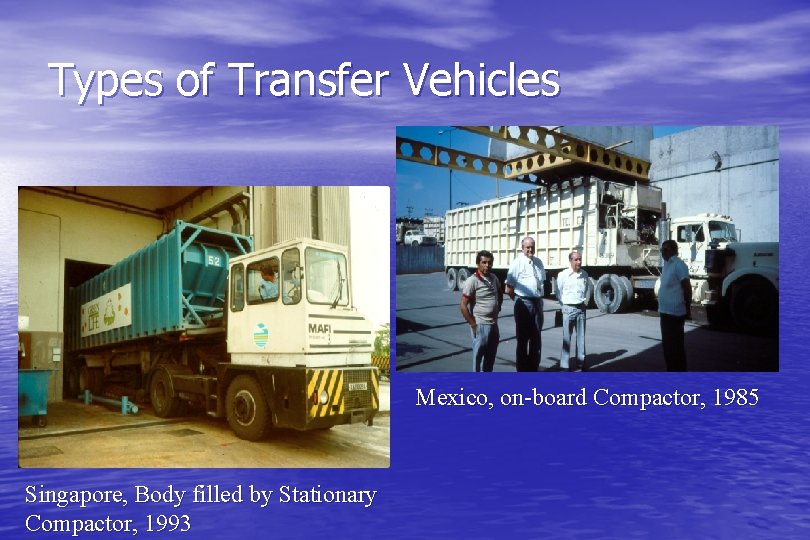
Types of Transfer Vehicles Mexico, on-board Compactor, 1985 Singapore, Body filled by Stationary Compactor, 1993
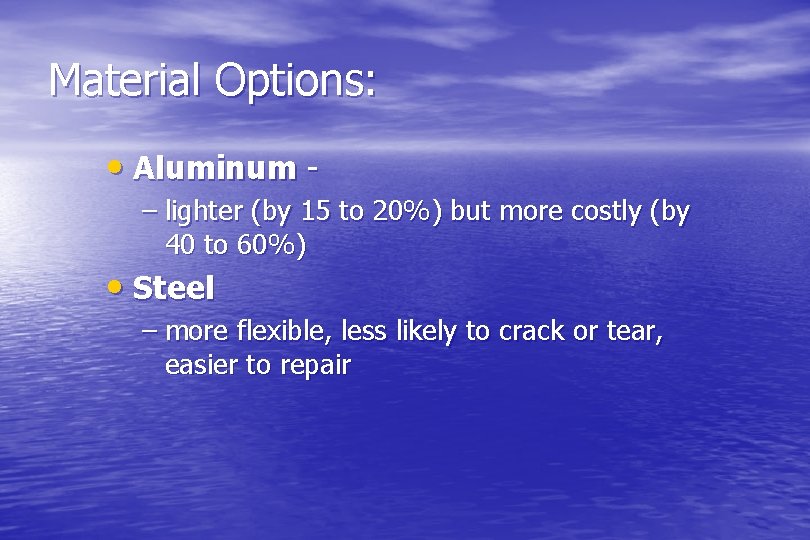
Material Options: • Aluminum – lighter (by 15 to 20%) but more costly (by 40 to 60%) • Steel – more flexible, less likely to crack or tear, easier to repair
Discharge Options: • Push-Blade Mounted at Front of Trailer – Takes up 10 to 15% of Trailer Capacity • Live-Floor Mounted on Floor of Trailer – Takes up 2 to 3% of Trailer Capacity, More Moving Parts Require More Maintenance
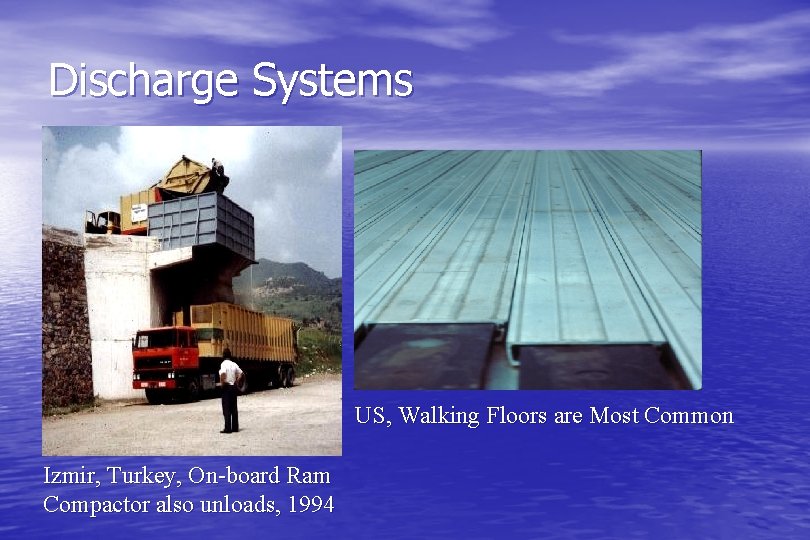
Discharge Systems US, Walking Floors are Most Common Izmir, Turkey, On-board Ram Compactor also unloads, 1994
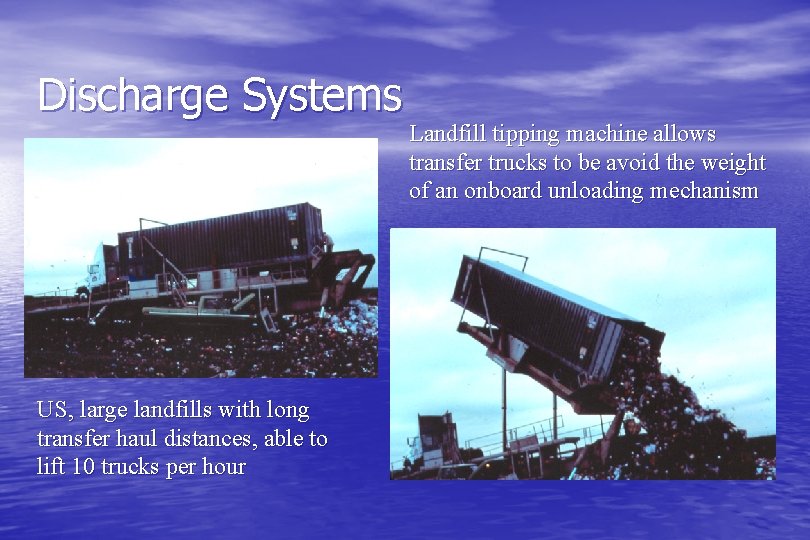
Discharge Systems US, large landfills with long transfer haul distances, able to lift 10 trucks per hour Landfill tipping machine allows transfer trucks to be avoid the weight of an onboard unloading mechanism
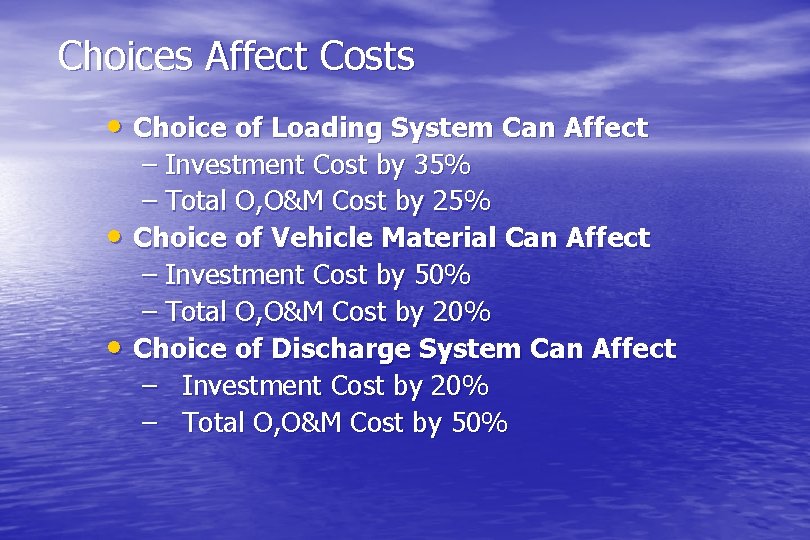
Choices Affect Costs • Choice of Loading System Can Affect – Investment Cost by 35% – Total O, O&M Cost by 25% • Choice of Vehicle Material Can Affect – Investment Cost by 50% – Total O, O&M Cost by 20% • Choice of Discharge System Can Affect – Investment Cost by 20% – Total O, O&M Cost by 50%
Transfer Stations are the Heart of Economic Solid Waste Systems: • Enable performance monitoring of collection by • • • weighbridge and computerized MIS. Allow collection systems to be rationalized. Allow fuel to be conserved. Allow bundling of waste into inter-municipal regions for economic sanitary landfill.
Paper and film of presentation available at: • http: //www. worldbank. org/urban/uswm Thank you for your kind attention