
SOLID WASTE MANAGEMENTSOURCE SEGREGATION SOURCE SEGREGATION The SWM

- Slides: 21
SOLID WASTE MANAGEMENTSOURCE SEGREGATION
SOURCE SEGREGATION The SWM Rules, 2016 defines segregation as sorting and separate storage of various components of solid waste namely: Biodegradable wastes including agriculture and dairy waste. Non biodegradable wastes including recyclable waste. Non- recyclable combustible waste. Sanitary waste and non recyclable inert waste Domestic hazardous wastes, and Construction and Demolition wastes. Segregating waste at source ensures that waste is less contaminated and can be collected and transported for further processing. It results in high proportion of segregated material that could be reused and recycled, leading to less consumption of virgin material.
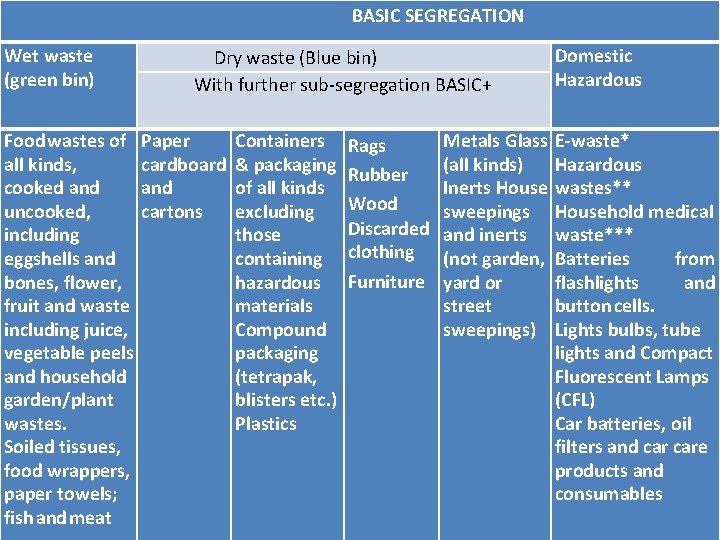
BASIC SEGREGATION Wet waste (green bin) Food wastes of all kinds, cooked and uncooked, including eggshells and bones, flower, fruit and waste including juice, vegetable peels and household garden/plant wastes. Soiled tissues, food wrappers, paper towels; fish and meat Dry waste (Blue bin) With further sub-segregation BASIC+ Paper cardboard and cartons Containers & packaging of all kinds excluding those containing hazardous materials Compound packaging (tetrapak, blisters etc. ) Plastics Rags Rubber Wood Discarded clothing Furniture Metals Glass (all kinds) Inerts House sweepings and inerts (not garden, yard or street sweepings) Domestic Hazardous E-waste* Hazardous wastes** Household medical waste*** Batteries from flashlights and button cells. Lights bulbs, tube lights and Compact Fluorescent Lamps (CFL) Car batteries, oil filters and care products and consumables
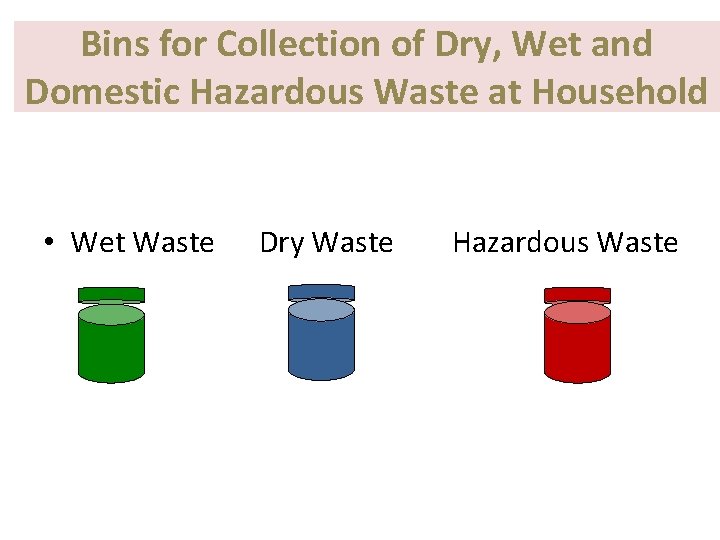
SEGREGATION SOURCE SEGREGATION-Cont. . As per SWM Rules, 2016 - Every waste generator shall --- • segregate and store the waste generated by them in three separate streams namely bio-degradable, non bio- degradable and domestic hazardous wastes in suitable bins and handover segregated wastes to authorized waste pickers or waste collectors as per the direction or notification by the local authorities from time to time; • The colour of the garbage bins should be in accordance with the SWM Rules, 2016; wet waste is to be placed in a covered green bin and dry waste in a covered white bin. the rule does not specify the colour of the bins for storage of domestic hazardous waste urban local bodies (ULBs) should decide on an appropriately coloured bin. • wrap securely the used sanitary waste like diapers, sanitary pads etc. , in the pouches provided by the manufacturers or brand owners of these products or in a suitable wrapping material as instructed by the local authorities and shall place the same in the bin meant for dry waste or non- bio-degradable waste;
Bins for Collection of Dry, Wet and Domestic Hazardous Waste at Household • Wet Waste Dry Waste Hazardous Waste
SOURCE SEGREGATION-Cont. . • store separately construction and demolition waste, as and when generated, in his own premises and shall dispose off as per the Construction and Demolition Waste Management Rules, 2016; and • No waste generator shall throw, burn or burry the solid waste generated by him, on streets, open public spaces outside his premises or in the drain or water bodies. • All waste generators shall pay such user fee for solid waste management, as specified in the bye-laws of the local bodies.
SOURCE SEGREGATION-Cont. . • No person shall organize an event or gathering of more than one hundred persons at any unlicensed place without intimating the local body, at least three working days in advance and such person or the organizer of such event shall ensure segregation of waste at source and handing over of segregated waste to waste collector or agency as specified by the local body. • Every street vendor shall keep suitable containers for storage of waste generated during the course of his activity such as food waste, disposable plates, cups, cans, wrappers, coconut shells, leftover food, vegetables, fruits, etc. , and shall deposit such waste at waste storage depot or container or vehicle as notified by the local body.
SOURCE SEGREGATION-Cont. . Contd. . • All resident welfare and market associations , All gated communities and institutions with more than 5, 000 sqm area and All hotels and restaurants shall, in partnership with the local body ensure segregation of waste at source as prescribed in these rules, facilitate collection of segregated waste in separate streams, handover recyclable material to ULB authorised recyclers. • The bio-degradable waste shall be processed, treated and disposed off through composting or biomethanation within the premises as far as possible. The residual waste shall be given to the waste collectors or agency as directed by the local body.
SOURCE SEGREGATION-Cont. . • Whereas vegetable and flower market waste generators should deposit their waste in conveniently located large green bins for preferable utilization of waste on site or as directed by ULB. • Number and capacity of bins required may be computed by considering quantity of waste to be stored before collection plus an additional 100% storage. • Storage bins should be compatible with the primary collection system to avoid multiple handling of waste.
Storage of MSW in Public Places or Parks • to ensure that streets and public places are not littered with waste, litter bins may be provided at important streets, markets, public places, tourist spots, bus and railway stations, large commercial complexes, etc. at a distance ranging from 25 m to 250 m depending on the local conditions. The collection from these bins should be segregated into wet and dry waste.
STORAGE OF YARD WASTE OR GARDEN WASTE • The SWM Rules, 2016 suggests that horticulture waste from parks and gardens should be collected separately and treated on-site to make optimum use of such wastes and also to minimise the cost of its collection and transportation. • The skip bins or containers shall be of a standard design and amenable to automatic hydraulic lifting and unloading by a transport vehicle. This waste should not be mixed with domestic waste.
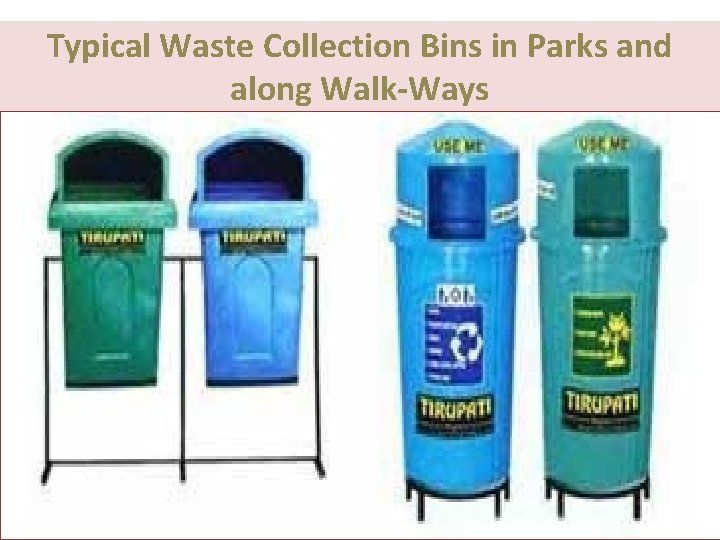
Typical Waste Collection Bins in Parks and along Walk-Ways
Duties of manufacturers or brand owners of sanitary pads and diapers: • Manufacturers or brand owners or marketing companies of sanitary napkins and diapers shall explore the possibility of using all recyclable materials in their products or they shall provide a pouch or wrapper for disposal of each napkin or diapers along with the packet of their sanitary products. • All such manufacturers, brand owners or marketing companies shall educate the masses for wrapping and disposal of their products.
STORAGE AND PROCESSING OF SPECIAL WASTES • Domestic hazardous wastes can pose a substantial or potential threat to health and environment because of their constituents which may be hazardous. A municipal waste component is hazardous if it contains one of the following characteristics: • Ignitability • Corrosivity • Reactivity, and • Toxicity. The Domestic Hazardous waste shall be segregated and handed over to collectors or at designated places at
Industrial solid waste • Industrial solid waste refers to waste generated by processing activities of different industries, e. g. , thermal power plants producing coal ash; integrated iron and steel mills producing blast furnace slag and steel melting slag; nonferrous industries like aluminum, zinc, and copper producing red mud and tailings; etc. • Industrial waste can be solid, liquid, or gas, and can be hazardous or non-hazardous. Hazardous industrial waste may cause danger to public health and environment and hence should not be mixed with MSW. Large industries have to manage their waste by themselves and are required to seek authorisations from respective SPCBs. • The ULBs are not responsible for the management of industrial solid waste, ULBs should ensure that MSW generated by the industrial units should be handled appropriately by the industry
Duties and responsibilities of local authorities: • Arrange for door to door collection of segregated solid waste from all households including slums and informal settlements, commercial, institutional and other non residential premises. • direct waste generators not to litter i. e throw or dispose of any waste such as paper, water bottles, liquor bottles, soft drink canes, tetra packs, fruit peel, wrappers, etc. , or burn or burry waste on streets, open public spaces, drains, waste bodies • Direct waste generators to segregate the waste at source as prescribed under these rules and hand over the segregated waste to authorised waste pickers or waste collectors authorised by the local body • setup material recovery facilities or secondary storage facilities with sufficient space for sorting of recyclable materials to enable informal or authorised waste pickers and waste collectors to separate recyclables from the waste and provide easy access to waste pickers and recyclers for collection of segregated recyclable waste such as paper, plastic, metal, glass, textile from the source of generation or from material recovery facilities
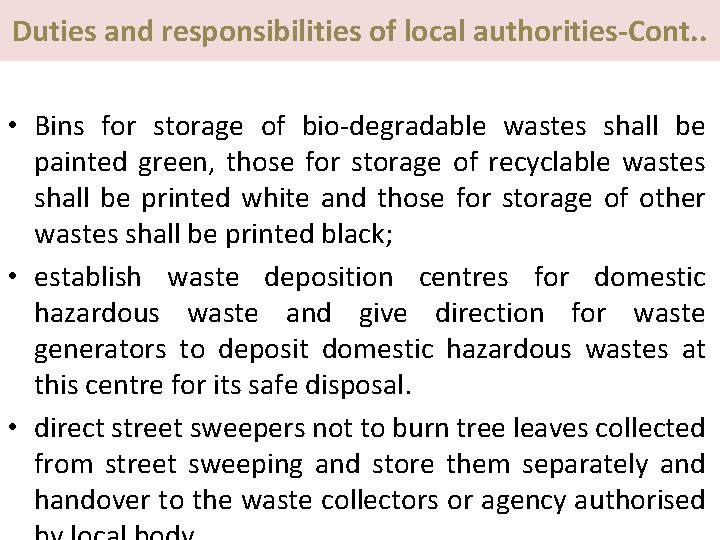
Duties responsibilities of local authorities: Duties andand responsibilities of local authorities-Cont. . • Bins for storage of bio-degradable wastes shall be painted green, those for storage of recyclable wastes shall be printed white and those for storage of other wastes shall be printed black; • establish waste deposition centres for domestic hazardous waste and give direction for waste generators to deposit domestic hazardous wastes at this centre for its safe disposal. • direct street sweepers not to burn tree leaves collected from street sweeping and store them separately and handover to the waste collectors or agency authorised
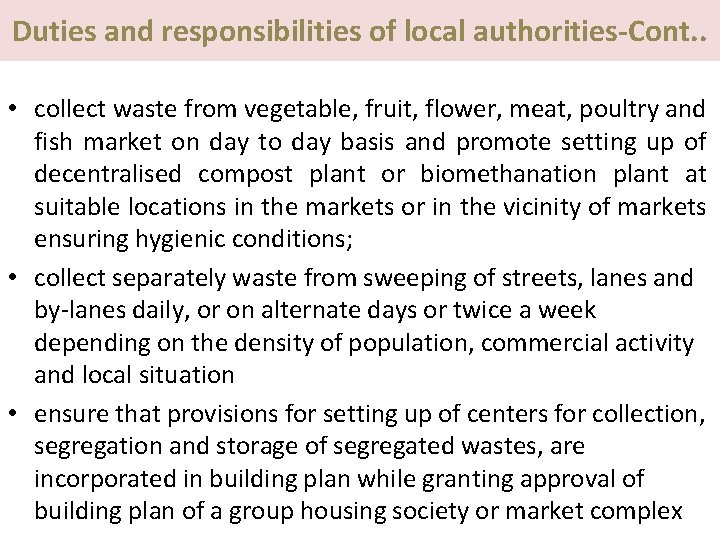
Duties and responsibilities of local authorities-Cont. . • collect waste from vegetable, fruit, flower, meat, poultry and fish market on day to day basis and promote setting up of decentralised compost plant or biomethanation plant at suitable locations in the markets or in the vicinity of markets ensuring hygienic conditions; • collect separately waste from sweeping of streets, lanes and by-lanes daily, or on alternate days or twice a week depending on the density of population, commercial activity and local situation • ensure that provisions for setting up of centers for collection, segregation and storage of segregated wastes, are incorporated in building plan while granting approval of building plan of a group housing society or market complex
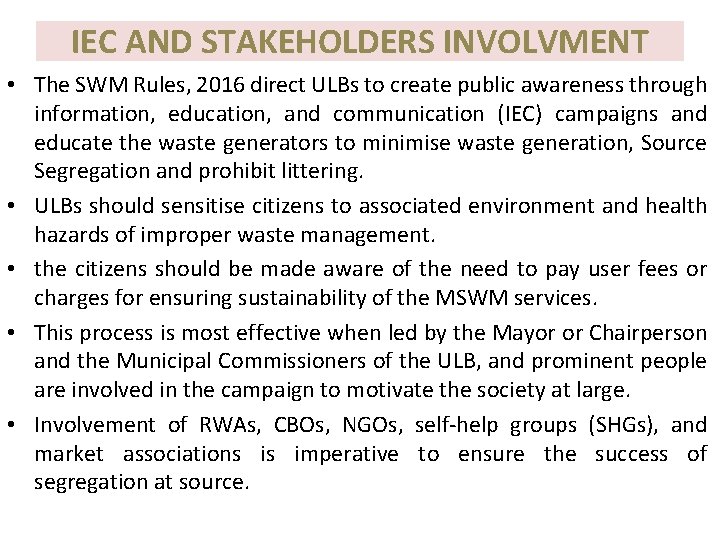
IEC AND STAKEHOLDERS INVOLVMENT • The SWM Rules, 2016 direct ULBs to create public awareness through information, education, and communication (IEC) campaigns and educate the waste generators to minimise waste generation, Source Segregation and prohibit littering. • ULBs should sensitise citizens to associated environment and health hazards of improper waste management. • the citizens should be made aware of the need to pay user fees or charges for ensuring sustainability of the MSWM services. • This process is most effective when led by the Mayor or Chairperson and the Municipal Commissioners of the ULB, and prominent people are involved in the campaign to motivate the society at large. • Involvement of RWAs, CBOs, NGOs, self-help groups (SHGs), and market associations is imperative to ensure the success of segregation at source.
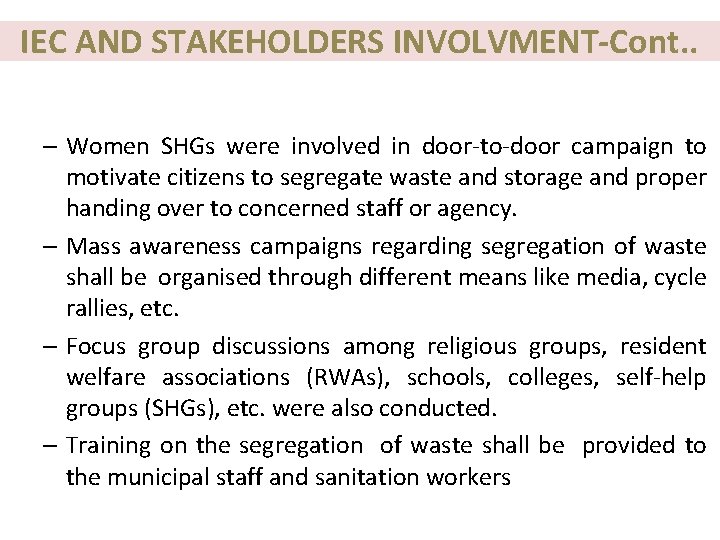
IEC AND STAKEHOLDERS INVOLVMENT-Cont. . – Women SHGs were involved in door-to-door campaign to motivate citizens to segregate waste and storage and proper handing over to concerned staff or agency. – Mass awareness campaigns regarding segregation of waste shall be organised through different means like media, cycle rallies, etc. – Focus group discussions among religious groups, resident welfare associations (RWAs), schools, colleges, self-help groups (SHGs), etc. were also conducted. – Training on the segregation of waste shall be provided to the municipal staff and sanitation workers
THANK YOU