
SOLID WASTE MANAGEMENT WASTE MINIMISATION What is Municipal



- Slides: 21
SOLID WASTE MANAGEMENT WASTE MINIMISATION
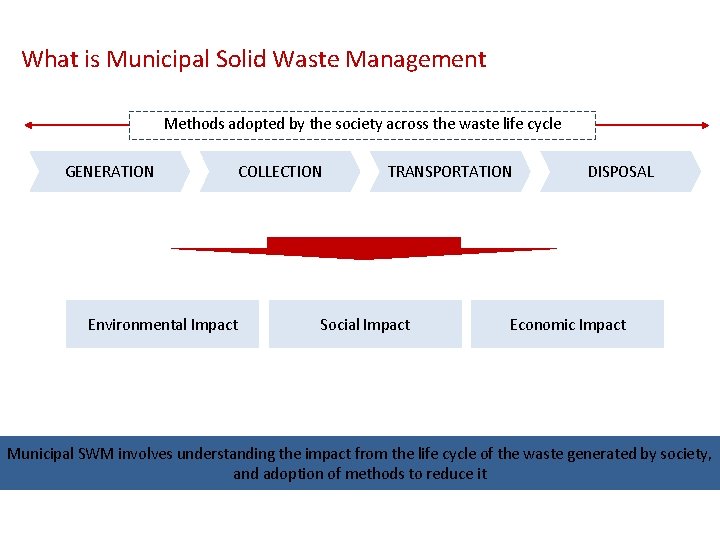
What is Municipal Solid Waste Management Methods adopted by the society across the waste life cycle GENERATION Environmental Impact COLLECTION TRANSPORTATION Social Impact DISPOSAL Economic Impact Municipal SWM involves understanding the impact from the life cycle of the waste generated by society, and adoption of methods to reduce it
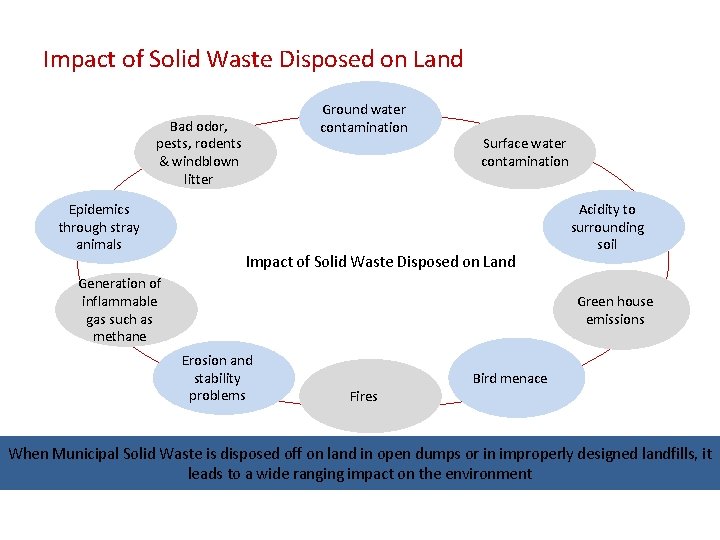
Impact of Solid Waste Disposed on Land Ground water contamination Bad odor, pests, rodents & windblown litter Epidemics through stray animals Surface water contamination Impact of Solid Waste Disposed on Land Generation of inflammable gas such as methane Acidity to surrounding soil Green house emissions Erosion and stability problems Bird menace Fires When Municipal Solid Waste is disposed off on land in open dumps or in improperly designed landfills, it leads to a wide ranging impact on the environment
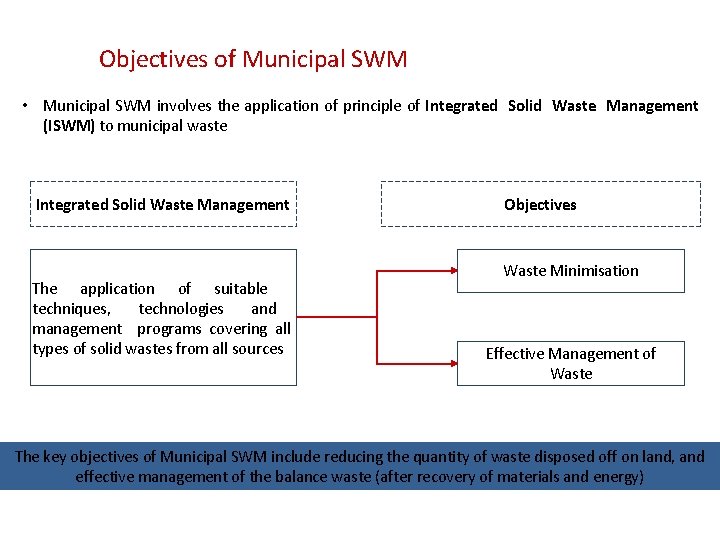
Objectives of Municipal SWM • Municipal SWM involves the application of principle of Integrated Solid Waste Management (ISWM) to municipal waste Integrated Solid Waste Management The application of suitable techniques, technologies and management programs covering all types of solid wastes from all sources Objectives Waste Minimisation Effective Management of Waste The key objectives of Municipal SWM include reducing the quantity of waste disposed off on land, and effective management of the balance waste (after recovery of materials and energy)
WASTE MINIMISATION The ISWM (Integrated Solid Waste Management) hierarchy of waste management prioritises waste minimisation (reduction at source and reuse) as the most preferred waste management strategy As per the SWM Rules, 2016, the ULB should create public awareness for - minimizing waste generation and - reusing waste to the extent possible. Source reduction is the most preferred tier in the ISWM hierarchy because of its potential to directly reduce the quantity of waste generated and hence reduce associated financial and environmental costs.
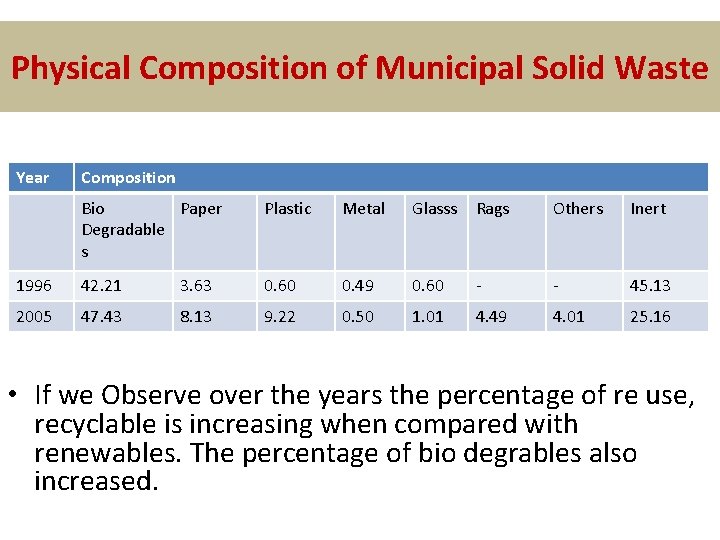
Physical Composition of Municipal Solid Waste Year Composition Bio Paper Degradable s Plastic Metal Glasss Rags Others Inert 1996 42. 21 3. 63 0. 60 0. 49 0. 60 - - 45. 13 2005 47. 43 8. 13 9. 22 0. 50 1. 01 4. 49 4. 01 25. 16 • If we Observe over the years the percentage of re use, recyclable is increasing when compared with renewables. The percentage of bio degrables also increased.
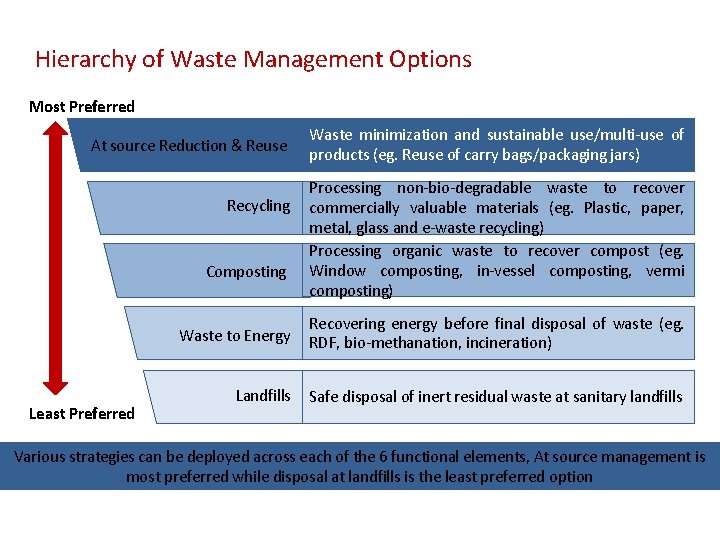
Hierarchy of Waste Management Options Most Preferred At source Reduction & Reuse Recycling Composting Least Preferred Waste minimization and sustainable use/multi-use of products (eg. Reuse of carry bags/packaging jars) Processing non-bio-degradable waste to recover commercially valuable materials (eg. Plastic, paper, metal, glass and e-waste recycling) Processing organic waste to recover compost (eg. Window composting, in-vessel composting, vermi composting) Waste to Energy Recovering energy before final disposal of waste (eg. RDF, bio-methanation, incineration) Landfills Safe disposal of inert residual waste at sanitary landfills Various strategies can be deployed across each of the 6 functional elements, At source management is most preferred while disposal at landfills is the least preferred option
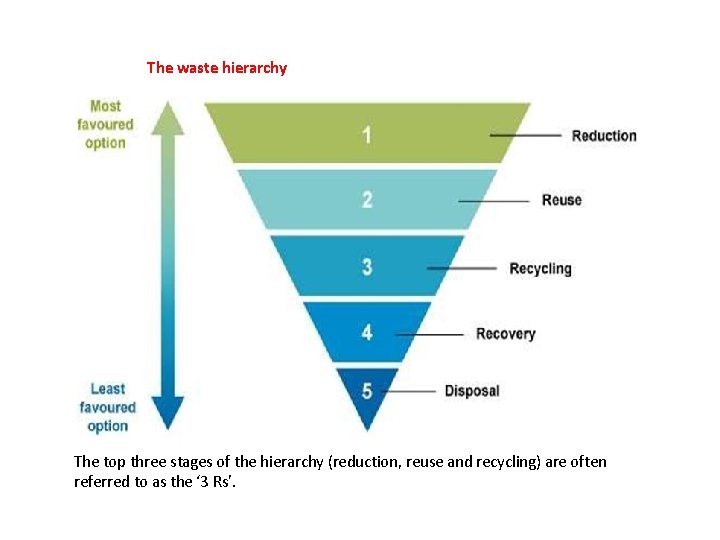
The waste hierarchy The top three stages of the hierarchy (reduction, reuse and recycling) are often referred to as the ‘ 3 Rs’.
Waste Minimisation in the ISWM Waste Hierarchy Reduction and Reuse: – Most preferred among all Waste Management options – Waste minimization and – sustainable / multi use of products Recycling: Processing non bio-degradable waste to recover commercially valuable materials Like Plastic , Paper etc Composting: Processing biodegradable waste to recover
Waste Minimisation in the ISWM Waste Hierarchy Various Composting methods are available now, which are suitable for House hold level, Bulk Generator level and ULB level Waste to Energy: Recovering energy before final disposal of waste Examples - RDF, Biomethanation , incineration and Pyrolysis etc. , Land fills: Safe disposal of inert residual waste at Sanitary land fills after Recycling and reuse to the maximum extent possible.
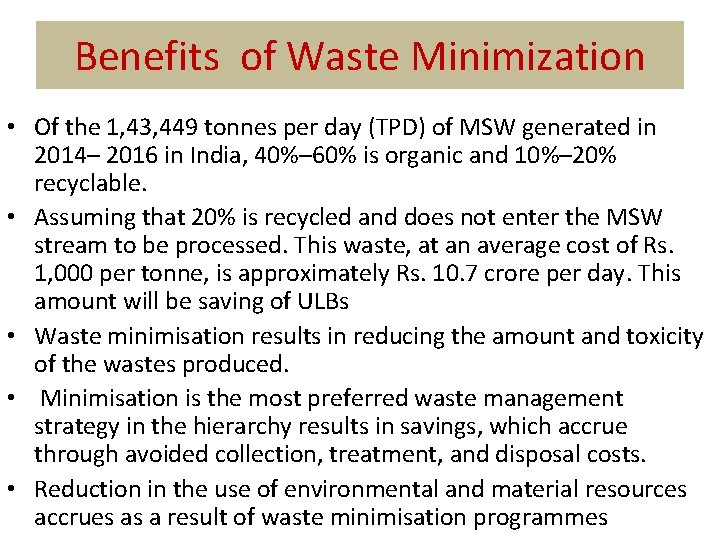
Benefits of Waste Minimization • Of the 1, 43, 449 tonnes per day (TPD) of MSW generated in 2014– 2016 in India, 40%– 60% is organic and 10%– 20% recyclable. • Assuming that 20% is recycled and does not enter the MSW stream to be processed. This waste, at an average cost of Rs. 1, 000 per tonne, is approximately Rs. 10. 7 crore per day. This amount will be saving of ULBs • Waste minimisation results in reducing the amount and toxicity of the wastes produced. • Minimisation is the most preferred waste management strategy in the hierarchy results in savings, which accrue through avoided collection, treatment, and disposal costs. • Reduction in the use of environmental and material resources accrues as a result of waste minimisation programmes
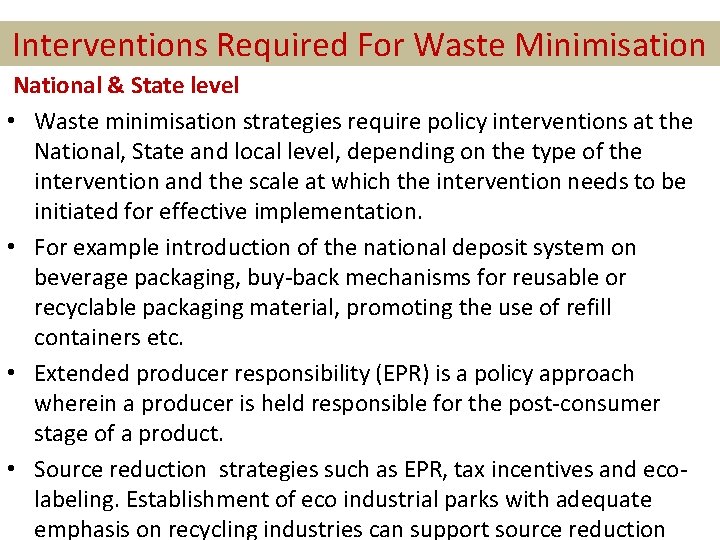
Interventions Required For Waste Minimisation National & State level • Waste minimisation strategies require policy interventions at the National, State and local level, depending on the type of the intervention and the scale at which the intervention needs to be initiated for effective implementation. • For example introduction of the national deposit system on beverage packaging, buy-back mechanisms for reusable or recyclable packaging material, promoting the use of refill containers etc. • Extended producer responsibility (EPR) is a policy approach wherein a producer is held responsible for the post-consumer stage of a product. • Source reduction strategies such as EPR, tax incentives and ecolabeling. Establishment of eco industrial parks with adequate emphasis on recycling industries can support source reduction
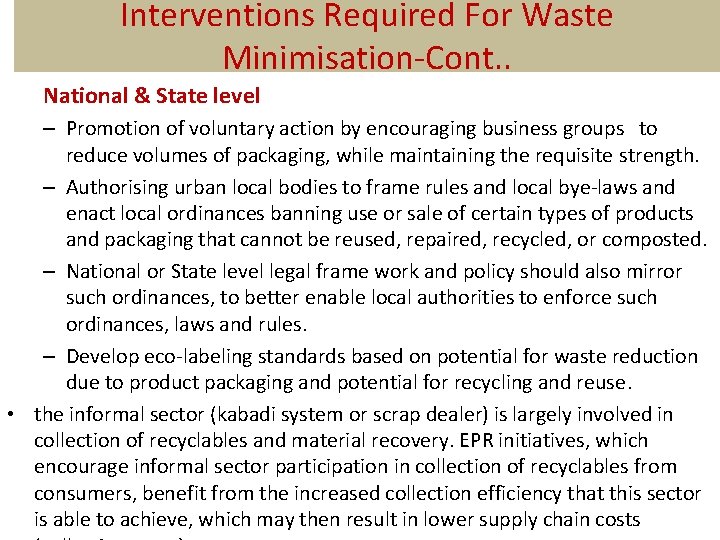
Interventions Required For Waste STRATEGIES FOR WASTE MINIMISATION Minimisation-Cont. . National & State level – Promotion of voluntary action by encouraging business groups to reduce volumes of packaging, while maintaining the requisite strength. – Authorising urban local bodies to frame rules and local bye-laws and enact local ordinances banning use or sale of certain types of products and packaging that cannot be reused, repaired, recycled, or composted. – National or State level legal frame work and policy should also mirror such ordinances, to better enable local authorities to enforce such ordinances, laws and rules. – Develop eco-labeling standards based on potential for waste reduction due to product packaging and potential for recycling and reuse. • the informal sector (kabadi system or scrap dealer) is largely involved in collection of recyclables and material recovery. EPR initiatives, which encourage informal sector participation in collection of recyclables from consumers, benefit from the increased collection efficiency that this sector is able to achieve, which may then result in lower supply chain costs
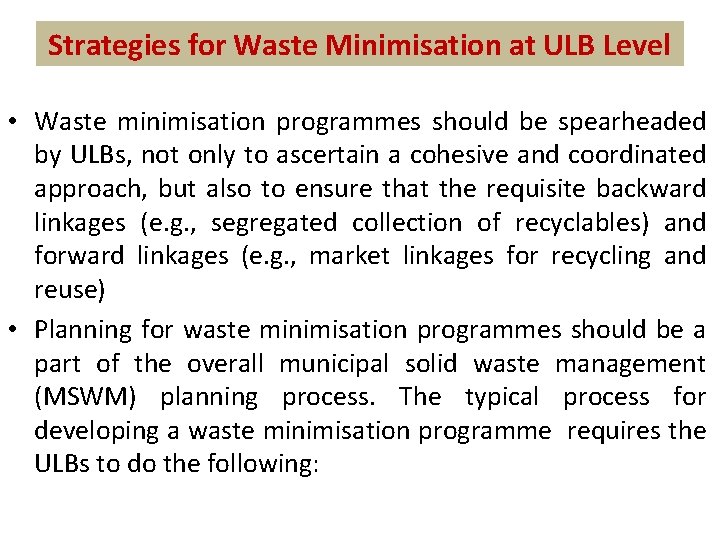
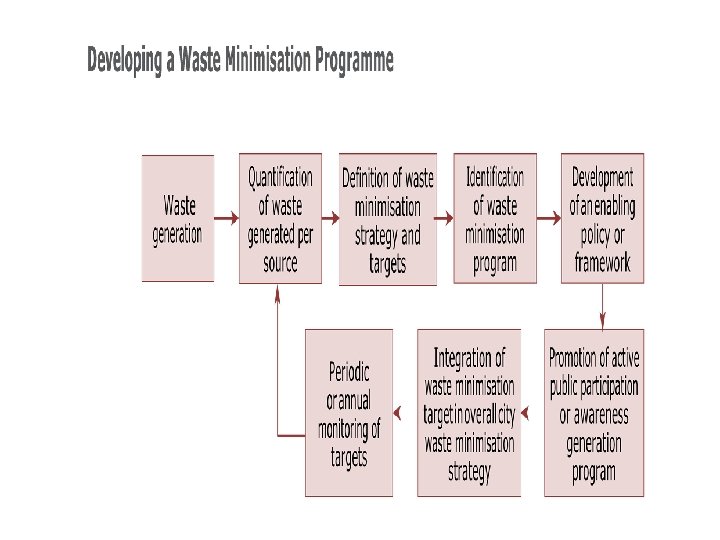
Strategies for Waste Minimisation at ULB Level • Waste minimisation programmes should be spearheaded by ULBs, not only to ascertain a cohesive and coordinated approach, but also to ensure that the requisite backward linkages (e. g. , segregated collection of recyclables) and forward linkages (e. g. , market linkages for recycling and reuse) • Planning for waste minimisation programmes should be a part of the overall municipal solid waste management (MSWM) planning process. The typical process for developing a waste minimisation programme requires the ULBs to do the following:
Strategies for Waste Minimisation at ULB Level – Promoting and implementing awareness and education programmes addressing different stakeholders e. g. , residential, commercial and industrial educational programmes that increase public awareness and participation, in at source reduction programmes. – Developing and promoting at source reduction programmes in the community, e. g. domestic composting programmes that reduce the volume of food waste, leaves and garden trimmings entering the collection system. – Campaigns for reducing the use of specific non-recyclable, non- reusable or toxic material. Practicing and promoting material substitution where possible. (Promoting the use of rechargeable batteries instead of single use batteries)
Strategies for Waste Minimisation at ULB Level • Bans within local authorities’ jurisdiction through replacing disposable materials and products with recyclables and reusable • Local businesses should be encouraged to reward consumers for returning recyclable products or products which are toxic (e. g. batteries). EPR programmes by manufacturers are a pre-requisite to these initiatives.
Strategies for Waste Minimisation at ULB Level – Promoting materials exchange and reuse programmes that divert Material from the waste streams which will eventually go to the landfills, e. g. , programmes which link sellers of used furniture with potential second hand furniture buyers. – Green procurement and take back programmes, whereby the suppliers of a product to the municipality are responsible for providing a take back programme and to promote the recycling of
Developing a Waste Minimisation Programme • Identify and quantify main contributors to the waste problem. Local waste information data system is required. • Define sectoral waste minimisation potentials and targets (residential waste, organic market waste, institutional waste, MSW from business establishments and hospitals, etc. ). • Identification or adoption of programmes targeted at producers and generators. Programmes should be well-defined, considering viable and efficient collection and recycling systems, and supported with required municipal bye-laws to ensure implementation. • Develop an institutional mechanism with all relevant stakeholders to facilitate implementation. Identification and registration of scrap dealers and recyclers is a pre-requisite to assess the viability and sufficiency of recycling facilities in the ULB.
Developing a Waste Minimisation Programme • Examine environmental and health-related issues when assessing the suitability of recycling facilities in close coordination with the State Pollution Control Board (SPCB) committees. • Assess the capacity to implement the programme and seek external expertise if required. • Promote active awareness raising campaigns, advertising the targets, programmes, and modes of involvement of stakeholders. Targeting school children and women groups and actively engaging with the business community are essential. • Integrating waste minimisation targets in the overall waste management strategy of the city.
THANK YOU