
Solid Waste Management Rules 2016 Current Issues of
- Slides: 31
Solid Waste Management Rules, 2016
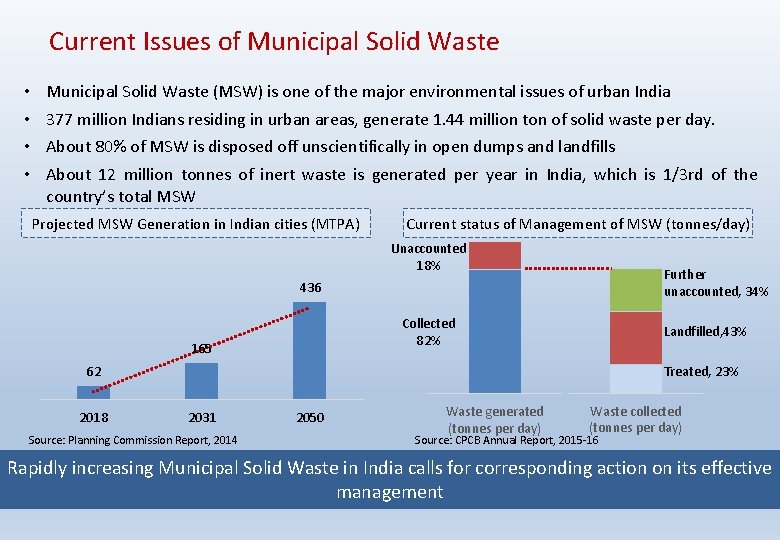
Current Issues of Municipal Solid Waste • • Municipal Solid Waste (MSW) is one of the major environmental issues of urban India 377 million Indians residing in urban areas, generate 1. 44 million ton of solid waste per day. About 80% of MSW is disposed off unscientifically in open dumps and landfills About 12 million tonnes of inert waste is generated per year in India, which is 1/3 rd of the country’s total MSW Projected MSW Generation in Indian cities (MTPA) Current status of Management of MSW (tonnes/day) Unaccounted 18% Further unaccounted, 34% 436 Collected 82% 165 Landfilled, 43% Treated, 23% 62 2018 2031 Source: Planning Commission Report, 2014 2050 Waste generated (tonnes per day) Waste collected (tonnes per day) Source: CPCB Annual Report, 2015 -16 Rapidly increasing Municipal Solid Waste in India calls for corresponding action on its effective management
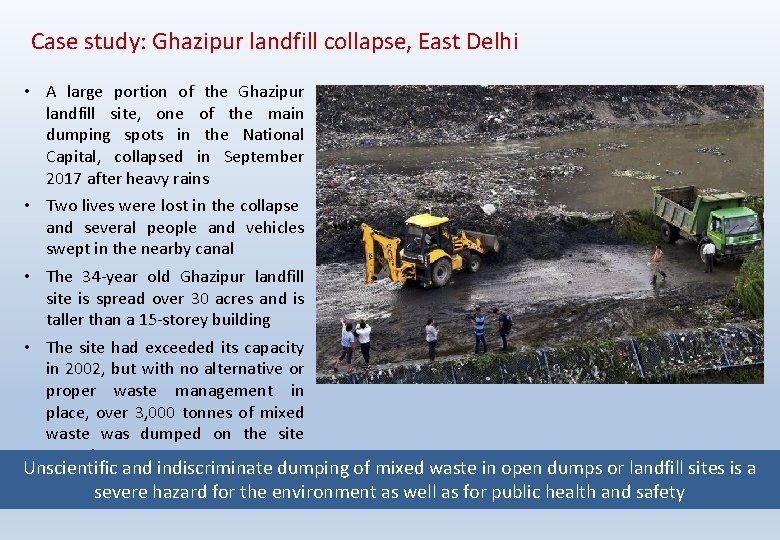
Case study: Ghazipur landfill collapse, East Delhi • A large portion of the Ghazipur landfill site, one of the main dumping spots in the National Capital, collapsed in September 2017 after heavy rains • Two lives were lost in the collapse and several people and vehicles swept in the nearby canal • The 34 -year old Ghazipur landfill site is spread over 30 acres and is taller than a 15 -storey building • The site had exceeded its capacity in 2002, but with no alternative or proper waste management in place, over 3, 000 tonnes of mixed waste was dumped on the site everyday Unscientific and indiscriminate dumping of mixed waste in open dumps or landfill sites is a severe hazard for the environment as well as for public health and safety
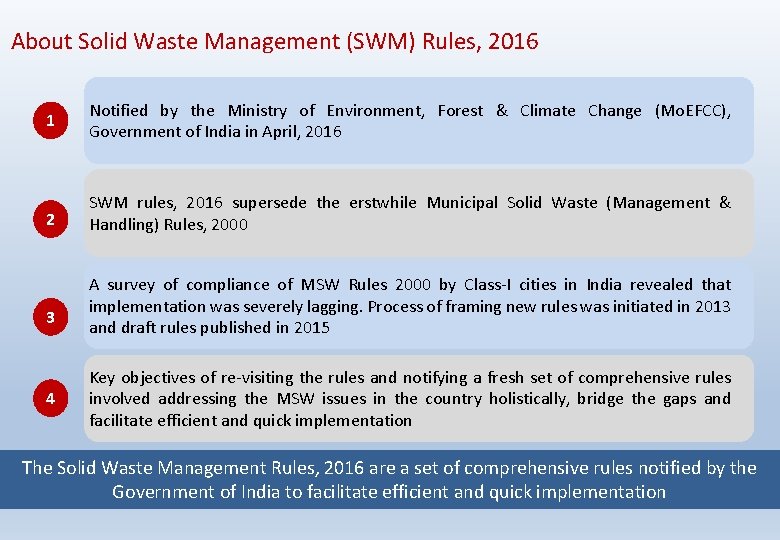
About Solid Waste Management (SWM) Rules, 2016 1 Notified by the Ministry of Environment, Forest & Climate Change (Mo. EFCC), Government of India in April, 2016 2 SWM rules, 2016 supersede the erstwhile Municipal Solid Waste (Management & Handling) Rules, 2000 3 4 A survey of compliance of MSW Rules 2000 by Class-I cities in India revealed that implementation was severely lagging. Process of framing new rules was initiated in 2013 and draft rules published in 2015 Key objectives of re-visiting the rules and notifying a fresh set of comprehensive rules involved addressing the MSW issues in the country holistically, bridge the gaps and facilitate efficient and quick implementation The Solid Waste Management Rules, 2016 are a set of comprehensive rules notified by the Government of India to facilitate efficient and quick implementation
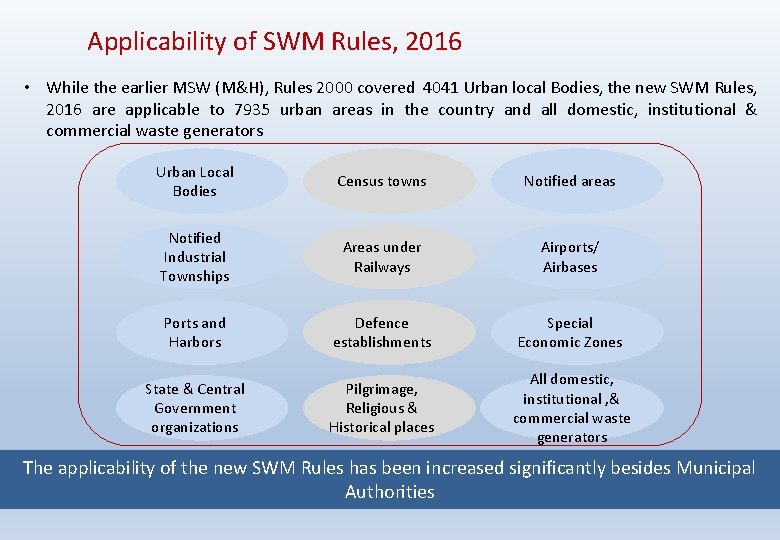
Applicability of SWM Rules, 2016 • While the earlier MSW (M&H), Rules 2000 covered 4041 Urban local Bodies, the new SWM Rules, 2016 are applicable to 7935 urban areas in the country and all domestic, institutional & commercial waste generators Urban Local Bodies Census towns Notified areas Notified Industrial Townships Areas under Railways Airports/ Airbases Ports and Harbors Defence establishments Special Economic Zones State & Central Government organizations Pilgrimage, Religious & Historical places All domestic, institutional , & commercial waste generators The applicability of the new SWM Rules has been increased significantly besides Municipal Authorities
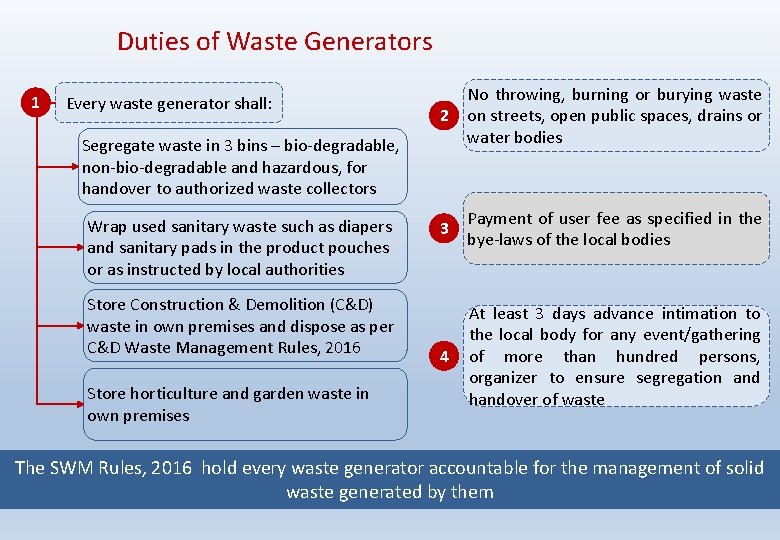
Duties of Waste Generators 1 Every waste generator shall: 2 No throwing, burning or burying waste on streets, open public spaces, drains or water bodies 3 Payment of user fee as specified in the bye-laws of the local bodies 4 At least 3 days advance intimation to the local body for any event/gathering of more than hundred persons, organizer to ensure segregation and handover of waste Segregate waste in 3 bins – bio-degradable, non-bio-degradable and hazardous, for handover to authorized waste collectors Wrap used sanitary waste such as diapers and sanitary pads in the product pouches or as instructed by local authorities Store Construction & Demolition (C&D) waste in own premises and dispose as per C&D Waste Management Rules, 2016 Store horticulture and garden waste in own premises The SWM Rules, 2016 hold every waste generator accountable for the management of solid waste generated by them
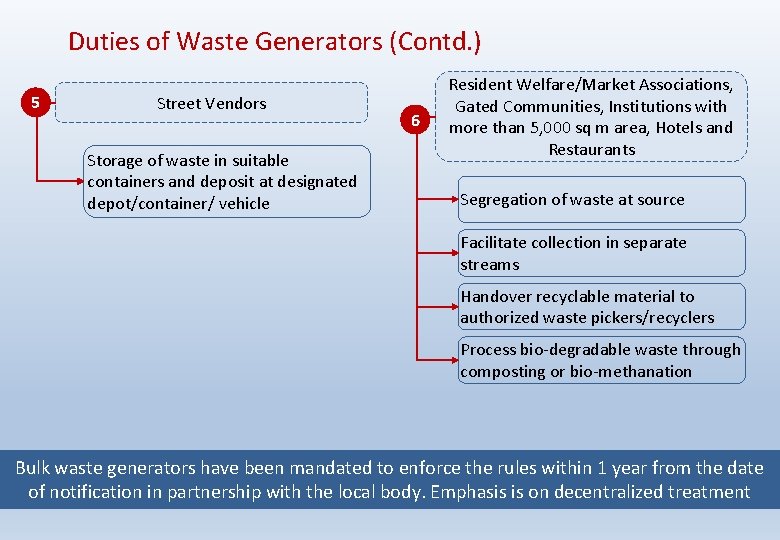
Duties of Waste Generators (Contd. ) 5 Street Vendors Storage of waste in suitable containers and deposit at designated depot/container/ vehicle 6 Resident Welfare/Market Associations, Gated Communities, Institutions with more than 5, 000 sq m area, Hotels and Restaurants Segregation of waste at source Facilitate collection in separate streams Handover recyclable material to authorized waste pickers/recyclers Process bio-degradable waste through composting or bio-methanation Bulk waste generators have been mandated to enforce the rules within 1 year from the date of notification in partnership with the local body. Emphasis is on decentralized treatment
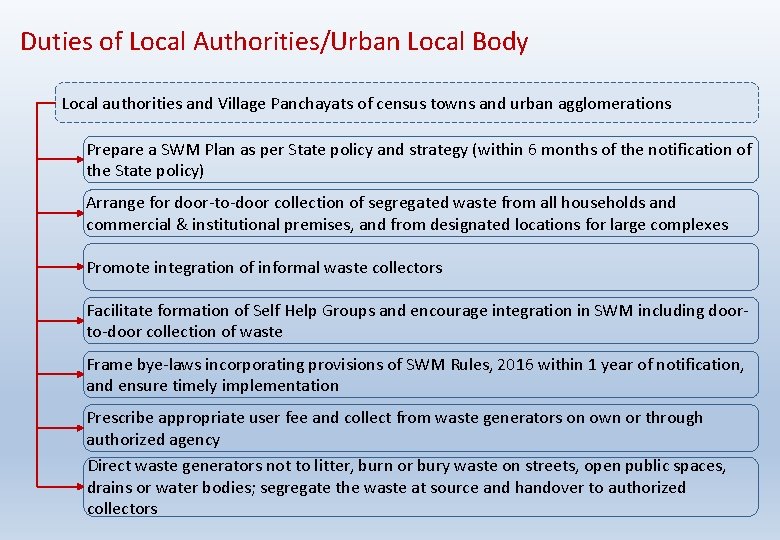
Duties of Local Authorities/Urban Local Body Local authorities and Village Panchayats of census towns and urban agglomerations Prepare a SWM Plan as per State policy and strategy (within 6 months of the notification of the State policy) Arrange for door-to-door collection of segregated waste from all households and commercial & institutional premises, and from designated locations for large complexes Promote integration of informal waste collectors Facilitate formation of Self Help Groups and encourage integration in SWM including doorto-door collection of waste Frame bye-laws incorporating provisions of SWM Rules, 2016 within 1 year of notification, and ensure timely implementation Prescribe appropriate user fee and collect from waste generators on own or through authorized agency Direct waste generators not to litter, burn or bury waste on streets, open public spaces, drains or water bodies; segregate the waste at source and handover to authorized collectors
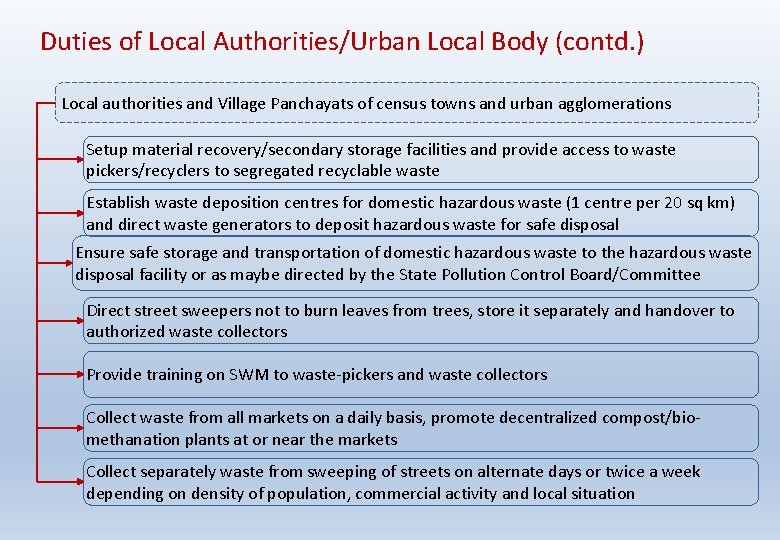
Duties of Local Authorities/Urban Local Body (contd. ) Local authorities and Village Panchayats of census towns and urban agglomerations Setup material recovery/secondary storage facilities and provide access to waste pickers/recyclers to segregated recyclable waste Establish waste deposition centres for domestic hazardous waste (1 centre per 20 sq km) and direct waste generators to deposit hazardous waste for safe disposal Ensure safe storage and transportation of domestic hazardous waste to the hazardous waste disposal facility or as maybe directed by the State Pollution Control Board/Committee Direct street sweepers not to burn leaves from trees, store it separately and handover to authorized waste collectors Provide training on SWM to waste-pickers and waste collectors Collect waste from all markets on a daily basis, promote decentralized compost/biomethanation plants at or near the markets Collect separately waste from sweeping of streets on alternate days or twice a week depending on density of population, commercial activity and local situation
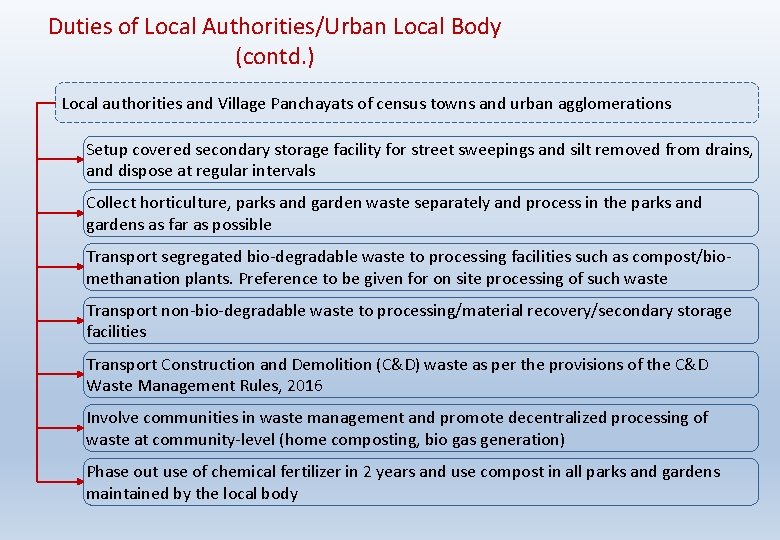
Duties of Local Authorities/Urban Local Body (contd. ) Local authorities and Village Panchayats of census towns and urban agglomerations Setup covered secondary storage facility for street sweepings and silt removed from drains, and dispose at regular intervals Collect horticulture, parks and garden waste separately and process in the parks and gardens as far as possible Transport segregated bio-degradable waste to processing facilities such as compost/biomethanation plants. Preference to be given for on site processing of such waste Transport non-bio-degradable waste to processing/material recovery/secondary storage facilities Transport Construction and Demolition (C&D) waste as per the provisions of the C&D Waste Management Rules, 2016 Involve communities in waste management and promote decentralized processing of waste at community-level (home composting, bio gas generation) Phase out use of chemical fertilizer in 2 years and use compost in all parks and gardens maintained by the local body
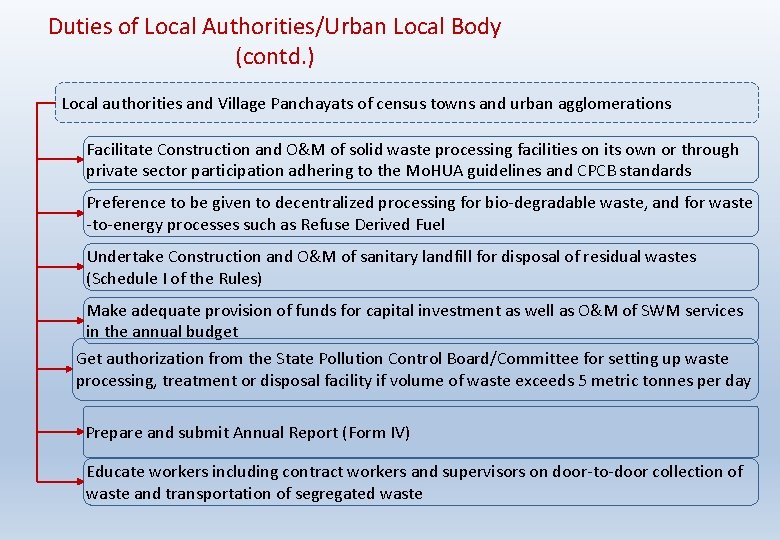
Duties of Local Authorities/Urban Local Body (contd. ) Local authorities and Village Panchayats of census towns and urban agglomerations Facilitate Construction and O&M of solid waste processing facilities on its own or through private sector participation adhering to the Mo. HUA guidelines and CPCB standards Preference to be given to decentralized processing for bio-degradable waste, and for waste -to-energy processes such as Refuse Derived Fuel Undertake Construction and O&M of sanitary landfill for disposal of residual wastes (Schedule I of the Rules) Make adequate provision of funds for capital investment as well as O&M of SWM services in the annual budget Get authorization from the State Pollution Control Board/Committee for setting up waste processing, treatment or disposal facility if volume of waste exceeds 5 metric tonnes per day Prepare and submit Annual Report (Form IV) Educate workers including contract workers and supervisors on door-to-door collection of waste and transportation of segregated waste
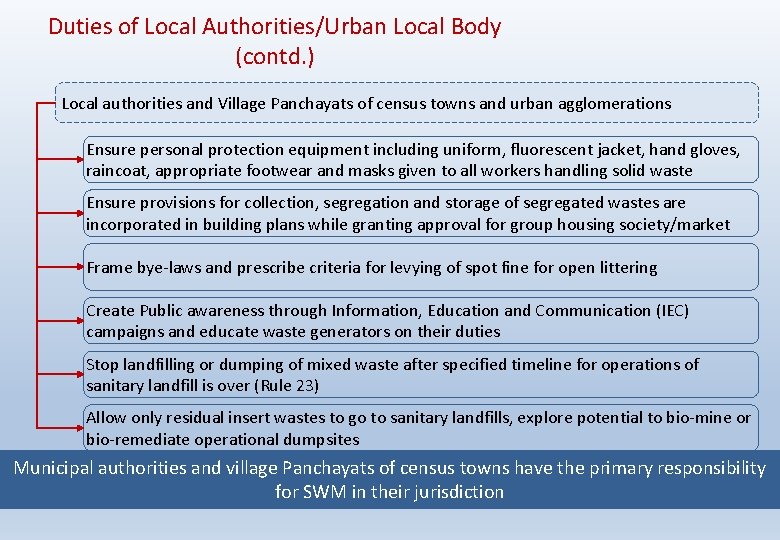
Duties of Local Authorities/Urban Local Body (contd. ) Local authorities and Village Panchayats of census towns and urban agglomerations Ensure personal protection equipment including uniform, fluorescent jacket, hand gloves, raincoat, appropriate footwear and masks given to all workers handling solid waste Ensure provisions for collection, segregation and storage of segregated wastes are incorporated in building plans while granting approval for group housing society/market Frame bye-laws and prescribe criteria for levying of spot fine for open littering Create Public awareness through Information, Education and Communication (IEC) campaigns and educate waste generators on their duties Stop landfilling or dumping of mixed waste after specified timeline for operations of sanitary landfill is over (Rule 23) Allow only residual insert wastes to go to sanitary landfills, explore potential to bio-mine or bio-remediate operational dumpsites Municipal authorities and village Panchayats of census towns have the primary responsibility for SWM in their jurisdiction
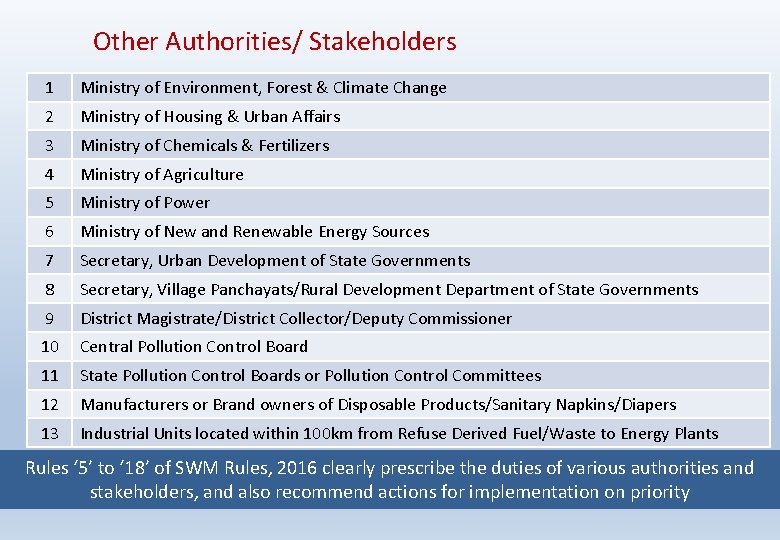
Other Authorities/ Stakeholders 1 Ministry of Environment, Forest & Climate Change 2 Ministry of Housing & Urban Affairs 3 Ministry of Chemicals & Fertilizers 4 Ministry of Agriculture 5 Ministry of Power 6 Ministry of New and Renewable Energy Sources 7 Secretary, Urban Development of State Governments 8 Secretary, Village Panchayats/Rural Development Department of State Governments 9 District Magistrate/District Collector/Deputy Commissioner 10 Central Pollution Control Board 11 State Pollution Control Boards or Pollution Control Committees 12 Manufacturers or Brand owners of Disposable Products/Sanitary Napkins/Diapers 13 Industrial Units located within 100 km from Refuse Derived Fuel/Waste to Energy Plants Rules ‘ 5’ to ‘ 18’ of SWM Rules, 2016 clearly prescribe the duties of various authorities and stakeholders, and also recommend actions for implementation on priority
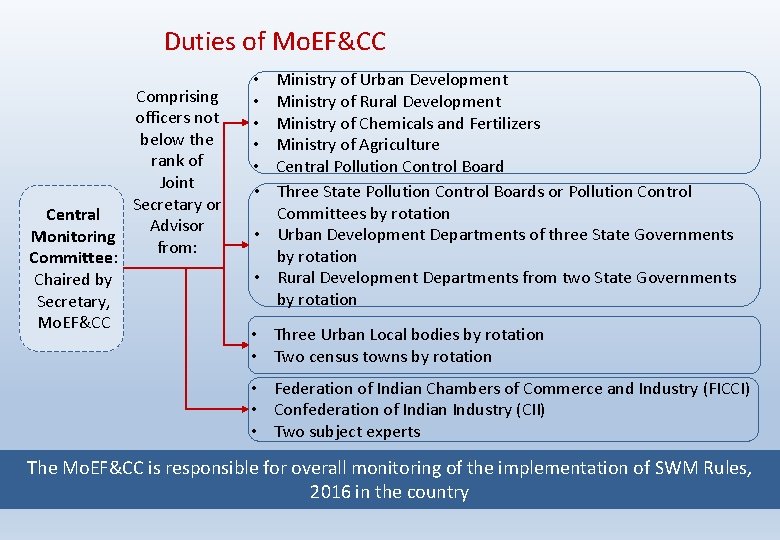
Duties of Mo. EF&CC Comprising officers not below the rank of Joint Secretary or Central Advisor Monitoring from: Committee: Chaired by Secretary, Mo. EF&CC Ministry of Urban Development Ministry of Rural Development Ministry of Chemicals and Fertilizers Ministry of Agriculture Central Pollution Control Board Three State Pollution Control Boards or Pollution Control Committees by rotation • Urban Development Departments of three State Governments by rotation • Rural Development Departments from two State Governments by rotation • • Three Urban Local bodies by rotation • Two census towns by rotation • Federation of Indian Chambers of Commerce and Industry (FICCI) • Confederation of Indian Industry (CII) • Two subject experts The Mo. EF&CC is responsible for overall monitoring of the implementation of SWM Rules, 2016 in the country
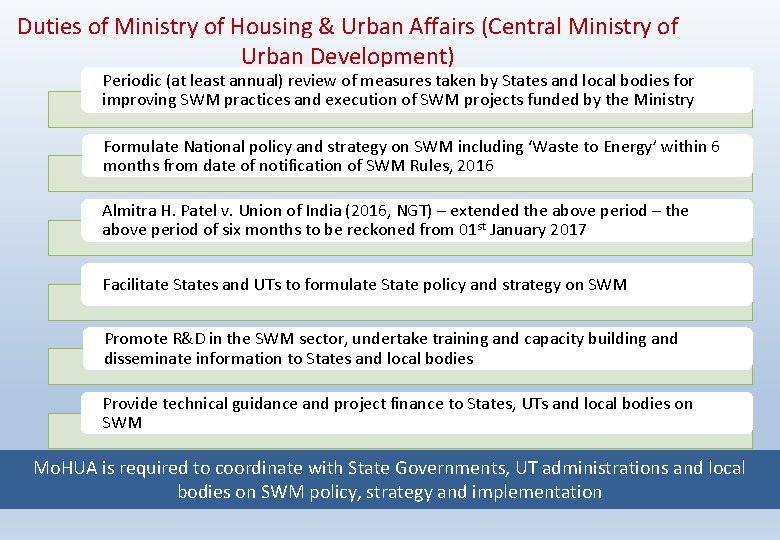
Duties of Ministry of Housing & Urban Affairs (Central Ministry of Urban Development) Periodic (at least annual) review of measures taken by States and local bodies for improving SWM practices and execution of SWM projects funded by the Ministry Formulate National policy and strategy on SWM including ‘Waste to Energy’ within 6 months from date of notification of SWM Rules, 2016 Almitra H. Patel v. Union of India (2016, NGT) – extended the above period – the above period of six months to be reckoned from 01 st January 2017 Facilitate States and UTs to formulate State policy and strategy on SWM Promote R&D in the SWM sector, undertake training and capacity building and disseminate information to States and local bodies Provide technical guidance and project finance to States, UTs and local bodies on SWM Mo. HUA is required to coordinate with State Governments, UT administrations and local bodies on SWM policy, strategy and implementation
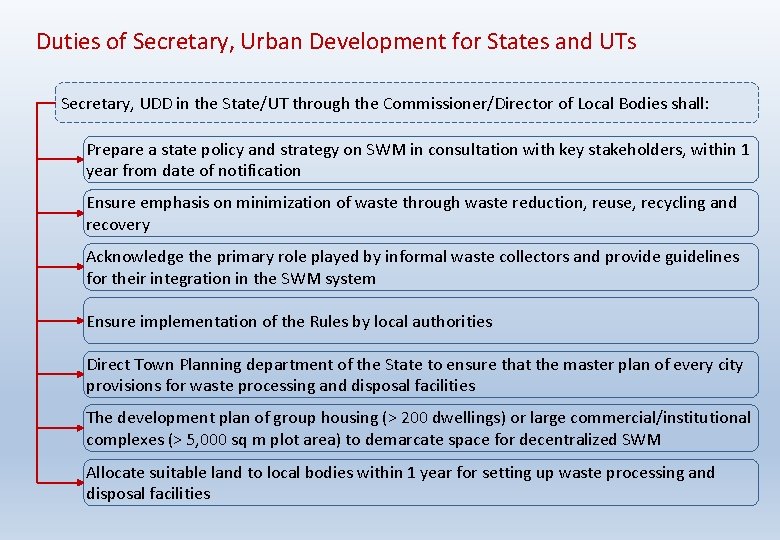
Duties of Secretary, Urban Development for States and UTs Secretary, UDD in the State/UT through the Commissioner/Director of Local Bodies shall: Prepare a state policy and strategy on SWM in consultation with key stakeholders, within 1 year from date of notification Ensure emphasis on minimization of waste through waste reduction, reuse, recycling and recovery Acknowledge the primary role played by informal waste collectors and provide guidelines for their integration in the SWM system Ensure implementation of the Rules by local authorities Direct Town Planning department of the State to ensure that the master plan of every city provisions for waste processing and disposal facilities The development plan of group housing (> 200 dwellings) or large commercial/institutional complexes (> 5, 000 sq m plot area) to demarcate space for decentralized SWM Allocate suitable land to local bodies within 1 year for setting up waste processing and disposal facilities
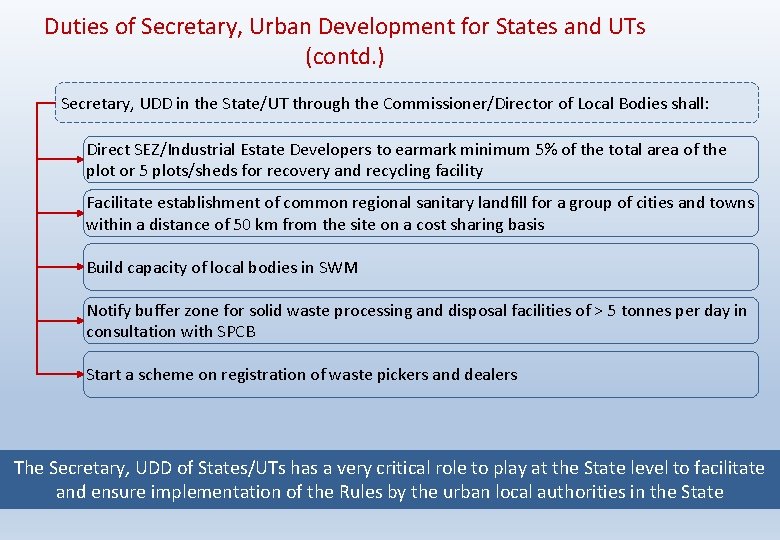
Duties of Secretary, Urban Development for States and UTs (contd. ) Secretary, UDD in the State/UT through the Commissioner/Director of Local Bodies shall: Direct SEZ/Industrial Estate Developers to earmark minimum 5% of the total area of the plot or 5 plots/sheds for recovery and recycling facility Facilitate establishment of common regional sanitary landfill for a group of cities and towns within a distance of 50 km from the site on a cost sharing basis Build capacity of local bodies in SWM Notify buffer zone for solid waste processing and disposal facilities of > 5 tonnes per day in consultation with SPCB Start a scheme on registration of waste pickers and dealers The Secretary, UDD of States/UTs has a very critical role to play at the State level to facilitate and ensure implementation of the Rules by the urban local authorities in the State
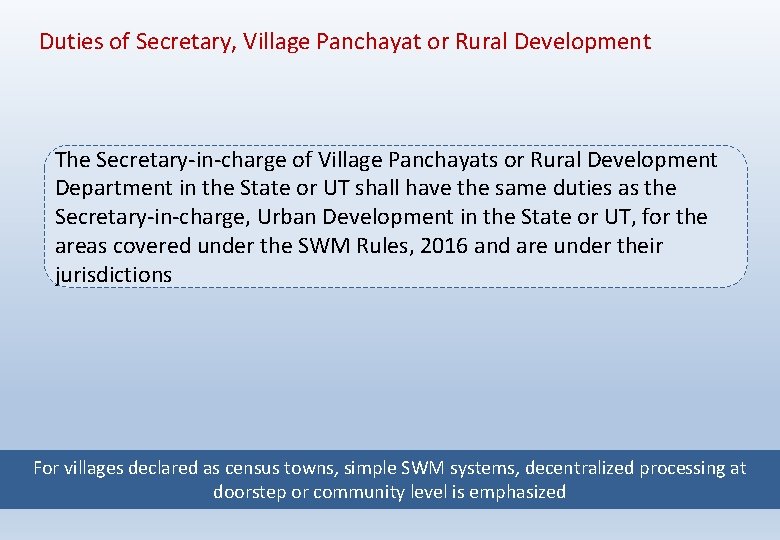
Duties of Secretary, Village Panchayat or Rural Development The Secretary-in-charge of Village Panchayats or Rural Development Department in the State or UT shall have the same duties as the Secretary-in-charge, Urban Development in the State or UT, for the areas covered under the SWM Rules, 2016 and are under their jurisdictions For villages declared as census towns, simple SWM systems, decentralized processing at doorstep or community level is emphasized
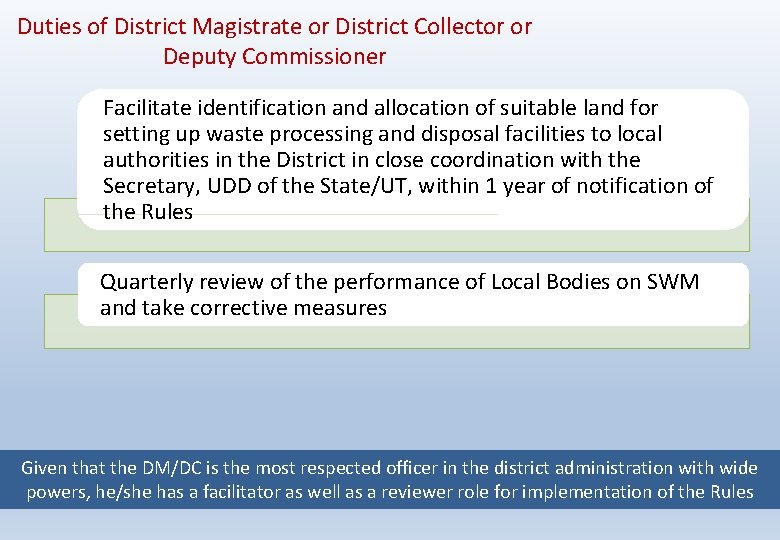
Duties of District Magistrate or District Collector or Deputy Commissioner Facilitate identification and allocation of suitable land for setting up waste processing and disposal facilities to local authorities in the District in close coordination with the Secretary, UDD of the State/UT, within 1 year of notification of the Rules Quarterly review of the performance of Local Bodies on SWM and take corrective measures Given that the DM/DC is the most respected officer in the district administration with wide powers, he/she has a facilitator as well as a reviewer role for implementation of the Rules
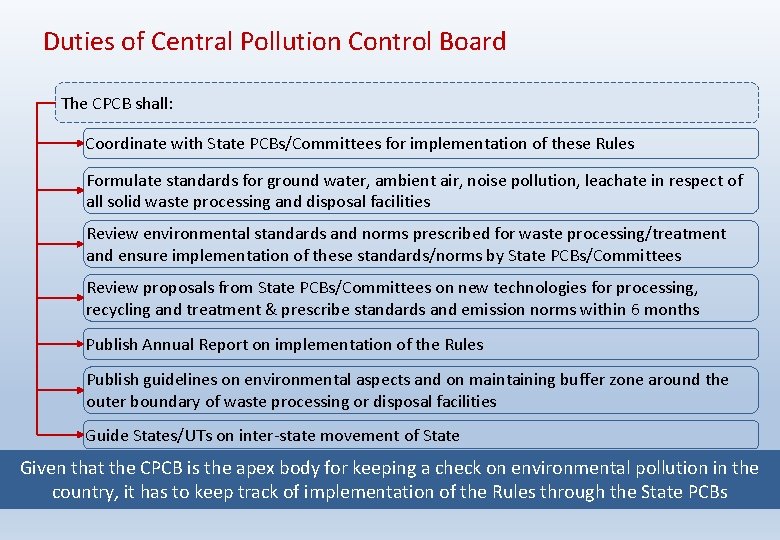
Duties of Central Pollution Control Board The CPCB shall: Coordinate with State PCBs/Committees for implementation of these Rules Formulate standards for ground water, ambient air, noise pollution, leachate in respect of all solid waste processing and disposal facilities Review environmental standards and norms prescribed for waste processing/treatment and ensure implementation of these standards/norms by State PCBs/Committees Review proposals from State PCBs/Committees on new technologies for processing, recycling and treatment & prescribe standards and emission norms within 6 months Publish Annual Report on implementation of the Rules Publish guidelines on environmental aspects and on maintaining buffer zone around the outer boundary of waste processing or disposal facilities Guide States/UTs on inter-state movement of State Given that the CPCB is the apex body for keeping a check on environmental pollution in the country, it has to keep track of implementation of the Rules through the State PCBs
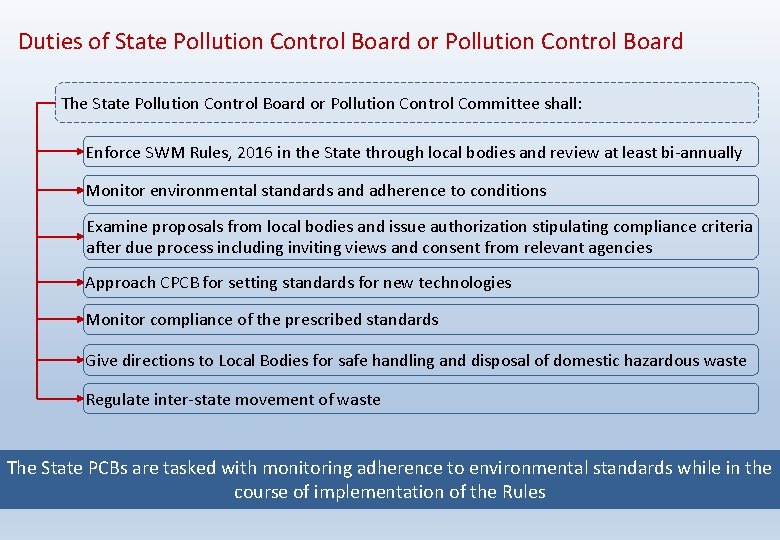
Duties of State Pollution Control Board or Pollution Control Board The State Pollution Control Board or Pollution Control Committee shall: Enforce SWM Rules, 2016 in the State through local bodies and review at least bi-annually Monitor environmental standards and adherence to conditions Examine proposals from local bodies and issue authorization stipulating compliance criteria after due process including inviting views and consent from relevant agencies Approach CPCB for setting standards for new technologies Monitor compliance of the prescribed standards Give directions to Local Bodies for safe handling and disposal of domestic hazardous waste Regulate inter-state movement of waste The State PCBs are tasked with monitoring adherence to environmental standards while in the course of implementation of the Rules
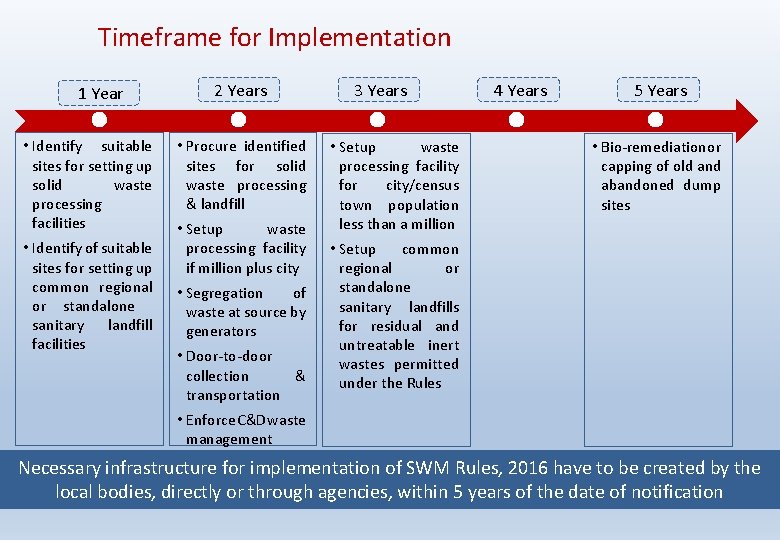
Timeframe for Implementation 1 Year • Identify suitable sites for setting up solid waste processing facilities • Identify of suitable sites for setting up common regional or standalone sanitary landfill facilities 2 Years • Procure identified sites for solid waste processing & landfill • Setup waste processing facility if million plus city • Segregation of waste at source by generators • Door-to-door collection & transportation 3 Years • Setup waste processing facility for city/census town population less than a million 4 Years 5 Years • Bio-remediation or capping of old and abandoned dump sites • Setup common regional or standalone sanitary landfills for residual and untreatable inert wastes permitted under the Rules • Enforce C&D waste management Necessary infrastructure for implementation of SWM Rules, 2016 have to be created by the local bodies, directly or through agencies, within 5 years of the date of notification
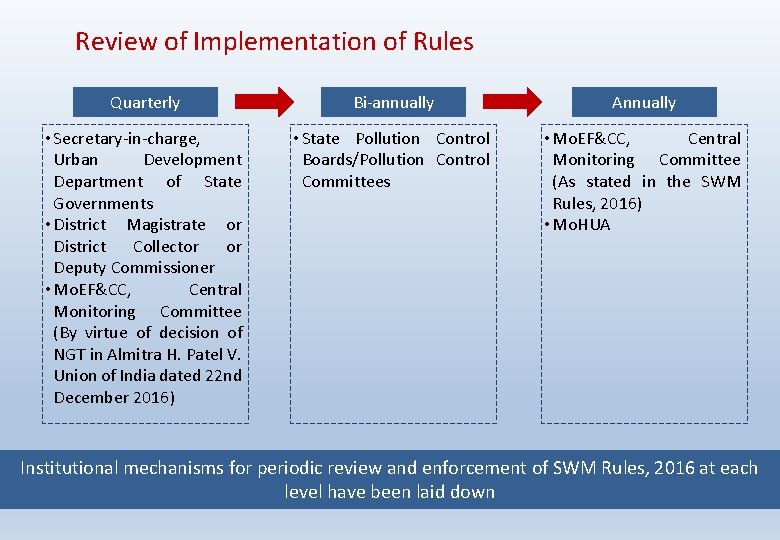
Review of Implementation of Rules Quarterly Bi-annually Annually • Secretary-in-charge, Urban Development Department of State Governments • District Magistrate or District Collector or Deputy Commissioner • Mo. EF&CC, Central Monitoring Committee (By virtue of decision of NGT in Almitra H. Patel V. Union of India dated 22 nd December 2016) • State Pollution Control Boards/Pollution Control Committees • Mo. EF&CC, Central Monitoring Committee (As stated in the SWM Rules, 2016) • Mo. HUA Institutional mechanisms for periodic review and enforcement of SWM Rules, 2016 at each level have been laid down
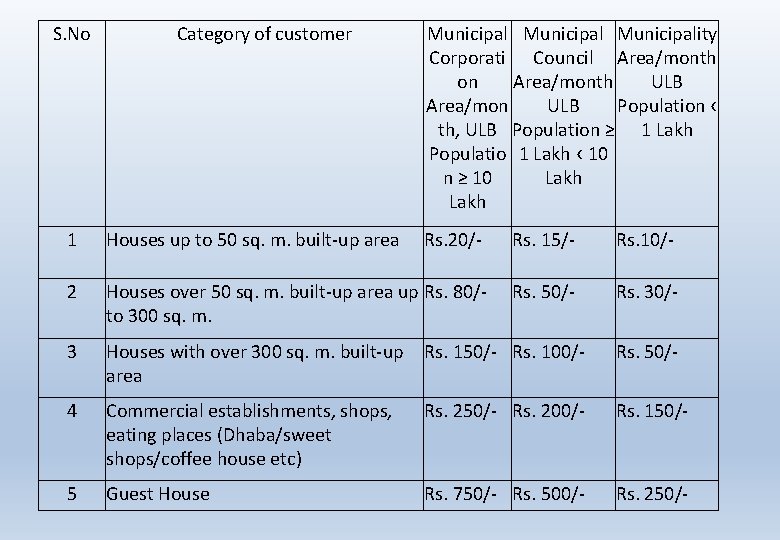
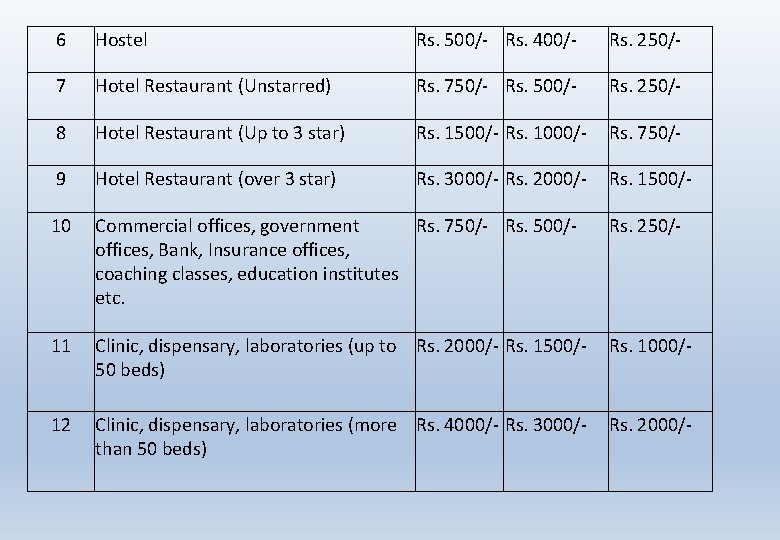
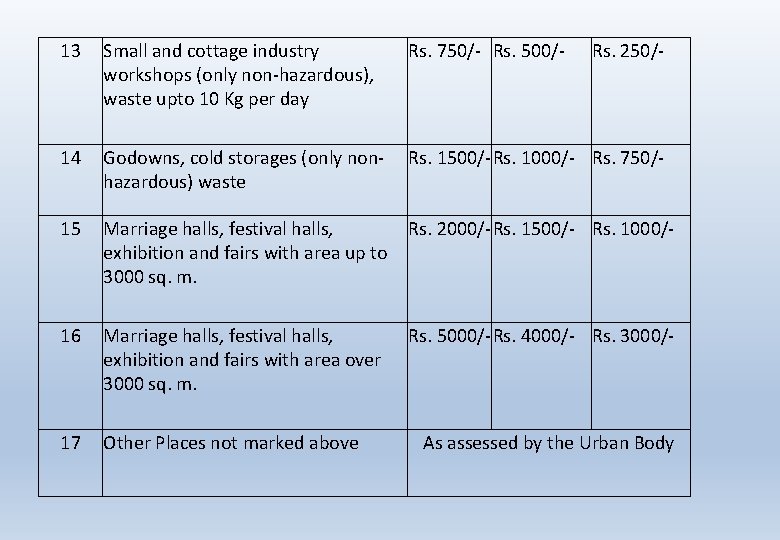
The Rates/User Charges/Fees for collecting garbage from home and establishments for Garbage Collection are fixed as follows: -
S. No Category of customer Municipality Corporati Council Area/month on Area/month ULB Area/mon ULB Population ‹ th, ULB Population ≥ 1 Lakh Populatio 1 Lakh ‹ 10 n ≥ 10 Lakh 1 Houses up to 50 sq. m. built-up area Rs. 20/- Rs. 15/- Rs. 10/- 2 Houses over 50 sq. m. built-up area up Rs. 80/to 300 sq. m. Rs. 50/- Rs. 30/- 3 Houses with over 300 sq. m. built-up area Rs. 150/- Rs. 100/- Rs. 50/- 4 Commercial establishments, shops, eating places (Dhaba/sweet shops/coffee house etc) Rs. 250/- Rs. 200/- Rs. 150/- 5 Guest House Rs. 750/- Rs. 500/- Rs. 250/-
6 Hostel Rs. 500/- Rs. 400/- Rs. 250/- 7 Hotel Restaurant (Unstarred) Rs. 750/- Rs. 500/- Rs. 250/- 8 Hotel Restaurant (Up to 3 star) Rs. 1500/- Rs. 1000/- Rs. 750/- 9 Hotel Restaurant (over 3 star) Rs. 3000/- Rs. 2000/- Rs. 1500/- 10 Commercial offices, government Rs. 750/- Rs. 500/offices, Bank, Insurance offices, coaching classes, education institutes etc. Rs. 250/- 11 Clinic, dispensary, laboratories (up to Rs. 2000/- Rs. 1500/50 beds) Rs. 1000/- 12 Clinic, dispensary, laboratories (more Rs. 4000/- Rs. 3000/than 50 beds) Rs. 2000/-
13 Small and cottage industry workshops (only non-hazardous), waste upto 10 Kg per day Rs. 750/- Rs. 500/- Rs. 250/- 14 Godowns, cold storages (only nonhazardous) waste Rs. 1500/- Rs. 1000/- Rs. 750/- 15 Marriage halls, festival halls, exhibition and fairs with area up to 3000 sq. m. Rs. 2000/- Rs. 1500/- Rs. 1000/- 16 Marriage halls, festival halls, exhibition and fairs with area over 3000 sq. m. Rs. 5000/- Rs. 4000/- Rs. 3000/- 17 Other Places not marked above As assessed by the Urban Body
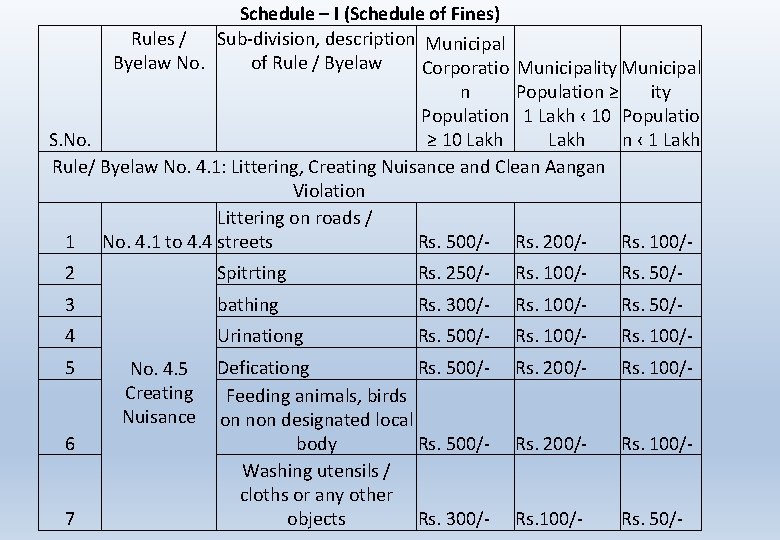
Schedule – I (Schedule of Fines) Rules / Sub-division, description Municipal Byelaw No. of Rule / Byelaw Corporatio Municipality Municipal n Population ≥ ity Population 1 Lakh ‹ 10 Populatio S. No. ≥ 10 Lakh n ‹ 1 Lakh Rule/ Byelaw No. 4. 1: Littering, Creating Nuisance and Clean Aangan Violation Littering on roads / 1 No. 4. 1 to 4. 4 streets Rs. 500/- Rs. 200/Rs. 100/2 Spitrting Rs. 250/- Rs. 100/- Rs. 50/- 3 bathing Rs. 300/- Rs. 100/- Rs. 50/- 4 Urinationg Rs. 500/- Rs. 100/- Deficationg Rs. 500/Feeding animals, birds on non designated local body Rs. 500/Washing utensils / cloths or any other objects Rs. 300/- Rs. 200/- Rs. 100/- Rs. 50/- 5 6 7 No. 4. 5 Creating Nuisance
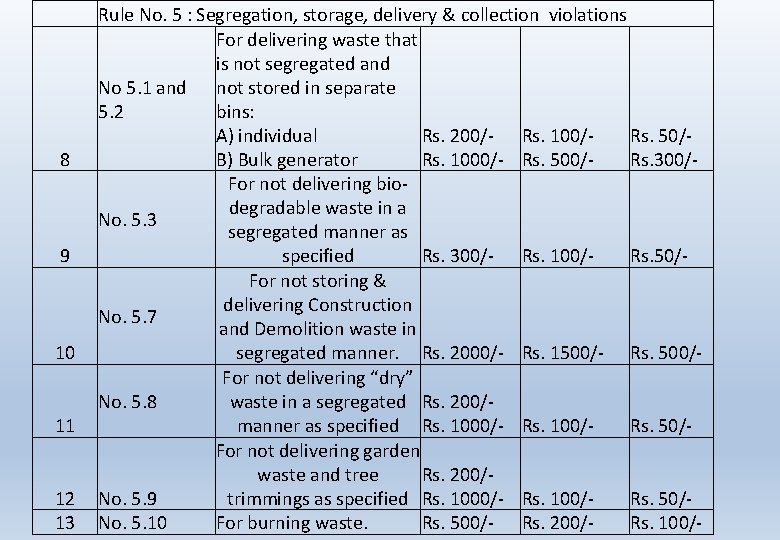
8 9 10 11 12 13 Rule No. 5 : Segregation, storage, delivery & collection violations For delivering waste that is not segregated and No 5. 1 and not stored in separate 5. 2 bins: A) individual Rs. 200/- Rs. 100/Rs. 50/B) Bulk generator Rs. 1000/- Rs. 500/Rs. 300/For not delivering biodegradable waste in a No. 5. 3 segregated manner as specified Rs. 300/- Rs. 100/Rs. 50/For not storing & delivering Construction No. 5. 7 and Demolition waste in segregated manner. Rs. 2000/- Rs. 1500/- Rs. 500/For not delivering “dry” No. 5. 8 waste in a segregated Rs. 200/manner as specified Rs. 1000/- Rs. 100/Rs. 50/For not delivering garden waste and tree Rs. 200/No. 5. 9 trimmings as specified Rs. 1000/- Rs. 100/Rs. 50/No. 5. 10 For burning waste. Rs. 500/- Rs. 200/Rs. 100/-
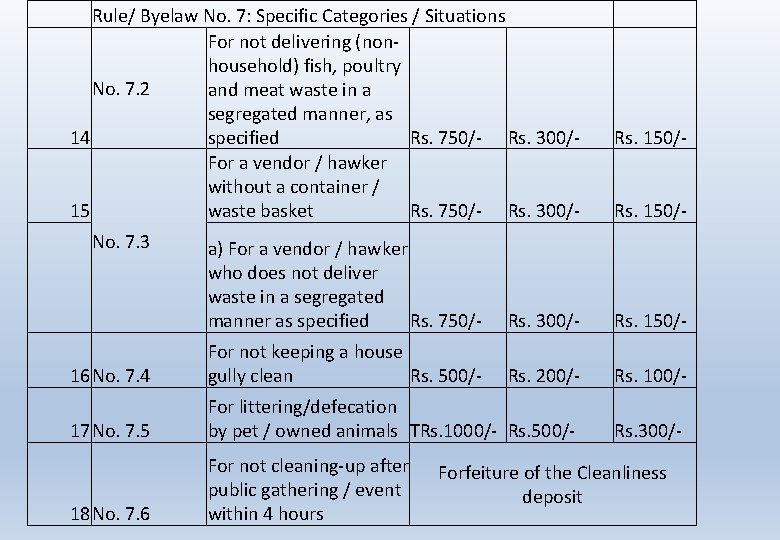
Rule/ Byelaw No. 7: Specific Categories / Situations For not delivering (nonhousehold) fish, poultry No. 7. 2 and meat waste in a segregated manner, as 14 specified Rs. 750/- Rs. 300/For a vendor / hawker without a container / 15 waste basket Rs. 750/- Rs. 300/No. 7. 3 Rs. 150/- a) For a vendor / hawker who does not deliver waste in a segregated manner as specified Rs. 750/- Rs. 300/- Rs. 150/- 16 No. 7. 4 For not keeping a house gully clean Rs. 500/- Rs. 200/- Rs. 100/- 17 No. 7. 5 For littering/defecation by pet / owned animals TRs. 1000/- Rs. 500/- Rs. 300/- 18 No. 7. 6 For not cleaning-up after public gathering / event within 4 hours Forfeiture of the Cleanliness deposit