
SOLID WASTE MANAGEMENT Dr Ragunathan AL Santiagoo Pusat






- Slides: 30
SOLID WASTE MANAGEMENT Dr. Ragunathan A/L Santiagoo Pusat Pengajian Kejuruteraan Alam Sekitar School of Environmental Engineering
Solid waste definition ■ Malaysian Legislation Waste has been defined as any matter prescribed to be scheduled waste, or any matter whether in a solid, semi-solid or liquid form, or in the form of gas or vapour which is emitted, discharged or deposited in the environment in such as volume, composition or manner as to cause pollution ■ Malaysia definition Any scrap material or unwanted surplus substances or rejected product arise from application of any process and any substances required to be disposed (National Solid Waste Management Department, MHLG) Pusat Pengajian Kejuruteraan Alam Sekitar School of Environmental Engineering
Act 672 Solid Waste and Public Cleaning management Act 2007 q Solid waste include – Any scrap material or other unwanted surplus substances or rejects products arising from the application of any process. – Any substances required to be disposed of as being broken, worn out, contaminated or otherwise spoiled. – Any other material that according to this Act or any other written law is required by the authority to be disposed of. q WASTE GENERATION Those activities in which materials are identified as no longer being of value and are either thrown away or gathered together for disposal q ON-SITE HANDLING, STORAGE AND PROCESSING Those activities associated with the handling, storage and processing of solid wastes at or near the point of generation
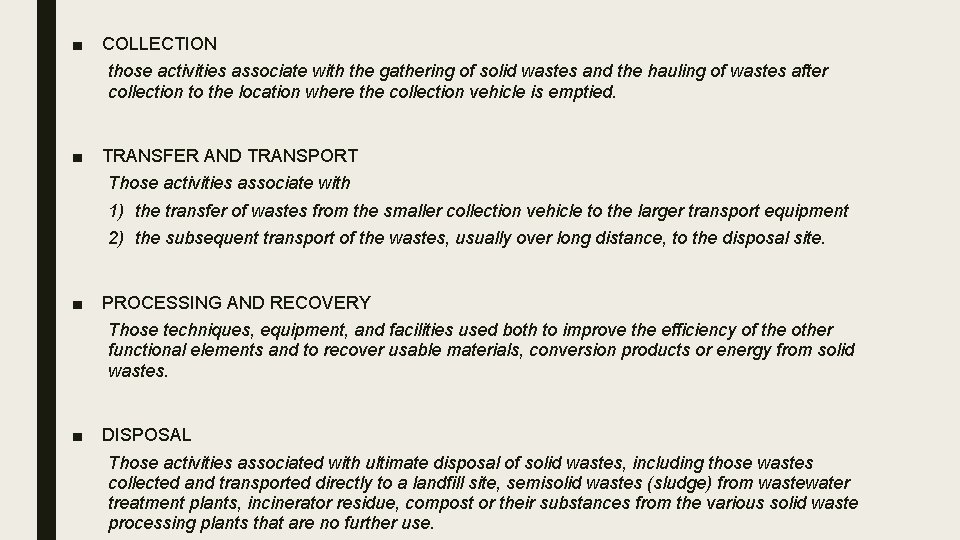
■ COLLECTION those activities associate with the gathering of solid wastes and the hauling of wastes after collection to the location where the collection vehicle is emptied. ■ TRANSFER AND TRANSPORT Those activities associate with 1) the transfer of wastes from the smaller collection vehicle to the larger transport equipment 2) the subsequent transport of the wastes, usually over long distance, to the disposal site. ■ PROCESSING AND RECOVERY Those techniques, equipment, and facilities used both to improve the efficiency of the other functional elements and to recover usable materials, conversion products or energy from solid wastes. ■ DISPOSAL Those activities associated with ultimate disposal of solid wastes, including those wastes collected and transported directly to a landfill site, semisolid wastes (sludge) from wastewater treatment plants, incinerator residue, compost or their substances from the various solid waste processing plants that are no further use.
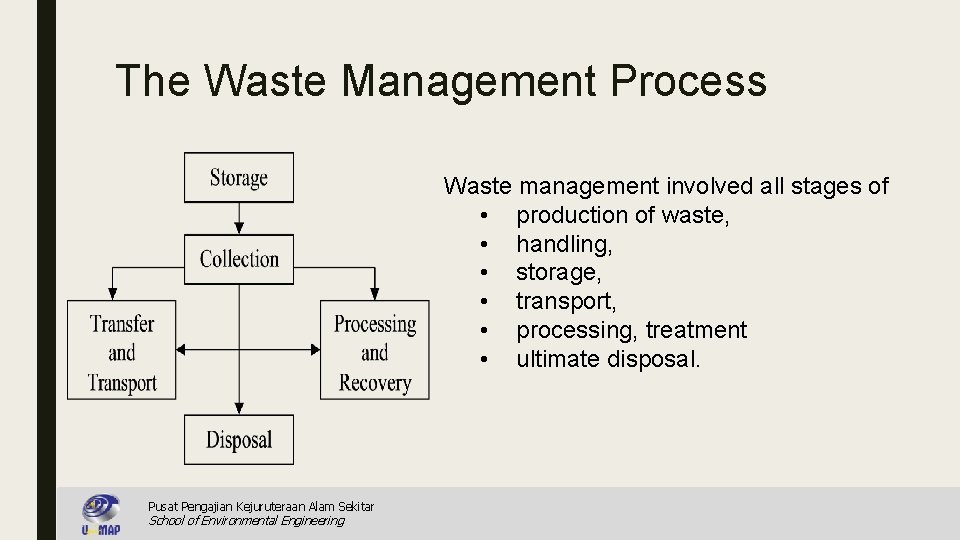
The Waste Management Process Waste management involved all stages of • production of waste, • handling, • storage, • transport, • processing, treatment • ultimate disposal. Pusat Pengajian Kejuruteraan Alam Sekitar School of Environmental Engineering
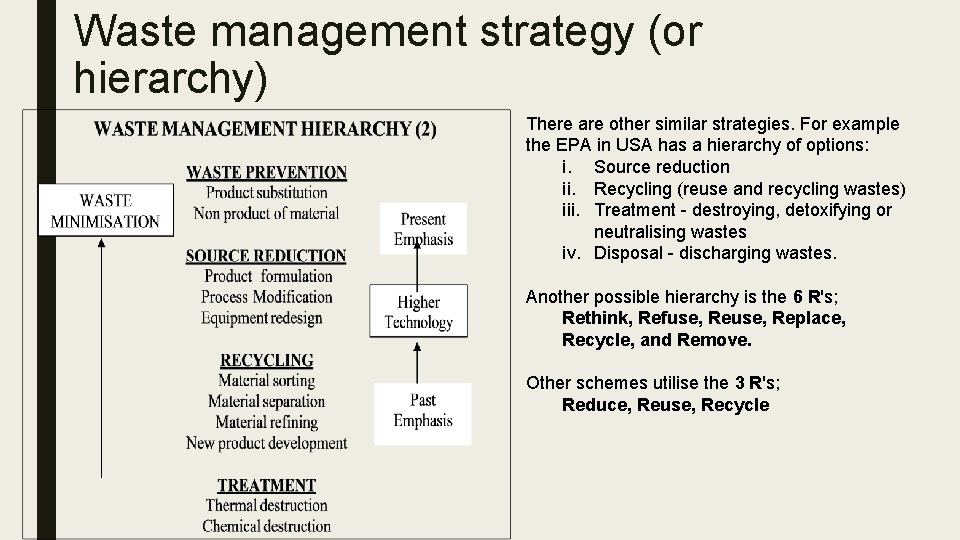
Waste management strategy (or hierarchy) There are other similar strategies. For example the EPA in USA has a hierarchy of options: i. Source reduction ii. Recycling (reuse and recycling wastes) iii. Treatment - destroying, detoxifying or neutralising wastes iv. Disposal - discharging wastes. Another possible hierarchy is the 6 R's; Rethink, Refuse, Replace, Recycle, and Remove. Other schemes utilise the 3 R's; Reduce, Reuse, Recycle
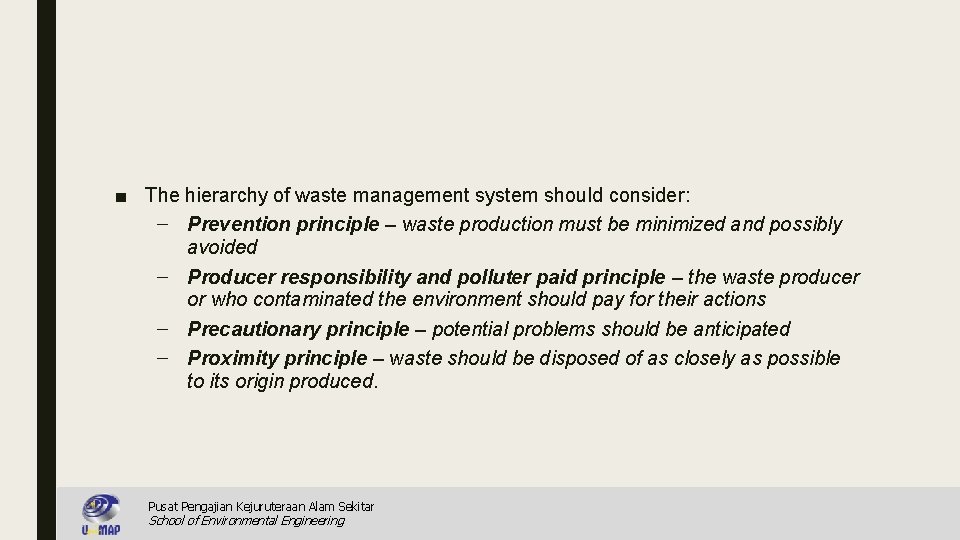
■ The hierarchy of waste management system should consider: – Prevention principle – waste production must be minimized and possibly avoided – Producer responsibility and polluter paid principle – the waste producer or who contaminated the environment should pay for their actions – Precautionary principle – potential problems should be anticipated – Proximity principle – waste should be disposed of as closely as possible to its origin produced. Pusat Pengajian Kejuruteraan Alam Sekitar School of Environmental Engineering
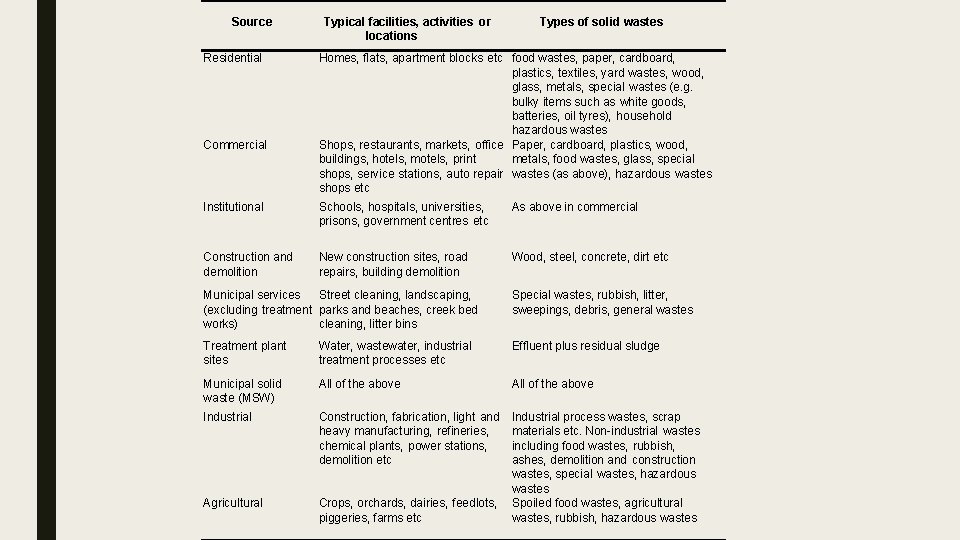
Source Residential Commercial Typical facilities, activities or locations Types of solid wastes Homes, flats, apartment blocks etc food wastes, paper, cardboard, plastics, textiles, yard wastes, wood, glass, metals, special wastes (e. g. bulky items such as white goods, batteries, oil tyres), household hazardous wastes Shops, restaurants, markets, office Paper, cardboard, plastics, wood, buildings, hotels, motels, print metals, food wastes, glass, special shops, service stations, auto repair wastes (as above), hazardous wastes shops etc Institutional Schools, hospitals, universities, prisons, government centres etc As above in commercial Construction and demolition New construction sites, road repairs, building demolition Wood, steel, concrete, dirt etc Municipal services Street cleaning, landscaping, (excluding treatment parks and beaches, creek bed works) cleaning, litter bins Special wastes, rubbish, litter, sweepings, debris, general wastes Treatment plant sites Water, wastewater, industrial treatment processes etc Effluent plus residual sludge Municipal solid waste (MSW) All of the above Industrial Construction, fabrication, light and heavy manufacturing, refineries, chemical plants, power stations, demolition etc Agricultural Industrial process wastes, scrap materials etc. Non-industrial wastes including food wastes, rubbish, ashes, demolition and construction wastes, special wastes, hazardous wastes Crops, orchards, dairies, feedlots, Spoiled food wastes, agricultural piggeries, farms etc wastes, rubbish, hazardous wastes
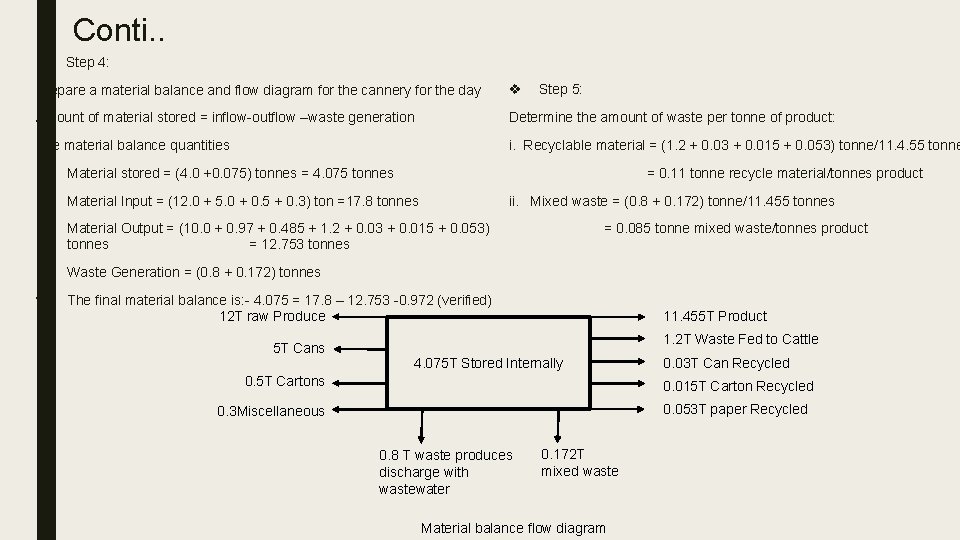
Example 3 -1: Calculation on MSW Material Balance A cannery receives on a given day 12 tonnes of raw produce, 5 tonnes of cans, 0. 5 tonne of cartons and 0. 3 tonne of miscellaneous materials. Of the 12 tonnes of raw produce, 10 tonnes become products, 1. 2 tonnes end up as product waste, which is fed to cattle, and the remainder is discharged with the wastewater from plant. 4 tonnes of the cans are stored internally for future use, and the remainder is used to package the product. About 3 % of the cans used are damaged. Stored separately, the damaged cans are recycled. The cartons are used for packaging the canned product, expect for 3 % that are damaged and subsequently separated for recycling. Of the miscellaneous materials, 25 % is stored internally for future use; 50 % becomes waste paper, of which 35 % is separated for recycling with the remainder being discharged as mixed waste; and 25 % becomes a mixture of solid waste materials. Assume the materials separated for recycling and disposals are collected daily. Prepare a material balance for the cannery on this day and a material flow diagram accounting for all of the materials. Also determine the amount of waste per tonnes of product. Pusat Pengajian Kejuruteraan Alam Sekitar School of Environmental Engineering
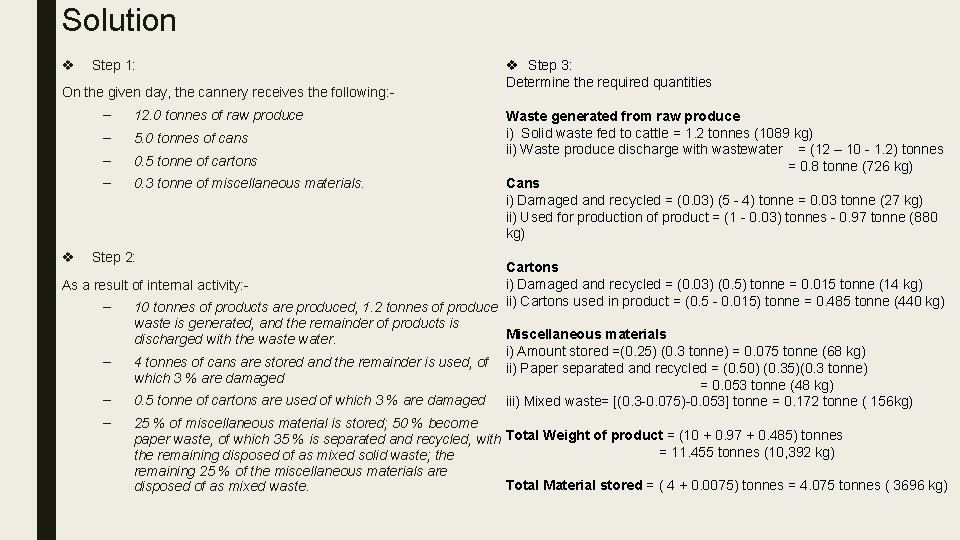
Solution v Step 1: On the given day, the cannery receives the following: - v – 12. 0 tonnes of raw produce – 5. 0 tonnes of cans – 0. 5 tonne of cartons – 0. 3 tonne of miscellaneous materials. v Step 3: Determine the required quantities Waste generated from raw produce i) Solid waste fed to cattle = 1. 2 tonnes (1089 kg) ii) Waste produce discharge with wastewater = (12 – 10 - 1. 2) tonnes = 0. 8 tonne (726 kg) Cans i) Damaged and recycled = (0. 03) (5 - 4) tonne = 0. 03 tonne (27 kg) ii) Used for production of product = (1 - 0. 03) tonnes - 0. 97 tonne (880 kg) Step 2: Cartons i) Damaged and recycled = (0. 03) (0. 5) tonne = 0. 015 tonne (14 kg) As a result of internal activity: – 10 tonnes of products are produced, 1. 2 tonnes of produce ii) Cartons used in product = (0. 5 - 0. 015) tonne = 0. 485 tonne (440 kg) waste is generated, and the remainder of products is Miscellaneous materials discharged with the waste water. i) Amount stored =(0. 25) (0. 3 tonne) = 0. 075 tonne (68 kg) – 4 tonnes of cans are stored and the remainder is used, of ii) Paper separated and recycled = (0. 50) (0. 35)(0. 3 tonne) which 3 % are damaged = 0. 053 tonne (48 kg) – 0. 5 tonne of cartons are used of which 3 % are damaged iii) Mixed waste= [(0. 3 -0. 075)-0. 053] tonne = 0. 172 tonne ( 156 kg) – 25 % of miscellaneous material is stored; 50 % become paper waste, of which 35 % is separated and recycled, with Total Weight of product = (10 + 0. 97 + 0. 485) tonnes = 11. 455 tonnes (10, 392 kg) the remaining disposed of as mixed solid waste; the remaining 25 % of the miscellaneous materials are Total Material stored = ( 4 + 0. 0075) tonnes = 4. 075 tonnes ( 3696 kg) disposed of as mixed waste.
Conti. . v Step 4: Prepare a material balance and flow diagram for the cannery for the day v Amount of material stored = inflow-outflow –waste generation Determine the amount of waste per tonne of product: The material balance quantities i. Recyclable material = (1. 2 + 0. 03 + 0. 015 + 0. 053) tonne/11. 4. 55 tonne i. Material stored = (4. 0 +0. 075) tonnes = 4. 075 tonnes ii. Material Input = (12. 0 + 5. 0 + 0. 5 + 0. 3) ton =17. 8 tonnes iii. Material Output = (10. 0 + 0. 97 + 0. 485 + 1. 2 + 0. 03 + 0. 015 + 0. 053) tonnes = 12. 753 tonnes iv. Waste Generation = (0. 8 + 0. 172) tonnes v. The final material balance is: - 4. 075 = 17. 8 – 12. 753 -0. 972 (verified) 12 T raw Produce Step 5: = 0. 11 tonne recycle material/tonnes product ii. Mixed waste = (0. 8 + 0. 172) tonne/11. 455 tonnes = 0. 085 tonne mixed waste/tonnes product 11. 455 T Product 1. 2 T Waste Fed to Cattle 5 T Cans 4. 075 T Stored Internally 0. 5 T Cartons 0. 03 T Can Recycled 0. 015 T Carton Recycled 0. 053 T paper Recycled 0. 3 Miscellaneous 0. 8 T waste produces discharge with wastewater 0. 172 T mixed waste Material balance flow diagram
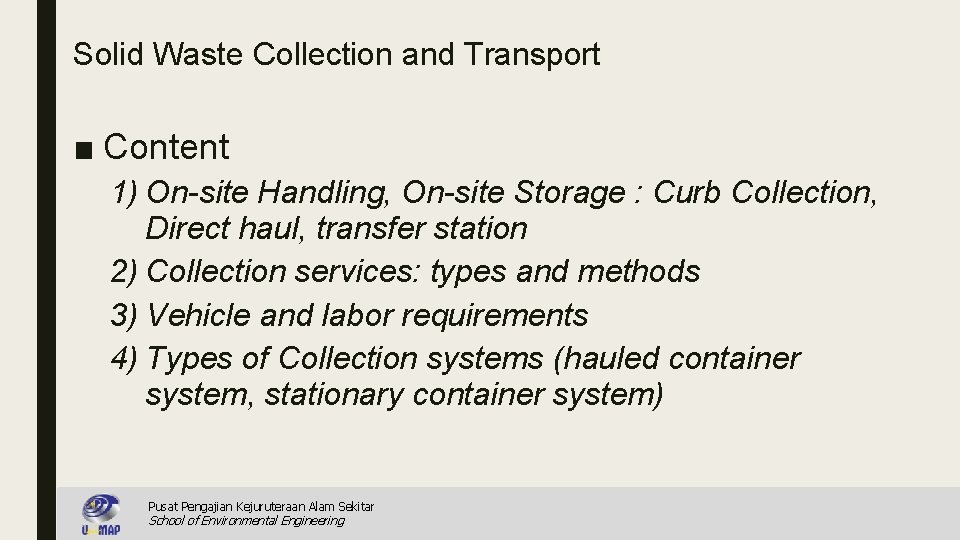
Solid Waste Collection and Transport ■ Content 1) On-site Handling, On-site Storage : Curb Collection, Direct haul, transfer station 2) Collection services: types and methods 3) Vehicle and labor requirements 4) Types of Collection systems (hauled container system, stationary container system) Pusat Pengajian Kejuruteraan Alam Sekitar School of Environmental Engineering
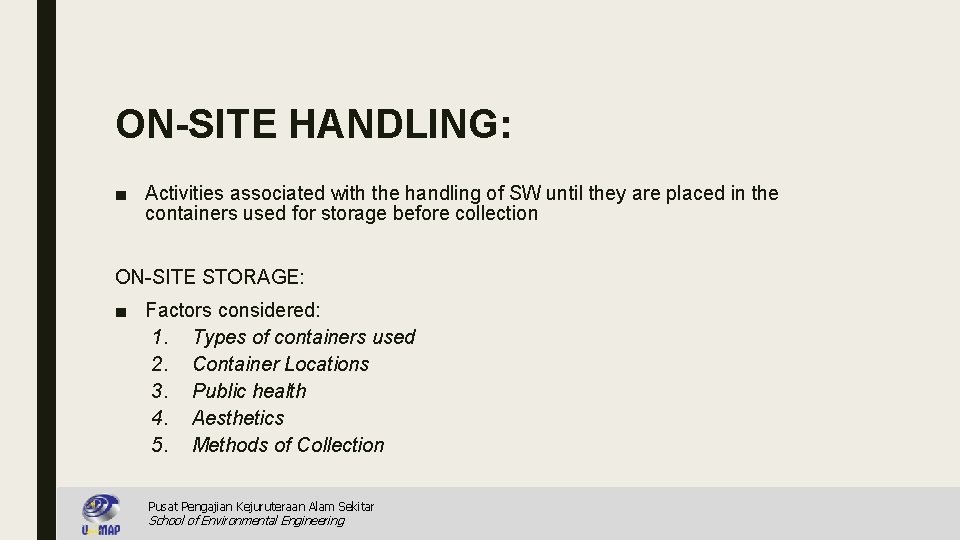
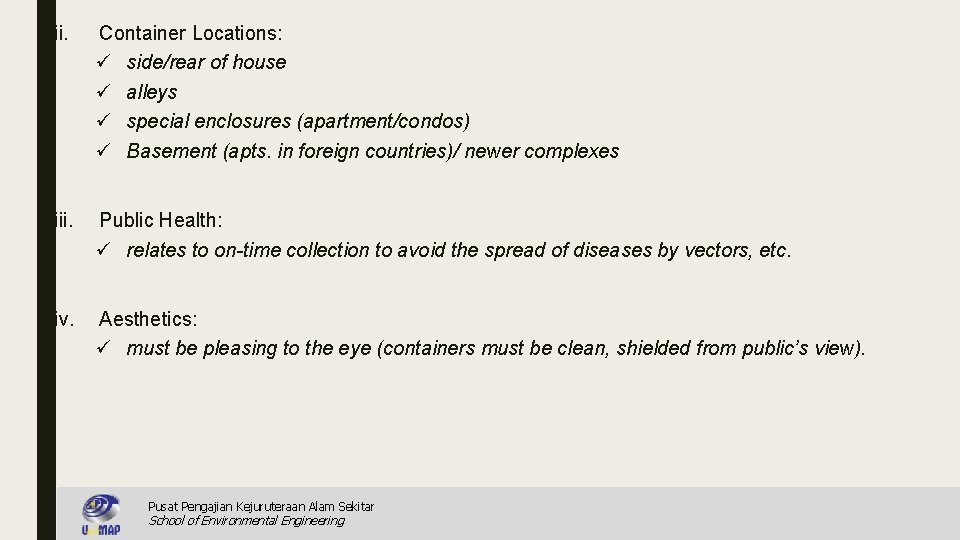
ON-SITE HANDLING: ■ Activities associated with the handling of SW until they are placed in the containers used for storage before collection ON-SITE STORAGE: ■ Factors considered: 1. Types of containers used 2. Container Locations 3. Public health 4. Aesthetics 5. Methods of Collection Pusat Pengajian Kejuruteraan Alam Sekitar School of Environmental Engineering
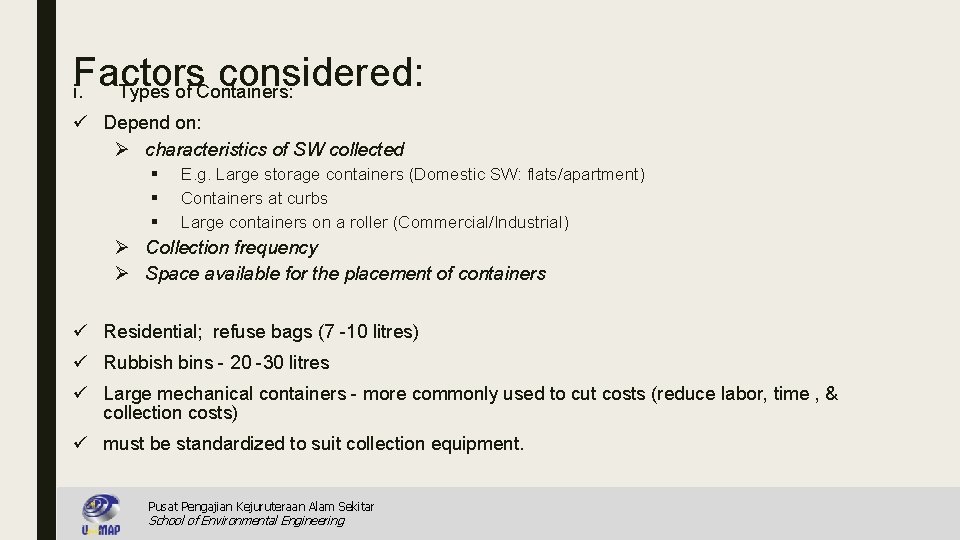
Factors considered: i. Types of Containers: ü Depend on: Ø characteristics of SW collected § § § E. g. Large storage containers (Domestic SW: flats/apartment) Containers at curbs Large containers on a roller (Commercial/Industrial) Ø Collection frequency Ø Space available for the placement of containers ü Residential; refuse bags (7 -10 litres) ü Rubbish bins - 20 -30 litres ü Large mechanical containers - more commonly used to cut costs (reduce labor, time , & collection costs) ü must be standardized to suit collection equipment. Pusat Pengajian Kejuruteraan Alam Sekitar School of Environmental Engineering
ii. Container Locations: ü side/rear of house ü alleys ü special enclosures (apartment/condos) ü Basement (apts. in foreign countries)/ newer complexes iii. Public Health: ü relates to on-time collection to avoid the spread of diseases by vectors, etc. iv. Aesthetics: ü must be pleasing to the eye (containers must be clean, shielded from public’s view). Pusat Pengajian Kejuruteraan Alam Sekitar School of Environmental Engineering
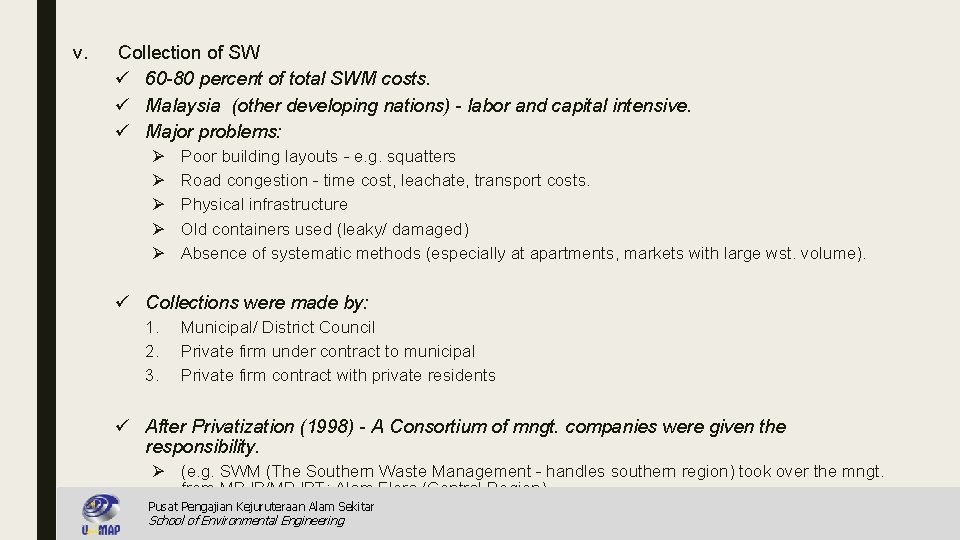
v. Collection of SW ü 60 -80 percent of total SWM costs. ü Malaysia (other developing nations) - labor and capital intensive. ü Major problems: Ø Ø Ø Poor building layouts - e. g. squatters Road congestion - time cost, leachate, transport costs. Physical infrastructure Old containers used (leaky/ damaged) Absence of systematic methods (especially at apartments, markets with large wst. volume). ü Collections were made by: 1. 2. 3. Municipal/ District Council Private firm under contract to municipal Private firm contract with private residents ü After Privatization (1998) - A Consortium of mngt. companies were given the responsibility. Ø (e. g. SWM (The Southern Waste Management - handles southern region) took over the mngt. from MBJB/MPJBT; Alam Flora (Central Region). Pusat Pengajian Kejuruteraan Alam Sekitar School of Environmental Engineering
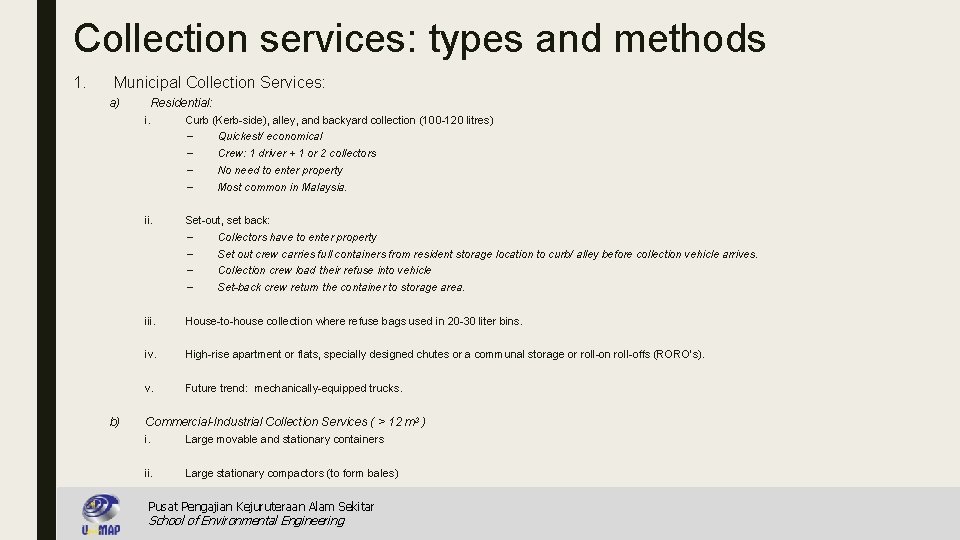
Collection services: types and methods 1. Municipal Collection Services: a) Residential: i. Curb (Kerb-side), alley, and backyard collection (100 -120 litres) – Quickest/ economical – Crew: 1 driver + 1 or 2 collectors – No need to enter property – Most common in Malaysia. ii. Set-out, set back: – – b) Collectors have to enter property Set out crew carries full containers from resident storage location to curb/ alley before collection vehicle arrives. Collection crew load their refuse into vehicle Set-back crew return the container to storage area. iii. House-to-house collection where refuse bags used in 20 -30 liter bins. iv. High-rise apartment or flats, specially designed chutes or a communal storage or roll-on roll-offs (RORO’s). v. Future trend: mechanically-equipped trucks. Commercial-Industrial Collection Services ( > 12 m 3 ) i. Large movable and stationary containers ii. Large stationary compactors (to form bales) Pusat Pengajian Kejuruteraan Alam Sekitar School of Environmental Engineering
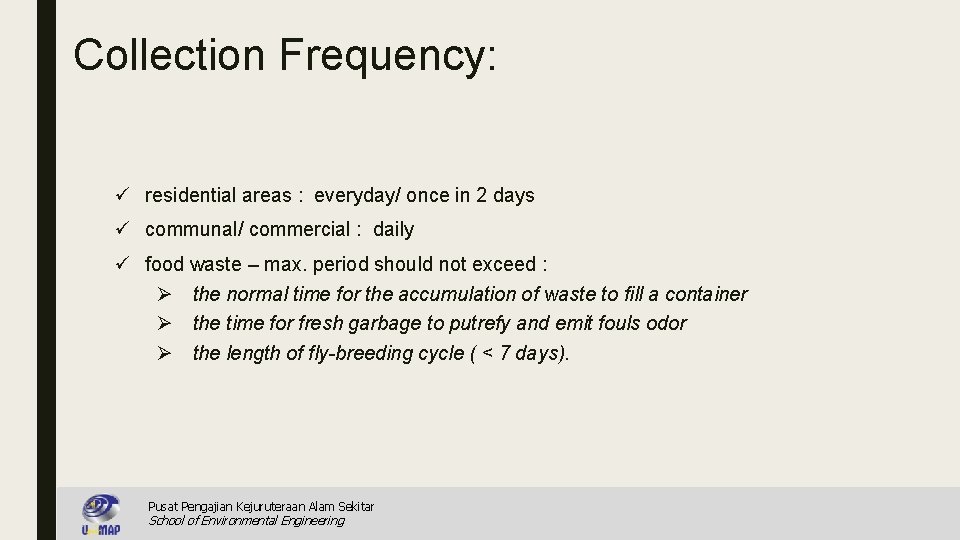
Collection Frequency: ü residential areas : everyday/ once in 2 days ü communal/ commercial : daily ü food waste – max. period should not exceed : Ø the normal time for the accumulation of waste to fill a container Ø the time for fresh garbage to putrefy and emit fouls odor Ø the length of fly-breeding cycle ( < 7 days). Pusat Pengajian Kejuruteraan Alam Sekitar School of Environmental Engineering
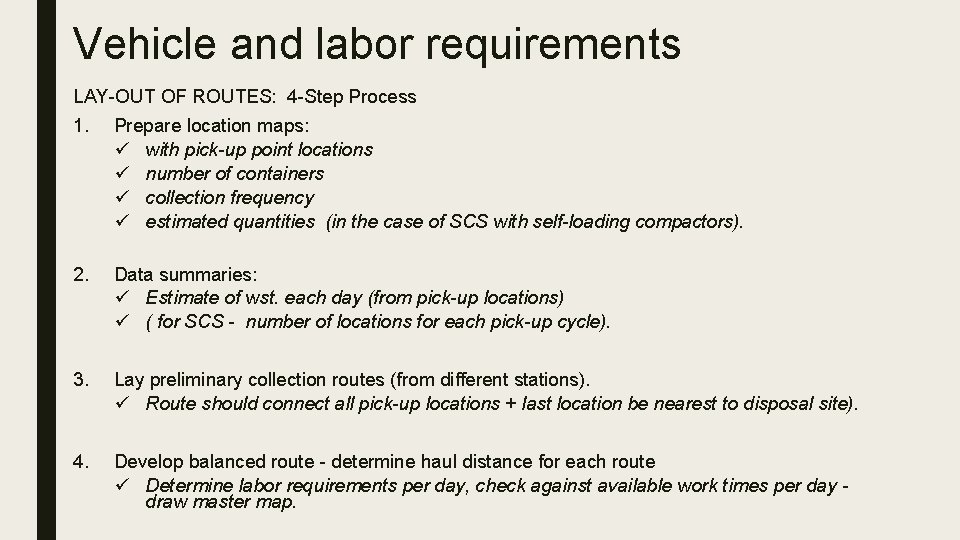
Vehicle and labor requirements LAY-OUT OF ROUTES: 4 -Step Process 1. Prepare location maps: ü with pick-up point locations ü number of containers ü collection frequency ü estimated quantities (in the case of SCS with self-loading compactors). 2. Data summaries: ü Estimate of wst. each day (from pick-up locations) ü ( for SCS - number of locations for each pick-up cycle). 3. Lay preliminary collection routes (from different stations). ü Route should connect all pick-up locations + last location be nearest to disposal site). 4. Develop balanced route - determine haul distance for each route ü Determine labor requirements per day, check against available work times per day draw master map.
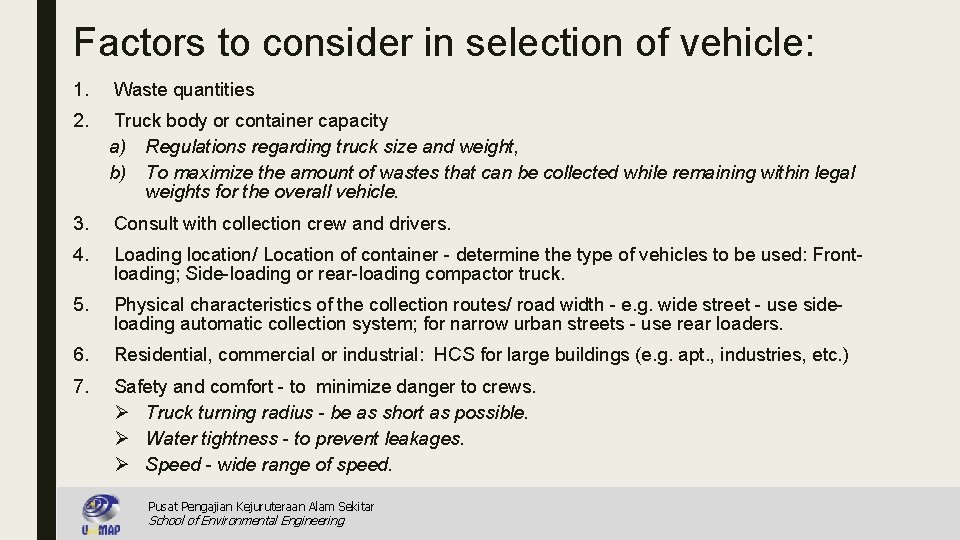
Factors to consider in selection of vehicle: 1. Waste quantities 2. Truck body or container capacity a) Regulations regarding truck size and weight, b) To maximize the amount of wastes that can be collected while remaining within legal weights for the overall vehicle. 3. Consult with collection crew and drivers. 4. Loading location/ Location of container - determine the type of vehicles to be used: Frontloading; Side-loading or rear-loading compactor truck. 5. Physical characteristics of the collection routes/ road width - e. g. wide street - use sideloading automatic collection system; for narrow urban streets - use rear loaders. 6. Residential, commercial or industrial: HCS for large buildings (e. g. apt. , industries, etc. ) 7. Safety and comfort - to minimize danger to crews. Ø Truck turning radius - be as short as possible. Ø Water tightness - to prevent leakages. Ø Speed - wide range of speed. Pusat Pengajian Kejuruteraan Alam Sekitar School of Environmental Engineering
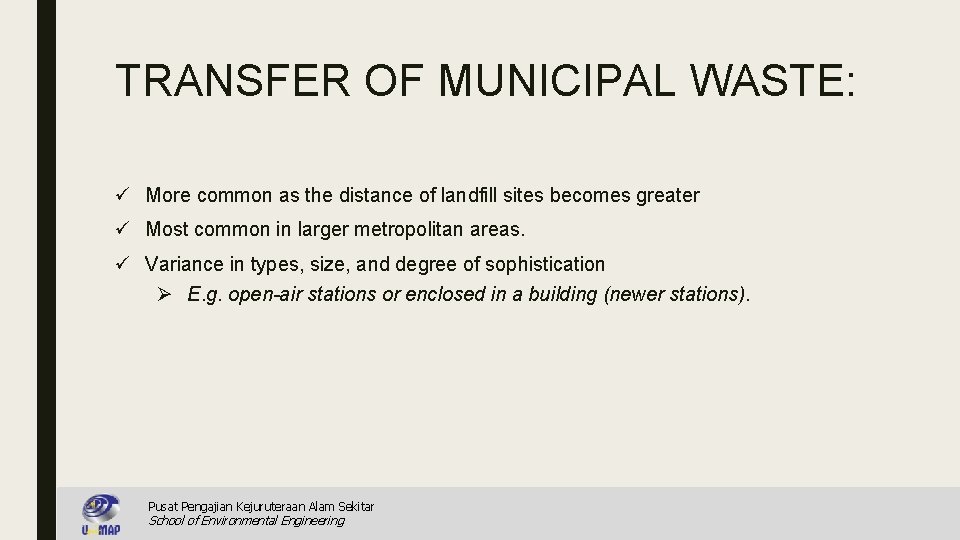
TRANSFER OF MUNICIPAL WASTE: ü More common as the distance of landfill sites becomes greater ü Most common in larger metropolitan areas. ü Variance in types, size, and degree of sophistication Ø E. g. open-air stations or enclosed in a building (newer stations). Pusat Pengajian Kejuruteraan Alam Sekitar School of Environmental Engineering
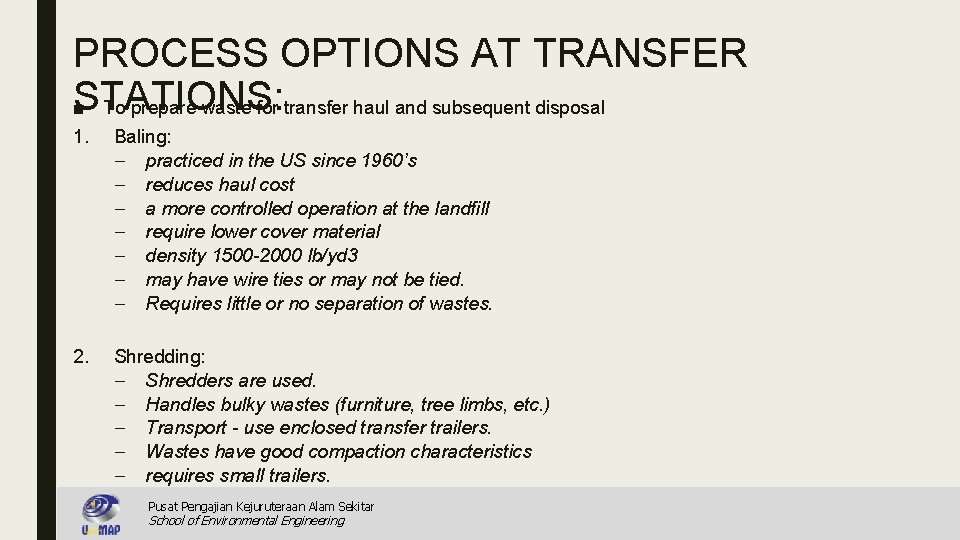
PROCESS OPTIONS AT TRANSFER STATIONS: ■ To prepare waste for transfer haul and subsequent disposal 1. Baling: – practiced in the US since 1960’s – reduces haul cost – a more controlled operation at the landfill – require lower cover material – density 1500 -2000 lb/yd 3 – may have wire ties or may not be tied. – Requires little or no separation of wastes. 2. Shredding: – Shredders are used. – Handles bulky wastes (furniture, tree limbs, etc. ) – Transport - use enclosed transfer trailers. – Wastes have good compaction characteristics – requires small trailers. Pusat Pengajian Kejuruteraan Alam Sekitar School of Environmental Engineering
Advantages of Transfer stations: ü better haul roads for collection vehicles (usually paved - reducing damages to trucks and delay). ü greater traffic control (avoid traffic jams/congestion or litter + safety to children). ü fewer truck on the sanitary landfill haul routes( reduction ratio of from 3 (trucks) : 1 (transfer haul) or 5: 1). ü improved landfill operating efficiency (fewer trucks mean better traffic control). ü Lower overall haul cost (reduction in no. of drivers/crew).
Criteria for Transfer Location: ü Near the collection area served (to minimize collection crew time for haul to the transfer station). ü Accessible to major haul routes (public acceptance and economics - lower transfer haul cost)). ü Adequate land area to provide isolation (to handle traffic flow). ü Suitable Zoning (commercial or industrial) ü Served by utilities (water, sanitary sewer, storm drainage, electricity)( Size vs. station capacity) Pusat Pengajian Kejuruteraan Alam Sekitar School of Environmental Engineering
Station Concepts ■ Pit 1. 2. Direct Dump Compaction ■ Pit: – – Collection vehicles unloaded wastes into a large pit. Wastes are then pushed to an open-top transfer trailer by a tractor. The pit - as storage during peak periods. Compaction of bulk items made by the tractor in the pit. Pusat Pengajian Kejuruteraan Alam Sekitar School of Environmental Engineering
a) Direct Dump: Ø collection vehicles dump directly into open-top transfer trailer Ø Large hoppers direct the waste into the transfer trailers. Ø Very large transfer trailers are used (due to minimal compaction). Ø Efficient - no intermediate handling required (direct from vehicle to transfer trailer). b) Compaction: i. Hopper type compaction station : waste drop by gravity into a compactor - packs the waste into the trailers. ii. Push pit compactor station: a large hydraulically operated blade moves the waste to the stationary packer - then packs the waste into the trailers.
TYPES OF COLLECTION SYSTEMS: ■ 1. Hauled Container System (HCS) ■ 2. Stationary Container System (SCS)
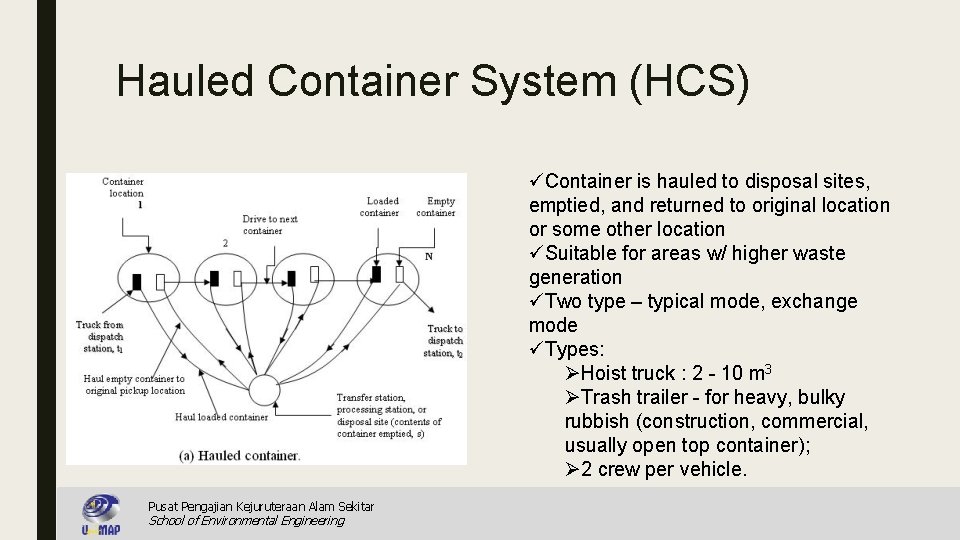
Hauled Container System (HCS) üContainer is hauled to disposal sites, emptied, and returned to original location or some other location üSuitable for areas w/ higher waste generation üTwo type – typical mode, exchange mode üTypes: ØHoist truck : 2 - 10 m 3 ØTrash trailer - for heavy, bulky rubbish (construction, commercial, usually open top container); Ø 2 crew per vehicle. Pusat Pengajian Kejuruteraan Alam Sekitar School of Environmental Engineering
Stationary Container System (SCS) ü the container used to store waste remain at the point of generation; except when moved to curb or other location to be emptied. ü Types include: Ø Mechanically-loaded system Ø Manually-loaded collection vehicle(more common) ü Used for residential/commercial sites. ü Vehicle w/ internal compaction mechanism or un-compacted (open top lorry - side loaded. Pusat Pengajian Kejuruteraan Alam Sekitar School of Environmental Engineering
THANK YOU ■ Thank you for being my excellent students