
SOLID SOLUTION STRENGTHENING Strengthening due to addition of



- Slides: 27
SOLID SOLUTION STRENGTHENING Strengthening due to addition of solute atoms as a result of their interaction with moving dislocations during dislocation glide is SSS. Course Name: Mechanical Behaviour of Materials Level(UG) LO’s for prior viewing : NONE Authors: R. Mridhula/A. Subhedar Guide: Prof. P. Pant
Learning Objectives After interacting with this Learning Object, the learner will be able to: • Visualise how addition of solute atoms to a metal or alloy enhances strength. • Explain how size of the solute atom in comparison to the solvent atom affects strengthening
1 2 3 4 5 Definitions of the components/Keywords: Solid solution: is a solid-state solution of one or more solutes in a solvent Interstitial Solution: Solute atoms are appreciably smaller than the matrix atoms and occupy places between regular sites Substitutional solid solution : Solute atoms are of nearly same size of the matrix atoms and substitute parent atoms in regular sites.
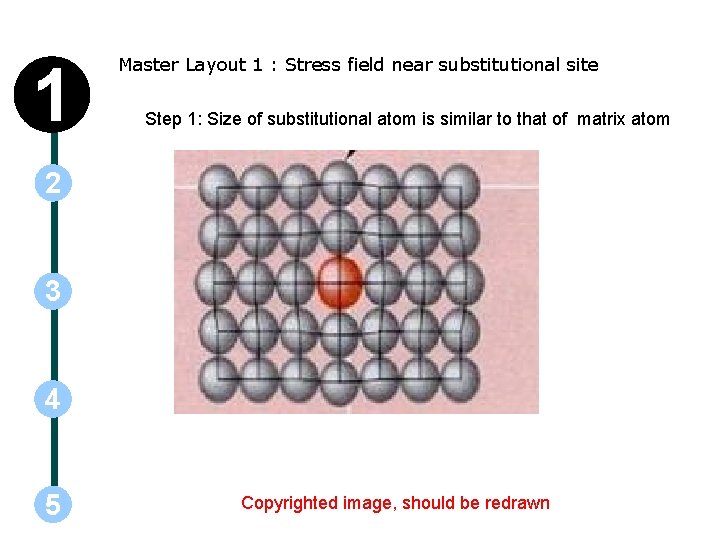
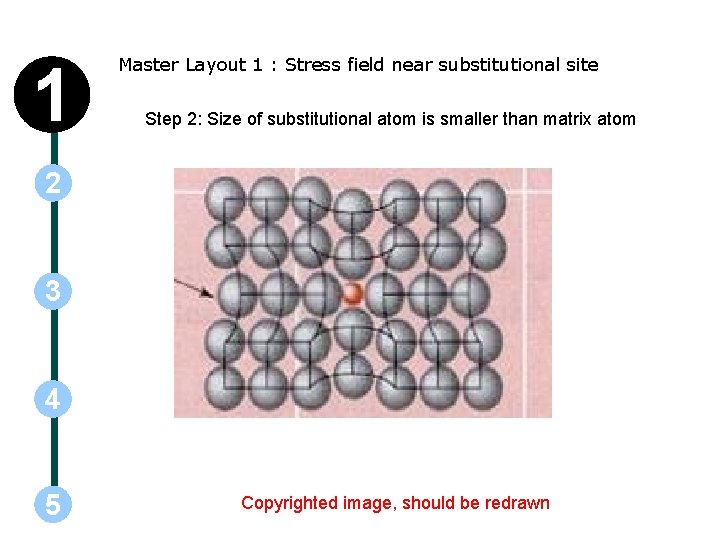
1 Master Layout 1 : Stress field near substitutional site Step 1: Size of substitutional atom is similar to that of matrix atom 2 3 4 5 Copyrighted image, should be redrawn
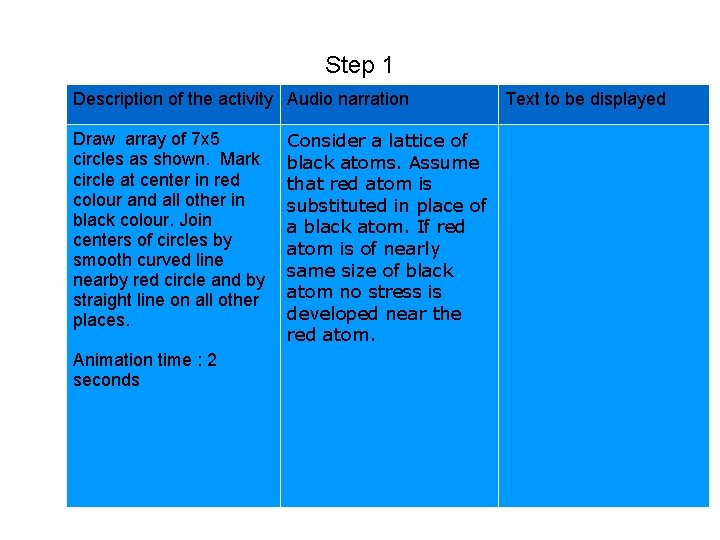
Step 1 Description of the activity Audio narration Draw array of 7 x 5 circles as shown. Mark circle at center in red colour and all other in black colour. Join centers of circles by smooth curved line nearby red circle and by straight line on all other places. Animation time : 2 seconds Consider a lattice of black atoms. Assume that red atom is substituted in place of a black atom. If red atom is of nearly same size of black atom no stress is developed near the red atom. Text to be displayed
1 Master Layout 1 : Stress field near substitutional site Step 2: Size of substitutional atom is smaller than matrix atom 2 v: Velocity of interface ∆T : undercooling 3 4 5 Copyrighted image, should be redrawn
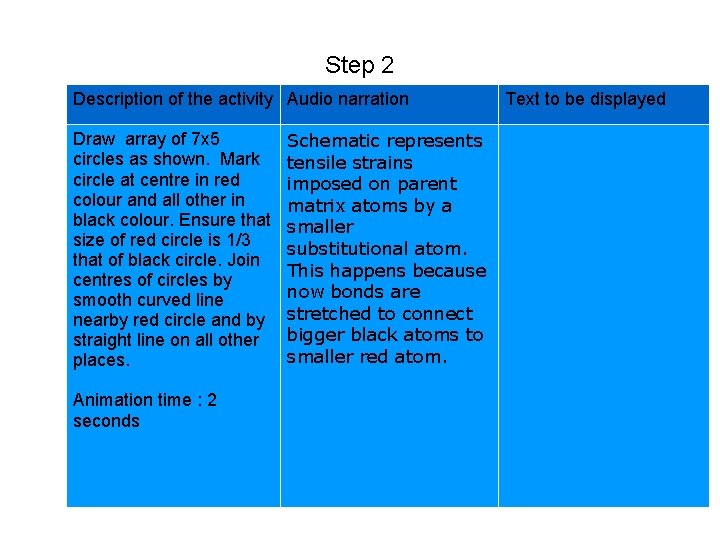
Step 2 Description of the activity Audio narration Draw array of 7 x 5 circles as shown. Mark circle at centre in red colour and all other in black colour. Ensure that size of red circle is 1/3 that of black circle. Join centres of circles by smooth curved line nearby red circle and by straight line on all other places. Animation time : 2 seconds Schematic represents tensile strains imposed on parent matrix atoms by a smaller substitutional atom. This happens because now bonds are stretched to connect bigger black atoms to smaller red atom. Text to be displayed
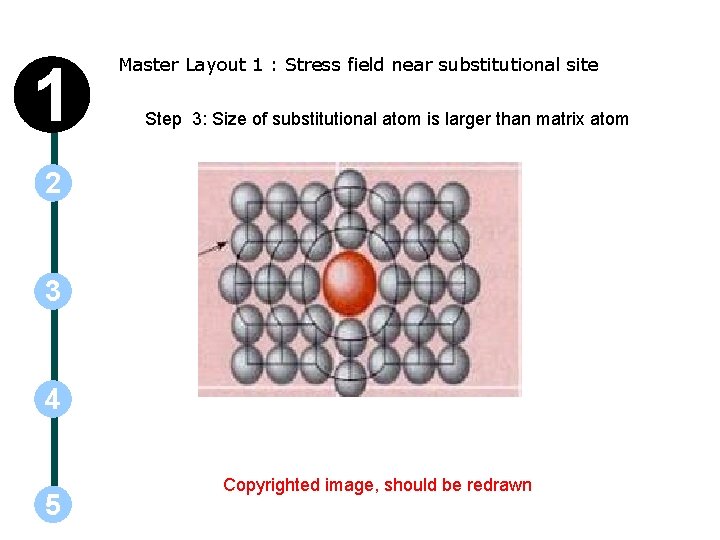
1 Master Layout 1 : Stress field near substitutional site Step 3: Size of substitutional atom is larger than matrix atom 2 v: Velocity of interface ∆T : undercooling 3 4 5 Copyrighted image, should be redrawn
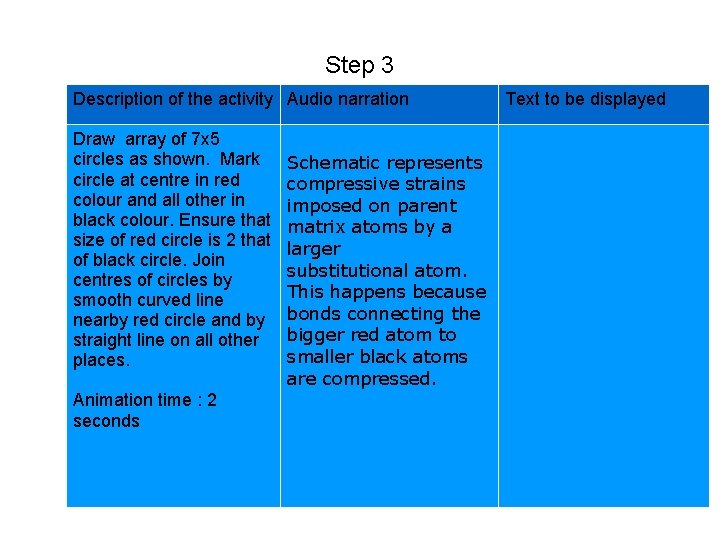
Step 3 Description of the activity Audio narration Draw array of 7 x 5 circles as shown. Mark circle at centre in red colour and all other in black colour. Ensure that size of red circle is 2 that of black circle. Join centres of circles by smooth curved line nearby red circle and by straight line on all other places. Animation time : 2 seconds Schematic represents compressive strains imposed on parent matrix atoms by a larger substitutional atom. This happens because bonds connecting the bigger red atom to smaller black atoms are compressed. Text to be displayed
Master Layout 2 : Repositioning of solute atoms 1 2 3 4 5 Step 1: Stress field around edge dislocation
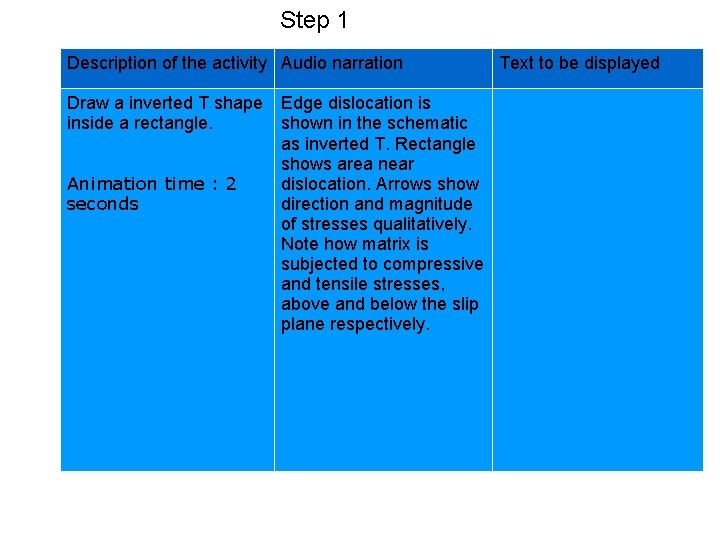
Step 1 Description of the activity Audio narration Draw a inverted T shape inside a rectangle. Animation time : 2 seconds Edge dislocation is shown in the schematic as inverted T. Rectangle shows area near dislocation. Arrows show direction and magnitude of stresses qualitatively. Note how matrix is subjected to compressive and tensile stresses, above and below the slip plane respectively. Text to be displayed
1 2 3 4 5 Master Layout 2 : Repositioning of substitutional solute atoms Step 2: Substitutional atoms in random motion
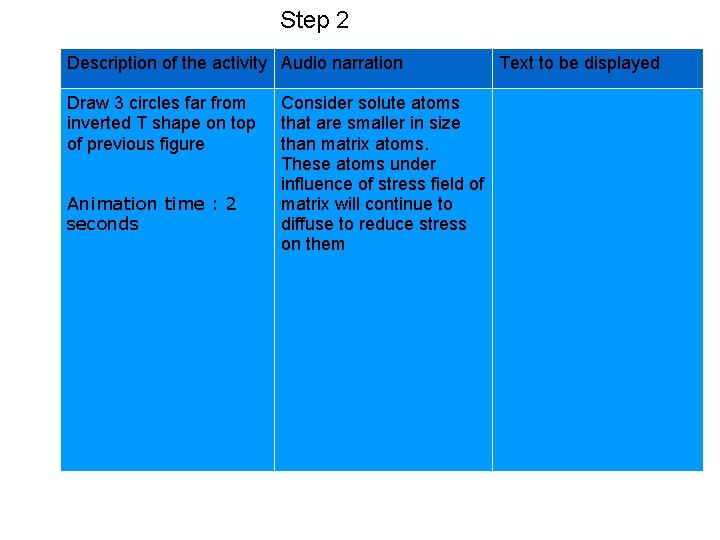
Step 2 Description of the activity Audio narration Draw 3 circles far from inverted T shape on top of previous figure Animation time : 2 seconds Consider solute atoms that are smaller in size than matrix atoms. These atoms under influence of stress field of matrix will continue to diffuse to reduce stress on them Text to be displayed
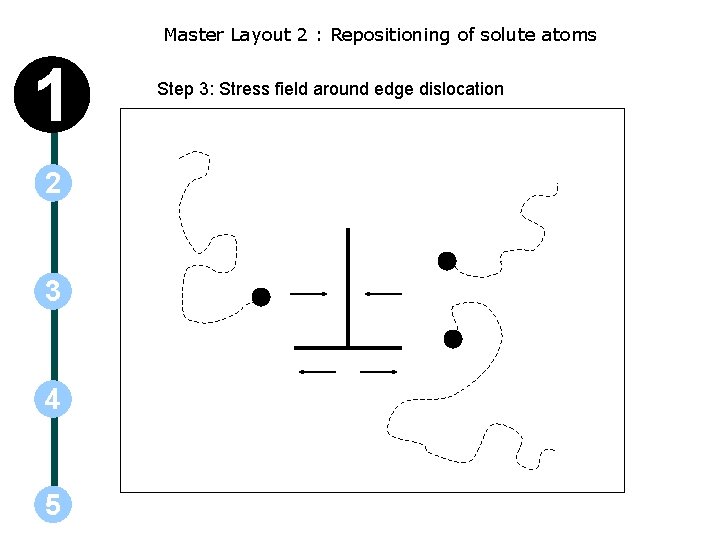
Master Layout 2 : Repositioning of solute atoms 1 2 3 4 5 Step 3: Stress field around edge dislocation
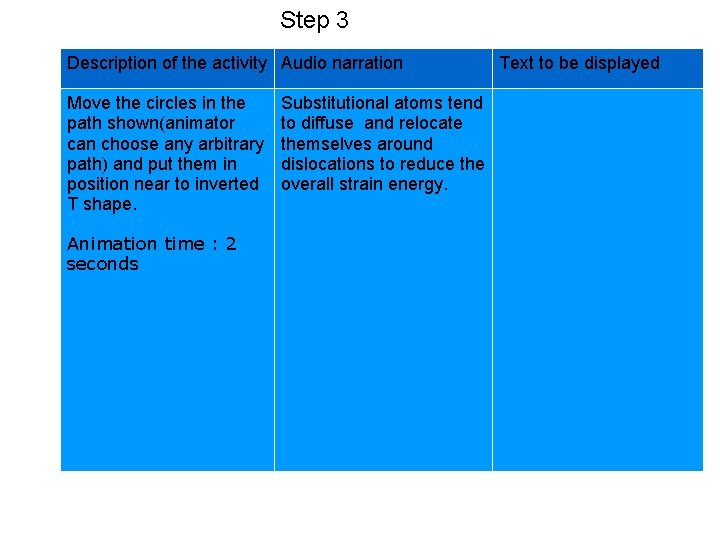
Step 3 Description of the activity Audio narration Move the circles in the path shown(animator can choose any arbitrary path) and put them in position near to inverted T shape. Animation time : 2 seconds Substitutional atoms tend to diffuse and relocate themselves around dislocations to reduce the overall strain energy. Text to be displayed
Master Layout 2 : Repositioning of solute atoms 1 2 3 4 5 Step 4: Stress field around edge dislocation
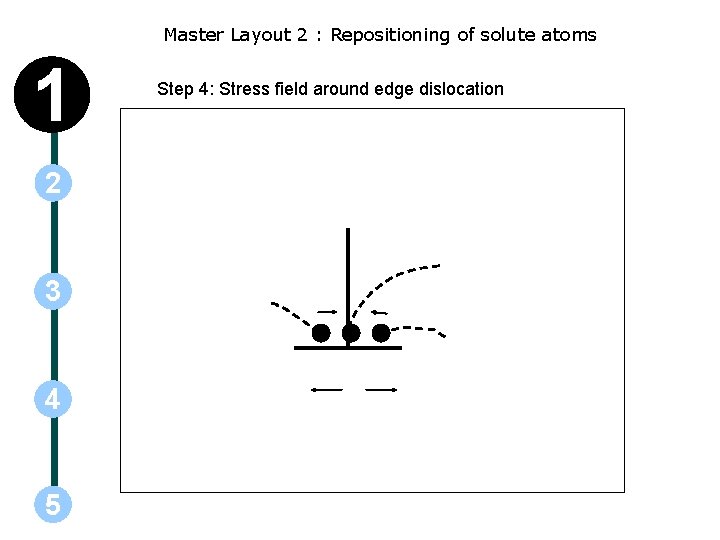
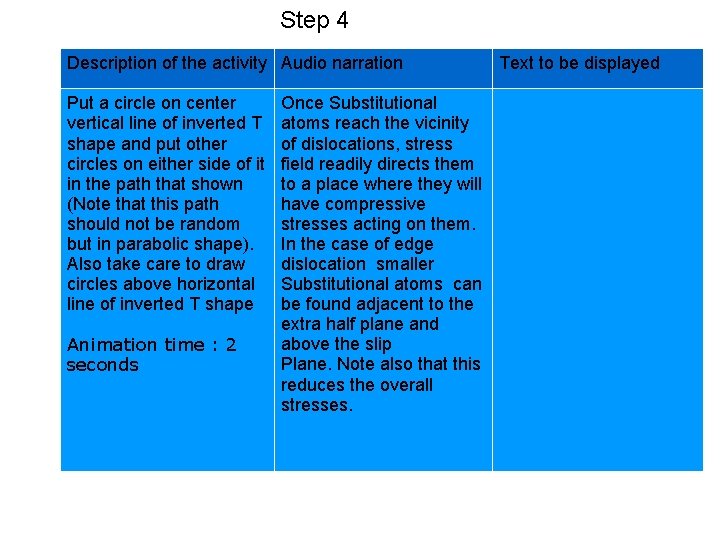
Step 4 Description of the activity Audio narration Put a circle on center vertical line of inverted T shape and put other circles on either side of it in the path that shown (Note that this path should not be random but in parabolic shape). Also take care to draw circles above horizontal line of inverted T shape Animation time : 2 seconds Once Substitutional atoms reach the vicinity of dislocations, stress field readily directs them to a place where they will have compressive stresses acting on them. In the case of edge dislocation smaller Substitutional atoms can be found adjacent to the extra half plane and above the slip Plane. Note also that this reduces the overall stresses. Text to be displayed
Master Layout 2 : Repositioning of solute atoms 1 2 3 4 5 Step 5: Repositioning of larger atoms
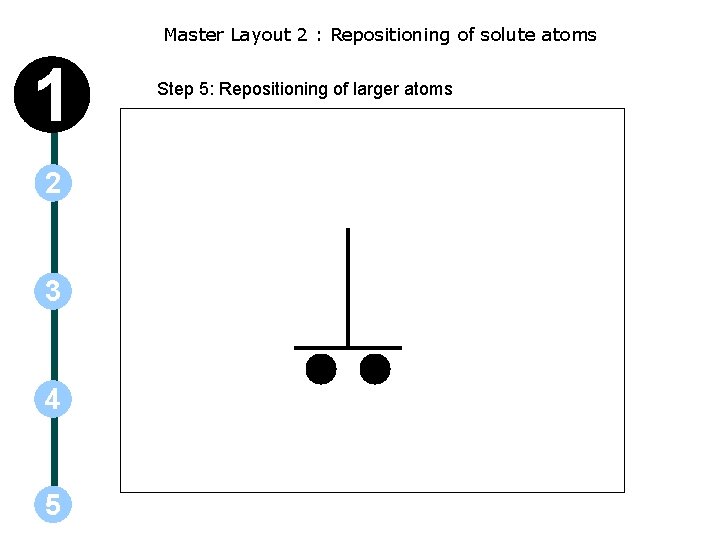
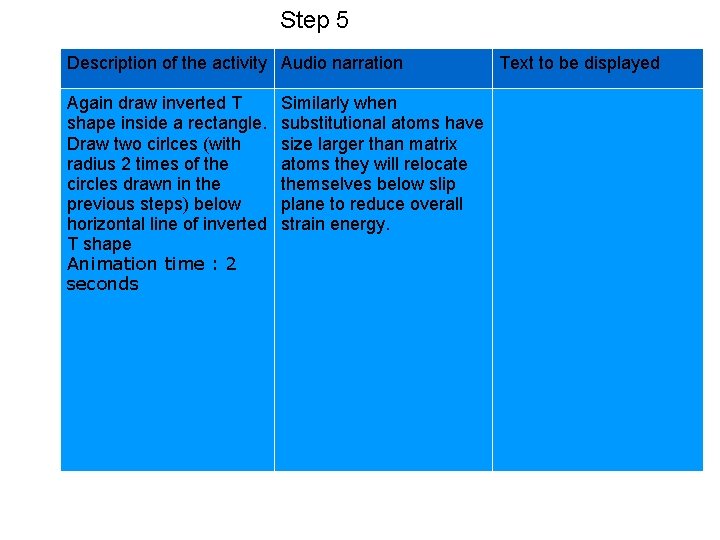
Step 5 Description of the activity Audio narration Again draw inverted T shape inside a rectangle. Draw two cirlces (with radius 2 times of the circles drawn in the previous steps) below horizontal line of inverted T shape Animation time : 2 seconds Similarly when substitutional atoms have size larger than matrix atoms they will relocate themselves below slip plane to reduce overall strain energy. Text to be displayed
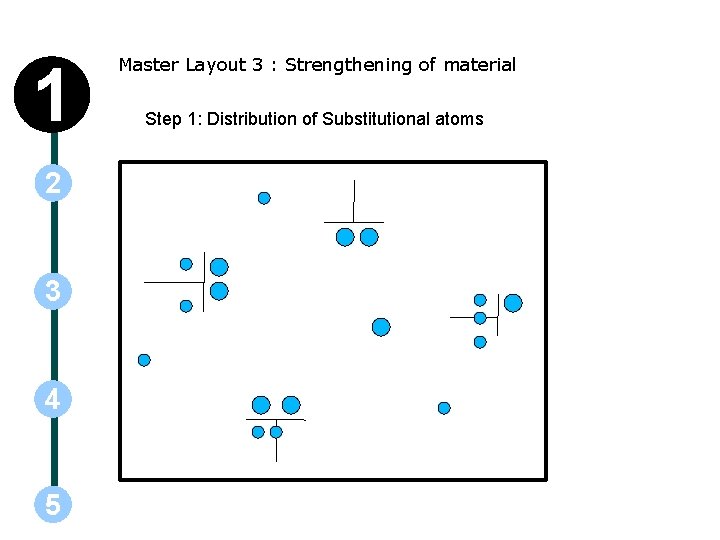
1 2 3 4 5 Master Layout 3 : Strengthening of material Step 1: Distribution of Substitutional atoms
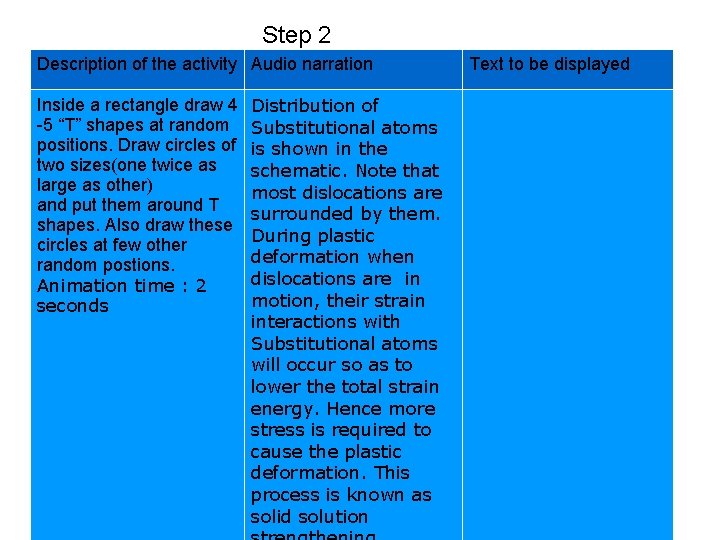
Step 2 Description of the activity Audio narration Inside a rectangle draw 4 -5 “T” shapes at random positions. Draw circles of two sizes(one twice as large as other) and put them around T shapes. Also draw these circles at few other random postions. Animation time : 2 seconds Distribution of Substitutional atoms is shown in the schematic. Note that most dislocations are surrounded by them. During plastic deformation when dislocations are in motion, their strain interactions with Substitutional atoms will occur so as to lower the total strain energy. Hence more stress is required to cause the plastic deformation. This process is known as solid solution Text to be displayed
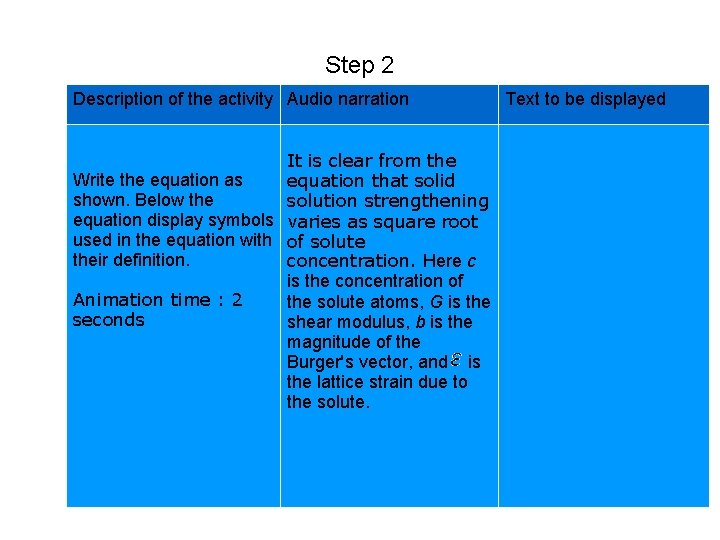
Master Layout 4 : Quantification of Solid Solution Strengthening Step 1: strength dependence on solute atom concentration = Increase in yield strength = concentration of the solute atoms = Burgers vector magnitude = Lattice strain due to solute atom = Shear Modulus
Step 2 Description of the activity Audio narration It is clear from the Write the equation as equation that solid shown. Below the solution strengthening equation display symbols varies as square root used in the equation with of solute their definition. concentration. Here c is the concentration of Animation time : 2 the solute atoms, G is the seconds shear modulus, b is the magnitude of the Burger's vector, and is the lattice strain due to the solute. Text to be displayed
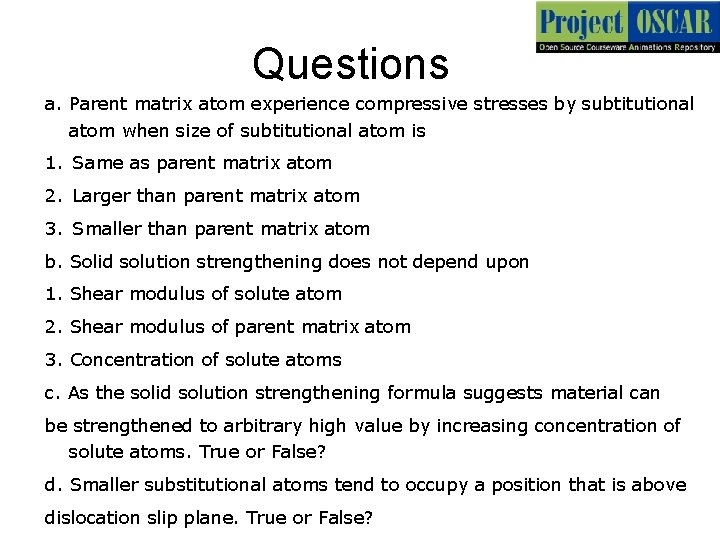
Questions a. Parent matrix atom experience compressive stresses by subtitutional atom when size of subtitutional atom is 1. Same as parent matrix atom 2. Larger than parent matrix atom 3. Smaller than parent matrix atom b. Solid solution strengthening does not depend upon 1. Shear modulus of solute atom 2. Shear modulus of parent matrix atom 3. Concentration of solute atoms c. As the solid solution strengthening formula suggests material can be strengthened to arbitrary high value by increasing concentration of solute atoms. True or False? d. Smaller substitutional atoms tend to occupy a position that is above dislocation slip plane. True or False?
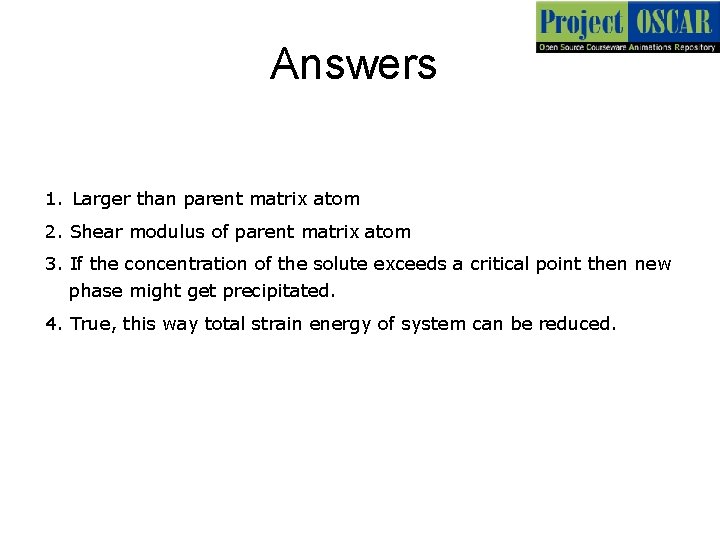
Answers 1. Larger than parent matrix atom 2. Shear modulus of parent matrix atom 3. If the concentration of the solute exceeds a critical point then new phase might get precipitated. 4. True, this way total strain energy of system can be reduced.
Links for further reading Reference websites: 1. http: //en. wikipedia. org/wiki/Solid_solution_strengthening Books: 1. G. Dieter, Mechanical Metallurgy, Third Edition(1986), Mc. Graw Hill Book Company. 2. W. Callister, Materials Science and Engineering - An Introduction, Seventh Edition(2007), John Wiley & Sons, Inc. Research papers:
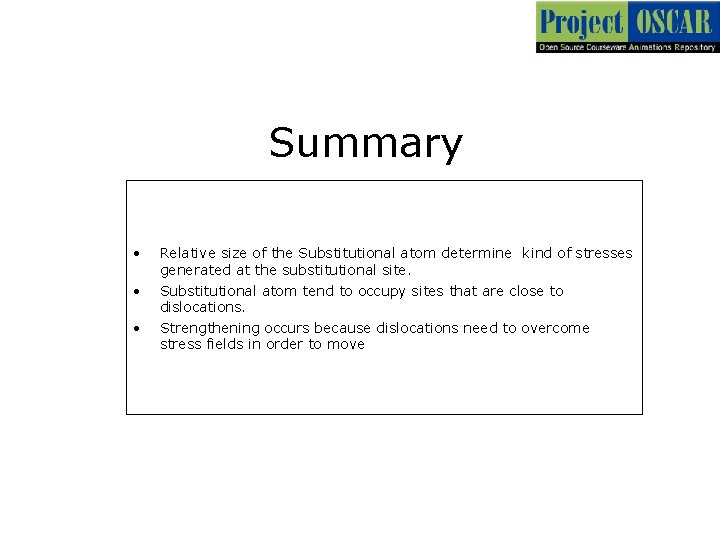
Summary • • • Relative size of the Substitutional atom determine kind of stresses generated at the substitutional site. Substitutional atom tend to occupy sites that are close to dislocations. Strengthening occurs because dislocations need to overcome stress fields in order to move