
Solid phase peptide synthesis Part II Application of


- Slides: 29
Solid phase peptide synthesis Part II Application of Fmoc/t. Bu strategy Gábor Mező Research Group of Peptide Chemistry Hungarian Academy of Sciences Eötvös L. University Budapest, Hungary
Outline ü Resins; ü Protecting groups; ü Synthetic protocol; ü Monitoring; ü Cleavage technics; ü Side reactions;
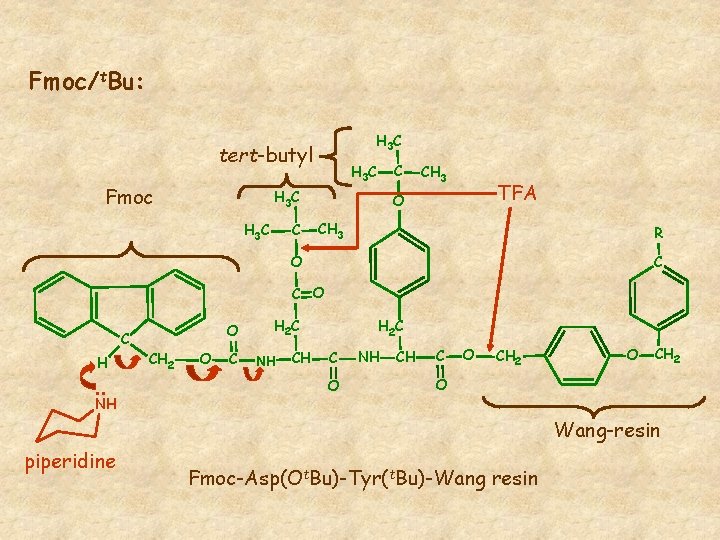
Fmoc/t. Bu: H 3 C tert-butyl Fmoc C H 3 C CH 3 TFA O CH 3 R C O O C H . . NH CH 2 O C H 2 C NH CH H 2 C C O NH CH C O CH 2 O Wang-resin piperidine Fmoc-Asp(Ot. Bu)-Tyr(t. Bu)-Wang resin
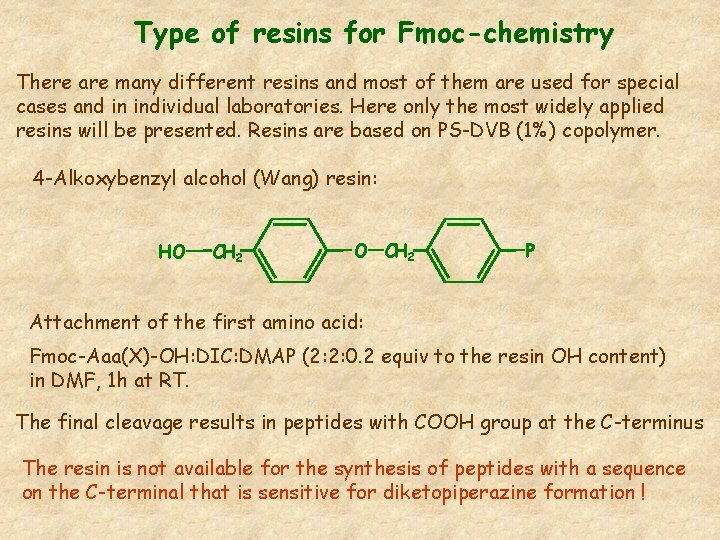
Type of resins for Fmoc-chemistry There are many different resins and most of them are used for special cases and in individual laboratories. Here only the most widely applied resins will be presented. Resins are based on PS-DVB (1%) copolymer. 4 -Alkoxybenzyl alcohol (Wang) resin: HO CH 2 P Attachment of the first amino acid: Fmoc-Aaa(X)-OH: DIC: DMAP (2: 2: 0. 2 equiv to the resin OH content) in DMF, 1 h at RT. The final cleavage results in peptides with COOH group at the C-terminus The resin is not available for the synthesis of peptides with a sequence on the C-terminal that is sensitive for diketopiperazine formation !
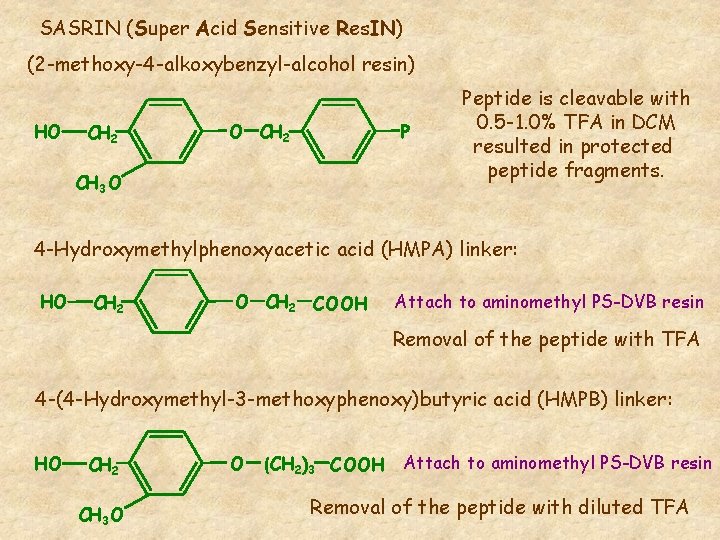
SASRIN (Super Acid Sensitive Res. IN) (2 -methoxy-4 -alkoxybenzyl-alcohol resin) HO CH 2 P CH 3 O Peptide is cleavable with 0. 5 -1. 0% TFA in DCM resulted in protected peptide fragments. 4 -Hydroxymethylphenoxyacetic acid (HMPA) linker: HO CH 2 C OOH Attach to aminomethyl PS-DVB resin Removal of the peptide with TFA 4 -(4 -Hydroxymethyl-3 -methoxyphenoxy)butyric acid (HMPB) linker: HO CH 2 CH 3 O O (CH 2)3 C OOH Attach to aminomethyl PS-DVB resin Removal of the peptide with diluted TFA
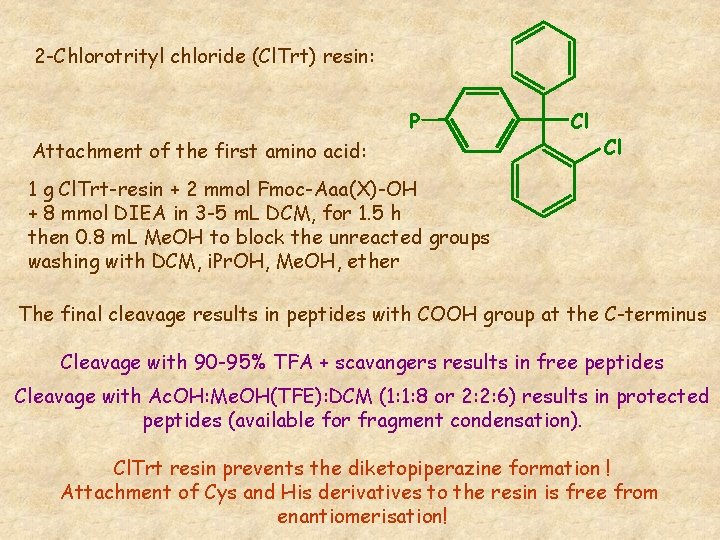
2 -Chlorotrityl chloride (Cl. Trt) resin: P Attachment of the first amino acid: Cl Cl 1 g Cl. Trt-resin + 2 mmol Fmoc-Aaa(X)-OH + 8 mmol DIEA in 3 -5 m. L DCM, for 1. 5 h then 0. 8 m. L Me. OH to block the unreacted groups washing with DCM, i. Pr. OH, Me. OH, ether The final cleavage results in peptides with COOH group at the C-terminus Cleavage with 90 -95% TFA + scavangers results in free peptides Cleavage with Ac. OH: Me. OH(TFE): DCM (1: 1: 8 or 2: 2: 6) results in protected peptides (available for fragment condensation). Cl. Trt resin prevents the diketopiperazine formation ! Attachment of Cys and His derivatives to the resin is free from enantiomerisation!
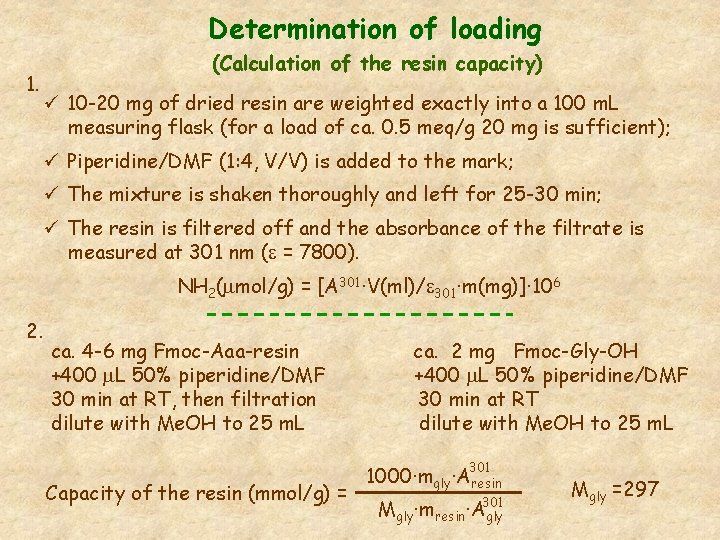
Determination of loading 1. (Calculation of the resin capacity) ü 10 -20 mg of dried resin are weighted exactly into a 100 m. L measuring flask (for a load of ca. 0. 5 meq/g 20 mg is sufficient); ü Piperidine/DMF (1: 4, V/V) is added to the mark; ü The mixture is shaken thoroughly and left for 25 -30 min; ü The resin is filtered off and the absorbance of the filtrate is measured at 301 nm (e = 7800). NH 2(mmol/g) = [A 301. V(ml)/e 301. m(mg)]. 106 2. ca. 4 -6 mg Fmoc-Aaa-resin +400 m. L 50% piperidine/DMF 30 min at RT, then filtration dilute with Me. OH to 25 m. L ca. 2 mg Fmoc-Gly-OH +400 m. L 50% piperidine/DMF 30 min at RT dilute with Me. OH to 25 m. L 301 Capacity of the resin (mmol/g) = 1000. mgly. Aresin Mgly . m . A 301 resin gly Mgly =297
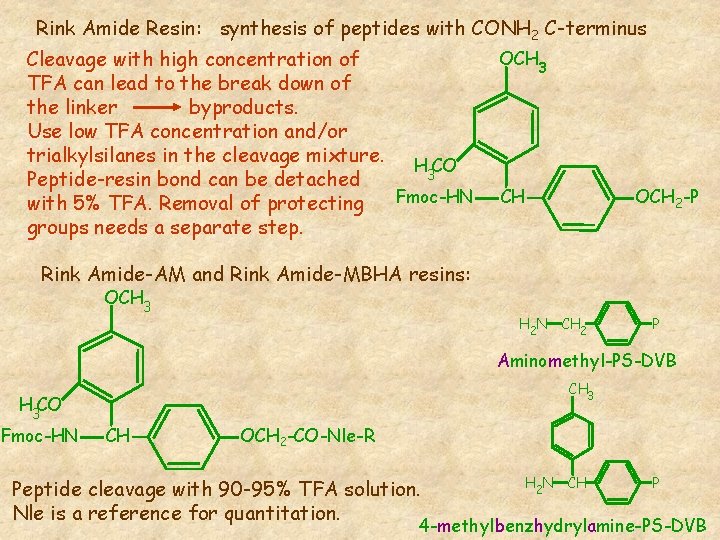
Rink Amide Resin: synthesis of peptides with CONH 2 C-terminus Cleavage with high concentration of TFA can lead to the break down of the linker byproducts. Use low TFA concentration and/or trialkylsilanes in the cleavage mixture. H 3 CO Peptide-resin bond can be detached Fmoc-HN with 5% TFA. Removal of protecting groups needs a separate step. OCH 3 CH OCH 2 -P Rink Amide-AM and Rink Amide-MBHA resins: OCH 3 H 2 N CH 2 P Aminomethyl-PS-DVB H 3 CO Fmoc-HN CH 3 CH OCH 2 -CO-Nle-R Peptide cleavage with 90 -95% TFA solution. Nle is a reference for quantitation. H 2 N CH P 4 -methylbenzhydrylamine-PS-DVB
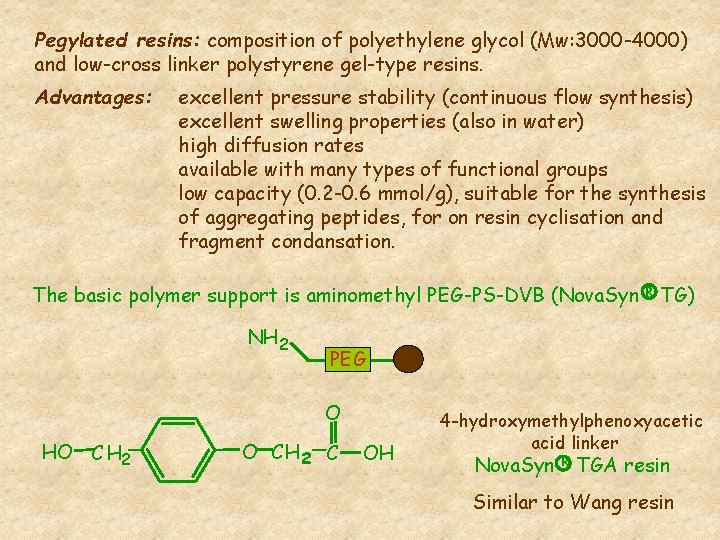
Pegylated resins: composition of polyethylene glycol (Mw: 3000 -4000) and low-cross linker polystyrene gel-type resins. Advantages: excellent pressure stability (continuous flow synthesis) excellent swelling properties (also in water) high diffusion rates available with many types of functional groups low capacity (0. 2 -0. 6 mmol/g), suitable for the synthesis of aggregating peptides, for on resin cyclisation and fragment condansation. The basic polymer support is aminomethyl PEG-PS-DVB (Nova. Syn NH 2 TG) PEG O HO C H 2 R O CH 2 C OH 4 -hydroxymethylphenoxyacetic acid linker Nova. Syn R TGA resin Similar to Wang resin
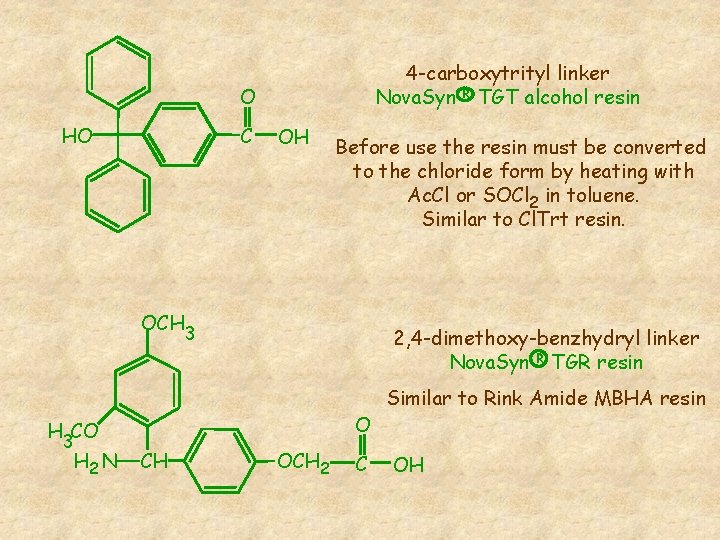
4 -carboxytrityl linker Nova. Syn R TGT alcohol resin O HO C OH Before use the resin must be converted to the chloride form by heating with Ac. Cl or SOCl 2 in toluene. Similar to Cl. Trt resin. OCH 3 H CO 3 H 2 N 2, 4 -dimethoxy-benzhydryl linker Nova. Syn R TGR resin O CH OCH 2 C Similar to Rink Amide MBHA resin OH
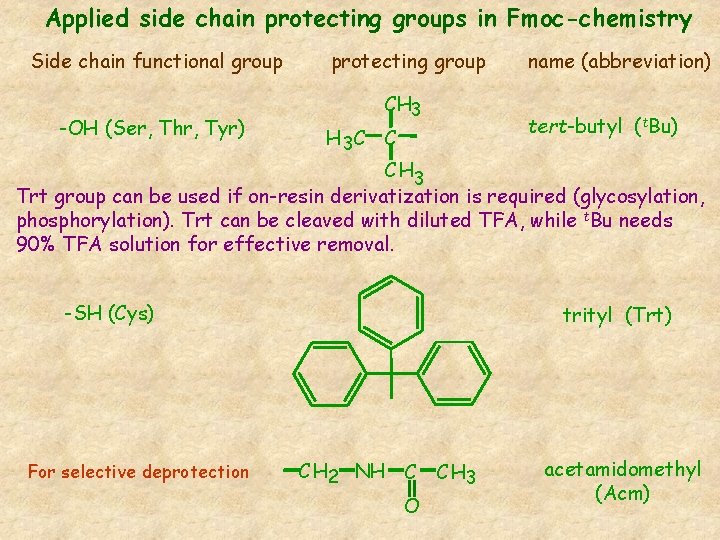
Applied side chain protecting groups in Fmoc-chemistry Side chain functional group -OH (Ser, Thr, Tyr) protecting group CH 3 H 3 C C name (abbreviation) tert-butyl (t. Bu) CH 3 Trt group can be used if on-resin derivatization is required (glycosylation, phosphorylation). Trt can be cleaved with diluted TFA, while t. Bu needs 90% TFA solution for effective removal. -SH (Cys) For selective deprotection trityl (Trt) CH 2 NH C CH 3 O acetamidomethyl (Acm)
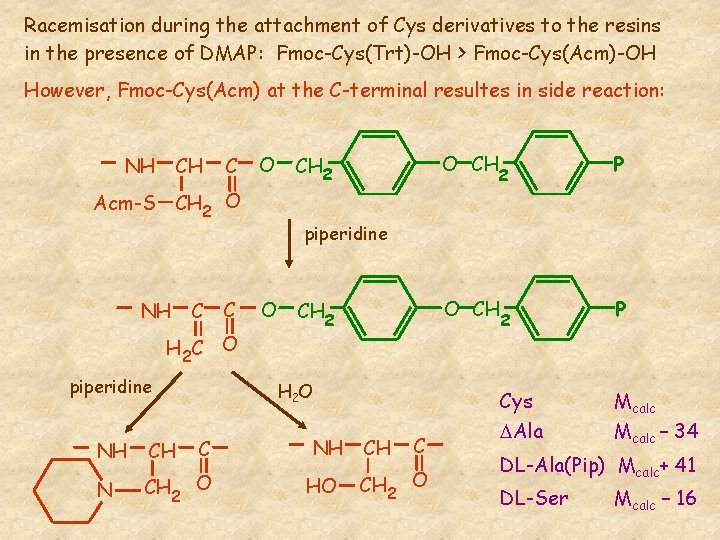
Racemisation during the attachment of Cys derivatives to the resins in the presence of DMAP: Fmoc-Cys(Trt)-OH > Fmoc-Cys(Acm)-OH However, Fmoc-Cys(Acm) at the C-terminal resultes in side reaction: NH CH C O Acm-S CH 2 O NH C C H 2 C O piperidine CH 2 O CH 2 P piperidine O CH 2 O Cys C NH CH N CH 2 O HO CH 2 O DAla Mcalc – 34 DL-Ala(Pip) Mcalc+ 41 DL-Ser Mcalc – 16
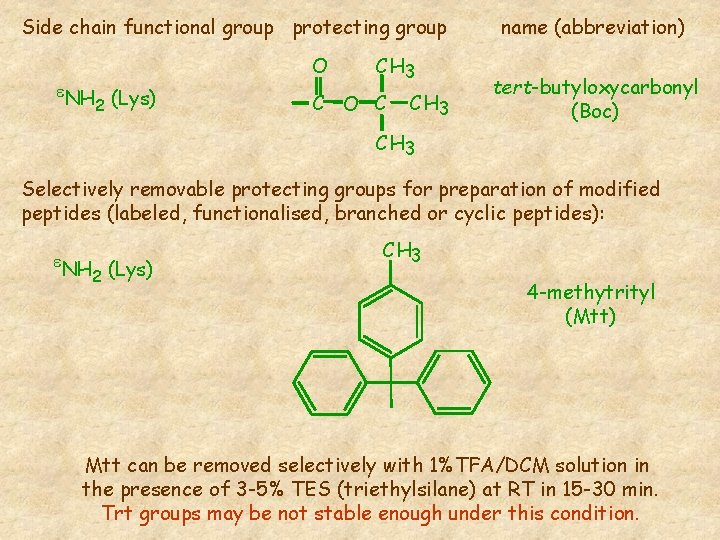
Side chain functional group protecting group e. NH (Lys) 2 O CH 3 C O C CH 3 name (abbreviation) tert-butyloxycarbonyl (Boc) CH 3 Selectively removable protecting groups for preparation of modified peptides (labeled, functionalised, branched or cyclic peptides): e. NH (Lys) 2 CH 3 4 -methytrityl (Mtt) Mtt can be removed selectively with 1%TFA/DCM solution in the presence of 3 -5% TES (triethylsilane) at RT in 15 -30 min. Trt groups may be not stable enough under this condition.
Side chain functional group protecting group O R CH 3 e. NH (Lys) C 2 CH 3 O R = metil 1, isopropyl 2 iv. Dde is more stable in basic cleavage mixture applied for Fmoc removal than Dde. name (abbreviation) 1 -(4, 4 -dimethyl 2, 6 -dioxocyclohex-1 ylidene)ethyl (Dde)1 1 -(4, 4 -dimethyl 2, 6 -dioxocyclohex-1 ylidene)-3 -methylbutyl (iv. Dde)2 Both protecting groups can be removed with 2% NH 2 -NH 2 in DMF e. NH (Lys) 2 O CH 2 CH CH 2 allyloxycarbonyl (Aloc) Aloc protecting group is compatible with Boc as well as Fmoc-chemistry. It is stable in acids and bases. It can be removed in P(Ph)3 by Pd(0) catalysis. To prevent addition on double bond under other cleavage conditions application of allyl alcohol in cleavage mixtures is recommended.
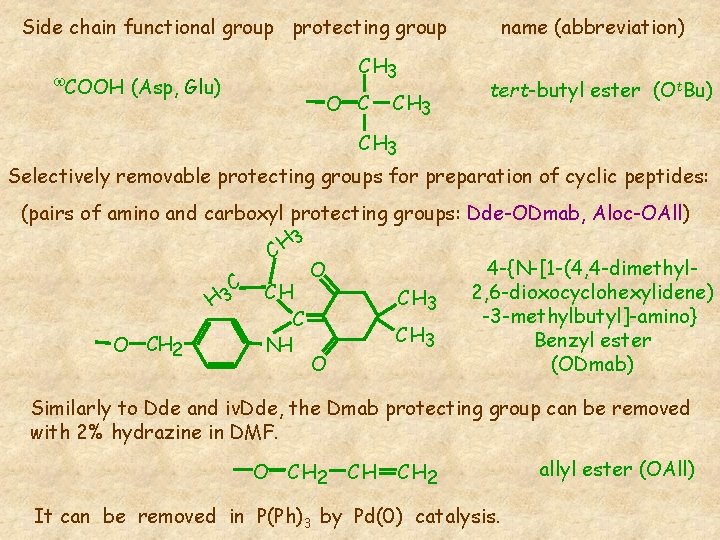
Side chain functional group protecting group CH 3 w. COOH (Asp, Glu) O C CH 3 name (abbreviation) tert-butyl ester (Ot. Bu) CH 3 Selectively removable protecting groups for preparation of cyclic peptides: (pairs of amino and carboxyl protecting groups: Dde-ODmab, Aloc-OAll) CH C H 3 O CH 2 3 CH C NH O CH 3 O 4 -{N-[1 -(4, 4 -dimethyl 2, 6 -dioxocyclohexylidene) -3 -methylbutyl]-amino} Benzyl ester (ODmab) Similarly to Dde and iv. Dde, the Dmab protecting group can be removed with 2% hydrazine in DMF. O CH 2 CH CH 2 It can be removed in P(Ph)3 by Pd(0) catalysis. allyl ester (OAll)
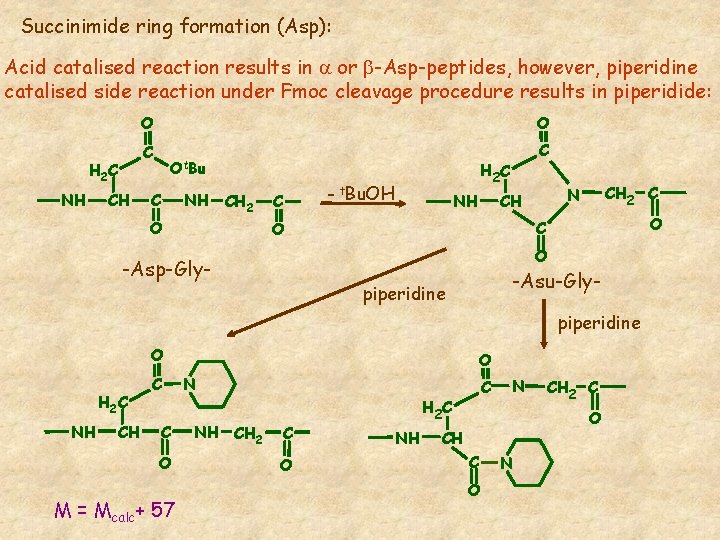
Succinimide ring formation (Asp): Acid catalised reaction results in a or b-Asp-peptides, however, piperidine catalised side reaction under Fmoc cleavage procedure results in piperidide: H 2 C NH CH O O C C Ot. Bu C NH CH 2 O C H 2 C - t. Bu. OH NH CH 2 C N CH O C O O -Asp-Gly- -Asu-Gly- piperidine O H 2 C NH CH C C O M = Mcalc+ 57 O N NH CH 2 C O C H 2 C NH N CH 2 C O CH C O N
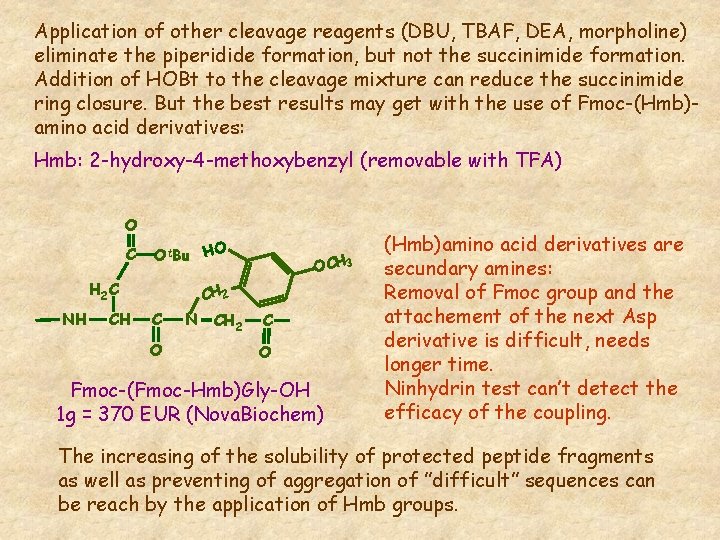
Application of other cleavage reagents (DBU, TBAF, DEA, morpholine) eliminate the piperidide formation, but not the succinimide formation. Addition of HOBt to the cleavage mixture can reduce the succinimide ring closure. But the best results may get with the use of Fmoc-(Hmb)amino acid derivatives: Hmb: 2 -hydroxy-4 -methoxybenzyl (removable with TFA) O C Ot. Bu HO H 2 C NH CH OCH 3 CH 2 C O N CH 2 C O Fmoc-(Fmoc-Hmb)Gly-OH 1 g = 370 EUR (Nova. Biochem) (Hmb)amino acid derivatives are secundary amines: Removal of Fmoc group and the attachement of the next Asp derivative is difficult, needs longer time. Ninhydrin test can’t detect the efficacy of the coupling. The increasing of the solubility of protected peptide fragments as well as preventing of aggregation of ”difficult” sequences can be reach by the application of Hmb groups.
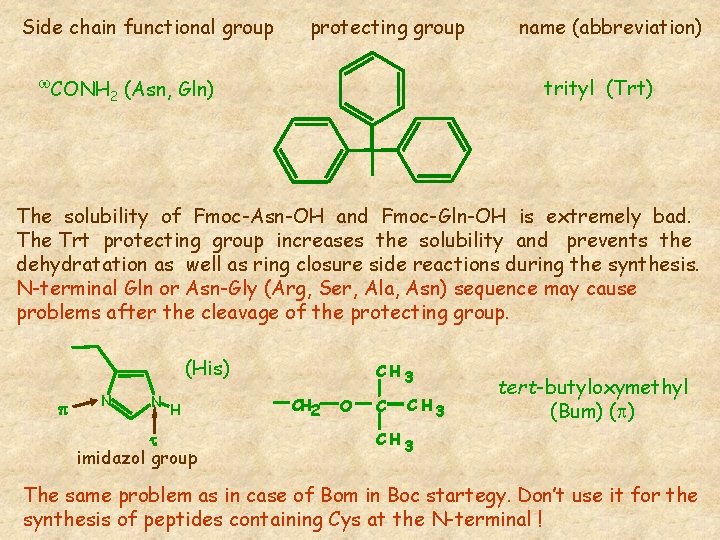
Side chain functional group protecting group w. CONH (Asn, Gln) 2 name (abbreviation) trityl (Trt) The solubility of Fmoc-Asn-OH and Fmoc-Gln-OH is extremely bad. The Trt protecting group increases the solubility and prevents the dehydratation as well as ring closure side reactions during the synthesis. N-terminal Gln or Asn-Gly (Arg, Ser, Ala, Asn) sequence may cause problems after the cleavage of the protecting group. (His) p N N H t imidazol group C H 3 CH 2 O C C H 3 tert-butyloxymethyl (Bum) (p) C H 3 The same problem as in case of Bom in Boc startegy. Don’t use it for the synthesis of peptides containing Cys at the N-terminal !
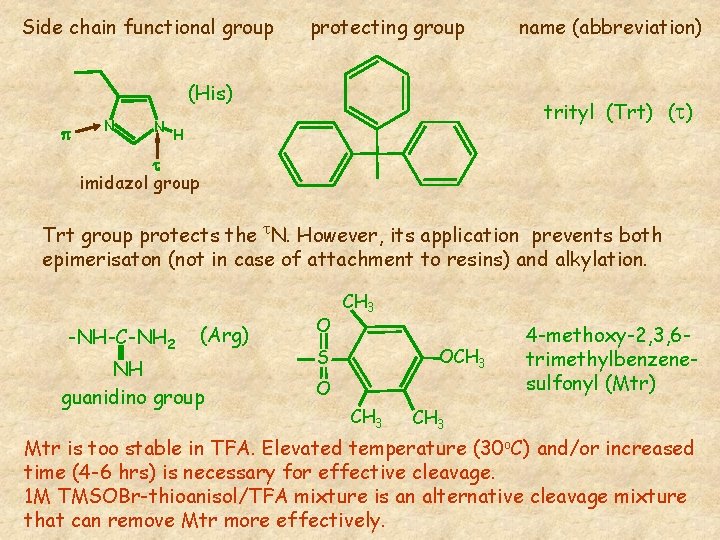
Side chain functional group protecting group (His) p N N name (abbreviation) trityl (Trt) (t) H t imidazol group Trt group protects the t. N. However, its application prevents both epimerisaton (not in case of attachment to resins) and alkylation. -NH-C-NH 2 (Arg) NH guanidino group O CH 3 OCH 3 S O CH 3 4 -methoxy-2, 3, 6 trimethylbenzenesulfonyl (Mtr) CH 3 Mtr is too stable in TFA. Elevated temperature (30 o. C) and/or increased time (4 -6 hrs) is necessary for effective cleavage. 1 M TMSOBr-thioanisol/TFA mixture is an alternative cleavage mixture that can remove Mtr more effectively.
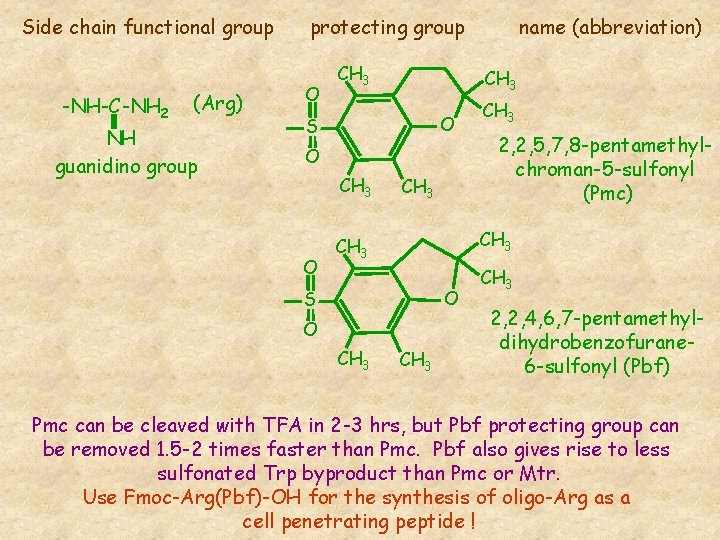
Side chain functional group -NH-C-NH 2 (Arg) NH guanidino group protecting group O CH 3 O S O CH 3 2, 2, 5, 7, 8 -pentamethylchroman-5 -sulfonyl (Pmc) CH 3 O S O CH 3 name (abbreviation) CH 3 2, 2, 4, 6, 7 -pentamethyldihydrobenzofurane 6 -sulfonyl (Pbf) Pmc can be cleaved with TFA in 2 -3 hrs, but Pbf protecting group can be removed 1. 5 -2 times faster than Pmc. Pbf also gives rise to less sulfonated Trp byproduct than Pmc or Mtr. Use Fmoc-Arg(Pbf)-OH for the synthesis of oligo-Arg as a cell penetrating peptide !
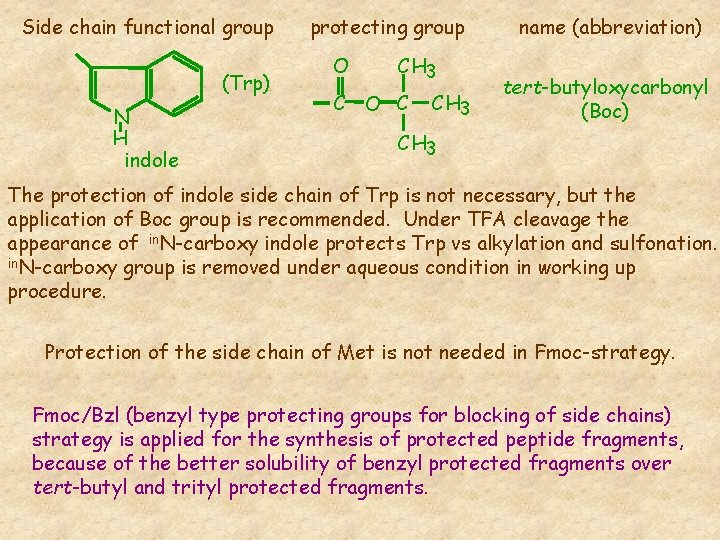
Side chain functional group (Trp) N H indole protecting group O CH 3 C O C CH 3 name (abbreviation) tert-butyloxycarbonyl (Boc) CH 3 The protection of indole side chain of Trp is not necessary, but the application of Boc group is recommended. Under TFA cleavage the appearance of in. N-carboxy indole protects Trp vs alkylation and sulfonation. in. N-carboxy group is removed under aqueous condition in working up procedure. Protection of the side chain of Met is not needed in Fmoc-strategy. Fmoc/Bzl (benzyl type protecting groups for blocking of side chains) strategy is applied for the synthesis of protected peptide fragments, because of the better solubility of benzyl protected fragments over tert-butyl and trityl protected fragments.
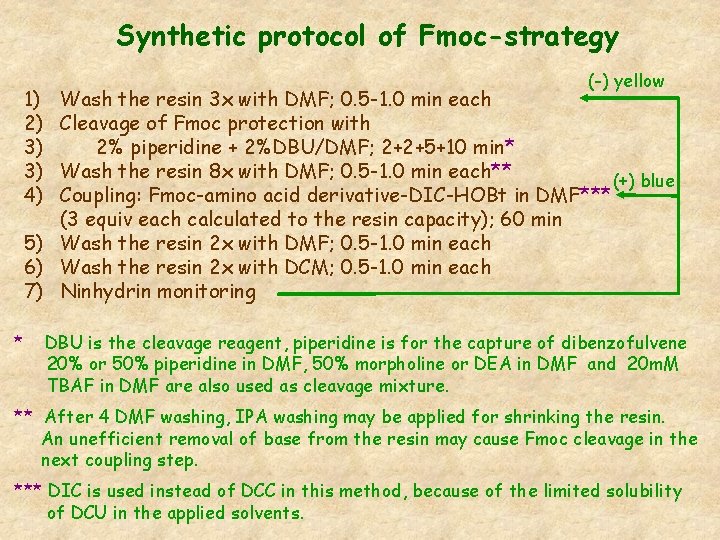
Synthetic protocol of Fmoc-strategy 1) 2) 3) 3) 4) (-) yellow Wash the resin 3 x with DMF; 0. 5 -1. 0 min each Cleavage of Fmoc protection with 2% piperidine + 2%DBU/DMF; 2+2+5+10 min* Wash the resin 8 x with DMF; 0. 5 -1. 0 min each** (+) blue Coupling: Fmoc-amino acid derivative-DIC-HOBt in DMF*** (3 equiv each calculated to the resin capacity); 60 min 5) Wash the resin 2 x with DMF; 0. 5 -1. 0 min each 6) Wash the resin 2 x with DCM; 0. 5 -1. 0 min each 7) Ninhydrin monitoring * DBU is the cleavage reagent, piperidine is for the capture of dibenzofulvene 20% or 50% piperidine in DMF, 50% morpholine or DEA in DMF and 20 m. M TBAF in DMF are also used as cleavage mixture. ** After 4 DMF washing, IPA washing may be applied for shrinking the resin. An unefficient removal of base from the resin may cause Fmoc cleavage in the next coupling step. *** DIC is used instead of DCC in this method, because of the limited solubility of DCU in the applied solvents.
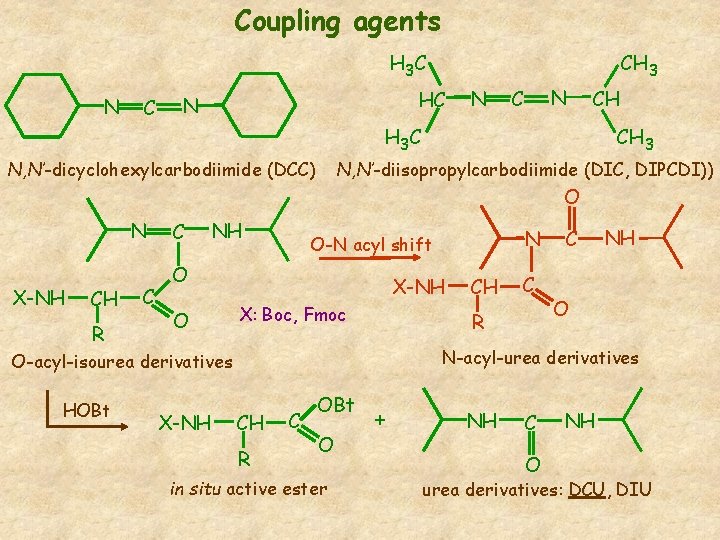
Coupling agents H 3 C N C CH 3 HC N N N C CH H 3 C CH 3 N, N’-diisopropylcarbodiimide (DIC, DIPCDI)) N, N’-dicyclohexylcarbodiimide (DCC) O N X-NH CH R C C NH O O X-NH X: Boc, Fmoc X-NH CH C R C NH O N-acyl-urea derivatives O-acyl-isourea derivatives HOBt N O-N acyl shift CH R C OBt O in situ active ester + NH C O NH urea derivatives: DCU, DIU
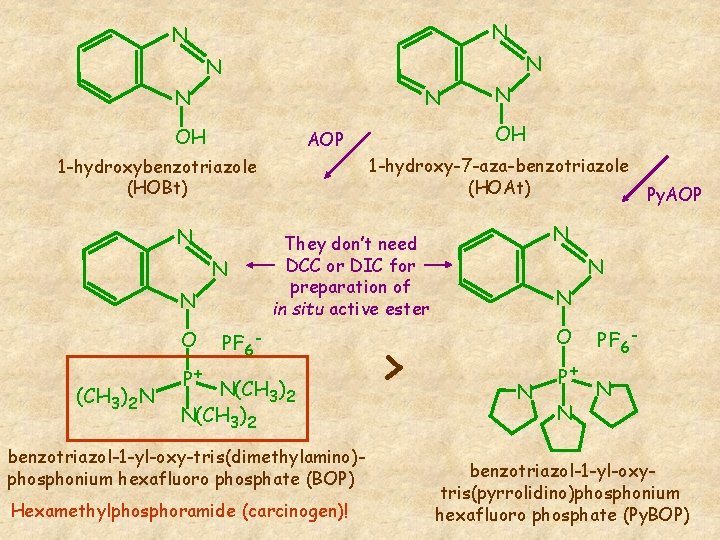
N N N OH 1 -hydroxy-7 -aza-benzotriazole (HOAt) Py. AOP 1 -hydroxybenzotriazole (HOBt) N N O (CH 3)2 N OH AOP N N N They don’t need DCC or DIC for preparation of in situ active ester PF 6 - P+ N(CH ) 3 2 N(CH 3)2 benzotriazol-1 -yl-oxy-tris(dimethylamino)phosphonium hexafluoro phosphate (BOP) Hexamethylphosphoramide (carcinogen)! > N N O N P+ N PF 6 N benzotriazol-1 -yl-oxytris(pyrrolidino)phosphonium hexafluoro phosphate (Py. BOP)
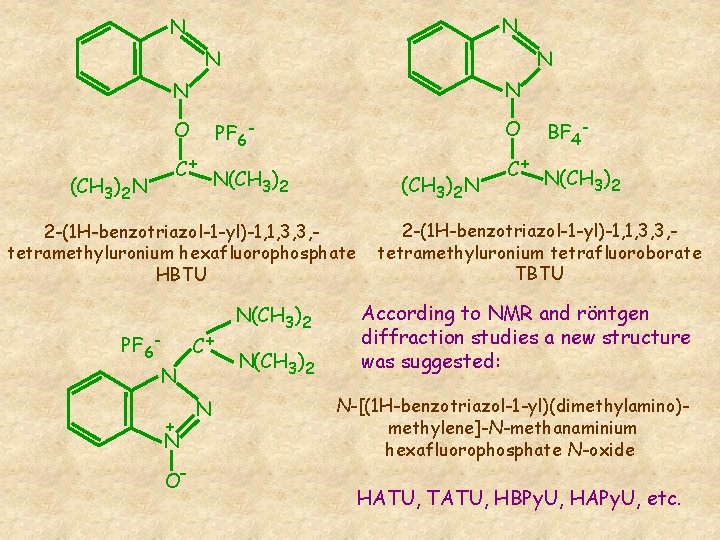
N N N O O PF 6 - C+ N(CH ) 3 2 (CH 3)2 N 2 -(1 H-benzotriazol-1 -yl)-1, 1, 3, 3, tetramethyluronium hexafluorophosphate HBTU PF 6 - C+ N O- N N(CH 3)2 BF 4 - C+ N(CH ) 3 2 2 -(1 H-benzotriazol-1 -yl)-1, 1, 3, 3, tetramethyluronium tetrafluoroborate TBTU According to NMR and röntgen diffraction studies a new structure was suggested: N-[(1 H-benzotriazol-1 -yl)(dimethylamino)methylene]-N-methanaminium hexafluorophosphate N-oxide HATU, TATU, HBPy. U, HAPy. U, etc.
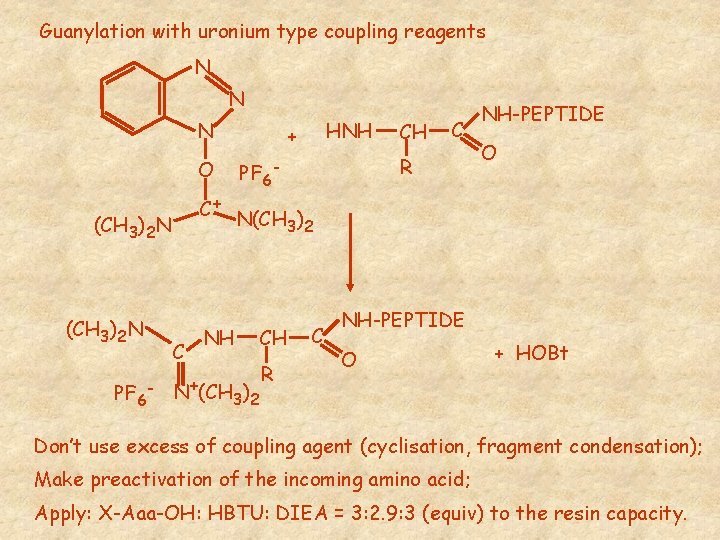
Guanylation with uronium type coupling reagents N N N O PF 6 C - PF 6 CH C R - O C+ N(CH ) 3 2 (CH 3)2 N HNH + NH-PEPTIDE NH N+(CH CH 3 )2 R C NH-PEPTIDE O + HOBt Don’t use excess of coupling agent (cyclisation, fragment condensation); Make preactivation of the incoming amino acid; Apply: X-Aaa-OH: HBTU: DIEA = 3: 2. 9: 3 (equiv) to the resin capacity.
Fmoc cleavage flow chart Does the peptide contain N-terminal Fmoc group? yes no Remove Fmoc Does the peptide contain Arg, Met, Trp or Trt? yes Does the peptide contain Arg, Met? no Use cleavage mixture A no yes Use cleavage mixture B yes Use cleavage mixture C A: 0. 5 m. L d. i. water 9. 5 m. L TFA Does the peptide contain Trp or Trt? no B: 0. 75 g cryst. phenol 0. 25 m. L EDT C: 0. 25 m. L EDT 0. 50 m. L thioanisole 0. 25 m. L d. i. Water 0. 50 m. L d. i. water 9. 50 m. L TFA 10 m. L TFA
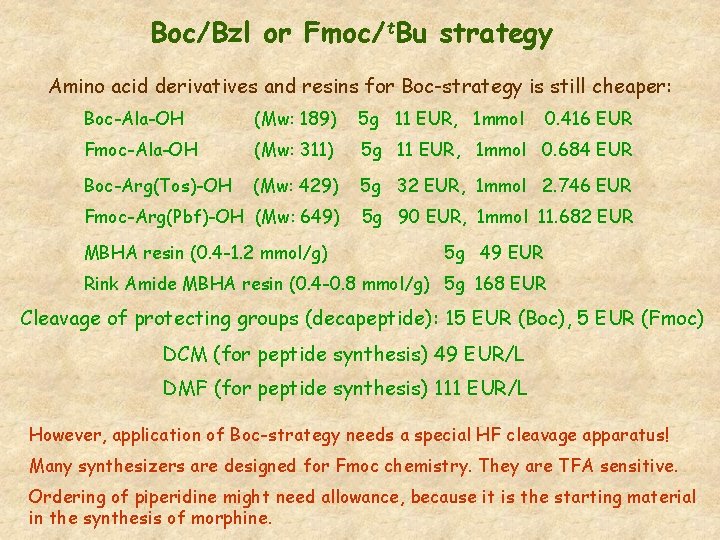
Boc/Bzl or Fmoc/t. Bu strategy Amino acid derivatives and resins for Boc-strategy is still cheaper: Boc-Ala-OH (Mw: 189) 5 g 11 EUR, 1 mmol Fmoc-Ala-OH (Mw: 311) 5 g 11 EUR, 1 mmol 0. 684 EUR Boc-Arg(Tos)-OH (Mw: 429) 5 g 32 EUR, 1 mmol 2. 746 EUR Fmoc-Arg(Pbf)-OH (Mw: 649) 5 g 90 EUR, 1 mmol 11. 682 EUR MBHA resin (0. 4 -1. 2 mmol/g) 0. 416 EUR 5 g 49 EUR Rink Amide MBHA resin (0. 4 -0. 8 mmol/g) 5 g 168 EUR Cleavage of protecting groups (decapeptide): 15 EUR (Boc), 5 EUR (Fmoc) DCM (for peptide synthesis) 49 EUR/L DMF (for peptide synthesis) 111 EUR/L However, application of Boc-strategy needs a special HF cleavage apparatus! Many synthesizers are designed for Fmoc chemistry. They are TFA sensitive. Ordering of piperidine might need allowance, because it is the starting material in the synthesis of morphine.
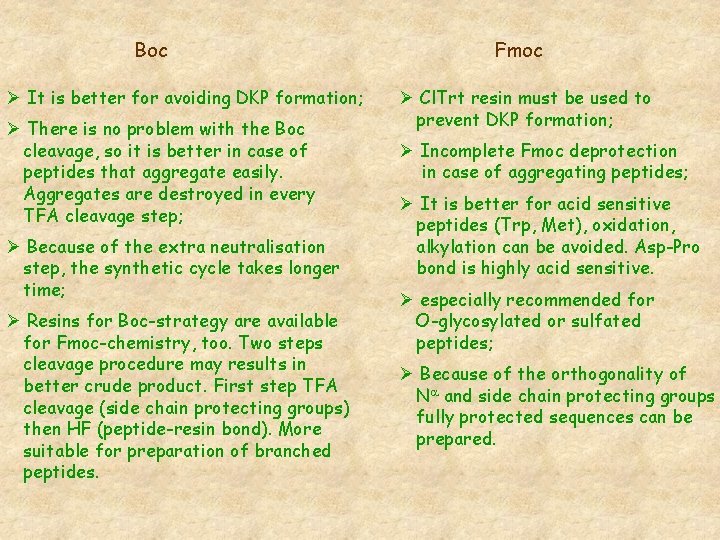
Boc Ø It is better for avoiding DKP formation; Ø There is no problem with the Boc cleavage, so it is better in case of peptides that aggregate easily. Aggregates are destroyed in every TFA cleavage step; Ø Because of the extra neutralisation step, the synthetic cycle takes longer time; Ø Resins for Boc-strategy are available for Fmoc-chemistry, too. Two steps cleavage procedure may results in better crude product. First step TFA cleavage (side chain protecting groups) then HF (peptide-resin bond). More suitable for preparation of branched peptides. Fmoc Ø Cl. Trt resin must be used to prevent DKP formation; Ø Incomplete Fmoc deprotection in case of aggregating peptides; Ø It is better for acid sensitive peptides (Trp, Met), oxidation, alkylation can be avoided. Asp-Pro bond is highly acid sensitive. Ø especially recommended for O-glycosylated or sulfated peptides; Ø Because of the orthogonality of Na and side chain protecting groups fully protected sequences can be prepared.