
Solid Phase Extraction SPE Or so when do


- Slides: 40
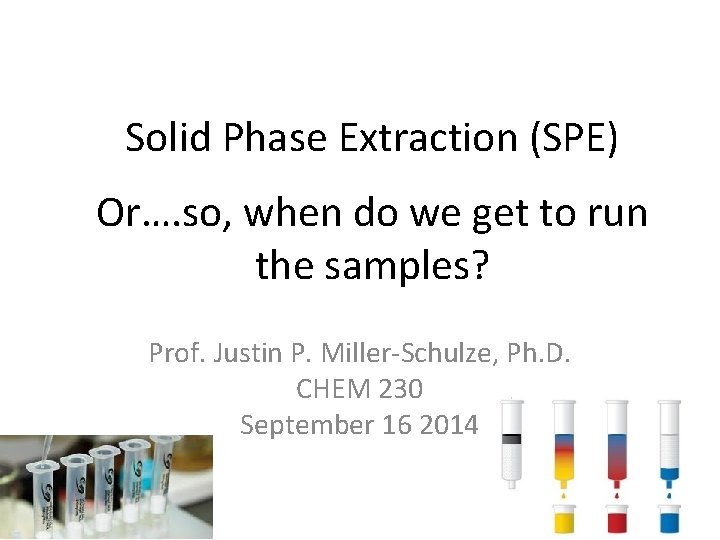
Solid Phase Extraction (SPE) Or…. so, when do we get to run the samples? Prof. Justin P. Miller-Schulze, Ph. D. CHEM 230 September 16 2014
Solid Phase Extraction (SPE) 1) 2) 3) 4) What is SPE? Types of SPE Why do we have to do SPE? SPE Method Development Example (s)
What is SPE? • Solid Phase Extraction is Liquid Chromatography (SPE is LC) – We are forcing the analyte to make a decision between remaining attached to the stationary phase or going with the mobile phase – In LC, this is upstream of a detector – In SPE, this is upstream of subsequent sample processing steps
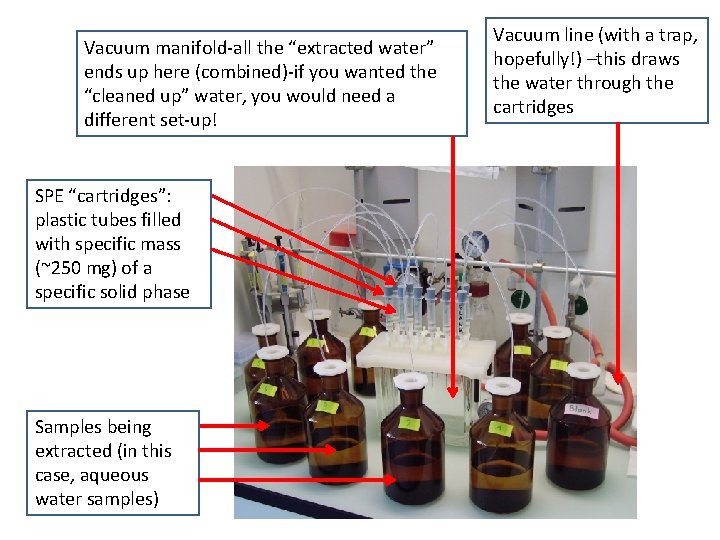
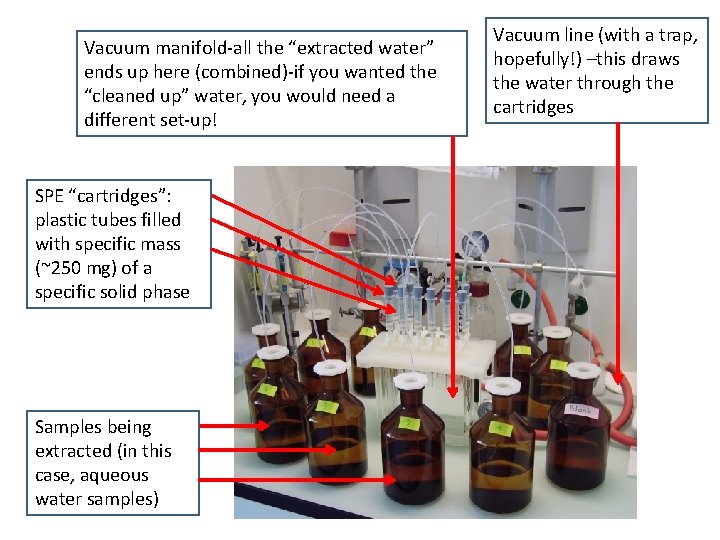
Vacuum manifold-all the “extracted water” ends up here (combined)-if you wanted the “cleaned up” water, you would need a different set-up! SPE “cartridges”: plastic tubes filled with specific mass (~250 mg) of a specific solid phase Samples being extracted (in this case, aqueous water samples) Vacuum line (with a trap, hopefully!) –this draws the water through the cartridges
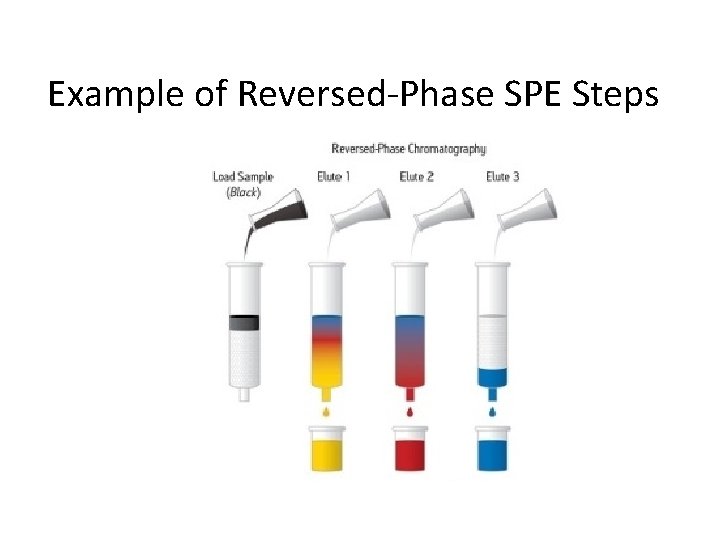
Example of Reversed-Phase SPE Steps
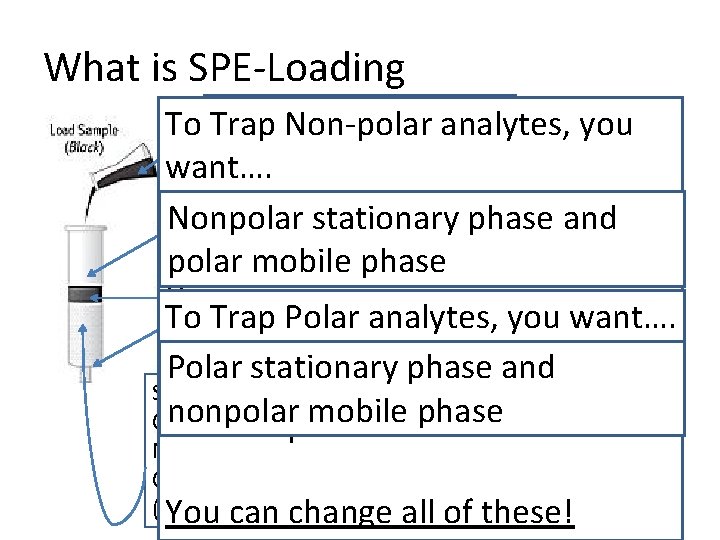
What is SPE-Loading Sample (contains analytes and To Non-polar analytes, you The. Trap efficiency of the loading step a bunch of other stuff) want…. (how many analyte molecules get Plastic or Glass cylinder “stuck” onto the stationary phase) Nonpolar stationary phase and is dependent on the polarity of polar mobile phase Frits (porous grate to keep the: solid phase from falling out) To Trap Polar analytes, you want…. -Analytes Polar stationary phase and -Stationary phase Solid Phasenonpolar mobile phase Can be reversed phase (i. e. , -Mobile phase C 18), Normal Phase (i. e. , silica) Cation or Anion exchange (with – charge groups) You+ orcan change all of these!
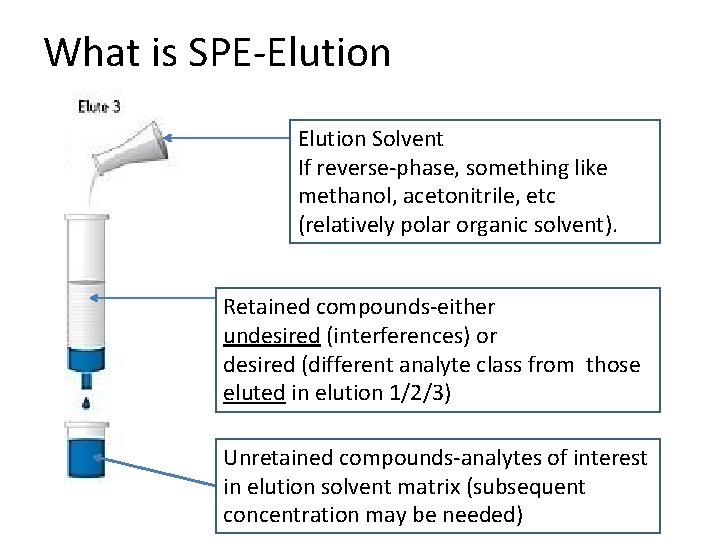
What is SPE-Elution Solvent If reverse-phase, something like methanol, acetonitrile, etc (relatively polar organic solvent). Retained compounds-either undesired (interferences) or desired (different analyte class from those eluted in elution 1/2/3) Unretained compounds-analytes of interest in elution solvent matrix (subsequent concentration may be needed)
Vacuum manifold-all the “extracted water” ends up here (combined)-if you wanted the “cleaned up” water, you would need a different set-up! SPE “cartridges”: plastic tubes filled with specific mass (~250 mg) of a specific solid phase Samples being extracted (in this case, aqueous water samples) Vacuum line (with a trap, hopefully!) –this draws the water through the cartridges
https: //www. youtube. com/watch? v=D 6 Sy. HU 6 Cc. OU
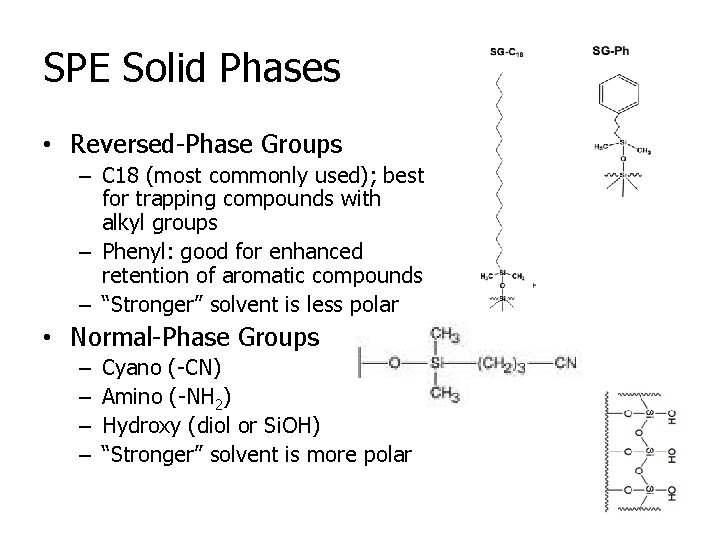
SPE Solid Phases • Reversed-Phase Groups – C 18 (most commonly used); best for trapping compounds with alkyl groups – Phenyl: good for enhanced retention of aromatic compounds – “Stronger” solvent is less polar • Normal-Phase Groups – – Cyano (-CN) Amino (-NH 2) Hydroxy (diol or Si. OH) “Stronger” solvent is more polar
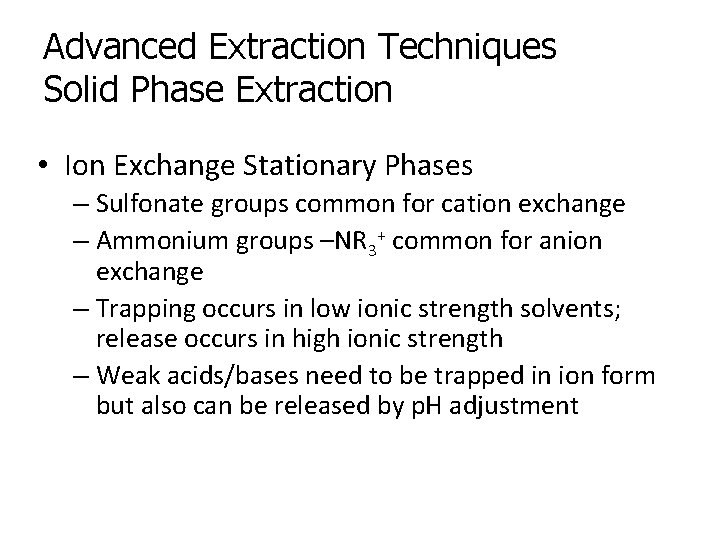
Advanced Extraction Techniques Solid Phase Extraction • Ion Exchange Stationary Phases – Sulfonate groups common for cation exchange – Ammonium groups –NR 3+ common for anion exchange – Trapping occurs in low ionic strength solvents; release occurs in high ionic strength – Weak acids/bases need to be trapped in ion form but also can be released by p. H adjustment
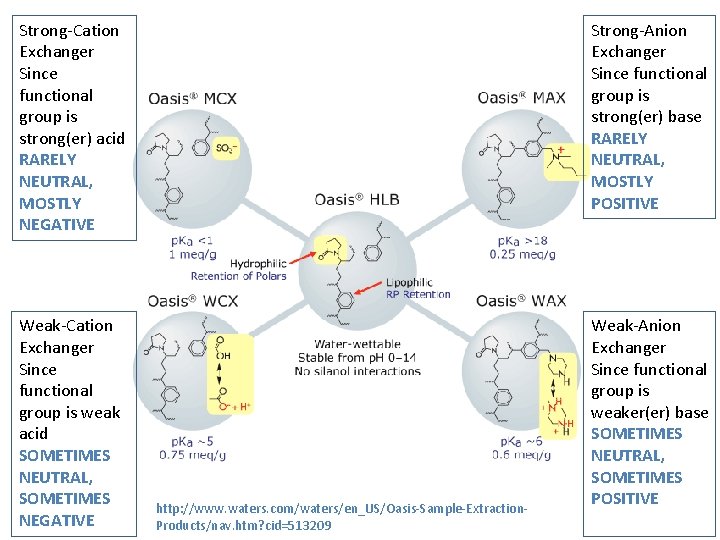
Strong-Cation Exchanger Since functional group is strong(er) acid RARELY NEUTRAL, MOSTLY NEGATIVE Strong-Anion Exchanger Since functional group is strong(er) base RARELY NEUTRAL, MOSTLY POSITIVE Weak-Cation Exchanger Since functional group is weak acid SOMETIMES NEUTRAL, SOMETIMES NEGATIVE Weak-Anion Exchanger Since functional group is weaker(er) base SOMETIMES NEUTRAL, SOMETIMES POSITIVE http: //www. waters. com/waters/en_US/Oasis-Sample-Extraction. Products/nav. htm? cid=513209
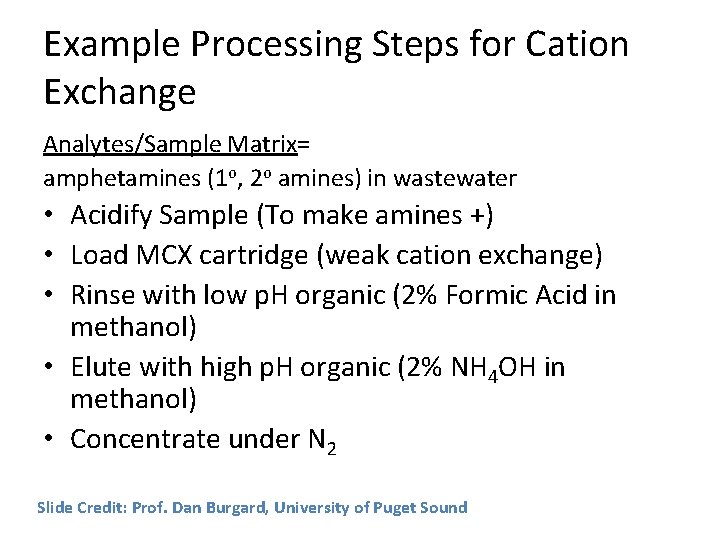
Example Processing Steps for Cation Exchange Analytes/Sample Matrix= amphetamines (1 o, 2 o amines) in wastewater • Acidify Sample (To make amines +) • Load MCX cartridge (weak cation exchange) • Rinse with low p. H organic (2% Formic Acid in methanol) • Elute with high p. H organic (2% NH 4 OH in methanol) • Concentrate under N 2 Slide Credit: Prof. Dan Burgard, University of Puget Sound
WHY DO WE HAVE TO DO SPE? Any thoughts?
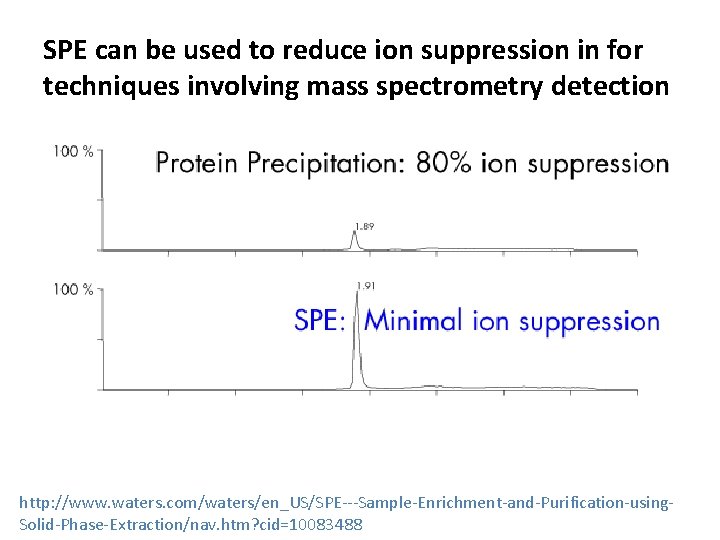
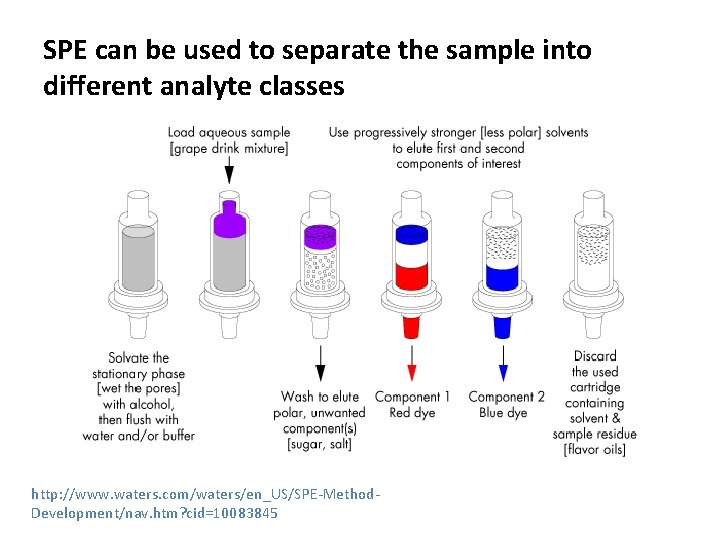
Why Do We Have To (or Want To) Do SPE? : 1. SPE can be used to enrich (increase the concentration of) trace chemical species 2. SPE can be used to remove interferences and simplify the matrix of the collected sample a) Complex sample matrices = urine, blood, serum, plasma, tissue, sediment…. . 3. SPE can be used to reduce ion suppression in for techniques involving mass spectrometry detection a) Kind of a “sub-reason” of (2) 4. SPE can be used to separate the sample into different analyte classes a) Polar analytes can be analyze by LC-MS, non-polar analytes by GC-MS, etc.
SPE can be used to enrich (increase the concentration of) trace chemical species Enrich = Concentrate – i. e. , to INCREASE the concentration of the analyte – In many applications (environmental sample analysis, pharmaceutical applications, biomonitoring, etc. ) there is too little of the analyte present to directly analyze collected samples
SPE can be used to enrich (increase the concentration of) trace chemical species – We can change some things about the methodology: • Injection volume of method • Volume of sample collected • Volume of final extract – These factors can make the necessary concentration factor less (i. e. , you don’t need to concentrate as much) – But everything is inter-related, and the method may or may not be amenable to modification “Pay me now or pay me later…”
Contaminants of Emerging Concern in Puget Sound: A Comparison of Spatial and Temporal Levels and Occurrence Justin P. Miller-Schulze, Alex Gipe, Derek Overman, Joel E. Baker May 2 2014
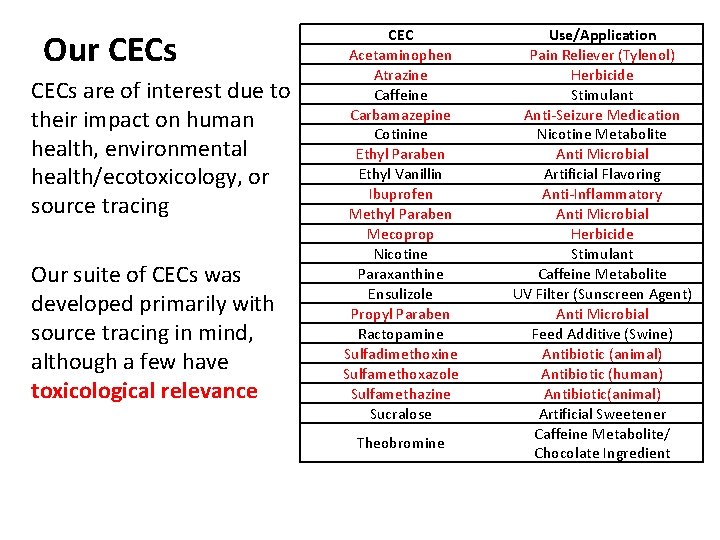
Our CECs are of interest due to their impact on human health, environmental health/ecotoxicology, or source tracing Our suite of CECs was developed primarily with source tracing in mind, although a few have toxicological relevance CEC Acetaminophen Atrazine Caffeine Carbamazepine Cotinine Ethyl Paraben Ethyl Vanillin Ibuprofen Methyl Paraben Mecoprop Nicotine Paraxanthine Ensulizole Propyl Paraben Ractopamine Sulfadimethoxine Sulfamethoxazole Sulfamethazine Sucralose Theobromine Use/Application Pain Reliever (Tylenol) Herbicide Stimulant Anti-Seizure Medication Nicotine Metabolite Anti Microbial Artificial Flavoring Anti-Inflammatory Anti Microbial Herbicide Stimulant Caffeine Metabolite UV Filter (Sunscreen Agent) Anti Microbial Feed Additive (Swine) Antibiotic (animal) Antibiotic (human) Antibiotic(animal) Artificial Sweetener Caffeine Metabolite/ Chocolate Ingredient
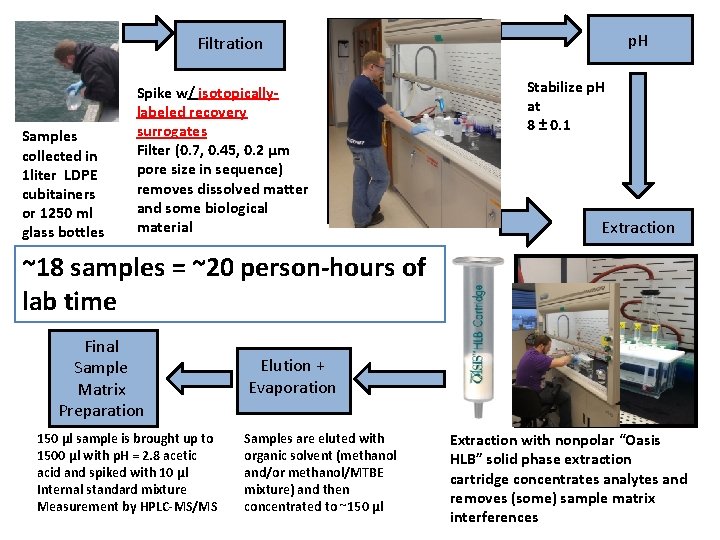
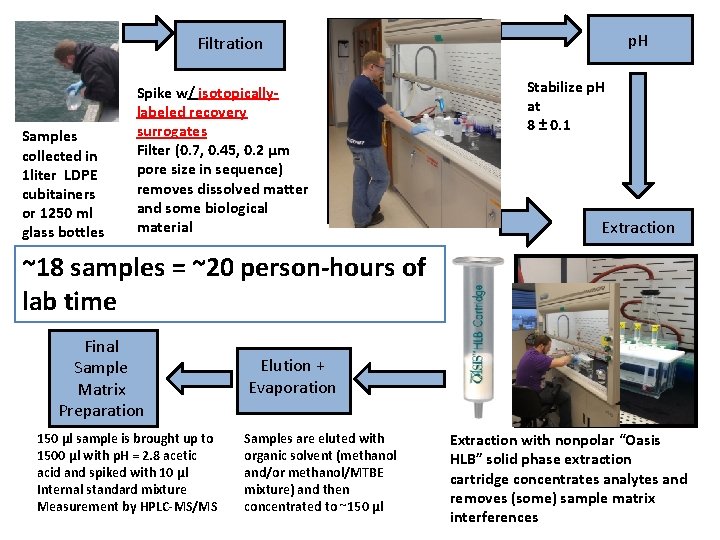
p. H Filtration Samples collected in 1 liter LDPE cubitainers or 1250 ml glass bottles Spike w/ isotopicallylabeled recovery surrogates Filter (0. 7, 0. 45, 0. 2 µm pore size in sequence) removes dissolved matter and some biological material Stabilize p. H at 8 ± 0. 1 Extraction ~18 samples = ~20 person-hours of lab time Final Sample Matrix Preparation 150 µl sample is brought up to 1500 µl with p. H = 2. 8 acetic acid and spiked with 10 µl Internal standard mixture Measurement by HPLC-MS/MS Elution + Evaporation Samples are eluted with organic solvent (methanol and/or methanol/MTBE mixture) and then concentrated to ~150 µl Extraction with nonpolar “Oasis HLB” solid phase extraction cartridge concentrates analytes and removes (some) sample matrix interferences
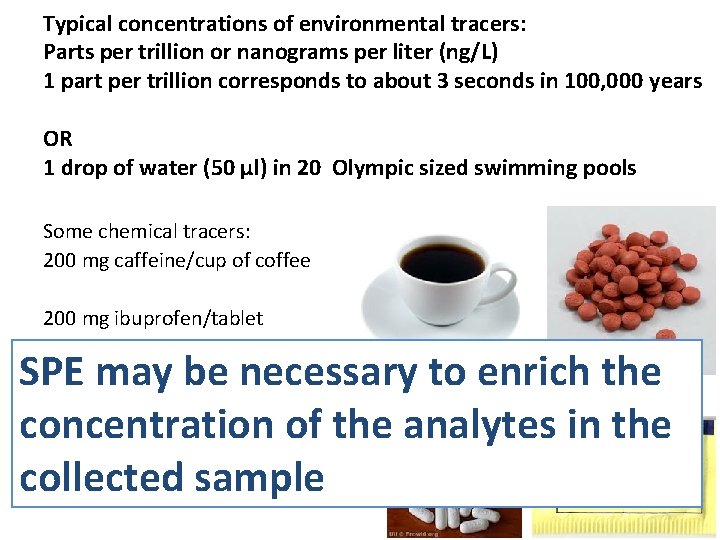
Typical concentrations of environmental tracers: Parts per trillion or nanograms per liter (ng/L) 1 part per trillion corresponds to about 3 seconds in 100, 000 years OR 1 drop of water (50 µl) in 20 Olympic sized swimming pools Some chemical tracers: 200 mg caffeine/cup of coffee 200 mg ibuprofen/tablet 325 mg acetaminophen/ SPE may be necessary to enrich the Regular Strength Tylenol concentration (500 mg/ Extra Strength) of the analytes in the collected sample ~50 mg sucralose/1 packet Splenda
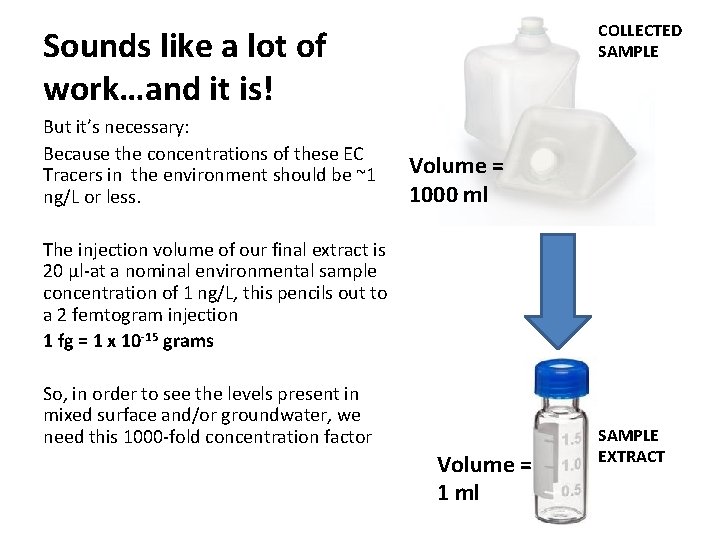
COLLECTED SAMPLE Sounds like a lot of work…and it is! But it’s necessary: Because the concentrations of these EC Tracers in the environment should be ~1 ng/L or less. Volume = 1000 ml The injection volume of our final extract is 20 µl-at a nominal environmental sample concentration of 1 ng/L, this pencils out to a 2 femtogram injection 1 fg = 1 x 10 -15 grams So, in order to see the levels present in mixed surface and/or groundwater, we need this 1000 -fold concentration factor Volume = 1 ml SAMPLE EXTRACT
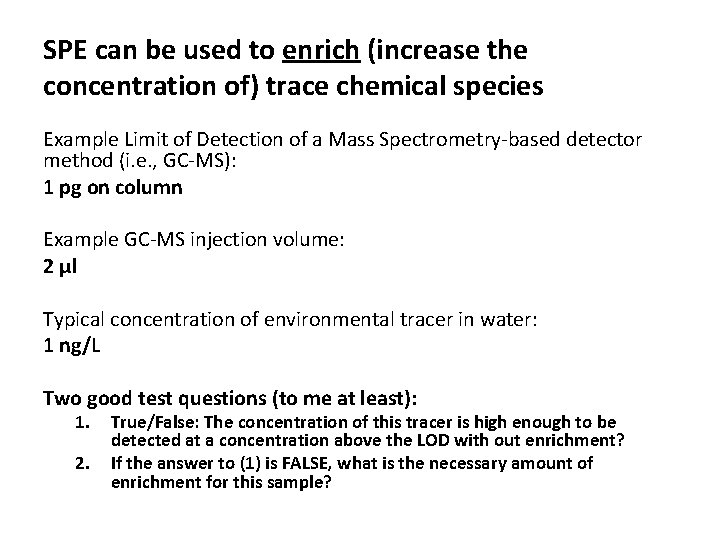
SPE can be used to enrich (increase the concentration of) trace chemical species Example Limit of Detection of a Mass Spectrometry-based detector method (i. e. , GC-MS): 1 pg on column Example GC-MS injection volume: 2 µl Typical concentration of environmental tracer in water: 1 ng/L Two good test questions (to me at least): 1. 2. True/False: The concentration of this tracer is high enough to be detected at a concentration above the LOD with out enrichment? If the answer to (1) is FALSE, what is the necessary amount of enrichment for this sample?
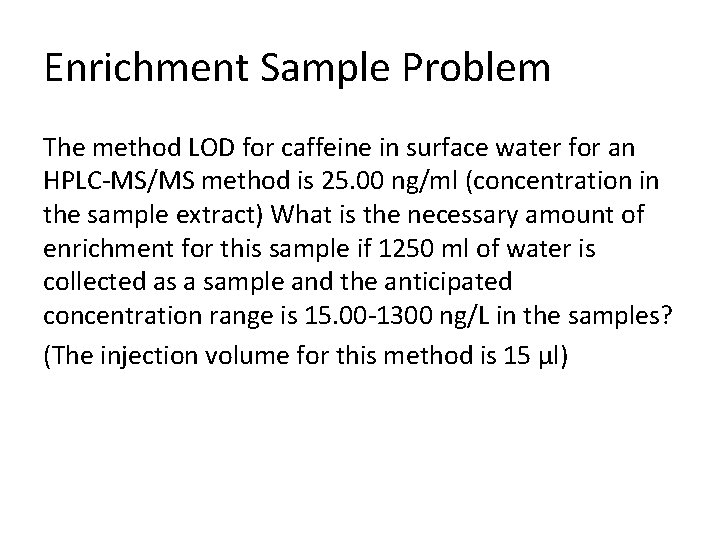
Enrichment Sample Problem The method LOD for caffeine in surface water for an HPLC-MS/MS method is 25. 00 ng/ml (concentration in the sample extract) What is the necessary amount of enrichment for this sample if 1250 ml of water is collected as a sample and the anticipated concentration range is 15. 00 -1300 ng/L in the samples? (The injection volume for this method is 15 µl)
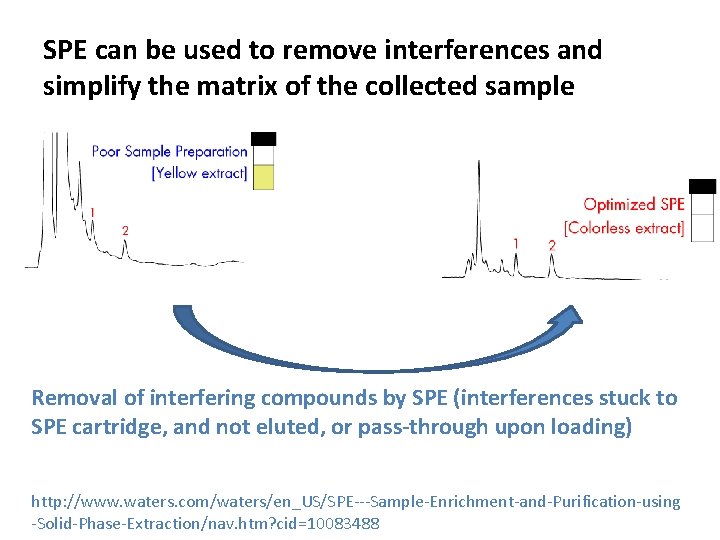
SPE can be used to remove interferences and simplify the matrix of the collected sample Removal of interfering compounds by SPE (interferences stuck to SPE cartridge, and not eluted, or pass-through upon loading) http: //www. waters. com/waters/en_US/SPE---Sample-Enrichment-and-Purification-using -Solid-Phase-Extraction/nav. htm? cid=10083488
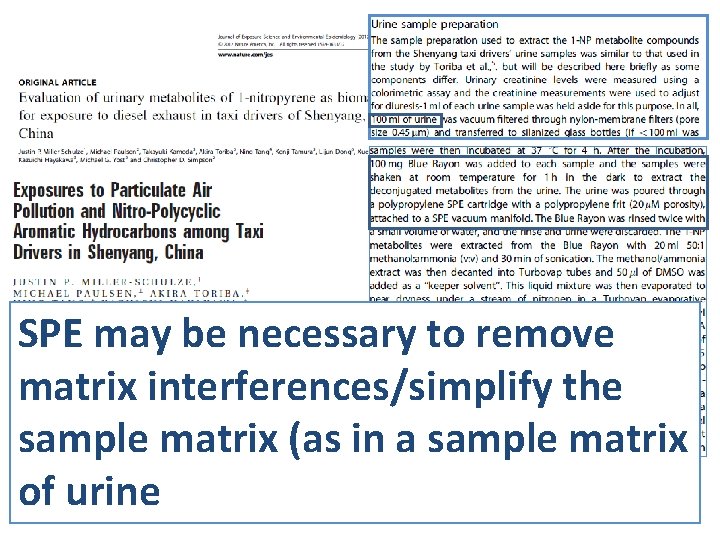
A Few (personally) Relevant Examples SPE may be necessary to remove matrix interferences/simplify the sample matrix (as in a sample matrix of urine
SPE can be used to reduce ion suppression in for techniques involving mass spectrometry detection http: //www. waters. com/waters/en_US/SPE---Sample-Enrichment-and-Purification-using. Solid-Phase-Extraction/nav. htm? cid=10083488
SPE can be used to separate the sample into different analyte classes http: //www. waters. com/waters/en_US/SPE-Method. Development/nav. htm? cid=10083845
SPE Issues/Specific Method Development Issues • Sometimes, you are looking for 4 of the same class of analytes – Good for you! • Other times, you are looking for a variety of analyte classes: weak bases, weak acids, zwitterions, etc. – I’m sorry…
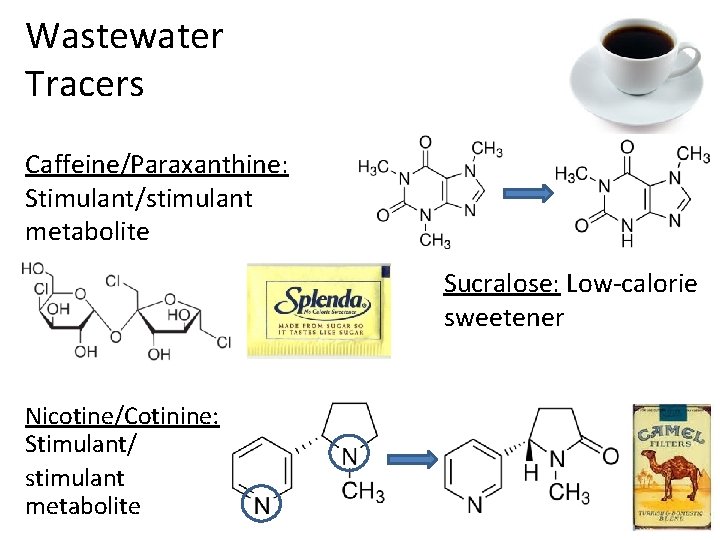
Wastewater Tracers Caffeine/Paraxanthine: Stimulant/stimulant metabolite Sucralose: Low-calorie sweetener Nicotine/Cotinine: Stimulant/ stimulant metabolite
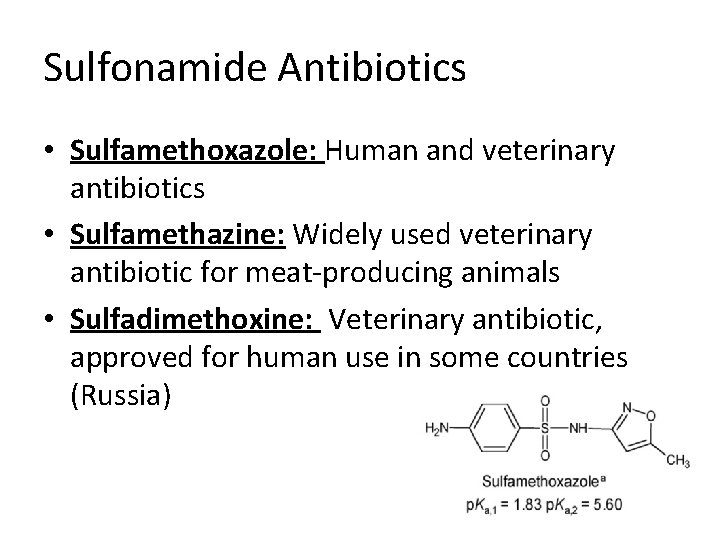
Sulfonamide Antibiotics • Sulfamethoxazole: Human and veterinary antibiotics • Sulfamethazine: Widely used veterinary antibiotic for meat-producing animals • Sulfadimethoxine: Veterinary antibiotic, approved for human use in some countries (Russia)
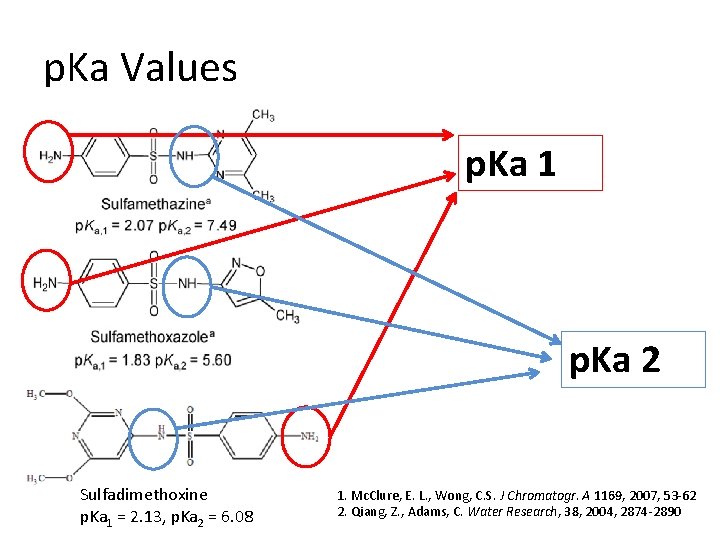
p. Ka Values p. Ka 1 p. Ka 2 Sulfadimethoxine p. Ka 1 = 2. 13, p. Ka 2 = 6. 08 1. Mc. Clure, E. L. , Wong, C. S. J Chromatogr. A 1169, 2007, 53 -62 2. Qiang, Z. , Adams, C. Water Research, 38, 2004, 2874 -2890
p. H Filtration Samples collected in 1 liter LDPE cubitainers or 1250 ml glass bottles Spike w/ isotopicallylabeled recovery surrogates Filter (0. 7, 0. 45, 0. 2 µm pore size in sequence) removes dissolved matter and some biological material Stabilize p. H at 8 ± 0. 1 Extraction ~18 samples = ~20 person-hours of lab time Final Sample Matrix Preparation 150 µl sample is brought up to 1500 µl with p. H = 2. 8 acetic acid and spiked with 10 µl Internal standard mixture Measurement by HPLC-MS/MS Elution + Evaporation Samples are eluted with organic solvent (methanol and/or methanol/MTBE mixture) and then concentrated to ~150 µl Extraction with nonpolar “Oasis HLB” solid phase extraction cartridge concentrates analytes and removes (some) sample matrix interferences
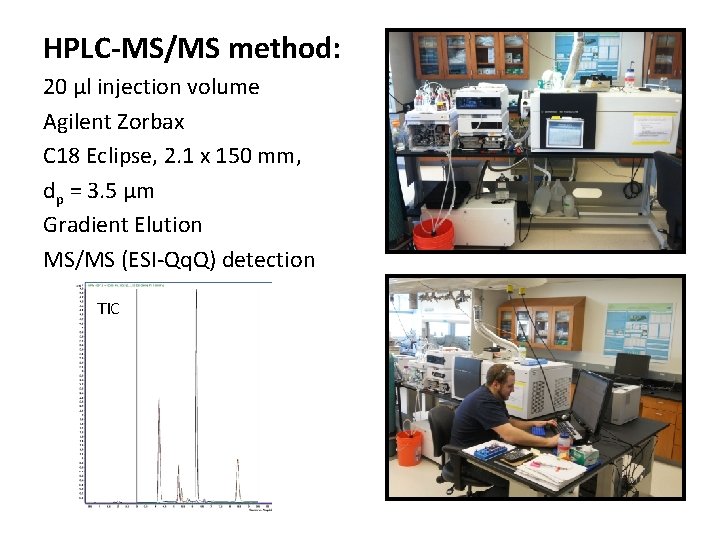
HPLC-MS/MS method: 20 µl injection volume Agilent Zorbax C 18 Eclipse, 2. 1 x 150 mm, dp = 3. 5 µm Gradient Elution MS/MS (ESI-Qq. Q) detection TIC
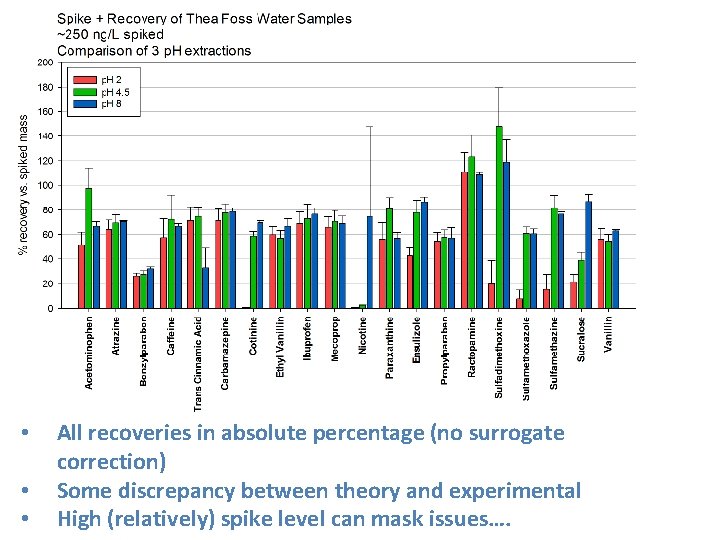
• • • All recoveries in absolute percentage (no surrogate correction) Some discrepancy between theory and experimental High (relatively) spike level can mask issues….
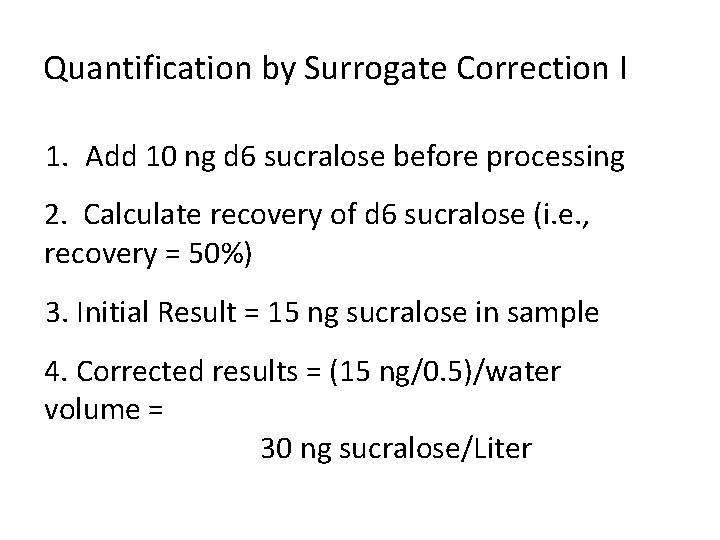
Quantification by Surrogate Correction I How. Add do we we are analyzing that 1. 10 know ng d 6 that sucralose before everything processing was in our sample? § In. Calculate other words: How much do sucralose we lose in the extraction 2. recovery of d 6 (i. e. , process? recovery = 50%) • To account for CEC loss during extraction, we use 3. isotopically-labeled Initial Result = 15 surrogates ng sucralose in identical sample that are chemically, but differ in mass, from our CEC analytes: 4. Corrected results = (15 Mass ng/0. 5)/water Corrected CEC = volume = Mass. CEC / Fractional Recovery of Appropriate Calculated Surrogate 30 ng sucralose/Liter
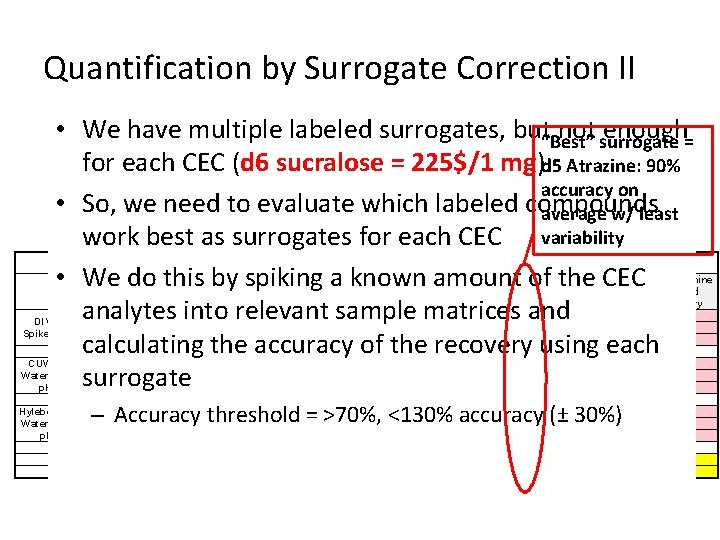
Quantification by Surrogate Correction II • We have multiple labeled surrogates, but“Best” not surrogate enough= for each CEC (d 6 sucralose = 225$/1 mg)d 5 Atrazine: 90% accuracy on • So, we need to evaluate which labeled compounds average w/ least work best as surrogates for each CEC variability Acetaminophen Spike + Recovery Data • We do this by spiking a known amount of the CEC analytes into relevant sample matrices and calculating the accuracy of the recovery using each surrogate Name Raw % Recovery DI SPK 1 PH 8 DI Water DI SPK 2 PH 8 Spikes, p. H=8 DI SPK 3 PH 8 62 46 52 CUW Dock D. SPK 1 PH 8 Water Spikes, D. SPK 2 PH 8 p. H = 8 D. SPK 3 PH 8 38 66 47 d 3 Vanillin d 4 Propylparaben d 4 Sulfamethoxazole Corrected % Recovery 95 124 96 70 86 81 81 104 89 124 126 120 118 123 108 168 151 136 d 5 Atrazine Corrected % Recovery 98 71 78 d 6 Sucralose Corrected % Recovery 94 70 73 d 6 Theobromine Corrected % Recovery 144 279 103 100 86 156 145 126 136 310 378 47 116 133 124 112 123 – Accuracy threshold = >70%, <130% accuracy (± 30%) 46 80 95 109 72 79 Hylebos Creek STREAM SPK 1 PH 8 Water Spikes, STREAM SPK 2 PH 8 p. H= 8 STREAM SPK 3 PH 8 AVERAGE RSD(%) 50 100 115 118 92 99 179 323 261 50 17 101 21 112 13 119 24 90 16 107 29 235 41
Conclusions/Wrap-Up • SPE is a widely applicable tool for sample pretreatment that can make analysis of low-level analytes in complex matrices possible • The variety in SPE strategies gives you a variety of strategies to process their samples: – Enrichment – Clean-Up – Fractionation • You can adjust the efficacy of all of these with some knowledge of the factors at work – p. H, p. H – Mobile phase – Stationary Phase
Seminar Advertisement September 26 2014 Sequoia 338 1 PM Contaminants of Emerging Concern: How Much is Out There, How Do We Measure Them, and Why Do We Care?
Acknowledgements-Thank You! UWT/CUW Interns Alex Gipe Derek Overman Donny Glaser Jessica Maves Connor Bacon Slides Dr. Dan Burgard, University of Puget Sound Dr. Roy Dixon, Sac State Waters Corp.