
Solid Movement in Pebble Bed Reactors Mehmet Morali
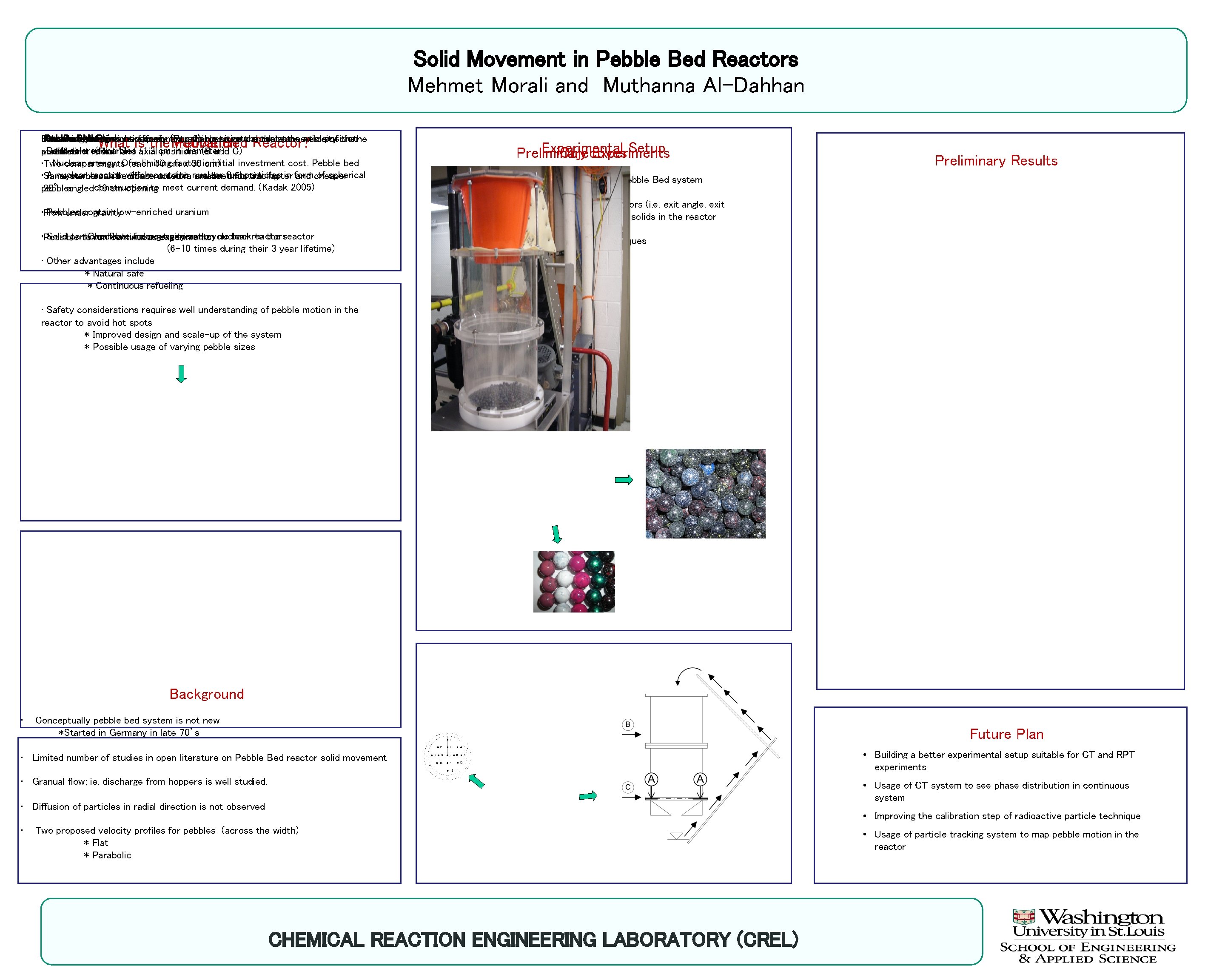
Solid Movement in Pebble Bed Reactors Mehmet Morali and Muthanna Al-Dahhan Measure the time necessary for particle to return the same Pebble Bed Material Rig Assuming and no continuous particle diffusion experiments, in radial to measure position the calculate resistance the axial velocity timeposition of on thethe • Batch Run the system continuously (Run 2) Motivation What is the Pebble Bed Reactor? • Dark colored marbles (1. 2 cm in diameter) particles steam-line. (Run 1) at different radial and axial positions (B and C) Nuclear energy: One limiting factor initial investment cost. Pebble bed • Two compartments (each 30 cm x 30 iscm) • Same A nuclear reactor, contains in form of spherical systems can bewhich constructed in nuclear smaller units, i. e. faster and cheaper marbles with different colors are usedfuel forparticles tracing to meet current demand. (Kadak 2005) pebbles • 25° angledconstruction 10 cm opening Experimental Setup Preliminary Objectives Experiments Preliminary Results • Characterization of solid movement by Pebble Bed system • Investigation of different dimensional factors (i. e. exit angle, exit opening, particle size, etc. ) on the flow of solids in the reactor • Flow Pebbles contain under gravitylow-enriched uranium for next generation nuclear • Possible Solid particles under gravity and cycle backreactors to the reactor to. Candidate run flow continuous experiments (6 -10 times during their 3 year lifetime) • Other advantages include * Natural safe * Continuous refueling • Improving necessary experimental techniques • Safety considerations requires well understanding of pebble motion in the reactor to avoid hot spots * Improved design and scale-up of the system * Possible usage of varying pebble sizes Background • Conceptually pebble bed system is not new *Started in Germany in late 70’s Future Plan • Limited number of studies in open literature on Pebble Bed reactor solid movement • Building a better experimental setup suitable for CT and RPT experiments • Granual flow; ie. discharge from hoppers is well studied. • Usage of CT system to see phase distribution in continuous system • Diffusion of particles in radial direction is not observed • • Improving the calibration step of radioactive particle technique Two proposed velocity profiles for pebbles (across the width) * Flat * Parabolic CHEMICAL REACTION ENGINEERING LABORATORY (CREL) • Usage of particle tracking system to map pebble motion in the reactor
- Slides: 1