
Solid and Hazardous Waste Chapter 16 Section 16
- Slides: 60
Solid and Hazardous Waste Chapter 16
Section 16 -1 WHAT ARE SOLID WASTE AND HAZARDOUS WASTE, AND WHY ARE THEY PROBLEMS?
We throw away huge amounts of useful things and hazardous materials • No waste in natural world because wastes of one organism become nutrients for others as a natural recycling of nutrients occurs. • Modern humans produce huge amounts of waste that go unused and pollute. • Solid waste—any unwanted or discarded material we produce that is not a liquid or a gas. – Industrial solid waste produced by mines, agriculture, and industries that supply people with goods and services. – Municipal solid waste (MSW), consisting of the combined solid waste produced by homes and workplaces.
We throw away huge amounts of useful things and hazardous materials • Hazardous, or toxic, waste threatens human health or the environment because it is poisonous, dangerously chemically reactive, corrosive, or flammable. Examples include: – Industrial solvents. – Hospital medical waste. – Car batteries. – Household pesticide products. – Dry-cell batteries. – Ash from incinerators and coal-burning power plants.
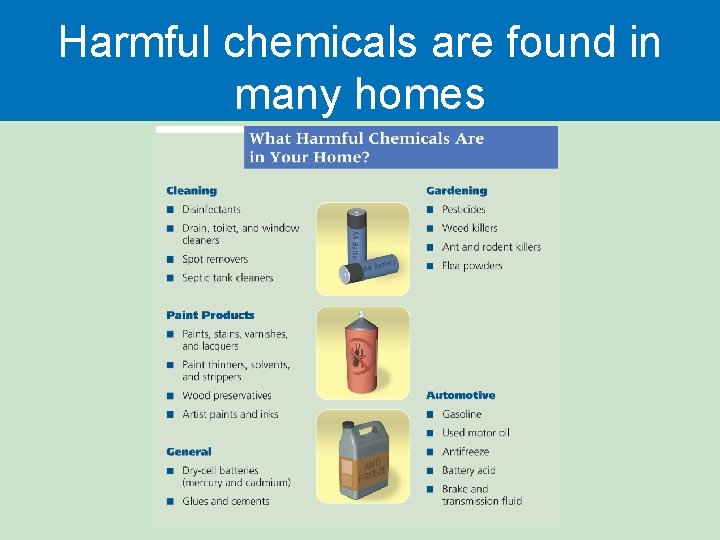
Harmful chemicals are found in many homes
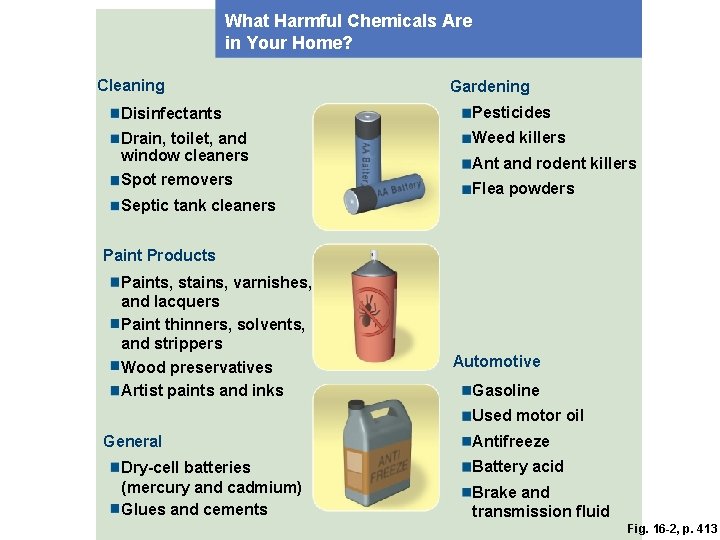
What Harmful Chemicals Are in Your Home? Cleaning Gardening Disinfectants Pesticides Drain, toilet, and window cleaners Weed killers Spot removers Septic tank cleaners Ant and rodent killers Flea powders Paint Products Paints, stains, varnishes, and lacquers Paint thinners, solvents, and strippers Wood preservatives Artist paints and inks Automotive Gasoline Used motor oil General Dry-cell batteries (mercury and cadmium) Glues and cements Antifreeze Battery acid Brake and transmission fluid Fig. 16 -2, p. 413
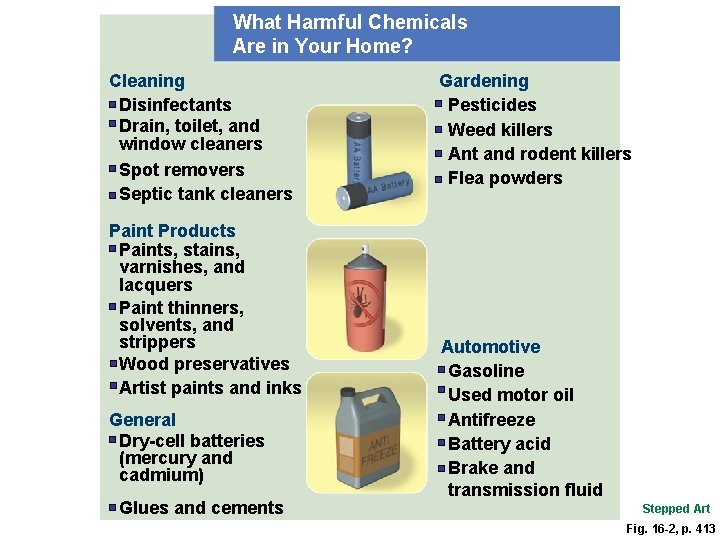
What Harmful Chemicals Are in Your Home? Cleaning Disinfectants Drain, toilet, and window cleaners Spot removers Septic tank cleaners Paint Products Paints, stains, varnishes, and lacquers Paint thinners, solvents, and strippers Wood preservatives Artist paints and inks General Dry-cell batteries (mercury and cadmium) Glues and cements Gardening Pesticides Weed killers Ant and rodent killers Flea powders Automotive Gasoline Used motor oil Antifreeze Battery acid Brake and transmission fluid Stepped Art Fig. 16 -2, p. 413
We throw away huge amounts of useful things and hazardous materials • Classes of hazardous wastes are: – Organic compounds • Various solvents, pesticides, PCBs, and dioxins. – Nondegradable toxic heavy metals • Lead, mercury, and arsenic. – Highly radioactive waste produced by nuclear power plants and nuclear weapons facilities.
Section 16 -2 HOW SHOULD WE DEAL WITH SOLID WASTE?
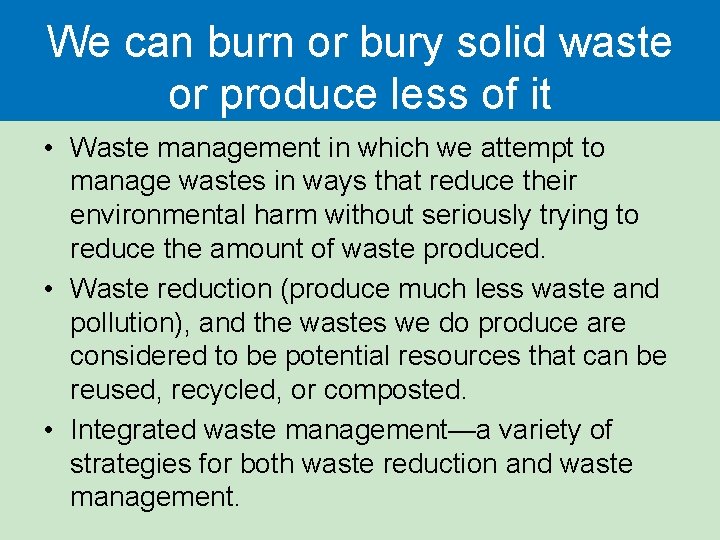
We can burn or bury solid waste or produce less of it • Waste management in which we attempt to manage wastes in ways that reduce their environmental harm without seriously trying to reduce the amount of waste produced. • Waste reduction (produce much less waste and pollution), and the wastes we do produce are considered to be potential resources that can be reused, recycled, or composted. • Integrated waste management—a variety of strategies for both waste reduction and waste management.
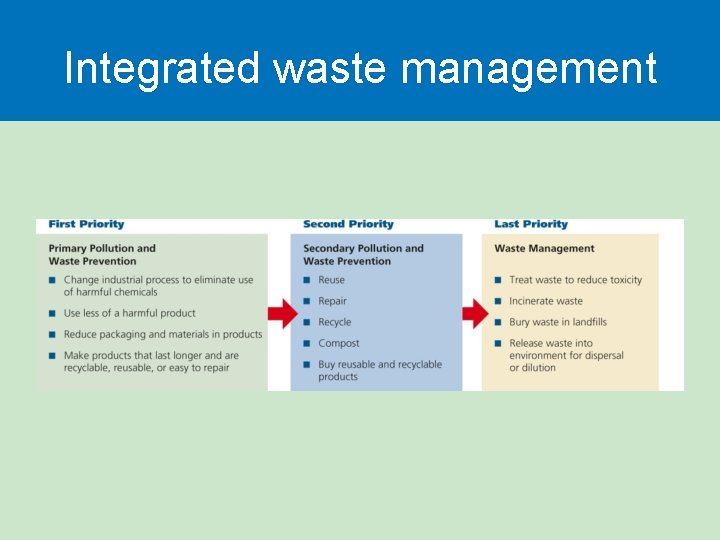
Integrated waste management
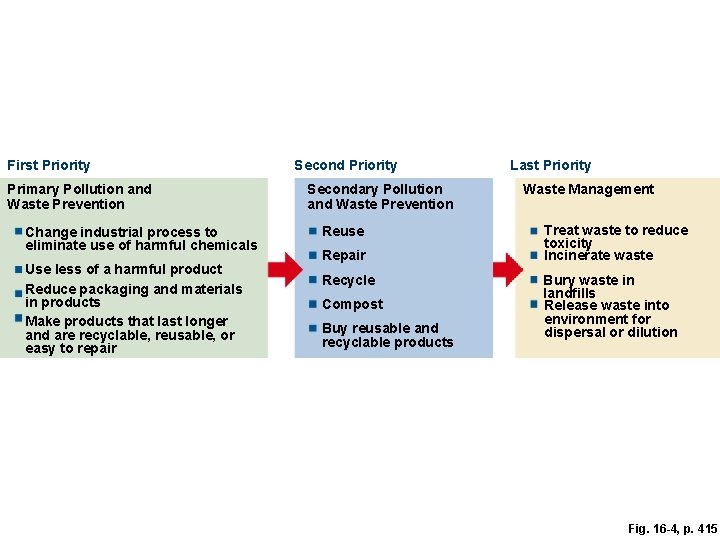
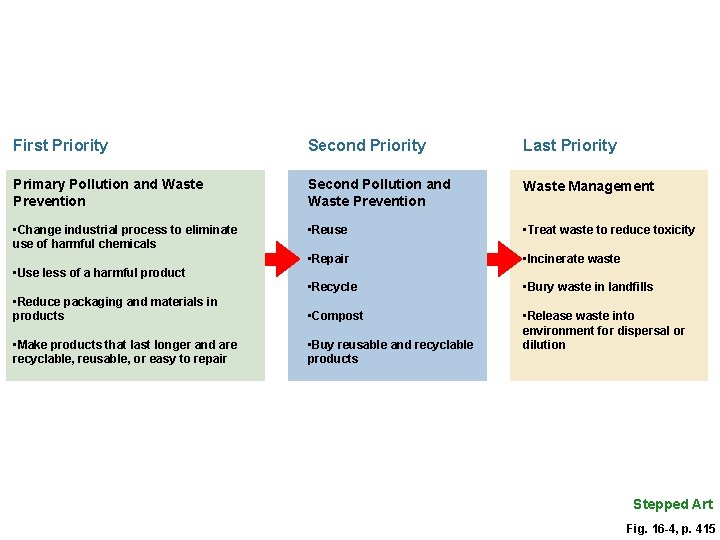
First Priority Primary Pollution and Waste Prevention Change industrial process to eliminate use of harmful chemicals Use less of a harmful product Reduce packaging and materials in products Make products that last longer and are recyclable, reusable, or easy to repair Second Priority Secondary Pollution and Waste Prevention Reuse Repair Recycle Compost Buy reusable and recyclable products Last Priority Waste Management Treat waste to reduce toxicity Incinerate waste Bury waste in landfills Release waste into environment for dispersal or dilution Fig. 16 -4, p. 415
First Priority Second Priority Last Priority Primary Pollution and Waste Prevention Second Pollution and Waste Prevention Waste Management • Change industrial process to eliminate use of harmful chemicals • Reuse • Treat waste to reduce toxicity • Repair • Incinerate waste • Recycle • Bury waste in landfills • Reduce packaging and materials in products • Compost • Make products that last longer and are recyclable, reusable, or easy to repair • Buy reusable and recyclable products • Release waste into environment for dispersal or dilution • Use less of a harmful product Stepped Art Fig. 16 -4, p. 415
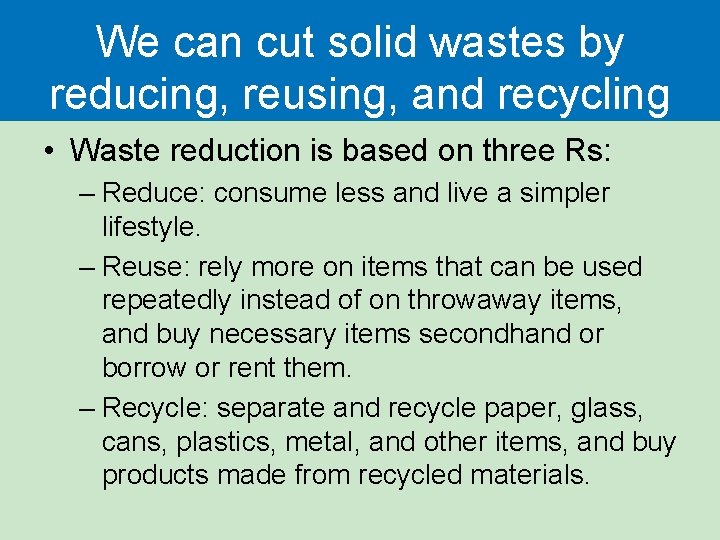
We can cut solid wastes by reducing, reusing, and recycling • Waste reduction is based on three Rs: – Reduce: consume less and live a simpler lifestyle. – Reuse: rely more on items that can be used repeatedly instead of on throwaway items, and buy necessary items secondhand or borrow or rent them. – Recycle: separate and recycle paper, glass, cans, plastics, metal, and other items, and buy products made from recycled materials.
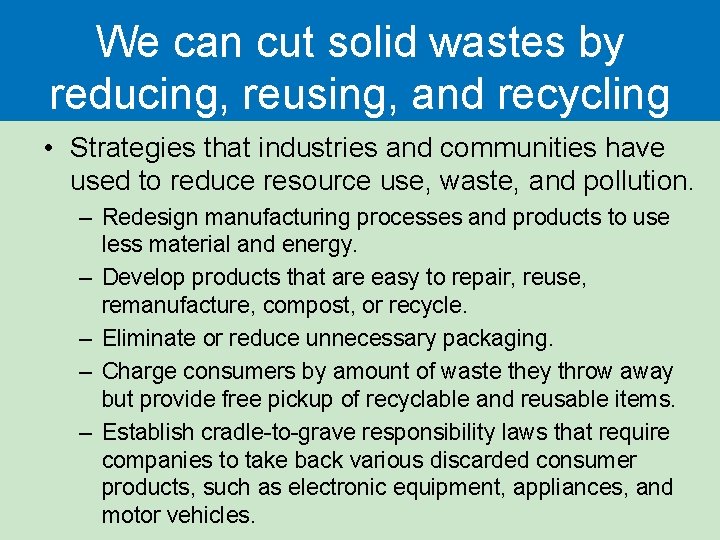
We can cut solid wastes by reducing, reusing, and recycling • Strategies that industries and communities have used to reduce resource use, waste, and pollution. – Redesign manufacturing processes and products to use less material and energy. – Develop products that are easy to repair, reuse, remanufacture, compost, or recycle. – Eliminate or reduce unnecessary packaging. – Charge consumers by amount of waste they throw away but provide free pickup of recyclable and reusable items. – Establish cradle-to-grave responsibility laws that require companies to take back various discarded consumer products, such as electronic equipment, appliances, and motor vehicles.
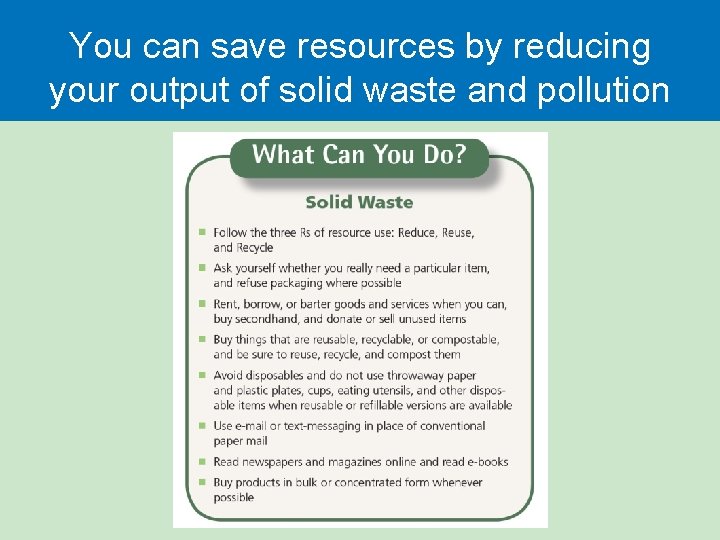
You can save resources by reducing your output of solid waste and pollution
Section 16 -3 WHY IS REUSING AND RECYCLING MATERIALS SO IMPORTANT?
Reuse is an important way to reduce solid waste and pollution, and to save money • Increasingly substituted throwaway items for reusable ones, which has resulted in growing masses of solid waste. • Reuse involves cleaning and using materials over and thus increasing the typical life span of a product. • Waste reduction decreases the use of matter and energy resources, cuts pollution and waste, creates local jobs, and saves money. • In many less-developed countries, the poor scavenge in open dumps for food scraps and items that they can reuse or sell, and are often exposed to toxins and infectious diseases.
Reuse is an important way to reduce solid waste and pollution, and to save money • Reuse strategies in more-developed countries include yard sales, flea markets, secondhand stores, and online sites such as e. Bay and craigslist. • To encourage people reusable bags, the governments of Ireland, Taiwan, and the Netherlands tax plastic shopping bags. • Australia, France, Italy, and the U. S. city of San Francisco have banned the use of all or most types of plastic shopping bags. • Plastics industry officials have mounted a massive advertising and political campaign to prevent such bans.
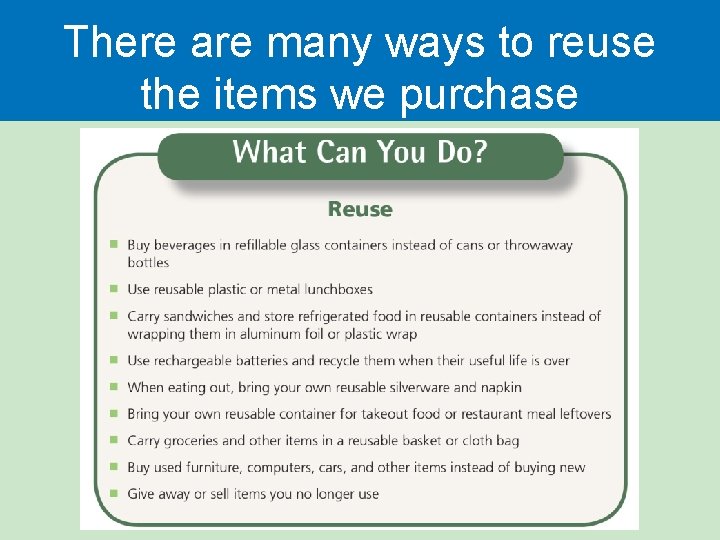
There are many ways to reuse the items we purchase
There are two types of recycling • Recycling involves reprocessing discarded solid materials into new, useful products. • Households and workplaces produce five major types of materials that we can recycle: paper products, glass, aluminum, steel, and some plastics. • Primary, or closed-loop, recycling—materials are recycled into new products of the same type. • Secondary recycling— waste materials converted into different products.
There are two types of recycling • Key questions about recycling: – Do the items that are separated for recycling actually get recycled? – Do businesses, governments, and individuals complete the recycling loop by buying products that are made from recycled materials?
Composting is a form of recycling that mimics nature’s recycling of nutrients • Involves using decomposer bacteria to recycle yard trimmings, food scraps, and other organic wastes. • The resulting organic material can be added to soil to supply plant nutrients, slow soil erosion, retain water, and improve crop yields. • Homeowners can compost such wastes in simple backyard containers. • Some cities in Canada and in many European Union countries collect and compost more than 85% of their biodegradable wastes in centralized community facilities. • In the US, about 3, 000 municipal composting programs recycle about 60% of the yard wastes.
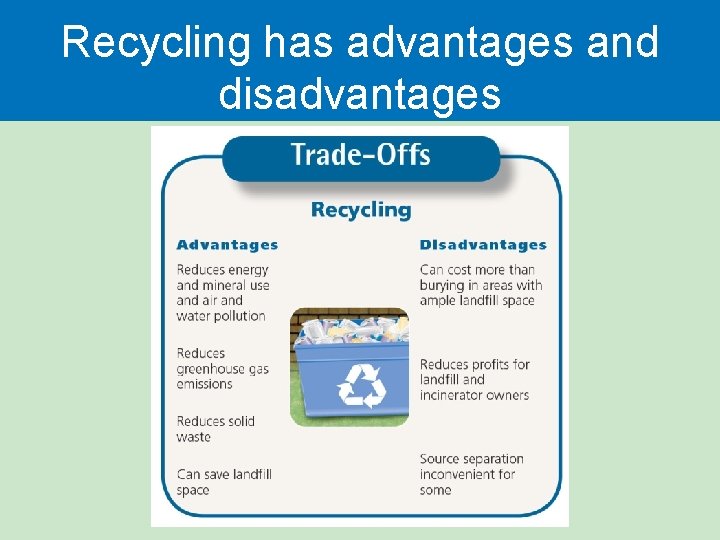
Recycling has advantages and disadvantages • Whether recycling makes economic sense depends on how we look at its economic and environmental benefits and costs. • Critics of recycling programs argue that recycling is costly and adds to the taxpayer burden in communities where recycling is funded through taxation. • Proponents of recycling point to studies showing that the net economic, health, and environmental benefits of recycling far outweigh the costs. • Critics say that recycling may make economic sense for valuable and easy-to-recycle materials such as aluminum, paper, and steel.
Recycling has advantages and disadvantages
We can encourage reuse and recycling • Three factors hinder reuse and recycling. – The market prices of almost all products do not include the harmful environmental and health costs associated with producing, using, and discarding them. – The economic playing field is uneven, because in most countries, resource-extracting industries receive more government tax breaks and subsidies than reuse and recycling industries. – The demand, and thus the price paid, for recycled materials fluctuates, mostly because buying goods made with recycled materials is not a priority for most governments, businesses, and individuals.
We can encourage reuse and recycling • Ways to encourage reuse and recycling: – Increase subsidies and tax breaks for reusing and recycling materials and decrease subsidies and tax breaks for making items from virgin resources. – Increase use of the fee-per-bag waste collection system and encourage or require government purchases of recycled products to help increase demand for and lower prices of these products. – Pass laws requiring companies to take back and recycle/reuse packaging and electronic waste. – Citizens can pressure governments to require product labeling that lists recycled content of products and the types and amounts of any hazardous materials.
We can encourage reuse and recycling • Recycling is popular because it helps to soothe consciences of people living in a throwaway society. • Reducing resource consumption and reusing resources are more effective prevention approaches to reducing the flow and waste of resources.
Section 16 -4 WHAT ARE THE ADVANTAGES AND DISADVANTAGES OF BURNING OR BURYING SOLID WASTE?
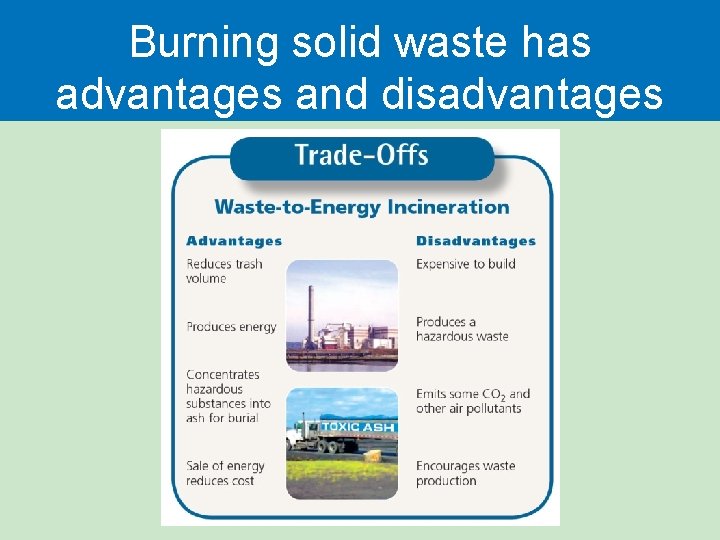
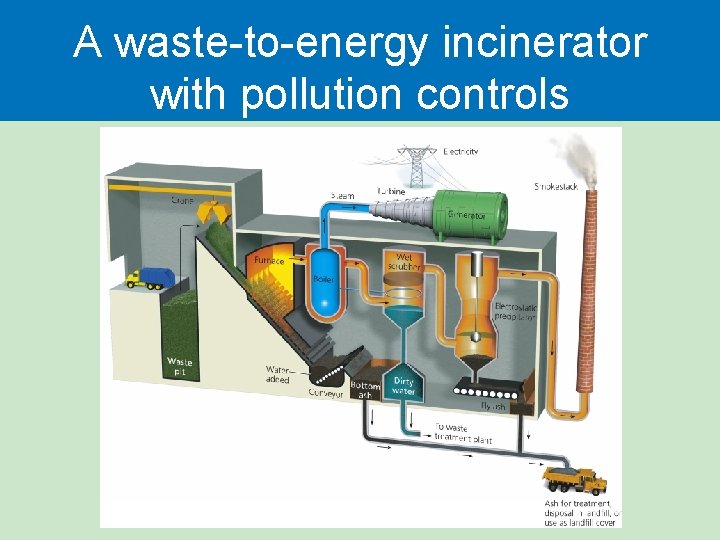
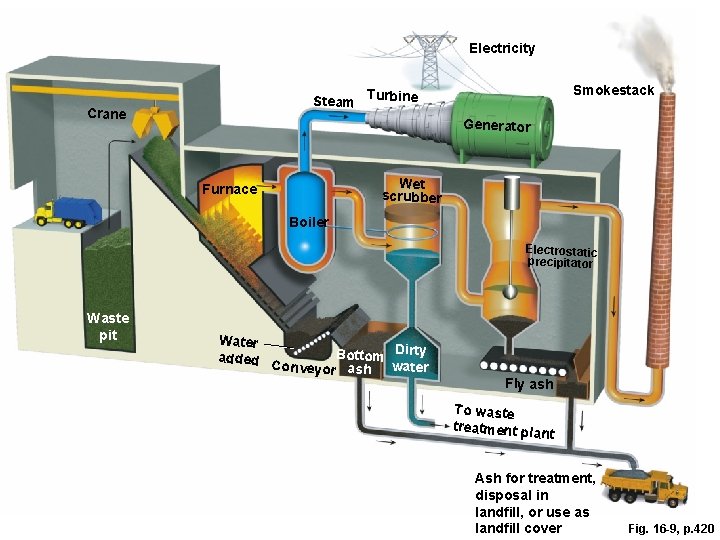
Burning solid waste has advantages and disadvantages • Globally, MSW is burned in more than 600 large waste-to-energy incinerators which use the heat they generate to boil water and make steam for heating water or interior spaces, or for producing electricity. • The US incinerates only about 12% of its MSW. – Incineration has a bad reputation stemming from past use of highly polluting and poorly regulated incinerators. – Incineration competes with an abundance of low-cost landfills in many areas.
Burning solid waste has advantages and disadvantages
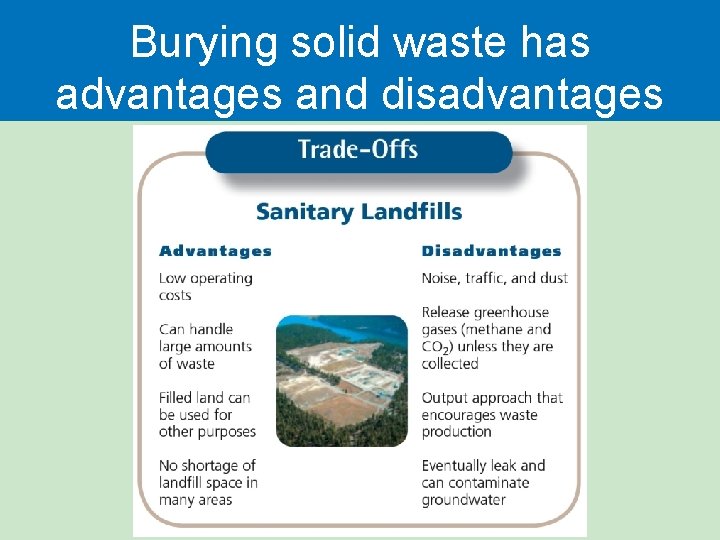
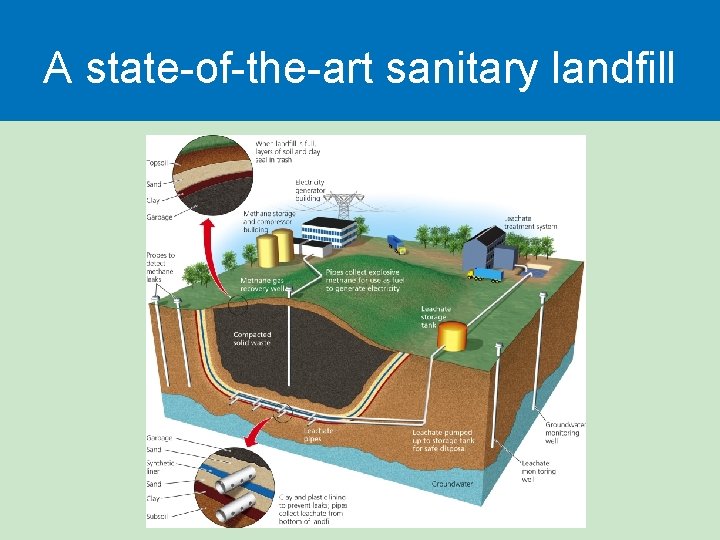
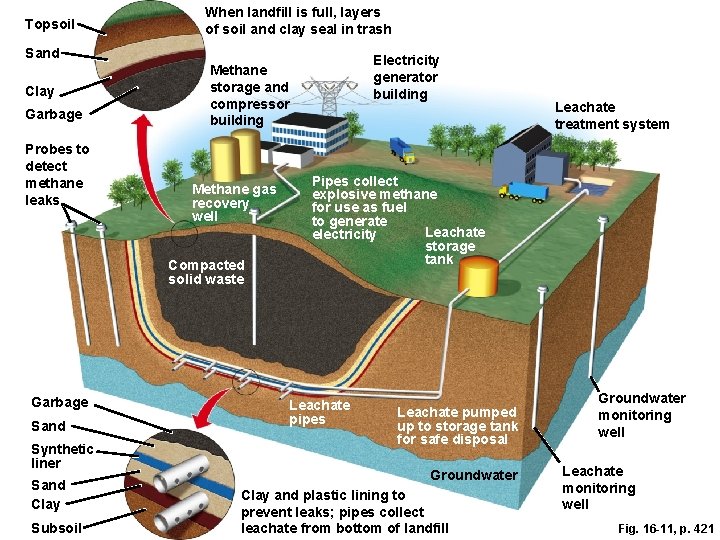
Burying solid waste has advantages and disadvantages • About 54%, by weight, of the MSW in the United States is buried in sanitary landfills, compared to 80% in Canada, 15% in Japan, and 4% in Denmark. • Sanitary landfills are where solid wastes are spread out in thin layers, compacted, and covered daily with a fresh layer of clay or plastic foam, which helps to keep the material dry and reduces leakage of contaminated water.
Burying solid waste has advantages and disadvantages • Open dumps are essentially fields or holes in the ground where garbage is deposited and sometimes burned. – Rare in more-developed countries. – China disposes of about 85% of its solid waste in rural open dumps or in poorly designed and poorly regulated landfills.
A waste-to-energy incinerator with pollution controls
Electricity Smokestack Steam Turbine Crane Generator Wet scrubber Furnace Boiler Electrostatic precipitator Waste pit Water added Bottom Dirty Conveyor ash water Fly ash To waste treatment pla nt Ash for treatment, disposal in landfill, or use as landfill cover Fig. 16 -9, p. 420
Burying solid waste has advantages and disadvantages
A state-of-the-art sanitary landfill
Topsoil When landfill is full, layers of soil and clay seal in trash Sand Clay Garbage Probes to detect methane leaks Methane gas recovery well Compacted solid waste Garbage Sand Synthetic liner Sand Clay Subsoil Electricity generator building Methane storage and compressor building Leachate treatment system Pipes collect explosive methane for use as fuel to generate Leachate electricity storage tank Leachate pipes Leachate pumped up to storage tank for safe disposal Groundwater Clay and plastic lining to prevent leaks; pipes collect leachate from bottom of landfill Groundwater monitoring well Leachate monitoring well Fig. 16 -11, p. 421
Section 16 -5 HOW SHOULD WE DEAL WITH HAZARDOUS WASTE?
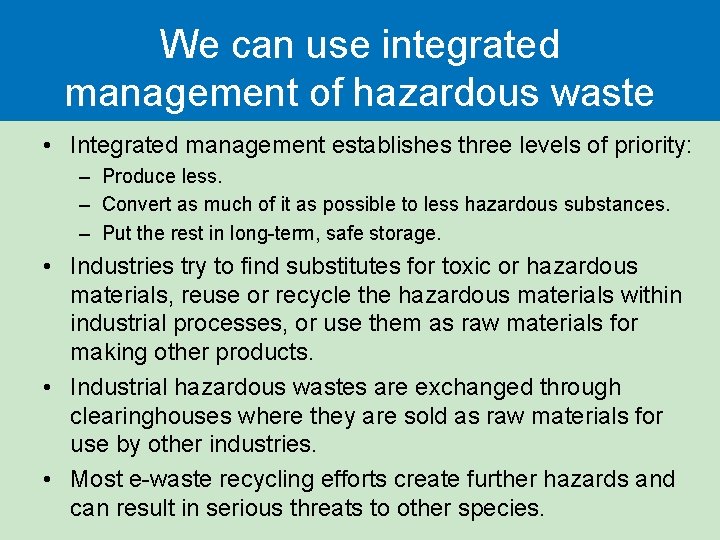
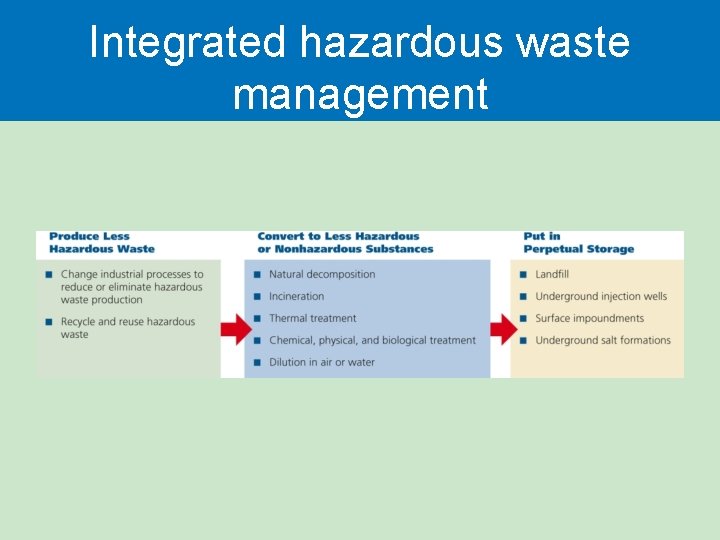
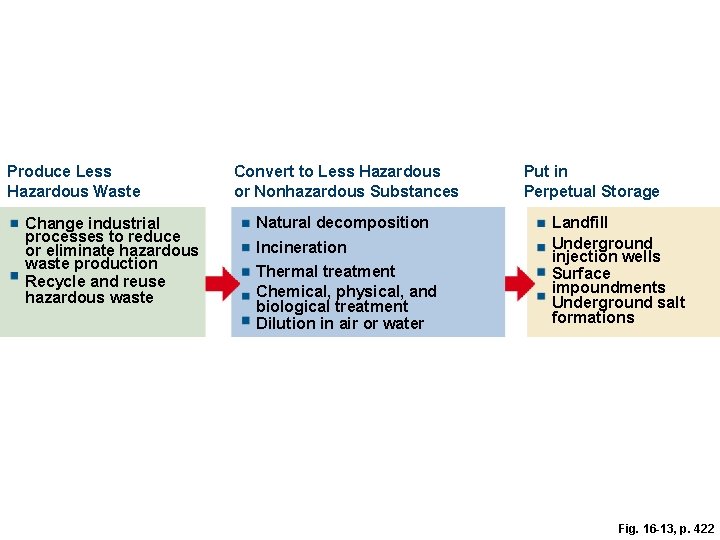
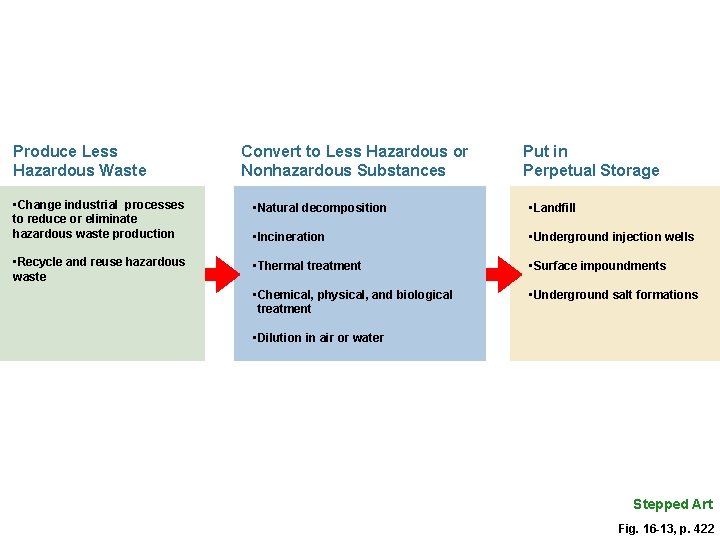
We can use integrated management of hazardous waste • Integrated management establishes three levels of priority: – Produce less. – Convert as much of it as possible to less hazardous substances. – Put the rest in long-term, safe storage. • Industries try to find substitutes for toxic or hazardous materials, reuse or recycle the hazardous materials within industrial processes, or use them as raw materials for making other products. • Industrial hazardous wastes are exchanged through clearinghouses where they are sold as raw materials for use by other industries. • Most e-waste recycling efforts create further hazards and can result in serious threats to other species.
Integrated hazardous waste management
Produce Less Hazardous Waste Change industrial processes to reduce or eliminate hazardous waste production Recycle and reuse hazardous waste Convert to Less Hazardous or Nonhazardous Substances Natural decomposition Incineration Thermal treatment Chemical, physical, and biological treatment Dilution in air or water Put in Perpetual Storage Landfill Underground injection wells Surface impoundments Underground salt formations Fig. 16 -13, p. 422
Produce Less Hazardous Waste Convert to Less Hazardous or Nonhazardous Substances Put in Perpetual Storage • Change industrial processes to reduce or eliminate hazardous waste production • Natural decomposition • Landfill • Incineration • Underground injection wells • Recycle and reuse hazardous waste • Thermal treatment • Surface impoundments • Chemical, physical, and biological treatment • Underground salt formations • Dilution in air or water Stepped Art Fig. 16 -13, p. 422
We can detoxify hazardous wastes • Bioremediation employs bacteria and enzymes that help destroy toxic or hazardous substances or convert them to harmless compounds. • Phytoremediation involves using natural or genetically engineered plants to absorb, filter, and remove contaminants from polluted soil and water. • Hazardous wastes can be incinerated to break them down and convert them to harmless or less harmful chemicals such as carbon dioxide and water. • Detoxify hazardous wastes by using a plasma arc torch, somewhat similar to a welding torch, to incinerate them at very high temperatures.
We can store some forms of hazardous waste • Burial on land or long-term storage of hazardous and toxic wastes should be used only as the last resort. • Currently, burial on land is the most widely used method in the United States and in most countries, largely because it is the least expensive of all methods. – The most common form of burial is deep-well disposal. • Liquid hazardous wastes are pumped under pressure through a pipe into dry, porous rock formations far beneath aquifers that are tapped for drinking and irrigation water.
We can store some forms of hazardous waste • Cost is low and the wastes can often be retrieved if problems develop. • Problems with deep-well disposal: • Limited number of such sites and limited space within them. • Wastes can leak into groundwater from the well shaft or migrate into groundwater in unexpected ways. • Encourages the production of hazardous wastes.
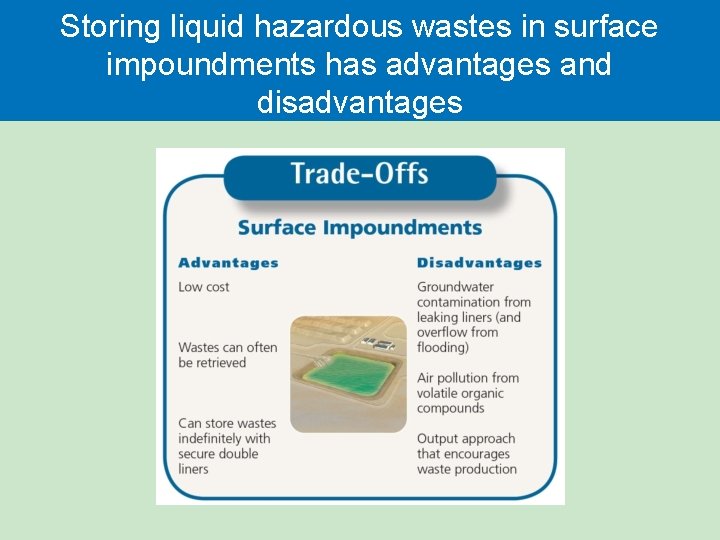
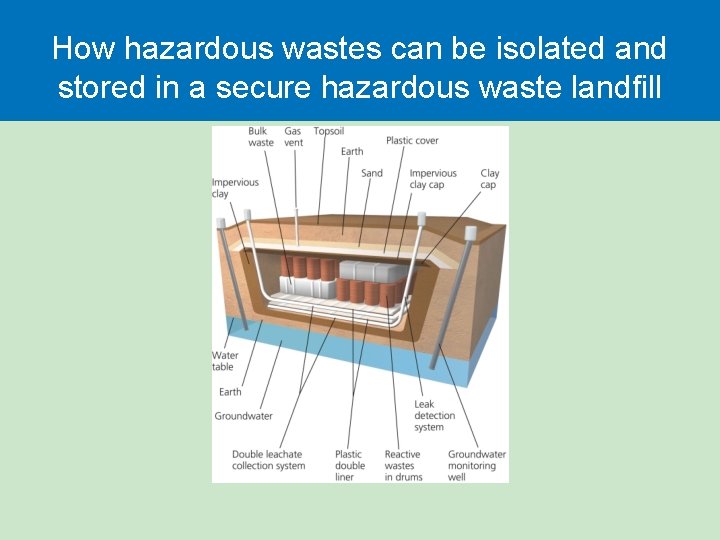
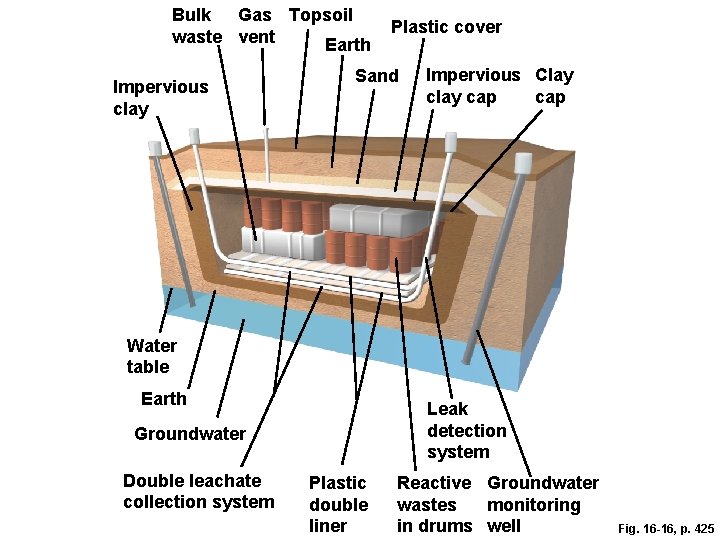
We can store some forms of hazardous waste – Surface impoundments are ponds, pits, or lagoons in which wastes are stored. • May have liners to help contain the waste. • 70% of the storage ponds in the United States have no liners. • Eventually all impoundment liners are likely to leak and could contaminate groundwater. – Liquid and solid hazardous wastes can be put into drums or other containers and buried in carefully designed and monitored secure hazardous waste landfills.
Storing liquid hazardous wastes in surface impoundments has advantages and disadvantages
How hazardous wastes can be isolated and stored in a secure hazardous waste landfill
Bulk Gas Topsoil waste vent Earth Impervious clay Plastic cover Sand Impervious Clay cap cap Water table Earth Leak detection system Groundwater Double leachate collection system Plastic double liner Reactive Groundwater wastes monitoring in drums well Fig. 16 -16, p. 425
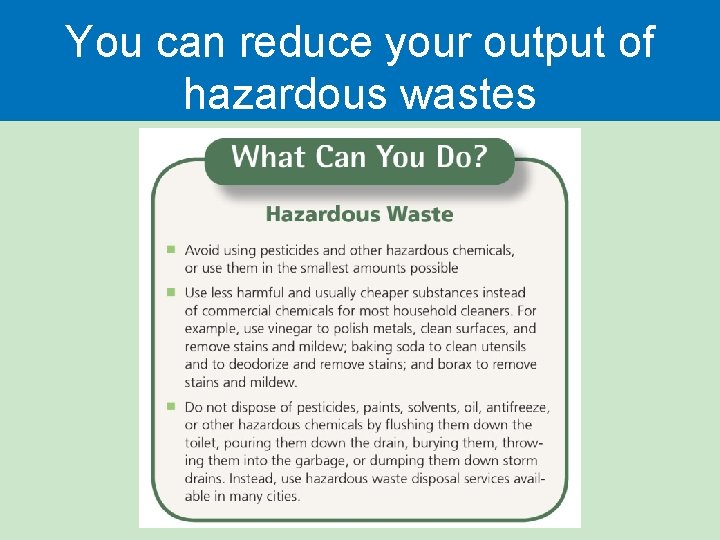
You can reduce your output of hazardous wastes
Section 16 -6 HOW CAN WE MAKE THE TRANSITION TO A MORE SUSTAINABLE LOWWASTE SOCIETY?
Grassroots action has led to better solid and hazardous waste management • Individuals have organized to prevent the construction of hundreds of incinerators, landfills, treatment plants for hazardous and radioactive wastes, and polluting chemical plants in or near their communities. • If local citizens adopt a “not in my back yard” (NIMBY) approach, the waste will always end up in someone’s back yard. • A call for drastically reducing production of such wastes by emphasizing pollution prevention and using the precautionary principle.
Providing environmental justice for everyone is an important goal • Environmental justice is an ideal whereby every person is entitled to protection from environmental hazards regardless of race, gender, age, national origin, income, social class, or any political factors. • A larger share of polluting factories, hazardous waste dumps, incinerators, and landfills in the United States are located in or near communities populated mostly by African Americans, Asian Americans, Latinos, and Native Americans. • In general, toxic waste sites in Caucasian communities have been cleaned up faster and more completely than such sites in African American and Latino communities.
International treaties have reduced hazardous waste • For decades, some more-developed countries had been shipping hazardous wastes to lessdeveloped countries. • Since 1992, international treaty known as the Basel Convention has banned participating countries from shipping hazardous waste to or through other countries without their permission. – In 1995, the treaty was amended to outlaw all transfers of hazardous wastes from industrial countries to less-developed countries.
International treaties have reduced hazardous waste – By 2010, this agreement had been signed by 175 countries and ratified by 172 countries. – The United States, Afghanistan, and Haiti have signed but have not ratified the convention. • Hazardous waste smugglers evade the laws by using an array of tactics.
International treaties have reduced hazardous waste • In 2000, delegates from 122 countries completed a global treaty called the Stockholm Convention on Persistent Organic Pollutants (POPs) to control 12 POPs. – POPs are widely used toxic chemicals that can accumulate in the fatty tissues of humans and other organisms at high trophic levels in food webs. – The original list of 12 chemicals, called the dirty dozen, includes DDT and eight other chlorine-containing persistent pesticides, PCBs, dioxins, and furans. – By 2009, 169 countries had signed a strengthened version of the POPs treaty that seeks to ban or phase out the use of these chemicals and to detoxify or isolate stockpiles of them. – It does allow 25 countries to continue using DDT to combat malaria until safer alternatives are available. – The United States has not yet ratified this treaty.
International treaties have reduced hazardous waste • In 2000, the Swedish Parliament enacted a law that, by 2020, will ban all chemicals that are persistent in the environment and that can accumulate in living tissue. – Industries required to perform risk assessments on the chemicals they use and to show that these chemicals are safe to use, as opposed to requiring the government to show that they are dangerous. – Strong opposition to this approach in the United States.
We can make the transition to low-waste societies • Many environmental scientists argue that we can make a transition to a low-waste society by understanding and following key principles: – Everything is connected. – There is no away, as in to throw away, for the wastes we produce. – Polluters and producers should pay for the wastes they produce. – Different categories of hazardous waste and recyclable waste should not be mixed.
Three big ideas • The order of priorities for dealing with solid waste should be to produce less of it, reuse, and recycle as much of it as possible and safely burn or bury what is left. • The order of priority for dealing with hazardous waste should be to produce less of it, reuse or recycle it, convert it to less-hazardous material, and safely store what is left. • We need to view solid wastes as wasted resources and hazardous wastes as materials that we should not be producing in the first place.