
Soldered and diffusionbonded splices between Nb 3 Sn
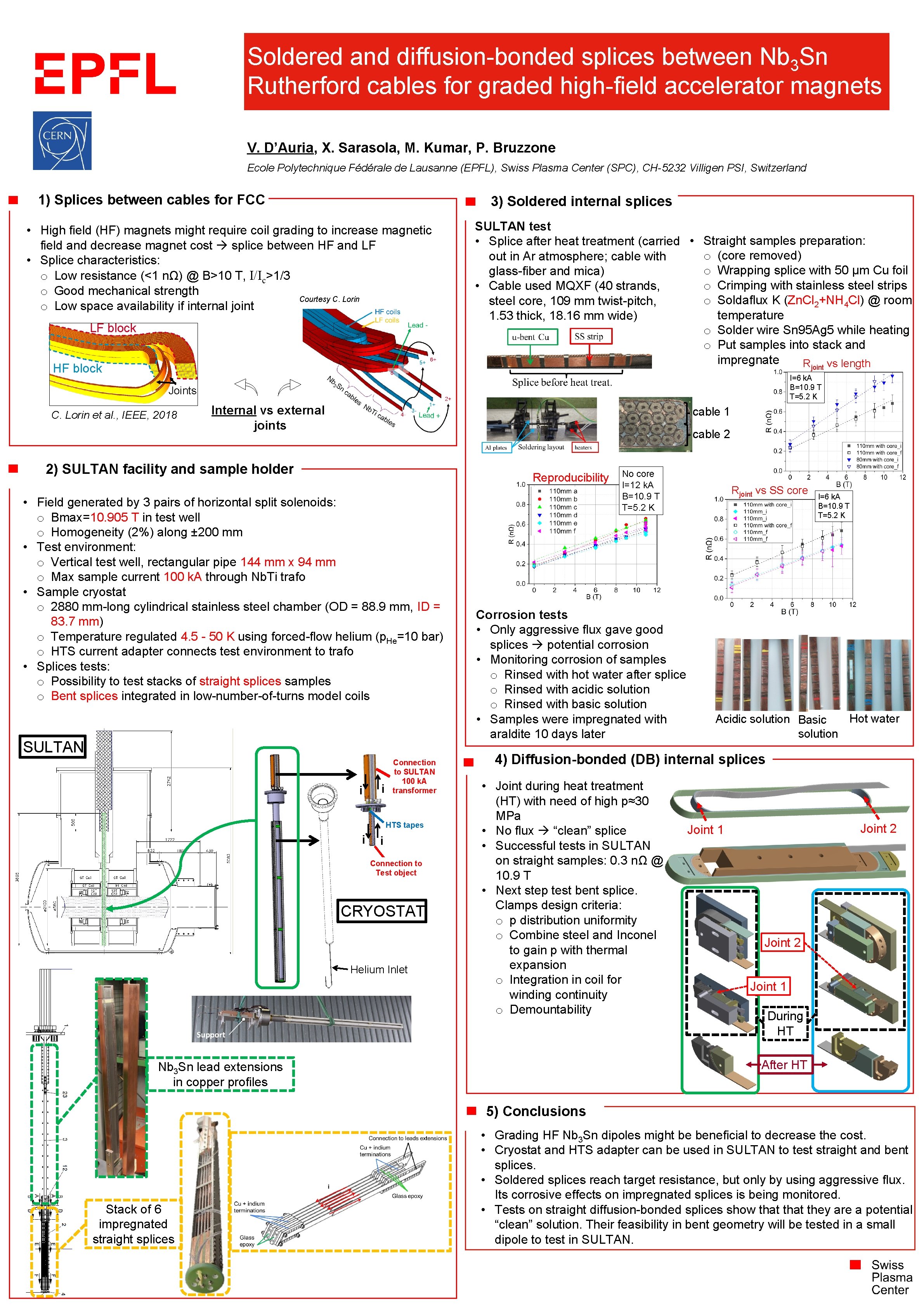
Soldered and diffusion-bonded splices between Nb 3 Sn Rutherford cables for graded high-field accelerator magnets V. D’Auria, X. Sarasola, M. Kumar, P. Bruzzone Ecole Polytechnique Fédérale de Lausanne (EPFL), Swiss Plasma Center (SPC), CH-5232 Villigen PSI, Switzerland 1) Splices between cables for FCC 3) Soldered internal splices • High field (HF) magnets might require coil grading to increase magnetic field and decrease magnet cost splice between HF and LF • Splice characteristics: o Low resistance (<1 nΩ) @ B>10 T, I/Ic>1/3 o Good mechanical strength Courtesy C. Lorin o Low space availability if internal joint LF block HF block SULTAN test • Splice after heat treatment (carried • Straight samples preparation: o (core removed) out in Ar atmosphere; cable with o Wrapping splice with 50 μm Cu foil glass-fiber and mica) o Crimping with stainless steel strips • Cable used MQXF (40 strands, o Soldaflux K (Zn. Cl 2+NH 4 Cl) @ room steel core, 109 mm twist-pitch, temperature 1. 53 thick, 18. 16 mm wide) o Solder wire Sn 95 Ag 5 while heating o Put samples into stack and impregnate Rjoint vs length I=6 k. A B=10. 9 T T=5. 2 K Joints C. Lorin et al. , IEEE, 2018 Internal vs external joints cable 1 cable 2 2) SULTAN facility and sample holder Reproducibility • Field generated by 3 pairs of horizontal split solenoids: o Bmax=10. 905 T in test well o Homogeneity (2%) along ± 200 mm • Test environment: o Vertical test well, rectangular pipe 144 mm x 94 mm o Max sample current 100 k. A through Nb. Ti trafo • Sample cryostat o 2880 mm-long cylindrical stainless steel chamber (OD = 88. 9 mm, ID = 83. 7 mm) o Temperature regulated 4. 5 - 50 K using forced-flow helium (p. He=10 bar) o HTS current adapter connects test environment to trafo • Splices tests: o Possibility to test stacks of straight splices samples o Bent splices integrated in low-number-of-turns model coils SULTAN i i Connection to SULTAN 100 k. A transformer HTS tapes i i Connection to Test object CRYOSTAT Helium Inlet No core I=12 k. A B=10. 9 T T=5. 2 K Corrosion tests • Only aggressive flux gave good splices potential corrosion • Monitoring corrosion of samples o Rinsed with hot water after splice o Rinsed with acidic solution o Rinsed with basic solution • Samples were impregnated with araldite 10 days later Rjoint vs SS core I=6 k. A B=10. 9 T T=5. 2 K Hot water Acidic solution Basic solution 4) Diffusion-bonded (DB) internal splices • Joint during heat treatment (HT) with need of high p≈30 MPa • No flux “clean” splice • Successful tests in SULTAN on straight samples: 0. 3 nΩ @ 10. 9 T • Next step test bent splice. Clamps design criteria: o p distribution uniformity o Combine steel and Inconel to gain p with thermal expansion o Integration in coil for winding continuity o Demountability Joint 2 Joint 1 During HT After HT Nb 3 Sn lead extensions in copper profiles 5) Conclusions Stack of 6 impregnated straight splices • Grading HF Nb 3 Sn dipoles might be beneficial to decrease the cost. • Cryostat and HTS adapter can be used in SULTAN to test straight and bent splices. • Soldered splices reach target resistance, but only by using aggressive flux. Its corrosive effects on impregnated splices is being monitored. • Tests on straight diffusion-bonded splices show that they are a potential “clean” solution. Their feasibility in bent geometry will be tested in a small dipole to test in SULTAN.
- Slides: 1